吉利

Search documents
魏建军在炮轰谁?
表舅是养基大户· 2025-05-26 13:32
Core Viewpoint - The recent significant decline in the stock prices of major Chinese automakers BYD and Geely is attributed to a combination of industry price wars and negative commentary from industry leaders regarding market practices [1][2][14]. Group 1: Industry Issues - The automotive industry is facing severe issues, including a price war that has led to losses exceeding 100 billion yuan, with some companies reportedly losing money on every vehicle sold [4][5]. - The price war has resulted in compromised vehicle safety due to cost-cutting measures, delayed payments to suppliers, and a drastic drop in the resale value of used cars, which negatively impacts the reputation of Chinese automakers abroad [5][6]. - There is a trend of capital-driven blind expansion in the industry, leading to decreased capacity utilization and increased losses, with some companies relying heavily on external funding rather than profitability [5][6]. - The phenomenon of "zero-kilometer used cars" is prevalent, where new cars are registered as used to inflate sales figures and obtain subsidies, effectively creating hidden price reductions [6][7]. Group 2: Company-Specific Developments - BYD recently announced a major promotional event, reducing prices on 22 models by up to 53,000 yuan, which is seen as a direct escalation in the ongoing price war [11][14]. - The competitive landscape is further complicated by the fact that BYD and Geely have significantly higher sales volumes compared to Great Wall Motors, which has a lower focus on electric vehicles [7][8]. Group 3: Market Reactions and Future Outlook - The stock market's reaction to the price war and industry commentary has led to significant declines in share prices for major automakers, reminiscent of past market responses to similar pricing strategies [16]. - Despite current challenges, the long-term outlook suggests that the industry may consolidate, benefiting leading companies as the market stabilizes and matures [16]. - There is potential for growth in the export of traditional and hybrid vehicles, particularly in regions lacking electric vehicle infrastructure, indicating a broader market opportunity beyond just electric vehicles [18][19].


德尔股份(300473) - 德尔股份投资者关系管理信息20250523
2025-05-26 01:10
Group 1: Company Overview - Del Automotive Parts Co., Ltd. is a global automotive parts supplier focusing on NVH, thermal insulation, lightweight products, electric pumps, motors, and automotive electronics [1] - Approximately 70% of the company's revenue comes from its wholly-owned subsidiary, KakuSi, which has over 20 years of experience in the automotive parts industry [1][2] Group 2: Product Development and Innovation - KakuSi has established a New Energy Vehicle (NEV) division to develop products like battery flame retardant covers and electromagnetic shielding for battery packs, successfully supplying well-known OEMs [2] - The company has been advancing solid-state battery technology since 2018, achieving significant milestones including passing third-party safety tests and obtaining a national invention patent in 2024 [3][4] Group 3: Market Position and Competitive Advantage - KakuSi's solid-state batteries are characterized by high safety and stability, with a simple manufacturing process that reduces production costs [4] - The company has a global production and R&D base, allowing it to respond quickly to customer needs and maintain high-quality standards [9] Group 4: Financial Performance - The company's financial reports for 2024 and Q1 2025 indicate continuous improvement, driven by enhanced operational efficiency and rapid revenue growth in the NEV sector [8] - KakuSi's products, particularly in thermal insulation, noise reduction, and lightweight categories, account for nearly 70% of the company's total revenue [8] Group 5: Future Growth Strategies - KakuSi aims to optimize its product structure in line with the electric vehicle trend and has already developed several products for NEVs, including battery protection solutions [10][11] - The company is well-positioned to meet the overseas market demands of leading domestic automakers due to its existing production capabilities in the U.S., Mexico, and Europe [11] Group 6: Product Specifics - The liquid retarder developed by the company can handle 80% of a vehicle's braking needs, enhancing safety and reducing brake system wear [12] - The liquid retarder product has gained recognition from first-line commercial vehicle customers, with production volumes increasing compared to the previous year [12]

拆解魏建军的全球棋局 中国汽车需坚持长线主义
2 1 Shi Ji Jing Ji Bao Dao· 2025-05-24 15:15
Core Insights - The Chinese automotive industry has achieved significant growth in the new energy vehicle (NEV) sector, with projected production and sales reaching 12.888 million and 12.866 million units in 2024, maintaining its position as the global leader for ten consecutive years [1] - Despite the growth, the industry faces challenges such as declining profits and increased competition, with a reported profit of 462.3 billion yuan in 2024, down 8% year-on-year, and an industry profit margin of 4.3%, below the average of 6% for downstream industrial enterprises [2] - The price war in the automotive sector has led to significant price reductions, with average price drops of 18,000 yuan (9.2%) for NEVs and 13,000 yuan (6.8%) for fuel vehicles, impacting profitability across the industry [3][4] Industry Challenges - The automotive industry is experiencing a shift from rapid expansion to a focus on profitability, with some companies facing continuous losses and pressure to optimize their business models [5][6] - Long-term investment and maintaining research and development (R&D) capabilities are critical for companies to navigate the competitive landscape [6][7] - The trend of excessive price cuts is seen as detrimental to the industry's future, with calls for a more sustainable approach to pricing and profitability [4][5] Global Expansion - The global market is viewed as the next growth frontier for Chinese automotive companies, with a focus on establishing a presence in international markets [8][10] - Long-term strategies emphasize compliance, respect for local cultures, and building trust with partners and consumers in overseas markets [8][9] - The "ecological export" strategy adopted by companies like Great Wall Motors aims to create a comprehensive global R&D, production, and sales system, enhancing competitiveness in international markets [10][11]

中金《秒懂研报》 | 智能驾驶:引领出行变革的新时代
中金点睛· 2025-05-24 08:32
Group 1: Core Viewpoints - The article discusses the rapid development and potential of intelligent driving technology, highlighting its transformative impact on urban mobility and the automotive industry [1][2][3]. Group 2: Technology Engine Behind Intelligent Driving - The end-to-end architecture is a significant innovation in intelligent driving, reducing data annotation difficulty and optimizing data processing through unique algorithms, which enhances vehicle responsiveness to road conditions [2][3]. - The introduction of visual language models and cloud models improves the system's ability to handle complex scenarios, akin to equipping vehicles with sharper "eyes" [3]. Group 3: Current Development of Intelligent Driving - The high-speed Navigation on Autopilot (NOA) feature is expected to be scaled up in 2024, becoming a standard for intelligent driving vehicles priced above 200,000 yuan [5]. - The penetration rate of urban NOA is projected to reach 6.5% in 2024, driven by increased consumer acceptance and reduced costs, expanding its availability to more consumers [7]. Group 4: Business Model of Intelligent Driving - The L2++ intelligent driving software faces challenges in charging fees due to low consumer willingness to pay, leading most automakers to standardize systems to accumulate users and data [11]. - Some leading automakers are exploring buyout or subscription payment models, with promotional activities to attract customers [11][12]. Group 5: Benefits of Urban NOA - Urban NOA is expected to drive sales of high-configured, high-margin models, as consumers are likely to prefer higher-end vehicles once the technology gains market acceptance [13][14]. - The overlap in technology requirements between Robotaxi and urban NOA is anticipated to enhance intelligent driving system capabilities, potentially leading to a shift towards mobility services by 2025 [15]. Group 6: Globalization of Intelligent Driving Industry - China's late start in intelligent driving is countered by rapid development, with domestic companies gaining advantages in technology and production experience, positioning them favorably in the global market [16]. - Collaborations between joint venture automakers and domestic intelligent driving companies are expected to facilitate access to international projects and opportunities for global expansion [16][17].
珠海冠宇连放三大招!
起点锂电· 2025-05-23 10:15
Core Viewpoint - Zhuhai Guanyu is exploring new opportunities in the lithium battery sector, particularly through collaborations in soft-pack batteries and advancements in artificial intelligence technology, while facing challenges in profitability and international trade dynamics [1][3][4]. Group 1: Business Transition and Strategy - Zhuhai Guanyu has transitioned from consumer electronics to lithium batteries, with the latter showing significant growth despite initial losses [3]. - The company is focusing on high-safety electrolyte development and high-nickel cathode material modifications to innovate and overcome current market challenges [3]. - The company has slowed down expansion projects in Zhejiang and Chongqing, indicating a cautious approach to potential new technologies like solid-state batteries [3]. Group 2: Financial Performance and Challenges - The company's revenue from power and energy storage business was approximately 980 million yuan, with a loss of about 540 million yuan, highlighting the financial strain despite growth in these sectors [6]. - The gross margin for the power battery business remains negative, although there has been some improvement in 2023 due to economies of scale [6]. - Research and development expenses have increased significantly to nearly 1.5 billion yuan, reflecting the company's commitment to technological advancement [7]. Group 3: International Market Dynamics - Approximately 60% of the company's revenue comes from overseas clients, including major brands like HP, Dell, Microsoft, and Apple, positioning it as a leader in the notebook battery market [8]. - The company has expressed limited exposure to U.S. tariffs, as direct exports of consumer batteries to the U.S. are minimal, but potential cost pressures could arise if products using its batteries are affected [9]. - The company is also expanding its operations in Malaysia, although it faces similar tariff challenges in that market [9].

黑芝麻智能(2533.HK):国产智能驾驶和机器人AI芯片先驱
Ge Long Hui· 2025-05-23 09:41
Company - Black Sesame Intelligence is a leading Chinese company in autonomous driving computing and AI chip production, with advantages in self-developed core IP, high-performance architecture, and automotive-grade chip mass production capabilities [2] - The company has developed two self-researched automotive-grade IPs: NeuralIQ ISP image processor and DynamAI NN neural network accelerator, creating a high-efficiency, low-power chip platform supported by a complete algorithm and toolchain [2] - Black Sesame has a product range covering computing power from tens of TOPS to thousands of TOPS, supporting applications in intelligent driving, integrated cockpit, and robotics [2] - The company is expected to accelerate chip shipment growth in 2025, with mass production solutions for multiple models from major manufacturers like Geely, FAW, and Dongfeng [2] - The company anticipates revenue growth of 76.8%, 69.3%, and 44.0% for 2025, 2026, and 2027, respectively, with projected revenues of 840 million, 1.42 billion, and 2.04 billion yuan [2] - The gross margin is expected to improve to 45.8%, 47.0%, and 47.7% for 2025, 2026, and 2027, respectively [2] - The target price is set at 24.04 HKD, based on a 16.8 times 2025 P/S ratio, with a "buy" rating [1][2] Industry - The global autonomous driving and robotics industry is entering a rapid development phase, with advanced driving functions being integrated into vehicles priced at 100,000 yuan by 2025, significantly increasing industry penetration [1] - Companies like Tesla, Xiaomi, and XPeng, along with robotics startups such as Yushu and Zhiyuan, are accelerating the commercialization of humanoid robots [1] - The demand for high-performance AI chips is expected to grow due to the competitive landscape of smart vehicles, where advanced driving features may become standard, driving the need for mid-to-high-performance chips [1] - Future robots are anticipated to penetrate various sectors, including home, healthcare, industry, commerce, and education, leading to long-term demand for robotics AI chips [1]

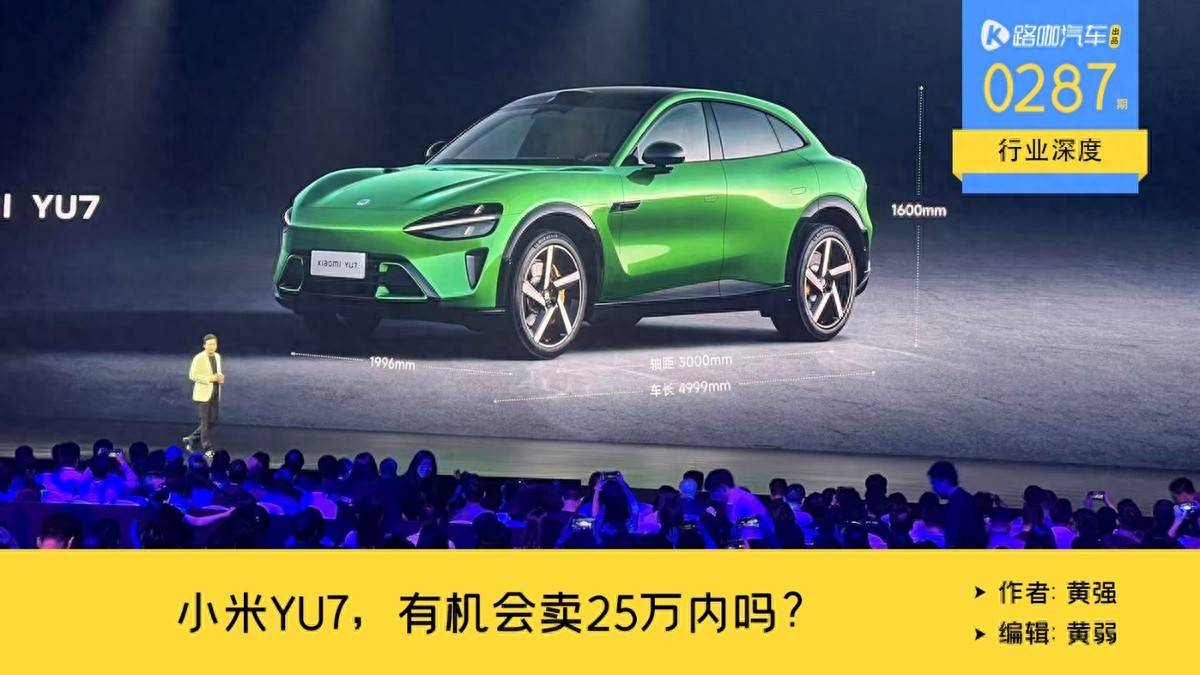
小米YU7发布,起售价成谜,但雷军避开和华为正面竞争?
Sou Hu Cai Jing· 2025-05-23 09:38
Core Viewpoint - The article highlights the competitive landscape during the Xiaomi launch event, focusing on the simultaneous announcements from Huawei and Geely, emphasizing AI and technology advancements in their respective products [2]. Group 1: Xiaomi YU7 Launch - The main question post-launch is the pricing of the Xiaomi YU7, with expectations of it being a potential bestseller, although exact sales figures remain uncertain [4][6]. - Xiaomi's production capacity is set to reach 300,000 units annually, with the first phase factory achieving a monthly production of 24,000 units, exceeding initial estimates [6]. - The launch event followed a typical Xiaomi format, showcasing various industry-leading features while managing public expectations [6][9]. Group 2: Product Positioning and Features - The YU7 is positioned as a luxury high-performance SUV, aiming to create a market niche with minimal direct competition, similar to the strategy employed with the SU7 [9][11]. - The YU7 boasts impressive specifications, including a maximum range of 835 km and a peak power of 365 kW, which are competitive within the current market [16][20]. - The vehicle's design includes advanced features such as laser radar and NVIDIA DRIVE AGX Thor™ for enhanced driving assistance, indicating a strong focus on technology [20][22]. Group 3: Pricing Strategy - The anticipated price for the YU7 is around 249,900 yuan, which aligns with Xiaomi's strategy of undercutting competitors like the Tesla Model Y [24][27]. - Comparisons with other models, such as the Zeekr 7X, suggest that the YU7's pricing is feasible given its specifications and features [25][27]. - Xiaomi's pricing strategy reflects a shift towards targeting younger consumers and families, potentially attracting buyers from traditional luxury brands [28][30]. Group 4: Market Dynamics and Future Outlook - The article discusses the evolving automotive market, where advanced driver-assistance systems are becoming a key selling point, influencing consumer preferences [32][34]. - Xiaomi's approach with the YU7 aims to differentiate itself from competitors by focusing on driving enjoyment and performance, rather than solely on autonomous features [34][35]. - The overall strategy indicates Xiaomi's intent to penetrate the automotive market by leveraging its brand recognition and technological expertise to appeal to a broader audience [35].
纳芯微:车规模拟芯片龙头,磁传感器加速成长-20250523
GOLDEN SUN SECURITIES· 2025-05-23 00:23
Investment Rating - The report assigns a "Buy" rating for the company [4] Core Views - The company is a leading player in automotive analog chips, achieving record revenue in Q1 2025, with a revenue of 717 million yuan, representing a year-on-year growth of 97.82% and a quarter-on-quarter growth of 20.66% [1][23] - The domestic demand for analog chips is expected to grow significantly, with a projected market size of 84.3 billion USD by 2025, while the domestic localization rate for automotive analog chips is only about 5% in 2024, indicating substantial room for domestic substitution [2][46] - The company is expected to benefit from the electrification and intelligence of vehicles, with the magnetic sensor market projected to grow from 8.2 billion yuan in 2025 to 19 billion yuan in 2029 [3] Summary by Sections Section 1: Automotive Analog Chip Leader - The company focuses on automotive analog chips and has expanded its product matrix, with over 3,300 product models available for sale by the end of 2024 [1][14] - The company has a stable shareholding structure and an experienced core management team [16][20] - The company’s revenue is expected to return to growth in 2024, with net profit temporarily pressured by stock incentive costs [21][23] Section 2: Demand for Domestic Analog Chips - The analog chip market is expected to grow steadily, with the global market projected to reach 84.3 billion USD by 2025 [2][43] - The domestic analog chip market is anticipated to grow at a CAGR of 11.0% from 2025 to 2029, with automotive and energy sectors leading the growth [46] Section 3: Benefiting from Electrification and Intelligence - The company’s acquisition of Maguan enhances its magnetic sensing IP technology, positioning it as a leader in the Chinese magnetic sensor market [3][42] - The company’s automotive electronics revenue is expected to account for 36.88% of total revenue in 2024, with a shipment volume of 363 million units, reflecting a year-on-year growth of over 100% [35][36] Section 4: Profit Forecast and Investment Recommendations - The company is projected to achieve revenues of 2.96 billion, 3.80 billion, and 4.73 billion yuan in 2025, 2026, and 2027 respectively, with year-on-year growth rates of 51.0%, 28.2%, and 24.6% [4][5] - The report emphasizes the company’s strong positioning in the automotive analog chip sector and recommends a "Buy" rating based on its growth potential [4][6]

华人运通等成立新高合汽车公司,宁德时代H股将加入MSCI指数 | 汽车早参
Mei Ri Jing Ji Xin Wen· 2025-05-22 23:39
每经实习记者|余婷婷 每经编辑|孙磊 | 2025年5月23日 星期五 | NO.1 华人运通等成立新高合汽车公司 天眼查App显示,5月22日,江苏高合汽车有限公司成立,法定代表人为Jihad Mohammad,注册资本约 1.43亿美元,由EV Electra Ltd.和华人运通(江苏)技术有限公司共同持股。 此前,高合汽车经营出现 困难,其母公司华人运通(江苏)技术有限公司已于2024年8月申请破产重整。不久前,江苏盐城经济 技术开发区人民法院经过裁定,准许华人运通(江苏)公司等五十二家公司实质合并重整的申请。 点评:华人运通等成立新高合汽车公司,显示出公司在经历破产重整后,积极推动新品牌发展。这一举 措可能提振新能源汽车板块的市场信心,特别是在中国汽车产业面临转型压力时。对于投资者而言,关 注公司能否在资金和技术的双重支持下顺利恢复将成为关键。 NO.2 宁德时代股票6月2日起加入MSCI指数 5月22日,MSCI在其网站上宣布,宁德时代在香港上市的股票将自6月2日起加入MSCI中国标准和大盘 股指数。此前的5月20日,宁德时代在香港联合交易所有限公司主板正式挂牌上市。据悉,宁德时代此 次港股上市仅历 ...

电力设备行业深度报告:欧洲电车趋势已起——从欧洲车企2025Q1财报看电动化趋势
KAIYUAN SECURITIES· 2025-05-21 10:23
Investment Rating - The investment rating for the electric power equipment industry is "Positive" (maintained) [1] Core Viewpoints - The report highlights a significant increase in BEV sales among major automakers in Europe, indicating a strong trend towards electrification in the automotive industry. Renault's BEV sales grew by 88% year-on-year, Volkswagen's by 113%, and BMW's by 64% in Q1 2025 [4][14][23] - The introduction of new electric vehicle models is expected to sustain the electrification trend, with various automakers planning to launch competitively priced electric vehicles in the coming years [6][37] - The report discusses the implications of carbon emission regulations, noting that a shift to a three-year average assessment period for emissions targets could alleviate pressure on automakers and allow for better planning and execution of new model launches [53] Summary by Sections Sales Performance - In Q1 2025, Renault's BEV sales increased by 88% year-on-year, with a penetration rate of 17.1% [15] - Volkswagen's BEV deliveries in Europe rose by 113%, achieving a market share of approximately 26% [19][21] - BMW's BEV sales in Europe grew by 64%, with a penetration rate of 18.7% [23] New Model Launches - Stellantis plans to introduce multiple new models priced below €25,000, which are expected to boost sales in Q2 2025 [40] - Renault's new model, the Renault 4, is set to launch in Q2 2025, building on the success of the Renault 5 [41] - Volkswagen will showcase a new range of entry-level BEVs in September 2025, with the ID.2 model expected to launch in 2026 [45] Carbon Emission Regulations - The European Parliament has approved a revision of carbon emission regulations, shifting to a three-year average assessment, which is seen as beneficial for the industry [53] - Stellantis believes that relaxing the assessment timeline can prevent panic pricing strategies in late 2025 [54] - BMW is confident in meeting the revised emission targets, having already exceeded previous goals [58] Investment Recommendations - The report recommends investing in companies involved in lithium batteries, such as CATL and Yiwei Lithium Energy, as well as companies producing lithium materials and components [59]