华润啤酒

Search documents
食品饮料周观点:白酒底部价值,大众品把握龙头-20250914
GOLDEN SUN SECURITIES· 2025-09-14 08:14
Investment Rating - The report maintains an "Increase" rating for the food and beverage industry, indicating a positive outlook for the sector [5]. Core Insights - The white liquor sector is showing signs of bottoming out, with the upcoming peak season expected to improve the fundamentals. The report highlights the long-term value of leading brands such as Kweichow Moutai and Wuliangye, while also identifying short-term elastic stocks like Luzhou Laojiao and Jiangsu Yanghe [1][2]. - In the beverage segment, Budweiser plans to expand its investment in Xiamen, while Baijiu's major shareholder is transferring shares, indicating confidence in the future of the company. The report emphasizes the importance of focusing on high-growth stocks and market leaders in the beverage sector [3]. - The snack industry is experiencing rapid growth, with the number of stores for "Mingming Hen Mang" surpassing 20,000. The report notes that the milk price is stabilizing, which may lead to opportunities in the dairy sector post-harvest season [4]. Summary by Sections White Liquor - Kweichow Moutai is leading the industry with a focus on product and channel transformation, aiming for market recovery as the peak season approaches. The report anticipates a gradual improvement in the fundamentals of the white liquor sector [2]. Beer and Beverage - Budweiser's strategic upgrade includes consolidating its operations in the Asia-Pacific region. The report suggests monitoring the recovery of the restaurant sector and the performance of leading beer brands like Yanjing Beer and Zhujiang Beer [3]. Snacks and Dairy - The snack market is characterized by intense competition, with leading brands leveraging scale and supply chain advantages. The report also notes a slight recovery in raw milk prices, indicating potential growth in the dairy sector [4].
啤酒行情回暖?前8月相关企业注册量同比增长10.83%
Qi Cha Cha· 2025-09-12 04:23
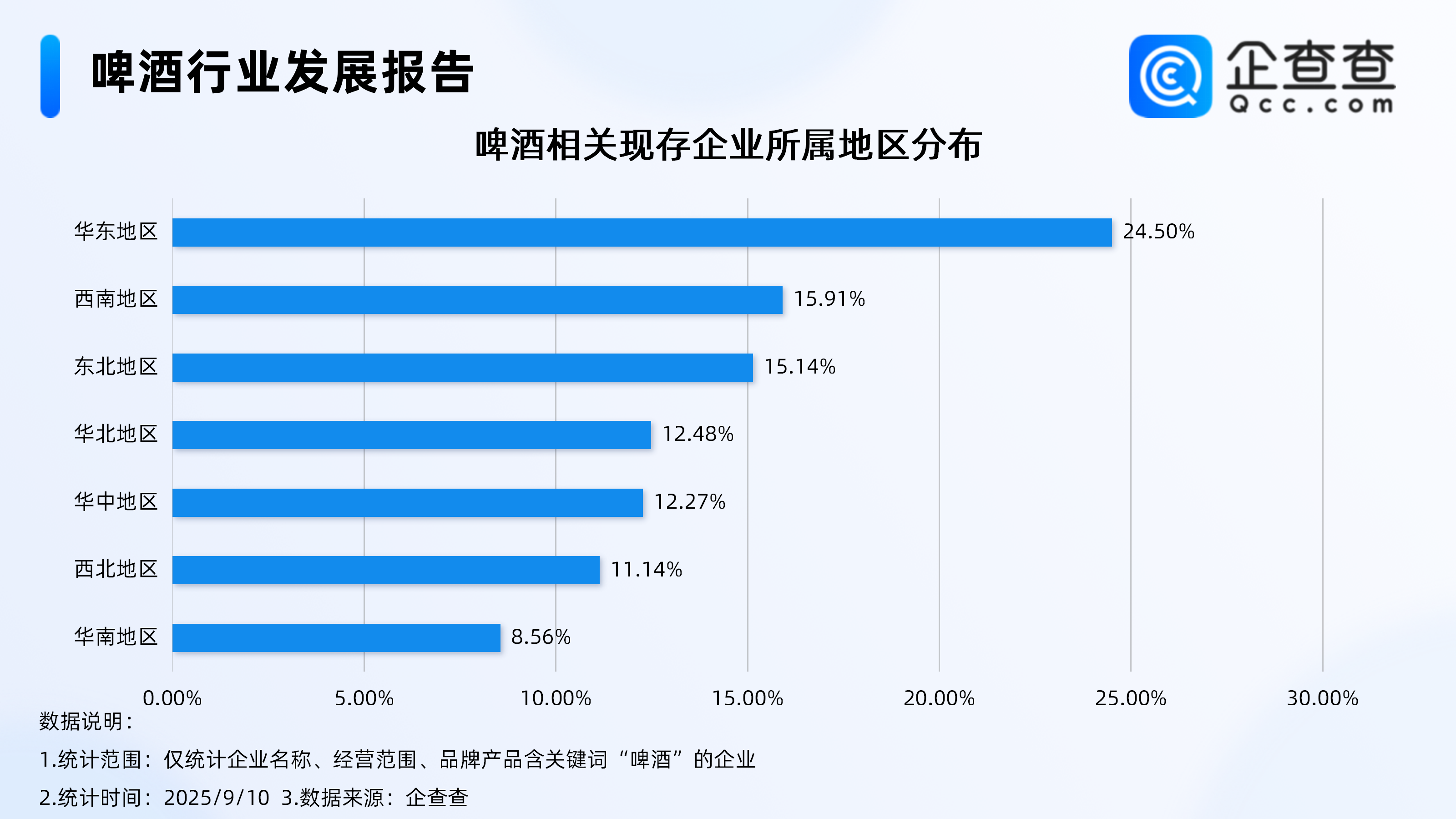
Core Insights - The domestic beer industry is experiencing a performance recovery period in the first half of the year, with major breweries reporting revenue and profit growth, indicating a trend of "most recovering, few under pressure" [1] - The total revenue of five major breweries, including China Resources Beer, Budweiser APAC, Qingdao Beer, Chongqing Beer, and Yanjing Beer, exceeded 84 billion yuan in the first half of the year [1] Group 1 - The number of existing beer-related enterprises in China has reached 64,900, primarily concentrated in the East China region, which accounts for 24.5% [3] - Over 60% of the beer-related enterprises have been established for more than five years, with those established between five to ten years making up 35.53% of the total [4] - The registration volume of beer-related enterprises has shown a fluctuating trend over the past decade, with 6,449 new registrations expected in 2024, and 5,616 registered so far this year, including 5,463 in the first eight months, representing a year-on-year growth of 10.83% [5]

西部证券晨会纪要-20250912
Western Securities· 2025-09-12 04:02
Group 1: Communication Industry Insights - The communication industry is experiencing a positive spillover effect from AI computing power, with both domestic and international demand resonating [5][7]. - In H1 2025, 226 listed companies in the communication sector reported a total revenue of 1,969.54 billion, a year-on-year increase of 11.2% [5]. - The overall gross margin for the communication industry in Q2 2025 was 25.2%, with a slight year-on-year decrease of 1.3 percentage points [5]. Group 2: Individual Company Performance - China Resources Beer - China Resources Beer is positioned as a leader in the Chinese beer industry, with a focus on high-end product strategies driving revenue per ton and profit margin improvements [9][10]. - The company’s revenue forecasts for 2025-2027 are 38.87 billion, 40.65 billion, and 42.20 billion respectively, with net profits expected to be 5.89 billion, 6.29 billion, and 6.79 billion [10]. - The implementation of a "three precision management" strategy has led to an increase in gross margin to 48.9% and net profit margin to 24.0% in H1 2025 [9][10]. Group 3: Company Performance - Peak Technology - Peak Technology achieved a revenue of 375 million in H1 2025, representing a year-on-year growth of 32.84% [13][14]. - The company is expanding into automotive and robotics sectors, with revenue forecasts for 2025-2027 set at 760 million, 949 million, and 1.212 billion respectively [14]. - The decline in net profit by 4.52% in H1 2025 was attributed to increased stock incentive expenses, but excluding this, net profit would have grown by 18.69% [14]. Group 4: Company Performance - Longxun Co., Ltd. - Longxun Co., Ltd. reported a revenue of 247 million in H1 2025, with a year-on-year increase of 11.35% [17][18]. - The company is focusing on automotive electronics, with expectations for revenue growth driven by the SerDes product line, which is entering full market promotion [18][19]. - Revenue forecasts for Longxun Co., Ltd. for 2025-2027 are 705 million, 1.119 billion, and 1.450 billion respectively [19]. Group 5: Company Performance - Fuzhijun Technology - Fuzhijun Technology achieved a revenue of 519 million in H1 2025, with a year-on-year increase of 18.10% [21][22]. - The company is focusing on the ultra-precision optical field, with significant growth in its subsidiary, achieving a revenue of 76.1 million in 2024, a year-on-year increase of 180.08% [23]. - Revenue forecasts for Fuzhijun Technology for 2025-2027 are 1.031 billion, 1.165 billion, and 1.306 billion respectively [23]. Group 6: Company Performance - Meixinsheng - Meixinsheng reported a revenue of 265 million in H1 2025, reflecting a year-on-year growth of 36.83% [25][26]. - The optical sensor business saw a significant increase in revenue, driven by demand from leading smartwatch brands [26]. - Revenue forecasts for Meixinsheng for 2025-2027 are 653 million, 1.043 billion, and 1.417 billion respectively [27].





华润啤酒(00291.HK):高端化驱动 啤酒龙头从更大迈向更强
Ge Long Hui· 2025-09-12 02:55
Core Viewpoint - China Resources Beer is successfully implementing its high-end strategy, which is driving an increase in ton price and gross margin [1] Group 1: High-End Strategy and Market Position - The company is firmly executing its "battle for high-end" strategy, establishing a matrix of "Chinese brands + international brands" to solidify its leading market position [1] - The use of popular brands like "Yong Chuang Tian Ya" and "Snow Beer" helps to enhance market share, while premium brands like Heineken and Red Horse elevate product positioning, driving ton price and profit margin increases [1] - The company is actively developing new products to meet consumer demands for personalization and differentiation [1] Group 2: Capacity Optimization - The company is proactively shutting down excess capacity, reducing the number of factories from 98 in 2017 to 60 by 2025, while maintaining a production capacity of 19.2 million kiloliters [1] - Factories are widely distributed across 25 provinces and municipalities in China, covering most regions of the country [1] Group 3: Operational Efficiency and Profitability - The implementation of the "Three Precision Management" strategy (streamlining organization, lean cost, and refined business) has led to significant improvements in operational efficiency [1] - In the first half of 2025, the company's gross margin increased to 48.9%, and net profit margin rose to 24.0% [1] Group 4: Management Transition and Market Confidence - The company has experienced a smooth management transition, actively communicating with investors and emphasizing that core strategies remain unchanged [1] - The new management team has extensive frontline experience in the beer business and has successfully led recent channel and marketing innovations, helping to stabilize market confidence and eliminate uncertainties [1] Group 5: Financial Projections - Revenue projections for 2025-2027 are estimated at 38.87 billion, 40.65 billion, and 42.20 billion yuan, with year-on-year growth of +0.6%, +4.6%, and +3.8% respectively [2] - Net profit attributable to shareholders is projected to be 5.89 billion, 6.29 billion, and 6.79 billion yuan for the same period, with year-on-year growth of +24.3%, +6.8%, and +7.8% respectively [2] - Earnings per share (EPS) are expected to be 1.82 yuan, 1.94 yuan, and 2.09 yuan for 2025-2027 [2]
华润啤酒(00291):首次覆盖报告:高端化驱动,啤酒龙头从更大迈向更强
Western Securities· 2025-09-11 12:39
Investment Rating - The report gives a "Buy" rating for China Resources Beer [5][12] Core Views - China Resources Beer is executing its high-end strategy effectively, driving up tonnage price and gross margin. The company has established a matrix of "Chinese brands + international brands" to solidify its market position and enhance product pricing [1][12] - The company is optimizing its production capacity by shutting down excess facilities, reducing the number of factories from 98 in 2017 to 60 by 2025, while maintaining a capacity of 19.2 million kiloliters [1][12] - The implementation of "Three Precision Management" has improved operational efficiency, with gross margin rising to 48.9% and net profit margin to 24.0% in the first half of 2025 [1][12] Summary by Sections Company Overview - China Resources Beer is a leading player in the Chinese beer industry, focusing solely on beer after divesting non-beer businesses in 2015. The company has a significant market presence with a strong brand portfolio [17][19] Industry Analysis - The Chinese beer market is experiencing stagnation in sales volume, with a projected CAGR of -0.4% from 2010 to 2025. However, the retail price of beer is expected to continue rising, indicating potential for price increases [36][38][43] - The market is concentrated, with the top three players (China Resources, Tsingtao, and Budweiser) accounting for 60.1% of the market share as of 2023, suggesting limited room for further consolidation [45][47] Investment Logic - The long-term strategy focuses on high-end product development, leveraging both domestic and international brands to enhance product pricing and market share. The company aims to continue optimizing its product structure to drive tonnage price and profit margin improvements [63][68] - The forecast for revenue from 2025 to 2027 is projected at 38.87 billion, 40.65 billion, and 42.20 billion yuan, with net profit expected to reach 5.89 billion, 6.29 billion, and 6.79 billion yuan respectively [12][3]
交银国际:25H1消费行业整体温和修复 业绩结构性分化
Zhi Tong Cai Jing· 2025-09-11 07:24
Group 1 - The overall consumer market in mainland China is showing a mild recovery in the first half of 2025, with structural differentiation in various segments and three core trends observed: experience-driven consumption leading the way, globalization strategies contributing to revenue growth, and operational efficiency becoming a key factor in profit differentiation [1] Group 2 - Experience-driven consumption is experiencing strong growth, with new generation consumers reshaping consumption logic, leading to significant revenue increases for companies like Pop Mart and Top Toy, which saw year-on-year revenue growth of 204% and 73% respectively [2] - Companies are accelerating their globalization strategies, with overseas revenue contributions increasing significantly. For instance, Midea's overseas revenue grew by 18%, Haier's by 12%, Miniso's by 29%, Pop Mart's by 440%, and Anta's by over 150% [2] Group 3 - Despite a stabilization in revenue for most consumer companies, consumer sentiment remains cautious, leading to soft sales trends in July and August. Competitive pressures and heavy promotions have put pressure on profit margins, particularly in the sports goods sector, where major companies experienced a decline in gross margins [3] - Improving operational efficiency is crucial for enhancing profitability, with leading companies like Yili and China Resources Beer maintaining stable or slightly improved operating profit margins through cost reduction and efficiency enhancement [3]
白酒行业冰与火:珍酒李渡失速与头部酒企的进击
Sou Hu Cai Jing· 2025-09-11 02:03
Core Viewpoint - The Chinese liquor industry is experiencing a significant divergence, with leading companies showing growth while others, like Zhenjiu Lidu, face substantial declines in revenue and profit [2][4][5]. Group 1: Financial Performance of Liquor Companies - In the first half of 2025, 22 listed liquor companies reported a total revenue of approximately 242.4 billion yuan and a net profit of about 95.1 billion yuan [4]. - Six companies, including Kweichow Moutai and Wuliangye, achieved both revenue and net profit growth, with Kweichow Moutai reporting revenue of 89.389 billion yuan, up 9.1%, and net profit of 45.403 billion yuan, up 8.9% [2]. - Conversely, Zhenjiu Lidu saw a significant decline, with revenue dropping to 2.497 billion yuan, down 39.6%, and adjusted net profit falling to 613 million yuan, down 39.3% [2][6]. Group 2: Industry Challenges - The liquor industry is undergoing a deep adjustment period characterized by high channel inventory, leading companies to adopt inventory control and price stabilization strategies [3]. - Macro-economic pressures and limited consumption scenarios have reduced consumer purchasing willingness, with liquor sales dropping 15% year-on-year during the 2025 Spring Festival, and mid-to-high-end sales declining by 20% [3]. - Intense competition and price wars among companies, particularly among smaller enterprises, are compressing profit margins and reducing overall profitability in the industry [3][5]. Group 3: Zhenjiu Lidu's Struggles - Zhenjiu Lidu is facing severe challenges, including excessive inventory turnover days at 855, far exceeding the healthy range of 450-700 days [6]. - The company relies heavily on its Zhenjiu brand, with other brands contributing minimally to revenue, and has seen a consistent decline in core product sales over the past four years [6][7]. - The decline in sales reflects weakened product competitiveness and shrinking consumption scenarios, with the company struggling to adapt its product structure and marketing strategies [7]. Group 4: Strategic Responses - Zhenjiu Lidu is attempting to navigate its challenges by launching new products, such as the "Da Zhen·Zhenjiu," priced at 600 yuan, targeting middle-class families and small business owners [8]. - The company is also implementing a "Ten Thousand Merchants Alliance" strategy to expand its dealer network and create a broad channel ecosystem [8]. - Additionally, Zhenjiu Lidu is entering the craft beer market with its "Niu Shi" brand, seeking to establish a second growth curve amid the liquor industry's stagnation [9][10]. Group 5: Market Entry Challenges - The craft beer market is highly competitive, dominated by established players like China Resources and Budweiser, posing significant challenges for new entrants like Zhenjiu Lidu [11]. - Transitioning from liquor to beer requires Zhenjiu Lidu to reconfigure its sales channels, as beer distribution is more diverse and includes restaurants and bars, unlike the traditional liquor sales model [12]. - While seeking new growth avenues is a reasonable strategy, the differences in product, channel, and consumer demographics between liquor and beer present substantial hurdles for successful cross-industry expansion [12].





“招募合伙人+片区融合”,济宁带动农民增收6亿元以上
Qi Lu Wan Bao Wang· 2025-09-11 01:37
Core Insights - The Jining government has successfully implemented a partner model for rural revitalization, recruiting 1,031 partners and achieving over 90% coverage in demonstration areas, resulting in 725 projects that have increased farmers' income by over 600 million yuan [1][3][4] Group 1: Partner Recruitment and Resource Activation - Jining focuses on "precise matching" to activate resources in demonstration areas by recruiting partners to address issues of resource idleness and talent shortages [3] - The city has established 150 "Rural Revitalization Workstations" across 308 demonstration areas to identify local resources and collect partnership intentions, resulting in 1,105 partner projects [3] - Partner recruitment is enhanced through collaboration with institutions like Tsinghua University and enterprises, with biannual recruitment campaigns targeting entrepreneurs and investors [3] Group 2: Support and Project Development - A comprehensive support system has been established to address challenges in project implementation, including policy integration and service provision [4] - The government has introduced measures to support partner recruitment and has created a service team to assist with project approvals, land transfers, and skill training [4] - Expert services and training sessions have been organized to guide partners in project development, with 36 events held since last year [4] Group 3: Economic Impact and Community Benefits - The partner model aims to create a win-win situation where partners develop projects, areas improve, and villagers benefit [5] - Collective income for villages has increased by 120 million yuan through the activation of idle assets and participation in partner projects [6] - Employment opportunities have been enhanced, with initiatives to train local residents and prioritize them for jobs in partner projects, exemplified by the "Nishan Luming" project which created over 2,000 jobs [6]
华源晨会精粹20250910-20250910
Hua Yuan Zheng Quan· 2025-09-10 13:11
New Consumption - In August 2025, the GMV of the beauty category on Douyin exceeded 20 billion yuan, with a year-on-year growth of 19.56% and a month-on-month growth of 21.46% [2][7] - Domestic brands performed well, with Han Shu leading the market with a GMV exceeding 700 million yuan, and the Han Shu Hongman Waist Ring Six Peptide Set being the only product to exceed 100 million yuan in sales [7][8] - The trend in Douyin beauty consumption is shifting from "trial consumption" to "stable repurchase," indicating a more rational consumer behavior focusing on product practicality [8] Robotics Industry - The human-shaped robot market is expected to grow significantly, with the market size projected to reach approximately 27.6 billion yuan in 2024 and 750 billion yuan by 2029 [9][10] - Key components for human-shaped robots include actuators, sensors, and transmission systems, with the planetary roller screw expected to account for 19% of the total cost by 2030 [9][10] - Domestic companies are gradually breaking into the high-end bearing market, which is currently dominated by eight global enterprises, with a current localization rate of less than 20% [10][11] Food and Beverage Industry - National beer companies showed stable revenue and profit performance in the first half of 2025, with cost reductions contributing to gross profit growth [15][16] - The dairy sector is expected to see a reversal in fundamentals as raw milk prices stabilize and beef prices rise, which could enhance profitability for dairy companies [16] - The snack food sector is experiencing a divergence in performance, with emerging channels like bulk snacks and membership supermarkets maintaining high momentum, while traditional channels face challenges [17] Logistics Industry - Zhonggu Logistics reported a revenue of 5.338 billion yuan in the first half of 2025, a decrease of 6.99% year-on-year, but net profit increased by 41.59% to 1.072 billion yuan [19][20] - The company is optimizing its capacity deployment in response to domestic demand recovery and external trade needs, which supports profit growth [20][21] - The company plans to distribute 9.03 billion yuan in dividends, reflecting its strong profit attributes [21] Public Utilities and Environmental Protection - Datang New Energy achieved a revenue of 6.845 billion yuan in the first half of 2025, with a year-on-year growth of 3.26%, while net profit decreased by 4.37% [22][23] - The company’s capital expenditure significantly decreased, indicating a focus on optimizing financial structure [26][27] - The wind power sector is expected to outperform solar power in terms of output and operational cycles, with a favorable market environment anticipated for wind power operators [27]

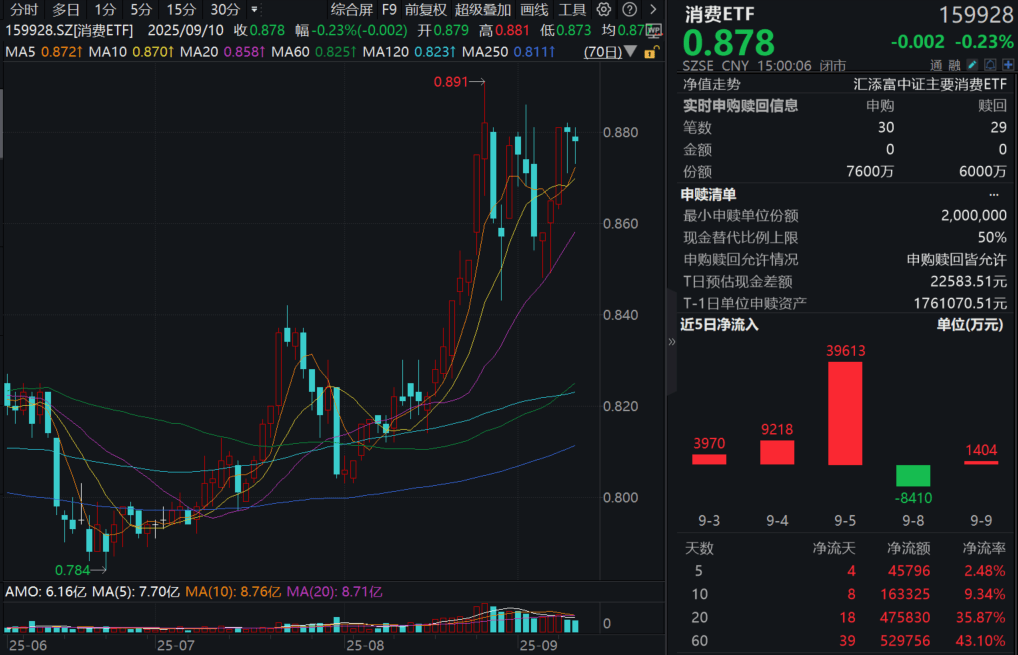
8月核心CPI继续回升,促消费政策有望加码!消费ETF(159928)回调再度吸金,近20日净流入超47亿元!港股通消费50ETF(159268)小幅收跌!
Sou Hu Cai Jing· 2025-09-10 09:42
Group 1: Market Overview - The market experienced a slight rebound with the consumption ETF (159928) declining by 0.23%, and a total trading volume exceeding 616 million yuan [1] - The consumption ETF (159928) saw a net subscription of 16 million units, with a net inflow of over 4.7 billion yuan in the past 20 days, leading to a total scale of over 19.1 billion yuan as of September 9 [1] Group 2: Hong Kong Market - The Hong Kong consumption ETF (159268) experienced a decline of 0.38%, with a trading volume exceeding 40 million yuan and a cumulative capital inflow of over 270 million yuan in the past 20 days [3] - Notable declines were observed in major stocks such as Lao Pu Gold, which fell over 7%, and Pop Mart, which dropped over 4% [3] Group 3: Consumer Price Index (CPI) Data - The CPI remained stable in August, with a month-on-month change of 0% and a year-on-year decrease of 0.4% [5] - The core CPI, excluding food and energy, increased by 0.9% year-on-year, marking the fourth consecutive month of growth [5] Group 4: Consumption Policies - The end of the summer travel peak is expected to lead to enhanced consumption policies, with new measures to stimulate service consumption anticipated in September [6] - The government aims to increase high-quality service supply and promote new consumption models, including AI and inbound consumption [6] Group 5: Alcohol and Consumer Goods Sector - The white liquor sector shows resilience among leading brands, although profit margins are under pressure, with a slight year-on-year increase in gross margin for Q2 2025 [7] - The snack food sector faces intensified competition, necessitating differentiated products to maintain or improve profit margins [8] Group 6: Consumption ETF Composition - The consumption ETF (159928) has a significant concentration in its top holdings, with the top ten stocks accounting for over 68% of its weight, including major liquor brands and agricultural companies [9] - The ETF is positioned as a resilient investment option within the consumer sector, capable of withstanding economic cycles [9]