五粮液

Search documents
酒价内参1月19日价格发布,飞天茅台下跌3元
Xin Lang Cai Jing· 2026-01-19 01:20
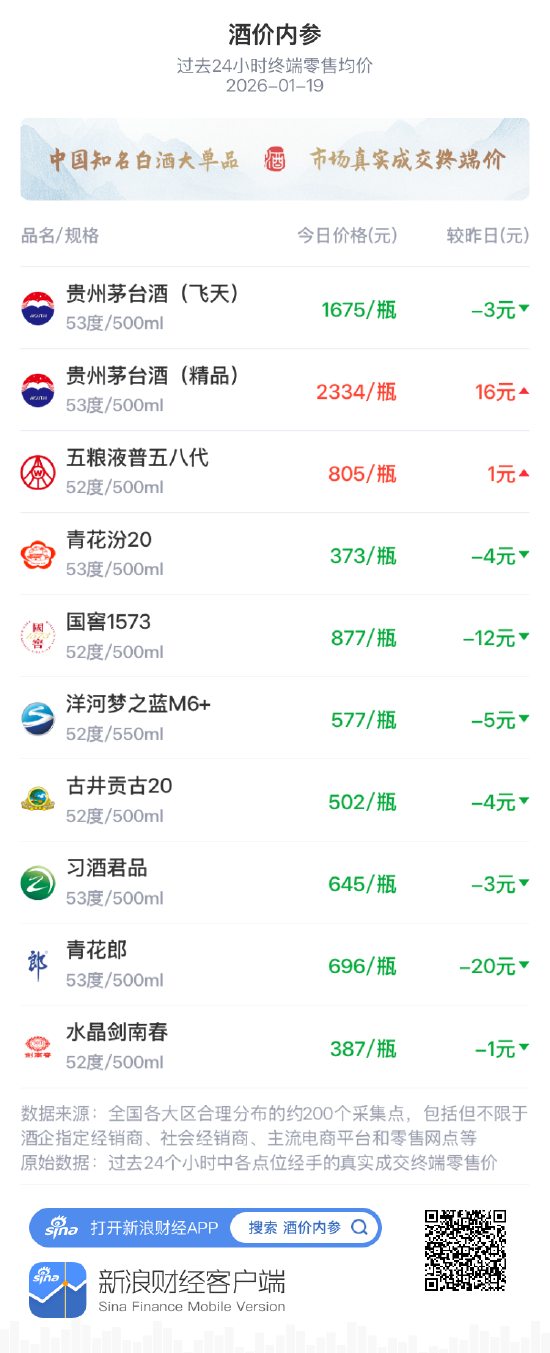
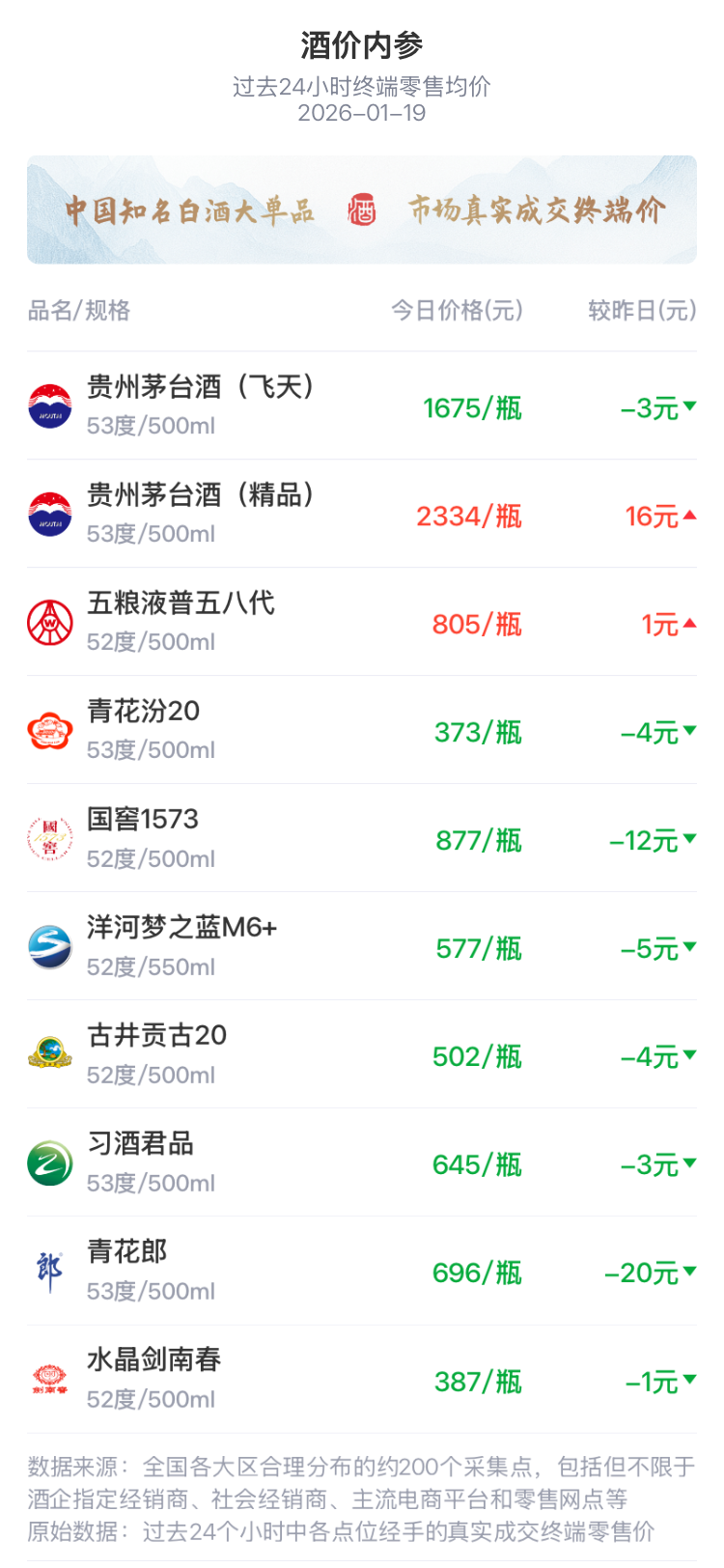
Core Insights - The core viewpoint of the article highlights a recent decline in the retail prices of major Chinese liquor brands, indicating ongoing market pressure and a trend of price differentiation among products [1][8]. Price Trends - The average retail price of the top ten Chinese liquor products fell to 8,871 yuan on January 19, a decrease of 35 yuan from the previous day [1][7]. - This marks the third time in two months that prices have hit a near low, reflecting a sustained downward trend in the market [1][8]. - Among the ten core products, eight experienced price drops while only two saw increases, with Qinghua Lang leading the decline at 20 yuan [1][8]. Product-Specific Price Changes - Notable price changes include: - Qinghua Lang: down 20 yuan - Guojiao 1573: down 12 yuan - Yanghe Dream Blue M6+: down 5 yuan - Gujing Gonggu 20 and Qinghua Fen 20: down 4 yuan each - Xijiu Junpin and Feitian Moutai: down 3 yuan each - Shuijing Jianan Chun: down 1 yuan - Only the premium Moutai saw an increase of 16 yuan, while Wuliangye Pu Wu 8th generation rose by 1 yuan [1][6][10]. Data Collection Methodology - The "Liquor Price Reference" collects data from approximately 200 sampling points across various regions, including designated distributors, social distributors, e-commerce platforms, and retail outlets [2][8]. - The data aims to provide an objective and traceable representation of the market prices for well-known liquor brands [2][8]. Market Dynamics - The introduction of new sales channels for Moutai products, such as the official i-Moutai platform selling Feitian Moutai at 1,499 yuan and premium Moutai at 2,299 yuan, has begun to influence market prices [2][8]. - The industry is facing inventory reduction pressures, leading to a continued trend of price differentiation among products [1][8]. Company Announcements - On January 18, Kweichow Moutai Co., Ltd. issued a statement warning against fraudulent recruitment information circulating online, emphasizing that they have not authorized any third parties to distribute such information [3][9]. - The company reiterated that all sales contracts for 2026 are being handled through offline channels and urged consumers to be cautious of misleading offers [3][9].

酒价内参1月19日价格发布,五粮液普五八代温和上涨1元
Xin Lang Cai Jing· 2026-01-19 01:20
Core Insights - The article highlights a significant decline in the retail prices of major Chinese liquor brands, indicating a market under pressure with prices hitting a two-month low [1][8] - The overall market shows a trend of eight products decreasing in price while only two products increased, reflecting ongoing inventory reduction challenges within the industry [1][8] Price Trends - The average retail price of the top ten liquor products fell to 8,871 yuan, a decrease of 35 yuan from the previous day [1][7] - The price drop is characterized by specific products: - Qinghua Lang led the decline with a drop of 20 yuan - Guojiao 1573 followed with a decrease of 12 yuan - Yanghe Dream Blue M6+ fell by 5 yuan - Other notable declines include 4 yuan drops for Gujing Gong and Qinghua Fen, and 3 yuan drops for Xijiu Junpin and Feitian Moutai [1][8] Market Data Collection - The "Wine Price Reference" collects data from approximately 200 sampling points across various regions, including designated distributors, social distributors, e-commerce platforms, and retail outlets, ensuring a comprehensive and objective price tracking system [2][8] - The data aims to provide a scientifically traceable overview of the market prices for well-known liquor brands [2][8] New Sales Channels - The introduction of new sales channels, such as the official i-Moutai platform selling Feitian Moutai at 1,499 yuan per bottle and boutique Moutai at 2,299 yuan, has begun to influence the market prices of these products [2][8] Company Announcements - Kweichow Moutai Co., Ltd. issued a statement warning against fraudulent recruitment information circulating online, emphasizing that they have not authorized any third parties to distribute such information [3][9] - The company reiterated that all sales contracts for 2026 are being handled through offline channels with existing corporate clients, and they are actively cooperating with authorities to address these fraudulent activities [3][9]

酒价内参1月19日价格发布 十大单品整体均价再创近两月新低
Xin Lang Cai Jing· 2026-01-19 01:19
Core Viewpoint - The Chinese liquor market is experiencing a price decline, with the average retail price of the top ten liquor products dropping, indicating ongoing pressure in the market [1]. Price Trends - The total retail price for a package of the top ten liquor products is 8,871 yuan, down by 35 yuan from the previous day [1]. - This marks the third time in two months that prices have hit a low point, reflecting a sustained downward trend [1]. Performance of Key Products - Out of the top ten core products, eight have seen price declines while only two have increased [1]. - The largest drop was observed in Qinghua Lang, which fell by 20 yuan; followed by Guojiao 1573 with a decrease of 12 yuan [1]. - Other notable declines include Yanghe Dream Blue M6+ down by 5 yuan, and several products including Gujing Gonggu 20 and Qinghua Fen 20 each down by 4 yuan [1]. - In contrast, the only significant price increase was for Boutique Moutai, which rose by 16 yuan, while Wuliangye Pu 58 also saw a slight increase of 1 yuan [1]. Market Dynamics - The price differentiation trend continues as the industry faces inventory reduction pressures [1]. - The data reflects real transaction prices collected from approximately 200 points across major regions, including designated distributors and mainstream e-commerce platforms [4].





水井坊还没说卖,上门考察的来了
2 1 Shi Ji Jing Ji Bao Dao· 2026-01-19 00:56
21世纪经济报道肖夏 综合报道 大股东"放风"考虑出售还没两天,水井坊迎来了要客上门。 1月15日,川酒集团党委书记、董事长曹勇,总经理、总工程师杨官荣率考察组赴水井坊邛崃全产业链 基地考察学习。 这一消息是川酒集团1月16日深夜通过官方公众号披露的。 "水井坊将智能化酿造与经验丰富的技术人员有机结合的前瞻性探索和扎实成效,为川酒集团建设'中国 白酒梦工厂'提供了宝贵经验。"曹勇说。水井坊一方陪同考察的,是水井坊传统技艺总监林东,公司的 技术代表人物。 就在上述考察前两天,有消息称帝亚吉欧正在探索出售中国资产的可能性,投行已在接触本地的战略投 资者和私募。对于这一消息,帝亚吉欧中国方面给21记者的回应是"不发表评论",水井坊方面则没有回 应。 去年以来,市场一直猜测帝亚吉欧会否考虑出售水井坊,水井坊方面多次出面否认,并在去年底剑南春 收购的传言引发涨停后直接公告称相关报道不实。迄今为止,帝亚吉欧、水井坊都没有在任何公开渠道 表达过出售意向。 而这一次川酒集团的来访,官方口径为生产层面的"考察学习",并未涉及资产层面的内容。但如此高调 的考察,还是为水井坊的出售猜想进一步添砖加瓦。 邻居登门 此次川酒集团对水井 ...

资与治 西南F4拓新局
Zhong Guo Zheng Quan Bao· 2026-01-18 20:44
——上市公司质量和投资价值进一步提高。全省上市公司累计实施并购重组136家次、交易金额813亿 元,累计实施股份回购增持283家次、总金额298亿元,累计实施现金分红超2300亿元。全省科创板、创 业板和北交所上市公司数量占比提升至44%。 对于"十五五"时期,四川证监局表示,将继续按照证监会党委和省委、省政府部署,充分发挥资本市场 功能作用,助力地方经济社会高质量发展。主要从四方面发力:聚焦科技创新,更好助力四川新质生产 力发展;凝聚发展合力,推动上市公司做优做强;强化功能发挥,服务区域发展战略;提高监管精准有 效性,守牢风险底线。 拓面增质 辖区资本市场亮点多 过去五年,四川资本市场发展环境和生态体系持续优化,各类市场主体搭乘政策东风,加速发展。 资本市场亮蜀光 资本市场亮 光 星奔川骛,岁聿云暮。回看"十四五"时期,四川资本市场交出了一份"高分答卷": ——直接融资效能进一步提升。全省新增46家A股上市公司、首发募集资金超360亿元,省内各类市场 主体通过资本市场实现直接融资超2.1万亿元,支持企业发行科创债、绿色债、乡村振兴债等创新品种 债券168只,募集资金超1000亿元。 上市公司总量稳增、赛道更 ...
资本市场亮“蜀”光
Zhong Guo Zheng Quan Bao· 2026-01-18 20:44
Core Insights - The Sichuan capital market has shown significant growth during the "14th Five-Year Plan" period, with 46 new A-share listed companies and over 360 billion yuan raised in initial public offerings [1][2] - The quality and investment value of listed companies in Sichuan have improved, with 136 mergers and acquisitions totaling 81.3 billion yuan and cash dividends exceeding 230 billion yuan [1][2] - The Sichuan Securities Regulatory Bureau aims to enhance the capital market's role in supporting high-quality economic development during the "15th Five-Year Plan" by focusing on technology innovation, strengthening listed companies, and improving regulatory effectiveness [1][6] Direct Financing Efficiency - Sichuan has achieved over 21 trillion yuan in direct financing through various market entities, including innovative bond types such as tech bonds and green bonds [1] - The number of listed companies in Sichuan has increased to 179, ranking 8th nationally, with a 32% growth in overall scale since the end of 2020 [2] Industry Structure and Regional Development - Traditional industries remain stable, with four listed liquor companies contributing 10.9% of total revenue and over 40% of profits among A-share companies [2] - Emerging industries like industrial technology and materials are becoming significant drivers of market value growth in Sichuan [2] - Chengdu is the capital market hub, hosting 122 A-share companies with a total market value of 2.12 trillion yuan, accounting for 68.15% of the province's A-share companies [2] Collaborative Efforts and Policy Implementation - The Sichuan Securities Regulatory Bureau has collaborated with various government departments to enhance market participation and compliance among companies [3] - Initiatives to promote venture capital and support the development of private equity funds have led to 349 private fund managers with over 310 billion yuan in managed assets [3] Investor Protection and Market Satisfaction - The Sichuan Securities Regulatory Bureau has implemented measures to improve investor returns and optimize dividend mechanisms, resulting in over 2.3 billion yuan in dividends distributed since 2021 [4] - A new dispute resolution mechanism has been established to enhance investor protection, with successful mediation cases recovering losses for investors [5] Future Development Focus - The Sichuan Securities Regulatory Bureau plans to continue supporting technology innovation and the development of key industries during the "15th Five-Year Plan" [6] - Emphasis will be placed on enhancing the quality of listed companies, improving governance, and facilitating mergers and acquisitions [7] - The bureau aims to strengthen the regional financial center and improve direct financing levels through collaboration with local financial institutions [7]
重大预警,2026年春节前中国A股或将再现历史级行情
Sou Hu Cai Jing· 2026-01-18 18:16
Core Viewpoint - The A-share market is experiencing a significant surge in trading volume and financing, indicating a potential bull market, with major sectors like commercial aerospace and technology seeing substantial gains [1][4][7]. Group 1: Market Performance - The first week of 2026 saw a trading volume of 14.26 trillion, nearly breaking the record from August 2025, with financing balances surpassing 2.6 trillion for the first time [1]. - The Shenzhen Component Index reached 14,000 points, and the ChiNext Index hit a four-year high, with the commercial aerospace sector rising by 20% and aerospace equipment by 26% in just one week [1]. - The Shanghai Composite Index recorded a 16-day consecutive rise with a cumulative increase of 3.35%, while the Shenzhen and ChiNext indices rose by 5.59% and 4.93%, respectively, marking the strongest start to the year in nearly a decade [4]. Group 2: Capital Flow - Net financing purchases amounted to 79 billion, with the electronics sector receiving 24.1 billion, power equipment 12 billion, and defense and military industries 9.4 billion [3]. - Major funds have shifted over 600 billion into electronics and computer sectors, with mechanical and power equipment sectors also seeing inflows exceeding 500 billion [3]. Group 3: Policy Support - The government is actively promoting investment with the upcoming "14th Five-Year Plan," focusing on technology, consumption, and domestic demand, alongside direct financial incentives like birth subsidies [5][13]. - The recent policies are expected to stimulate consumer spending, benefiting sectors such as consumer goods and services [13]. Group 4: Sector Opportunities - The commercial aerospace sector is highlighted as a key growth area for 2026, with strong policy support and performance expectations similar to the rise of the new energy vehicle sector [7][10]. - AI applications are gaining traction, with companies in AI healthcare and education reporting significant revenue growth, indicating a shift towards commercial viability [10]. - The consumer sector shows signs of recovery, particularly in dining, tourism, and healthcare services, although disparities exist within sub-sectors like liquor and medical services [11]. Group 5: Historical Context and Future Outlook - Historically, the A-share market tends to rise before the Spring Festival, with the Shanghai Composite Index showing an average increase of 1.72% in the five trading days leading up to the holiday [8]. - The current market dynamics suggest a more rational participation from investors, with a higher proportion of long-term funds compared to speculative short-term trading [11].
食饮行业周报(2026年1月第3期):茅台发布市场化运营方案,看好春节旺季备货行情-20260118
ZHESHANG SECURITIES· 2026-01-18 13:23
Investment Rating - The industry rating is maintained as "Positive" [5] Core Views - The report highlights that the liquor sector is currently at a bottom phase, with leading brands expected to see an upward trend in sales during the upcoming Spring Festival, particularly for core products [2][10] - The report emphasizes the importance of the Spring Festival stocking season for consumer goods, with a focus on new consumption trends in the medium to long term [3][12] Summary by Sections Market Performance Review - The food and beverage sector experienced a decline of 2.10% from January 12 to January 16, 2026, underperforming compared to the Shanghai Composite Index, which fell by 0.45%, and the CSI 300 Index, which dropped by 0.57% [1][19] - Specific declines included the liquor sector at -2.35%, processed foods at -2.13%, and dairy products at -2.09% [1][19] Weekly Updates - **Liquor Sector**: The liquor sector's performance was weaker than the overall food and beverage sector, with a notable decline of 2.35%. The report mentions the release of a market-oriented operational plan by Kweichow Moutai, which aims to stabilize retail prices and enhance sales channels [2][10] - **Consumer Goods**: The report indicates a positive outlook for snack foods, with significant gains in stocks such as "Good Idea" and "Kangbiter" [3][12] Investment Recommendations - **Liquor Sector**: Recommended stocks include Kweichow Moutai, Luzhou Laojiao, Shanxi Fenjiu, and Gujing Gongjiu, with a focus on potential sales exceeding expectations during the Spring Festival [2][10][17] - **Consumer Goods**: Emphasis on the importance of stocking for the Spring Festival, with recommendations for companies like Wei Long and Wanchen Group, as well as monitoring new product launches and channel adjustments [3][12][18] Sector and Stock Performance - The report provides detailed performance metrics for various sectors, indicating that the processed food and baking sectors also faced declines, with specific stocks like Weizhi Xiang and Kemei Foods showing some resilience [15][19] - The report notes that the dynamic price-to-earnings ratio for the food and beverage sector is currently at 21 times, ranking it 24th among primary industries [24]
大消费行业周报:细分赛道出现分化-20260118
Ping An Securities· 2026-01-18 12:06
Investment Rating - The industry investment rating is "stronger than the market," indicating an expected performance that exceeds the market by more than 5% within the next six months [25]. Core Insights - The report highlights a divergence in the performance of various segments within the consumer sector, with a stable overall market performance but most sub-sectors underperforming compared to the broader market [4][6]. - There is an expectation for consumer demand to improve ahead of the Lunar New Year, driven by sufficient market liquidity [4]. - The tourism sector is showing potential for growth, with leading companies responding effectively to changing consumer demands [4]. - The beauty industry is experiencing steady growth, with a focus on companies that adapt quickly to market dynamics [4]. - The food and beverage sector is seeing a recovery in supply-demand relationships, particularly in dairy products, while the restaurant supply chain is stabilizing [4]. - In the liquor segment, leading companies are expected to maintain market share despite recent profit adjustments [4]. Market Performance Review - The Shanghai Composite Index fell by 0.57% during the week of January 12-16, with the media sector rising by 3.34% while other sectors like food and beverage and agriculture saw declines of 2.03% and 3.49% respectively [6][8]. Social Services - The report emphasizes the importance of companies that actively respond to changes in consumer demand, particularly in tourism and beauty sectors [4]. Industry Dynamics - The People's Bank of China has introduced measures to enhance structural monetary policy support, which may positively impact consumer spending and economic recovery [10]. - The Philippines has announced visa-free entry for Chinese citizens, which could boost tourism [11]. Company Announcements - Companies like Giant Biological and Proya are making strategic moves, such as product approvals and share buybacks, indicating proactive management in response to market conditions [13][19]. - The report notes significant developments in the liquor industry, including the launch of premium products and partnerships for promotional events [20].

【转|太平洋食饮-26年度策略】底部向阳,寻找结构性亮点
远峰电子· 2026-01-18 11:38
Overall Sector Review - The food and beverage sector significantly underperformed the market, with a year-to-date decline of -0.62%, lagging behind the Shanghai Composite Index by 15.0 percentage points [2] - The sector experienced a deep correction after an initial rebound driven by expectations of consumption recovery and supportive policies, but the actual recovery rate was lower than anticipated, leading to a consensus on weak domestic demand [2] Subsector Performance - The snack sector outperformed with a year-to-date increase of 28.88%, driven by channel expansion and a revenue growth rate of 30.97% in the first three quarters [4] - Soft drinks also showed resilience with a 10.11% stock price increase, benefiting from strong travel demand and low-cost, high-frequency consumption [4] - The restaurant chain sector saw a rebound with gains of approximately 10.34% and 10.29% for pre-processed and baked goods, respectively [4] - The liquor sector, particularly high-end liquor, faced challenges with weaker sales and declining prices, while beer performance was supported but affected by high-end market constraints [4] Investment Insights - The sector is under pressure from deflationary trends and a weak recovery, with consumer confidence remaining low, indicating a shift to a "new normal" of low growth [8] - High-end consumption has shown slight recovery due to stock market wealth effects, but sustainability remains a concern [9] - The food and beverage sector's valuation is at historical lows, with a current PE (TTM) of 21.9X, indicating potential investment opportunities in undervalued segments [12] Fund Holdings - As of Q3 2025, the food and beverage sector's fund holdings decreased to 6.38%, nearing levels seen in 2016, with the liquor segment comprising 5.52% of this [14] - Fund holdings in the liquor sector increased for certain subsectors, including white liquor and seasoning products, while others saw declines [16] Long-term Trends - The liquor industry is undergoing its longest adjustment period since 2003, with significant price corrections and a potential bottoming out of valuations [21] - The white liquor sector has underperformed the market with a year-to-date return of -4.87%, reflecting weak demand and a divergence from broader market trends [24] - The third quarter of 2025 saw a significant decline in revenue and net profit for the white liquor sector, indicating a deep adjustment phase [27] Pricing Dynamics - The white liquor market is experiencing a general decline in prices, particularly in high-end segments, while lower price segments show resilience [29] - The average price of high-end products like Moutai has dropped significantly, while mid-range and lower-range products have maintained stability or slight increases [31] Investment Recommendations - The white liquor sector is advised to focus on inventory reduction and demand recovery, with a preference for leading brands that can maintain pricing power and product stability [32]