去美元化

Search documents
中信证券:历次中东冲突后的金价和黄金板块复盘
Sou Hu Cai Jing· 2026-03-19 05:35
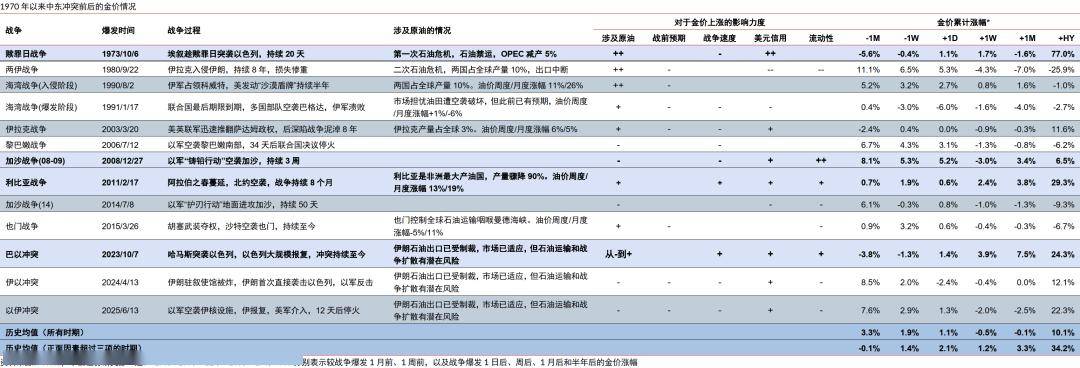
Core Viewpoint - The mid-term trend of gold prices after conflicts in the Middle East is influenced by the factors of US dollar credit and liquidity, with expectations of continued liquidity easing and weakening dollar credit driving gold prices higher [1][4]. Group 1: Historical Performance of Gold Prices - Historically, the average increase in gold prices six months after major Middle Eastern conflicts is 10%, with a significant average increase of 34% when at least three of the five influencing factors are positive [2][4]. - The average half-year increase in gold prices during periods of favorable conditions has reached 26%, with excess returns of 16 percentage points [4][19]. Group 2: Current Market Conditions - The current trend of liquidity easing and weakening dollar credit is expected to continue, which will support gold prices [4][15]. - The US economy is facing "stagflation" risks, which historically correlate with higher probabilities and greater increases in gold prices [8][15]. Group 3: Valuation and Investment Opportunities - The valuation of leading gold companies has dropped to historical lows of 15-20 times PE, indicating a strong margin of safety for investments in the gold sector [28]. - The synchronization of stock prices with gold price peaks has been validated multiple times since 2020, suggesting that new highs in gold prices will likely lead to new highs in the stock prices of gold companies [28].


2026年03月19日申万期货品种策略日报-铂、钯-20260319
Shen Yin Wan Guo Qi Huo· 2026-03-19 03:39
1. Report Industry Investment Rating - The report maintains a bullish outlook on platinum and palladium [4] 2. Core View of the Report - The long - term core logic for platinum and palladium remains unchanged, but short - term fluctuations are intensified due to technical corrections and Fed personnel changes. Despite significant retracements from previous highs, the long - term bullish view is still valid, though investors need to be wary of risks related to the nomination process and external market corrections [4] 3. Summary Based on Relevant Catalogs 3.1 Futures Market - **Platinum Futures**: For contracts pt2606, pt2608, and pt2610, the current prices are 548.00, 548.10, and 545.45 respectively, with price drops of - 6.55, - 6.45, and - 5.35, and percentage drops of - 1.18%, - 1.16%, and - 0.97%. The trading volumes are 4480, 94, and 32, and the open interests are all 13013 [1] - **Palladium Futures**: For contracts pd2606, pd2608, and pd2610, the current prices are 402.80, 399.50, and 397.85 respectively, with price drops of - 7.10, - 9.80, and - 7.85, and percentage drops of - 1.73%, - 2.39%, and - 1.93%. The trading volumes are 2158, 116, and 52, and the open interests are all 4388 [1] 3.2 Spot Market - **Platinum Spot**: The price of Shanghai platinum dropped by - 7.98 to 540.95, with a percentage drop of - 0.015%. The price of London platinum dropped by - 91.00 to 2066.00, with a percentage drop of - 0.042%. The prices of Zhou Dafu and Lao Fengxiang platinum changed by 10.00 and 0.00 respectively, with percentage changes of 0.012% and 0.000% [1] - **Palladium Spot**: The price of Chinese palladium increased by 7.00 to 397.00, with a percentage increase of 0.018%. The price of Russian palladium increased by 137.41 to 4353.60, with a percentage increase of 0.033% [1] 3.3 Inventory - **Platinum Inventory**: The NYMEX inventory and registered warehouse receipts remained unchanged at 582,440.79 and 313,567.94 ounces respectively. The turnover of the Gold Exchange decreased by 3403.6 to 108.19 million yuan, and the trading volume decreased by 62.0 to 2.00 kilograms [1] - **Palladium Inventory**: The NYMEX inventory and registered warehouse receipts remained unchanged at 200,716.01 and 164,229.68 ounces respectively [1] 3.4 Related Derivatives - **Related Indexes**: The US dollar index increased by 0.74 to 100.30, the S&P 500 index decreased by - 91.39 to 6,624.70, the US Treasury yield increased by 0.06 to 4.26, the Nasdaq index decreased by - 327.11 to 22,152.42, the Dow Jones index decreased by - 768.11 to 46,225.15, and the US dollar to RMB exchange rate decreased by - 0.01 to 6.89 [1] - **Gold and Silver Futures**: The prices of Shanghai gold futures contracts 2604, 2606, and 2608 decreased by - 2.68, - 2.40, and - 2.92 respectively. The prices of Shanghai silver futures contracts 2604, 2606, and 2608 decreased by - 374, - 328, and - 314 respectively [1] 3.5 Macro News - **Fed Interest Rate Decision**: The Fed kept the federal funds rate target range at 3.50% - 3.75%, with a 11 - 1 vote. Fed Governor Milan opposed the decision, advocating a 25 - basis - point rate cut. The dot plot shows only one rate cut in 2026 and 2027, indicating a more conservative rate - cut path [2] - **Geopolitical Tension**: US - Israeli military strikes on Iran have disrupted shipping in the Strait of Hormuz [2] - **Fed Chair Nomination**: US President Trump nominated former Fed Governor Kevin Warsh as the next Fed Chair. However, some senators oppose the nomination, and the process and subsequent policy independence are uncertain [2] - **PBOC Meeting**: The People's Bank of China held a 2026 payment and settlement work meeting, aiming to promote the high - quality development of the modern payment system, including accelerating the construction of the RMB cross - border payment system and strengthening regulatory measures [3]
首席点评:美联储按兵不动,原油价格坚挺
Shen Yin Wan Guo Qi Huo· 2026-03-19 03:05
1. Report Industry Investment Rating - The report provides a possibility judgment on various varieties, with a "cautiously bullish" outlook for stock indices (IH, IF, IC, IM), crude oil, methanol, rubber, coking coal, coke, manganese silicon, ferrosilicon, gold, silver, aluminum, lithium carbonate, cotton, and corn, and a "cautiously bearish" outlook for螺纹, hot-rolled coils, iron ore, and apples [5]. 2. Core Viewpoints - The Federal Reserve kept interest rates unchanged, raised inflation expectations, and still expects one interest rate cut this year. The situation in the Middle East is tense, which has an impact on the prices of various assets. The prices of U.S. stocks, U.S. bonds, gold, and digital currencies have fallen, while the prices of oil and gas and the U.S. dollar have risen [1]. - For precious metals, in the short term, the Fed's hawkish signal and rising inflation pressure suppress prices, but in the long term, factors such as geopolitical risks, anti - inflation needs, de - dollarization, and central bank gold purchases support the upward trend [2][18]. - For stock indices, in the short term, geopolitical risks affect market sentiment, and there are signs of weakness. In the long term, the trend will return to the domestic fundamentals and policies. The market will shift from "expectation - driven" to "profit - driven" [3][12]. - For other varieties, the report analyzes the supply and demand, market environment, and price trends of each variety, such as the impact of supply and demand on the prices of rubber, polyolefins, glass, and soda ash, and the impact of production and policy on the prices of agricultural products [15][16][24]. 3. Summary by Relevant Catalogs 3.1.当日主要新闻关注 3.1.1 International News - Iran launched the "True Promise - 4" 63rd round of operations, attacking U.S. - related oil and energy facilities in the region as a retaliatory measure for the earlier attack on its energy infrastructure [6]. 3.1.2 Domestic News - The China Securities Regulatory Commission held a meeting on comprehensively strengthening Party discipline and anti - corruption work in 2026, emphasizing the need to deepen the special governance of corruption in key areas and crack down on those who disrupt the capital market order and harm the interests of small and medium - sized investors [7]. 3.1.3 Industry News - NVIDIA announced a cooperation with Qnity Electronics to jointly develop advanced materials for semiconductors and advanced packaging technologies for artificial intelligence and high - performance computing [9]. 3.2.外盘每日收益情况 - The report shows the daily income of various external market varieties on March 17 and 18, 2026, including the S&P 500, FTSE China A50 futures, ICE Brent crude oil, London gold, London silver, LME aluminum, LME copper, LME zinc, LME nickel, ICE No. 11 sugar, ICE No. 2 cotton, CBOT soybeans, CBOT soybean meal, CBOT soybean oil, CBOT wheat, and CBOT corn, along with their price changes and percentage changes [10]. 3.3.主要品种早盘评论 3.3.1 Financial - **Stock Indices**: Affected by the Fed's interest rate decision and geopolitical factors, the U.S. stock market declined. The stock index rebounded after hitting the bottom. The communication sector led the rise, and the petrochemical sector led the decline. The market turnover was 2.06 trillion yuan. The performance - driven market will gradually replace the expectation - driven market, and stocks without performance support may be weak. In the short term, it is recommended to wait and see [12][13]. - **Treasury Bonds**: Treasury bonds continued to rise. The central bank's open - market reverse repurchase had a net withdrawal of 6 billion yuan. The Fed's stance and the tense situation in the Middle East increased inflation expectations. Although the short - term Treasury bond futures prices are supported, the long - term Treasury bond futures prices will be under pressure [14]. 3.3.2 Energy and Chemical - **Rubber**: The natural rubber is in the low - production season. Although the supply pressure is expected to increase due to the early opening of the domestic Yunnan production area, the current output is still small. The demand for all - steel tires is stable, and the rubber price is expected to be weak in the short term [15]. - **Polyolefins**: Polyolefins fluctuated widely on Wednesday and rose sharply at night. The situation in the Middle East has an impact on oil prices and the chemical market. The future trend depends on the actual start - up of devices and the support of demand [16]. - **Glass and Soda Ash**: The glass and soda ash futures prices declined. The inventory of glass production enterprises decreased last week, and the inventory of soda ash production enterprises also decreased. In the future, the digestion of glass inventory and the supply - demand pattern of soda ash need to be concerned [17]. 3.3.3 Metals - **Precious Metals**: Precious metals fluctuated downward in the short term due to the Fed's hawkish signal and rising inflation pressure. In the long term, the price center will continue to rise due to multiple factors [18][19]. - **Copper**: The copper price decreased at night. The supply of concentrates is tight, and the smelting profit is at the break - even point. The copper price may fluctuate in the short term, and factors such as the U.S. dollar, smelting output, and downstream demand need to be concerned [20]. - **Zinc**: The zinc price decreased at night. The supply of zinc concentrates is temporarily tight, and the smelting output continues to increase. The zinc price may follow the overall trend of non - ferrous metals, and factors such as the U.S. dollar, smelting output, and downstream demand need to be concerned [21]. - **Aluminum**: The Shanghai aluminum price remained flat at night. Due to the blockade of the Strait of Hormuz, some aluminum plants are looking for alternative import and export routes, and two aluminum plants have announced production cuts. The aluminum price has support at the bottom [22]. 3.3.4 Black - **Coking Coal and Coke**: The main contracts of coking coal and coke fluctuated at night. The supply pressure of coking coal is increasing, but with the end of environmental protection restrictions and the resumption of production, the iron water output is expected to increase, and the market should not be overly pessimistic [23]. 3.3.5 Agricultural Products - **Protein Meal**: The soybean meal price fluctuated and rose at night. Although the South American soybean harvest is in progress, some institutions have lowered their production forecasts for Brazilian soybeans. The U.S. biofuel policy may boost soybean demand, but the domestic supply is still abundant in the medium term, which suppresses the price [24]. - **Oils and Fats**: The price of oils and fats fluctuated strongly at night. The palm oil production in Southeast Asia will increase, but the geopolitical conflict may limit palm oil exports, and the U.S. biofuel policy will boost soybean oil demand. The price will fluctuate greatly in the short term [26]. - **Pigs**: The pig market is in a weak consolidation pattern. The supply exceeds the demand, and the terminal demand is weak, so the pig price lacks upward support and is expected to fluctuate narrowly in the short term [27]. - **Sugar**: The Zhengzhou sugar price rose overnight. The situation in Iran may affect the ethanol - to - sugar price ratio, and the sugar production ratio in the 26/27 season may decline. The domestic sugar price is boosted by the external market, and the impact of the macro environment needs to be concerned [28]. - **Cotton**: The Zhengzhou cotton price fluctuated overnight. The issuance of additional cotton import quotas may put short - term pressure on the cotton price, but in the long term, the supply is expected to be tight, and the overall trend remains unchanged [29]. 3.3.6 Shipping Index - **Container Shipping to Europe**: The EC index decreased by 1.71%. The shipping price of the European line has gradually returned to the supply - demand pricing, and the sentiment is still affected by geopolitical changes. The actual cargo volume is expected to increase in April, and the price increase by shipping companies needs to be concerned [30].
西南期货早间评论-20260319
Xi Nan Qi Huo· 2026-03-19 02:57
1. Report Industry Investment Ratings There is no information regarding industry investment ratings in the provided content. 2. Core Views of the Report - The overall market is affected by multiple factors such as the Fed's interest - rate decision, the Middle - East geopolitical conflict, and domestic economic recovery. Different sectors show various trends, and investors are advised to take different strategies according to the specific situation of each sector [6][9][12] - The Fed maintains the federal funds rate target range at 3.50% - 3.75%, and the market expects cautious monetary policy. The Middle - East conflict has a significant impact on the market, increasing uncertainty and volatility [6] 3. Summary by Directory Fixed - Income (Treasury Bonds) - The previous trading day saw all treasury bond futures close higher. The 30 - year, 10 - year, 5 - year, and 2 - year main contracts rose by 0.23%, 0.12%, 0.08%, and 0.04% respectively. The central bank conducted 205 billion yuan of 7 - day reverse repurchase operations, with a net withdrawal of 60 billion yuan on the day [5] - The Fed's decision to keep interest rates unchanged and the Middle - East conflict have increased the uncertainty of the US economy. The domestic macro - economic recovery momentum needs to be strengthened, and the treasury bond market is expected to face certain pressure, so it is advisable to be cautious [6] Equity Index Futures - The previous trading day saw mixed performance in stock index futures. The CSI 300, SSE 50, CSI 500, and CSI 1000 main contracts changed by 0.14%, - 0.38%, 0.77%, and 0.68% respectively [8] - The domestic economy is stable, but the recovery momentum is weak, and corporate profit growth is low. However, asset valuations are low, and there is room for repair. The policy environment is favorable, but the Iran situation has high uncertainty, so it is recommended to stay on the sidelines [9] Precious Metals - The previous trading day saw gold and silver main contracts decline by 0.24% and 1.62% respectively. The US February PPI data exceeded expectations [11] - The global trade and financial environment is complex, and the long - term logic of precious metals is strong. However, due to the high market pricing and the uncertainty of the Iran situation, it is recommended to stay on the sidelines [12] Steel Products (Rebar, Hot - Rolled Coil) - The previous trading day saw rebar and hot - rolled coil futures fluctuate. The Middle - East conflict may affect sentiment, but has little impact on the actual supply - demand pattern. In the long - term, the real - estate industry's downward trend has not reversed, and the demand for rebar is decreasing. In the medium - term, it is necessary to focus on the peak season. The supply pressure has been alleviated, and prices may rebound but with limited space. Investors can pay attention to low - position long - entry opportunities [14] Iron Ore - The previous trading day saw iron ore futures fluctuate. The Middle - East conflict may affect sentiment, but has little impact on the actual supply - demand pattern. After the key meeting, the daily output of molten iron may increase, which is positive for prices. The inventory is at a high level in the past five years. Investors can pay attention to low - position long - entry opportunities [16][17] Coking Coal and Coke - The previous trading day saw coking coal and coke futures decline slightly. The Middle - East conflict may affect sentiment, but has little impact on the actual supply - demand pattern. The supply of coking coal may increase, and the demand is weak. The supply of coke is stable, and the demand may increase. The prices of coke and coking coal are in a volatile pattern, and investors can pay attention to low - position long - entry opportunities [19] Ferroalloys - The previous trading day saw the manganese - silicon and silicon - iron main contracts decline by 1.51% and 2.19% respectively. The cost of ferroalloys is in a narrow - range fluctuation, and the supply is still in a surplus state. After a rapid price rebound, investors can consider taking profits on long positions [21][22] Crude Oil - The previous trading day saw INE crude oil rise and then fall. Speculators increased their net long positions in US crude oil futures and options. The number of oil and gas rigs in the US increased. The conflict between the US and Iran has intensified, and the global crude oil supply shortage is still a concern. Investors can pay attention to long - entry opportunities in the main crude - oil contract [23][24] Polyolefins - The previous trading day saw the PP market in Hangzhou decline, and the LLDPE market in Yuyao adjust. In the short - term, polyolefins show a contraction trend. In the long - term, the import volume may decrease in April, but new production capacity is planned to be put into operation at home and abroad, and the supply pressure will gradually increase. The demand shows the characteristics of "rising production but cautious purchasing". Investors can pay attention to long - entry opportunities [26] Synthetic Rubber - The previous trading day saw the synthetic rubber main contract decline by 1.62%. The cost support has weakened. The supply pressure is high in the short - term, and the demand is affected by the Middle - East conflict. The inventory has changed from accumulation to depletion. The price is expected to be in a relatively strong volatile pattern [28][29] Natural Rubber - The previous trading day saw the natural - rubber main contract decline by 2.55%, and the 20 - rubber main contract decline by 2.67%. The Middle - East conflict has increased the cost of synthetic rubber, which strengthens the substitution demand for natural rubber. However, the expectation of new - rubber supply and slow demand recovery suppress the price increase. The price is expected to be in a wide - range volatile pattern [31] PVC - The previous trading day saw the PVC main contract decline by 1.31%. The market is driven by overseas geopolitical conflicts and domestic spring demand. The cost support is strong in the short - term, but the high inventory restricts the upward space. The price is expected to be in a relatively strong volatile pattern [34] Urea - The previous trading day saw the urea main contract decline by 1.70%. The market is facing high supply and policy restrictions. The demand is weak, and the export is strictly controlled. The price is expected to be in a weak volatile pattern, with limited downward space [36] PX - The previous trading day saw the PX2605 main contract decline by 0.42%. The PXN spread and short - process profit are slightly compressed. The PX supply is expected to be tight, and the downstream demand is gradually recovering. The price is expected to be in a slightly strong volatile pattern, and investors can consider cautious long - entry at low positions [37] PTA - The previous trading day saw the PTA2605 main contract decline by 0.76%. The PTA processing fee has been adjusted, and the supply - demand situation is expected to improve in March. The price is mainly affected by the cost. Due to the uncertainty of the geopolitical situation, investors can consider cautious long - entry at low positions [38] Ethylene Glycol - The previous trading day saw the ethylene - glycol main contract rise by 1.11%, and the night - session rise by 8.73%. The supply is expected to decrease due to the Middle - East conflict, and the inventory is expected to be depleted. The price is expected to be in a relatively strong volatile pattern [39] Short - Fiber - The previous trading day saw the short - fiber 2606 main contract decline by 0.39%. The supply is gradually increasing, and the terminal demand is recovering. The price is mainly affected by the cost. Investors should pay attention to the geopolitical situation, device dynamics, and downstream factory resumption progress [40] Bottle Chips - The previous trading day saw the bottle - chips 2605 main contract decline by 2.35%. The processing fee has increased significantly, and the supply is expected to decrease. The demand is recovering, and the price is expected to follow the cost and be in a volatile pattern. Investors should be cautious and pay attention to the restart of the maintenance device and cost changes [41] Soda Ash - The previous trading day saw the 2605 main contract close at 1211 yuan/ton, with a decline of 2.57%. The production is stable, the inventory has decreased slightly, and the downstream demand is weak. The market sentiment is weak, but the decline in the number of warehouse receipts may lead to market fluctuations. Investors should control risks [42][43] Glass - The previous trading day saw the 2605 main contract close at 1066 yuan/ton, with a decline of 2.74%. The production line is shrinking, the inventory has decreased slightly, and the demand is recovering slowly. The market is in a state of high - level long - short game, and the price is volatile. Investors should control positions and pay attention to the Middle - East situation and fundamental changes [44] Caustic Soda - The previous trading day saw the 2605 main contract close at 2442 yuan/ton, with a decline of 2.01%. The supply has decreased slightly, and the inventory has decreased. The price of high - concentration caustic soda is rising due to export orders. The market may fluctuate due to the decline in the number of warehouse receipts. Investors should pay attention to overseas device dynamics, export orders, inventory changes, and device maintenance progress [45][46] Pulp - The previous trading day saw the 2605 main contract close at 5040 yuan/ton, with a decline of 2.10%. The domestic production may decrease, and the port inventory has decreased slightly. The downstream demand is weak, and the market lacks substantial positive support [47][48] Lithium Carbonate - The previous trading day saw the lithium - carbonate main contract decline by 4.43%. The global lithium - resource supply - demand balance is being reshaped, and the supply is expected to be tight. The demand in the energy - storage and power - battery sectors is improving, and the inventory is decreasing. The price has strong support, but the short - term volatility may increase [49] Copper - The previous trading day saw the Shanghai copper main contract close at 96340 yuan/ton, with a decline of 2.58%. The geopolitical conflict has increased inflation expectations, and the supply pressure is high in the short - term. The downstream demand has recovered to some extent, but the high inventory and macro - pressure may lead to a weak volatile pattern [50][51] Aluminum - The previous trading day saw the Shanghai aluminum main contract close at 24835 yuan/ton, unchanged; the alumina main contract rose by 0.85%. The supply pressure of alumina is high, and the Middle - East conflict has increased the cost. The supply is expected to tighten, and the domestic consumption is recovering. The price is expected to be in a relatively strong volatile pattern [53] Zinc - The previous trading day saw the Shanghai zinc main contract close at 23000 yuan/ton, with a decline of 1.84%. The domestic supply has increased, and the overseas supply is disturbed. The demand is expected to recover, but the actual recovery strength needs to be verified. The inventory is increasing, and the price may be under pressure and in a volatile pattern [55] Lead - The previous trading day saw the Shanghai lead main contract close at 16585 yuan/ton, with a decline of 0.57%. The production of primary lead has increased, and the recovery of secondary lead is slow. The demand for lead - acid batteries has recovered, but the geopolitical risk affects exports. The inventory is increasing, and the price may be under pressure and adjust [57] Tin - The previous trading day saw the Shanghai tin main contract decline by 3.39%. The geopolitical conflict has increased price volatility. The supply pressure has eased, and the demand in emerging fields is strong. The inventory has decreased, and the price has support, but investors should control risks due to overseas uncertainties [59][60] Nickel - The previous trading day saw the Shanghai nickel main contract decline by 0.69%. The geopolitical conflict has increased price volatility. The supply of nickel ore is expected to be tight, and the cost is rising. The downstream demand is weak, and the inventory is at a relatively high level. The market is in a surplus state, and investors should pay attention to Indonesian policies and macro - events [61] Soybean Oil and Soybean Meal - The previous trading day saw the soybean - meal main contract decline by 0.26%, and the soybean - oil main contract decline by 0.93%. The Brazilian soybean harvest is approaching 60%, and the crude - oil price rise provides support. The domestic soybean import is slowing down, and the supply may be tight in the short - term, but it is expected to be relatively loose in the medium - term. It is advisable to stay on the sidelines due to the uncertainty of the Middle - East conflict [62][63] Palm Oil - The Malaysian palm - oil market has declined for two consecutive days. The export demand in April is a concern. The domestic palm - oil import has increased, and the inventory is at a relatively high level. Investors can consider reducing or closing long positions [64][65] Rapeseed Meal and Rapeseed Oil - The Canadian rapeseed futures have declined. The domestic import policy has changed, and the inventory of rapeseed and rapeseed meal has decreased, while the inventory of rapeseed oil has increased. It is advisable to stay on the sidelines [66][67] Cotton - The previous trading day saw domestic cotton futures decline slightly, and the overseas market fluctuated. The global cotton production is expected to decrease in the new season, and the inventory is expected to decrease. The domestic supply is expected to be tight in the long - term, and the price is expected to be in a relatively strong volatile pattern [69][70] Sugar - The previous trading day saw domestic sugar futures decline slightly, and the overseas market rose. The domestic sugar production is expected to increase, and the import volume is high. The overseas sugar production is lower than expected, and the crude - oil price rise is beneficial to the sugar price. The long - term sugar price bottom may rise [71][72] Apple - The previous trading day saw apple futures fluctuate strongly. The spot market is stable, and it is in the consumption off - season. The inventory is decreasing, and the demand is expected to increase during the Tomb - Sweeping Festival. The market is expected to be stable and strong, and investors should pay attention to inventory reduction and weather conditions [73] Live Pigs - The previous trading day saw the main contract decline by 2.29%. The supply is increasing, and the demand is weak. The government has started the purchase and storage mechanism, but the short - term effect may be limited. It is advisable to hold short positions [74][75] Eggs - The previous trading day saw the main contract rise by 0.29%. The egg supply is expected to be at a high level in March, and the long - term supply improvement is uncertain. It is advisable to hold short positions in the far - month contracts [76] Corn and Corn Starch - The previous trading day saw the corn main contract rise by 0.08%, and the corn - starch main contract decline by 0.51%. The domestic corn supply and demand are basically balanced. The new - season corn cost may be revised down, and the wheat substitution effect may increase. The corn - starch demand has recovered slightly, and the price may follow the corn market. Investors can pay attention to put - option opportunities [77][79] Logs - The previous trading day saw the 2605 main contract close at 806.0 yuan/ton, with a decline of 0.68%. The supply of New Zealand logs has increased, and the downstream demand has improved. The cost pressure has increased, and the market is in a high - level volatile pattern. Investors should pay attention to external quotes, shipping dynamics, and downstream consumption [80][82]
中东局势影响深远-中国迎来战略机遇
2026-03-19 02:39
Summary of Key Points from Conference Call Records Industry or Company Involved - The discussion primarily revolves around the geopolitical situation in the Middle East, particularly the ongoing U.S.-Iran conflict, and its implications for global markets and the Chinese economy. Core Insights and Arguments 1. **Long-term U.S.-Iran Conflict**: The U.S.-Iran war is expected to become prolonged and escalate, with a low probability of ceasefire by the end of March 2026, currently at 11% according to Polymarket [1][5] 2. **Impact on Oil Prices**: Brent crude oil prices have surged to $150 per barrel, which may hinder the Federal Reserve's ability to lower interest rates in 2026, affecting global asset pricing [1][6] 3. **Threat to Petrodollar System**: The potential blockade of the Strait of Hormuz could disrupt oil exports from Gulf countries, leading to a liquidity crisis and accelerating the de-dollarization process globally [1][7] 4. **China's Strategic Advantage**: China benefits from a dual energy pillar of coal and renewable energy, allowing it to attract high-energy-consuming manufacturing industries back from Japan and South Korea [1][8] 5. **A-Share Market Outlook**: The A-share market is expected to experience short-term volatility, with a support level around 6,600 points. Long-term prospects for RMB assets remain positive [1][11] 6. **Investment Focus**: The main investment themes include the revaluation of physical assets (coal, coal chemical, electricity) and sectors with predictable growth (renewable energy exports, AI industry chain, nuclear energy storage) [1][12] Other Important but Possibly Overlooked Content 1. **Market Expectations**: Current market pricing reflects a bias towards a short-term conflict scenario, with a 50% chance of the conflict extending beyond June 2026 [5] 2. **Global Economic Impact**: The prolonged conflict is likely to exacerbate global inflation, disrupt the Federal Reserve's interest rate policies, and impact capital markets significantly [6][7] 3. **China's Energy and Manufacturing Opportunities**: China's coal and renewable energy sectors are positioned to thrive, especially as energy costs rise in neighboring economies, potentially leading to a return of manufacturing to China [8][9] 4. **Sector Rotation in A-Share Market**: Recent shifts towards sectors like food and beverage and finance are seen as a rebalancing rather than a change in market leadership, with AI sectors expected to experience volatility [12] 5. **Theme Investment Directions**: Key areas for thematic investment include lithium batteries, nuclear power, energy storage, and wind power, driven by urgent demand in both China and Europe [13]
LSEG跟“宗”|中东局势短期难以结束 美降息预期再次延后 9月首次降息几率仅五五开
Refinitiv路孚特· 2026-03-18 06:04
Core Viewpoint - The market has delayed expectations for interest rate cuts in the US due to rising oil prices and inflation, which are perceived as reasons for the Federal Reserve to maintain its current stance. This interpretation may overlook the complexities of the situation, particularly the geopolitical factors influencing oil prices and their indirect effects on monetary policy [2][25]. Group 1: Market Sentiment and Commodity Prices - The recent escalation in the Middle East has led to a decline in market optimism, particularly affecting gold prices, which fell below the $5,000 mark. This situation reflects a shift in market sentiment, where good news is viewed as an opportunity for shareholders to liquidate positions [2][25]. - The net long positions in US futures for gold have increased by 1% to 318 tons, marking the highest level in six weeks, while silver has seen a significant rise in net long positions by 33% to 1,512 tons [6][10][12]. - The gold/silver ratio has increased to 62.301, indicating a market sentiment shift, with historical trends suggesting that higher ratios often correlate with increased market fear [21][22]. Group 2: Geopolitical Influences and Economic Implications - Historical parallels are drawn to the 1970s, where geopolitical tensions led to rising oil prices and inflation, subsequently driving investment into gold as a safe haven. Current conditions suggest a similar environment may favor gold, despite potential pressures from rising interest rates [26][27]. - The US government's strategic investments in critical materials, such as rare earth elements, indicate a focus on securing resources amid geopolitical tensions, which may support commodity prices in the long term [17][27]. - The market's perception of the Federal Reserve's actions is critical, as any significant interest rate hikes could lead to broader economic repercussions, including increased bankruptcies and public discontent [2][25]. Group 3: Investment Opportunities in Precious Metals - The outlook for precious metals remains positive, with companies like Agnico Eagle investing in strategic resources, indicating confidence in the sector's future [18]. - The current market dynamics suggest that while gold has appreciated significantly, there may still be opportunities for long-term investments, particularly as geopolitical tensions persist [26][28]. - The performance of mining stocks relative to physical metals is a key indicator; if gold prices continue to rise but mining stocks decline, it may signal caution for investors [20][21].

中企出海,人民币结算崛起
第一财经· 2026-03-18 03:01
Core Viewpoint - The article discusses the significant fluctuations in the US dollar index and the implications for Chinese enterprises expanding overseas, emphasizing the need for enhanced risk management strategies in a volatile currency environment [3]. Group 1: Dollar Index and Investment Trends - The US dollar index has shown notable volatility, oscillating between a high of 110.01 and a low of 95.44 over the past 12 months, with a recent rebound of approximately 3% as geopolitical tensions rise [3]. - In 2025, China's non-financial direct investment abroad reached $145.66 billion, marking a 1.3% increase from the previous year, with significant growth in investments in Africa (41%) and Europe (20.9%) [3]. Group 2: Risk Management for Chinese Enterprises - Despite increasing awareness of currency risk management, many small and medium-sized enterprises (SMEs) still prefer traditional spot transactions, which may not adequately cover risks in a fluctuating exchange rate environment [4]. - The trend of de-dollarization and the promotion of RMB settlements are becoming more prevalent in daily trade, as suppliers are increasingly recognizing the feasibility of cross-border RMB settlements [5][6]. Group 3: RMB Internationalization - The RMB has become the largest settlement currency for China's foreign trade and the second-largest trade financing currency globally, with cross-border RMB payment amounts reaching 70.6 trillion yuan in 2025 [5]. - The People's Bank of China has signed bilateral currency swap agreements with 32 countries, totaling over 4.5 trillion yuan, enhancing the liquidity of RMB in offshore markets [5]. Group 4: Flexible Financial Solutions - Traditional rigid foreign exchange contracts are insufficient for the diverse needs of enterprises; a flexible foreign exchange forward contract option allows companies to choose the execution time within a specified window, providing greater operational flexibility [8][9]. - Establishing a global local currency collection system is becoming a mainstream choice for medium-sized enterprises, allowing for natural hedging and risk diversification [9]. Group 5: Profit Repatriation and Trade Strategies - For profit repatriation from emerging markets, companies are advised to utilize professional financial services to find compliant pathways for converting local currencies into offshore RMB [10]. - Companies are adopting a dual strategy of "pricing optimization" and "supply chain extension" to address frequent tariff policy changes, with a shift from merely selling abroad to establishing production bases in Eastern and Southern Europe [10].

2026年3月18日申万期货品种策略日报-黄金白银-20260318
Shen Yin Wan Guo Qi Huo· 2026-03-18 02:24
Report Industry Investment Rating - Not provided in the given content Core Viewpoints - In the short term, the high - level oscillation of crude oil prices and the downward revision of the Fed's interest rate cut expectations suppress precious metals. In the long run, the price center of precious metals will continue to rise. The long - term upward trend of gold remains unchanged due to multiple factors such as geopolitical risks, anti - inflation needs, de - dollarization, and central bank gold purchases. Silver, platinum, and palladium follow the overall sector trend with greater volatility [6]. Summary by Relevant Catalogs Futures Market - **Prices and Changes**: For Shanghai Gold 2606, the previous day's closing price was 1121.50, the closing price yesterday was 1119.16, with a decline of 2.34 and a decline rate of - 0.21%. For Shanghai Gold 2604, the previous day's closing price was 1118.340, the closing price yesterday was 1116.200, with a decline of 2.140 and a decline rate of - 0.19%. For Shanghai Silver 2606, the previous day's closing price was 20301, the closing price yesterday was 20308, with an increase of 7 and an increase rate of 0.03%. For Shanghai Silver 2604, the previous day's closing price was 20380, the closing price yesterday was 20371, with a decline of 9 and a decline rate of - 0.04% [2]. - **Positions and Volumes**: The position volume of Shanghai Gold 2606 was 148093, and the trading volume was 71848. The position volume of Shanghai Gold 2604 was 90930, and the trading volume was 146932. The position volume of Shanghai Silver 2606 was 218466, and the trading volume was 550109. The position volume of Shanghai Silver 2604 was 73981, and the trading volume was 74236 [2]. - **Spot Premiums**: The spot premium of Shanghai Gold 2606 was - 3.68, and that of Shanghai Gold 2604 was - 0.72. The spot premium of Shanghai Silver 2606 was 22, and that of Shanghai Silver 2604 was - 41 [2]. Spot Market - **Prices and Changes**: The previous day's closing price of Shanghai Gold T + D was 1114.99, the closing price yesterday was 1115.48, with an increase of 0.49 and an increase rate of 0.04%. The previous day's closing price of London Gold was 5003.82, the closing price yesterday was 5006.63, with an increase of 2.81 and an increase rate of 0.06%. The previous day's closing price of Shanghai Silver T + D was 20077, the closing price yesterday was 20330, with an increase of 253 and an increase rate of 1.26%. The previous day's closing price of London Silver was 80.73, the closing price yesterday was 79.36, with a decline of 1.37 and a decline rate of - 1.70% [2]. - **Price Differences**: The current value of Shanghai Gold 2606 - Shanghai Gold 2604 was 2.96, and the previous value was 3.16. The current value of Shanghai Silver 2606 - Shanghai Silver 2604 was - 63.00, and the previous value was - 79.00. The current value of the gold/silver ratio (spot) was 54.87, and the previous value was 55.54. The current value of Shanghai Gold/London Gold was 1.01, and the previous value was 1.00. The current value of Shanghai Silver/London Silver was 1.16, and the previous value was 1.15 [2]. Inventory - **Changes**: The current value of the Shanghai Futures Exchange's gold inventory was 105,315 kg, a decrease of 102 kg from the previous value. The current value of the Shanghai Futures Exchange's silver inventory was 353,763 kg, an increase of 23055 kg from the previous value. The current value of the COMEX gold inventory was 32,236,075 troy ounces, a decrease of 160323 troy ounces from the previous value. The current value of the COMEX silver inventory was 337,892,693 troy ounces, a decrease of 1689570 troy ounces from the previous value [2]. Related Derivatives - **ETF Positions and CFTC Net Positions**: The current value of the SPDR Gold ETF position was 1,070 tons, a decrease of 1 ton from the previous value. The current value of the SLV Silver ETF position was 15,390 tons, an increase of 34 tons from the previous value. The current value of the CFTC speculator's net position in gold was 163,132, an increase of 2987 from the previous value. The current value of the CFTC speculator's net position in silver was 24,578, an increase of 1240 from the previous value [2]. Macro News - **Fed Interest Rate Expectations**: According to CME "FedWatch", the probability that the Fed will keep interest rates unchanged this week is 98.9%, the probability of a 25 - basis - point cut is 0%, and the probability of a 25 - basis - point increase is 1.1%. The probability of a 25 - basis - point cumulative cut by April is 3.1%, the probability of keeping interest rates unchanged is 95.9%, and the probability of a 25 - basis - point increase is 1.1%. The probability of a 25 - basis - point cumulative cut by June is 78.1% [3]. - **Iranian Incidents**: Iran has designated multiple replacement candidates for key national positions. Iran's President confirmed the death of Ali Larijani, the secretary of the Supreme National Security Council. Israel's Prime Minister Netanyahu said Larijani and Basij militia commander Suleimani were killed in an Israeli air - strike [3][4]. - **US - Related News**: US President Trump criticized his allies, threatened to withdraw from NATO, and the US will relax sanctions on Venezuela during the Iran war to release more oil resources [5].
美联储议息会议在即,贵金属短期承压中期可期
Guo Xin Qi Huo· 2026-03-17 08:31
1. Report Industry Investment Rating - No relevant information provided 2. Core View of the Report - The precious metals market will present a pattern of "short - term pressure and prominent medium - to - long - term allocation value" considering the expectations of the upcoming Fed FOMC meeting and the current market environment [3][13] - In the short term, the pressure on the precious metals market is difficult to change due to high - interest rate expectations, a strong US dollar index, and profit - taking and increased liquidity needs [3][13] - In the long term, the allocation value of precious metals is gradually emerging with price corrections, supported by "stagflation risks", weakening US dollar credit, and expectations of loose policies [4][14] - Gold will be the core asset for medium - to - long - term allocation, silver has greater elasticity and industrial demand support, platinum is relatively resistant to decline and may rebound, and palladium may continue to lag behind other precious metals in the medium - to - long term [5][15] 3. Summary by Relevant Catalogs Policy Expectation Background - The core suppression factor in the precious metals market is the repricing of market expectations for the Fed's monetary policy, which is closely related to inflation prospects. The "geopolitical risk → energy cost → inflation expectation" transmission chain is strengthening [8] - The market focus has shifted from "geopolitical hedging" to "the game between inflation expectations and monetary policy". The "slow growth and persistent inflation" situation restricts the Fed's policy choices [10] - As of March 16, the market - expected number of interest rate cuts this year has been significantly reduced, and the probability of maintaining the interest rate unchanged in December has risen to 64.7%. The upcoming March Fed FOMC meeting will be crucial for the market direction [10] 3 - Month FOMC Meeting Core Concerns Analysis - The three core concerns of the March FOMC meeting are Powell's statement, the adjustment of the Economic Projection Summary (SEP), and the change in the dot plot, which will determine the market's re - evaluation of the Fed's policy path and affect the precious metals market [11] - Political variables add uncertainty to the meeting, including the appeal of the dismissal of Powell's subpoena and the delay of the confirmation process of Trump's nominee for Fed chair [12] Precious Metals: Short - Term Pressure and Medium - to - Long - Term Allocation Value - In the short term, precious metals are under pressure due to high - interest rate expectations, a strong US dollar, and profit - taking and increased liquidity needs. Silver and platinum - group metals have more significant price corrections [13] - In the long term, precious metals' allocation value is emerging, supported by "stagflation risks", weakening US dollar credit, and expectations of loose policies [14] - At the variety level, gold is the core asset for medium - to - long - term allocation, silver has greater elasticity and industrial demand support, platinum may rebound after the macro - pressure eases, and palladium may lag behind [15]
金属行业周报:国内需求缓慢复苏,地缘局势扰动情绪-20260317
BOHAI SECURITIES· 2026-03-17 07:43
Investment Rating - The report maintains a "Positive" rating for the steel industry and a "Positive" rating for the non-ferrous metals industry [2] Core Insights - Domestic demand is slowly recovering, but geopolitical tensions are affecting market sentiment [1] - The steel supply is expected to continue recovering as environmental production restrictions in northern regions end, but overall improvements in supply-demand balance are limited [1][15] - Copper prices are significantly influenced by macroeconomic sentiment and oil prices, with high oil prices exerting downward pressure on copper prices [1][38] - Geopolitical factors are currently the main influence on aluminum prices, with expectations of supply disruptions supporting aluminum prices in the short term [1][45] - Gold prices are under pressure due to high inflation driven by oil prices and low expectations for interest rate cuts [1][48] - Lithium prices are expected to fluctuate due to strong demand for energy storage and macroeconomic sentiment [1][51] - Rare earth prices are anticipated to fluctuate due to intense competition between upstream and downstream sectors [1][61] Summary by Sections Steel Industry - The production of five major steel products increased by 2.98% week-on-week, with total steel inventory rising [15][23] - As of March 13, the total steel inventory was 19.51 million tons, up 1.18% week-on-week [23] - The average price index for steel increased by 1.22% week-on-week, with the comprehensive price at 3,445.39 CNY/ton [36][37] Copper Industry - As of March 13, LME copper spot prices were 12,800 USD/ton, down 0.39% week-on-week [43] - Domestic copper inventory showed a slight decrease, while the refining fees were negative, indicating pressure on the copper market [39][43] Aluminum Industry - LME aluminum prices increased by 3.99% week-on-week, with domestic prices at 25,100 CNY/ton [46] - Domestic aluminum inventory continued to accumulate, while geopolitical tensions are expected to impact supply [45] Precious Metals - Gold and silver prices decreased, with COMEX gold at 5,023.10 USD/oz, down 3.05% week-on-week [48] - The outlook for gold remains cautious due to high inflation and geopolitical risks [48] New Energy Metals - Lithium carbonate prices remained stable, with domestic battery-grade lithium carbonate at 157,500 CNY/ton [52] - Market sentiment is influenced by geopolitical events and supply chain dynamics [51] Rare Earth and Minor Metals - Rare earth prices are expected to fluctuate due to upstream and downstream competition, with light rare earth oxide prices at 802,500 CNY/ton [61] - Tungsten prices increased significantly, with tungsten concentrate at 1,048,000 CNY/ton [63]