
反内卷

Search documents
从“硬核亮剑”到“绣花功夫” 优化营商环境如何切中要害
Yang Shi Xin Wen Ke Hu Duan· 2026-01-05 22:40
大会聚焦企业家关心的问题,提出了在八个方面开展专项整治。同时,还提出了具体的举措。比如说, 在我们大会当中明确提出坚决整治行政效能不高、办事拖沓的问题,全面在全省推行"立等可取"的服务 模式。目前,我们全省第一批的事项已经实现了立等可取。今年我们还将陆续地推出第二批、第三批这 样的清单,逐步地扩大覆盖范围。其他方面一些有效的举措,我们也将持之以恒地推行下去,通过体制 机制的改革创新,确保营商环境不断地优化提升。 1月4日,辽宁召开全省优化营商环境大会,全力打造营商环境最佳口碑省。会后还发布了《辽宁省大力 优化营商环境行动方案(2026版)》。同一天,上海召开2026年全市优化营商环境大会,这是上海自2018 年以来,连续9年召开全市营商环境大会,并发布优化营商环境行动方案。从辽宁到上海,如何持续优 化营商环境? 辽宁决心打破"投资不过山海关"魔咒 辽宁省发展和改革委员会主任周轶赢:营商环境看似是无形的"软实力",实则是发展的"硬支撑"。先进 地区的经验表明,环境优则人才聚,环境优则事业兴。良好的营商环境能够集聚各类要素人才,推动产 业转型升级。无论是招商引资引来的"金凤凰",还是培育本土企业成长为"领头雁", ...
开年政策如何做?——从部委工作会议看政策脉络
陈兴宏观研究· 2026-01-05 14:14
Core Viewpoints - Fiscal expansion will shift focus from scale to efficiency, emphasizing structural improvements and effectiveness in 2026, with debt instruments enhancing collaboration to amplify multiplier effects [2][9][12] - Monetary policy will prioritize coordination with fiscal measures, maintaining stable interest rates during periods of government leverage slowdown, with a focus on managing debt risks and other long-term variables [2][15][18] Expanding Domestic Demand - Broad fiscal expansion aims to stabilize investment, with a focus on utilizing new special bonds for "new infrastructure" and "green infrastructure" to promote investment recovery [21][23] - Subsidy policies will be optimized to enhance consumption, with a shift towards nationwide standardized subsidies and a focus on supporting quality service supply [26][27][28] Addressing Overcapacity - The core of addressing overcapacity involves curbing unreasonable incremental capacity expansion and cleaning up overdue payments to alleviate corporate burdens [30][31] New Growth Drivers - Emphasis on bridging gaps in the technology service sector, with a focus on converting technological advantages into competitive advantages in industries [32][33] - The integration of artificial intelligence with manufacturing is highlighted as a key direction for growth, opening new markets and enhancing manufacturing capabilities [33][34] Trade Structure Adjustment - Export structures need adjustment, with a focus on optimizing supply chain layouts to mitigate external shocks, encouraging service exports to enhance resilience against external policy uncertainties [35][36]


——从部委工作会议看政策脉络:开年政策如何做?
Huafu Securities· 2026-01-05 13:57
Group 1: Fiscal and Monetary Policy - Fiscal expansion in 2026 will shift focus from total scale to structural efficiency, emphasizing investment and consumption equally, with a tilt towards residents and livelihood保障[1] - The government is expected to remain the main entity for leveraging in 2026, with monetary policy aligning closely with fiscal efforts to maintain stable interest rates during periods of slower government leverage[2] - The focus of monetary policy will include reducing traditional capacity expansion credit, monitoring bank liability rates, and addressing long-term variables like debt and exchange rate risks[2] Group 2: Domestic Demand and Investment - Broad fiscal expansion is crucial for stabilizing investment, with a focus on new infrastructure and green projects to halt the decline in investment growth[3] - The 2026 target for new local government special bonds is set at 4.4 trillion yuan, significantly higher than other funding sources, making it a key tool for investment stabilization[3] - Subsidy policies will be optimized to enhance consumption, with a focus on both goods and services, aiming to maximize the utility of limited fiscal resources[3] Group 3: Structural Adjustments and Risks - The government aims to address overcapacity and reduce corporate burdens by clearing debts and setting standards to eliminate outdated production capacity[4] - Trade structure adjustments are necessary to mitigate long-term export risks, with a push towards service exports and optimizing supply chain layouts[6] - Risks include potential underperformance of fiscal and monetary policies, unexpected downturns in the real estate market, and a complex external environment[7]
今明两年年均上涨15%至20%!高盛高呼:超配中国股票!
Hua Er Jie Jian Wen· 2026-01-05 13:38
中国股票的吸引力正在持续升温。 高盛Hui Shan策略师团队在最新发布的策略报告中对中国资产发出强烈的看多信号,建议投资者在区域背景下"超配"中国股票。该行预测,受企 业盈利增长和估值修复的双重驱动,中国股市在2026年和2027年将迎来稳健的牛市行情,预计年均上涨幅度将达到15%至20%。1月5日,A股全 天高开高走,沪指实现12连阳,创1993年以来最长连涨纪录,且重返4000点上方。 尽管面临复杂的外部贸易环境,高盛对中国出口部门的竞争力保持乐观,这也是其看好中国上市公司的重要逻辑之一。报告指出,中国出口商已 成功实现市场多元化,新兴市场(EM)成为重要的增长点。 高盛分析,中国强大的制造业竞争力结合汇率优势,使得中国产品在许多国家(尤其是新兴市场)的进口份额显著增加。更重要的是,中国企业 的"出海"战略正在从单纯的产品出口转向全球化布局,中间品和资本品的出口显著上升,这表明中国制造商正在全球范围内建立工厂和供应链。 在这份题为《2026年中国展望:探索新增长引擎》的报告中,高盛维持对A股和H股的"超配"评级。高盛认为,中国股市的上涨动力将主要来自两 方面:一是企业盈利的实质性改善,预计2026年和2 ...

有色金属行业周报(2025.12.29-2026.1.4):地缘与库存博弈下,持续看好有色板块机会-20260105
Western Securities· 2026-01-05 12:18
Investment Rating - The report maintains a positive outlook on the non-ferrous metal sector, highlighting potential investment opportunities amidst geopolitical tensions and inventory dynamics [1][4]. Core Insights - China's manufacturing PMI for December 2025 exceeded expectations, indicating a general recovery in economic sentiment [1][14]. - The U.S. initial jobless claims fell below expectations, suggesting a stronger labor market than anticipated [2][15]. - Geopolitical tensions escalated with U.S. military actions in Venezuela, raising security risks in the region [3][16]. - China is tightening regulations on copper and alumina production capacity in its new five-year plan, aiming to curb disorderly investments [4][17]. - CME raised margin requirements for precious metals futures twice within two weeks, impacting silver prices while potentially supporting gold prices due to geopolitical uncertainties [5][18]. Market Review - The non-ferrous metal sector slightly outperformed the Shanghai Composite Index, with a weekly increase of 0.41% [9]. - Industrial metals showed a notable performance, with copper prices rising and inventory imbalances becoming more pronounced [19][22]. - Precious metals faced downward pressure due to margin increases, but geopolitical tensions may drive gold prices higher [31][36]. Price and Inventory Changes - Copper prices on LME reached $12,460.50 per ton, up 2.70% week-on-week, while SHFE copper prices were at ¥98,240.00 per ton, down 0.49% [19][22]. - LME aluminum prices increased to $3,021.00 per ton, with SHFE prices at ¥22,925.00 per ton [19][22]. - Zinc prices on LME were $3,127.00 per ton, with SHFE prices at ¥23,275.00 per ton [20][21]. - Inventory levels for copper on LME decreased by 5.98% to 145,325 tons, while SHFE inventory increased by 30.11% to 145,342 tons [23]. Strategic Metal Insights - Cobalt prices rose due to supply constraints, with electrolytic cobalt priced at ¥456,000 per ton [40][41]. - Tungsten prices continued to rise, supported by supply reductions and policy controls, with average prices for tungsten bars at ¥1,180.00 per kg [46][48]. - The report emphasizes the potential for strategic metals and small metals to experience valuation reconstruction opportunities due to ongoing export control measures and market dynamics [57].
沪指“九连阳”定调“春季躁动” 有色+科技+周期三重布局
Xin Lang Cai Jing· 2026-01-05 10:44
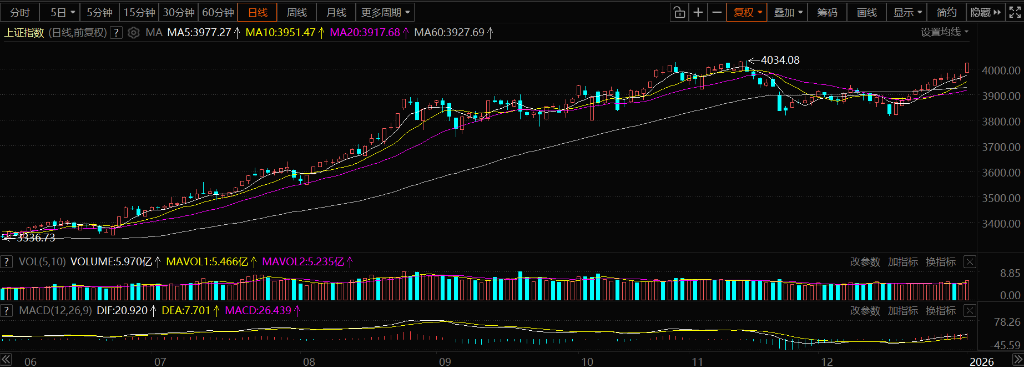
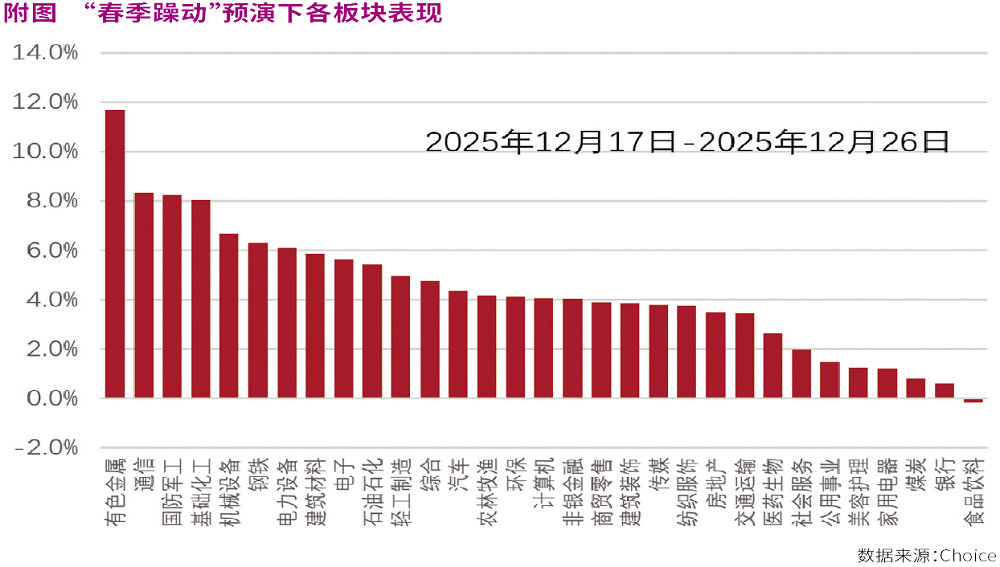
来源:@证券市场周刊微博 上证指数"九连阳"标志着"春季躁动"已经启动,"强者恒强"的有色和科技板块是最确定的主线。此外,随着价格水平的回升,周期板块的盈利 有望迎来改善,也是"春季躁动"值得布局的方向。 廖宗魁/文 如果说之前"春季躁动"还主要停留在市场的憧憬之中,那么随着上证指数自12月17日开始走出"九连阳",再度逼近4000点关口,期盼已久 的"春季躁动"大幕已经徐徐拉开。 美国股市通常有圣诞行情,中国股市则普遍存在"春季躁动"。这种日历效应看似偶然,其背后也蕴含着必然性。美国经济是消费驱动型,在圣 诞节前后往往是消费的旺季,消费的提升会增加投资者对美国企业盈利的预期,从而推动美股上涨。而在中国,"一年之计在于春",岁末年初 是一系列政策密集部署的时期,银行信贷的投放很大一部分也会集中在一季度,政策和信贷的预期很容易催生出"春季躁动"行情。 投资者该如何布局当下的"春季躁动"呢?"强者恒强"是"春季躁动"中最确定的主线,从"九连阳"的"春季躁动"预演行情看,有色和通信板块再 度领涨。2025年上市公司的盈利改善是略滞后于经济复苏的,随着"反内卷"的深入推进和促内需政策的持续发力,PPI从底部回升,20 ...
把握行业轮动,精选弹性个券
Xiangcai Securities· 2026-01-05 08:51
Report Industry Investment Rating No relevant information provided. Core Viewpoints - In December 2025, the equity market continued to recover and outperformed the CSI Convertible Bond Index significantly. The high - price convertible bonds were more elastic in the bull market, while the low - price convertible bonds were more resistant to decline during the market adjustment. The double - low strategy underperformed the high - price and low - premium strategy in the bull market [3][5]. - In 2026, the convertible bond valuation is expected to remain at a high level, and the pressure of individual bond call will increase. When selecting bonds, it is necessary to pay attention to industry rotation and individual bond selection, control risks and pursue elasticity [6][9]. Summary by Directory 1. Convertible Bond Monthly Market Tracking - **Overall Market Performance**: In December, the CSI Convertible Bond Index rose 2.13%, while the CSI All - Share Index rose 3.25%. Throughout 2025, the CSI Convertible Bond Index and the CSI All - Share Index rose 18.66% and 24.6% respectively. The CSI Convertible Bond Index underperformed the CSI 300 Index by 0.15 pct and the CSI 500 Index by 4 pct in December [3][15]. - **Performance by Price Classification**: In December, the Wind high - price convertible bond index rose 5.14%, while the medium - price and low - price convertible bond indexes rose 1.92% and 0.34% respectively. In 2025, the cumulative increases of the high - price, medium - price, and low - price convertible bond indexes were 28%, 16%, and 17% respectively [3][16]. - **Performance by Stock Size Classification**: In December, the Wind medium - cap and small - cap convertible bond indexes rose strongly by 2.52% and 3.23% respectively, while the large - cap convertible bond index fell 0.36%. In 2025, the small - cap convertible bond index rose 27%, leading the large - cap (+11%) and medium - cap (+19%) convertible bonds [19]. - **Performance by Credit Rating**: In December, high - rated convertible bonds continued to be weak. The AAA and AA+ convertible bond indexes rose - 0.01% and +1.87% respectively. In 2025, the AA - and below convertible bond index rose 28%, and the AA convertible bond index rose 25% [22]. - **Performance by Industry**: In December, only the energy (-2.05%) and financial (-0.39%) convertible bond indexes fell, while the corresponding underlying stock indexes rose 1.6% and 2.37% respectively. The largest increases in December were the materials (+3.66%) and optional consumption (+3.51%) convertible bond indexes. In 2025, the top three industries with the largest increases in the convertible bond indexes were materials (+26%), information technology (+25%), and industry (+24%), while the smallest were finance (+5%) and public utilities (+8%) [4][25]. - **Strategy Performance**: In 2025, the double - low strategy underperformed the high - price and low - premium strategy in the equity market bull market. The Wind double - low index rose 0.42% in December, while the high - price and low - premium index rose 5.78%. In 2025, they rose 30% and 12% respectively [5][32]. 2. Convertible Bond Monthly Investment Recommendations 2.1 Double - Low Strategy Recommendations: Grasp Industry Rotation and Focus on Individual Bond Selection - **December Double - Low Portfolio Performance**: In December, the self - constructed double - low portfolio had a return of - 4.72%, while the CSI Convertible Bond Index rose 2.13%. From June to the end of 2025, the cumulative return of the portfolio was 15.25%, underperforming the CSI Convertible Bond Index by 0.06 pct, with a maximum drawdown of - 12.78% [6][35]. - **January 2026 Double - Low Portfolio Recommendation**: Optimistic about the "anti - involution", consumption, robot, and brokerage sectors in January. The number of portfolio targets is reduced to 5, with 3 new targets (Huairui Convertible Bond, Guotou Convertible Bond, Jiayue Convertible Bond) and 2 original targets retained (China Southern Airlines Convertible Bond, Sanfang Convertible Bond). The average convertible bond price, conversion value, conversion premium rate, and double - low value of this portfolio are 122 yuan, 101 yuan, 23%, and 145 respectively [7][38]. 2.2 Industry Allocation Recommendations: Pay Attention to Call Risks, and Technology Remains the Main Line - In 2026, the equity market is still optimistic, which will keep convertible bond prices at a high level and increase the number of individual bonds facing call. It is recommended to choose high - growth technology sectors such as AI, semiconductors, and robots, and also pay attention to the "anti - involution" (chemical, photovoltaic) and consumption sectors with low valuations and expected demand recovery [9][42].
转向价值共创:新能源光伏等战略新兴产业亟需系统性政策引领
Zhong Guo Neng Yuan Wang· 2026-01-05 08:39
2025年,反"内卷"成为年度最强音。 据业内人士表示,"内卷"的土壤之一,是地方保护与市场分割。一些地方为追求本地GDP,通过违规的 税收、土地等优惠政策,盲目招商引资,导致产能重复布局和低效竞争。中央财经委员会会议已明确要 求纵深推进全国统一大市场建设,依法依规治理低价无序竞争。下一步,必须严格执行《全国统一大市 场建设指引》,集中力量攻坚整治各类显性与隐性的地方保护主义,确保要素在全国范围内自由流动, 让企业在同一套公平的规则下比拼。 "光伏产业'反内卷'治理初见成效,但不止要在硅料环节,还要硅片、电池、组件环节,甚至辅料环节 都能达成,才算行业治理达成目标。"光伏组件龙头天合光能董事长高纪凡如此说道。 针对多重挑战,在上述行业大会上,企业领袖已经形成共识:在监管上,要在于设立清晰、不可逾越的 竞争红线,恢复市场最基本的公平属性;在产业政策上,发挥强有力的导向作用,推动产业结构向高端 化、差异化演进;在技术上,要依靠自主创新和原创技术,提高产品技术标准和质量标准,加速现有产 能改造升级。 事实上,光伏产业反内卷必须超越对个别企业价格行为的简单纠偏,转而构建一个系统性、多层次的政 策框架,以法治化、市场化 ...

开年重返4000点!盘点名私募们的慢牛共识,如何挖掘“不拥挤的成长”和抓住仍然“低垂的果实”
聪明投资者· 2026-01-05 07:08
Core Viewpoint - The consensus among investment managers is not whether a bull market will occur, but how a slow bull market will unfold, with a reminder to lower return expectations due to fewer "low-hanging fruits" compared to previous years [2] Group 1: Market Performance and Trends - The Shanghai Composite Index and CSI 300 Index saw annual gains of 18.41% and 17.66% respectively in 2025, while the Hang Seng Index rose by 27.77%, and the ChiNext Index surged by 49.57%, indicating strong profitability growth and valuation increases in high-growth sectors [2] - Notable private equity firms achieved impressive annual returns exceeding 50%, with some even doubling their investments, highlighting the potential for high returns in the current market [3] - Many investment managers have maintained above-average performance, focusing on risk management and capital preservation strategies [4] Group 2: Investment Outlook for 2026 - The first key theme for 2026 is AI, with a shift in focus towards the economic feasibility of applications rather than just increased computing power [5][6] - The second theme involves the repricing of dividend assets in a low-interest-rate environment, with many managers believing that the lack of significant price increases has made these assets more attractive [6][7] - The third theme is the structural recovery of consumption, with managers looking for undervalued assets in traditional consumption sectors and recognizing the re-emergence of price advantages in new consumption [7][8] - The fourth theme is the "anti-involution" trend, which has begun to show signs of improving price order in certain industries, such as automotive and aviation [8][9] - The fifth theme focuses on high-quality globalization, with a consensus on the importance of companies that can establish localized ecosystems abroad [9] Group 3: Key Insights from Investment Managers - Investment managers emphasize the importance of understanding macroeconomic trends and the need for a cautious approach to AI investments due to potential bubbles [10][16] - The outlook for consumer wealth is optimistic, with expectations for a recovery in consumer spending driven by a stabilization of household wealth [21][22] - The "anti-involution" strategy is seen as having strategic significance, with varying short-term effects across different industries [23] - The transition from "global pricing and safe outbound" to "global investment and local service" reflects the evolving landscape of Chinese manufacturing and its competitive advantages [24] Group 4: Macroeconomic Context - The performance of non-financial real estate companies in A-shares shows limited revenue growth compared to 2023, indicating a trend of declining demand against expanding capacity [26] - The downward trend in prices is expected to continue, supported by fiscal data showing stable tax revenues [27] - Interest rates are projected to remain low, with implications for investment strategies favoring stable, well-governed companies [28][29] - The overall market is anticipated to enter a prolonged slow bull phase, with a focus on sectors that can adapt to changing economic conditions [39]
建材、建筑及基建公募REITs半月报(12月20日-1月2日):北京市优化地产政策,《求是》强调地产政策不能采取添油战术-20260105
EBSCN· 2026-01-05 07:05
1. Report Industry Investment Rating No specific industry investment rating is provided in the report. 2. Core Views of the Report - Beijing optimized and adjusted housing purchase restriction policies, and "Qiushi" emphasized that real - estate policies should not adopt a piecemeal approach. The continuous introduction of real - estate policies further supports demand, and the pace of subsequent policy introduction may accelerate. Although the new construction of the real - estate chain still faces multiple pressures, the industry bottom is approaching as the base gradually decreases. Sales data (new + second - hand houses) remains the leading indicator for driving the sector's valuation [3][7]. - Anti - involution is the main line for cyclical products. In the new field, attention should be paid to electronic cloth, clean rooms, and commercial aerospace. For the cement and glass industries, the effective reduction of supply is the key point to observe in the next stage. The glass fiber sector has relatively good profitability, and there is a possibility of a staged price increase. In the new field, the high - growth of the AI supply chain in 26H1 is the most certain direction, and the semiconductor/storage capital expenditure at home and abroad drives the performance and valuation of the clean - room sector. The theme investment in commercial aerospace is constantly catalyzed [4][8]. 3. Summary According to the Directory 3.1 Anti - involution is the Main Line for Cyclical Products, and Attention is Paid to Electronic Cloth, Clean Rooms, and Commercial Aerospace in the New Field - **Real - estate Policy**: On December 24, 2025, Beijing optimized real - estate policies, including relaxing the conditions for non - Beijing households to purchase houses, supporting the housing needs of multi - child families, optimizing personal housing credit policies, and adjusting the project approval method for real - estate development. On January 1, 2026, "Qiushi" proposed that policies should be sufficient at one time to avoid a game between the market and policies [3][7]. - **Cyclical Products**: For the cement and glass industries, with demand declining, the effective reduction of supply is crucial. Currently, the average profitability of the cement and float glass industries has fallen below the break - even line. The cold - repair reduction of glass production capacity in Q1 will determine the price recovery space of float glass from March to April. The glass fiber sector has relatively good profitability, with stable demand growth and potential for staged price increases [4][8]. - **New Fields**: The high - growth of the AI supply chain in 26H1 is the most certain direction. Special electronic cloth has high demand elasticity and limited short - term supply, so its price is elastic. The increasing semiconductor/storage capital expenditure at home and abroad drives the performance and valuation of the clean - room sector. The theme investment in commercial aerospace is constantly catalyzed [4][8]. 3.2 Profit Forecast and Valuation of Main Covered Companies The report provides the profit forecast, valuation, and investment ratings of 28 companies from 2024 to 2027, including Punaite, China Jushi, and Conch Cement. Most of the investment ratings are "Buy" or "Increase", and all ratings remain unchanged [10]. 3.3 Weekly Market Review - **Industry Index**: The construction index, building materials index, etc. had different changes. The construction index decreased by 1.4%, and the building materials index decreased by 0.6% [13]. - **Sub - sectors of Construction**: The building decoration II index increased by 9.33%, and the garden engineering index increased by 1.92%, while some sub - sectors had negative growth [15]. - **Infrastructure Public REITs**: The report provides the weekly, monthly, and annual - to - date price changes of 70 infrastructure public REITs. The average weekly decline was 0.47%, and the average annual - to - date increase was 9.29% [23][24][25]. 3.4 Aggregate Data Tracking - **Real - estate Data**: It includes the cumulative year - on - year changes in real - estate new construction, construction, completion, and sales areas, land transaction data, real - estate transaction data, social financing data, and infrastructure investment growth rates [28][37][47]. - **New Contracts of Eight Major Construction Central Enterprises**: The report shows the quarterly new contract amounts and year - on - year growth rates of eight major construction central enterprises from 2022Q1 to 2025Q3 [73]. - **Special Bond Issuance**: It shows the monthly and cumulative issuance amounts of new and replacement special bonds from 2022 to 2025 [75][77]. 3.5 High - frequency Data Tracking - **Building Materials Data**: It includes the price trends, cost - profit differences, inventory, and other data of cement, float glass, photovoltaic glass, glass fiber, carbon fiber, magnesium sand, alumina, and other building materials [83][90][98]. - **Upstream Raw Material Prices**: It shows the price trends of asphalt, waste paper, PVC, HDPE, etc. [137][138]. - **Physical Workload Data**: It includes the price trends of acrylic acid, titanium dioxide, and the rental rate of high - altitude machines, asphalt average start - up rate, etc. [144][147].


