AI投资

Search documents
国产半导体设备替代加速,科创半导体设备ETF(588710)连续五个交易日获资金净流入
Xin Lang Cai Jing· 2026-01-13 06:34
Group 1 - The semiconductor sector is experiencing increased volatility, but the domestic substitution process and long-term growth trends remain unchanged, attracting funds through ETFs for investment opportunities [1][6] - The domestic semiconductor equipment substitution rate has increased from 25% in 2025 to 35% in 2026, with core equipment like etching machines and thin film deposition equipment exceeding a 40% substitution rate [1][6] - Dongwu Securities reports that domestic semiconductor equipment is entering a historic development opportunity, with a strong expansion cycle expected in 2026 driven by domestic storage manufacturers and global AI investments [7] Group 2 - The Kexin Semiconductor Equipment ETF (588710) has seen a net inflow of funds for five consecutive trading days from January 6 to January 12, with a product scale increase of 45% during this period [7][8] - The Kexin Semiconductor Equipment ETF targets the upstream segment of the semiconductor industry chain and is expected to benefit from the domestic substitution wave, with a focus on the Sci-Tech Innovation Board [8] - The fund manager, Huatai-PB Fund, is one of the first ETF managers in China, and their leading ETF, Huatai-PB CSI 300 ETF, has a current scale of 4,384.80 billion [9]
粤开宏观:2026年美国经济展望:乐观预期背后的三个风险
Yuekai Securities· 2026-01-13 05:52
Group 1: Economic Outlook for 2026 - International institutions predict US GDP growth will exceed 2% in 2026, with estimates ranging from 2.1% by IMF to 2.6% by Goldman Sachs[11][12] - AI investment is expected to continue expanding, but growth rates may decline from 72% in 2025 to 29% in 2026, potentially weakening its impact on GDP[11][12] - The "Big and Beautiful" tax cuts are projected to increase the fiscal deficit by $553.8 billion in 2026, three times the deficit in 2025[16][18] Group 2: Risks to Economic Growth - The effective tariff rate has risen to 11.2%, the highest since 1943, potentially reducing long-term economic growth by 0.7 percentage points[27][28] - A weak job market may constrain income growth, with unemployment expected to hover around 4.5% and monthly job additions below 100,000[31][32] - Stock market returns are likely to decline in 2026 due to increased volatility and uncertainty surrounding monetary policy and midterm elections, which historically yield lower returns[35][36]
铜-站在10万的起点
2026-01-13 01:10
Summary of Key Points from the Conference Call Industry Overview - **Industry**: Copper Market - **Current Price Levels**: LME copper price exceeds $13,000 per ton, while domestic copper futures reach ¥105,000 per ton [1][3] Core Insights and Arguments - **Price Drivers**: The recent surge in copper prices is driven by macroeconomic recovery expectations, supply-demand tightness, and low overseas inventories leading to short-covering behavior [1][3] - **Supply Constraints**: The copper mining supply is limited due to a defensive capital expenditure cycle, low willingness to develop new mines, and high production disruption rates [1][7] - **Demand from AI Investments**: Significant increases in copper demand are anticipated due to data center construction, with IEA predicting that the share of copper used in data centers will rise to about 2% by 2026 [1][8] - **2026 Market Outlook**: The copper market is expected to perform strongly in 2026, with a projected supply-demand gap of approximately 630,000 tons, driven by a 3% growth in global demand [2][4][9] Additional Important Content - **Impact of Social Inventory**: The influence of social inventory on copper prices has diminished, as it now reflects price changes rather than being a leading factor [1][5] - **US Tariffs on Copper**: The US has imposed tariffs on electrolytic copper as part of a strategy to enhance domestic resource production capabilities, which is expected to tighten non-US inventories and increase price elasticity [4][11] - **Trade Flow Effects**: The US's absorption of electrolytic copper is leading to low inventories and tight spot markets in non-US regions, making price spikes more likely [12] - **Recommended Companies**: Companies such as Minmetals Resources, Zijin Mining, and Luoyang Molybdenum are highlighted for their potential strong performance in the equity market due to cost advantages and growth prospects [13][14] - **Focus on Smelting Enterprises**: Smelting companies are also worth monitoring due to their high recovery rates and potential profits from by-products, despite low processing fees [15]
国联民生:“亲历”一次科网泡沫,我们能学到什么?
Xin Lang Cai Jing· 2026-01-13 00:58
Overview - The article discusses the parallels between the current AI investment climate and the dot-com bubble of the late 1990s, emphasizing the importance of understanding the timing and scale of market bubbles to identify trading opportunities [3][6]. Market Dynamics - The Nasdaq index experienced significant volatility from 1995 to 2000, with annual declines exceeding 10% or even 20%, yet the market did not enter a bear market, demonstrating resilience [6]. - The tech sector saw a surge in IPOs starting in 1995, peaking in 1999, with the Nasdaq reaching a record high of 5048.62 on March 10, 2000, before a global sell-off triggered by Japan's economic downturn [3][6]. Economic Factors - Two key economic features during this period were rapid increases in labor productivity and a boom in tech investments, which led to a contraction in output gaps and a failure of the Phillips curve, as inflation did not rise despite declining unemployment [8]. - The Federal Reserve's monetary policy shifted from a focus on controlling inflation in the 1980s to a more flexible approach in the 1990s, allowing for a more accommodative stance that supported economic growth [11]. Policy Changes - The Federal Reserve under Alan Greenspan adopted a more lenient monetary policy framework, focusing on both inflation and employment while being cautious about raising interest rates despite rising productivity [11][12]. - Greenspan's evolving views on asset prices included warnings about "irrational exuberance" in 1996, but he maintained that monetary policy should not excessively intervene in asset markets [12]. Industry Developments - The period from 1995 to 1997 marked the beginning of the internet boom, with significant policy changes, such as the Telecommunications Act of 1996, which facilitated the establishment of a unified national internet market and spurred a wave of mergers and acquisitions [14][17]. - The telecommunications sector was a major driver of investment, with a significant portion of capital allocated to communication equipment, reflecting the industry's growth and the increasing importance of internet infrastructure [33]. Investment Trends - The late 1990s saw a surge in speculative investment activities, particularly in the tech sector, with companies relying heavily on external financing and aggressive revenue recognition practices [32][36]. - The "new economy" narrative was supported by a closed-loop mechanism where internet companies drove investment, service providers facilitated capital expenditures, and equipment manufacturers confirmed revenues, creating a cycle of growth [35][36]. Financial Risks - High levels of debt among telecommunications service providers led to a series of bankruptcies in the early 2000s, revealing the vulnerabilities within the sector and the potential for a cascading financial crisis [45]. - The aggressive financing practices, such as vendor financing, contributed to a cycle of increasing debt and financial instability, reminiscent of the dynamics seen in the subprime mortgage crisis [39][41].




资管一线 | 资本市场“水涨船高” 投资聚焦科技主线——首席经济学家共话2026资产配置
Xin Hua Cai Jing· 2026-01-12 08:21
Group 1 - The core viewpoint of the articles emphasizes that the capital market in 2026 will present both opportunities and challenges, with a focus on deepening reforms and asset allocation strategies [1][2] - The goal of capital market reform is to cultivate a "slow bull" market, enhancing market vitality by attracting patient capital and long-term funds [2][3] - Experts suggest that the stock market is gradually forming a "slow bull" pattern, with key support levels for the Shanghai Composite Index expected to rise from 3800-3900 points to 4000 points [2] Group 2 - Recommendations for institutional investors include strengthening internal mechanisms, expanding investment ranges, and improving delisting mechanisms to enhance market efficiency [3][4] - The commodity market is expected to show a clear rotation pattern, with significant opportunities for investment in various sectors, including precious metals and industrial metals [6][7] - The bond market is anticipated to perform better than expected in a loose monetary environment, serving as a potential switch option after stock and commodity price increases [7][8] Group 3 - Investment strategies for 2026 should focus on technology as a core theme, with an emphasis on balancing offensive and defensive positions while being cautious of potential risks [8][9] - Experts recommend diversifying investments into advanced manufacturing, reasonably valued cyclical leaders, and high-dividend assets to enhance overall portfolio resilience [9][10] - The importance of timing and market rhythm is highlighted, suggesting that investors should avoid a passive buy-and-hold strategy and instead actively manage their portfolios [9]
高盛闭门会-亚洲和中国经济2026展望-中国印度引领增长日本-闪辉谈中国新增长和结构性转型
Goldman Sachs· 2026-01-12 01:41
Investment Rating - The report maintains an optimistic outlook for global economic growth in 2026, projecting a growth rate of 2.8%, which is above the market consensus of 2.5% [2] Core Insights - The report highlights that the global economic growth in 2026 will benefit from a loose financial environment, reduced policy uncertainty, AI investments, and fiscal stimulus from tax and spending legislation passed in 2025 [1][2] - It emphasizes the resilience of the Indian economy, forecasting a GDP growth rate of 6.7% for 2026, which is higher than global consensus expectations [10] - The report notes that China needs to find new growth engines beyond real estate and expand into emerging markets outside the U.S., with actual export growth expected to remain at 5% to 6% annually [6][14] Summary by Sections Global Economic Outlook - The global economic growth is expected to exceed market consensus, driven by a favorable financial environment and AI investments [1][2] - Inflation pressures in emerging markets are anticipated to ease, aided by falling oil prices and reduced food price pressures [1] U.S. Economic and Policy Outlook - The Federal Reserve is expected to lower interest rates twice in the first half of 2026, supported by fiscal stimulus from the 2025 tax and spending legislation [3][2] Asian Economic Conditions - The report expresses optimism about the overall economic situation in Asia, with median and average growth rates around 5% [4] - It highlights strong performance in AI chip exports from China and India, which is expected to exceed market consensus [4] China’s Economic Transition - China is projected to maintain a 5% to 6% annual growth in actual exports, with a current account surplus expected to rise to 4.2% of GDP [6][14] - The "14th Five-Year Plan" focuses on integrating AI with manufacturing and modern industrial infrastructure, indicating a sustained investment in AI technologies [15] Japan’s Economic Outlook - Japan's growth rate is forecasted at 0.8% for 2026, supported by rising wages and easing inflation [7] - The Bank of Japan may accelerate interest rate hikes, with a potential increase of 25 basis points in July 2026 [7] India’s Economic Trends - India is expected to show strong resilience with a projected GDP growth rate of 6.7% for 2026, driven by rural and urban consumption recovery [10][12] - The Reserve Bank of India has implemented measures to support economic growth, including interest rate cuts and liquidity measures [9]


摩根士丹利基金雷志勇:基于中观景气度投资 AI估值或继续抬升
Zheng Quan Shi Bao· 2026-01-12 00:47
证券时报记者 吴琦 凭借聚焦以AI为核心的TMT(科技、媒体和通信)板块,摩根士丹利基金投资总监、基金经理雷志勇 拿下2024年公募基金业绩冠军。时隔一年,雷志勇在2025年再度斩获85.95%的高回报。 若说2024年的业绩登顶尚存一定运气成分,那么2025年业绩的再度爆发,或能验证雷志勇AI投资框架 的有效性。AI投资带来高回报已经延续两年,近期AI投资泡沫论甚嚣尘上,展望2026年,AI能否再度 爆发,哪些投资机会值得关注?针对以上问题,近期雷志勇接受了证券时报记者采访。他明确指出,从 AI产业的整体演进来看,当前仍处于从0到1的起步阶段,局部领域的过热在某种程度上也将助力产业 加速发展,未来龙头公司的估值仍有较大提升空间。 坚守景气度比较 锚定投资确定性 雷志勇投资框架的核心为"坚守景气度比较,追求确定性",聚焦契合人类社会远期发展趋势的产业方 向,在泛科技板块中锁定具备确定性的赛道,同时在个股层面做好估值评估与仓位配置。 具体来看,他基于中期维度(如未来2—3个季度)的行业景气度比较,重点跟踪行业订单展望与景气度 趋势,聚焦高景气赛道。同时,雷志勇结合自下而上的研究精选龙头个股。作为公募基金行业为数 ...
2026年资产价格走势怎么看?5位首席给出答案
Xin Lang Cai Jing· 2026-01-11 15:08
Group 1 - The core logic for 2026 is "a rising tide lifts all boats," indicating that various asset classes will have opportunities, but volatility may increase compared to 2025 [4] - The stock market's key focus is not on index peaks but on whether new and old growth drivers can resonate together, with technology remaining the main theme [5] - The bond market is expected to experience wide fluctuations in interest rates, reflecting structural changes in the macro economy [5] Group 2 - From a country allocation perspective, the gradual appreciation of the RMB presents a revaluation opportunity for Chinese assets, which have medium to long-term allocation value [6] - Long-term prospects for equity assets are positive, but valuation has significantly increased since September 2024, necessitating a reduction in return expectations [6] - The commodity market is anticipated to enter a "super cycle" due to de-globalization and supply chain reconstruction, although participation requires careful risk management [6] Group 3 - The commodity market is expected to see a healthy rotation, transitioning from gold to industrial metals like copper and aluminum, and then to new energy products [7] - 2026 is projected to be a significant year for commodities, with both trends in gold and copper continuing, as well as potential for low-priced commodities to surge [8] - In a declining risk-free interest rate environment, asset allocation should prioritize offensive directions, particularly in the stock market and commodities [8]

A股分析师前瞻:增量资金入市,春季做多的时间窗口连续不断
Xuan Gu Bao· 2026-01-11 13:37
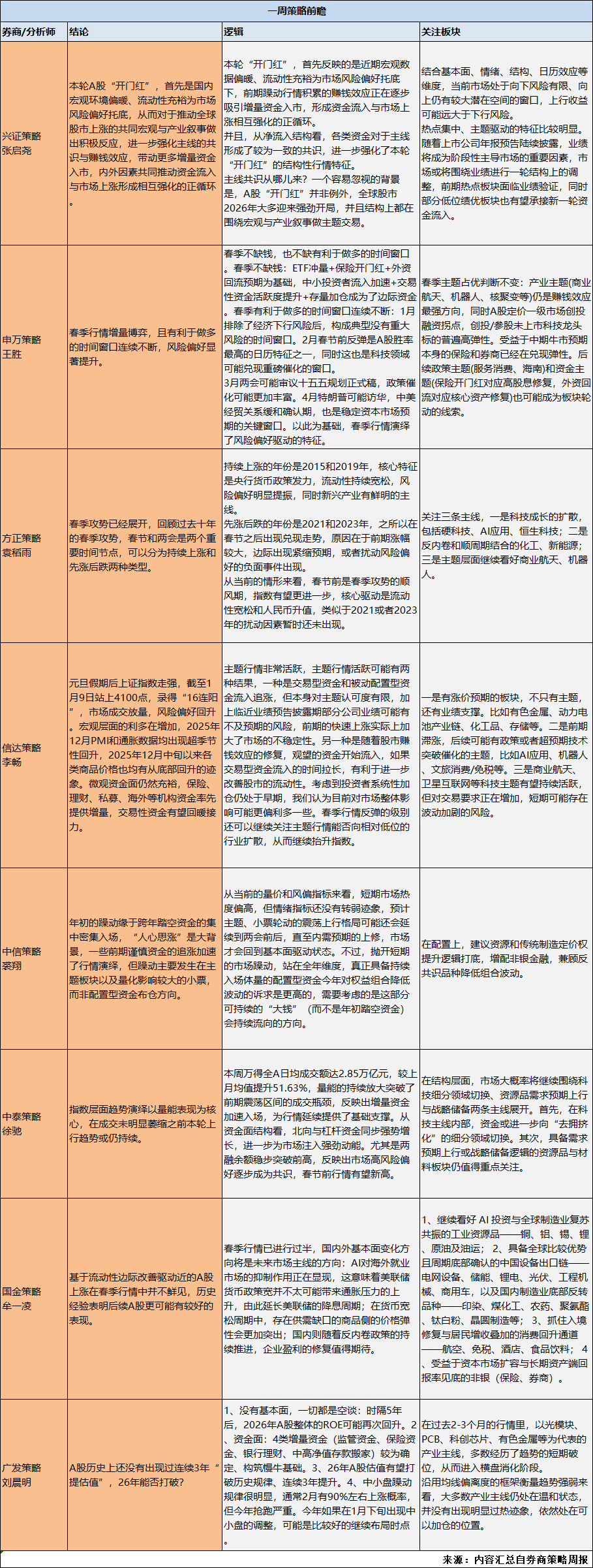
Group 1 - The core viewpoint is that the spring season presents a favorable environment for investment, characterized by ample liquidity and positive macroeconomic indicators, which are expected to drive market performance [1][2] - The analysis indicates that the current market is experiencing a "spring rally," supported by increased inflows from various types of investors, including ETFs, insurance funds, and foreign capital, which collectively enhance market risk appetite [1][2] - The upcoming political events, such as the Two Sessions and potential visits from foreign leaders, are anticipated to provide additional policy catalysts that could further stimulate market activity [1][2] Group 2 - The short-term market sentiment is currently high, with indicators suggesting that the upward trend may continue until the Two Sessions, driven by improved domestic demand expectations [2][3] - Historical data suggests that A-shares have not experienced three consecutive years of valuation increases, but 2026 may break this trend, with a potential recovery in overall ROE [2][4] - Various sectors, particularly those related to technology and materials, have shown signs of short-term consolidation after previous upward trends, indicating a potential for further investment opportunities [2][4] Group 3 - The analysis highlights that the current market dynamics are influenced by a combination of macroeconomic factors and investor sentiment, creating a positive feedback loop that encourages further capital inflow [1][2] - The spring season is marked by a series of favorable time windows for investment, with specific months identified as having historically high success rates for market performance [1][2] - The focus on thematic investments, particularly in sectors like commercial aerospace and robotics, is expected to remain strong, with potential for significant returns as these industries continue to develop [3][4]
百利好丨2026年全球经济展望
Sou Hu Cai Jing· 2026-01-09 08:24
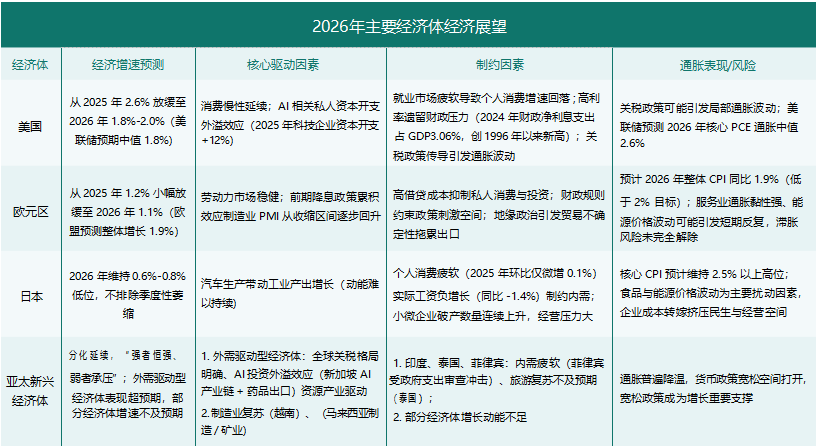
Global Economic Outlook - In 2026, the global economy is expected to continue developing under a moderate slowdown, with emerging markets gradually replacing developed economies as the key growth drivers [1] - The monetary policy will shift from accommodative to a wait-and-see approach, focusing on structural differentiation, policy window management, and tail risk control as the main strategies for 2026 [1] Economic Projections for Major Economies - The US economy is projected to slow down from 2.6% in 2025 to a range of 1.8%-2.0% in 2026, driven by chronic consumption issues and AI-related private capital expenditure [2] - The Eurozone is expected to grow at 1.1% in 2026, with manufacturing PMI gradually recovering but facing challenges from geopolitical tensions and weak personal consumption [2] - Japan's growth is anticipated to remain low, with potential quarterly fluctuations, as real wages decline and small businesses face increasing operational pressures [2] - Emerging economies in the Asia-Pacific region are showing mixed performance, with some exceeding expectations while others struggle with weak domestic demand and external pressures [2] Global Central Bank Monetary Policy Outlook - The Federal Reserve is likely to implement three rate cuts of 25 basis points each, bringing the benchmark rate down to 3.00%-3.25% [3] - The European Central Bank is expected to maintain a stable interest rate policy, with no clear plans for rate adjustments, while monitoring inflation close to the 2% target [3] - The Bank of Japan is likely to keep the benchmark rate at a low level of 0.5%, facing challenges in balancing inflation control and economic growth [3] - Emerging market central banks will continue a high-accommodation cycle, with varying policy rhythms based on local economic conditions [3] Investment Bank Perspectives - The IMF reports that global economic growth will continue to slow down moderately in 2026, with structural differentiation intensifying due to weakened growth momentum in developed economies [4] - OECD forecasts a decline in global economic growth from 3.2% in 2025 to 2.9% in 2026, with the US economy expected to slow to 1.7% [5] - The Eurozone is projected to grow only 1%, indicating a relatively weak performance compared to other regions [5] Core Risk Overview - Geopolitical and trade risks include uncertainties from global tariff restructuring and regional conflicts that could disrupt supply chains and commodity prices [6] - Financial vulnerabilities are high in the Eurozone, with rising debt levels in emerging markets potentially leading to localized financial risks during interest rate adjustments [6] - Commodity price volatility, particularly in energy and food sectors, may disrupt central bank policy rhythms due to external factors like geopolitical conflicts and extreme weather [6] Summary - Globalization is significantly impacted by tariff conflicts, leading to disruptions in global trade chains and a high probability of economic slowdown [7] - The Federal Reserve is expected to maintain a loose monetary policy, but the interplay between the Fed and the US government may heighten global financial risks [7] - Precious metals, particularly gold, are likely to benefit, with potential prices reaching between $5000-$5200, while the dollar index may decline below 90 [7] - Commodity markets show mixed signals, with energy prices struggling but potential rebounds in the second half of the year, while non-ferrous metals may rise due to increased global electricity demand and AI development [7]