资金面

Search documents
三十张图看清2025年债市表现
Shenwan Hongyuan Securities· 2026-01-10 15:36
1. Report Industry Investment Rating - Not provided in the content 2. Core Views - The long - end interest rate bonds in the bond market in 2025 were restricted by low odds, and the long - end interest rates tried to break through the previous lows multiple times but failed, showing a rounded bottom state. The leverage strategy's effectiveness increased, and there was still a large carry space for medium - and short - duration credit bonds. The performance of major asset classes in 2025 was metal commodities > equities > credit > interest rates [3][5][22]. 3. Summary by Relevant Catalogs 2025 Bond Market Trends - **Long - end rate constraints**: Long - end interest rate bonds were restricted by low odds throughout 2025 [3]. - **Multiple attempts to break through lows**: The 10Y Treasury yield attempted to break through the previous low 5 times in 2025 but failed. Different attempts were influenced by factors such as the economic data window period, central bank policies, institutional behavior, and overseas environments [5][6]. - **Leverage strategy effectiveness**: The effectiveness of the leverage strategy increased in 2025, and there was still a large carry space for medium - and short - duration credit bonds. The 10 - 1Y Treasury term spread first compressed and then widened, and the 30Y - 10Y Treasury spread widened after oscillation. The holding experience of long - duration Treasury bonds in Q4 2025 was average, while the volatility of the Wind All - A Index decreased and the returns were stable [9][10][13]. 2025 Performance of Major Asset Classes - The performance ranking of major asset classes in 2025 was metal commodities > equities > credit > interest rates. In Q4 2025, metal commodities outperformed equities, and credit outperformed interest rates [22][23]. 2025 Stock - Bond Performance - The stock - bond performance in 2025 implied relatively high economic growth expectations [24]. Bond Supply and Demand - The supply - demand structure of ultra - long - duration bonds changed, with the net buying volume of ultra - long - term Treasury bonds by funds and insurance companies declining [34]. Fundamentals - The "anti - involution" trend promoted the expectation of rising prices. The report also provided forecasts for PPI and CPI, and presented data on social financing scale and manufacturing PMI [39]. Institutional Behavior - **Fund performance differences**: In 2025, the returns of medium - and long - term interest - rate bond funds were significantly lower than those of credit bond funds [62]. - **Insurance asset allocation**: In Q3 2025, insurance institutions reduced their allocation of bonds and bank deposits and increased their allocation of equities. The static YTM requirements of insurance institutions for fixed - income assets could be used to infer the corresponding points of 30Y Treasury bonds [67][69]. - **Wealth management product characteristics**: In 2026, wealth management products may have incremental liabilities, but they prefer short - duration assets and have relatively limited leverage utilization. The demand for controlling net - value drawdown of wealth management products may increase [71].
流动性跟踪:税期未至,资金面依然平稳
HUAXI Securities· 2026-01-10 14:55
Group 1: Liquidity Overview - The liquidity environment has turned loose as expected at the beginning of the year, with the overnight rate (R001) stabilizing around 1.33% in the first week of January[1] - Despite a significant net withdrawal of 1.72 trillion yuan in the first week, liquidity pressures have led to a gradual increase in funding rates, reaching 1.35% by Friday[1] - The 7-day funding rate (R007) fluctuated, initially rising to 1.53% before returning to a downward trend, closing at 1.52%[1] Group 2: Market Outlook - The liquidity is expected to remain stable and loose until the tax period impact becomes evident after January 16, with overnight rates likely to hover around 1.35%[2] - The upcoming week will see a low maturity pressure in the open market, with only 138.7 billion yuan in reverse repos maturing, significantly lower than the average of over 1 trillion yuan in 2025[3] - The estimated net tax payment for the upcoming week is projected at -531 billion yuan, indicating a mild impact on liquidity[5] Group 3: Bill Market and Government Bonds - In the bill market, rates have risen, with 1-month bills increasing by 159 basis points to 1.60% and 3-month bills up by 100 basis points to 1.50%[4] - The government bond net payment for January 12-16 is estimated at -931 billion yuan, a significant decrease from the previous week's 4.327 trillion yuan[5] - The total issuance of government bonds is expected to be 2.372 billion yuan, with a notable reduction in the issuance volume compared to the previous week[5] Group 4: Interbank Certificates of Deposit - The maturity pressure for interbank certificates of deposit is set to rise, with 833.9 billion yuan maturing next week, up from 332.8 billion yuan the previous week[6] - The overall maturity for January 2026 is projected at 2.3 trillion yuan, significantly higher than the seasonal average of 1.1-1.4 trillion yuan from 2021-2025[6] - The weighted issuance term for interbank certificates of deposit has increased to 7.5 months, indicating a shift in funding strategies among banks[6]
宏观金融数据日报-20260109
Guo Mao Qi Huo· 2026-01-09 03:11
Report Overview - The report is a macro financial data daily report released by the Guomao Futures Research Institute's Macro Financial Research Center on January 9, 2026 [3][4] Market Interest Rate - DRO01 closed at 1.27 with a 0.21bp increase; DR007 closed at 1.47 with a 1.15bp increase [4] - GC001 closed at 1.12 with a 50.00bp decrease; GC007 closed at 1.48 with a 5.50bp decrease [4] - SHBOR 3M closed at 1.60 with a 0.20bp decrease; LPR 5 - year remained at 3.50 [4] - 1 - year treasury bond remained at 1.34; 5 - year treasury bond closed at 1.65 with a 0.70bp decrease; 10 - year treasury bond closed at 1.88 with a 0.60bp increase; 10 - year US treasury bond closed at 4.15 with a 0.30bp increase [4] Central Bank Operations - The central bank conducted 286 billion yuan of 7 - day reverse repurchase operations with an operating rate of 1.40% yesterday. With 5288 billion yuan of reverse repurchases maturing, the net withdrawal was 5002 billion yuan [4] - This week, there are 13236 billion yuan of reverse repurchases maturing in the central bank's open market, and 11000 billion yuan of outright reverse repurchases will mature on Thursday, and 600 billion yuan of treasury cash fixed - deposits will mature on Friday [5] Stock Index Futures - The CSI 300 closed at 4738 with a 0.82% decrease; the SSE 50 closed at 3122 with a 0.73% decrease; the CSI 500 closed at 7895 with a 0.25% increase; the CSI 1000 closed at 7972 with a 0.82% increase [6] - The trading volume of IF increased by 6.2% to 119688, and the open interest increased by 2.1% to 288744; the trading volume of IH decreased by 5.7% to 44844, and the open interest increased by 1.0% to 91182; the trading volume of IC decreased by 1.1% to 147847, and the open interest decreased by 2.7% to 294237; the trading volume of IM increased by 10.4% to 196014, and the open interest increased by 0.8% to 374177 [6] Market Analysis - Yesterday, the market sentiment cooled slightly, the commodity market weakened significantly, and the stock index fluctuated with a contraction in trading volume [7] - In the short term, the stock index is expected to remain in a bullish pattern. In 2026, with continuous macro - policy support, moderate inflation recovery, capital market reform, and the role of Central Huijin, the stock index may continue to rise on the basis of 2025. It is recommended that investors take long positions [7] Premium and Discount Situation - The premium and discount rates of IF for the current - month, next - month, current - quarter, and next - quarter contracts are - 0.14%, 2.05%, 2.09%, and 3.07% respectively [8] - The premium and discount rates of IH for the current - month, next - month, current - quarter, and next - quarter contracts are 0.68%, 0.34%, - 0.06%, and 0.64% respectively [8] - The premium and discount rates of IC for the current - month, next - month, current - quarter, and next - quarter contracts are 2.97%, 4.88%, 5.22%, and 7.24% respectively [8] - The premium and discount rates of IM for the current - month, next - month, current - quarter, and next - quarter contracts are 10.07%, 9.71%, 9.74%, and 10.58% respectively [8]
光大期货金融期货日报-20260108
Guang Da Qi Huo· 2026-01-08 02:42
Report Industry Investment Rating - No investment rating for the industry is provided in the report. Core Viewpoints - **Stock Index Futures**: The A-share market fluctuated after a rise and fall yesterday. The style was divided, with sectors such as electronics and power equipment rising, and sectors such as petroleum and petrochemicals and non-bank finance correcting. The capital sentiment remained high. The A500ETF received significant subscriptions, and the net short positions of the Top5 member units in IF increased significantly recently. It is expected that the stock index will continue to fluctuate within the shock center formed since October. The spring rally may not be as strong as in previous years [1]. - **Treasury Bond Futures**: On Wednesday, treasury bond futures closed down. The central bank conducted reverse repurchase operations, resulting in a net withdrawal of funds. The reasonable and sufficient liquidity in the capital market is the biggest support for the bond market, but economic stability, rising inflation, and cautious interest rate cuts pose certain constraints. It is expected that the bond market will remain in a range-bound pattern in the short term [1][2]. Summary by Directory 1. Research Views - **Stock Index Futures**: The A-share market fluctuated after a rise and fall yesterday. The Wind All A index rose 0.19% with a trading volume of 2.88 trillion yuan. The CSI 1000 index rose 0.53%, the CSI 500 index rose 0.78%, the SSE 50 index fell 0.43%, and the SSE 300 index fell 0.29%. The A500ETF received significant subscriptions, and the net short positions of the Top5 member units in IF increased significantly recently. The stock index is expected to continue to fluctuate within the shock center formed since October. The spring rally may not be as strong as in previous years [1]. - **Treasury Bond Futures**: On Wednesday, treasury bond futures closed down. The 30-year main contract fell 0.44%, the 10-year main contract fell 0.08%, the 5-year main contract fell 0.06%, and the 2-year main contract fell 0.03%. The central bank conducted 286 billion yuan of 7-day reverse repurchase operations, resulting in a net withdrawal of funds. The reasonable and sufficient liquidity in the capital market is the biggest support for the bond market, but economic stability, rising inflation, and cautious interest rate cuts pose certain constraints. It is expected that the bond market will remain in a range-bound pattern in the short term [1][2]. 2. Daily Price Changes - **Stock Index Futures**: From December 31, 2025, to January 5, 2026, IH rose 2.44%, IF rose 2.11%, IC rose 3.17%, and IM rose 2.73%. The SSE 50 index rose 2.26%, the SSE 300 index rose 1.90%, the CSI 500 index rose 2.49%, and the CSI 1000 index rose 2.09% [3]. - **Treasury Bond Futures**: From December 31, 2025, to January 5, 2026, TS fell 0.04%, TF fell 0.055%, T remained unchanged, and TL remained unchanged [3]. 3. Market News - On January 7, the Chinese Foreign Ministry spokesperson Mao Ning stated that the US government's demand to obtain 50 million barrels of oil from Venezuela violates international law and infringes on Venezuela's sovereignty. China's legitimate rights and interests in Venezuela must be protected [4]. 4. Chart Analysis - **Stock Index Futures**: The report provides charts showing the trends of IH, IF, IM, and IC main contracts, as well as the basis trends of IH, IF, IC, and IM [5][6][7]. - **Treasury Bond Futures**: The report provides charts showing the trends of treasury bond futures main contracts, treasury bond yields, basis, inter - period spreads, cross - variety spreads, and capital interest rates [12][13][14]. - **Exchange Rates**: The report provides charts showing the central parity rates of the US dollar and euro against the RMB, forward exchange rates, the US dollar index, and exchange rates between major currencies [21][22][23].
日度策略参考-20260108
Guo Mao Qi Huo· 2026-01-08 02:26
Report Industry Investment Rating No specific industry investment ratings were provided in the report. Core Viewpoints of the Report - A-share market is expected to continue its upward trend in the short term and may rise further in 2026 compared to 2025, supported by macro policies, inflation, capital market reforms, and the role of Central Huijin [1]. - The bond market is favored by asset shortages and weak economic conditions, but the central bank has recently warned of interest rate risks [1]. - Metal prices are influenced by factors such as supply disruptions, macro sentiment, and cost changes. Some metals are expected to have upward trends, while others may experience volatility or are subject to supply concerns [1]. - Energy and chemical product prices are affected by factors such as geopolitical conflicts, supply and demand, and cost support. Some products are expected to have upward trends, while others may experience volatility [1]. - Agricultural product prices are influenced by factors such as seasonal changes, policy support, and supply and demand. Some products are expected to have upward trends, while others may experience volatility [1]. Summary by Category A-shares - A-share market has continuous trading volume increase. Short-term, the index is expected to remain strong. In 2026, the index may continue to rise on the basis of 2025, supported by macro policies, inflation, capital market reforms, and Central Huijin [1]. Bonds - Asset shortages and weak economic conditions are favorable for bond futures, but the central bank has recently warned of interest rate risks. Attention should be paid to the Bank of Japan's interest rate decision [1]. Metals - Copper: Supply disruptions and improved macro sentiment have led to a rise in copper prices, and the upward trend is expected to continue [1]. - Aluminum: Domestic electrolytic aluminum has accumulated inventory, but macro sentiment is positive, and global aluminum ingot supply is expected to tighten, leading to a strong aluminum price [1]. - Alumina: Supply has significant release potential, putting pressure on prices. However, the current price is close to the cost line, and the price is expected to oscillate [1]. - Zinc: Fundamentals have improved, and the cost center has shifted upward. With positive macro sentiment, zinc prices have risen, but the upside space is limited due to fundamental pressure [1]. - Nickel: Supply concerns have led to a significant increase in nickel prices and an increase in positions. The short-term price may be strongly oscillating, but high risks and volatility are present at high price levels. Attention should be paid to Indonesian policies and macro sentiment [1]. Industrial and Energy Chemicals - Polycrystalline silicon: Northwest production has increased, while southwest production has decreased. December production schedules for polycrystalline silicon and organic silicon have declined [1]. - Carbonate lithium: It is the traditional peak season for new energy vehicles, with strong energy storage demand and increased supply from restarts. Prices have risen rapidly in the short term [1]. - Rebar and hot-rolled coil: Futures-spot arbitrage positions can be rolled for profit-taking. The price valuation is not high, and short-selling is not recommended [1]. - Iron ore: Near-term contracts are restricted by production cuts, but the commodity sentiment is positive, and there is still an upward opportunity for far-term contracts [1]. - Silicone and ferrosilicon: There is a combination of weak reality and strong expectations. In the short term, expectations dominate, and energy consumption control and anti-involution may disrupt supply [1]. - Soda ash: The market sentiment has improved, and the supply and demand are supportive. The price is low and expected to be strong in the short term [1]. - Coking coal and coke: If the "capacity reduction" expectation continues to ferment and there is pre-holiday restocking of spot goods, there may still be room for price increases, but the actual increase is difficult to judge, and volatility increases after a significant rise [1]. Agricultural Products - Palm oil: The December MPOB data is expected to be bearish, but the price is expected to reverse under themes such as seasonal production cuts, the B50 policy, and US biofuels. Short-term rebounds due to macro sentiment should be watched out for [1]. - Soybean oil: The fundamentals are strong, and it is recommended to be overweight in the oil market. Consider the spread between soybean oil and palm oil [1]. - Cotton: There is support but no driving force in the short term. Future attention should be paid to the central government's No. 1 document in the first quarter of next year, planting area intentions, weather during the planting period, and peak season demand [1]. - Sugar: There is a global surplus and increased domestic supply. The short side consensus is strong. If the price continues to fall, there is strong cost support, but there is a lack of continuous driving force in the short term [1]. - Corn: With the release of reserve and imported grains, the supply has increased. The spot price is expected to be firm in the short term, and the futures price will oscillate within a range [1]. - Pulp: The 05 contract is expected to oscillate between 5400 - 5700 yuan/ton due to the tug-of-war between "strong supply" and "weak demand" [1]. - Logs: The spot price has shown signs of bottoming out and rebounding, and the downward space for the futures price is limited. However, the January overseas quotation has slightly declined, and there is a lack of upward driving factors. The price is expected to oscillate between 760 - 790 yuan/m³ [1]. Energy and Chemicals - Crude oil: OPEC+ has suspended production increases until the end of 2026. The uncertainty of the Russia-Ukraine peace agreement and US sanctions on Venezuelan oil exports have an impact [1]. - Fuel oil: Follows the trend of crude oil in the short term, with no prominent supply-demand contradictions [1]. - Asphalt: The "14th Five-Year Plan" rush demand is likely to be disproven, and the supply of Ma Rui crude oil is sufficient. The profit margin is high [1]. - Natural rubber: The raw material cost provides strong support, the futures-spot price difference has rebounded significantly, and the midstream inventory has increased substantially [1]. - BR rubber: The upward momentum has slowed down, the spot price has led the recovery of the basis, and the processing profit has narrowed. There are positive factors for future domestic butadiene exports [1]. - PTA: The PX market has experienced a sharp rise, and the PTA market is expected to remain tight in 2026. Domestic PTA maintains high production, and the gasoline spread provides support for aromatics [1]. - Ethylene glycol: Two MEG plants in Taiwan, China, plan to shut down next month. The price has rebounded rapidly due to supply-side news, and the downstream demand is slightly better than expected [1]. - Styrene: The Asian market is stable, with suppliers reluctant to cut prices due to losses and buyers pressing for lower prices due to weak downstream demand. The market is in a weak balance, and the upward momentum depends on overseas markets [1]. - Urea: The export sentiment has eased, and the upside space is limited due to insufficient domestic demand. There is support from anti-involution and the cost side [1]. - PE: There is a risk of rising crude oil prices due to geopolitical conflicts. The supply pressure is high, and the market expectation is weak due to planned production increases in 2026 [1]. - PP: The supply pressure is high, and the downstream improvement is less than expected. The cost is supported by high propylene monomer and crude oil prices [1]. - PVC: The global production is expected to be low in 2026, but the current supply pressure is rising. The demand is weak, and the implementation of differential electricity prices in the northwest may force the clearance of PVC production capacity [1]. - LPG: The January CP has risen unexpectedly, and the import cost provides strong support. Geopolitical conflicts have increased the risk premium. The inventory accumulation trend has slowed down, and the domestic port inventory is decreasing. The long-term demand for LPG is expected to increase [1]. Aviation - It is expected to peak in mid-January. Airlines are still cautious about trial resumptions [1].
每日债市速递 | 央行将开展1.1万亿买断式逆回购
Wind万得· 2026-01-07 23:08
Monetary Policy Operations - The central bank announced a 28.6 billion yuan 7-day reverse repo operation on January 7, with a fixed rate of 1.40%, matching the tender amount of 28.6 billion yuan. On the same day, 528.8 billion yuan in reverse repos matured, resulting in a net withdrawal of 500.2 billion yuan [1] Market Liquidity - The interbank market continues to maintain a loose liquidity environment, with the weighted average rate of DR001 slightly rising to around 1.26%. Overnight quotes on the anonymous click (X-repo) system are around 1.25%, indicating ample supply. Non-bank institutions' pledged certificates of deposit and overnight credit bonds are quoted around 1.40%. Traders noted that the central bank's net withdrawal increased after the New Year, but the impact on liquidity was limited, with recent central bank meetings reiterating the possibility of reserve requirement ratio (RRR) cuts and interest rate reductions to soothe market sentiment [3] Interbank Certificates of Deposit - The latest transaction for one-year interbank certificates of deposit among major banks is around 1.63%, showing a slight increase from the previous day [7] Bond Market Overview - The yields on major interbank government bonds have generally risen, with specific rates as follows: - 1-year government bond at 1.3050% (down 0.10) - 2-year at 1.4475% (up 3.75) - 3-year at 1.4700% (up 3.50) - 10-year at 1.7730% (up 1.05) - 30-year at 2.3325% (up 2.25) [9] Government Bond Futures - The main contracts for government bond futures saw declines: - 30-year contract down 0.44% - 10-year down 0.08% - 5-year down 0.06% - 2-year down 0.03% [11] Foreign Exchange Reserves - As of December 2025, China's foreign exchange reserves stood at 33,579 billion USD, an increase of 11.5 billion USD from the end of November, reflecting a rise of 0.34%. This increase is attributed to the influence of major economies' monetary policies and macroeconomic data, alongside fluctuations in exchange rates and asset prices [13] Global Manufacturing PMI - In December 2025, the global manufacturing PMI was reported at 49.5%, a slight decrease of 0.1 percentage points from the previous month, maintaining a range of 49%-50% for ten consecutive months. The average PMI for 2025 was 49.6%, up 0.3 percentage points from 2024 [15]


货币市场日报:1月7日
Xin Hua Cai Jing· 2026-01-07 18:33
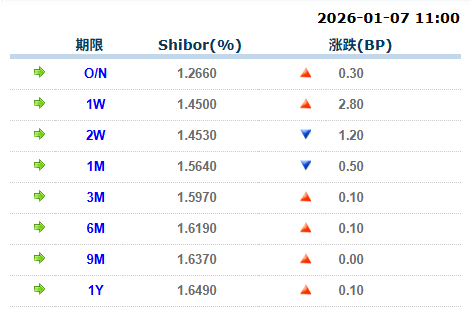
Group 1 - The People's Bank of China conducted a 286 billion yuan 7-day reverse repurchase operation at an interest rate of 1.40%, maintaining the previous rate, resulting in a net withdrawal of 500.2 billion yuan due to 528.8 billion yuan of reverse repos maturing on the same day [1] - The Shanghai Interbank Offered Rate (Shibor) showed slight fluctuations, with the overnight Shibor rising by 0.30 basis points to 1.2660%, and the 7-day Shibor increasing by 2.80 basis points to 1.4500% [2][3] - In the interbank pledged repo market, short-term funding rates remained stable, with the weighted average rates for overnight and 7-day repos increasing by 0.5 basis points and 3.0 basis points, respectively, while transaction volumes for these repos saw significant increases [5] Group 2 - The overall funding environment on January 7 was balanced and slightly loose, with overnight rates for repos trading in the range of 1.20% to 1.40%, indicating a stable funding situation throughout the day [10] - In the secondary market for negotiable certificates of deposit, trading sentiment was generally moderate, with yields for 1-month, 3-month, and 6-month deposits showing an upward trend, reflecting a slight increase in market rates [11] - The People's Bank of China announced plans for a 1.1 trillion yuan buyout reverse repo operation on January 8, with a term of 90 days, indicating ongoing liquidity management efforts [13]
央行预告开展11000亿元买断式逆回购
Feng Huang Wang· 2026-01-07 12:31
Group 1 - The central bank announced a 1.1 trillion yuan reverse repurchase operation on January 8 to maintain ample liquidity in the banking system, marking the third consecutive month of equal-scale operations [1] - The upcoming maturity of 1.1 trillion yuan in 3-month reverse repos on January 8 indicates a continuation of the policy tool without increasing the scale, reflecting the central bank's strategy to manage liquidity [1] - Market analysts expect the central bank to conduct another 6-month reverse repurchase operation in January, with a likelihood of increasing the scale due to the upcoming maturity of 600 billion yuan [1][4] Group 2 - Factors affecting the funding environment in January include credit demand, tax payments, government bond repayments, and cash withdrawals for the Spring Festival, which may tighten liquidity [2][3] - The anticipated issuance of local government bonds in January, following the early allocation of the 2026 debt limit, is expected to contribute to a tighter funding situation [4] - The first month of the year typically sees higher tax payments, which will further impact the liquidity landscape, as companies confirm and declare their previous year's income tax [4] Group 3 - Analysts predict that the central bank may increase its purchases of government bonds in January, with a possibility of a reserve requirement ratio (RRR) cut before the Spring Festival [6] - The overall expectation for the first quarter of 2026 includes potential interest rate cuts and reserve requirement reductions, with liquidity easing being a significant factor [5][6] - The central bank's approach in January is expected to be less aggressive in tightening liquidity compared to previous years, indicating a potential increase in government bond transactions and a higher likelihood of RRR cuts [6]
利率|继续跌吗?一个神奇的历史规律
CAITONG SECURITIES· 2026-01-07 06:41
Report Industry Investment Rating No relevant content provided. Core Viewpoints - The bond market has been continuously adjusting at the beginning of the year, with the 10-year and 30-year Treasury bond yields breaking through key levels. Historically, bond market yields usually choose a direction around mid-January. The probability of a unilateral upward movement in yields at the turn of the year is extremely low. Over the past 10 years, yields have shown a V-shaped pattern in 5 years, an inverted V-shaped pattern in 2 years, a unilateral downward movement in 2 years, and a unilateral upward movement in 1 year [2]. - The direction of yields after mid-January depends on the verification of expectations after the end of the information vacuum period. If the verification falls short of expectations, yields usually return to pre-expectation levels. Currently, market concerns focus on factors such as ultra-long bond supply, the spring rally in equities, and less-than-expected monetary easing. However, since the third quarter of last year, the bond market has already priced in these negative factors, and the likelihood of these factors further exceeding expectations seems low [2]. - The effective upper limits for the 10-year and 30-year Treasury bond yields are 1.85% and 2.3% respectively. Short-term deviations do not represent a sustained breakthrough. The bond market requires patience, and investors should wait for opportunities around mid-January [2]. Summary by Directory How to Evaluate the Indicators at the Beginning of the Year? How to View the Market Expectations and Actual Trends Since the Beginning of 2022? - In early 2022, the expectation gap was between the verification of loose monetary policy and strong credit growth. Interest rates first declined due to expectations of monetary easing after a mid-January interest rate cut, but then rebounded as the strong start of the year became more apparent [10]. - In early 2023, the expectation gap was the actual strength of the post-pandemic economic recovery. Despite a tightening of the money supply, bond yields declined as the economic recovery fell short of expectations and the government set a relatively modest economic growth target [11]. - In early 2024, the expectation gap was the disappointment in incremental policies and the strong start of the year. After initial expectations for further growth-stabilizing policies faded, bond yields entered a second phase of decline as property and fiscal policies underperformed and government bond issuance was slow [12]. - In early 2025, the expectation gap was a significant reversal in expectations of monetary easing. Rooted in factors such as the strong start of the year, Sino-US relations, and technological narratives, risk appetite increased, leading to a tightening of funds by the central bank [13]. How Much Impact Do the Quality of the Strong Start and Supply Have? - The final verification of the strong start will come in March or April. In the short term, the market focuses on financial data and the PMI. Over the past 4 years, the net financing increment of government bonds from January to February has been most correlated with yield changes. If the year-on-year increase exceeds 50 billion yuan, the bond market may face pressure. Credit, PMI, and yield changes have a weak correlation, and the relationship between social financing and yields depends on market expectations [18]. Does the Stock-Bond跷跷板 Relationship Hold at the Beginning of the Year? - Since 2022, the short-term performance of stocks and bonds has shown some correlation, but the relationship may weaken after mid-January [19]. How to View Sino-US Disturbances? - Sino-US relations are a key factor. The impact on the bond market depends on the comparison between actual situations and market expectations [23][24]. How Much Impact Does the Money Supply Have? - The money supply is affected by various factors such as the economic situation, Sino-US relations, and the stock market. At the beginning of the year, the money supply is crucial. Before the Spring Festival, interest rates tend to rise seasonally, and whether this leads to a tight money supply depends on the central bank's attitude. A tight money supply can impede yield declines [26]. Is There a Final Decline? What Experience Can We Learn from History? - Regarding social financing and government bond supply, it is expected that the social financing growth rate from January to February will remain flat or increase slightly by 0.1 percentage points, and the net financing of government bonds will increase by more than 70 billion yuan compared to the same period last year. However, the central bank's bond purchases may offset the impact of supply [28]. - Regarding the stock-bond relationship, the stock market's spring rally may disrupt the bond market, but the stock market's ability to continuously rise and the potential decoupling of stock and bond trends after mid-January suggest that the stock market may not pose a long-term negative impact on the bond market [29][30]. - Regarding Sino-US relations, the market has been optimistic about Sino-US relations since the third quarter of last year. The likelihood of further unexpected improvement in Sino-US relations is lower than the possibility of negative changes, which is relatively favorable for the bond market [31][32]. - Regarding the money supply, the money supply has been improving since December. With the early issuance of government bonds and the central bank's view that interest rates have returned to a reasonable level, the central bank is likely to maintain a supportive stance, at least avoiding a repeat of last year's first-quarter situation [34]. A Magical Market Rule - Observing bond yields from November of the previous year to March of the following year, a pattern has emerged. Since 2016, a phased reversal has been the most common, with a V-shaped pattern in 5 years, an inverted V-shaped pattern in 2 years, a unilateral downward movement in 2 years, and a unilateral upward movement in 1 year. The probability of a unilateral upward movement is extremely low [35]. How Has the Market Performed in the First Quarter in Recent Years? - In the first quarter of 2022, yields first declined and then rose. Interest rate cuts and the COVID-19 situation initially pushed yields down, but expectations of strong credit growth and local property policies led to an increase in yields [46]. - In the first quarter of 2023, yields first rose and then fell. A tightening of funds and expectations of post-pandemic economic recovery pushed yields up at the beginning of the year, but unmet expectations, a lower economic growth target, the Silicon Valley Bank collapse, and a reserve requirement ratio cut led to a decline in yields [47][49]. - In the first quarter of 2024, yields declined steadily. Weak fundamentals, a poor stock market performance, a reserve requirement ratio cut, disappointing incremental policies, and a reduction in deposit rates contributed to the decline. Regulatory concerns about interest rate risk in March provided some resistance to the downward trend [52]. - In the first quarter of 2025, yields rose steadily. The central bank's suspension of bond purchases, a rise in the stock market driven by Deepseek, a structural stabilization of the economy, and better-than-expected US tariff policies led to an increase in yields [54].
每日债市速递 | 央行公开市场单日净回笼2963亿
Wind万得· 2026-01-06 22:38
1. 公开市场操作 央行公告称, 1 月 6 日以固定利率、数量招标方式开展了 162 亿元 7 天期逆回购操作,操作利率 1.40% ,投标量 162 亿元,中标量 162 亿元。 Wind 数据 显示,当日 3125 亿元逆回购到期,据此计算,单日净回笼 2963 亿元。 2. 资金面 银行间市场资金面维持宽松格局, DR001 加权平均利率微升并徘徊于 1.26% 附近。匿名点击( X-repo )系统上,隔夜报价在 1.25% 供给充足;非银机构 质押存单及信用债隔夜报价在 1.40%-1.45% 附近。交易员表示,年初逆回购集中到期,但市场流动性受影响尚有限,本周关注央行本月首次买断式逆回购 操作情况。 海外方面,最新美国隔夜融资担保利率为 3.75% 。 ( * 数据来源: Wind- 央行动态 PBOC ) // 债市综述 // ( IMM ) ( * 数据来源: Wind- 国际货币资金情绪指数、资金综合屏) 3. 同业存单 全国和主要股份制银行一年期同业存单最新成交在 1.63% 附近,较上日上行超 1bp 。 ( * 数据来源: Wind- 同业存单 - 发行结果) 4. 银行间主要利率债 ...