
去美元化

Search documents
专访广开首席连平:“去美元化”浪潮下 金价或长期高位震荡
21世纪经济报道· 2026-01-23 03:20
Core Viewpoint - The article discusses the economic outlook for China in 2026, emphasizing the need for effective qualitative and quantitative growth, and identifies potential investment opportunities and market trends for investors. Monetary Policy - The current domestic interest rates are at historical lows, with room for further reduction. A small rate cut of 0.25-0.5 percentage points is likely in early 2026 to alleviate cost pressures and support long-term liquidity [4][5] - The People's Bank of China may lower policy rates by 0.1-0.3 percentage points to reduce social financing costs and stimulate consumption and investment [5] - Credit growth is expected to moderately recover, with government investment projects and policy financial tools supporting long-term loans in sectors like new energy and infrastructure [5] Market Trends - A-shares and Hong Kong stocks are anticipated to continue a trend of oscillating upward, driven by corporate profit improvements, macro policy easing, and long-term capital inflows [6][7] - The government is expected to implement measures to boost market confidence, including promoting the use of policy tools, guiding institutional investments, and enhancing the registration system for new listings [7] Bond Market - The bond market is projected to maintain a low-interest, high-volatility environment, with 10-year government bond yields expected to range between 1.6% and 1.9% [8] - Credit bond issuance is anticipated to grow steadily, particularly in short-duration high-grade credit bonds, with yields expected between 2.0% and 2.5% [8] Investment Opportunities - Future technology innovation policies will focus on breakthroughs in key areas such as integrated circuits and artificial intelligence, with significant investment opportunities in sectors like semiconductors, new energy, and quantum technology [9] - The article highlights the potential for investment in strategic emerging industries, particularly in the context of the "14th Five-Year Plan" [9] Global Market Trends - The global economic landscape is transitioning from high volatility to a new equilibrium, with significant geopolitical tensions and economic challenges in developed economies [9][10] - The article notes that the U.S. stock market may enter a phase of high valuation and weak growth, with potential risks in the AI sector and the Federal Reserve's monetary policy [10] Currency and Commodities - The Chinese yuan is expected to appreciate in a two-way fluctuation, supported by domestic economic conditions and a weakening dollar [10] - Gold prices are projected to experience high volatility with an overall upward trend, while silver is expected to be more volatile due to its industrial applications [11][12] - Oil prices are likely to decline initially before recovering, with an average price forecasted between $60 and $70 per barrel in 2026 [11]


无视风险偏好回暖COMEX金买盘强劲
Jin Tou Wang· 2026-01-23 03:04
Group 1 - Gold prices are rising, approaching this week's historical high, driven by strong technical bullish sentiment and active buying based on technical factors, with February gold up $47.3 to $4,884.8 [1] - Despite an increase in risk appetite among traders and investors, both gold and silver recorded gains, indicating their resilience in uncertain market conditions [2] - The geopolitical landscape remains a key factor, with President Trump's unpredictability causing caution in the EU, potentially leading to increased volatility in the market [2] Group 2 - The next upward target for February gold futures is to close above the key resistance level of $5,000.00, while the next short-term downward target for bears is to push prices below the key support level of $4,539.10 [3] - Initial resistance is at the historical high of $4,891.10, followed by $4,900.00, while initial support is at $4,800.00 and the overnight low at $4,772.70 [3]
2026年买铜还是买金?多只有色金属主题基金业绩翻倍,回报最高超139%
Hua Xia Shi Bao· 2026-01-23 02:57
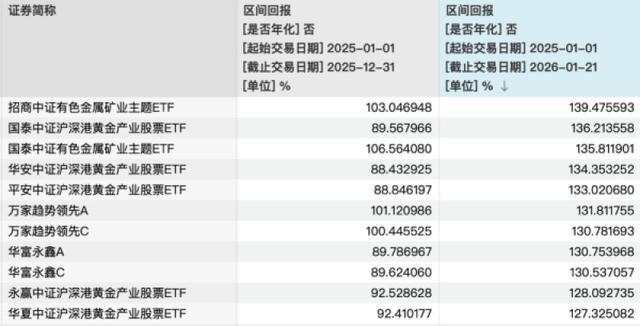
Core Viewpoint - The performance of metal and mining-themed funds has significantly improved over the past year, with several funds achieving returns exceeding 100% due to a market recovery and rising commodity prices, particularly in the metals sector [2][3]. Fund Performance Summary - The top-performing fund, the招商中证有色金属矿业主题ETF, recorded a return of 139.48% from January 1, 2025, to January 21, 2026 [2][3]. - Other notable funds include: - 国泰中证沪深港黄金产业股票ETF with a return of 136.21% [3]. - 国泰中证有色金属矿业主题ETF at 135.81% [3]. - 华安中证沪深港黄金产业股票ETF at 134.35% [3]. - 平安中证沪深港黄金产业股票ETF at 133.02% [3]. - Active management products like 万家趋势领先A and C achieved returns of 131.81% and 130.78%, respectively [3][4]. Annual Performance Overview - In the complete year of 2025, major metal and mining-themed funds showed strong performance, with 15 products reporting annual returns exceeding 95%, and five funds achieving returns over 100% [6][8]. - The top annual performers included: - 国泰中证有色金属矿业主题ETF at 106.56% [8]. - 招商中证有色金属矿业主题ETF at 103.05% [8]. - 万家趋势领先A and C at 101.12% and 100.45%, respectively [8]. - 南方中证申万有色金属ETF at 100.11% [8]. Market Trends and Insights - The international gold price increased by over 73% from early 2025 to January 21, 2026, contributing to the rise in net values of gold-themed funds [3]. - Experts express a divided outlook on gold prices for 2026, with some suggesting a potential decline compared to 2025, while others highlight copper as a promising investment opportunity [2][10].
瑞郎避险底色下平衡零利率
Jin Tou Wang· 2026-01-23 02:54
Core Viewpoint - The Swiss Franc (CHF) has maintained a unique position as a safe-haven currency, supported by a combination of zero interest rate policy, regular foreign exchange interventions, and a differentiated economic backdrop, allowing it to avoid excessive appreciation while preserving its core value in a volatile global monetary environment [1][2]. Group 1: Monetary Policy and Economic Outlook - The Swiss National Bank (SNB) is one of the few major central banks maintaining a zero interest rate, with a high threshold for reintroducing negative rates, contrasting sharply with the easing cycles of the Federal Reserve and the European Central Bank [1]. - The SNB reaffirmed its commitment to a 0% policy rate until the second half of 2027, even with inflation projected at only 0.4% in 2026, due to concerns over the long-term negative effects of negative rates on the Swiss pension and banking sectors [1]. - The Swiss economy, being export-oriented, faces challenges from global demand slowdown, with watch exports declining by 7.3% year-on-year in November 2025, and GDP growth forecasted to slow from 1.2% to 1.0% in 2026, alongside an increase in unemployment to 3.0% [1]. Group 2: Supportive Factors for the Swiss Franc - Switzerland's macroeconomic advantages, such as a current account surplus consistently above 4% of GDP and a net international investment position exceeding 100% of GDP, bolster the CHF's safe-haven status [2]. - Despite facing a 39% tariff from the U.S. in 2025, Switzerland quickly negotiated a reduction to 15%, leading to a rapid recovery in the trade account, with gold exports increasing significantly from an average of 0.3 tons to 128.2 tons [2]. - Switzerland's low government debt ratio of 40% and decades of political neutrality make the CHF a preferred choice for safe-haven investments amid global risks, although central bank interventions moderate excessive appreciation [2]. Group 3: Exchange Rate Dynamics - The CHF has remained within a narrow trading range of 0.79-0.81 against the USD, with the SNB's proactive measures neutralizing the impact of interest rate differentials [3]. - The CHF's performance diverges from other non-USD currencies, maintaining stability even amid global capital flows triggered by monetary policy changes from the ECB and BoJ [3]. - Short-term forecasts suggest the USD/CHF will oscillate between 0.79-0.80, with the SNB's interventions setting clear boundaries for exchange rates [3]. Group 4: Future Considerations - Key variables to monitor include the escalation of global geopolitical risks, which could lead to significant inflows of safe-haven capital, potentially surpassing the SNB's intervention thresholds and driving unexpected CHF appreciation [4]. - Changes in the SNB's intervention tools may occur if export weaknesses intensify, possibly leading to increased foreign exchange interventions or adjustments to the current deposit rates to manage CHF valuation [4]. - Overall, the CHF's trajectory in 2026 represents a new approach for safe-haven currencies, balancing the preservation of its safe-haven attributes, the health of the export economy, and stable exchange rate movements through active central bank management [4].
黄金,突破4900美元!还能涨吗?
Jin Rong Shi Bao· 2026-01-23 02:45
Group 1 - The core viewpoint of the articles is that the price of gold has surged, breaking the $4900 per ounce mark, reaching a historical high of $4953 per ounce as of January 23 [1] - The rise in gold prices is attributed to the long-term trend of "de-dollarization," which is seen as a structural factor supporting gold's value over time [2] - Multiple long-term trends are influencing gold prices, including the reconstruction of the international monetary system, rising macro leverage ratios, and the current economic cycle [2] Group 2 - Looking ahead to 2026, the logic supporting the long-term rise in gold prices remains unchanged, with ongoing monetary easing and a continued trend of central banks purchasing gold [3] - The World Gold Council indicates that future policy risks, inflation expectations, and investor positions will shape the direction of gold prices [3] - Investment options for ordinary investors in the gold market include various products such as physical gold, gold-themed financial products, gold ETFs, and related stocks [4] Group 3 - As of January 23, the price of accumulated gold has exceeded 1100 yuan per gram, reflecting the overall upward trend in gold prices [4] - The price of branded gold has also increased, nearing 1500 yuan per gram as of January 23 [6]
startrader:金价破4900美元 国内金饰克价冲1548元
Sou Hu Cai Jing· 2026-01-23 02:43
Core Viewpoint - The international gold price has reached a historic high, surpassing $4900 per ounce, driven by a combination of long-term support factors and short-term catalysts, with a year-to-date increase nearing 15% [1][3]. Group 1: Market Dynamics - The surge in international gold prices has rapidly transmitted to the domestic gold jewelry market, with leading brands like Lao Miao and Chow Sang Sang raising their gold prices significantly, reflecting the dual resonance of gold's financial and consumer attributes [1][4]. - The domestic gold jewelry pricing mechanism, which is based on the "base gold price + processing fee" model, is closely linked to the Shanghai Gold Exchange T+D contracts, showing a 99.8% correlation with the London spot market [4]. Group 2: Long-term Support Factors - Long-term support for gold prices is attributed to the weakening of the US dollar's credibility and the acceleration of the "de-dollarization" process, alongside concerns over high US debt and interventions in the Federal Reserve's independence [3]. - Central banks globally are increasing their gold reserves as a hedge against risks, with China's central bank having increased its gold holdings for 14 consecutive months, reaching 74.15 million ounces by the end of December 2025 [3]. Group 3: Short-term Catalysts - Short-term catalysts for the rise in gold prices include geopolitical risks and heightened risk aversion due to factors such as US-EU trade disputes and tensions in the Middle East, leading to increased market panic and a surge in gold investments [3]. - The VIX index, a measure of market volatility, spiked to 20.09, the highest since November of the previous year, indicating rising market fears [3]. Group 4: Market Sentiment and Future Outlook - Market sentiment is divided, with optimistic views suggesting that ongoing geopolitical risks and central bank gold purchases, combined with anticipated interest rate cuts by the Federal Reserve, could push gold prices towards the $5000 mark [4]. - Conversely, cautious perspectives highlight potential short-term pullback risks due to profit-taking pressures at the $5000 level and possible easing of geopolitical tensions, which could lead to a decline in gold prices [5]. Group 5: Domestic Consumption Trends - Domestic consumption data indicates that wedding-related gold jewelry sales in lower-tier cities have increased by 18% year-on-year, as consumers adapt to rising prices by opting for "quality over quantity" [4]. - There has been a significant surge in demand for investment-grade gold bars, with banks reporting a doubling in reservations for gold bars over 100 grams [4].

有色ETF鹏华(159880)涨超1.6%,贵金属领涨市场
Sou Hu Cai Jing· 2026-01-23 02:28
Group 1 - The core viewpoint of the articles highlights the strong resurgence of gold's financial attributes, driven by factors such as real interest rates, the US dollar index, and regional situations, with gold prices reaching historical highs of $4,960 per ounce and silver surpassing $97 per ounce [1] - The World Gold Council reported that in 2025, gold prices set records 53 times, with global gold ETF inflows reaching $89 billion and total holdings climbing to a historical high of 4,025 tons, indicating a continuous influx of funds driving up the value of gold assets [1] - Silver is positioned as an essential raw material in three key sectors: solar photovoltaic, automotive and electric vehicles, and data centers and artificial intelligence, supporting its core role in future industrial transformations [1] Group 2 - As of January 23, 2026, the National Securities Nonferrous Metals Industry Index (399395) rose by 1.86%, with component stocks such as silver and gold companies showing significant gains, including a 9.97% increase in silver stocks and a 7.02% rise in Chifeng Jilong Gold Mining [2] - The National Securities Nonferrous Metals Industry Index reflects the overall performance of listed companies in the nonferrous metals sector, based on a sample of 50 securities with notable scale and liquidity, providing a benchmark for industry investment [2] - The top ten weighted stocks in the National Securities Nonferrous Metals Industry Index as of December 31, 2025, include Zijin Mining, Luoyang Molybdenum, and Northern Rare Earth, collectively accounting for 51.65% of the index [2]





西南期货早间评论-20260123
Xi Nan Qi Huo· 2026-01-23 02:24
1. Report Industry Investment Ratings No specific industry investment ratings are provided in the report. 2. Core Views of the Report - The macro - economic recovery momentum needs to be strengthened, and it is expected that the monetary policy will remain loose. Treasury bond futures may face pressure, stock index futures' volatility center may gradually rise, and precious metals' market volatility may increase. Different commodity futures have different trends and investment suggestions based on their own fundamentals and market conditions [5][6][8]. 3. Summary by Relevant Catalogs Treasury Bonds - **Market Performance**: The previous trading day, Treasury bond futures closed down across the board. The 30 - year, 10 - year, 5 - year, and 2 - year main contracts fell by 0.07%, 0.05%, 0.04%, and 0.02% respectively [5]. - **Open Market Operation**: On January 22, the central bank conducted 210.2 billion yuan of 7 - day reverse repurchase operations, with a net investment of 30.9 billion yuan [5]. - **Policy Expectation**: The central bank will continue to implement a moderately loose monetary policy in 2026. There is still room for reserve requirement ratio cuts and interest rate cuts this year [5]. - **Outlook**: Treasury bond futures may face certain pressure, and a cautious attitude is recommended [6][7]. Stock Index Futures - **Market Performance**: The previous trading day, stock index futures showed mixed trends. The main contracts of IF, IH, IC, and IM changed by - 0.19%, - 0.51%, 0.53%, and 0.91% respectively [8]. - **Analysis**: Although the domestic economic recovery momentum is not strong and corporate profit growth is at a low level, domestic asset valuations are low, and the market sentiment has warmed up recently. It is expected that the volatility center of stock index futures will gradually rise, and previous long positions can be held [8][9]. Precious Metals - **Market Performance**: The previous trading day, the gold main contract closed at 1,087.58 with a decrease of 0.43%, and the silver main contract closed at 23,339 with an increase of 0.90% [10]. - **Analysis**: The global trade and financial environment is complex. The "de - globalization" and "de - dollarization" trends are beneficial to the allocation and hedging value of gold. However, the recent sharp rise in precious metals has led to a significant increase in speculative sentiment. It is expected that market volatility will increase significantly, and long positions can be liquidated and wait and see [10][11]. Rebar and Hot - Rolled Coil - **Market Performance**: The previous trading day, rebar and hot - rolled coil futures showed weak oscillations. The spot prices of Tangshan billet, Shanghai rebar, and Shanghai hot - rolled coil were reported [12]. - **Analysis**: In the medium term, the prices of finished products are dominated by industrial supply - demand logic. The demand for rebar is declining year - on - year, and the market will enter the off - season. The supply pressure has been relieved, but the inventory is slightly higher than last year. It is expected that the prices of rebar and hot - rolled coil will continue to oscillate weakly. Investors can pay attention to the opportunity of buying on dips and manage positions carefully [12][13]. Iron Ore - **Market Performance**: The previous trading day, iron ore futures oscillated and consolidated. The spot prices of PB powder and Super Special powder were reported [14]. - **Analysis**: The demand for iron ore has decreased month - on - month, and the port inventory has continued to rise. The supply - demand pattern of the iron ore market has weakened. Technically, it shows signs of stabilizing after a decline. Investors can pay attention to the opportunity of buying on dips and manage positions carefully [14][15]. Coking Coal and Coke - **Market Performance**: The previous trading day, coking coal and coke futures rebounded slightly [16]. - **Analysis**: The production of domestic coking coal is stable, and the demand from downstream coking enterprises has increased. However, the demand for coke has decreased due to the decline in iron - making production. Technically, it may continue to be weak in the short term. Investors can pay attention to the opportunity of buying at low levels and manage positions carefully [17][18]. Ferroalloys - **Market Performance**: The previous trading day, the main contracts of ferromanganese and ferrosilicon rose by 0.48% and 0.94% respectively. The spot prices also changed [19]. - **Analysis**: Since the fourth quarter of 2025, the production of ferroalloys has declined, and the demand is weak. The overall over - supply pressure continues. The cost is at a low level, and the downward space is limited. After a decline, investors can consider long positions in the low - level range [19]. Crude Oil - **Market Performance**: The previous trading day, INE crude oil opened higher and oscillated, closing above the 5 - day moving average [20]. - **Analysis**: Speculators have turned to hold net long positions in US crude oil futures and options. The number of US oil and gas rigs has declined, and the US is expanding Chevron's oil production license in Venezuela. The market is concerned about the over - supply pattern. It is recommended to wait and see for the main crude oil contract [20][21][22]. Fuel Oil - **Market Performance**: The previous trading day, fuel oil oscillated upward, closing above the moving average group [23]. - **Analysis**: The import of fuel oil in Asia from the West has increased, and the supply of low - sulfur fuel oil is in good condition. The price has risen due to increased downstream demand after the holidays and expected pre - Spring Festival demand. It is recommended to wait and see for the main fuel oil contract [24][25]. Polyolefins - **Market Performance**: The previous trading day, the Hangzhou PP market showed a rising trend, and the Yuyao LLDPE market adjusted prices [26]. - **Analysis**: The开工 rate has declined due to low - temperature and labor shortages, but the demand for modified PP in high - end manufacturing fields is growing steadily. The profit of external - propylene - purchasing enterprises has recovered, but PDH is still in deep losses. Investors can pay attention to long - position opportunities [26][27]. Synthetic Rubber - **Market Performance**: The previous trading day, the main synthetic rubber contract rose by 4.50%, and the Shandong mainstream price increased [28]. - **Analysis**: The rise in the synthetic rubber market is supported by the increase in butadiene prices and high device operation rates, but weak downstream demand limits the increase. It is expected to be mainly in a strong - oscillation pattern [28][29][30]. Natural Rubber - **Market Performance**: The previous trading day, the main natural rubber contracts and 20 - grade rubber contracts rose, and the Shanghai spot price increased [31]. - **Analysis**: The domestic rubber - tapping season is coming to an end, the demand for raw materials has increased, and the demand from downstream tire enterprises has improved. However, the inventory has continued to accumulate. It is expected to show a wide - range oscillation pattern [31][32]. PVC - **Market Performance**: The previous trading day, the main PVC contract rose by 2.21%, and the spot price increased [33]. - **Analysis**: In the short term, it is the traditional off - season for PVC, but the market may oscillate strongly under policy expectations. In the medium term, capacity clearance and export growth may improve the supply - demand situation. It is recommended to be cautious due to the uncertainty of demand [33][34]. Urea - **Market Performance**: The previous trading day, the main urea contract rose by 1.30%, and the Shandong Linyi price increased [35]. - **Analysis**: In the short term, urea prices will maintain a strong - oscillation pattern, driven by export demand and cost support. The daily production is expected to remain high, and the demand from the compound fertilizer industry is increasing, while the demand from the board industry is decreasing [35][36]. p - Xylene (PX) - **Market Performance**: The previous trading day, the PX2603 main contract rose by 2.13%. The PXN spread and short - process profit are stable [37]. - **Analysis**: The PX operating rate has declined, and the cost of crude oil may provide support. In the short term, it may oscillate and adjust. Investors can participate in the range and pay attention to external crude oil fluctuations and macro - policy changes [37][38]. PTA - **Market Performance**: The previous trading day, the PTA2605 main contract rose by 2.75% [39]. - **Analysis**: The PTA processing fee has adjusted to the average level of previous years, and the upward space may be limited. The supply has not changed much recently, and the demand has decreased seasonally. It is expected to oscillate in the short term, with a slight inventory build - up in January and February. Investors should operate carefully and pay attention to oil - price changes [39]. Ethylene Glycol - **Market Performance**: The previous trading day, the main ethylene glycol contract rose by 4.51% [40]. - **Analysis**: The supply has decreased slightly due to increased domestic and foreign device maintenance, but the port inventory is under pressure, and the pre - arrival volume has increased significantly. It is expected to have pressure on the price in January and February. It is recommended to wait and see and pay attention to port inventory and supply changes [40][41]. Short - Fiber - **Market Performance**: The previous trading day, the short - fiber 2603 main contract rose by 2.31% [42]. - **Analysis**: The supply of short - fiber remains at a relatively high level, and the sales have improved. The terminal factories are mainly consuming raw - material inventories. The low inventory may provide support at the bottom. It is expected to follow the cost - end logic and oscillate. Investors should control risks and pay attention to cost changes and pre - holiday stocking by downstream enterprises [42]. Bottle - Grade PET - **Market Performance**: The previous trading day, the bottle - grade PET 2603 main contract rose by 3.39%, and the processing fee has recovered [43]. - **Analysis**: The production load of bottle - grade PET has slightly decreased, and there are plans for concentrated production cuts around the Spring Festival. The export growth rate has increased, but the main logic is still the cost end. It is expected to follow the cost - end oscillation. Investors should participate carefully, control risks, and pay attention to the implementation of maintenance plans [43][44]. Soda Ash - **Market Performance**: The previous trading day, the main 2605 soda ash contract closed at 1185 yuan/ton, rising 1.46% [45]. - **Analysis**: The supply - demand pattern of soda ash remains loose, and the price is stable. The production has decreased slightly, and the inventory has continued to accumulate. The downstream demand is average. It shows obvious off - season characteristics. It is recommended to be cautious as the market lacks substantial support in the short term [45][46]. Glass - **Market Performance**: The previous trading day, the main 2605 glass contract closed at 1057 yuan/ton, rising 0.67% [47]. - **Analysis**: The supply - demand pattern of glass remains loose. The number of production lines remains unchanged, the inventory has increased, and the sales of enterprises have slowed down. It is expected to oscillate before the Spring Festival [47][48][49]. Caustic Soda - **Market Performance**: The previous trading day, the main 2603 caustic soda contract closed at 1948 yuan/ton, falling 0.51% [50]. - **Analysis**: Caustic soda shows obvious winter seasonal characteristics, with sufficient supply, high inventory, and weak demand. The market is in a weak state, and the outlook is not optimistic [50]. Pulp - **Market Performance**: The previous trading day, the main 2605 pulp contract closed at 5380 yuan/ton, rising 0.34% [51]. - **Analysis**: The inventory of pulp has continued to accumulate, and the spot trading is light. The prices of coniferous and broad - leaved pulp have declined. The downstream procurement is coming to an end, and the market sentiment is pessimistic [51]. Lithium Carbonate - **Market Performance**: The previous trading day, the main lithium carbonate contract rose by 2.55% to 168,780 yuan/ton [52]. - **Analysis**: The macro - liquidity has increased, and the supply of lithium carbonate is still high, while the demand from the energy - storage and power - battery sectors has improved. The inventory has decreased, and the price has support at the bottom. However, the short - term volatility may increase [52]. Copper - **Market Performance**: The previous trading day, the main Shanghai copper contract closed at 100,270 yuan/ton, falling 0.43% [53]. - **Analysis**: The inflation in the US is still high, the international situation is tense, and the supply of copper is extremely tight. However, the high price has suppressed the actual demand, and the inventory has continued to accumulate. The price is supported in the long term but restricted in the short term. The current risk is relatively high [53][54]. Aluminum - **Market Performance**: The previous trading day, the main Shanghai aluminum contract closed at 24,070 yuan/ton, rising 0.21%, and the main alumina contract closed at 2729 yuan/ton, rising 1.15% [55]. - **Analysis**: The supply of bauxite is abundant, the production of alumina is in excess, and the production of electrolytic aluminum is approaching the ceiling. The demand is suppressed in the short term, and the inventory has increased. It is recommended to short alumina on rallies before the Spring Festival. The long - term outlook for aluminum prices is still optimistic, but there may be a short - term correction [55][56]. Zinc - **Market Performance**: The previous trading day, the main Shanghai zinc contract closed at 24,530 yuan/ton, rising 0.74% [58]. - **Analysis**: The supply of zinc raw materials is tight, the processing fee is under pressure, and the consumption will weaken seasonally. The market sentiment has cooled down, and the price may decline under pressure [58][59]. Lead - **Market Performance**: The previous trading day, the main Shanghai lead contract closed at 17,100 yuan/ton, unchanged [60]. - **Analysis**: The supply of lead is restricted by the shortage of raw materials, and the demand is differentiated. The low inventory of primary lead provides support, while the off - season demand restricts the upward space. It is expected to oscillate within a range [60][61]. Tin - **Market Performance**: The previous trading day, the main Shanghai tin contract rose by 1.7% to 417,250 yuan/ton [62]. - **Analysis**: The supply of tin is tight due to geopolitical conflicts and slow production recovery. The demand shows certain resilience supported by emerging fields. The inventory has decreased, and the price is expected to oscillate strongly. Attention should be paid to risk control [62]. Nickel - **Market Performance**: The previous trading day, the main Shanghai nickel contract rose by 0.28% to 142,730 yuan/ton [63]. - **Analysis**: The macro - situation and Indonesian policies have affected the nickel market. The cost of nickel production is expected to rise, but the demand from the stainless - steel industry is weak, and the inventory is relatively high. The market is in an over - supply situation, and attention should be paid to Indonesian policies [63]. Soybean Oil and Soybean Meal - **Market Performance**: The previous trading day, the main soybean meal contract rose by 1.50% to 2768 yuan/ton, and the main soybean oil contract rose by 0.55% to 8084 yuan/ton. The spot prices also changed [64]. - **Analysis**: The import of soybeans has slowed down, the oil - mill crushing is in loss, and the cost support has decreased. The demand for soybean meal is growing moderately, and the demand for soybean oil has improved slightly. Investors can pay attention to long - position opportunities for soybean meal at low - cost support levels and consider exiting long positions for soybean oil on rallies [64][65]. Palm Oil - **Market Performance**: Malaysian palm oil has reached a two - month high. The export of palm oil products in Malaysia has increased, and the production has decreased [66]. - **Analysis**: The production of palm oil may decline, the demand is strong, and the inventory in China is at a medium level. Investors can consider long - position opportunities after a correction [66][67][68]. Rapeseed Meal and Rapeseed Oil - **Market Performance**: Canadian rapeseed has little change, and the import of rapeseed, rapeseed oil, and rapeseed meal in China has changed [69]. - **Analysis**: China will reduce the comprehensive tariff on Canadian rapeseed. The inventory of rapeseed meal has decreased, and the inventory of rapeseed oil has increased. Investors can consider holding positions to expand the spread between soybean and rapeseed products [69][70]. Cotton - **Market Performance**: The previous trading day, domestic Zhengzhou cotton rebounded slightly, and the external - market cotton fluctuated [71]. - **Analysis**: The USDA supply - demand report is favorable to the market. The domestic cotton production is high, but the inventory build
2026宏观展望:周期的力量
Guang Fa Qi Huo· 2026-01-23 02:17
Report Industry Investment Rating No relevant content provided. Core Viewpoints of the Report - In 2026, the world will be in a macro - background of deepening "de - globalization" and the resonance of loose fiscal policies of major economies. Supply - chain vulnerability and demand expansion will lead to a tightening of resource supply - demand relations, and intensify strategic competition for key minerals and energy [1]. - China's economy will be based on the principle of "internal stability and external control" in 2026. Exports will remain a mainstay, investment will play a supporting role, and consumption will focus on equipment updates and service - scenario innovation. The de - dollarization trend and the weakening of the US dollar credit will bring opportunities for international capital inflows into RMB assets, and Sino - US competition will focus on technology and supply - chain security [1]. - In 2026, a macro - hedging portfolio should be constructed under the premise of seeking certainty. Commodity assets will have prominent allocation value, with the order of commodity > equity > bond. Attention should be paid to potential uncertainties such as recessions in Europe and the US, domestic inflation repair, geopolitics, and real - estate risks [2]. Summary by Directory I. Cycle Changes: Resonance of "De - globalization" and Loose Fiscal Policies (1) The Wave of De - globalization: From Great - Power Games to the G2 Pattern - International events such as the COVID - 19 pandemic, the Russia - Ukraine war, and the Trump administration's high - tariff policies have led to the wave of de - globalization, which is essentially the reshaping of the world order [6]. - Traditional capitalist powers like the US and the UK are withdrawing from international alliances, while emerging - market countries led by China are exploring new international cooperation models. A G2 competition pattern between China and the US is gradually taking shape in key technologies and resources [7]. - The wave of de - globalization has increased the vulnerability of the global supply chain, deteriorated the global trade environment, and accelerated the rotation and increased the volatility of global major assets. The credit systems of the US dollar and US Treasury bonds have been shaken [9]. (2) Loose Fiscal Resonance: Upward Global Manufacturing and Inventory Cycles - In 2026, the fiscal policies of major overseas economies such as the US, Europe, and Japan are expected to expand further. The US "big and beautiful" bill may increase the fiscal deficit by $4.1 trillion in the next decade, and EU countries will increase their defense spending to 5% of GDP by 2035. Japan will implement a trillion - level economic stimulus plan. This will lead to an increase in economic activity demand and drive up the global manufacturing and inventory cycles [15]. (3) Resource Shortage: Tightening Supply - Demand Balance - De - globalization has increased supply - chain vulnerability, and loose fiscal policies will stimulate demand, leading to a tightening of the global industrial supply - demand relationship. Countries will pay more attention to resource competition for national security. The US is seizing resources through trade control and military actions. Core resources such as minerals and energy will see price increases in 2026 [16]. II. The Game between Endogenous Momentum and External Changes (1) Endogenous Economic Transformation: Long - Term Policy Guidance of the 15th Five - Year Plan - In 2026, as the starting year of the 15th Five - Year Plan, China aims to achieve a reasonable GDP growth rate while gradually realizing structural transformation. New - quality productivity sectors such as AI, biomedicine, and new energy will become new pillar industries [17]. - Investment will be the supporting force for achieving economic growth goals, while consumption will be the main growth driver. Exports will remain a mainstay due to factors such as reduced Sino - US trade - dispute volatility, fiscal expansion in developed economies, and the rise of emerging markets. Investment in infrastructure, manufacturing, and new areas will support economic growth, and real - estate's negative impact on the economy is expected to turn neutral [18][19][23]. - In the consumption area, policies will focus on releasing existing demand through subsidies and exploring incremental demand by expanding service - consumption scenarios [27]. (2) External Changes and Game: Coexistence of Challenges and Opportunities - The weakening of the US dollar credit due to the expiration of the "petro - dollar" agreement and the establishment of a new cross - border settlement mechanism provides an opportunity for RMB assets. International capital will flow back to the Asia - Pacific market and drive up the prices of RMB - denominated assets. China can promote RMB internationalization [30]. - Sino - US relations will remain a key variable in 2026. The two countries have long - term competition and phased balance in technology and resource issues. The competition pattern will not change significantly, and extreme decoupling is unlikely [31]. III. Guidance on Major Asset Allocation: Constructing a Macro - Hedging Portfolio (1) Between "Change and Constancy": Unchanging Competition Relations and Changing Cycle Rotations - The long - term competition exists among all global economies due to limited resources and growing economic demand. China's economic recovery has three main lines: technological independence, price repair, and expansion of domestic demand. The US will try to avoid recession and stagflation, and continue to rely on the stock market and AI to support the economy [33]. (2) 2026: Seeking Certainty and Constructing a Major Asset Portfolio: Commodity > Equity > Bond - In 2026, asset allocation should pursue certainty and balance risks. Attention should be paid to risks such as recessions in Europe and the US, slow domestic inflation repair, intensified de - globalization, and a downward real - estate market [36]. (3) Grasping the Rhythm and Main Lines in the Short, Medium, and Long Terms - Based on economic - cycle theory, in the high - inflation and high - growth stage (2026 - 2027 expected), commodities will be dominant. Different commodity sectors will rotate in the order of risk pricing, expected trading, and real - situation regression [37]. - In 2026, the four quarters will be dominated by different factors: Q1 is dominated by short - term liquidity, driving up the prices of precious metals and non - ferrous metals; Q2 focuses on correcting the mid - term narrative; Q3 verifies the long - term logic; Q4 is for brewing cross - year expectations [39].
去美元化加速,警惕美元指数下行风险
Hua Tai Qi Huo· 2026-01-23 02:05
1. Report Industry Investment Rating - No relevant content provided 2. Core View of the Report - The report anticipates the USD/CNY exchange rate to remain range - bound. In the short - term, it warns of the risk of a sudden drop in the US dollar index due to cracks in the US - ally relationship. The exchange rate is expected to continue trading in the range of 6.95 - 7.00, and a breakthrough from the current range requires new external catalysts from the interest or policy side [32]. 3. Summary by Directory 3.1 Quantity - Price and Policy Signals 3.1.1 Quantity - Price Observation - The implied volatility curve of 3 - month USD/CNY options shows an appreciation trend of the RMB. The Put - end volatility is still higher than the Call - end, and the Put - end volatility has decreased overall [4]. - The term structure data of the USD/CNY futures and forward premium/discount, as well as the US - China interest rate spread, are presented, but no specific conclusions are drawn from the data in the text [6]. 3.1.2 Policy Observation - The value of the counter - cyclical factor has moved down, and the negative adjustment signal has strengthened. There is also volatility in the 3 - month CNH HIBOR - SHIBOR spread [8]. 3.2 Fundamentals and Views 3.2.1 Macro - Economic Situation - **Interest Rate and Liquidity**: There is a divergence in the pricing of interest rate cuts between the US and Europe. The TGA account balance on January 14 was 777 billion (- 84.3 billion compared to the previous period), and the reserve balance of deposit institutions in November was 2.87 trillion (- 65.6 billion compared to the previous period). The Fed's balance sheet increased by about 40 billion compared to December 10. There are uncertainties in the Fed chair nomination, with Kevin Warsh having a 62% probability of being nominated according to betting websites, and current chair Powell facing criminal charges, which may lead to an increased probability of him remaining as a governor after his term expires [15]. - **US Economic Situation**: The employment authority has declined, with non - farm payrolls exceeding expectations. Inflation in December was lower than expected, supporting subsequent interest rate cuts. The economic outlook has been revised upwards, with a slight decline in PMI and a slight increase in real estate sales in December [17]. - **De - dollarization**: The US's external relations have deteriorated. Issues such as the Greenland issue, the Iran issue, and Canada's opposition to US tariffs have led to an acceleration of de - dollarization. For example, a Danish pension fund plans to sell all its US Treasury bonds, and the EU is considering imposing tariffs on US goods [19][20]. - **Chinese Economic Situation**: There is a strong expectation but weak reality. In December, imports and exports showed resilience, but there was still significant pressure on fixed - asset investment, and consumption slowed down. The government's policy window has loosened under increasing pressure, and the gap between fundamentals and sentiment has widened [21]. - **December Economic Situation in 2025**: The contributions of final consumption expenditure, capital formation, and net exports of goods and services to economic growth were 52.0%, 15.3%, and 32.7% respectively in 2025, and 52.9%, 16.0%, and 31.1% respectively in the fourth quarter [23][26]. 3.2.2 Overall View - The current situation shows that the economic expectation difference is favorable for the RMB, the Sino - US interest rate spread is neutral, and trade policy uncertainty is also neutral. The strategy is to expect the USD/CNY exchange rate to maintain a range - bound movement. In the short - term, attention should be paid to the risk of a sudden drop in the US dollar index [32]. 3.2.3 2026 Scenario Deduction - Throughout 2026, there are various policy events and economic cycles. In the first quarter, there are OPEC and FOMC meetings, and the government work report. In the second quarter, there are events such as the expiration of Powell's term and the FOMC meeting. In the third quarter, there is a political bureau meeting and another FOMC meeting. In the fourth quarter, there are the US mid - term elections and the expiration of Sino - US tariff extensions. There are also inventory cycle turning points, re - balancing of economic facts and policies, and tariff re - games [35].