估值修复

Search documents
能源化工日报-20260109
Wu Kuang Qi Huo· 2026-01-09 01:00
Report Industry Investment Rating There is no information provided in the report regarding the industry investment rating. Core Viewpoints - For crude oil, although the geopolitical premium has disappeared and OPEC's production increase is minimal with supply not yet surging, oil prices should not be overly shorted in the short - term. A range strategy of buying low and selling high is maintained, but it is recommended to wait and see for now to observe OPEC's export price - support intention [3]. - For methanol, the current valuation is low, and the outlook for next year is marginally improving with limited downside. Due to the recent geopolitical instability in Iran, there is a feasibility of buying on dips [6]. - For urea, the current situation of the internal - external price difference has opened the import window, and with the expectation of increased production at the end of January, there will be bearish fundamentals, so it is advisable to take profits on rallies [8]. - For rubber, the stock market and commodities mostly rose, and the technical analysis of rubber prices is bullish but shows signs of weakness. There are different views from the long and short sides. The short - term trading strategy is neutral, with a short - selling strategy if it falls below 16,000. It is also recommended to partially build a position by buying the NR main contract and shorting the RU2609 [10][11][14]. - For PVC, the overall fundamentals are poor with strong supply and weak demand in the domestic market. In the short - term, electricity prices are expected to support PVC at the cost end, while in the medium - term, a strategy of shorting on rallies is recommended before significant production cuts in the industry [16][17]. - For pure benzene and styrene, the non - integrated profit of styrene is neutral to low with large upward repair space. It is advisable to go long on the non - integrated profit of styrene before the first quarter of next year [20]. - For polyethylene, OPEC + plans to suspend production growth in Q1 2026, and the crude oil price may have bottomed. It is recommended to go long on the LL5 - 9 spread on dips [23]. - For polypropylene, under the background of weak supply and demand with high inventory pressure, the futures price may bottom out when the oversupply situation changes in Q1 next year [26]. - For PX, it is expected to maintain a slight inventory build - up before the maintenance season. There are medium - term opportunities to go long on dips [29]. - For PTA, it is expected to enter the Spring Festival inventory build - up stage after short - term inventory drawdown. There are medium - term opportunities to go long on dips [31]. - For ethylene glycol, the overall load is still high, and the port inventory build - up cycle will continue. In the medium - term, there is an expectation of further profit compression and load reduction. It is necessary to beware of rebound risks in the short - term due to the tense situation in Iran [33]. Summary by Related Catalogs Crude Oil - **Market Information**: The main INE crude oil futures closed down 8.60 yuan/barrel, a 2.02% decline, at 416.20 yuan/barrel. High - sulfur fuel oil rose 1.00 yuan/ton, a 0.04% increase, to 2458.00 yuan/ton, and low - sulfur fuel oil rose 33.00 yuan/ton, a 1.14% increase, to 2929.00 yuan/ton. The U.S. EIA weekly data showed that commercial crude oil inventories decreased by 3.83 million barrels to 419.06 million barrels, a 0.91% decrease; SPR increased by 0.25 million barrels to 413.46 million barrels, a 0.06% increase; gasoline inventories increased by 7.70 million barrels to 242.04 million barrels, a 3.29% increase; diesel inventories increased by 5.59 million barrels to 129.27 million barrels, a 4.52% increase; fuel oil inventories decreased by 0.06 million barrels to 22.98 million barrels, a 0.27% decrease; and aviation kerosene inventories increased by 0.05 million barrels to 44.03 million barrels, a 0.11% increase [2]. - **Strategy**: Maintain a range strategy of buying low and selling high, but wait and see for now [3]. Methanol - **Market Information**: Regional spot prices in Jiangsu changed by 10 yuan/ton, Shandong by 0 yuan/ton, Henan by - 15 yuan/ton, Hebei by 0 yuan/ton, and Inner Mongolia by - 2.5 yuan/ton. The main futures contract decreased by 36 yuan/ton to 2231 yuan/ton, and the MTO profit was 127 yuan [5]. - **Strategy**: Buy on dips [6]. Urea - **Market Information**: Regional spot prices in Shandong, Hebei, Hubei, and Jiangsu increased by 10 yuan/ton, while those in Henan and Shanxi remained unchanged. The overall basis was - 36 yuan/ton. The main futures contract decreased by 14 yuan/ton to 1776 yuan/ton [7]. - **Strategy**: Take profits on rallies [8]. Rubber - **Market Information**: The stock market and commodities mostly rose, and the technical analysis of rubber prices is bullish but shows signs of weakness. There are different views from the long and short sides. The tire开工率 has marginally deteriorated. As of December 25, 2025, the operating rate of all - steel tires in Shandong was 62.20%, 2.46 percentage points lower than the previous week and 0.02 percentage points lower than the same period last year. The operating rate of semi - steel tires was 73.74%, 0.98 percentage points higher than the previous week but 5.05 percentage points lower than the same period last year. The social inventory of natural rubber in China was 118.2 tons as of December 21, 2025, a 2.5% increase from the previous month [10][11][12]. - **Strategy**: Adopt a neutral short - term trading strategy, or wait and see. Short if it falls below 16,000. Partially build a position by buying the NR main contract and shorting the RU2609 [14]. PVC - **Market Information**: The PVC05 contract rose 53 yuan to 4972 yuan. The spot price of Changzhou SG - 5 was 4650 yuan/ton, a decrease of 50 yuan/ton. The basis was - 255 yuan/ton, an increase of 17 yuan/ton. The 5 - 9 spread was - 137 yuan/ton, a decrease of 2 yuan/ton. The overall operating rate of PVC was 78.6%, a 1.4% increase from the previous period, with the calcium - carbide method at 78.4% (a 0.1% decrease) and the ethylene method at 79.3% (a 5% increase). The overall downstream operating rate was 44.5%, a 0.9% decrease. Factory inventory was 30.9 tons (an increase of 0.3 tons), and social inventory was 106.3 tons (an increase of 0.3 tons) [15]. - **Strategy**: Short on rallies in the medium - term before significant production cuts in the industry [17]. Pure Benzene & Styrene - **Market Information**: The spot price of pure benzene in East China was 5320 yuan/ton, unchanged. The closing price of the active contract was 5442 yuan/ton, unchanged. The basis was - 122 yuan/ton, an increase of 22 yuan/ton. The spot price of styrene was 6925 yuan/ton, an increase of 25 yuan/ton. The closing price of the active contract was 6807 yuan/ton, a decrease of 21 yuan/ton. The basis was 118 yuan/ton, an increase of 46 yuan/ton. The BZN spread was 138.25 yuan/ton, an increase of 4.5 yuan/ton. The profit of non - integrated EB plants was - 99.3 yuan/ton, a decrease of 25 yuan/ton. The EB spread between the first and second contracts was 69 yuan/ton, a decrease of 19 yuan/ton. The upstream operating rate was 70.7%, a 1.57% increase. The inventory at Jiangsu ports was 13.23 tons, a decrease of 0.65 tons. The weighted operating rate of the three S products was 42.24%, a 1.77% increase [19]. - **Strategy**: Go long on the non - integrated profit of styrene before the first quarter of next year [20]. Polyethylene - **Market Information**: The closing price of the main contract was 6628 yuan/ton, a decrease of 14 yuan/ton. The spot price was 6525 yuan/ton, unchanged. The basis was - 103 yuan/ton, an increase of 14 yuan/ton. The upstream operating rate was 83.39%, a 0.04% increase. The production enterprise inventory was 39.54 tons, a 2.47 - ton increase, and the trader inventory was 2.93 tons, a 0.17 - ton increase. The average downstream operating rate was 40.8%, a 0.35% decrease. The LL5 - 9 spread was - 37 yuan/ton, an 8 - yuan increase [22]. - **Strategy**: Go long on the LL5 - 9 spread on dips [23]. Polypropylene - **Market Information**: The closing price of the main contract was 6484 yuan/ton, a decrease of 2 yuan/ton. The spot price was 6340 yuan/ton, unchanged. The basis was - 144 yuan/ton, an increase of 2 yuan/ton. The upstream operating rate was 73.85%, a 1.03% decrease. The production enterprise inventory was 46.77 tons, a 2.3 - ton decrease, the trader inventory was 20.47 tons, a 2.75 - ton increase, and the port inventory was 7.11 tons, a 0.48 - ton increase. The average downstream operating rate was 52.76%, a 0.48% decrease. The LL - PP spread was 144 yuan/ton, a 12 - yuan decrease [24][25]. - **Strategy**: Wait for the oversupply situation to change in Q1 next year for the price to bottom out [26]. PX - **Market Information**: The PX03 contract decreased by 50 yuan to 7286 yuan. The PX CFR price decreased by 14 dollars to 886 dollars. The basis was 1 yuan (an increase of 6 yuan), and the 3 - 5 spread was - 42 yuan (unchanged). The Chinese PX operating rate was 90.9%, a 0.3% increase, and the Asian operating rate was 81.2%, a 0.3% increase. A 820,000 - ton overseas plant in Kuwait was under maintenance, and the load of FCFC in Taiwan, China increased. The PTA operating rate was 78.2%, a 0.1% increase. In December, South Korea exported 433,000 tons of PX to China, a 42,000 - ton increase year - on - year. In November, the inventory was 4.02 million tons, a 50,000 - ton decrease from the previous month. The PXN was 367 dollars (a 2 - dollar decrease), the South Korean PX - MX was 147 dollars (a 7 - dollar decrease), and the naphtha crack spread was 90 dollars (a 1 - dollar decrease) [28]. - **Strategy**: Look for medium - term opportunities to go long on dips [29]. PTA - **Market Information**: The PTA05 contract remained unchanged at 5150 yuan. The East China spot price decreased by 30 yuan to 5070 yuan. The basis was - 48 yuan/ton, a 7 - yuan decrease. The 5 - 9 spread was 60 yuan/ton, a 16 - yuan decrease. The PTA operating rate was 78.2%, a 0.1% increase. The downstream operating rate was 90.8%, unchanged. Some plants were under maintenance or restarted. The social inventory (excluding credit warrants) was 203 tons as of January 4, a 25,000 - ton decrease from the previous period. The spot processing fee of PTA increased by 43 yuan to 367 yuan, and the processing fee on the futures market increased by 14 yuan to 384 yuan [30]. - **Strategy**: Look for medium - term opportunities to go long on dips, paying attention to the rhythm [31]. Ethylene Glycol - **Market Information**: The EG05 contract rose 41 yuan to 3879 yuan. The East China spot price decreased by 2 yuan to 3717 yuan. The basis was - 143 yuan/ton, a 4 - yuan decrease. The 5 - 9 spread was - 91 yuan/ton, unchanged. The ethylene glycol operating rate was 73.9%, a 0.2% increase, with the syngas - based method at 78.6% (a 2.8% increase) and the ethylene - based method at 71.3% (a 1.2% decrease). Some plants were under maintenance or planned to start production. The import arrival forecast was 178,000 tons, and the departure from East China ports on January 7 was 12,600 tons. The port inventory was 72.5 tons, a 5000 - ton decrease from the previous period. The profit of naphtha - based production was - 756 yuan, that of domestic ethylene - based production was - 892 yuan, and that of coal - based production was 188 yuan. The ethylene price remained unchanged at 745 dollars, and the price of Yulin pit - mouth steam coal decreased to 540 yuan [32]. - **Strategy**: Be cautious of short - term rebound risks due to the tense situation in Iran. Expect further valuation compression in the medium - term without further production cuts in China [33].
证券ETF(512880)昨日资金净流入超6.6亿元,规模同类第一,非银金融行业配置价值逐步凸显
Mei Ri Jing Ji Xin Wen· 2026-01-08 04:50
Group 1 - The core viewpoint of the article highlights the increasing value and resilience of the non-bank financial sector, particularly the securities and insurance segments, as they benefit from a recovering capital market and supportive policies for mergers and acquisitions [1] - The Securities ETF (512880) experienced a net inflow of over 660 million yuan, ranking first in its category, indicating strong investor interest in the sector [1] - The non-bank financial sector is currently at a historical low in terms of underweight positioning, suggesting significant potential for valuation recovery, especially in the securities sector, which has strong beta characteristics in a bull market [1] Group 2 - The insurance sector is showing signs of a fundamental bottom reversal, with increased equity allocation in insurance funds and a recovering equity market contributing to profit growth [1] - The PB (Price-to-Book) and ROE (Return on Equity) metrics for the securities sector have shown slight recoveries, indicating potential for further performance improvement if policy catalysts emerge [1] - The Securities ETF tracks the securities company index, which includes listed companies involved in brokerage, underwriting, and proprietary trading, reflecting the overall performance of the securities industry [1]
能源化工日报-20260108
Wu Kuang Qi Huo· 2026-01-08 01:22
1. Report Industry Investment Rating No relevant content provided. 2. Core Viewpoints of the Report - For crude oil, although the geopolitical premium has disappeared and OPEC's production increase is minimal with supply not yet surging, short - term oil prices should not be overly bearish. Maintain a range strategy of buying low and selling high, but currently wait and see, and wait for OPEC's export decline when oil prices fall for verification [2]. - For methanol, the current valuation is low, and the situation will improve marginally next year. There is limited downside. With geopolitical expectations from Iran, there is feasibility to buy on dips [5]. - For urea, the current internal - external price difference has opened the import window, and with the expected improvement in production at the end of January, bearish expectations for the fundamentals are coming, so take profits on rallies [6]. - For rubber, adopt a neutral strategy, trade short - term, enter and exit quickly, and partially close the hedging position of buying RU2605 and selling RU2609 [11]. - For PVC, the comprehensive corporate profit is at a historically low level, but supply reduction is small, production is at a historical high, domestic demand is entering the off - season, and exports also face off - season pressure. With a strong supply and weak demand situation, short - term electricity prices support PVC, and in the medium term, adopt a strategy of shorting on rallies before substantial industry production cuts [13]. - For pure benzene and styrene, the non - integrated profit of styrene is moderately low with large upward repair space. The supply of pure benzene is still abundant, and styrene's port inventory is decreasing. One can go long on the non - integrated profit of styrene before the first quarter of next year [17]. - For polyethylene, OPEC+ plans to suspend production growth in Q1 2026, and the crude oil price may have bottomed. The spot price of polyethylene is rising, and the overall inventory is expected to decline from a high level. One can go long on the LL5 - 9 spread on dips [20]. - For polypropylene, the EIA monthly report predicts a slight decline in global oil inventories, and the supply surplus may ease. With no new capacity planned in H1 2026, the supply pressure is relieved. The disk price may bottom out when the supply surplus pattern changes in Q1 next year [23]. - For PX, the current load is high, and downstream PTA has many maintenance activities. It is expected to accumulate inventory slightly before the maintenance season. In the medium term, pay attention to opportunities to go long on dips [26]. - For PTA, the supply will maintain high - level maintenance in the short term, and demand is under pressure. It is expected to enter the inventory accumulation stage during the Spring Festival. In the medium term, pay attention to opportunities to go long on dips [29]. - For ethylene glycol, the overall load is still high, the import decline in January is limited, and the port inventory accumulation period will continue. In the medium term, it is expected to compress the valuation without further domestic production cuts [31]. 3. Summaries According to Relevant Catalogs Crude Oil - **Market Information**: INE's main crude oil futures closed down 11.00 yuan/barrel, a decrease of 2.57%, at 416.30 yuan/barrel. Related refined oil futures also declined. In the Fujeirah port, gasoline, fuel oil, and total refined oil inventories decreased, while diesel inventory increased [1]. - **Strategy Viewpoint**: Although the geopolitical premium has disappeared and OPEC's production increase is minimal with supply not yet surging, short - term oil prices should not be overly bearish. Maintain a range strategy of buying low and selling high, but currently wait and see, and wait for OPEC's export decline when oil prices fall for verification [2]. Methanol - **Market Information**: Regional spot prices in different areas had different changes, and the main futures contract fell 26 yuan/ton to 2267 yuan/ton, with an MTO profit of - 106 yuan [4]. - **Strategy Viewpoint**: The current valuation is low, and the situation will improve marginally next year. There is limited downside. With geopolitical expectations from Iran, there is feasibility to buy on dips [5]. Urea - **Market Information**: Regional spot prices in different areas changed, with an overall basis of - 60 yuan/ton. The main futures contract rose 12 yuan/ton to 1790 yuan/ton [5]. - **Strategy Viewpoint**: The current internal - external price difference has opened the import window, and with the expected improvement in production at the end of January, bearish expectations for the fundamentals are coming, so take profits on rallies [6]. Rubber - **Market Information**: The stock market and commodities mostly rose, and the rubber price broke through the range. Bulls and bears had different views. Tire开工率 showed marginal changes, and inventory increased [8][9]. - **Strategy Viewpoint**: Adopt a neutral strategy, trade short - term, enter and exit quickly, and partially close the hedging position of buying RU2605 and selling RU2609 [11]. PVC - **Market Information**: The PVC05 contract rose 53 yuan to 4972 yuan. The overall start - up rate increased, but the downstream start - up rate decreased, and inventory increased [12]. - **Strategy Viewpoint**: The comprehensive corporate profit is at a historically low level, but supply reduction is small, production is at a historical high, domestic demand is entering the off - season, and exports also face off - season pressure. With a strong supply and weak demand situation, short - term electricity prices support PVC, and in the medium term, adopt a strategy of shorting on rallies before substantial industry production cuts [13]. Pure Benzene & Styrene - **Market Information**: The cost - end price of pure benzene and the price of the active contract rose, and the basis decreased. The spot and active contract prices of styrene rose, and the basis strengthened. Supply - side start - up rate increased, and port inventory decreased. Demand - side start - up rate also increased [16]. - **Strategy Viewpoint**: The non - integrated profit of styrene is moderately low with large upward repair space. The supply of pure benzene is still abundant, and styrene's port inventory is decreasing. One can go long on the non - integrated profit of styrene before the first quarter of next year [17]. Polyethylene - **Market Information**: The main contract price and spot price rose, the basis weakened, the upstream start - up rate increased, inventory decreased, and the downstream start - up rate decreased [19]. - **Strategy Viewpoint**: OPEC+ plans to suspend production growth in Q1 2026, and the crude oil price may have bottomed. The spot price of polyethylene is rising, and the overall inventory is expected to decline from a high level. One can go long on the LL5 - 9 spread on dips [20]. Polypropylene - **Market Information**: The main contract price and spot price rose, the basis weakened, the upstream start - up rate decreased, inventory decreased, and the downstream start - up rate decreased [21][22]. - **Strategy Viewpoint**: The EIA monthly report predicts a slight decline in global oil inventories, and the supply surplus may ease. With no new capacity planned in H1 2026, the supply pressure is relieved. The disk price may bottom out when the supply surplus pattern changes in Q1 next year [23]. PX - **Market Information**: The PX03 contract fell 50 yuan to 7286 yuan. PX load increased in China and Asia. Some domestic and overseas devices had changes. PTA load increased. Import volume from South Korea to China increased, and inventory decreased [25]. - **Strategy Viewpoint**: The current load is high, and downstream PTA has many maintenance activities. It is expected to accumulate inventory slightly before the maintenance season. In the medium term, pay attention to opportunities to go long on dips [26]. PTA - **Market Information**: The PTA05 contract remained unchanged at 5150 yuan, the spot price rose, the basis increased, and the 5 - 9 spread decreased. PTA load increased, some devices restarted or increased production, and some downstream devices had maintenance. Terminal load decreased, and inventory decreased [28]. - **Strategy Viewpoint**: The supply will maintain high - level maintenance in the short term, and demand is under pressure. It is expected to enter the inventory accumulation stage during the Spring Festival. In the medium term, pay attention to opportunities to go long on dips [29]. Ethylene Glycol - **Market Information**: The EG05 contract rose 41 yuan to 3879 yuan, the spot price rose, the basis decreased, and the 5 - 9 spread decreased. Supply - side load increased, some domestic and overseas devices had changes. Downstream load increased, terminal load decreased, and port inventory decreased [30]. - **Strategy Viewpoint**: The overall load is still high, the import decline in January is limited, and the port inventory accumulation period will continue. In the medium term, it is expected to compress the valuation without further domestic production cuts [31].
玻璃、纯碱期价大幅上涨!涨势能否持续?
Qi Huo Ri Bao· 2026-01-07 23:39
Core Viewpoint - The significant rise in glass and soda ash futures prices is primarily driven by improved policy expectations and a recovery in market sentiment, with main contracts seeing increases of nearly 8% [1][2]. Macro Factors - The recent Central Bank meeting indicated a commitment to maintaining a moderately loose monetary policy, which is expected to support economic stability and boost market sentiment for commodities [3]. - The emphasis on counter-cyclical and cross-cyclical adjustments, along with maintaining ample liquidity, is seen as a foundation for improving macro expectations [3]. Industry Factors - The ongoing "anti-involution" policies are leading to structural adjustments in the glass and soda ash industries, with initiatives like differentiated electricity pricing aimed at phasing out outdated capacities [3]. - Specific regional efforts, such as the transition to cleaner energy in glass production, are expected to further support price rebounds [3]. Supply and Demand Dynamics - Recent improvements in production and sales in key regions are contributing to a favorable supply-demand balance for glass, with expectations of entering a destocking phase [4]. - However, the soda ash industry still faces significant supply pressure, with ongoing capacity expansions projected to add 410 million tons in 2025 and 430 million tons in 2026, while demand remains weak [5]. - The float glass market is experiencing a dual weakness in supply and demand, with recent production declines and a slow recovery in the real estate market expected to lead to continued demand decreases [5][6]. Market Outlook - Industry experts suggest that both glass and soda ash sectors are at the bottom of their cycles, with limited rebound potential and increased short-term market volatility anticipated [7]. - Policy expectations are expected to dominate price trends, with fundamental factors unlikely to support sustained price increases [8]. - The long-term oversupply situation in soda ash is not expected to change quickly, while glass prices may see upward movement later in the year if supply-side adjustments are realized [8].


2026,预见|宏观篇:盈利为核,流动为翼——2026年全球温和复苏中的价值新主线
Xin Lang Cai Jing· 2026-01-07 08:16
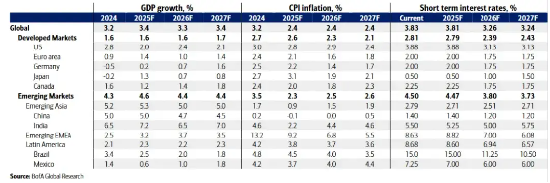
Core Viewpoint - The global economy is expected to show moderate recovery in 2026, supported by ample liquidity and a gradual recovery in inventory and profit cycles, shifting the market narrative from valuation recovery to profit support [1][30]. Group 1: Overseas Macro - The global economy will continue to recover, with K-shaped economic characteristics persisting but narrowing. Major economies are projected to have varied GDP growth rates: the US at 2.4%, Eurozone at 1.0%, Japan at 0.8%, and emerging markets at 4.2% [2][30]. - Global inflation is on a downward trend, with expectations that the Federal Reserve may cut interest rates 2-3 times in 2026, leading to a decrease in short-term rates [31][30]. Group 2: Domestic Macro - Fiscal policies are expected to drive investment recovery in major economic provinces, with a focus on infrastructure, manufacturing recovery, and a narrowing decline in real estate sales and investment [8][35]. - The Producer Price Index (PPI) is anticipated to rise initially before stabilizing, while the Consumer Price Index (CPI) may see moderate increases. The profit cycle is gradually recovering, with improvements expected in various sectors [9][35]. Group 3: Liquidity Environment - A clear trend of global liquidity easing is established, with the Federal Reserve leading improvements in overseas liquidity. Domestic monetary policy is expected to align with fiscal measures, potentially leading to interest rate cuts [12][38]. - The supply of funds is likely to be dominated by institutional capital, with private equity funds potentially driving high-net-worth individuals back into equity allocations [14][38]. Group 4: Strategic Allocation Directions - The market is expected to shift from valuation recovery to profit-driven dynamics in 2026, with Chinese assets still having room for valuation recovery [41][42]. - Key sectors to focus on include technology and advanced manufacturing, traditional export chains, and industries with increasing overseas revenue proportions [42][45]. - Future industry themes may include smart manufacturing, next-generation communications, advanced materials, and future energy solutions [47].
英大证券晨会纪要-20260107
British Securities· 2026-01-07 04:37
Market Overview - In 2025, the majority of industry sectors in A-shares experienced gains, with non-ferrous metals leading at a 94.73% increase, followed by communications at 84.75% and electronics at 47.88% [1][10] - The A-share market welcomed a strong start in 2026, with the Shanghai Composite Index breaking through the previous high of 4034 points, indicating a bullish trend [2][12] - The total trading volume exceeded 2.8 trillion yuan, reflecting a robust market sentiment and increased participation from investors [2][12] Sector Performance - The insurance and financial sectors were significant contributors to the market rally, with insurance premiums reaching 57.629 billion yuan in the first 11 months of 2025, marking a 7.6% year-on-year increase [7][8] - The energy metals, solar equipment, and wind power sectors showed strong activity, driven by ongoing global initiatives towards carbon neutrality and supportive government policies [9][10] Investment Strategy - Despite the upward trend, caution is advised as profit-taking may lead to market corrections; investors are encouraged to wait for pullbacks to enter positions [3][11] - The report emphasizes the importance of focusing on companies with strong earnings to navigate market uncertainties, suggesting a preference for sectors like technology (semiconductors, AI) and cyclical industries (solar, chemicals) [3][11]
券商研究框架-探寻产业变迁和投资价值
2026-01-07 03:05
Summary of the Conference Call Records Industry Overview - The brokerage industry currently has a Price-to-Book (PB) ratio of approximately 1.47, which is around the 35th percentile historically, indicating a relative undervaluation and potential for valuation recovery [1][2] - Regulatory optimization is expected to enhance the asset-liability management of quality brokerages, leading to an increase in Return on Equity (ROE) [1][2] Key Projections for 2026 - The brokerage sector is anticipated to experience a market recovery, with trading activity and margin financing (two-in-one business) expected to maintain a growth rate of around 20% [1][2] - The overall industry ROE is projected to rise to approximately 9%, while leading brokerages may achieve ROE levels of 11%-12% [1][2] Business Segments Brokerage Business - The brokerage business is experiencing cyclical weakening, with a price war leading to a decline in net commission rates, resulting in weak growth [1][5] - Margin financing, as a pro-cyclical indicator, is expected to maintain a good interest margin, contributing to significant growth in net interest income for brokerages [1][5] Investment Banking - A recovery in investment banking is expected in 2026, with an anticipated rebound in IPO and refinancing volumes, particularly benefiting leading firms like Guotai Junan, CITIC Securities, and CICC [1][6][7] Asset Management - Following the new asset management regulations in 2018, the scale of brokerage asset management has stabilized and is expected to recover, although fixed-income products are unlikely to provide long-term support for profit growth [1][8] - Equity public funds are experiencing rapid growth post-fee reductions, driven by changes in resident wealth management demands [1][8] Recommended Stocks - Leading stocks in the sci-tech theme are recommended, with Guotai Junan as the top pick, followed by CICC H shares, benefiting from leading project reserves in the sci-tech board [1][3][9] - Guotai Junan has a PB of approximately 1.15, indicating significant room for valuation recovery [3][9] Cost Structure and Market Dynamics - The brokerage industry's profitability model is primarily analyzed using the ROE-PB framework, with self-operated businesses accounting for about 40% of revenue, followed by brokerage services at 25% and investment banking at 15% [1][4] - Cost management has improved, with a decrease in management expense ratios and lower credit impairment losses since 2022, leading to better performance among listed brokerages [1][11] Future Outlook - The overall outlook for the securities industry in 2026 is optimistic, with expected growth rates around 20% from a low base, and an increase in industry ROE from 8% to 9% [1][13] - The valuation uplift potential is estimated to be between 30%-50%, with a focus on sci-tech themed stocks like Guotai Junan and CICC H shares [1][13]
“旗手”归来!券商板块开年爆发 机构解读2026投资主线
2 1 Shi Ji Jing Ji Bao Dao· 2026-01-06 23:38
Core Viewpoint - The A-share market has been performing strongly since the beginning of the year, with the brokerage sector leading the charge, indicating potential for valuation recovery and long-term investment opportunities in the sector [1][9]. Market Performance - As of January 6, the three major A-share indices rose collectively, with the Shanghai Composite Index reaching a ten-year high and recording a 13-day winning streak. The trading volume in the Shanghai and Shenzhen markets reached 2.81 trillion yuan, an increase of 260.2 billion yuan from the previous trading day, marking a three-month high [1]. - The brokerage sector saw significant gains, with stocks like Huazhong Securities and Hualin Securities hitting the daily limit, while others like Changjiang Securities and Guotai Junan rose over 5% [1]. Institutional Insights - Multiple institutions predict that the brokerage sector will benefit from a "slow bull" market and the acceleration of building world-class investment banks, leading to valuation recovery and highlighting long-term investment value [1][9]. - Key investment strategies for 2026 include focusing on "low valuation," "leading brokerages," "mergers and acquisitions," "wealth management," and "overseas business" [1][12]. Policy Impact - The recent comprehensive reform of public funds is seen as a significant policy benefit for the brokerage sector, effective from January 1, 2026, which aims to promote long-term value investment and optimize the investment ecosystem [2][3]. Performance Discrepancy - In 2025, despite a 42.55% increase in revenue and a 62.38% rise in net profit for 42 listed brokerages, the sector's overall stock performance was only up 4.05%, significantly lagging behind major indices like the CSI 300 and the Shanghai Composite [6][8]. - Analysts attribute this discrepancy to high timing difficulty, a mismatch between market performance and earnings, and significant individual stock differentiation [8]. Future Outlook - Predictions for 2026 suggest a shift towards a more stable market with moderate growth in trading volume, with daily trading expected to range between 2.2 trillion and 3.2 trillion yuan [9]. - Regulatory focus on "high-quality development" is expected to expand capital space for leading brokerages, supporting mergers and acquisitions and the development of wealth management and international business [10][11]. Investment Recommendations - Institutions recommend focusing on low-valuation leading brokerages, those with strong wealth management capabilities, and firms benefiting from cross-border asset management trials [12][13]. - Analysts also highlight the importance of investment banking and the potential for improved performance from underwriting and follow-on investments in the context of a recovering market [14].
保险等板块拉动 上证指数连续两天站上4000点
Zheng Quan Ri Bao Wang· 2026-01-06 12:25
Core Viewpoint - The insurance sector has experienced significant growth at the beginning of the year, driven by market sentiment, valuation recovery, and improvements in both the asset and liability sides of the industry [1][2]. Group 1: Market Performance - On January 6, the insurance sector index rose by 3.44%, with a cumulative increase of 9.84% over the first two trading days of the year, leading all sectors [1]. - The Shanghai Composite Index surpassed 4000 points on January 5 and continued to rise by 60.25 points to 4083.67 on January 6 [1]. - The insurance sector index had a cumulative increase of 21.07% in 2025, indicating a continuation of last year's upward trend [1]. Group 2: Factors Driving Growth - The recent surge in insurance stocks is attributed to a combination of market sentiment, valuation recovery, and improvements in the insurance industry's fundamentals [1][2]. - The strong performance of the capital market and the upward movement of the market index have provided robust external support for the insurance sector [2]. - Insurance companies, as significant institutional investors, benefit directly from the stock market's rise, enhancing market expectations for their profitability [2][3]. Group 3: Future Outlook - The average new policy growth rate for listed insurance companies is expected to reach around 30% in the first quarter of this year, driven by the advantages of dividend insurance in a low-interest-rate environment [3]. - The insurance industry is anticipated to see continued growth in premium income and profitability, supported by favorable macroeconomic conditions and active capital markets [4]. - The ongoing transformation of insurance products and the accumulation of low-cost premiums are expected to further enhance profit growth in the industry [3][4].
A股五大上市险企集体飘红,多股创历史新高
21世纪经济报道· 2026-01-06 11:44
Core Viewpoint - The insurance sector is experiencing a strong performance driven by a bull market, favorable policies, improved industry fundamentals, and institutional support for valuation recovery [2][3][5]. Group 1: Market Performance - In the first two trading days of 2026, the insurance industry index rose by 3.29%, with all five major listed insurance companies in A-shares showing positive performance [1]. - Several insurance stocks reached historical highs, with China Ping An (601318.SH) hitting a peak of 234.59 yuan per share, marking a record since its listing [2][1]. - The total market capitalization of the five major listed insurance companies reached approximately 3.89 trillion yuan, an increase of about 128.8 billion yuan from the previous trading day [1]. Group 2: Driving Factors - The bull market is identified as a key driver for the insurance stock performance, with expectations of market growth enhancing the earnings elasticity and valuation recovery potential of the insurance sector [3]. - Recent policy adjustments by the National Financial Regulatory Administration, including changes to risk factors for insurance companies, are expected to lower capital constraints and expand investment opportunities [3]. - The improvement in the industry fundamentals is also a significant factor, with expectations of a strong performance in insurance premiums for 2026, driven by liability cost optimization and a shift in product structure [4]. Group 3: Financial Metrics - In the first eleven months of 2025, the insurance industry reported a total premium income of 5.76 trillion yuan, reflecting a year-on-year growth of 7.6%, with life insurance premiums growing by 9.2% [4]. - The total assets of the insurance industry surpassed 40 trillion yuan, with net assets reported at 3.68 trillion yuan [4]. Group 4: Future Outlook - The insurance sector is expected to maintain its upward trend in 2026, supported by strong demand for protection and savings products, as well as ongoing policy support [5]. - However, potential risks include the pace of valuation recovery and the sustainability of liability-side improvements, which need to be monitored closely [5].