
宏观经济

Search documents
原油周报:逢低做多-20260117
Wu Kuang Qi Huo· 2026-01-17 15:04
Report Industry Investment Rating - The report recommends "Buy on Dips" for crude oil [17] Core Viewpoints of the Report - The heavy oil crack spread can be taken as a profit, while crude oil can be bought on dips within the shale oil break - even cost range [15][17] - In 2025, the oil price center will move down, with a bottom margin, and it's difficult to predict a trend. The extremely pessimistic bottom range is expected to be between $45/barrel and $55/barrel. It is recommended to short on rallies [22] - In 2026, the oil price center will reach the bottom, and the price is expected to rise steadily during the peak season, but the increase is still limited. The center is expected to be between $60/barrel and $65/barrel. It is recommended to buy on dips and focus on crack spread opportunities [22] Summary by Directory 1. Weekly Assessment & Strategy Recommendation - **Market Review**: Crude oil rebounded this week. The geopolitical situation in Venezuela did not expand, but there were potential geopolitical expectations between Iran and Israel, causing oil prices to fluctuate with the geopolitical situation [15] - **Supply - Demand Changes**: US commercial crude oil inventories increased, while in the Middle East, production in Venezuela and Iran declined, leading to a marginal decrease. The CPC pipeline export is expected to resume, and overall supply in January is expected to decline slightly [15] - **Macro - Political Situation**: In December, the US CPI was 2.7% year - on - year and + 0.3% month - on - month, and the core CPI was 2.6% year - on - year, slightly lower than the expected 2.7%. Politically, President Trump imposed sanctions on countries trading with Iran, and the geopolitical friction between the US and Iran intensified, but the probability of military strikes is considered low [15] - **Viewpoint Summary**: The heavy oil crack spread can be taken as a profit, and crude oil can be bought on dips within the shale oil break - even cost range [15][17] 2. Macro & Geopolitical - **Macro Short - Term High - Frequency Indicators**: Include the US ISM manufacturing PMI, Citigroup G10 economic surprise index, US 10 - year inflation expectation, and US long - short - term spread, which are correlated with WTI oil prices [46] - **Macro Medium - Term Forecast Indicators**: Such as the eurozone investment confidence index, eurozone PMI, US investment confidence index, and US PMI, which are used to predict the macro - economic situation [49] - **Geopolitical Indicators**: The Middle East geopolitical risk index and the high - frequency export statistics of sensitive oil countries (Iran, Libya, Venezuela, and Russia) are related to WTI oil prices [56] 3. Oil Product Spreads - **Forward Curve**: Analyzes the WTI crude oil forward curve, including the M1/M4 month - spread and the M1 price, as well as the forward curves of other crude oils such as Brent, Dubai, and INE [60] - **Inter - Regional Spreads**: Compares the spreads between Brent/WTI, Brent/Dubai, INE/WTI, and MRBN/WTI [63] - **Product Spreads**: Studies the spreads between different oil products such as LGO diesel, gasoline, and diesel, including the RB/HO and LGO/RB spreads [70] - **Crack Spreads**: Analyzes the crack spreads of gasoline, diesel, high - sulfur fuel oil, and low - sulfur fuel oil in Singapore, Europe, and the US [74][77][80] 4. Crude Oil Supply - **OPEC & OPEC+ Supply**: OPEC and OPEC+ have implemented a series of production - cut and production - increase measures. The production and export of OPEC 12 countries and OPEC+ main member countries are analyzed, including Saudi Arabia, Iraq, Iran, etc. [86][91][112] - **US Supply**: The US has implemented a series of policies, such as reducing SPR funds, imposing sanctions on Iran and Russia, and planning to purchase SPR. The number of oil wells, rigs, production, and export in the US are also analyzed [117][118] - **Other Supply**: The production of other countries such as Canada, Norway, and Brazil is analyzed [126] 5. Crude Oil Demand - **US Demand**: Includes the US crude oil input, refinery capacity utilization, direct import and export demand, and the demand for refined oil products such as gasoline, diesel, fuel oil, and aviation kerosene [132][134][137] - **Chinese Demand**: Analyzes China's crude oil input, import, refinery profit, and the production and demand of refined oil products such as gasoline and diesel. Micro - demand indicators such as new - energy vehicle penetration and population migration are also considered [154][159][167] - **European Demand**: Focuses on the refinery start - up rate, crude oil input, and the production of refined oil products in 16 European countries [173][178] - **Indian Demand**: Analyzes India's crude oil input, refinery start - up rate, import, and demand [183] - **Other Demand**: Considers the average daily speed of oil tankers and the oil - transportation quality model [187][190] 6. Crude Oil Inventory - **US Inventory**: Includes US commercial crude oil inventory, Cushing inventory, and the inventory of refined oil products such as gasoline, diesel, fuel oil, and aviation kerosene [197][199][201] - **Chinese Inventory**: Analyzes China's crude oil port inventory, gasoline and diesel inventory, and the inventory of refined oil products [206][209][212] - **European Inventory**: Focuses on the ARA inventory and the inventory of 16 European countries, including gasoline, diesel, fuel oil, and total refined oil products [217][222][225] - **Singapore Inventory**: Analyzes Singapore's gasoline, diesel, fuel oil, and total refined oil product inventory [229] - **Fujairah Inventory**: Focuses on the gasoline, diesel, fuel oil, and total refined oil product inventory in Fujairah [234] - **Marine Inventory**: Analyzes the floating storage of gasoline, diesel, fuel oil, kerosene, heavy oil, light oil, and crude oil at sea [239][245][249] 7. Meteorological Disasters - **Crude Oil Supply Area Meteorological Disasters**: Include the US Gulf of Mexico storm model, the Middle East strait storm model, the Canadian wildfire probability model, and the US Gulf of Mexico rainstorm and thunderstorm [255][261] 8. Alternative Data - **Crude Oil Alternative Data**: Such as the in - transit supply of crude oil by sea, the oil - transportation demand model, the shipping freight in the Arabian Sea, and the media - voted probability of the Hormuz Strait blockade, which are related to WTI oil prices [267]
光大期货:1月16日能源化工日报
Xin Lang Cai Jing· 2026-01-16 01:13
Oil Market - Oil prices saw a significant decline, with WTI February contract closing down by $2.83 to $59.19 per barrel, a drop of 4.56% [2][17] - Brent March contract closed down by $2.76 to $63.76 per barrel, a decrease of 4.15% [2][17] - The easing of tensions in Iran led to a reduction in geopolitical risk premium, contributing to the largest single-day drop in oil prices since October [2][17] - The U.S. announced new sanctions against Iran, which are expected to have a lasting impact, although the likelihood of escalating conflict in the short term has decreased [2][17] Fuel Oil - The main contract for fuel oil (FU2603) rose by 1.33% to 2586 yuan/ton, while low-sulfur fuel oil (LU2603) fell by 0.48% to 3087 yuan/ton [3][18] - Singapore's onshore fuel oil inventory increased by 65,000 barrels (0.26%) to 25.473 million barrels, while Fujairah's inventory rose by 114,200 barrels (12.83%) to 10.041 million barrels [3][18] - The low-sulfur fuel oil market remains stable, while the high-sulfur market shows some support due to recovering demand [3][18] Asphalt - The main asphalt contract (BU2602) increased by 1.38% to 3168 yuan/ton [5][19] - Domestic asphalt shipments rose by 1.0% to 317,000 tons, and the capacity utilization rate for modified asphalt increased by 0.1% to 6.8% [5][19] - The asphalt market is expected to experience a balance between weak demand and strong cost expectations, with prices likely to stabilize [5][19] Rubber - The main rubber contract (RU2605) fell by 165 yuan/ton to 15,995 yuan/ton, with similar declines in other rubber products [6][20] - Despite a rebound in prices due to macroeconomic expectations, the low production season is expected to limit price elasticity [6][20] PX, PTA, and MEG - TA605 closed at 5048 yuan/ton, down 1.33%, while EG2605 closed at 3817 yuan/ton, down 1.29% [7][21] - The PX futures contract closed at 7130 yuan/ton, down 1.82%, with spot prices at $881/ton [7][21] - Polyester demand is expected to decline due to maintenance shutdowns and the upcoming Chinese New Year holiday [7][21] Methanol - Methanol prices in Taicang were at 2240 yuan/ton, with CFR China prices ranging from $265 to $269/ton [8][22] - The market is expected to maintain a bottom range due to declining port inventory pressures, although geopolitical tensions may increase volatility [8][22] Polyolefins - Mainstream prices for polypropylene (PP) in East China ranged from 6430 to 6550 yuan/ton, with various production margins reported [9][24] - HDPE film prices increased by 136 yuan/ton to 7550 yuan/ton, while LDPE film prices rose by 457 yuan/ton to 9024 yuan/ton [9][24] - Supply is expected to decrease slightly due to temporary maintenance, while demand is anticipated to recover before the Chinese New Year [9][24] PVC - PVC prices showed mixed trends across regions, with prices for different grades ranging from 4630 to 4900 yuan/ton [10][25] - Overall supply remains high, but domestic demand is slowing, leading to a bearish outlook for prices [10][25] Urea - Urea futures prices remained stable, with the main contract closing at 1801 yuan/ton, a rise of 0.28% [11][26] - Market prices in Shandong and Henan increased to 1760 yuan/ton, with a slight rise in daily production [11][26] - Demand is expected to be supported by winter storage and pre-spring planting needs, although high prices may suppress purchasing sentiment [11][26] Soda Ash - Soda ash futures prices fell by 2.05% to 1193 yuan/ton, with stable manufacturer quotes [12][27] - The industry’s operating rate increased by 2.43%, indicating a recovery in supply levels [12][27] Glass - Glass futures prices experienced a slight decline, closing at 1086 yuan/ton, down 0.55% [13][28] - The market remains cautious with limited demand support, and inventory levels are decreasing [13][28]


中银晨会聚焦-20260116-20260116
Bank of China Securities· 2026-01-15 23:58
Core Insights - The report highlights a significant increase in December's financial data, with new social financing (社融) reaching 2.21 trillion yuan, exceeding expectations of 1.82 trillion yuan, although it was lower than the previous year by 645.7 billion yuan [5][6] - The report indicates a strong demand for corporate loans, with new corporate loans amounting to 1.07 trillion yuan in December, while household loans remained weak, showing a decrease of 916 million yuan [8][9] - The central bank's recent policy adjustments, including a 0.25 percentage point reduction in the re-lending and rediscount rates, signal a continued easing of monetary policy, with expectations for further reductions in reserve requirements [9][10] Macroeconomic Overview - December's financial data showed that new social financing, new loans, and M2 growth were all above consensus expectations, driven primarily by an increase in corporate loan demand [3][5] - The total social financing stock grew by 8.3% year-on-year, slightly above the expected 8.2%, while the new RMB loans for December were 9.757 trillion yuan, an increase of 1.355 trillion yuan compared to the previous year [5][6] Market Strategy - The regulatory body has raised the margin requirement for financing from 80% to 100%, effective January 19, 2026, to curb speculation and stabilize market volatility [10][11] - This adjustment is seen as a response to recent market overheating, aiming to balance market styles and reduce leverage growth rates [10][12] - Historical context suggests that such margin adjustments can indicate market tops and bottoms, with potential short-term impacts on high-beta stocks due to reduced liquidity [11][12]
2026年宏观和大类资产配置展望:行稳致远-五矿证券
Sou Hu Cai Jing· 2026-01-15 16:34
Global Economic Outlook - The global economy is expected to operate steadily in 2026, with major asset classes showing a "stocks outperform bonds, commodities in a long bull market" trend, and China aiming for around 5% growth amid its economic transformation [1][2] - Major economies are experiencing cyclical divergence, with the US in a late-stage downturn, the EU and Japan in late-stage recovery, and the UK entering a new downturn [1][2] - The Federal Reserve's interest rate cut cycle is projected to continue, with expected cuts of 50 to 75 basis points in 2026, influenced by pressures on the Fed's independence from the Trump administration [1][2] China Economic Analysis - China's economy faces a "macro-micro temperature difference," primarily due to low prices and structural factors such as weak financial cycles and a shift in consumer demand from goods to services [2][3] - Inflation is expected to recover moderately in 2026, but the difficulty of turning the Producer Price Index (PPI) positive remains significant [2][3] - Investment is anticipated to marginally recover, with manufacturing investment stabilizing and infrastructure investment supported by policy financial tools, while real estate investment is expected to see a narrowing decline [2][3] Currency and Exchange Rate - The US dollar is entering a long-term downtrend, influenced by overvaluation relative to purchasing power parity, government efforts to promote a weaker dollar, and high debt interest rates [2][3] - The Chinese yuan is expected to appreciate, supported by narrowing interest rate differentials with the US and trade surpluses with the EU and ASEAN [2][3] Asset Allocation Strategy - The stock market is expected to experience a slow bull market, benefiting from improved global liquidity due to a weak dollar, the central government's commitment to stabilizing capital markets, and breakthroughs in technology and military sectors [3][8] - The bond market's allocation value is declining, with monetary policy not being extremely loose and the central bank cautious about capital turnover [3][8] - Commodities are in a long-term upward cycle, driven by a weak dollar, supply-demand tensions from global supply chain restructuring, and policies promoting a shift from virtual to real assets [3][8]

中信建投期货:1月15日工业品早报
Xin Lang Cai Jing· 2026-01-15 01:42
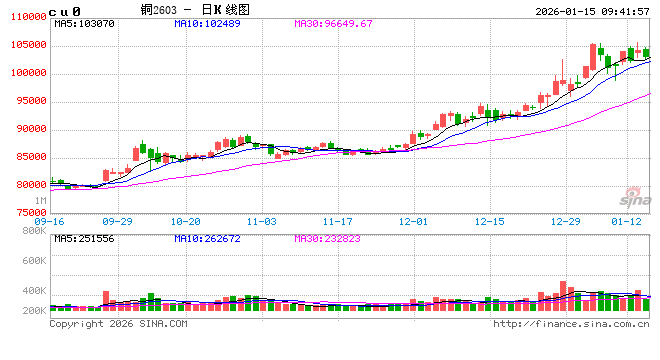
Group 1: Copper - The main copper futures in Shanghai retreated to 103,660 yuan, while London copper hovered around 13,311 USD [2][12] - The macroeconomic outlook is neutral, with the US November PPI and core PPI year-on-year growth at 3%, slightly above expectations, and a minor adjustment in interest rate cut expectations [2][12] - The increase in copper warehouse receipts by 27,000 tons to 149,000 tons indicates a rise in inventory, while weak consumer demand continues to pressure prices [2][12] - Overall, copper prices are expected to maintain high volatility supported by pre-holiday stocking, with a reference range of 102,500 to 104,500 yuan per ton for the main futures [2][12] Group 2: Nickel & Stainless Steel - Indonesia's Ministry of Energy and Mineral Resources announced an adjustment of nickel ore RKAB quotas to 250-260 million tons by 2026, providing short-term support for nickel prices [3][13] - The nickel market lacks further supply-demand contradictions, and the tightening quota expectations have already been priced in [3][13] - The operational strategy for nickel and stainless steel is currently to remain on the sidelines, with reference ranges for nickel at 140,000 to 165,000 yuan per ton and stainless steel at 14,000 to 15,000 yuan per ton [3][13] Group 3: Aluminum - The price of alumina has shown a slight decline, with the 05 contract experiencing high opening and low closing, facing pressure from multiple moving averages [16][17] - The overall supply of alumina has slightly increased to around 96 million tons, but the market sentiment remains weak due to high prices affecting downstream consumption [16][17] - The operational range for the 05 alumina contract is set between 2,500 to 2,800 yuan per ton, with a recommendation to hold short positions [16][17] Group 4: Zinc - Zinc prices showed strong fluctuations, with macroeconomic indicators such as the US November PPI and retail sales exceeding expectations, creating a mixed market sentiment [19] - Domestic TC prices have shown signs of slowing down, with low acceptance for prices below 1,000 yuan, while overseas prices are also declining [19] - The operational strategy for zinc is to take profits on highs, with the main contract expected to trade between 24,500 to 25,500 yuan per ton [19] Group 5: Lead - Lead prices are experiencing strong fluctuations, with supply-side pressures easing slightly due to adjustments in primary smelter maintenance plans [20][21] - The recycling of waste batteries is expected to decline, impacting the supply of recycled lead, while consumer acceptance of new vehicle models is decreasing [20][21] - The operational range for lead is set between 17,000 to 18,000 yuan per ton, with a recommendation for range trading [20][21] Group 6: Precious Metals - Precious metals are showing mixed performance, with gold and platinum slightly rising, while silver continues to break through strongly, and palladium shows a soft decline [10][22] - The market is influenced by concerns over the weakening independence of the Federal Reserve and the delayed decision on Trump's tariff policy by the US Supreme Court [10][22] - The operational strategy suggests holding long positions in gold while remaining cautious with silver, platinum, and palladium, with reference ranges for gold at 1,010 to 1,060 yuan per gram and silver at 22,000 to 24,500 yuan per kilogram [10][22]

宏观金融类:文字早评2026/01/15星期四-20260115
Wu Kuang Qi Huo· 2026-01-15 00:58
Group 1: Report Industry Investment Rating - Not provided in the content Group 2: Report's Core View - For the stock index, at the beginning of the year, incremental funds entered the market, the margin trading scale increased significantly, and the market trading volume quickly expanded. In the long - term, policies support the capital market. In the short - term, focus on the market rhythm and adopt the strategy of buying on dips [4]. - For treasury bonds, the market's improved economic expectations may put pressure on the bond market, but the sustainability of economic recovery needs to be observed. In the first quarter, the bond market is expected to fluctuate weakly due to factors such as the stock market's spring rally, government bond supply, and interest rate cut expectations [7]. - For precious metals, the current international gold price is rising steadily, and the silver price is rising rapidly with significant volatility. It is recommended to hold existing long positions, and there are significant risks in opening new long or short positions [8]. - For non - ferrous metals, most metal prices are expected to fluctuate widely. For example, copper prices are supported by tight supply at the mine end, aluminum prices are affected by overseas low inventory and domestic downstream demand, and nickel prices are constrained by oversupply pressure but supported by macro - factors [12][14][18]. - For black building materials, steel prices are expected to continue to oscillate at the bottom, iron ore prices are expected to oscillate at a relatively high level, and the prices of coking coal and coke are expected to oscillate in the current range [32][34][38]. - For energy and chemicals, rubber can be considered with a neutral strategy, oil prices can be traded with a low - buying and high - selling strategy, and the strategies for other chemicals vary according to their fundamentals [54][56]. - For agricultural products, the short - term trend of hog prices is expected to be stable with partial fluctuations, egg prices may have different trends in the near and far months, and the prices of other agricultural products are also affected by supply and demand and other factors [78][79][81]. Group 3: Summary by Related Catalogs Macro - financial Stock Index - **Market Information**: Three departments held a symposium on new energy vehicle enterprises, Shanghai issued an action plan for high - level autonomous driving, the central bank carried out a 900 - billion - yuan repurchase operation, and tax rebates were offered for housing purchases [2]. - **Strategy**: Buy on dips in the short - term [4]. Treasury Bonds - **Market Information**: The prices of main contracts showed different changes. The central bank carried out a 900 - billion - yuan repurchase operation, and China's export and import data in December 2025 were positive. The central bank's net investment was 212.2 billion yuan [5]. - **Strategy**: The bond market is expected to fluctuate weakly in the first quarter [7]. Precious Metals - **Market Information**: Gold and silver prices rose, and there were differences in the statements of Fed officials. US PPI and retail sales data were released [8]. - **Strategy**: Hold existing long positions, and avoid opening new long or short positions [8]. Non - ferrous Metals Copper - **Market Information**: The domestic equity market fluctuated, copper prices rose, LME copper inventory increased, and the import loss of Shanghai copper expanded [10]. - **Strategy**: Copper prices are expected to oscillate at a high level in the short - term [12]. Aluminum - **Market Information**: The domestic spot market weakened, aluminum prices fluctuated, and inventory increased [13]. - **Strategy**: Aluminum prices are expected to oscillate at a high level in the short - term [14]. Zinc - **Market Information**: Zinc prices rose, and inventory and other data were released [15]. - **Strategy**: Zinc prices are expected to oscillate widely following the non - ferrous sector [15]. Lead - **Market Information**: Lead prices rose, and inventory and other data were released [16]. - **Strategy**: Lead prices are expected to oscillate widely following the non - ferrous sector [16]. Nickel - **Market Information**: Nickel prices fluctuated, and the prices of raw materials such as nickel ore and nickel iron were stable [17]. - **Strategy**: Nickel prices are expected to oscillate widely in the short - term, and it is recommended to wait and see [18]. Tin - **Market Information**: Tin prices rose to the daily limit, supply and demand and inventory data changed [19][20]. - **Strategy**: Tin prices are expected to fluctuate following market sentiment, and it is recommended to wait and see [21]. Carbonate Lithium - **Market Information**: The price of carbonate lithium decreased, and the trading volume and open interest changed [22]. - **Strategy**: Be cautious due to the risk of a significant correction, and it is recommended to wait and see or take a light position [23]. Alumina - **Market Information**: The price of alumina rose, and inventory and other data changed [24]. - **Strategy**: It is recommended to wait and see, and it is not cost - effective to chase long positions. Consider shorting near - month contracts on rallies [25]. Stainless Steel - **Market Information**: Stainless steel prices rose, and inventory decreased [26]. - **Strategy**: Stainless steel prices are expected to oscillate at a high level in the short - term [27]. Cast Aluminum Alloy - **Market Information**: Cast aluminum alloy prices fluctuated, and inventory decreased [28]. - **Strategy**: Cast aluminum alloy prices are supported by cost and supply factors, and may strengthen further [29]. Black Building Materials Steel - **Market Information**: Steel prices fluctuated, and inventory and other data changed [31]. - **Strategy**: Steel prices are expected to continue to oscillate at the bottom, and attention should be paid to market rumors and policy impacts [32]. Iron Ore - **Market Information**: Iron ore prices rose, and supply, demand, and inventory data changed [33]. - **Strategy**: Iron ore prices are expected to oscillate at a relatively high level in the short - term, and attention should be paid to steel mills' restocking and iron - making production rhythms [34]. Coking Coal and Coke - **Market Information**: Coking coal prices rose, and coke prices fell. Spot prices and inventory data changed [35]. - **Strategy**: Coking coal and coke prices are expected to oscillate in the current range, and attention should be paid to market sentiment and policy impacts [38]. Glass and Soda Ash - **Market Information**: Glass prices were stable, and inventory decreased. Soda ash prices rose, and inventory increased [39][41]. - **Strategy**: For glass, it is recommended to wait and see due to high inventory. For soda ash, the market is weak and lacks substantial positive support [40][41]. Manganese Silicon and Ferrosilicon - **Market Information**: Manganese silicon and ferrosilicon prices rose slightly [42]. - **Strategy**: The market is affected by market sentiment and cost factors. Pay attention to manganese ore supply and "dual - carbon" policy impacts [44]. Industrial Silicon and Polysilicon - **Market Information**: Industrial silicon prices rose, and polysilicon prices fell. Supply, demand, and inventory data changed [45][47]. - **Strategy**: Industrial silicon prices are expected to be under pressure, and polysilicon prices are expected to be weak in the short - term. Pay attention to production plans and policy impacts [46][49]. Energy and Chemicals Rubber - **Market Information**: Rubber prices fluctuated, and supply and demand data changed [51][52]. - **Strategy**: Adopt a neutral strategy. If the RU2605 contract falls below 16,000, switch to a short - term short strategy [54]. Crude Oil - **Market Information**: Crude oil and refined oil prices rose, and inventory data showed accumulation [55]. - **Strategy**: Do not be overly bearish on oil prices in the short - term. Adopt a low - buying and high - selling strategy and wait and see for now [56]. Methanol - **Market Information**: Methanol prices changed, and regional spot prices and MTO profits changed [57]. - **Strategy**: Methanol has limited downward space and is suitable for buying on dips [58]. Urea - **Market Information**: Urea prices rose, and regional spot prices and basis data changed [59][60]. - **Strategy**: Take profits on rallies due to expected fundamental bearish factors [61]. Pure Benzene and Styrene - **Market Information**: Pure benzene prices were stable, and styrene prices changed. Supply, demand, and inventory data changed [62]. - **Strategy**: It is possible to go long on non - integrated styrene profits before the first quarter [63]. PVC - **Market Information**: PVC prices fell, and supply, demand, and inventory data changed [64]. - **Strategy**: Adopt a short - selling strategy on rallies in the medium - term due to strong supply and weak demand [65]. Ethylene Glycol - **Market Information**: Ethylene glycol prices rose, and supply, demand, and inventory data changed [66]. - **Strategy**: The supply - demand pattern needs to be improved by increasing production cuts. Be cautious of rebound risks in the short - term [67]. PTA - **Market Information**: PTA prices fell, and supply, demand, and inventory data changed [68]. - **Strategy**: PTA is expected to enter the Spring Festival inventory accumulation stage after short - term inventory reduction. Pay attention to mid - term long - buying opportunities [69]. p - Xylene - **Market Information**: PX prices fell, and supply, demand, and inventory data changed [70][71]. - **Strategy**: PX is expected to maintain a small inventory accumulation pattern before the maintenance season and follow crude oil for mid - term long - buying opportunities [72]. Polyethylene (PE) - **Market Information**: PE prices rose, and supply, demand, and inventory data changed [73]. - **Strategy**: Go long on the LL5 - 9 spread on dips as the long - term contradiction shifts to production mismatch [74]. Polypropylene (PP) - **Market Information**: PP prices rose, and supply, demand, and inventory data changed [75]. - **Strategy**: The PP price may bottom out in the first quarter of next year as the supply - surplus pattern changes [76]. Agricultural Products Hogs - **Market Information**: Hog prices were stable with partial fluctuations [78]. - **Strategy**: The short - term spot price has limited downward momentum, and the mid - term supply is large. Consider short - selling on rallies and long - buying on dips in the long - term [79]. Eggs - **Market Information**: Egg prices were stable with some increases [80]. - **Strategy**: Short - sell near - month contracts on rallies and be cautious of over - valued far - month contracts [81]. Soybean and Rapeseed Meal - **Market Information**: Protein meal prices fell, and supply, demand, and inventory data changed [82]. - **Strategy**: Maintain a wait - and - see attitude in the short - term [83]. Oils and Fats - **Market Information**: Oil prices fluctuated, and supply, demand, and inventory data changed [84][85]. - **Strategy**: The current fundamentals are weak, but the long - term outlook is optimistic, and oil prices may be near the bottom [86]. Sugar - **Market Information**: Sugar prices rebounded, and supply, demand, and inventory data changed [87][88]. - **Strategy**: Wait for the international sugar price to rebound after the northern hemisphere's harvest in February. Temporarily wait and see in the domestic market [89]. Cotton - **Market Information**: Cotton prices rose, and supply, demand, and inventory data changed [90][91]. - **Strategy**: The 1 - month USDA report is neutral. Wait for a pullback to go long on Zhengzhou cotton [92].
《周末小结系列》: 美元难有大趋势,美股迎来考验,原油和日元在交易什么?
Xin Lang Cai Jing· 2026-01-15 00:17
Group 1 - The market appears stable with no significant volatility, but there are underlying changes that have not been fully priced in by the market [2][3] - The macroeconomic fundamentals show that while the manufacturing sector struggles, the service sector remains strong, indicating no acceleration in the U.S. economy but also no recession [3][4] - The "no firing, no hiring" trend is not detrimental to risk assets, as the Federal Reserve has reasons to maintain a loose monetary policy [4] Group 2 - The U.S. dollar has potential for short-term rebounds but is unlikely to experience significant trends, with the market's confidence remaining fragile [5][7] - The real risk for the dollar lies in changes within the Federal Reserve's structure rather than economic data [9][10] - The market is currently viewing the dollar as a trading asset rather than a long-term investment, with potential opportunities in the British pound [9][11] Group 3 - The U.S. stock market has shifted from defensive to cyclical stocks, with a focus on earnings realization rather than storytelling [13][15] - The upcoming earnings season is crucial, particularly for banks, with significant reports expected in late January and early February [18][21] - The market's low expectations for fourth-quarter earnings may reduce the risk of collective disappointments [21][23] Group 4 - Oil prices are facing underestimation of supply-side challenges, particularly regarding the recovery of production from Venezuela [29] - The difficulty in restoring production and geopolitical influences may alter supply-demand expectations, increasing the probability of a mid-term bottom for oil prices [29][31] Group 5 - In Japan, discussions about the central bank's interest rate policies are becoming less relevant as fiscal changes take precedence [32][33] - The market is pricing the yen in a manner similar to emerging markets, with short-term interest rates rising while the yen weakens [33][34]
三和管桩:股价波动受多种复杂因素共同影响
Zheng Quan Ri Bao Wang· 2026-01-14 09:44
Group 1 - The core viewpoint of the article emphasizes that the stock price fluctuations of Sanhe Pile (003037) are influenced by various complex factors, including macroeconomic conditions, industry policies, and market sentiment [1] - The company states that its primary task as a listed entity is to focus on operational management, strengthen its main business, and enhance core competitiveness [1] - The company is committed to delivering stable performance and long-term sustainable development to provide returns to investors, while continuously paying attention to the growth of its intrinsic value [1]

宏观经济高频数据统计周报-20260114
Zhe Shang Guo Ji Jin Rong Kong Gu· 2026-01-14 02:29
Production Sector - The coke oven operating rate increased to 71.63%, up by 0.87% from the previous week[7] - The blast furnace operating rate rose to 79.33%, a 0.37% increase week-on-week[7] - The PX operating rate improved to 90.07%, reflecting a 1.67% increase[7] - The full tire steel operating rate decreased slightly to 58.02%, down by 0.13%[7] - The semi-tire steel operating rate fell to 65.89%, a decrease of 2.36%[7] Consumption Sector - Weekly box office revenue reached 107.3 million yuan, a significant increase of 51.5 million yuan compared to the previous week[7] - Average daily retail sales of passenger cars increased to 82,048.55 units, up by 3,134.35 units[7] - Average daily wholesale sales of passenger cars rose to 106,358.95 units, an increase of 6,925.70 units[7] Real Estate and Infrastructure - The transaction area of commercial housing in 30 major cities dropped to 116.27 million square meters, down by 110.15 million square meters from the previous week[7] - The transaction area of second-hand houses in major cities increased to 206,569.54 square meters, up by 53,755.83 square meters[7] - The land transaction area in 100 major cities decreased to 625.15 million square meters, down by 593.60 million square meters[7] - The land premium rate in 100 major cities increased to 1.41%, up by 0.96%[7] Trade and Inflation - The Shanghai Export Container Freight Index (SCFI) fell to 1,647.39, a decrease of 8.93 points[8] - The China Export Container Freight Index (CCFI) rose to 1,194.89, an increase of 48.22 points[8] - The Baltic Dry Index (BDI) decreased to 1,688.00, down by 194.00 points[8] - The wholesale price index for agricultural products dropped to 128.65, down by 0.78 points[8] Transportation - The subway passenger volume in Beijing decreased to 950.13 million, down by 1.58 million from the previous week[8] - The subway passenger volume in Shanghai fell to 917.29 million, a decrease of 56.71 million[8] - The subway passenger volume in Guangzhou dropped to 969.54 million, down by 105.56 million[8] - The number of domestic flights (excluding Hong Kong, Macau, and Taiwan) decreased to 12,383.71, down by 294.57 flights[8]
中信期货晨报:贵金属波动率仍高,股指商品大部回调-20260114
Zhong Xin Qi Huo· 2026-01-14 02:05
投资咨询业务资格:证监许可【2012】669号 仲鼎 从业资格号F03107932 投资咨询号Z0021450 重要提示:本报告非期货交易咨询业务项下服务,其中的观点和信息仅作参考之用,不构成对任何人的投资建议。 我司不会因为关注、收到或阅读本报告内容而视相关人员为客户;市场有风险,投资需谨慎。 金融市场涨跌幅 | 2026-01-13 | 品种 | 现价 | 日度涨跌幅 | 周度涨跌幅 | 月度涨跌幅 | 季度涨跌幅 | 年度涨跌幅 | | --- | --- | --- | --- | --- | --- | --- | --- | | 殷指 | 炉深300用货 | 4758. 6 | -0. 53 | 0. 31 | 3. 45 | 3.45 | 3.45 | | | 上证50期货 | 3137. 6 | -0. 27 | 0.09 | 3.72 | 3.72 | 3.72 | | | 中证500期货 | 8131.2 | -1. 32 | 1.16 | 10. 44 | 10. 44 | 10. 44 | | | 中证1000期货 | 8160. 4 | -1. 87 | 1.39 | 9.74 | ...