
资源民族主义

Search documents
刚果(金)持续搅动全球钴矿江湖,中国何以制衡与破局|深度
24潮· 2025-10-19 23:06
Core Viewpoint - The article discusses the significant impact of the Democratic Republic of the Congo (DRC) on the global cobalt supply chain, particularly in light of recent export restrictions and quota management policies aimed at stabilizing cobalt prices amid a supply surplus and declining demand growth [2][9][18]. Group 1: Cobalt Market Dynamics - The DRC is the largest cobalt supplier globally, accounting for 75.86% of the world's production, and its policy changes are reshaping the global energy landscape [2][12]. - In February 2023, the DRC government imposed a four-month cobalt export ban due to plummeting prices, marking a significant intervention in the cobalt market [2][9]. - The DRC's Strategic Mineral Regulatory Bureau announced an end to the export ban on October 16, 2023, implementing an annual export quota system to manage supply [3][4]. Group 2: Export Quota Details - For the remainder of 2025, the DRC's export limit is set at 18,125 tons, with monthly allocations of 3,625 tons in October, 7,250 tons in November, and 7,250 tons in December [3][4]. - The annual quota for 2026-2027 is fixed at 96,600 tons, with 87,000 tons designated as "basic quota" and 9,600 tons as "strategic quota" for key national projects [3][4]. Group 3: Impact on Cobalt Prices - Following the DRC's export restrictions, cobalt prices surged, with increases of 185% for cobalt intermediates, 107% for MB cobalt, and 123% for metallic cobalt from February 24 to October 9, 2023 [8][9]. - The DRC's policies aim to reduce global inventory levels to a month's demand, as prolonged supply surpluses have led to a 60% price drop from 2022 highs, severely impacting the DRC's revenue [8][12]. Group 4: Supply and Demand Trends - Global cobalt production is projected to increase by 21.8% in 2024, reaching 290,000 tons, with the DRC's output expected to grow by 25.7% to 220,000 tons [12][14]. - However, demand growth is slowing, with a projected 14% increase in global cobalt consumption in 2024, primarily driven by electric vehicles and consumer electronics [14][15]. Group 5: Strategic Implications - The DRC's control over cobalt supply is a response to international market fluctuations and domestic economic pressures, emphasizing the need for resource-rich countries to assert pricing power [8][18]. - The ongoing competition for cobalt resources reflects broader geopolitical tensions and the strategic importance of securing supply chains for green energy technologies [18][37]. Group 6: Future Outlook - The DRC's new quota policy is expected to tighten the cobalt supply balance, potentially leading to a structural adjustment in the global cobalt supply chain [36][38]. - The increasing reliance on cobalt recycling and alternative sources, such as Indonesian nickel-cobalt projects, is seen as a critical strategy for mitigating supply risks [54][41].



透视新兴市场“危”与“机”,广交会送上“掘金”指南
2 1 Shi Ji Jing Ji Bao Dao· 2025-10-19 14:09
Core Insights - The article discusses the opportunities and risks associated with emerging markets, particularly in the context of the 138th Canton Fair, highlighting the importance of compliance in international trade [1][3]. Trade and Investment Trends - In the first three quarters of 2025, China's imports and exports to Belt and Road Initiative countries reached 17.37 trillion yuan, a growth of 6.2%, accounting for 51.7% of total trade, an increase of 1.1 percentage points [1]. - Chinese enterprises are increasingly focusing on emerging markets, with a significant portion of foreign investments directed towards manufacturing and Belt and Road countries [3]. Risks in Emerging Markets - The overall credit risk for small and medium-sized foreign trade enterprises in China has been on the rise, with an average annual increase of 7.2% in the risk index over the past three years [4]. - Trade protectionism and rising payment risks are contributing to increased uncertainty in the global trade environment, with a 7.4% rise in the overall index reflecting these challenges [4][5]. Sector-Specific Challenges - Labor-intensive industries like textiles and light manufacturing face challenges from trade barriers and raw material cost fluctuations, while technology-intensive sectors like electronics and new energy vehicles contend with rising compliance costs and intense competition [4]. Currency and Regulatory Risks - Emerging market currencies often exhibit high volatility, with examples like the Turkish lira showing daily fluctuations exceeding 10% [6]. - Companies expanding into emerging markets must navigate local tax laws and potential permanent establishment risks, as well as currency mismatch issues [6][7]. Compliance and Legal Considerations - Companies must prioritize compliance with local environmental regulations and intellectual property protections to avoid significant penalties and operational disruptions [7][9]. - Establishing a knowledge protection strategy is crucial, including proactive measures against trademark registration issues and leveraging technology for risk management [9]. Strategic Recommendations - Enterprises are advised to conduct thorough compliance planning before entering new markets, focusing on tax compliance and risk management [8]. - Utilizing financial instruments for currency hedging and establishing a robust environmental compliance framework are essential for mitigating risks in emerging markets [8][9].
国泰海通|有色:风险溢价收缩,静待内需指引
国泰海通证券研究· 2025-10-19 10:43
Core Insights - The article emphasizes the ongoing developments regarding the U.S. government shutdown, the response to the banking crisis, and the internal divisions within the Federal Reserve, suggesting that if market risk aversion eases, precious metal prices may experience wide fluctuations [1][2]. Precious Metals - Market risk aversion is fluctuating, leading to expectations of short-term wide price swings for gold. Comex gold prices reached $4,392 per ounce and Shanghai gold prices hit 1,001 yuan per gram during the week [2]. - The Federal Reserve Chairman Powell indicated rising risks in the employment market and potential cessation of balance sheet reduction in the coming months. The banking sector is facing renewed challenges, which has heightened market risk aversion [2]. - Long-term, despite existing federal debt risks and challenges to the dollar's status, gold may continue to perform well amid a restructuring of the global monetary system [2]. Industrial Metals - Industrial metal prices are under pressure due to declining market risk appetite, but upcoming domestic meetings and renewed U.S.-China trade negotiations may improve macroeconomic sentiment [3]. - Supply-side disruptions, particularly in mining, and historically low inventory levels are expected to provide upward support for industrial metal prices [3]. - Despite insufficient demand during the peak season, the overall supply situation remains tight, suggesting potential for price increases in the medium to long term [3].


中国矿企出海开垦“荒野”,如何规避风险?
财富FORTUNE· 2025-10-15 13:06
Core Viewpoint - The Chinese manufacturing industry, positioned in the global supply chain, faces dual pressures from downstream ESG evaluations in Western markets and concerns from upstream resource-rich countries regarding "neo-colonialism" [1] Group 1: Industry Challenges - Chinese companies expanding into remote or underdeveloped regions encounter strict policies and regulations, alongside significant challenges related to resource nationalism, which has been on the rise [3] - Geopolitical instability has led to various policy and supply chain issues, with threats to personal safety from kidnapping and theft in turbulent regions, resulting in longer timeframes and increased cost pressures for companies [3][4] Group 2: Corporate Responsibility and ESG - Companies must ensure compliance with local laws and regulations, understand cultural differences, and align their standards with international markets to manage risks effectively [3] - In regions with weak governance, companies often have to assume responsibilities typically held by local governments, such as community development and infrastructure [4] - There is a misconception among many investors that ESG risks are minimal in underdeveloped areas, while in reality, these regions often have historical legal frameworks that are not enforced effectively [5]


小金属何来“战略价值”?
Xin Lang Cai Jing· 2025-10-13 16:40
Summary of Key Points Core Viewpoint The recent quota distribution in the Democratic Republic of Congo (DRC) has led to significant implications for cobalt supply, with mining companies receiving the majority of quotas while smelting plants are left without direct allocations. This shift is expected to create a tight supply situation, impacting cobalt prices and market dynamics. Quota Distribution - The total quota allocated is 96,600 tons, with 87,000 tons as the basic quota and 10% as strategic quotas, which can be adjusted based on price changes [2] - Major mining companies like Luoyang Molybdenum (3,120 tons), Glencore (1,330 tons), and Eurasian Resources (1,020 tons) dominate the quota distribution, while domestic smelting plants received no direct quotas [2][3] - The government platforms EGC, STL, and ARECOMS received a combined quota of 16,700 tons for 2026, which can be utilized by smelting plants through collaboration [3] Supply Chain Implications - The lack of direct quotas for smelting plants means they will have to rely on mining companies for raw material supply, leading to increased competition and potential price hikes [7] - Cobalt prices are expected to reflect structural issues rather than just supply-demand balance, as smelting companies will need to purchase raw materials from quota-holding mining firms [7][8] Strategic Quotas and Regulations - Strategic quotas totaling 9,600 tons are aimed at supporting national key projects, indicating a focus on resource nationalism [5] - New regulations prevent quota transfer and require unused quotas to be forfeited, tightening control over cobalt exports [4][6] Market Dynamics and Future Outlook - The pricing power for cobalt is shifting towards companies like Glencore, as they will be the primary suppliers for cobalt salt manufacturers [8] - Resource nationalism is expected to increase costs for acquiring raw materials, leading to higher prices and a need for countries to build new supply chains and safety stocks [8] Conclusion The recent quota changes in the DRC are reshaping the cobalt market, concentrating power among a few mining companies and creating a tighter supply environment that could lead to significant price increases and shifts in market dynamics [7][8]

【建投策略】节后商品配置的几点想法
Xin Lang Cai Jing· 2025-10-09 09:12
Group 1: Domestic Consumption and Travel Market - During the double holiday period, the domestic consumption and travel market showed strong recovery momentum, with an average daily cross-regional flow of 304 million people, up 6.3% year-on-year, reaching a historical high for the same period [1] - Self-driving travel dominated, with an average daily flow of over 240 million small passenger cars on highways, accounting for about 80% of total travel [1] - The increase in electric vehicle travel significantly boosted the payment amount for charging stations, which rose by over 40% year-on-year [1] - Railway and civil aviation passenger volumes steadily recovered, with the "high-speed rail + airplane" travel model gaining popularity [1] - Outbound tourism saw a notable rebound, with an average of over 2 million inbound and outbound travelers per day during the holiday, up 7% year-on-year [1] - New trends in destination choices emerged, such as "taste tours" focusing on food and "small town tours" emphasizing cost-effectiveness, indicating strong consumption potential in lower-tier markets [1] Group 2: Commodity Market Trends - Precious metals and non-ferrous metals continued to lead the commodity market rebound, while the agricultural products sector showed weaker recovery [2] - Gold, supported by fundamentals and macro disturbances, has seen a strategic shift in central bank purchasing behavior, with China's central bank increasing gold reserves for 11 consecutive months, reaching approximately 2303.5 tons by the end of September [2] - The ongoing growth in official demand is positioning gold as a "timeless asset," reflecting concerns over the U.S. dollar credit system and geopolitical uncertainties [2] - Silver has strengthened relative to gold due to expectations of preventive interest rate cuts, with its dual role as a financial and industrial asset providing greater elasticity [3] - In the industrial metals sector, the copper market is undergoing a fundamental shift due to rising resource nationalism, impacting supply stability and costs [4] - Supply growth for copper is expected to decline from 1.8% to below 1.5% in the next 2-3 years, while demand from electric vehicles and renewable energy is projected to maintain a growth rate of 2.2%-2.5% [5] - The oil market is facing a different scenario, with OPEC+ implementing a gradual production increase strategy, potentially leading to a surplus of 1.5 to 2 million barrels per day by 2026 [5]

印尼镍业变局,为新能源敲响警钟
Hu Xiu· 2025-09-30 10:13
Core Insights - The Indonesian government has taken control of approximately 148 hectares of land from PT Weda Bay Nickel, one of the world's largest nickel mines, citing violations of forestry permits, which has raised concerns about global nickel supply stability [1][4][6] - PT Weda Bay Nickel is a significant player in the global nickel supply chain, crucial for electric vehicle battery production, with a capital structure involving Chinese, French, and Indonesian stakeholders [2][3] - The government's actions are part of a broader strategy under President Prabowo's administration to increase national revenue from natural resources, reflecting a shift towards resource nationalism [9][10] Market Impact - Following the news, nickel prices on the London Metal Exchange rose by 1.3%, highlighting the market's sensitivity to Indonesian policy changes, given that Indonesia supplies over 50% of the world's nickel [7][8] - The incident underscores the structural vulnerability in the global green energy transition, where critical mineral supply is overly concentrated in a few countries, raising risks for electric vehicle and battery manufacturers [7][17] Strategic Implications - The government's actions signal a potential reevaluation of existing investment agreements and operational models for foreign companies, particularly Chinese and French firms [8][10] - The event illustrates a shift in Indonesia's mining regulation, where the government is transitioning from a passive role to an active one in resource management and profit distribution [10][19] Future Scenarios - Possible outcomes include negotiated settlements where PT Weda Bay Nickel may regain control through fines and compliance with environmental standards, or legal disputes that could strain relationships [13][14] - The government's strong intervention may lead to renegotiations of equity structures or profit-sharing agreements, further enhancing the role of state-owned capital [14][15] Global Supply Chain Considerations - The incident serves as a warning for global downstream industries, particularly electric vehicle and battery manufacturers, about the risks of over-reliance on a single geographic region for critical minerals [16][17] - It emphasizes the need for countries to prioritize strategic mineral reserves and supply chain security in an era where geopolitical factors increasingly influence resource availability [18][20]
dbg markets:黑金骤断,Grasberg矿难引爆全球铜市完美风暴
Sou Hu Cai Jing· 2025-09-25 10:09
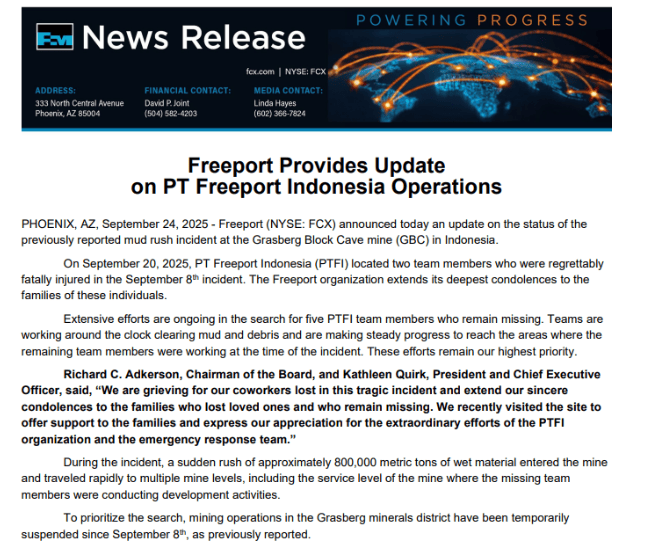
Core Viewpoint - The recent disaster at Freeport-McMoRan's Grasberg mine has triggered significant supply concerns in the copper market, leading to a sharp increase in copper prices and a reevaluation of market dynamics [2][4][5] Group 1: Incident Overview - On September 8, a mudslide at the Grasberg mine resulted in the loss of two workers and left five missing, causing substantial damage to infrastructure [2] - The Grasberg mine contributes 3.2% of global copper supply and 70% of Freeport's gold production, making its operational halt critical [2] - Following the incident, copper prices surged by 4% to $4.825 per pound, while Freeport's stock fell by 8% [2] Group 2: Market Reactions - Traders reacted instinctively to the supply disruption, with significant price movements observed across the market [4] - Goldman Sachs characterized the event as a "black swan," predicting a potential copper supply loss of 500,000 tons over the next 12-15 months, which could escalate to 2 million tons if recovery is delayed [4] - The current inventory structure is problematic, with 60% of global visible inventory locked in North America due to tariffs, limiting alternative sourcing options for Asian buyers [4] Group 3: Broader Supply Chain Implications - Other mines, such as Peru's Constancia and Panama's Cobre Panama, are also facing operational challenges, contributing to a tightening copper market [5] - Citigroup and Bank of America have raised their 2025 copper price forecasts to $5.2 per pound, an 18% increase from earlier predictions [5] - Freeport has revised its production guidance for 2026 down by 35%, indicating a prolonged recovery timeline that may extend to 2027 for full capacity restoration [5] Group 4: Impact on Industries - The copper supply shortage poses a significant challenge for manufacturers focused on global energy transition, as electric vehicles and wind farms require substantial copper [5] - If the supply gap persists for two years, the electric vehicle sector alone could consume an additional 300,000 tons of refined copper, equivalent to 40% of global tradable inventory [5] Group 5: Market Sentiment and Future Outlook - The capital markets are beginning to reassess the gap between green demand and brown supply, with significant inflows into copper mining ETFs and rising credit default swap rates for Freeport [6] - Analysts highlight that this operational disruption is the most severe for Freeport in 30 years, emphasizing the tangible risks posed by ESG factors and community conflicts [6] - The incident has exposed vulnerabilities in the global metal supply chain, raising concerns about potential systemic risks in the market [7]

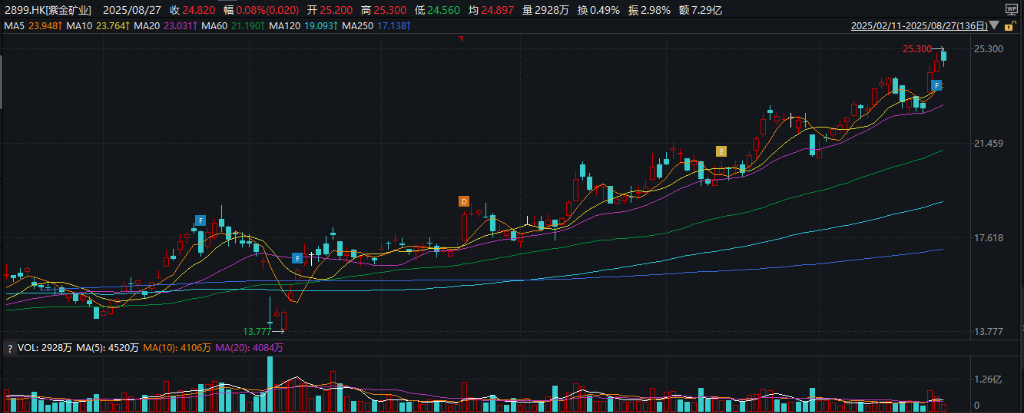
利润暴涨、股价新高!紫金矿业称“风险前所未有”,主要大国对关键矿产的竞争已进入高强度对抗阶段
Hua Er Jie Jian Wen· 2025-08-27 06:36
Core Viewpoint - Zijin Mining, the world's third-largest mining company, reported record quarterly performance but warned that geopolitical tensions and resource nationalism pose challenges to its overseas projects, with global uncertainty reaching unprecedented levels [1][3]. Financial Performance - Zijin Mining's latest financial report indicates a net profit of 28.6 billion yuan for the first half of 2025, a year-on-year increase of 55%, with attributable net profit reaching 23.3 billion yuan, up 54% [1]. - The company's revenue for the first half of the year was 167.7 billion yuan, reflecting an 11.5% year-on-year growth, and the overall gross margin for mineral products was 60.23%, an increase of 3 percentage points [4]. Production and Business Structure - The company produced 570,000 tons of copper, a 9% increase year-on-year; gold production reached 41 tons, up 16%; and silver production was 224 tons, a 6% increase [5]. - In terms of business structure, copper sales accounted for 27.8% of total revenue, with a gross margin of 38.5%, while gold sales represented 49.1% of revenue, benefiting from a significant rise in gold prices, with a gross margin of 38.6% [5]. Resource Strategy - Zijin Mining continues to implement a "exploration + acquisition" dual strategy, adding 2.049 million tons of copper resources and 888 tons of gold resources during the reporting period [5]. - The company has made strategic acquisitions, including the Akim gold mine in Ghana and the Raygorodok gold mine in Kazakhstan, enhancing its presence in West Africa and Central Asia [6]. Geopolitical Risks - The company highlighted multiple challenges facing the mining industry, including rising costs, trade disruptions, and countries seeking to protect their resources [7]. - Political, policy, and legal differences between countries, along with resource nationalism, may pose challenges to construction and production operations [7]. Market Outlook - In the copper market, the introduction of U.S. copper tariffs, combined with low global inventories, may lead to short-term market volatility as trade flows are reshaped [10]. - For the gold market, expectations of U.S. interest rate cuts, geopolitical tensions, a weak dollar, and central bank purchases are expected to enhance gold's attractiveness [11]. - The zinc market is facing short-term pressure with a tight balance, as production increases in China but reductions are seen overseas [12]. - In the lithium market, the company warned that disruptions in supply expectations could lead to high price volatility, and the clearing of excess supply will take time [13].
新能源及有色金属日报:基本面短期内或呈现双弱格局,铜价暂陷震荡-20250808
Hua Tai Qi Huo· 2025-08-08 03:27
1. Report Industry Investment Rating - Copper: Cautiously bullish [6] - Arbitrage: On hold - Options: Short put @ 77,000 yuan/ton 2. Core View of the Report - The supply constraint logic still exists, providing strong support for copper prices. The demand side shows that the global visible copper inventory has increased, and the downstream purchasing sentiment is cautious, with no obvious marginal improvement in demand. There are concerns about whether the demand can be maintained in the second half of the year due to global macro - economic uncertainties. In the short term, the macro - level catalysts are weakening, making it difficult to significantly improve the overall copper demand expectation. In the future, the domestic anti - involution meeting's stance on copper supply constraints can still be expected, and the probability of a significant weakening of demand is low. It is recommended to mainly use buy - on - dips hedging for copper, with a buying range of 77,000 yuan/ton to 77,500 yuan/ton [6][7] 3. Summary by Relevant Catalogs Market News and Important Data Futures Quotes - On August 7, 2025, the main Shanghai copper futures contract opened at 78,380 yuan/ton and closed at 78,460 yuan/ton, a 0.23% increase from the previous trading day's close. The night - session main contract opened at 78,420 yuan/ton and closed at 78,360 yuan/ton, a 0.13% decrease from the afternoon close [1] Spot Situation - The domestic electrolytic copper spot market showed a stable - to - strong trend. The spot price was at a premium of 70 - 150 yuan/ton to the 2508 contract, with an average of 110 yuan/ton, a 10 - yuan/ton increase from the previous day. The trading range was 78,410 - 78,590 yuan/ton. The market supply was structurally tight, with a decrease in domestic supply. The inventory decreased slightly this week, and the spot premium is expected to remain firm [2] Important Information Summary - Macro: The number of initial jobless claims in the US last week increased by 7,000 to 226,000, slightly higher than expected. The number of continued jobless claims increased by 38,000 to 1.97 million, the highest since November 2021. The market is trading on easing expectations. There are personnel changes in the Fed. Geopolitically, Russia and the US are preparing for a summit. Overall, the data and personnel changes are fueling easing expectations, which may support copper prices [3] Mining End - Jubilee metals' Zambian copper investment portfolio has made significant progress, and it has all the assets needed for its copper expansion strategy. It has built a diversified platform with three pillars in Zambia [4] Smelting and Imports - In July 2025, China's imports of unwrought copper and copper products were 480,000 tons, increasing for two consecutive months and up 9.6% year - on - year. From January to July, the cumulative imports were 3.113 million tons, a 2.6% year - on - year decrease. The imports of copper concentrates in July were 2.56 million tons, an 8.9% increase from June, and the cumulative imports from January to July were 17.314 million tons, an 8.0% year - on - year increase [4] Consumption - Wood Mackenzie's Charles Coope pointed out that copper consumption is expected to increase by about 2.6%. By 2035, about 6 million tons of new copper production capacity will be needed to meet the demand [5] Inventory and Warehouse Receipts - LME warehouse receipts changed by 2,275 tons to 156,000 tons, SHFE warehouse receipts changed by - 201 tons to 20,145 tons. On August 7, the domestic electrolytic copper spot inventory was 132,000 tons, a decrease of 3,900 tons from the previous week [5] Strategy - Copper: Cautiously bullish, with a recommended buy - on - dips hedging strategy and a buying range of 77,000 - 77,500 yuan/ton. - Arbitrage: On hold - Options: Short put @ 77,000 yuan/ton [6][7] Data Table - The table shows data on copper prices, basis, inventory, warehouse receipts, and arbitrage from August 8, 2025, compared with previous periods, including prices of different copper types, inventory in different markets, and arbitrage spreads [25][26][27]