
反内卷

Search documents
赵伟:综合整治“内卷式”竞争:背景、成因、影响及应对
赵伟宏观探索· 2025-12-24 16:03
Core Viewpoint - The article discusses the phenomenon of "involution" in the Chinese economy, highlighting its causes, impacts, and policy responses, emphasizing the need for structural reforms to promote high-quality economic development [3][4][5]. Group 1: Causes and Impacts of Involution - The current "involution" is characterized by long-term negative growth in the Producer Price Index (PPI) and low capacity utilization rates in mid- and downstream industries, which squeeze corporate profits and hinder industrial upgrades [3][4][5]. - The deep-rooted causes of this "involution" include the differentiation of old and new economic drivers during the economic transition period and the homogeneous and disorderly competition among local governments pursuing GDP and fiscal revenue [4][5][11]. - The "involution" phenomenon has created a spiral contraction cycle of "price-income-consumption," severely restricting healthy economic development and transformation [4][5]. Group 2: Policy Responses - Successful containment of "involution" is essential not only for stabilizing short-term economic growth but also for transitioning China's economy from factor-driven to innovation-driven, achieving high-quality development [5][6]. - Policy measures should focus on coordinated efforts from both supply and demand sides, combining growth stabilization with reform promotion [5][6]. - On the supply side, strategies include production adjustment, elimination of outdated capacity, and optimizing industrial structure to enhance product quality [5][6]. - On the demand side, there is a need to vigorously develop resident service consumption, release consumption potential through fiscal subsidies and social security improvements, and guide employment from manufacturing to services [5][6]. Group 3: Evolution of Anti-Involution Policies - Since mid-2024, high-level meetings have continuously addressed the need to combat "involution," with a clear policy commitment to prevent "malicious competition" [6][10]. - The 2025 government work report emphasizes the establishment of a unified national market and the need to eliminate local protectionism and market segmentation [7][10]. - The current anti-involution policies are characterized by a higher stance, broader coverage, and stronger synergy compared to previous supply-side reforms [10][11]. Group 4: Macroeconomic Background and Industry Characteristics - The macroeconomic environment is under pressure from continuously declining prices, with the PPI experiencing negative growth for 33 consecutive months, and industrial capacity utilization rates at historical lows [15][18]. - The profitability of industrial enterprises is under significant pressure, with many industries experiencing negative profit growth, particularly in mid- and downstream sectors [18][21]. - The phenomenon of "involution" is more complex and diverse compared to 2015, with competition shifting from traditional sectors to new areas, leading to lower capacity utilization rates in high-demand sectors [23][24]. Group 5: Recommendations and Future Directions - The article suggests that lessons from international experiences, such as industry consolidation and market clearing, could be beneficial in addressing the challenges posed by "involution" [31][32]. - It emphasizes the importance of combining total quantity policies with structural policies to effectively address the "involution" dilemma [34][37]. - Long-term strategies should focus on accelerating the development of the service sector to adapt to changing consumer preferences and demographic trends, thereby addressing the structural unemployment issues arising from the transition [38][40].

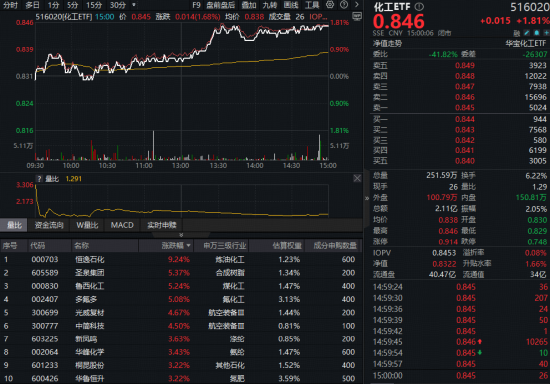
锂电挺价+产能出清,化工ETF(516020)午后猛拉飙涨1.81%!主力资金狂涌369亿布局景气反转
Xin Lang Cai Jing· 2025-12-24 14:09
Group 1 - The chemical sector showed strong performance today, with the chemical ETF (516020) closing up 1.81% after a volatile session [1][11] - Notable stocks included Hengyi Petrochemical, which surged by 9.24%, and several others like Shengquan Group and Luxi Chemical, which rose over 5% [1][11] - The chemical ETF's underlying index has recorded a year-to-date increase of 34.27%, significantly outperforming major indices like the Shanghai Composite Index (17.58%) and the CSI 300 Index (17.77%) [12][13] Group 2 - The basic chemical sector has attracted substantial capital inflow, with a net inflow of 79.67 billion yuan today, ranking sixth among 30 major sectors [4][14] - Over the past five days, the sector saw a total net inflow of 369.22 billion yuan, leading all sectors [4][14] Group 3 - The lithium industry is experiencing a recovery, with rising prices for lithium carbonate futures and optimistic market expectations for future prices [5][16] - The chemical sector is currently viewed as having a favorable valuation, with the chemical ETF's underlying index trading at a price-to-book ratio of 2.48, which is relatively low compared to historical levels [6][16] Group 4 - Looking ahead, the chemical industry is expected to face a contraction in capital expenditure, which may lead to a supply reduction and increased demand due to policy support and economic conditions [7][17] - The "anti-involution" trend is anticipated to lead to a reevaluation of the Chinese chemical industry, potentially resulting in higher dividend yields and improved market conditions for chemical stocks [8][18] Group 5 - The chemical ETF (516020) provides an efficient way to invest in the sector, with nearly 50% of its holdings in large-cap leading stocks, allowing investors to capitalize on strong market trends [8][18]



黑色金属日报-20251224
Guo Tou Qi Huo· 2025-12-24 13:27
Industry Investment Ratings - The investment rating for rebar is ★☆☆, indicating a slightly bullish view but with limited operability on the trading floor [1]. - The investment rating for hot-rolled coil is ★☆☆, suggesting a slightly bullish view but with limited operability on the trading floor [1]. - The investment rating for iron ore is ★★★, representing a clearer bullish trend with a relatively appropriate investment opportunity currently [1]. - The investment rating for coke is ★☆☆, meaning a slightly bullish view but with limited operability on the trading floor [1]. - The investment rating for coking coal is ★☆☆, indicating a slightly bullish view but with limited operability on the trading floor [1]. - The investment rating for silicon manganese is ★★☆, suggesting a clear bullish trend and the market is currently evolving [1]. - The investment rating for ferrosilicon is ★☆★, the white star implies that the short - term bullish or bearish trend is in a relatively balanced state, and the current trading floor has poor operability, so it's advisable to wait and see [1] Core Viewpoints - The steel market has a slightly bullish short - term trend with caution due to factors like demand, supply, and macro - policies [2]. - The iron ore market is expected to trade sideways in the short term with a relatively loose fundamental situation [3]. - The coke market will likely trade sideways as the market anticipates stimulus policies despite a rich carbon supply and downstream demand characteristics [4]. - The coking coal market is likely to trade sideways as it faces fundamental pressure after discount repair but also has expectations for stimulus policies [6]. - For silicon manganese, it's recommended to try going long on dips considering the market situation [7]. - For ferrosilicon, it's recommended to try going long on dips given the demand and supply situation [8] Summary by Commodity Steel - Rebar's apparent demand has recovered, production has slightly increased, and inventory has continued to decline. Hot - rolled coil's supply and demand have both decreased, and de - stocking has accelerated slightly but pressure remains. Iron - water production has continued to fall, supply pressure is easing, and the slowdown of steel mill production cuts may slow. The downstream demand is weak, and exports are high. The short - term trading floor is expected to be slightly bullish [2]. Iron Ore - The global supply of iron ore is strong with high - end - of - year shipment expectations. Domestic arrivals are also strong, and port inventory has increased significantly. The demand is low in the off - season, and iron - water production cuts are expected to slow. The short - term trading floor is expected to trade sideways [3]. Coke - The third round of price cuts for coke has been fully implemented, production has slightly decreased, and inventory has slightly declined. The carbon supply is abundant, downstream demand has seasonal decline but still has resilience, and the price is likely to trade sideways [4]. Coking Coal - Some coal mines have reduced or stopped production at the end of the year. Production has slightly decreased, spot auction prices have slightly increased, and inventory has increased. The carbon supply is abundant, downstream demand has seasonal decline but still has resilience, and the price is likely to trade sideways [6]. Silicon Manganese - The spot price of manganese ore has increased. There are structural problems in port inventory. Iron - water production has decreased seasonally, and silicon manganese production and inventory have slightly declined. It's recommended to try going long on dips [7]. Ferrosilicon - There are expectations of coal supply guarantee, which may lead to a decline in electricity costs and blue - carbon prices. Iron - water production has rebounded, export demand has decreased, and metal magnesium production has increased. Supply has significantly decreased, and inventory has slightly declined. It's recommended to try going long on dips [8]
中国经济-中国企业家调查:企业运营、反内卷与供应链转移
2025-12-24 12:57
abc 2025 年 12 月 22 日 中国经济透视 中国企业家调查:企业运营、反内卷与供应链 转移 受访者对贸易前景和中美关系预期改善 UBS Evidence Lab第17期中国企业家调查对400多名企业高管进行问卷调 查。得益于贸易谈判在过去几个月取得了积极进展,调查结果显示相较 于2025年4月和6月的调查,2025年9月企业家对中美关系的预期改善。 在2025年9月开展的调查中,大部分受访者预计中美两国可以达成贸易协 议、关税或将降低;在10月底中美贸易摩擦缓和,这一预期已部分兑现。受 访者所在企业的出口订单已较2025年6月的恐慌中恢复,非美国市场订单继 续好于整体订单。在美国加征关税的背景下,受访者中对美出口商的出口价 格较2024年底水平小幅提高。受访者对非美国贸易伙伴实施偏紧政策的担 忧较2025年6月调查有所上升,尤其是欧洲、加拿大和墨西哥。同时,受访 者对中国面临科技限制的预期转为相对更正面。 Powered by YES UBS Evidence Lab Global Research 预计供应链转移继续,但速度或有所放缓 中国 王 紫娇 经济学家 S1460524050003 gr ...

东兴证券晨报-20251224
Dongxing Securities· 2025-12-24 12:14
Economic News - The State-owned Assets Supervision and Administration Commission emphasized the need for central enterprises to enhance budget management and cost control across all aspects of operations [2] - The National Development and Reform Commission and the National Energy Administration aim for a total installed capacity of 15 million kilowatts for solar thermal power by 2030, with costs comparable to coal power [2] - The Ministry of Housing and Urban-Rural Development proposed measures to promote the sale of existing homes and optimize affordable housing supply [2] - The General Administration of Customs conducted research on cutting-edge technology development and technology transfer [2] - The Hainan Free Trade Port has begun exporting self-produced goods with a value of 32,000 yuan, benefiting from over 12% cost savings [2] - The Shanghai Municipal Finance Bureau announced a subsidy for pig income insurance, with the municipal government covering 50% of the premium [2] - The U.S. economy showed a revised annualized GDP growth of 4.3% in Q3, exceeding expectations [2] - Japan reported a leak of radioactive water from a new reactor, with ongoing investigations into external radiation exposure [2] - Brazil confirmed anti-dumping duties on automotive glass from China, with specific rates for Malaysian producers [2] - South Korea's BC Card completed a pilot project for stablecoin payments, allowing foreign users to pay local merchants [2] Company Insights - Haibo Technology plans to invest 2 billion yuan in a smart green energy storage factory, expected to be completed by December 2028 [6] - Zhenyu Technology's subsidiary signed a strategic cooperation agreement to invest at least 1 billion yuan in projects related to new energy vehicle components and humanoid robots [6] - Huaxin Cement's major shareholder plans to increase its stake in the company by 200 million to 400 million yuan within six months [6] - Biological Shares' major shareholder intends to increase its stake by 50 million to 100 million yuan over the next year [6] Industry Strategy Agriculture Sector - The report suggests focusing on three main investment lines for the agriculture sector in 2026, with an emphasis on pig farming, feed, and pet food [7][9][10] - The pig farming industry is expected to see a gradual improvement in supply-demand dynamics, with a focus on cost management as a key factor for long-term growth [7] - The report highlights the potential for leading companies like Muyuan Foods to benefit from improved valuations and market conditions [8] Feed and Veterinary Medicine - The veterinary medicine sector is shifting towards innovation, with companies that prioritize R&D expected to thrive [9] - The feed industry is anticipated to see stable demand supported by high livestock inventory, with leading companies likely to gain market share [9] Pet Food Market - The domestic pet food market is projected to grow, with local brands gaining market share despite tariff disruptions [10][11]






12月24日盘后播报:高弹性板块涨幅居前,贵金属涨势如虹
Mei Ri Jing Ji Xin Wen· 2025-12-24 12:01
Market Performance - A-shares showed strong performance today, with the Shanghai Composite Index rising by 0.53% to 3940.95 points, the Shenzhen Component Index increasing by 0.88%, and the ChiNext Index up by 0.77% [1] - The total trading volume in the Shanghai and Shenzhen markets was 1.88 trillion yuan, a decrease of 19.6 billion yuan compared to the previous trading day [1] - High-volatility sectors such as military, consumer electronics, photovoltaic, and telecommunications performed well, while sectors like aquaculture, coal, and dividend stocks lagged behind [1] Investment Outlook - The long-term outlook for the equity market remains optimistic, driven by policies aimed at "expanding domestic demand," which includes support for income-driven demand, reasonable investment returns, and financial demand constrained by capital and debt [2] - The current bottleneck in the A-share market is attributed to the K-shaped economic recovery, with high-growth sectors like AI and export chains facing uncertainty, while low-growth sectors such as consumption and real estate may require policy support to recover [2] - The trade surplus has exceeded 1.2 trillion USD, indicating strong competitiveness in Chinese manufacturing, but rising protectionism poses risks to export growth [2] Sector Recommendations - Investors are advised to focus on sectors with more certainty, such as those related to power infrastructure, including mining ETFs, non-ferrous metal ETFs, and grid ETFs [3] - The economic structure remains unchanged, but if risks in AI and related fields materialize, cash flow ETFs may present significant value [3] - Precious metals are experiencing a strong upward trend, with gold prices surpassing 4500 USD per ounce for the first time, driven by geopolitical risks, supply shortages, and strong investment demand [3]
ETF日报:资金正源源不断地流入黄金ETF,今年除5月外,全球黄金ETF的总持仓量每个月都在上升
Xin Lang Cai Jing· 2025-12-24 11:49
Market Overview - A-shares experienced a rebound with the Shanghai Composite Index recording six consecutive days of gains, closing up 0.53% at 3940.95 points, while the Shenzhen Component Index rose 0.88% and the ChiNext Index increased by 0.77% [1][15] - The total trading volume in the Shanghai and Shenzhen markets was 1.88 trillion yuan, a decrease of 19.6 billion yuan from the previous trading day [1][15] - High-volatility sectors such as military, consumer electronics, photovoltaic, and communication performed well, while sectors like aquaculture, coal, and dividend stocks lagged behind [1][15] Investment Strategy - The current market environment suggests a neutral to strong risk appetite, with a recommendation for "balanced allocation" as a more prudent investment strategy due to the increasing difficulty in accurately betting on a single sector [1][15] - The China Securities A500 Index is highlighted as a new core broad-based index that aligns with market demands for balanced sector exposure [1][15] Future Outlook - The market is expected to continue its oscillating structure, with 2026 being a critical year for cross-year layout as it marks the beginning of the "14th Five-Year Plan" [2][16] - Structural opportunities are anticipated to arise from policy guidance and industry prosperity, with a focus on the China Securities A500 ETF (159338) as a popular choice among investors [2][16] Sector Analysis - The China Securities A500 Index offers comprehensive and balanced coverage across various industries, reflecting the performance of representative listed companies [2][16] - The index has reduced its weight in traditional sectors like non-bank financials and food and beverage by approximately 10%, reallocating to emerging industries, enhancing its growth characteristics [2][16] - The index includes 97% of the leading companies across various sectors, combining traditional giants with high-growth potential "hidden champions" [2][16] Precious Metals - Gold, silver, and platinum prices have surged to historical highs due to geopolitical risks, ongoing supply shortages, and strong investment demand [5][19] - The price of gold has surpassed $4500 per ounce for the first time, while platinum futures have exceeded $2300 per ounce [5][19] - The strong performance of gold is attributed to factors such as the recent interest rate cuts, higher-than-expected unemployment rates, and lower-than-expected CPI, which have raised expectations for further rate cuts [20] Cash Flow ETFs - The cash flow ETF (159399) has completed its quarterly adjustment, significantly increasing the weight of the communication sector while enhancing the allocation to electronics, retail, steel, and automotive industries [23][24] - The index adjustment has resulted in a more balanced industry distribution, with a slight increase in the free cash flow rate of constituent stocks [23][24] - Compared to other cash flow indices, the FTSE cash flow index is characterized by its focus on large and mid-cap stocks, providing a better risk-return profile [24][26]
煤炭行业2026年度投资策略:遇火生辉
Changjiang Securities· 2025-12-24 11:41
Core Insights - In 2025, coal prices significantly declined, leading to a return of sector profitability to the lowest levels in the past decade. However, the outlook for 2026 suggests potential demand improvement and limited supply capacity utilization, which may lead to a recovery in coal price levels [2][5][6]. - The report emphasizes that with a clear supply-demand improvement and the presence of both defensive and offensive investment opportunities, the likelihood of success for selected stocks is high. If demand is strong and coal prices improve beyond expectations, attention should be given to currently undervalued stocks with low liquidity and lower profit margins [2][7]. Industry Overview - The coal industry faced a challenging year in 2025, with thermal coal prices dropping from 855 CNY/ton in 2024 to 697 CNY/ton, an 18% decrease. The profitability of the sector fell to the 30th percentile of the past decade due to weak demand driven by warm weather and sluggish manufacturing electricity consumption [5][16]. - Coking coal prices also saw a significant decline, dropping 26% from 2024's 2022 CNY/ton to 1502 CNY/ton, with profitability at the 10th percentile of the past decade. This was primarily due to strong supply, with a 1.5% year-on-year increase in coking coal supply in the first three quarters of 2025 [5][16]. Demand and Supply Dynamics - For thermal coal in 2026, demand improvement is anticipated, with limited supply growth expected. The report identifies three key questions regarding market resilience: whether negative growth in thermal power will become the norm, if domestic supply can be controlled, and whether rising coal prices will increase imports [6][30]. - The report suggests that the central government's focus on controlling "involution" competition will continue to limit supply growth in 2026, despite some new production capacity coming online. Long-term resource depletion may also exert upward pressure on domestic coal prices [6][30]. Investment Recommendations - The report advocates for investment in the coal sector in 2026, highlighting the potential for a bottom reversal. It suggests that the timing for investment should align with capital flows, particularly in the first quarter when there is often a demand for increased allocation to dividend-paying sectors [7][30]. - Recommended stocks include Yanzhou Coal Mining Company and China Shenhua Energy, which are expected to benefit from a recovery in coal prices to a range of 750-800 CNY/ton. Additionally, stocks with significant growth potential and low valuations, such as Huayang Co. and Jinkong Coal Industry, are highlighted as potential targets if demand and price improvements exceed expectations [7][30].


煤焦日报:多空博弈,煤焦震荡运行-20251224
Bao Cheng Qi Huo· 2025-12-24 10:09
Report Industry Investment Rating - No relevant information provided Core Viewpoints - On December 24, the coke main contract closed at 1,746 yuan/ton, with an intraday increase of 0.20%. The position volume was 28,700 lots, a decrease of 552 lots from the previous trading day. The Rizhao Port quasi-primary wet quenched coke flat price index was 1,520 yuan/ton, down 3.18% week-on-week; the Qingdao Port quasi-primary wet quenched coke ex-warehouse price was 1,480 yuan/ton, unchanged week-on-week. Coke maintains a weak supply and demand pattern, but downstream winter storage replenishment and anti-involution expectations drive the coke futures to stop falling. With the expectation of steel mills' resumption of production after January, attention should be paid to the subsequent downstream replenishment and production rhythm [5][28]. - On December 24, the coking coal main contract closed at 1,132 points, with an intraday increase of 0.62%. The position volume was 500,500 lots, a decrease of 8,652 lots from the previous trading day. The latest quotation of Mongolian coal at the Ganqimaodu Port was 1,140 yuan/ton, unchanged week-on-week. Currently, the pressure on the coking coal supply side is released periodically. With the resurgence of downstream winter storage replenishment and anti-involution expectations, the market sentiment has turned from weak to strong, and the coking coal main contract has rebounded from a low level. Attention can be paid to the downstream replenishment rhythm in the near future [5][28]. Summary by Directory Industry News - The People's Bank of China and seven other departments jointly issued the "Opinions on Financial Support for Accelerating the Construction of the New Western Land-Sea Corridor", proposing 21 key measures to support the high-quality development of the corridor [8]. - On December 24, the coking coal price in the Linfen Anze market remained stable. The ex-factory price of low-sulfur primary coking coal with A9, S0.5, V20, and G85 was 1,600 yuan/ton, cash含税 [9]. Spot Market | Variety | Current Value | Weekly Change | Monthly Change | Annual Change | Year-on-Year Change | | --- | --- | --- | --- | --- | --- | | Coke (Rizhao Port Quasi-Primary Flat) | 1,520 yuan/ton | -3.18% | -8.98% | -10.06% | -12.64% | | Coke (Qingdao Port Quasi-Primary Ex-Warehouse) | 1,480 yuan/ton | 0.00% | 2.07% | -8.64% | -8.64% | | Coking Coal (Ganqimaodu Port Mongolian Coal) | 1,140 yuan/ton | 0.00% | -10.94% | -3.39% | -6.56% | | Coking Coal (Jingtang Port Australian Origin) | 1,510 yuan/ton | 1.34% | -3.82% | 1.34% | 2.03% | | Coking Coal (Jingtang Port Shanxi Origin) | 1,700 yuan/ton | 0.00% | -0.58% | 11.11% | 11.11% | [10] Futures Market | Futures | Active Contract | Closing Price | Increase/Decrease | Highest Price | Lowest Price | Trading Volume | Volume Difference | Position Volume | Position Difference | | --- | --- | --- | --- | --- | --- | --- | --- | --- | --- | | Coke | 1 | 1,746 yuan/ton | 0.20% | 1,759.5 yuan/ton | 1,723 yuan/ton | 16,601 | 28 | 28,726 | -552 | | Coking Coal | 1 | 1,132 points | 0.62% | 1,143.5 points | 1,107 points | 1,169,245 | -73,297 | 500,547 | -8,652 | [13] Related Charts - The report provides charts on coke inventory, coking coal inventory, and other related production and consumption data, including the inventory of 230 independent coking plants, port coke inventory, 247 steel mills' coking plant inventory, etc., as well as the production situation of domestic steel mills, Shanghai terminal wire and screw procurement volume, etc. [14][15][16]
过剩格局下的矛盾演化与政策博弈:2026年光伏产业链年度报告
Guo Lian Qi Huo· 2025-12-24 10:09
Report Summary 1. Investment Rating The report does not provide an industry investment rating. 2. Core Views - **Industrial Silicon**: In 2026, the industrial silicon market is expected to continue the pattern of "overall surplus and structural differentiation." Supply will be concentrated in the northwest, with slow clearance of backward capacity. Demand growth will slow down, mainly driven by polysilicon but limited by the slowdown in photovoltaic installation growth. Electricity cost is the core variable, with the northwest having a stable cost advantage and the southwest showing significant seasonal fluctuations. Prices are expected to fluctuate around the cost range, constrained by supply elasticity [5][7][10]. - **Polysilicon**: The polysilicon industry is transitioning from an "excess logic" to a complex stage of "policy intervention and high - quality capacity reshaping." Supply will experience structural changes, with backward capacity facing rigid exit and high - quality N - type material in short supply. Demand will enter a platform period due to the slowdown in global photovoltaic installation growth, and the industrial chain profit needs to be redistributed downstream. The market will be in a game between the "policy bottom" and the "demand top," and price trends and basis structures will be significantly affected by policy implementation and technological iteration [5][13][17]. 3. Summary by Directory 3.1 2025 Market Review - **Industrial Silicon**: In 2025, the price of industrial silicon showed a significant downward trend in the first half of the year due to supply pressure, and then fluctuated widely in the second half. The price was affected by factors such as production reduction in the southwest, weak downstream demand, and policy expectations [25]. - **Polysilicon**: The polysilicon market in 2025 went through four stages: shock, decline, sharp rise, and high - level consolidation. Policy factors, supply - demand imbalances, and market sentiment were the main drivers of price changes [28][29][30]. 3.2 Cost and Profit - **Power Cost**: Power cost is the most important variable in the cost of industrial silicon. The southwest has obvious seasonal power cost changes, while the northwest has a relatively stable power cost structure. In the future, the power cost advantage in Xinjiang will be more obvious through the source - network - load - storage integration model, and Yunnan and Sichuan have their own green power utilization models, but there are still challenges in power supply stability [34][35][36]. - **Silicon Coal**: In 2025, the price of silicon coal dropped by 30% - 45%, but in 2026, the downward space is limited. If the coal price stabilizes and rebounds, it will support the cost of industrial silicon. The price of silicon coal is expected to rebound to 1600 - 1800 yuan/ton if the "anti - involution" policy promotes industry self - discipline [43][44]. - **Overall Cost and Profit**: The cost of industrial silicon is relatively stable in 2026. The northwest has a lower cost, while the southwest has higher costs in the dry season. The profit level in 2025 was differentiated, and the industry profit rebounded slightly in the second half of the year [49]. 3.3 Supply - **Excess Pattern and Slow Clearance**: The industrial silicon supply in 2026 will maintain the pattern of overall surplus and structural differentiation. There is a large amount of backward capacity, and the market has difficulty in quickly clearing it due to policy - market differences and regional interest differentiation [57][58][62]. - **New Capacity**: New capacity will still be concentrated in the northwest in 2026. However, due to the impact of industrial silicon profits, the construction and commissioning of some new capacity may be postponed [67]. 3.4 Demand - **Polysilicon**: The demand for polysilicon in 2026 will be affected by the slowdown in photovoltaic installation growth. The supply of polysilicon will experience structural changes, with backward capacity being eliminated and high - quality N - type material in short supply. The price and basis structure will be affected by policy implementation and technological iteration [69][74][131]. - **Organic Silicon**: The demand for organic silicon is expected to remain stable in 2026. The supply - demand balance is expected to be repaired, and exports will drive the growth of organic silicon demand [104][107]. - **Aluminum Alloy**: The demand for silicon in the aluminum alloy industry will remain stable in 2026. Although the production of the aluminum alloy industry is growing, the consumption of primary industrial silicon is limited, and new energy vehicle consumption has limited impact on the demand for industrial silicon [112]. - **Export**: The export of industrial silicon is expected to remain stable in 2026. Overseas markets mainly purchase on - demand, and some overseas orders have been transferred to China due to cost and quality advantages [122]. 3.5 Supply - Demand Balance Sheet - **Industrial Silicon**: In 2026, the supply of industrial silicon will increase slightly, and the demand growth rate will be about 5%. The supply - demand gap will widen slightly, and the surplus pattern will be slightly improved [125][126]. - **Polysilicon**: In 2026, the supply - demand situation of polysilicon will be affected by policies. If the capacity is tightened as expected, the market will be in a tight - balance state; otherwise, it will remain in an oversupply state [127][129]. 3.6 Market Outlook - **Industrial Silicon**: In 2026, the industrial silicon market will continue to be in a slightly surplus state. Prices will fluctuate around the cost range, and attention should be paid to the marginal changes brought about by short - term supply - demand mismatches and policy implementation [10][130]. - **Polysilicon**: The polysilicon market will be in a game between policy implementation, capacity clearance, and global installation demand. The price will seek a balance among the "policy bottom," "demand top," and "quality difference," and the market may be in a tight - balance state [17][131].