
反内卷

Search documents
全球布局+绿色转型双轮驱动 恒逸石化以一体化优势捕捉海内外机遇
Zheng Quan Shi Bao Wang· 2025-12-23 11:05
Core Viewpoint - Hengyi Petrochemical is positioned to benefit from the expansion of overseas cracking margins and the domestic industry's "anti-involution" trend, with significant growth opportunities anticipated in the Southeast Asian refined oil market by 2026 [1][2]. Group 1: Market Opportunities - By 2026, the refined oil supply-demand gap in Southeast Asia is expected to widen to 68 million tons, with Hengyi Petrochemical's Brunei Phase II project completed site preparations, laying a foundation for long-term development [1]. - The Brunei refining project, which Hengyi holds a 70% stake in, has an annual crude processing capacity of 8 million tons and is strategically positioned to meet the growing demand driven by a 5.4% average GDP growth in Southeast Asia [1]. - The European gasoline cracking margin surged by 149% year-to-date due to a 15.5% reduction in Russian refining capacity, while the Singapore diesel margin increased by 95% [1]. Group 2: Domestic Market Developments - The domestic market has seen significant results from multi-product "anti-involution" actions, with caprolactam prices rising from 8,050 CNY/ton to 9,125 CNY/ton in November, and polyester bottle chip processing margins recovering from 300 CNY/ton to 550 CNY/ton [2]. - Guotou Securities has issued a "buy" rating for Hengyi Petrochemical, predicting continued high growth in exports of polyester filament and bottle chips from 2026 to 2027, with a positive shift in the PTA supply-demand landscape [2]. Group 3: Sustainability and Innovation - Hengyi Petrochemical has established a full-chain advantage in green transformation, focusing on "recycling-degradation-regeneration" with a 300,000-ton BHET recycling project in Hubei Jiangling, supported by 169 intelligent recycling points [2]. - The company is expanding production of its self-developed biodegradable polyester "Betel" and antimony-free polyester "Yitai Kang," forming an innovation conversion system from laboratory to industrialization, positioning itself advantageously in the low-carbon economy era [2]. Group 4: Financial Performance and Value Creation - Since its listing, Hengyi Petrochemical has implemented a cash dividend of 5.6 billion CNY and an employee stock ownership plan of 5.2 billion CNY, alongside a planned share buyback of 1.5 to 2.5 billion CNY by the controlling shareholder [3]. - The company holds a 3.54% stake in Zheshang Bank, providing stable investment returns, and has built a diversified value creation system through "main business profitability + capital appreciation," supporting resilience through industry cycles [3].

摩根大通刘鸣镝最新发声!
Zhong Guo Ji Jin Bao· 2025-12-23 08:08
【导读】刘鸣镝:A股慢牛初长成,2026年看好四大主题 2025年12月19日,由中国基金报主办,摩根资产管理、慧博科技、安永支持的2025资本市场香港论坛成功举行。 论坛主题为"科技与资管赋能高质量发展",为紫荆文化集团主办的"首届国际AI艺术节"系列活动之一,汇集约150位来自香港特区政府、高校、科技企 业、金融服务机构以及境内外资产管理机构的相关负责人、专业人士,共同探讨驱动资产管理和科技增长的新动能,剖析人工智能(AI)革命带来的新机 遇,激辩全球视野下的中国资产配置新机遇。 摩根大通中国内地及香港地区股票策略研究主管刘鸣镝在本次论坛上发表题为"慢牛初长成:亚洲视角下的中国股票展望"的主题演讲。刘鸣镝回顾了近年 中国股票市场表现,并发表了对2026年市场的核心思考和深度解读。其核心观点指出,中国股市已步入慢牛初期,企业业绩将成为2026年市场核心驱动因 素,多个板块回报空间可期。 回顾2025年,行业表现分化明显。正向回报行业中,材料类行业受益于"反内卷"政策趋势与去美元化背景下对贵金属的需求,以及新能源对银、铝、铜, 碳酸锂等资源需求支撑,实现翻倍收益;医疗健康行业贴合创新发展浪潮,回报率超60%; ...


摩根大通刘鸣镝最新发声!
中国基金报· 2025-12-23 08:01
Core Viewpoint - The Chinese stock market has entered the initial phase of a slow bull market, with corporate earnings expected to be the main driving factor in 2026, and multiple sectors showing potential for returns [2][8]. Group 1: Slow Bull Market Formation Logic - The institutionalization of A-shares is a key reason for the current slow bull market, contrasting with the retail-driven market of 2014-2015 [4]. - Corporate earnings are gradually improving, providing crucial support for market growth, with the MSCI China Index expected to see a 2%-3% year-on-year growth in 2025 [5]. - The "PBOC put" mechanism introduced by the People's Bank of China has provided essential support to the market, alongside a narrowing of market volatility due to the dominance of institutional funds [5][6]. Group 2: Industry Performance in 2025 - Positive return sectors include materials, benefiting from the "anti-involution" policy and demand for precious metals, achieving returns of over 100%; the healthcare sector has seen returns exceeding 60% [6]. - The insurance sector performed well due to growth in new premiums and a favorable stock market, while AI-related sectors such as gaming, media, and semiconductors have become market favorites [6]. - Conversely, sectors linked to macroeconomic recovery, such as food and beverage, electricity, and delivery services, have underperformed due to weak consumer recovery and excessive competition [6]. Group 3: Outlook for 2026 - The main themes for 2026 include exports, AI, "anti-involution," and consumption, with corporate earnings being the most critical factor for stock performance [8][9]. - The MSCI China Index is projected to reach a target of 100, the CSI 300 Index at 5200, and the MSCI Hong Kong Index at 16000, all expected to achieve double-digit returns in 2026, supported by earnings growth [8]. - Key sectors to watch include export-related industries benefiting from global fiscal and monetary easing, AI-related sectors with recovery potential, and the consumer sector showing a "K"-shaped recovery [9].

锂电原料大面积涨价,化工板块猛攻延续!化工ETF(516020)盘中涨超1%,戴维斯双击将至?
Xin Lang Cai Jing· 2025-12-23 06:05
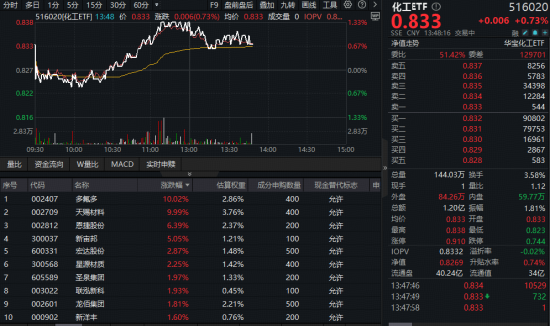
Core Viewpoint - The chemical sector continues to show strong performance, with the chemical ETF (516020) experiencing a significant increase, reflecting a broader positive trend in the industry [1][9]. Group 1: Market Performance - On December 23, the chemical ETF (516020) saw a maximum intraday price increase of 1.33%, closing with a gain of 0.73% [1][10]. - The chemical sector has outperformed major A-share indices this year, with the chemical ETF's index showing a year-to-date increase of 33.41%, compared to 16.87% for the Shanghai Composite Index and 17.2% for the CSI 300 Index [1][12]. Group 2: Stock Performance - Key stocks in the chemical sector, particularly in fluorine chemicals and lithium batteries, have shown notable gains, with companies like Duofu Duo and Tianci Materials hitting the daily limit up, and others like Enjie and Xinzhoubang increasing by over 6% and 5% respectively [1][10]. Group 3: Price Trends in Raw Materials - Since November, there has been a significant price increase in core raw materials for lithium batteries, with lithium hexafluorophosphate rising from 55,000 CNY/ton to 120,000 CNY/ton (over 118% increase), and lithium cobalt oxide increasing from 140,000 CNY/ton to 350,000 CNY/ton (over 150% increase) [4][13]. - The price of battery-grade lithium carbonate has also surpassed 94,000 CNY/ton, with a monthly increase of over 16% in November [4][13]. Group 4: Valuation and Investment Outlook - The current price-to-book ratio of the chemical ETF's index is 2.32, which is at a relatively low level compared to the past decade, indicating potential value for long-term investment [4][13]. - Analysts predict that the chemical industry may experience a cyclical upturn by 2026, driven by supply-side adjustments and policy support, suggesting a favorable environment for investment in the sector [6][14].






ETF日报|A股大反攻!光模块强势爆发,创业板人工智能ETF(159363)放量猛涨5%!机构:AI、反内卷或是两大主线!
Jin Rong Jie· 2025-12-23 05:43
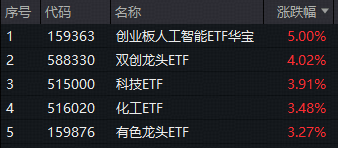
Market Overview - The A-share market saw a collective rise in the three major indices, with the Shanghai Composite Index up over 1% and the ChiNext Index up over 3%, with a total trading volume of 1.81 trillion yuan, an increase of 87 billion yuan from the previous day [1] - The market surge is attributed to three main factors: strong performance of brokerage stocks, significant trading activity in broad-based ETFs, and comments from a former Japanese central bank official opposing early interest rate hikes, easing global liquidity concerns [1] Sector Performance - The optical module sector experienced a strong breakout, with New Yi Sheng and Zhong Ji Xu Chuang topping the A-share capital inflow rankings. The ChiNext AI ETF (159363) surged 5% with a net subscription of 162 million units [1][6] - The "anti-involution" theme also performed well, with lithium carbonate futures seeing a sudden spike, leading to a 3.48% increase in the Chemical ETF (516020) and a 3.27% rise in the Nonferrous Metals ETF (159876) [2] Institutional Insights - Investment institutions are optimistic about the A-share market transitioning from a structural bull market to a more comprehensive bull market by 2026, with expectations of a gradual recovery in earnings [3][4] - J.P. Morgan highlighted that earnings will be key to the upward momentum of Chinese assets next year, with over one-third of sub-sectors currently in the revenue expansion quadrant [4] Key Stocks and ETFs - The top-performing stocks included Lian Te Technology, New Yi Sheng, and Tian Fu Communication, with significant price increases [6][7] - The Chemical ETF (516020) and Nonferrous Metals ETF (159876) have seen substantial inflows, indicating strong market interest in these sectors [13][19] Lithium Market Dynamics - The lithium carbonate futures market saw a dramatic increase, with prices nearing 109,860 yuan per ton, driven by supply-demand dynamics and regulatory changes affecting mining licenses [23] - The storage industry in China is expected to grow significantly over the next 3-5 years, driven by AI and data center demands, which will boost lithium demand [15] Future Outlook - Looking ahead to 2026, the chemical industry is expected to see improved profitability and dividend capabilities, with a focus on the "anti-involution" and global AI demand cycles [17] - The nonferrous metals sector is anticipated to benefit from supply-demand imbalances and geopolitical tensions, making it a core asset allocation target for the medium to long term [24]





上游反内卷,下游反垄断
Haitong Securities International· 2025-12-23 05:08
Investment Rating - The report maintains a positive long-term outlook on thermal power, indicating a favorable investment rating for the sector [1]. Core Insights - The Energy Bureau has penalized five cases of collusion in power plant pricing, reflecting ongoing anti-competitive measures in the industry [4]. - Downstream manufacturing sectors, such as photovoltaic (PV) and machinery, are experiencing export growth, which is beneficial for the national economy [4]. - Moderate electricity price increases are seen as supportive of energy storage development and carbon neutrality goals, while lowering prices could hinder these objectives and miss global demand opportunities [4]. - The second round of electricity bidding may yield lower prices compared to the first round, with specific examples from Jiangxi and Jilin indicating price reductions [4]. - November saw a negative growth rate in thermal power generation, with industrial power generation showing a year-on-year increase of 2.7% [4]. - Fixed asset investment in the power and utilities sector grew by 10.7%, contrasting with a 2.6% decline in overall fixed asset investment [4]. - The retail power price spread in Anhui remains stable, with average retail prices at RMB 0.4182/kWh and wholesale prices at RMB 0.3970/kWh [4]. - Qinghai's spot power price is capped at RMB 0.65, which is hindering the development of energy storage solutions [4].
高盛复盘2025年中国股市十大启示:AI重估科技,反内卷修复盈利,慢牛已在路上
美股IPO· 2025-12-23 04:15
Core Viewpoint - Goldman Sachs believes that after two consecutive years of gains, the Chinese stock market is poised for a "slow bull" market driven by profit growth taking over from valuation recovery [1][2][4]. Group 1: Market Trends - The report identifies ten core trends for the Chinese stock market in 2025, highlighting that the market is transitioning from a "hope" phase to a "growth" phase, primarily driven by valuation rather than profit growth [2][4]. - A-shares and H-shares recorded annual returns of 16% and 29% respectively in 2025, significantly surpassing earlier predictions [2]. - The MSCI China Index's forward P/E ratio increased from 9.9x at the beginning of 2025 to 12.5x currently, while forward earnings per share (fEPS) declined by 4% [4]. Group 2: AI and Technology - The release of DeepSeek-R1 has fundamentally changed the investment narrative for Chinese tech stocks, contributing to a market capitalization increase of over $2 trillion across related sectors [2][11]. - The widespread adoption of AI is expected to drive annual profit growth of 3% for companies over the next decade through cost savings and productivity improvements [12]. Group 3: Trade Performance - China's trade performance has exceeded expectations, with exports growing by 5.4% year-on-year and the RMB appreciating by 4% against the USD [9]. - The resilience of Chinese exports indicates a shift from low-cost manufacturing to selling high-value products in emerging markets [13]. Group 4: Consumption Trends - Despite a sluggish real estate market and slow household income growth, there is significant differentiation within the consumption sector, with service consumption outperforming goods consumption [15]. - New consumption sectors, such as entertainment and specialty retail, have shown strong performance, with an average net profit growth of 28% in the first half of 2025 [16]. Group 5: Policy and Economic Outlook - The "anti-involution" policy is expected to enhance corporate profits in certain sectors by 50% by 2027, as supply-side reductions and industry consolidation take effect [18]. - The "14th Five-Year Plan" is highlighted as a critical investment blueprint, with a constructed portfolio yielding a 68% return over the past year, outperforming the MSCI China Index [20]. Group 6: Capital Flows - Domestic capital is increasingly interested in equity assets, with southbound capital inflows reaching $180 billion, a record high [21]. - Global hedge funds have increased their net exposure to China from 6.8% at the beginning of the year to 7.8% by the end of November [21]. Group 7: Market Valuation - The Chinese market is seen as increasingly attractive for diversification, with a 35% discount compared to developed markets and a 9% discount compared to other emerging markets [22]. - The report suggests that structural migration of capital towards equity assets in China may have already begun, as equity assets start to outperform other asset classes [23].
太平洋证券:重视底部再布局 新技术持续落地+上游供需持续向好
智通财经网· 2025-12-23 04:06
Core Viewpoint - The report from Pacific Securities emphasizes the importance of re-entering the bottom of the new energy industry, highlighting the continuous implementation of new technologies and the improving supply-demand dynamics in the upstream sector. It suggests that the current period presents a favorable opportunity for investment, particularly focusing on the certainty of leading companies and the elasticity of upstream resources [1] New Energy Vehicle Industry Chain - A new cycle has begun with ongoing innovations in battery technology, such as large cylindrical and solid-state batteries. For instance, the new BMW iX3, equipped with a new generation large cylindrical battery from EVE Energy, achieved a real-world range of 1007.7 km, surpassing the official WLTP range of 805 km. EVE Energy is also planning a 30 GWh production facility for large cylindrical batteries near BMW's plant in Hungary, expected to be operational by 2026. Companies like CATL, EVE Energy, and Putailai are expected to benefit [2] - Solid-state battery technology is progressing, with laboratory tests showing energy densities reaching 824 Wh/kg, with potential to exceed 1000 Wh/kg in the future. The industry is adopting a strategy of prioritizing solid-state applications in high-value scenarios while using semi-solid-state for transitional applications [2] Lithium Battery Cathode Industry Chain - The lithium iron phosphate (LFP) market is projected to see significant demand growth, with production expected to reach 3.9 million tons in 2025 and 5.8 million tons in 2026. Companies like Hunan Youneng, Rongbai Technology, and Tianci Materials are likely to benefit from this trend [3] - The cost of lithium iron phosphate is anticipated to rise, with the industry cost range reported at 16,798.2 to 17,216.3 yuan per ton in November, an increase of 89.6 yuan per ton from October. The average market price also rose by 279.3 yuan per ton to 14,704.8 yuan [3] - Rongbai Technology announced plans to acquire Guizhou Xinren, which specializes in the research and production of lithium iron phosphate materials, enhancing its production capacity [3] Photovoltaic Industry Chain - The photovoltaic sector is undergoing a "reverse internal competition" with major companies like Longi, Aiko, and GCL benefiting. A self-regulatory initiative has been formed among leading firms to address industry practices, including the cancellation of export tax rebates and setting production limits for silicon materials [4] - The Ministry of Industry and Information Technology has outlined six key tasks for the photovoltaic industry by 2026, focusing on capacity regulation, innovation, and international cooperation to enhance the industry's global competitiveness [4] AI + New Energy and Wind Power Industry Chain - The application of robotics in manufacturing is advancing, with CATL launching the world's first humanoid robot production line for battery assembly, marking a significant breakthrough in intelligent manufacturing [5] - The wind power sector is experiencing unexpected growth, with a total of 117.97 GW of wind power projects opened for bidding from January to November 2025. The market is highly concentrated, with the top five companies holding a combined market share of 68.02% [6] - Daikin Heavy Industries has commenced manufacturing core components for the BC-Wind offshore wind project in Poland, marking its first international project [6]

支持科技创新 为投资者提供更多选择
Jin Rong Shi Bao· 2025-12-23 03:38
Group 1 - The Central Economic Work Conference has outlined the direction for economic work in 2026, emphasizing the role of public funds in serving the real economy and national strategies [1] - The public fund industry is expected to fully engage in high-quality development in 2026, integrating its growth with national development goals to contribute to the stable and healthy development of the capital market [1] Group 2 - The conference highlighted the importance of innovation-driven growth and the need to cultivate new economic drivers, urging the public fund industry to enhance research on new technologies and industries [2][3] - Public funds are encouraged to act as patient capital, supporting long-term investments in technology and innovation to foster a healthy market ecosystem [2][3] Group 3 - The conference stressed the need to expand domestic demand and combat "involution" in competition, with public funds playing a crucial role in helping residents achieve wealth growth through capital markets [4][5] - The public fund industry is tasked with improving investor experience and promoting the conversion of savings into capital market investments, addressing the challenges posed by an aging population and wealth accumulation [4][5] Group 4 - The focus on expanding domestic demand and addressing "involution" is expected to be a key investment theme for the market in 2026, with significant potential for growth in service consumption [5][6] - Financial market reforms and the establishment of a unified national market are seen as essential for high-quality economic development, with public funds positioned to benefit from these changes [6]
研究所日报-20251223
Yintai Securities· 2025-12-23 03:06
Report Summary 1. Investment Rating No investment rating for the industry is provided in the report. 2. Core Views - In 2025, China's A-share and H-share markets continued their rebound since late 2022, with returns of 16% and 29% respectively, mainly driven by valuation repair. Goldman Sachs predicts a cumulative 38% increase in the Chinese stock market by the end of 2027, fueled by profit growth and valuation expansion [6]. - Despite the increase in the effective US tariff on China from 11% to 29%, China's exports grew by 5.4% in 2025, and the RMB appreciated by 4% against the US dollar. The stock market's rise indicates that "unexpected trade resilience" offset the negative impact of "below - expected policies" [6]. - The release of DeepSeek - R1 triggered a surge in China's AI technology stocks, with an average increase of 40% in sectors such as data and cloud, semiconductors, and AI infrastructure, and a market value increase of over $2 trillion. AI popularization is estimated to boost Chinese enterprises' annual profit growth by 3% in the next decade [7]. - China's export resilience stems from structural transformation, and the overseas revenue share of listed companies is expected to reach 20% by 2030, driving the MSCI China Index's annual profit growth by about 1.5% [7]. - Overall consumption was suppressed by the real - estate slump, price drops, and slow income growth, but service consumption outperformed commodity consumption. "New consumption" sectors had strong profit growth and stock returns in 2025 [7]. - The "anti - involution" policy is expected to boost the profits of relevant industries. If supply contraction is implemented, the profits of involution - affected industries could increase by 50% by 2027 [8]. - Domestic and foreign investors are showing increased interest in the Chinese stock market, but global mutual funds are still underweight, indicating potential for incremental investment [8]. - Due to high valuations in the US market and a weakening US dollar, global funds are seeking alternatives, and China is favored for its low correlation with the US market and deep discounts [9]. 3. Summary by Category Real Estate - Vanke's 2 billion yuan bond extension plan for "22 Vanke MTN004" was rejected again. Vanke extended the grace period to 30 trading days, and the note will not default before January 28, 2026. Vanke's debt repayment issue is a landmark event for judging the policy orientation of resolving the real - estate industry's debt risks [2]. Finance - In December 2025, China's 1 - year LPR was 3.0% and the 5 - year LPR was 3.5%, both remaining unchanged for 7 consecutive months. Precious metal prices reached new highs, with London spot gold closing at $4443.97 per ounce and spot silver breaking through $69 per ounce on December 22. Goldman Sachs expects gold prices to rise to $4900 per ounce next year [3]. Stock Market - **Global Stock Markets**: On the day of the report, the A - share market generally rose, with the Shanghai Composite Index up 0.69%, the Shenzhen Component Index up 1.47%, and the ChiNext Index up 2.23%. Among international markets, Asian stock indexes led the gains, European indexes declined, and US stocks closed higher [4]. - **Industry Performance**: The top three industries in terms of daily gains were communication, comprehensive, and electronics. The top three industries in terms of daily net inflow of funds were communication, power equipment, and basic chemicals. The top three industries with net inflow of funds at the end of the day were non - ferrous metals, coal, and petroleum and petrochemicals. The top three themes in terms of daily gains were Hainan Free Trade Port, semiconductor equipment, and optical communication [20][22]. Interest Rates and Exchange Rates - The 10 - year Chinese Treasury bond yield was 1.8424%, with a change of 1.36BP. The average daily prices of inter - bank R001 and R007 were 1.3574% and 1.5063% respectively. The US dollar index closed at 98.2603, down 0.46%, and the US dollar against the offshore RMB exchange rate closed at 7.0313, with the offshore RMB appreciating 23 basis points against the US dollar [4].
