
反内卷政策

Search documents
内需动能进一步修复需要“反内卷”政策强力出手
Sou Hu Cai Jing· 2025-09-02 05:26
Core Viewpoint - Insufficient effective demand, weak terminal consumption, and low corporate investment willingness continue to suppress the price recovery space, indicating a significant gap from the annual inflation target of 2% [1] Group 1: Economic Conditions - The persistent low level of prices reflects the current weakness in domestic demand recovery, suggesting that policy measures need to further enhance counter-cyclical adjustments to boost overall demand [1] - The implementation of "anti-involution" policies in the second half of the year is expected to increase fiscal support, underpin investment, and enhance consumption policies [1] Group 2: Policy Measures - The National Development and Reform Commission has announced the arrangement of over 300 billion yuan to support the third batch of "two heavy" project lists within the year, indicating a proactive fiscal policy stance [1] - The potential expansion of policy financial tools may positively impact manufacturing investment, while moderately loose monetary policy also has room for adjustment, with interest rate cuts and reserve requirement ratio reductions becoming feasible [1] Group 3: Future Expectations - The further issuance of "national subsidies" is anticipated to boost retail growth rates, with expected reserve increment policies including government debt limits, central bank profit remittances, and the introduction of quasi-fiscal tools [1]
机构境内资产配置指南:宏观胜率和微观赔率视角下的定价研究
CMS· 2025-09-02 05:23
Quantitative Models and Construction Methods 1. Model Name: Pring Cycle - **Model Construction Idea**: The Pring Cycle is an upgraded version of the Merrill Clock, incorporating financial data to enhance the predictive accuracy of asset allocation recommendations. It defines financial indicators as leading indicators, real economy indicators as coincident indicators, and price indicators as lagging indicators. These three groups of indicators form six economic states, each corresponding to specific asset allocation strategies [9][10][11] - **Model Construction Process**: 1. Leading indicators include M2 growth and new social financing, filtered for cyclical factors to observe trend components [14] 2. Coincident indicators include real estate investment and export growth, also filtered for cyclical factors [14][22] 3. Lagging indicators include CPI and PPI growth, filtered similarly [14][28] 4. The model identifies the current economic state based on the trends of these indicators. For example, the "Recovery" state is characterized by rising leading indicators, stable coincident indicators, and declining lagging indicators [10][11] - **Model Evaluation**: The model improves upon the Merrill Clock by incorporating financial data, but it cannot fully capture real economic states during extraordinary events [13] 2. A-Share Pricing Framework - **Model Construction Idea**: The pricing framework integrates short-term fundamentals, long-term confidence, and required return rates to determine the reasonable valuation range of A-shares. It emphasizes the PB-ROE relationship for valuation assessment [52][56] - **Model Construction Process**: 1. Decompose stock returns into components: dividend yield, net asset growth, and valuation changes [56] 2. Use a two-stage DDM model to calculate reasonable PB values: $$PB_{current} = ROE_1 \times d_1 \times \sum_{t=1}^{T} \frac{(1+g_1)^{t-1}}{(1+R_f+R_p)^t}$$ $$PB_{stable} = \frac{ROE_2 \times d_2}{1+R_f+R_p-g_2} \times \frac{(1+g_1)^T}{(1+R_f+R_p)^T}$$ where \(ROE_1\) and \(ROE_2\) are the return on equity for the current and stable growth phases, \(d_1\) and \(d_2\) are dividend payout ratios, \(g_1\) and \(g_2\) are growth rates, and \(R_f+R_p\) is the required return rate [56][57] 3. Historical calibration suggests an 11-year duration for the first growth phase, with ROE assumptions adjusted for optimistic, neutral, and pessimistic scenarios [58] - **Model Evaluation**: The framework effectively captures valuation dynamics, but short-term ROE fluctuations introduce uncertainty [56][58] 3. Interest Rate Pricing Framework - **Model Construction Idea**: A three-factor model for long-term government bond yields, incorporating policy rates, inflation expectations, and growth expectations [59] - **Model Construction Process**: 1. Represent policy rates using one-year interbank CD rates, inflation expectations using CPI growth, and growth expectations using PMI levels [59] 2. Regression analysis reveals the relative importance of these factors: monetary policy > inflation expectations > growth expectations [62][63] 3. Additional analysis links bond yields to housing prices, reflecting cyclical economic drivers [67][69] - **Model Evaluation**: The model highlights the dominant role of monetary policy but acknowledges limitations in capturing short-term market dynamics [63][67] 4. Gold Pricing Framework - **Model Construction Idea**: Gold pricing is influenced by its commodity, financial, and monetary attributes, with monetary factors being the most consistent driver [74][75] - **Model Construction Process**: 1. Historical analysis identifies three gold bull markets driven by different factors: inflation and oil prices (1971-1980), financial crises and low real rates (2001-2011), and de-globalization and central bank purchases (2019-present) [74] 2. Introduce a valuation metric: - Pre-2022: Global gold reserves × gold price / US M2 - Post-2023: Global gold reserves × gold price / weighted M2 of reserve currency countries (USD, EUR, GBP, JPY, RMB) [80] - **Model Evaluation**: The framework effectively captures long-term trends but faces challenges in predicting short-term price movements [78][80] --- Model Backtesting Results 1. Pring Cycle - Current state: Recovery phase, favoring equity assets [35] 2. A-Share Pricing Framework - Reasonable PB range for CSI 800: 1.36-1.55 - Expected annual return: 5%-9% [58][59] 3. Interest Rate Pricing Framework - Predicted 10-year government bond yield: 1.36%-1.51% - Yield corridor: ±1.5 standard deviations around the central estimate [72][73] 4. Gold Pricing Framework - Current valuation percentile: 39% (10% below the median) - Long-term upward potential remains [80][82] --- Quantitative Factors and Construction Methods 1. Style Factors - **Value Style**: - ROE: 9.14% - PB range: 0.9-0.95 - Expected return: 6%-8% [96][100] - **Growth Style**: - ROE: 12.48% - PB range: 1.69-3.24 - Expected return: -7%-13% [103][108] - **Small-Cap Style**: - ROE: 5.99% - PB range: 0.65-1.82 - Expected return: Low [111][116] - **Large-Cap Style**: - ROE: 10.21% - PB range: 0.92-1 - Expected return: 0%-2% [119][123] - **Quality Style**: - ROE: 14.23% - PB range: 2.34-5.35 - Expected return: 8%-39% [128][131] - **Dividend Style**: - ROE: 9.09% - PB range: 0.83-0.87 - Expected return: 11%-12% [134][138] --- Factor Backtesting Results 1. Value Style - Historical PB-ROE alignment indicates moderate valuation [100][102] 2. Growth Style - High ROE volatility leads to wide valuation ranges [108][110] 3. Small-Cap Style - Valuation driven more by liquidity than fundamentals [113][117] 4. Large-Cap Style - Valuation closely tied to fundamentals, with limited upside [123][127] 5. Quality Style - Significant valuation recovery potential [131][133] 6. Dividend Style - Stable valuation with moderate upside [138][140]
有色商品日报-20250902
Guang Da Qi Huo· 2025-09-02 05:12
Report Industry Investment Rating No relevant content provided. Core Viewpoints of the Report - Copper prices are expected to continue rising in the future, but the upside may be limited due to concerns about a US recession and high copper prices affecting downstream demand [1]. - Alumina is recommended to be sold on rallies, while electrolytic aluminum may have strong upward momentum in September, and there is room for the spread of aluminum alloy to continue to repair [1][2]. - Nickel prices are likely to continue to oscillate with an upward bias as the marginal improvement in nickel - iron and the new energy sectors becomes more evident [2]. Summary by Relevant Catalogs Research Views Copper - Overnight copper prices oscillated weakly. A rising gold price may indicate increased risk aversion and potential for copper value re - evaluation. Three factors to watch include the market's expectation of a Fed rate cut in September, the traditional "Golden September and Silver October" consumption season in China, and the implementation of anti - involution policies in some domestic industries. However, the US recession expectation and high copper prices may limit the upside of copper prices [1]. Aluminum - Alumina oscillated weakly, while Shanghai aluminum and aluminum alloy oscillated strongly. Alumina production resumption is increasing, and inventory is piling up. It is recommended to sell on rallies but be cautious about chasing the decline. Downstream demand for electrolytic aluminum may exceed expectations during the peak season, and the industry profit is shifting from upstream to downstream. There is room for the spread of aluminum alloy to repair [1][2]. Nickel - Overnight LME nickel and Shanghai nickel both rose. Nickel ore prices were stable. Stainless steel inventory decreased slightly, but supply increased, and cost support strengthened. The demand for ternary materials in the new energy sector is increasing, and the price of nickel sulfate may continue to rise. First - grade nickel inventory decreased, and consumption increased significantly. Nickel prices are expected to oscillate with an upward bias [2]. Daily Data Monitoring Copper - On September 1, 2025, the price of flat - water copper was 79,830 yuan/ton, up 530 yuan/ton from August 29. The price of 1 bright scrap copper in Guangdong was 73,600 yuan/ton, up 300 yuan/ton. LME and SHFE copper inventories changed slightly [3]. Aluminum - On September 1, 2025, the Wuxi and Nanhai aluminum prices decreased. The inventory of electrolytic aluminum remained unchanged, while the inventory of alumina decreased by 0.7 million tons [4][5]. Nickel - On September 1, 2025, the price of Jinchuan nickel increased. LME nickel inventory increased by 300 tons, while SHFE nickel inventory decreased by 504 tons [4][5]. Zinc - On September 1, 2025, the main settlement price of zinc increased by 0.5%. The social inventory increased by 0.35 million tons [6]. Tin - On September 1, 2025, the main settlement price of tin decreased by 0.7%. The inventory of SHFE tin increased by 75 tons [6]. Chart Analysis - The report presents multiple charts, including those on spot premiums and discounts, SHFE near - far month spreads, LME and SHFE inventories, social inventories, and smelting profits for various non - ferrous metals such as copper, aluminum, nickel, zinc, lead, and tin, covering data from 2019 - 2025 [7][8][15]
中邮证券:电子布AI产业趋势加速 关注中国巨石后续切入产业链机遇
Zhi Tong Cai Jing· 2025-09-02 03:35
Group 1 - The core players in the fiberglass electronic cloth industry are accelerating their capacity expansion, with China National Materials announcing an addition of 35 billion low dielectric cloth capacity and China Jushi indicating progress in developing specialty electronic cloth series products [1] - China Jushi's scale and cost control capabilities, along with its strong cooperation with downstream CCL manufacturers, suggest that it will penetrate the supply chain and capture a certain market share in the future [1] - The cement industry is expected to see a continuous decline in capacity under the anti-overproduction policy, leading to a significant increase in capacity utilization rates, with a potential demand recovery and price increase anticipated in August [2] - The glass industry is facing a downward trend in demand due to real estate impacts, but the supply side is expected to improve as most companies meet environmental requirements, accelerating the industry's cold repair progress [2] - The fiberglass sector is experiencing a surge in demand driven by the AI industry, with low dielectric products seeing both volume and price increases, indicating a trend of continuous growth in demand [2]



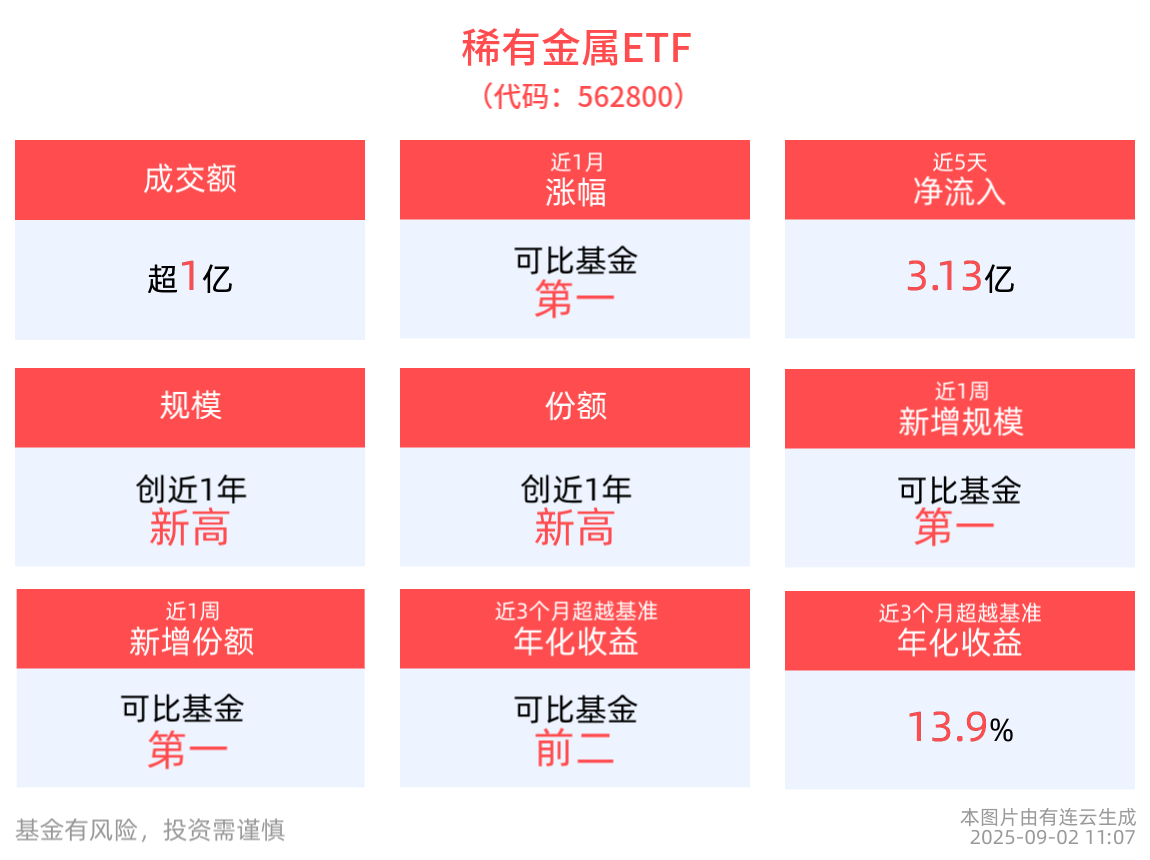
近5日累计“吸金”超3亿元,全市场规模最大稀有金属ETF(562800)规模突破22亿元!
Sou Hu Cai Jing· 2025-09-02 03:30
Core Viewpoint - The rare metals sector is experiencing fluctuations, with the China Rare Metals Theme Index down by 2.08% as of September 2, 2025, while certain stocks like Zhuhai Group and China Rare Earth show positive gains [1][4]. Group 1: Market Performance - The rare metals ETF (562800) has seen a weekly increase of 5.36% as of September 1, 2025, ranking it first among comparable funds [1]. - The ETF's trading volume reached 7.74% with a transaction value of 168 million yuan, and its average daily trading volume over the past week was 214 million yuan, also ranking first among comparable funds [3]. - The ETF's latest scale reached 2.2 billion yuan, marking a new high since its inception, and its share count reached 2.814 billion, also a record high [3]. Group 2: Fund Flows and Returns - The rare metals ETF recorded a net inflow of 81.9564 million yuan, with four out of the last five trading days showing net inflows totaling 313 million yuan [3]. - Over the past year, the ETF's net value has increased by 90.48%, placing it in the top 12.31% among 2,990 index equity funds [3]. - The ETF has achieved a maximum monthly return of 24.02% since inception, with the longest consecutive monthly gains being four months and an average monthly return of 8.77% [3]. Group 3: Industry Trends and Policies - The rare earth industry is entering a traditional consumption peak season, with increased downstream demand driving up prices for rare earths, tungsten, and cobalt [4]. - Recent policies aimed at regulating the rare earth sector have heightened expectations for supply-side tightening, contributing to a rapid price recovery for rare earth products [4]. - The top ten weighted stocks in the China Rare Metals Theme Index account for 57.58% of the index, with significant players including Northern Rare Earth and Luoyang Molybdenum [4][6].







大越期货纯碱早报-20250902
Da Yue Qi Huo· 2025-09-02 02:46
Report Industry Investment Rating - Not provided Core Viewpoints - The fundamental situation of soda ash shows strong supply and weak demand. With few alkali plant overhauls, supply remains at a high level. The daily melting volume of downstream float glass is stable, while that of photovoltaic glass has declined, leading to weaker terminal demand. The inventory of soda ash plants is at a historical high. Short - term soda ash is expected to fluctuate weakly [2]. - The main logic is that the supply of soda ash is at a high level, terminal demand has declined, and inventory is at a high level in the same period. The pattern of supply - demand mismatch in the industry has not been effectively improved [5]. Summary by Directory Soda Ash Futures Market - The closing price of the main contract was 1,271 yuan/ton, a decrease of 1.93% from the previous value. The low - end price of heavy soda ash in Shahe, Hebei was 1,180 yuan/ton, a decrease of 2.07%. The main basis was - 91 yuan/ton, with no change [6]. Soda Ash Spot Market - The low - end price of heavy soda ash in the Shahe market in Hebei was 1,180 yuan/ton, a decrease of 25 yuan/ton from the previous day [12]. - The profit of heavy soda ash by the North China ammonia - alkali method was - 48.10 yuan/ton, and that by the East China co - production method was - 58 yuan/ton. The production profit of soda ash has recovered from a historical low [15]. - The weekly industry operating rate of soda ash was 82.47%, showing a seasonal decline. The weekly output of soda ash was 71.91 tons, including 38.32 tons of heavy soda ash, at a historical high [18][20]. - From 2023 to 2025, there has been a large - scale expansion of soda ash production capacity, with new capacities of 640 tons in 2023, 180 tons in 2024, and a planned new capacity of 750 tons in 2025 (with an actual planned production of 100 tons) [22]. Fundamental Analysis - Demand - The weekly production - sales rate of soda ash was 97.80% [25]. - The daily melting volume of national float glass was 15.96 tons, and the operating rate was 75.49%, showing stability [28]. - The price of photovoltaic glass has continued to decline. Under the influence of the "anti - involution" policy, the industry has cut production, and the daily melting volume in production has continued a significant downward trend [34]. Fundamental Analysis - Inventory - The national in - plant inventory of soda ash was 1.8675 million tons, a decrease of 2.27% from the previous week, and the inventory was above the five - year average [37]. Fundamental Analysis - Supply - Demand Balance Sheet - The supply - demand balance sheet from 2017 to 2024E shows changes in effective production capacity, output, operating rate, import, export, net import, apparent supply, total demand, supply - demand difference, and growth rates of various indicators in different years [38]. Influencing Factors - Positive factors: The peak season of summer overhauls is coming, and production will decline [3]. - Negative factors: Since 2023, the production capacity of soda ash has expanded significantly, and there are still large production - launching plans this year. The production of the industry is at a historical high in the same period. The downstream photovoltaic glass of heavy soda ash has cut production, leading to weaker demand for soda ash. The positive sentiment of the "anti - involution" policy has faded [5].
两融余额突破历史新高,关注“行业均衡,龙头荟萃”A股核心资产标的,同类中更多人选择的中证A500ETF(159338)
Mei Ri Jing Ji Xin Wen· 2025-09-02 02:19
Group 1 - The A-share margin balance reached a historical high of 2.3 trillion yuan as of September 1, surpassing the previous peak of 2.27 trillion yuan on June 18, 2015, with an increase of 35.643 billion yuan from the previous day [1] - The financing balance also exceeded the historical peak of June 18, 2015, reaching 2.28 trillion yuan [1] - Historical experience suggests that the resolution of overcapacity and the rebound of PPI often accompany bull markets in the capital market, as seen in the periods of 2016-2017 and late 2020 to mid-2021 [1] Group 2 - The promotion of "anti-involution" policies may bring a new round of upward trends in the capital market [1] - The number of accounts for the Guotai CSI A500 ETF exceeded 100,000, making it the leader in its category, with more than three times the number of the second-ranked product [1] - Investors without stock accounts can consider the Guotai CSI A500 ETF linked funds, including Guotai CSI A500 ETF Initiated Link A, C, and I [1]
电子布AI产业趋势加速,关注中国巨石后续切入产业链机遇 | 投研报告
Zhong Guo Neng Yuan Wang· 2025-09-02 01:26
Group 1: Cement Industry - The cement industry is expected to see a continuous decline in production capacity due to the implementation of anti-overproduction policies, leading to a significant increase in capacity utilization [1][2] - Currently, the cement industry is experiencing a low demand and price season, but it is anticipated that demand will recover in August, resulting in gradual price increases [1][2] Group 2: Glass Fiber Industry - The glass fiber electronic cloth industry is witnessing accelerated expansion among key players, with China National Materials announcing an addition of 35 million square meters of low dielectric cloth capacity [2] - China Jushi is actively developing special electronic cloth series products, indicating a strong potential for market share acquisition due to its cost control capabilities and good cooperation with downstream CCL manufacturers [2] - The demand for traditional alkali-free coarse sand remains flat, while niche segments are performing well, driven by the AI industry, leading to a surge in demand for low dielectric products [3] Group 3: Glass Industry - The glass industry is facing a continuous downward trend in demand due to real estate impacts, with supply and demand still in conflict despite decent performance during the off-season from June to August [2] - The anti-overproduction policy is not expected to lead to a blanket capacity clearance, but it will raise environmental standards and costs, accelerating the industry's cold repair progress [2] Group 4: Market Performance - In the past week (August 25 - August 31), the construction materials sector index increased by 0.14%, while the Shanghai Composite Index rose by 0.84%, and the Shenzhen Component Index saw a significant increase of 4.36% [4] - Among the 31 first-level sub-industry indices, the construction materials sector ranked 14th in terms of performance [4]
中银晨会聚焦-20250902
Bank of China Securities· 2025-09-02 01:21
Macro Economic Overview - In August, the manufacturing PMI index slightly increased to 49.4%, indicating a marginal recovery in manufacturing activity, with new orders index at 49.5% and production index at 50.8% [5][6] - The "anti-involution" policy is identified as a key factor boosting manufacturing prices, particularly benefiting the midstream equipment manufacturing sector [6][7] Company Performance - New Beiyang - New Beiyang reported H1 2025 revenue of 1.279 billion yuan, a year-on-year increase of 24.0%, and net profit of 37 million yuan, up 114.6% [8][9] - The company shows strong growth potential in overseas and financial IT sectors, with a focus on enhancing operational efficiency and cost control [9][10] Company Performance - Wanhua Chemical - Wanhua Chemical's H1 2025 revenue was 90.901 billion yuan, down 6.35% year-on-year, with net profit of 6.123 billion yuan, a decrease of 25.10% [14][15] - The company is focusing on management reforms and innovation to enhance resource allocation efficiency and competitiveness in the polyurethane sector [15][16] Company Performance - Sensory Chip - Sensory Chip reported a 47.8% increase in revenue for H1 2025, reaching 300 million yuan, with net profit soaring 171.7% to 25 million yuan [19][20] - The company is actively developing AI sensor technologies and has initiated projects in humanoid robotics, indicating a strong growth trajectory [20][21] Strategic Developments - New Beiyang - New Beiyang is advancing its "one body, two wings, eight major businesses" strategy, with significant revenue growth in specialized printing and intelligent self-service terminals [10][11] - The overseas revenue share increased to 42% in H1 2025, reflecting a strategic focus on expanding into Southeast Asia and Central Asia [11][12] Strategic Developments - Wanhua Chemical - Wanhua Chemical is enhancing its self-research capabilities and accelerating the transformation of technological achievements, particularly in new materials [17][18] - The company is also focusing on improving production efficiency and reducing costs through management reforms [15][16] Industry Trends - The manufacturing sector is experiencing a slight recovery, but demand remains weak, particularly in the midstream equipment manufacturing sector [6][7] - The chemical industry is facing short-term pressures due to low product prices and reduced profit margins, particularly in the petrochemical sector [15][16]
光大期货交易内参20250902
Sou Hu Cai Jing· 2025-09-02 00:54
矿钢煤焦类 金融类 股指: 昨日,A股市场震荡上涨,Wind全A收涨0.81%,成交额2.78万亿元。中证1000指数上涨0.84%,中证 500指数上涨0.94%,沪深300指数上涨0.6%,上证50指数上涨0.16%。股指基差大幅贴水,IM2509贴水 达120点,对冲需求旺盛。美联储会议表态偏鸽,市场计价年内多次降息,A股同样受益。此外,上海 调整住房限购政策、公积金贷款政策和商业住房贷款利率定价机制,扩大潜在购房需求,地产银行板块 上涨。此前,中共中央办公厅、国务院办公厅印发了《育儿补贴制度实施方案》,标志着育儿补贴制度 正式在全国范围内落地。这是我国近年来第一次发布普惠型中央财政政策,尽管总量仍有提升空间,但 对于提升居民端收益水平影响较为直接。预计未来通过央行购买国债为中央政府筹集资金,推出更多普 惠型财政支持方案将成为拉动我国通胀环境企稳回升的一条重要路径。流动性行情预计仍将持续,但体 现出明显的缩圈特征,资金愈发集中在指数成分和科技风格,短期波动可能加大,长期存在继续冲高的 力量。 国债: 国债期货收盘,30年期主力合约涨0.30%,10年期主力合约涨0.17%,5年期主力合约涨0.08%,2 ...