
货币政策

Search documents
短端继续飘红,10年国债收益率窄幅震荡小幅上行
Xin Lang Cai Jing· 2025-12-24 09:36
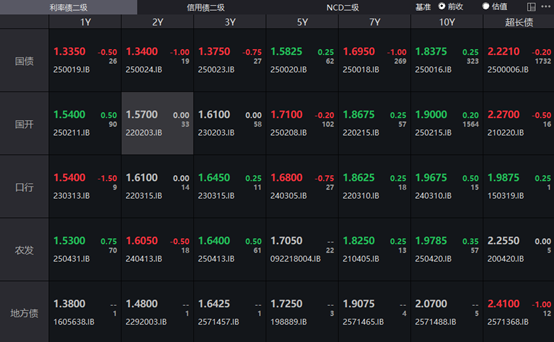
Group 1 - Short-term bond rates continue to rise, while long-term bond rates fluctuate narrowly, indicating a mixed market sentiment [1][4] - As of 16:30, the yield on the 10-year government bond increased by 0.25 basis points to 1.8375%, while the 30-year government bond yield decreased by 0.2 basis points to 2.221% [1][2] - The People's Bank of China conducted a 260 billion yuan reverse repurchase operation at a fixed rate of 1.40%, with the same amount of bids and successful bids [4][5] Group 2 - The trading market for non-financial credit bonds saw significant movements, with the top five gainers including 22 Vanke 04, which rose by 18.46% [3] - The yield to maturity (YTM) for the top gainer, 22 Vanke 04, is reported at 55.4134%, with a decrease of 850.35 basis points [3] - The market is experiencing a mixed sentiment with expectations of moderate monetary policy adjustments, limiting significant declines in interest rates [4][5]

日元越救越弱!日央行加息“失灵”,最强干预警告只是开始?
Sou Hu Cai Jing· 2025-12-24 08:50
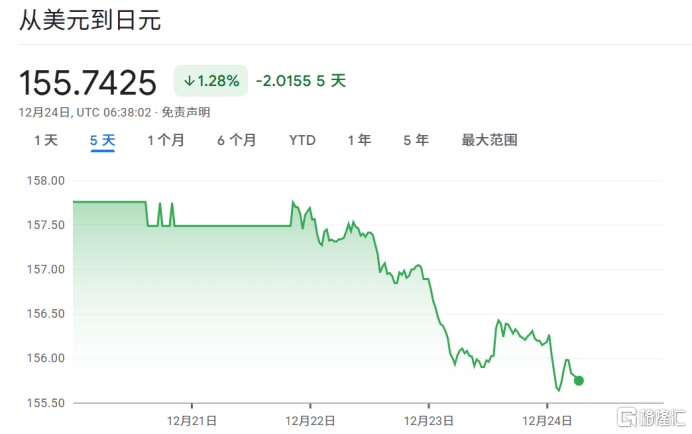
Core Viewpoint - The Japanese yen continues to weaken despite the Bank of Japan's recent interest rate hike, raising concerns about the effectiveness of monetary policy in stabilizing the currency [1][2][10]. Group 1: Monetary Policy and Interest Rates - The Bank of Japan raised interest rates by 25 basis points to a 30-year high during the December meeting, indicating a potential shift towards tighter monetary policy [1][8]. - The October monetary policy meeting minutes revealed intense debates among committee members regarding the necessity of further rate hikes to achieve long-term economic stability [6]. - Some committee members expressed concerns that the recent yen depreciation could lead to higher import costs and inflation exceeding expectations [6][16]. Group 2: Currency Performance - The yen has depreciated by 0.28% against the US dollar, trading at 155.7425, continuing its downward trend [3]. - Despite the interest rate hike, market reactions suggest a lack of confidence in the Bank of Japan's commitment to combating inflation, leading to further yen depreciation [10][11]. Group 3: Government Response and Fiscal Policy - The Japanese government issued a strong warning to currency speculators, emphasizing its authority to take decisive action against excessive currency fluctuations [5][13]. - The government has implemented an expansive fiscal policy totaling 21.3 trillion yen, which has raised concerns about Japan's fiscal health and contributed to rising bond yields [11]. - Plans for issuing new debt exceeding 28.6 trillion yen in the upcoming budget have intensified scrutiny over the government's fiscal strategy [11]. Group 4: Market Sentiment and Future Outlook - Analysts predict that the Bank of Japan may continue to raise interest rates in 2024, with expectations of reaching a policy rate of 1.25% by the end of 2026 [9]. - Concerns about the Bank of Japan's delayed response to inflation risks are growing, with market participants questioning the effectiveness of verbal interventions in stabilizing the yen [16].
诡异的日元:央行喊话干预市场
Sou Hu Cai Jing· 2025-12-24 08:50
Core Viewpoint - The Bank of Japan raised its benchmark interest rate by 25 basis points to 0.75%, marking a 30-year high, yet the yen depreciated against the dollar, indicating a disconnect from fundamental economic conditions [1] Group 1: Interest Rate and Currency Dynamics - The yen depreciated by 1.45% to 157.5 against the dollar following the interest rate hike, despite the increase in bond yields [1] - The Japanese government approved a substantial fiscal stimulus plan of 18.3 trillion yen, which may lead to increased bond issuance and impact the bond market negatively [2] - The yield on Japan's 30-year government bonds rose to 3.452%, while the 10-year yield reached 2.034%, widening the interest rate differential with China [1][2] Group 2: Inflation and Economic Policy - Current market expectations place inflation between 2.5% and 3%, while the nominal interest rate is only 0.75%, resulting in real interest rates between -1.75% and -2.25% [2] - The Bank of Japan's cautious stance on interest rate hikes reflects uncertainty amid persistent inflation pressures and economic recovery fluctuations [3] - The Bank of Japan's communication has been vague, leading to negative market expectations for future rate hikes [3] Group 3: Market Reactions and Future Outlook - The market anticipates potential intervention by the Bank of Japan if the yen approaches the critical level of 160 against the dollar [4] - Concerns in the U.S. regarding rising Japanese bond yields suggest potential financial risks that could affect other markets [5] - The Japanese economy's recovery relies on careful management of both monetary and fiscal policies, with market skepticism about the Bank of Japan's commitment to tightening [5]
市场风险偏好和流动性回升 金价维持高位震荡运行
Jin Tou Wang· 2025-12-24 08:40
Group 1 - The Shanghai gold spot price on December 24 was quoted at 1012.00 CNY per gram, showing a discount of 2.68 CNY per gram compared to the futures main price of 1014.68 CNY per gram [1] - The futures market saw the Shanghai gold futures main contract close at 1014.68 CNY per gram on December 24, with an increase of 0.63%, reaching a high of 1022.88 CNY per gram and a low of 1000.50 CNY per gram, with a trading volume of 351,301 contracts [2] - The recent week saw a cumulative increase of 1,989 kg in Shanghai gold futures warehouse receipts, representing a growth rate of 2.17%, while the monthly increase was 3,285 kg, or 3.63% [2] Group 2 - The recent rise in gold prices is attributed to macroeconomic factors, particularly the monetary policies of the US and Japan, with the Federal Reserve's dovish stance and the Bank of Japan's interest rate hike contributing to market dynamics [3] - Following the easing of tensions in US-China relations after the October meeting, gold prices have shown significant fluctuations, maintaining a high level of volatility [3]
狂奔、绞杀、崩盘,白银历史性疯牛背后 当前最需提防什么
Feng Huang Wang· 2025-12-24 07:29
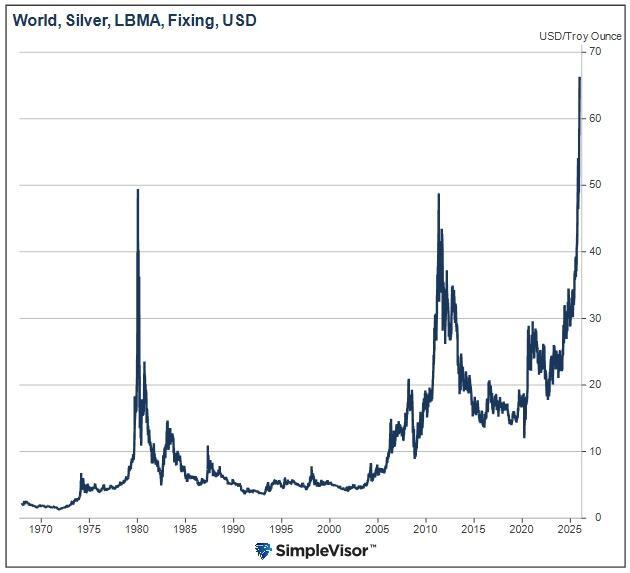
过去几周,白银抛物线般的上涨行情无疑引人注目——随着现货白银价格周三升破72美元,银价在今年已经翻了一倍多,比2022 年时17美元的低点价格更是高出了逾三倍。 从历史上看,当前银价的飙升与下图所示的两次先前的历史性跳涨几乎如出一辙,甚至这一回的疯牛行情要更为猛烈。 金融危机后的白银飙升 我们先来看距离我们目前更近的那一次白银史诗级大牛行情——随着2008年金融危机的动荡在2009年开始缓解,白银价格开启了 一轮500%的涨势,在两年内从8.50美元上涨至50.00美元。美联储对危机的过度货币反应,加上严重的投机,为白银市场创造了一 场完美风暴。 在金融危机期间,美联储史无前例地将利率降至零、推出量化宽松政策(QE)并实施了一系列货币救助。由此导致实际利率(经通 胀调整后)跌入负值区间。下图就显示了,2年期美国国债实际收益率如今在2009年的急剧下挫,并持续走低至2011年中期…… 白银价格的上涨当时恰与实际收益率的下降同步。这种由实际收益率反映的货币政策扭曲,使白银受益——因为白银往往被投资 者视为对冲极端货币政策行为的高贝塔工具。 尽管货币环境利好此轮白银涨势,但供需失衡同样推高了价格。白银供给弹性较低, ...
南华期货早评-20251224
Nan Hua Qi Huo· 2025-12-24 05:29
Report Industry Investment Ratings - Not provided in the content Core Views of the Report - In the short term, the USD/CNY spot exchange rate may approach the 7.0 key level and could potentially break through it briefly. In 2026, it is expected to "break 7" and experience mild depreciation. For stocks, they are expected to fluctuate in the short term. For bonds, there may be speculation on next year's monetary policy, and mid - term long positions can be held while short - term long positions may be closed for profit as appropriate. For shipping, the container shipping European route futures price is expected to fluctuate at a high level. For commodities, different varieties have different trends, such as platinum and palladium reaching new highs, gold and silver remaining strong in the short term, copper breaking through key levels, and various metals and energy - chemical products having their own supply - demand and price characteristics [4][6][7][8] Summaries by Relevant Catalogs Financial Futures - **Macro**: The US GDP in the third quarter exceeded expectations, growing by 4.3%, which hit the interest - rate cut expectation to some extent. Domestically, policies continue to be proactive in finance and moderately loose in currency. The key task for next year is to expand domestic demand. The RMB exchange rate has shown an upward trend, and the USD/CNY spot exchange rate is approaching 7.0 [1][2][3] - **Stock Index**: The stock index is under pressure above and supported below, and is expected to fluctuate in the short term. The strong US GDP data has affected the interest - rate cut expectation, and Trump's call for interest - rate cuts has also caused fluctuations in the expectation, but the overall impact on A - shares is limited [5][6] - **Treasury Bonds**: The trading behavior of institutions may be related to speculating on next year's monetary policy. If the market rebounds, long - term varieties may have greater elasticity, but it is not recommended to chase high. Mid - term long positions can continue to be held, and short - term long positions can be closed for profit as appropriate [7] - **Container Shipping European Route**: The futures price is at a high - level and fluctuating. The main point of the game is the future peak freight rate and the time to reach the peak. There are both long and short factors in the market [8][9] Commodities Non - ferrous Metals - **Platinum & Palladium**: The prices have reached new highs. The price movements are related to the Fed's monetary policy, supply - demand fundamentals, and short - term speculation. In the long - term, platinum's bull market foundation remains, but in the short - term, there is a risk of adjustment [10][11][12] - **Gold & Silver**: They have reached new highs. The US GDP data and geopolitical factors have affected the prices. In the short - term, they remain strong, with gold potentially accelerating upward after breaking through the previous high, and silver should be held with caution due to high volatility [12][13][14] - **Copper**: The price has broken through the 95,000 level. The spot market demand is weak, and the futures market has increased in volume at night. Whether it can stand firm at 95,000 remains to be seen. Attention can be paid to the volume of a second breakthrough [16][17] - **Zinc**: The price opened higher at night driven by LME and then fell back. The macro sentiment is warm, the short - term domestic raw material supply is tight, and the price is expected to fluctuate within a range in the future [18][19][20] - **Nickel - Stainless Steel**: The prices are oscillating strongly. The nickel ore is expected to be stable and slightly strong, and the new energy and nickel - iron markets have their own characteristics. The stainless - steel market is affected by export control and other factors [21] - **Tin**: The price is oscillating at a high level. The macro sentiment is warm, and the supply from Myanmar and Indonesia is expected to increase in December. It is necessary to be cautious about chasing high above 340,000 [22] - **Lead**: The price is oscillating narrowly. The macro sentiment is warm, the domestic smelting supply is decreasing, and the demand lacks new drivers. It is expected to oscillate around 16,700 - 17,500 in the short term [22] Black Metals - **Rebar & Hot - Rolled Coil**: The prices are under pressure above and supported below, and are oscillating at a low level. The cost of furnace materials provides support, but the demand is weak in the off - season [24][25] - **Iron Ore**: The price is continuing to decline, and the port inventory is accumulating. The supply pressure is significant, but there is also support from the demand for restocking by steel mills. It is expected to run within a range [25] - **Coking Coal & Coke**: The prices lack driving forces and are oscillating within a range. The coking coal inventory structure is deteriorating, and the coke fundamentals are deteriorating marginally [26][27] - **Silicon Iron & Silicon Manganese**: The prices are oscillating strongly in the short term, with limited upward space. The supply and demand are both weak, and the prices may follow the changes in steel prices [27][28] Energy - Chemicals - **Pulp - Offset Paper**: The pulp futures price is oscillating at a high level as expected. The supply of pulp is restricted by the flood in Indonesia, and the inventory is decreasing. The offset paper market sentiment is improving, and both can be observed first or short - term long positions can be tried [29][30] - **Crude Oil**: The price has rebounded due to the tense situation between the US and Venezuela. Geopolitical factors have brought upward driving forces for short - term oil prices [30][31] - **LPG**: The price is affected by the alternation of reality and expectations. The supply is relatively tight in the near term, and the demand is relatively stable. The near - term is supported, and the expected is under pressure [32][33] - **PTA - PX**: The PX supply is expected to remain high, and the PTA has reduced production significantly. The PX - TA structural contradiction has been alleviated. PX is expected to be in a tight supply - demand situation in the first half of 2026, and PTA processing fees have room for upward adjustment but are limited [33][34][35] - **MEG - Bottle Chips**: The demand for ethylene glycol is weakening, and the supply has shown some support signals. The cost of oil and coal is weak, and the inventory is accumulating. The overall situation is still under pressure [37][38] - **Methanol**: The fundamentals are mixed, with a near - term weak and long - term strong expectation. The 1 - 5 reverse spread can be held [39] - **PP**: The price is under pressure from the spot market, but the supply is expected to decrease in January due to low production profits. The demand is resilient, and short - term long positions can be considered at low prices [41][42] - **PE**: The spot price is continuously falling, and the demand is in the off - season. However, the supply pressure may be alleviated to some extent, and the downward space of the futures price is limited [43][44] - **Pure Benzene - Styrene**: The prices are oscillating. The supply of pure benzene is increasing slightly, the demand is weak, and the inventory is at a high level. The styrene is changing from a strong reality to a weak expectation [45][46] - **Fuel Oil**: The high - sulfur fuel oil supply is abundant, and the short - term cracking driving force is downward. The low - sulfur fuel oil supply has decreased, and the cracking driving force is upward [46][47] - **Asphalt**: The price is affected by the price adjustment in the South and geopolitical factors. The winter - storage policy has been introduced, and the price is expected to be oscillating strongly in the short term [48][49][51] - **Rubber**: The natural rubber price is oscillating under pressure, and the overall demand is weak. The synthetic rubber is oscillating, with increasing differences between long and short positions [52][53][54] - **Soda Ash & Caustic Soda**: The soda ash is in a situation of increasing over - supply expectation, and the price is breaking through the cost. The glass has high inventory, and the caustic soda is expected to oscillate weakly [55][56][57] - **Log**: The spot market is weak, and the price is affected by inventory changes. The 03 contract is undervalued, and interval operations can be considered [57][58][59] - **Propylene**: The price is oscillating. The supply is relatively loose, and the demand is under pressure. It is expected to oscillate at a low level [59][60] Agricultural Products - **Hogs**: The supply and demand in the peak season need to be verified. In the long - term, the supply may be affected by policies, but in the short - term, the supply pressure in the near - month is still high [61][62] - **Oilseeds**: The external market has stopped falling. The supply of imported soybeans and rapeseeds has different situations, and the domestic soybean meal and rapeseed meal have their own supply - demand characteristics. It is recommended to try long positions in the near - month [63][64] - **Oils**: The prices are oscillating weakly. Palm oil, soybean oil, and rapeseed oil have different supply - demand situations. It is necessary to pay attention to production and biodiesel market information [64][65][66] - **Cotton**: The price is firm. The domestic new - year cotton supply is expected to be tight in the long - term, but there is hedging pressure in the short - term. Attention should be paid to downstream orders before the festival [67][68] - **Sugar**: The price is continuing to rebound to repair the basis. The international and domestic sugar markets have different supply - demand situations, and the original sugar price is expected to return to the Brazilian cost line [68][69][70] - **Eggs**: The long - term egg - laying hen capacity is in surplus, and the price is under pressure. In the short - term, some farmers are culling chickens. It is recommended to participate in long positions with a light position if speculating on a rebound [70][71] - **Apples**: The price is oscillating strongly. The consumption slowdown has a phased impact on the price, and opportunities to buy on dips can be waited for [71][72] - **Jujubes**: The price is expected to oscillate at a low level in the short term. Attention should be paid to downstream pre - festival purchases, and the price will be under pressure in the long - term due to loose supply and demand [73]
美联储现在巴不得中国能早点抛售美债?为啥他们一直不降息,因为他们很清楚,中国迟早会卖掉手里那7800亿美元的美债。市场上能接过这么大一笔美债的,恐怕只有美联储自己,所以他们一直在等这个机会。 先说说中国为啥买这么多美债。 其实道理很简单,中国这么多年贸易顺差,赚了不少外汇,这些钱得...
Sou Hu Cai Jing· 2025-12-24 04:10
Group 1 - The Federal Reserve is waiting for China to sell its $780 billion in U.S. Treasury bonds, as it may need to step in as a buyer to stabilize the market [1][11][12] - China has accumulated a significant amount of U.S. debt due to trade surpluses, seeking a safe and profitable place to store its foreign exchange reserves [2][3][4] - However, holding U.S. debt carries risks, particularly with the increasing U.S. national debt nearing $38 trillion, which raises concerns about the dollar's credibility [6][15] Group 2 - If China were to sell its U.S. bonds, it could create market volatility, prompting other countries to follow suit, which would negatively impact the U.S. financial market [9][10][21] - The Federal Reserve's role is to maintain economic stability, and while it may see an opportunity in buying the bonds, it would also face increased debt pressure and interest rate risks [8][15][16] - China is likely to reduce its U.S. bond holdings gradually, considering the impact on its own economy and the importance of U.S. debt in its foreign exchange reserves [17][19][20]
STARTRADER外汇:美元兑加元为何延续跌势,触及近五个月新低?
Sou Hu Cai Jing· 2025-12-24 03:17
Core Viewpoint - The recent decline of the USD/CAD exchange rate reflects the differing economic expectations and monetary policy stances between the United States and Canada, with the USD under pressure and the CAD showing relative strength [1][3]. Economic Data - The U.S. GDP grew at an annualized rate of 4.3% from July to September, significantly exceeding market expectations of 3.3% and surpassing the previous quarter's growth of 3.8% [4]. - The core personal consumption expenditures price index rose by 2.9% quarter-on-quarter, aligning with market expectations, while the GDP price index increased by 3.7%, higher than the forecast of 2.7% [4]. - Despite strong economic data, there are concerns regarding sustainability, with some analysts noting that growth is partially reliant on healthcare spending and inventory depletion, limiting support for domestic demand [4]. Market Sentiment - The market is reassessing the future path of U.S. monetary policy, with expectations shifting towards potential rate cuts in 2026, which diminishes the medium-term attractiveness of the USD [3]. - The upcoming holiday season is expected to reduce market liquidity, making price adjustments more susceptible to changes in sentiment and expectations [4]. Canadian Economic Outlook - Canada's economy showed signs of recovery, with a preliminary estimate indicating a 0.1% month-on-month growth in November, following a 0.3% contraction in October [5]. - The Bank of Canada maintained its overnight rate at 2.25%, signaling a cautious approach to future policy decisions based on incoming data, which contrasts with the discussions surrounding potential rate cuts by the Federal Reserve [5].
【申万宏源脱水研报】中央经济工作会议的十大亮点——12月中央经济工作会议学习理解
申万宏源研究· 2025-12-24 02:56
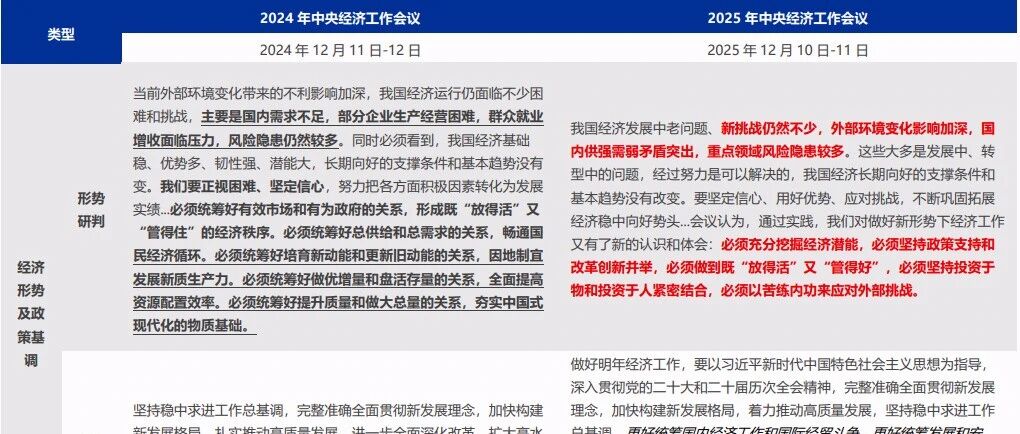
Core Viewpoint - The article presents a more optimistic outlook on the fiscal and monetary policy statements from the recent economic work conference compared to market expectations, highlighting the expanded role of the central bank in promoting economic stability and reasonable price increases [1]. Summary by Sections Economic Policy Direction - The 2025 Central Economic Work Conference emphasizes five "musts" that align with the 2024 "overall" strategies, focusing on tapping economic potential and policy reform coordination, addressing the core issue of "strong supply but weak demand" [2]. - The fiscal policy continues to adopt a "more proactive" stance, maintaining necessary deficits and debt levels while focusing on local fiscal challenges and debt resolution [2]. - Monetary policy aims to stabilize growth and promote reasonable price increases, with plans to flexibly use tools like reserve requirement ratio (RRR) cuts and interest rate reductions [2]. Internal Demand and Reform - The conference underscores the importance of domestic demand, proposing measures to increase residents' income, enhance service consumption, and expand budgetary investments to stabilize consumption and investment [2]. - Deepening reform remains a priority, with initiatives to advance the construction of a unified national market and address "involution" competition [2]. Risk Management - The article discusses proactive measures to mitigate risks in key areas, particularly in real estate, with a three-pronged approach to address challenges and focus on active debt management and restructuring [2]. Comparison of Economic Work Conference Statements - A comparison of the statements from the December 2024 and December 2025 conferences reveals a consistent acknowledgment of the challenges posed by insufficient domestic demand and external environmental changes, while also highlighting the resilience and potential of the Chinese economy [3]. Fiscal and Monetary Policy Details - The fiscal policy will continue to be proactive, increasing the fiscal deficit rate and ensuring sustained fiscal strength, with a focus on enhancing spending in key areas and issuing special bonds [3]. - The monetary policy will maintain a moderately loose stance, utilizing various tools to ensure ample liquidity and support for key sectors such as technology innovation and small and micro enterprises [3]. Domestic Market and Innovation - The article emphasizes the need to build a strong domestic market by enhancing consumption and investment efficiency, implementing special actions to boost consumption, and increasing the income of low- and middle-income groups [3]. - It also highlights the importance of technological innovation in driving new productive forces and developing a modern industrial system [3]. Reform and Opening Up - The conference calls for significant reforms to enhance the vitality of high-quality development, including the deepening of state-owned enterprise reforms and the promotion of private sector growth [3]. - It stresses the importance of expanding high-level opening up to stabilize foreign trade and investment, while also promoting cooperation in various fields [3]. Urbanization and Rural Revitalization - The article discusses the need for coordinated development between urbanization and rural revitalization, emphasizing the importance of maintaining agricultural productivity and enhancing the competitiveness of the agricultural sector [3].
格林大华期货早盘提示:国债-20251224
Ge Lin Qi Huo· 2025-12-24 02:51
1. Report's Industry Investment Rating - The report gives a "shock" rating for the macro and financial bond sector [1] 2. Core View of the Report - The latest macro - economic data shows that stabilizing growth remains the main theme of the fourth - quarter macro - economy. The central bank will continue to implement a moderately loose monetary policy next year. The stock market was flat on Tuesday, while the bond futures rose significantly. With the continuous loosening of funds near the end of the year, bond futures may fluctuate in the short term. The recommended trading strategy is for trading - type investors to conduct band operations [2] 3. Summary by Relevant Catalogs 3.1 Market Performance of Treasury Futures on Tuesday - 30 - year Treasury futures main contract TL2603 rose 0.89%, 10 - year T2603 rose 0.26%, 5 - year TF2603 rose 0.17%, and 2 - year TS2603 rose 0.07% [1] 3.2 Important Information - **Open Market**: The central bank conducted 5.93 billion yuan of 7 - day reverse repurchase operations on Tuesday, with 13.53 billion yuan of reverse repurchases maturing, resulting in a net withdrawal of 7.6 billion yuan on the day [1] - **Funds Market**: On Tuesday, the overnight interest rate in the inter - bank funds market remained low. The weighted average of DR001 was 1.27% throughout the day, unchanged from the previous trading day; the weighted average of DR007 was 1.41%, down from 1.43% in the previous trading day [1] - **Cash Bond Market**: On Tuesday, the closing yields of inter - bank Treasury bonds mostly declined compared with the previous trading day. The yield to maturity of 2 - year Treasury bonds decreased by 1.50 basis points to 1.35%, 5 - year bonds decreased by 1.26 basis points to 1.60%, 10 - year bonds decreased by 0.63 basis points to 1.84%, and 30 - year bonds decreased by 1.80 basis points to 2.22% [1] - **Policy Guidance**: President Xi Jinping made important instructions on the work of central enterprises, emphasizing focusing on main responsibilities and businesses, optimizing the layout of the state - owned economy, etc. Premier Li attended the meeting and put forward requirements for central enterprises in various aspects such as infrastructure construction, supply - chain security, and technological self - reliance. The National Housing and Urban - Rural Development Work Conference pointed out that in 2026, efforts should be made to stabilize the real estate market, including measures such as inventory reduction, supply optimization, and the construction of a new real - estate development model [1][2] - **US Economic Data**: Driven by factors such as strong consumer and corporate spending, the US economy grew at its fastest pace in two years in the third quarter. The inflation - adjusted GDP grew at an annualized rate of 4.3%, higher than the forecast of 3.3%. The annualized rate of personal consumption in the third quarter increased by 3.5%, and the initial value of the annualized quarterly rate of the core PCE price index in the third quarter was 2.9% [2] 3.3 Market Logic - In November, fixed - asset investment decreased by 2.6% year - on - year, social retail sales increased by 1.3% year - on - year, both lower than market expectations. The export growth rate in November was 5.9%, exceeding market expectations. China's CPI and core CPI both decreased by 0.1% month - on - month in November, and PPI rose by 0.1% month - on - month, with inflation remaining moderate. The central bank's Party committee meeting stated that next year, a moderately loose monetary policy will continue to be implemented. On Tuesday, the Wande All - A index was roughly flat at the opening and fluctuated horizontally throughout the day, closing slightly down 0.06% compared with the previous trading day, with a trading volume of 1.92 trillion yuan, slightly higher than the previous trading day's 1.88 trillion yuan. The stock market was flat on Tuesday, while the bond futures rose significantly. With the continuous loosening of funds near the end of the year, bond futures may fluctuate in the short term [2] 3.4 Trading Strategy - Trading - type investors should conduct band operations [2]