
扩内需政策

Search documents
核心CPI温和回升 7月物价运行边际改善
Shang Hai Zheng Quan Bao· 2025-08-10 17:36
Group 1: CPI Analysis - In July, the CPI remained flat year-on-year, with a month-on-month increase of 0.4%, driven by rising service and industrial consumer goods prices [2][3] - The core CPI, excluding food and energy, rose by 0.8% year-on-year, marking the highest increase since March 2024, reflecting effective demand expansion and improved market supply-demand dynamics [3][6] - Food prices saw a year-on-year decline of 1.6%, primarily due to a high base from the previous year, with fresh vegetable prices dropping by 7.6% [2][3] Group 2: PPI Analysis - The PPI decreased by 3.6% year-on-year in July, with the decline remaining consistent with June, although some industries showed signs of price recovery [4][5] - The month-on-month PPI fell by 0.2%, but this marked the first narrowing of the decline since March, indicating improved market competition and price stabilization in certain sectors [5][6] - Industries such as coal mining, black metal smelting, and photovoltaic manufacturing experienced reduced price declines compared to June, contributing to a less negative PPI [5] Group 3: Future Outlook - Experts anticipate that proactive macroeconomic policies will continue to support demand recovery, leading to a stabilization of domestic prices [6] - New policies aimed at boosting consumption, such as support for childbirth and early education, are expected to further stimulate domestic demand and contribute to a gradual recovery in CPI [6] - The ongoing "anti-involution" measures are projected to elevate industrial product prices in August compared to July, with a significant reduction in year-on-year price bases expected to aid in this recovery [6]
7月CPI环比转涨扩内需政策持续发力
Qi Huo Ri Bao Wang· 2025-08-10 16:05
Group 1 - The Consumer Price Index (CPI) increased by 0.4% month-on-month in July, reversing a previous decline of 0.1%, while year-on-year it remained flat [1] - The Producer Price Index (PPI) decreased by 0.2% month-on-month and saw a year-on-year decline of 3.6%, with the rate of decline consistent with the previous month [1] - The rise in CPI is attributed to the ongoing effects of domestic demand expansion policies, with prices in the service and industrial consumer goods sectors showing positive changes [1][2] Group 2 - Food prices fell by 1.6% year-on-year, influenced by a high price base from the previous year, with fresh vegetables and fruits being the main contributors to this change [1] - The core CPI, excluding food and energy prices, rose by 0.8% year-on-year, marking the highest increase since March 2024, indicating a positive signal from the consumer market [1] - Seasonal factors and uncertainties in the international trade environment have contributed to the decline in PPI, while domestic market competition has improved, leading to a narrowing of price declines in certain industries [2][3] Group 3 - The "anti-involution" policy has driven improvements in the month-on-month PPI readings, although the year-on-year figures remained unchanged, indicating a need for further demand-side policy support [3] - The ongoing consumer subsidy policies have supported durable goods prices, contributing to the sustained rise in core CPI [2] - There is a need to monitor the gradual release of the effects of "anti-involution" policies and the continuity of demand stimulation policies [2]
国泰海通|有色:降息预期强化,流动性行情或再起
国泰海通证券研究· 2025-08-10 14:39
Core Viewpoint - The article discusses the impact of U.S. economic data and policy changes on gold and industrial metal prices, highlighting the potential for price fluctuations due to inflation data and supply disturbances in the market [1][2][3]. Group 1: Gold Market Analysis - Recent weak U.S. economic data has led to increased expectations for Federal Reserve interest rate cuts, contributing to a decline in the U.S. dollar index and a rise in gold prices [2]. - The White House's announcement to clarify misinformation regarding gold tariffs has put downward pressure on gold prices, despite initial gains [2]. - Upcoming U.S. inflation data (CPI and PPI) is critical, with market expectations for July CPI at 0.2% month-on-month and 2.8% year-on-year, which could further influence gold price volatility [2][3]. Group 2: Industrial Metals Analysis - The transition into a seasonal demand phase shows weak current demand but potential marginal improvements in demand expectations, supported by supply disturbances in certain industrial metals [3]. - Domestic policies aimed at expanding demand are showing effects, with July CPI remaining stable and PPI decreasing by 3.6% year-on-year, indicating a tightening competitive market [3]. - The nomination of Milan to the Federal Reserve may influence previous consensus on tariffs and inflation, potentially enhancing expectations for interest rate cuts, which could support industrial metal prices [3].


利率周报:物价增长依然偏弱,但PPI增速可能企稳-20250810
Hua Yuan Zheng Quan· 2025-08-10 13:58
Report Industry Investment Rating No relevant information provided Core View of the Report - Price growth remains weak, and the policy bottom - support effect is emerging. The price recovery in July shows the characteristics of "consumption stronger than production, and policy - driven repair". The marginal improvement in price data in July, with CPI turning positive month - on - month and the narrowing of PPI decline, is closely related to the intensive implementation of "anti - involution" policies and the continuous efforts of domestic demand expansion policies since July [2][9][86]. - The continuous rise of core CPI inflation may indicate that the domestic demand expansion policy's bottom - support effect on domestic demand is gradually emerging, while the narrowing of PPI decline may rely more on the policy's regulation of the supply - side competition order, and the impact of the substantial expansion of the demand side needs continuous observation [2][10][86]. Summary by Relevant Catalogs 1. Macro - level News - In July, CPI was flat year - on - year, mainly affected by low food prices. Core CPI excluding food and energy prices was up 0.8% year - on - year, with the increase expanding for three consecutive months. CPI was up 0.4% month - on - month, higher than the seasonal level by 0.1 pct, mainly driven by the rise in service and industrial consumer goods prices [12]. - In July, PPI was down 3.6% year - on - year, the same as last month. PPI was down 0.2% month - on - month, with the decline narrowing by 0.2 pct compared to last month, the first narrowing of the month - on - month decline since March. The price recovery of production materials mainly occurred in July [15]. - In the first seven months of 2025, China's total value of goods trade imports and exports was 25.7 trillion yuan, up 3.5% year - on - year. Exports were 15.3 trillion yuan, up 7.3% year - on - year; imports were 10.39 trillion yuan, down 1.6% year - on - year, with the decline narrowing by 1.1 pct compared to the first six months. In July, the total value of goods trade imports and exports was 3.9 trillion yuan, up 6.7% year - on - year. Exports were 2.3 trillion yuan, up 8% year - on - year; imports were 1.6 trillion yuan, up 4.8% year - on - year [17]. 2. Meso - level High - frequency Data 2.1 Consumption - As of July 31, the average daily retail volume of passenger car manufacturers was 9.7 million vehicles, down 0.8% year - on - year, and the average daily wholesale volume was 17.2 million vehicles, up 1.3% year - on - year. As of August 8, the total box office revenue of national movies in the past 7 days was 168,932,800 yuan, up 98.5% year - on - year [20]. - As of August 1, the total retail volume of three major household appliances was 1.739 million units, down 3.7% year - on - year, and the total retail sales were 4.05 billion yuan, up 2.7% year - on - year [22]. 2.2 Transportation - As of August 3, the port's container throughput was 5.68 million twenty - foot equivalent units, down 7.0% year - on - year. As of August 7, the average subway passenger volume in first - tier cities in the past 7 days was 3,934,400 person - times, down 1.3% year - on - year [25]. - As of August 3, the postal express pick - up volume was 3.6 billion pieces, up 14.6% year - on - year. The railway freight volume was 77.694 million tons, up 6.5% year - on - year, and the highway truck traffic volume was 5.2593 million vehicles, up 2.8% year - on - year [27][31]. 2.3 Industrial Operating Rates - As of August 6, the blast furnace operating rate of major steel enterprises was 77.5%, up 3.4 pct year - on - year. As of August 7, the average asphalt operating rate was 25.0%, up 2.0 pct year - on - year [34]. - As of August 7, the soda ash operating rate was 85.2%, down 4.8 pct year - on - year, and the PVC operating rate was 75.5%, up 0.1 pct year - on - year. As of August 8, the average PX operating rate was 82.0%, and the average PTA operating rate was 76.8% [37]. 2.4 Real Estate - As of August 7, the total commercial housing transaction area in 30 large and medium - sized cities in the past 7 days was 1.392 million square meters, down 17.8% year - on - year. The total number of commercial housing transactions was 15,625 units, down 15.5% year - on - year [41][43]. 2.5 Prices - As of August 8, the average wholesale price of pork was 20.4 yuan/kg, down 21.2% year - on - year and 0.8% compared to four weeks ago; the average wholesale price of vegetables was 4.6 yuan/kg, down 16.9% year - on - year and up 4.1% compared to four weeks ago; the average wholesale price of six key fruits was 7.0 yuan/kg, down 4.3% year - on - year and 4.5% compared to four weeks ago [48]. - As of August 8, the average price of thermal coal at northern ports was 665 yuan/ton, down 21.7% year - on - year and up 7.8% compared to four weeks ago; the average spot price of WTI crude oil was 65.4 US dollars/barrel, down 11.9% year - on - year and 3.3% compared to four weeks ago; the average spot price of rebar was 3,328.1 yuan/ton, up 4.23% year - on - year and 6.5% compared to four weeks ago [51]. - As of August 8, the average spot price of iron ore was 786.5 yuan/ton, down 0.9% year - on - year and up 5.7% compared to four weeks ago; the average spot price of glass was 15.2 yuan/square meter, down 11.9% year - on - year and up 8.2% compared to four weeks ago [56]. 3. Bond and Foreign Exchange Markets - On August 8, overnight Shibor was 1.31%, up 0.04 BP from August 4. R001 was 1.34%, down 0.99 BP from August 4; R007 was 1.45%, down 2.17 BP from August 4. DR001 was 1.31%, down 0.30 BP from August 4; DR007 was 1.43%, down 2.67 BP from August 4. IBO001 was 1.35%, up 0.17 BP from August 4; IBO007 was 1.50%, up 0.78 BP from August 4 [62]. - Most government bond yields declined. On August 8, the yields of 1 - year/5 - year/10 - year/30 - year government bonds were 1.35%/1.54%/1.69%/1.96% respectively, down 2.0 BP/2.4 BP/1.9 BP/up 0.9 BP compared to August 1. The yields of 1 - year/5 - year/10 - year/30 - year China Development Bank bonds were 1.50%/1.66%/1.78%/2.05% respectively, up 0.0 BP/down 0.6 BP/up 1.6 BP/up 0.2 BP compared to August 1 [66]. - On August 8, the yields of 1 - year/5 - year/10 - year local government bonds were 1.38%/1.66%/1.82% respectively, down 0.3 BP/up 0.4 BP/up 0.2 BP compared to August 1. The yields of AAA 1 - month/1 - year and AA+ 1 - month/1 - year inter - bank certificates of deposit were 1.46%/1.62%/1.48%/1.66% respectively, down 1.3 BP from August 1 [72]. - As of August 8, 2025, the yields of 10 - year government bonds in the US, Japan, the UK, and Germany were 4.3%, 1.5%, 4.6%, and 2.7% respectively, up 4 BP/down 7 BP/up 6 BP/down 6 BP compared to August 1. The central parity rate and spot exchange rate of the US dollar against the RMB were 7.14/7.18 respectively, down 114/280 pips from August 1 [77][80]. 4. Institutional Behavior - Since the beginning of 2025, the duration of interest - rate bond medium - and long - term pure bond funds has shown a trend of first decline and then rise, and has been declining in the past two weeks. On August 8, the estimated average duration was about 5.2 years, down about 0.12 years from August 1 [83]. - Since the beginning of 2025, the duration of credit - bond medium - and long - term pure bond funds has shown a volatile trend. In the past three weeks, the duration has risen rapidly and then fluctuated. On August 8, the estimated median duration was about 2.7 years, and the estimated average duration was about 2.6 years, down about 0.03 years from August 1 [84]. 5. Investment Recommendations - Going long in the bond market is currently the path of least resistance. In August, the yield of 10Y government bonds may gradually return to around 1.65%, and the yield of 5Y national - joint - stock secondary bonds may fall below 1.9%. With the cooling of anti - involution, weak price growth, the stock market entering a volatile phase, and the possible decline in social financing growth rate, there are few negative factors for the bond market currently [11][88]. - The tax new regulations have relatively increased the scarcity of government bonds and old financial bonds, which may prompt banks' proprietary trading to scramble for government bonds and old financial bonds. The relatively low spread between newly - issued government bonds and existing bonds may temporarily push down yields. Currently, there is a phased overall bullish view on the bond market, bullish on long - duration sinking urban investment and capital bonds, bullish on urban investment dim sum bonds and US dollar bonds, strongly recommending perpetual bonds of Minsheng Bank, Bohai Bank, and Hengfeng Bank, and paying attention to capital bond opportunities of Tianjin Bank, Beibu Gulf Bank, and China Property Insurance [11][88].
7月CPI环比转涨0.4%,核心CPI创年内新高,扩内需政策效应显现
Sou Hu Cai Jing· 2025-08-10 13:12
Group 1 - The domestic economy shows positive changes as the Consumer Price Index (CPI) increased by 0.4% month-on-month in July, reversing a previous decline of 0.1%, while year-on-year it remained flat [1] - The Producer Price Index (PPI) saw a narrowing decline of 0.2% month-on-month, with a year-on-year decrease of 3.6%, indicating an improvement in market supply and demand relationships [1] - The expansion of domestic demand policies is having a noticeable effect, leading to marginal improvements in price movements [1] Group 2 - The core CPI rose by 0.8% year-on-year in July, marking the highest level since March 2024, reflecting enhanced market vitality and smoother economic circulation [3] - Service prices significantly contributed to the CPI increase, with airfares, tourism, hotel accommodations, and transportation rental fees rising by 17.9%, 9.1%, 6.9%, and 4.4% respectively, collectively accounting for over 60% of the CPI's month-on-month increase [3] - Industrial consumer goods prices also showed positive trends, with a 0.2% month-on-month increase excluding energy, driven by demand recovery from consumption policies [3] Group 3 - The month-on-month decline in the PPI has narrowed for the first time since March, indicating a stabilization in industrial product prices due to improved market competition [4] - Key industries such as coal, steel, photovoltaic, cement, and lithium battery sectors have seen reduced price declines, contributing to a decrease in the downward pressure on the PPI [4] - Prices of representative "anti-involution" goods like coking coal, rebar, polysilicon, and lithium carbonate have entered a strong upward cycle, positively impacting the PPI [4] Group 4 - International factors are also positively influencing industrial product prices, with oil and gas extraction prices rising by 3.0% and non-ferrous metal smelting and rolling prices increasing by 0.8% [4] - The transformation and upgrading of industries are driving price recoveries in related sectors, with caustic soda prices up by 3.6% and a reduced decline in glass manufacturing prices by 0.9% [4] - The release of domestic demand potential is leading to year-on-year price increases in certain industries, such as a 13.1% rise in the manufacturing of arts and crafts and a 5.3% increase in sports balls manufacturing [4]
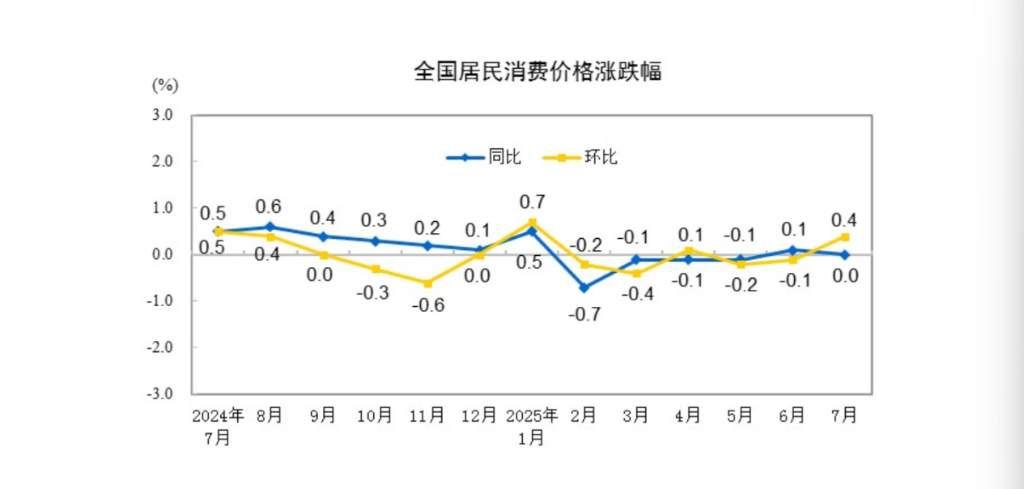
扩内需等政策持续发力,7月核心CPI涨幅连续3个月扩大
Hua Xia Shi Bao· 2025-08-10 05:34
Core Viewpoint - The continuous effect of the domestic demand expansion policy is leading to positive changes in consumer prices, with the Consumer Price Index (CPI) showing stability and slight increases in certain areas [1][2]. CPI Analysis - In July, the CPI remained flat year-on-year, with a month-on-month increase of 0.4%, reversing a previous decline of 0.1% [1]. - The core CPI, excluding food and energy, rose by 0.8% year-on-year, marking the highest increase since March 2024 [5]. - Food prices saw a significant decline, with fresh vegetable prices dropping by 7.6% and pork prices decreasing by 9.5%, contributing to the overall CPI stability [2][5]. Price Contributions - Service and industrial consumer goods prices were the main drivers of the CPI increase, with service prices rising by 0.6% month-on-month and industrial prices increasing by 0.5% [3][4]. - Specific price increases in the travel sector, such as airfares and accommodation, significantly impacted the CPI, contributing approximately 0.21 percentage points to the month-on-month increase [4]. PPI Insights - The Producer Price Index (PPI) decreased by 0.2% month-on-month in July, primarily due to seasonal factors affecting manufacturing and construction [6]. - Certain industries, such as non-metallic mineral products and coal mining, experienced price declines, but the overall rate of decline has narrowed, indicating potential stabilization [7][8]. - Expectations for August suggest a possible improvement in PPI, driven by a low base effect and ongoing domestic demand recovery [8].
财经聚焦|7月物价数据透出哪些积极信号?
Xin Hua She· 2025-08-10 04:48
Group 1 - The Consumer Price Index (CPI) in July increased by 0.4% month-on-month, indicating a shift from decline to growth, while the core CPI, excluding food and energy, rose by 0.8% year-on-year, marking the highest increase since March 2024 [1][3] - The rise in service prices by 0.6% month-on-month contributed approximately 0.26 percentage points to the CPI increase, driven by seasonal factors such as summer travel [1][2] - Various local governments have implemented consumption promotion measures, enhancing consumer activity during the summer season [1] Group 2 - The Producer Price Index (PPI) decreased by 0.2% month-on-month in July, but the decline was less than the previous month, indicating a narrowing of price drops in certain industries [4][5] - The central government's emphasis on regulating low-price competition and improving product quality is expected to optimize market competition and reduce price declines in industries such as coal, steel, and lithium batteries [4][5] - The narrowing of price declines in key sectors contributed to a reduced downward impact on the PPI by 0.14 percentage points compared to the previous month [4] Group 3 - The ongoing macroeconomic policies are fostering new growth drivers in various industries, leading to improved supply-demand relationships and positive price changes [6][7] - Traditional industries are upgrading while emerging industries are expanding, resulting in price increases in sectors like aircraft manufacturing and wearable technology [7] - Consumer demand is shifting from basic needs to quality improvements, with significant growth in sales of upgraded home appliances [7]
财经聚焦丨7月物价数据透出哪些积极信号?
Xin Hua Wang· 2025-08-10 03:33
Group 1 - The Consumer Price Index (CPI) in July showed a month-on-month increase of 0.4%, indicating a shift from decline to growth, while the core CPI excluding food and energy rose by 0.8%, marking the highest increase since March 2024 [1][6] - The rise in service prices by 0.6% in July contributed approximately 0.26 percentage points to the CPI increase, driven by seasonal factors such as summer travel, with significant price hikes in airfare, tourism, and accommodation [4][5] - Various local governments have implemented consumption-boosting measures, enhancing consumer activity during the summer season, which has positively impacted demand and prices in related sectors [4][5] Group 2 - The Producer Price Index (PPI) decreased by 0.2% in July, but the decline was less than the previous month, indicating an improvement in market competition and pricing stability in certain industries [7][8] - The central government's emphasis on regulating low-price competition and promoting product quality is expected to further optimize market conditions, particularly in industries like coal, steel, and lithium batteries [8][9] - The July data showed a narrowing of price declines in key sectors, suggesting a potential stabilization in pricing dynamics as supply and demand conditions improve [8][9] Group 3 - The ongoing macroeconomic policies are fostering new growth drivers in various industries, leading to improved supply-demand relationships and positive price changes [9][10] - Traditional industries are upgrading while emerging sectors are expanding, contributing to price increases in manufacturing, such as a 3.0% rise in aircraft manufacturing prices [10] - Consumer preferences are shifting towards quality upgrades, with significant increases in sales of advanced home appliances, indicating a trend towards improved consumption patterns [11][13]
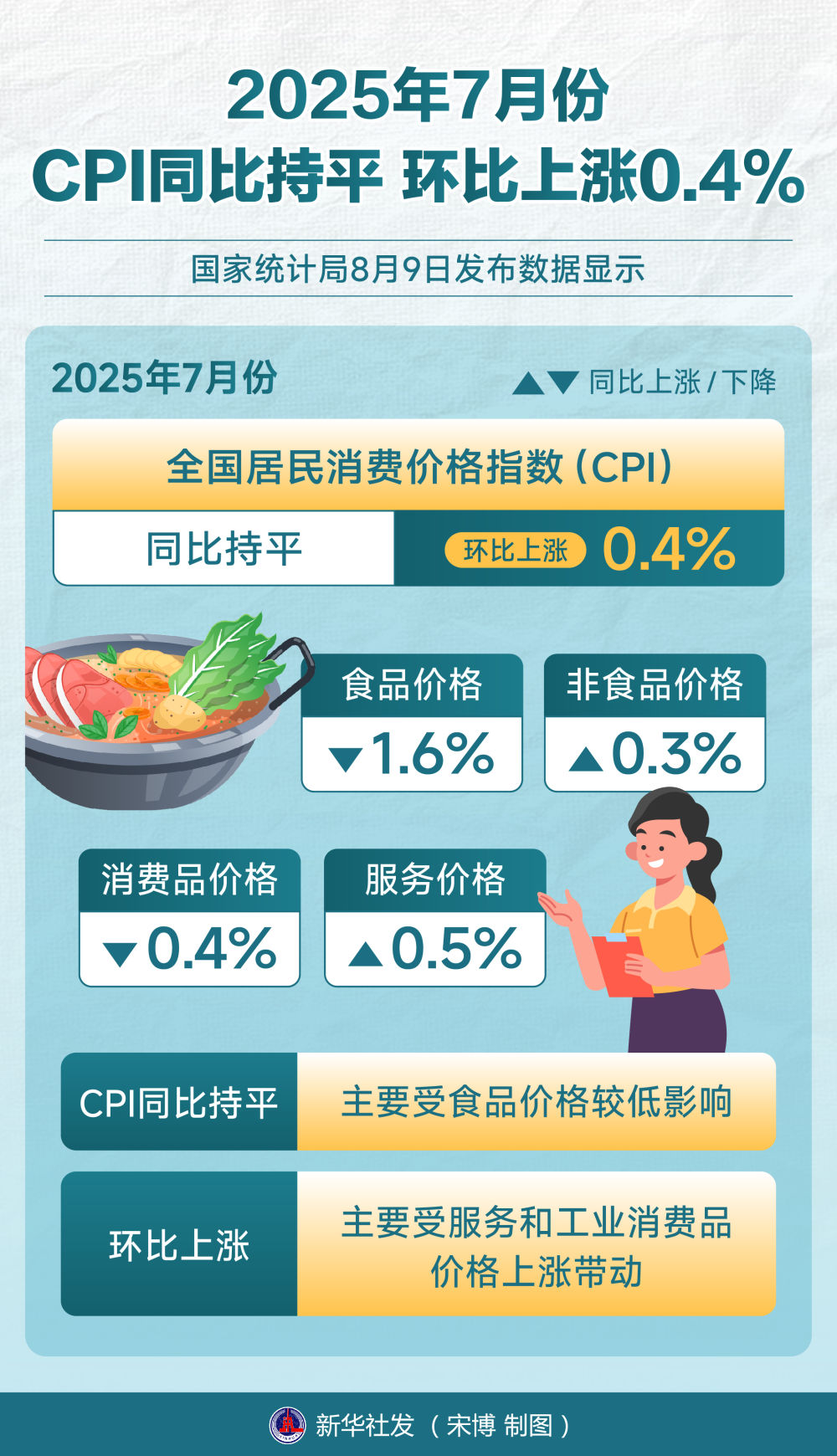
新华全媒+丨2025年7月份CPI同比持平 环比上涨0.4%
Xin Hua She· 2025-08-10 01:59
Group 1 - The core viewpoint of the article indicates that the effects of policies aimed at expanding domestic demand are becoming increasingly evident, as reflected in the Consumer Price Index (CPI) data for July [1][4][6] - In July, the national CPI remained flat year-on-year, while it increased by 0.4% month-on-month, reversing a previous decline of 0.1% [1][4][5] - The core CPI, which excludes food and energy prices, rose by 0.8% year-on-year, marking an expansion in growth for three consecutive months [1][4][6] Group 2 - The increase in CPI is primarily driven by rising prices in services and industrial consumer goods [3]
重磅数据公布!扩内需政策效应持续显现
Qi Huo Ri Bao· 2025-08-10 00:49
Group 1 - In July, the Consumer Price Index (CPI) increased by 0.4% month-on-month, reversing a previous decline of 0.1%, while the year-on-year change remained flat [1] - The core CPI, excluding food and energy, rose by 0.8% year-on-year, marking the third consecutive month of growth [1] - The Producer Price Index (PPI) decreased by 0.2% month-on-month, but the decline was less than the previous month, and the year-on-year drop remained at 3.6% [1] Group 2 - The increase in CPI is attributed to the effectiveness of policies aimed at boosting domestic demand and consumption, alongside a reduction in disorderly competition among enterprises [1] - The rise in non-food prices year-on-year indicates a gradual improvement in consumption structure, while food prices have been a drag due to falling vegetable prices and a slowdown in fruit price increases [1] - The PPI's month-on-month decline has narrowed for the first time since March, suggesting signs of stabilization in some industrial prices [2] Group 3 - Future CPI is expected to rise steadily due to ongoing consumption recovery and supportive policies, with service prices likely to remain high during peak seasons [2] - The impact of food price fluctuations is anticipated to decrease, while industrial consumption prices are expected to rebound due to rising household income and consumer confidence [2] - The ongoing construction of a unified national market is expected to optimize market competition and support the gradual recovery of PPI [3]