流动性危机

Search documents
突发!巨大抛盘,来袭!
券商中国· 2025-04-21 11:33
Core Viewpoint - The pressure from the Trump administration on U.S. universities is leading to significant sell-offs in the stock market, with Yale University planning to sell up to $6 billion of its private equity portfolio, representing 15% of its $41.4 billion endowment fund [1][2]. Group 1: University Actions - Yale University is seeking to sell its private equity investments, marking its first secondary market sale [2]. - Harvard University may also begin selling liquid assets and issuing more debt if its tax-exempt status is revoked, which could trigger a domino effect impacting the financial system [2][3]. - The Department of Homeland Security has terminated a $2.7 million grant to Harvard, which has already rejected government reform demands, indicating financial strain [2]. Group 2: Market Implications - The sell-off by prestigious universities like Yale and Harvard could lead to a liquidity crisis in the private equity market, as these institutions are significant players in the sector [3][7]. - The current liquidity issues in the private equity industry are reflected in the stock price declines of major firms like Blackstone and Apollo, which have dropped over 20% this year [7]. - The forced sales of high-quality assets by top institutions may lead to a re-evaluation of valuation models in the market [7][8]. Group 3: Broader Economic Impact - The potential sell-off of approximately $500 billion in private equity assets held by U.S. university endowments could create significant market turbulence [8]. - The global impact of this liquidity crisis is already being felt, with warnings from the European Private Equity Association about potential effects on emerging market asset prices [8]. - The ongoing pressure from the Trump administration could exacerbate the situation, potentially becoming a tipping point for the market [8].


日本成贸易谈判首选,美国会开出哪些条件?
Hua Er Jie Jian Wen· 2025-04-14 10:06
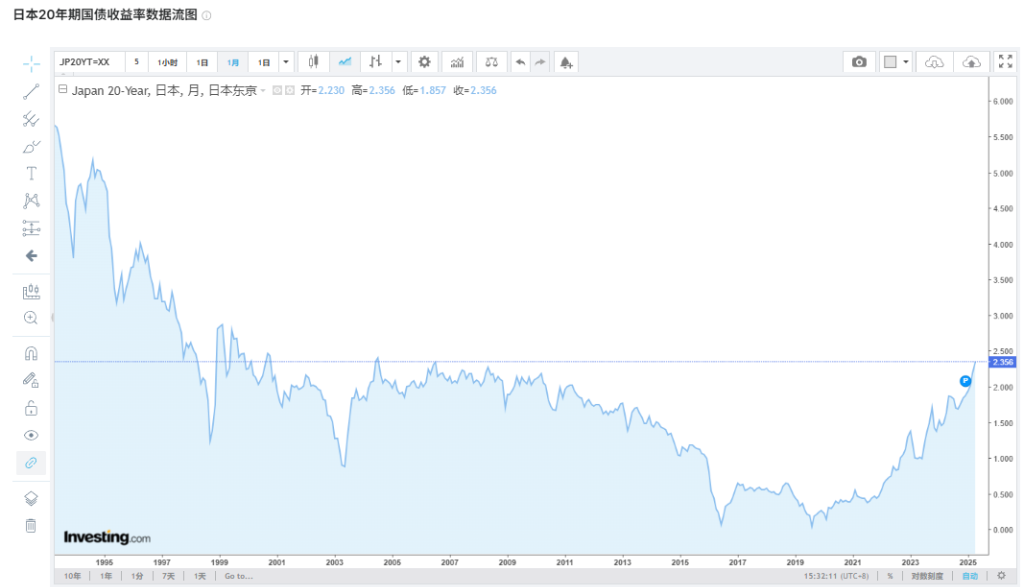
Core Viewpoint - The United States has initiated substantive trade negotiations with Japan, aiming to establish Japan as a model case for agreements with other countries following the recent tariff delay announcement [1][2]. Group 1: U.S.-Japan Trade Negotiations - Japan is the first country to engage in substantial trade negotiations with the U.S. after the tariff delay, indicating a strategic choice by the U.S. [1][2]. - The U.S. intends to use Japan as a template for future agreements with other nations, highlighting the importance of this negotiation [2]. Group 2: Potential U.S. Demands on Japan - The U.S. may push Japan to set explicit trade surplus targets, which could force Japan to reduce exports and increase imports, impacting its trade balance [3]. - Other potential demands include pushing for yen appreciation, which could harm Japanese export-oriented companies and hinder economic recovery [3]. - The U.S. might also request Japan to extend the maturity of its U.S. Treasury holdings, limiting Japan's foreign exchange reserve flexibility [3]. Group 3: Japanese Government's Stance - Japanese Prime Minister Kishida emphasized the importance of not compromising too quickly for a deal, advocating for a careful approach to negotiations [4]. - The potential U.S. demands could significantly impact Japan's financial markets, with warnings of a rapid depreciation of the dollar and a substantial appreciation of the yen [4]. Group 4: Impact on Japanese Economy and Bond Market - A stronger yen could reduce the competitiveness of Japanese exports, adversely affecting manufacturing firms that rely heavily on exports [5]. - Increased fiscal spending, as suggested by the U.S., would require Japan to issue more government bonds, exacerbating supply pressures in the bond market [5]. - The Japanese long-term bond market is already showing signs of instability, with recent spikes in yields indicating market volatility [5]. Group 5: Global Market Implications - Nomura warns of a global bond market imbalance and tightening liquidity risks, which could lead to broader credit contractions [7]. - The recent fluctuations in global stock markets and the widening of high-yield bond spreads indicate ongoing credit tightening [7].
美债忽然崩盘背后的秘密
雪球· 2025-04-14 03:45
以下文章来源于兵哥事务所 ,作者Slumdog Millionaire 兵哥事务所 . 尤其是美国还是蓝星上的霸主 , 就特别离谱 。 股票进攻,指数基金平衡,保险防守,深度剖析金融本质,为您的家庭财富配置保驾护航。 长按即可参与 风险提示:本文所提到的观点仅代表个人的意见,所涉及标的不作推荐,据此买卖,风险自负。 作者:贫民窟的大富翁 来源:雪球 特朗普是世界历史上第一个靠一己之力把自己国家搞出股债汇三杀危机的 ! 美国人过幸福生活根本原因是有着 " 无中生有 " 的金融本事 , 靠着空气+信用就可以从全球其 他国家换取真正的商品和服务 。 这里最重要的就是美国国债 , 我们简称美债 。 截至2025年3月 , 美国国债总额约36.6万亿美元 , 其中约40%是2020-2021年疫情期间发行 的低利率债券 。 这些债券的利率普遍在0.5%-1.5%之间 , 例如 : 2020年4月发行的10年期国债利率为0.66% 。 2021年1月发行的30年期国债利率为1.2% 。 疫情期间美国为了刺激经济增长 , 把十年期国债收益率打到了0.66% , 美国政府开启政府消费 大时代 , 向全世界借钱 , 在国内直升 ...

宏观与大类资产周报:关税冲击后关注结构性机会-20250413
CMS· 2025-04-13 15:15
Domestic Analysis - In the second week of April, domestic production rates showed a general decline, indicating adjustments due to tariff impacts, with demand indicators remaining weak and price pressures increasing[1] - The Trump administration's tariff policy remains uncertain, with many non-U.S. countries receiving a 90-day tariff exemption, potentially accelerating exports[1] - Recent high-frequency data suggests a cooling in automotive demand while daily consumer goods continue to see increased exports[1] Overseas Analysis - The 90-day suspension of reciprocal tariffs aligns with Trump's negotiation strategy, indicating a need for more time to reach solutions[2] - On April 10, the U.S. markets experienced a significant downturn, raising concerns about a liquidity crisis; however, past experiences suggest that the Federal Reserve responds quickly to such crises, often leading to a V-shaped recovery in the stock market[2] - Short-term, the yuan faces depreciation pressure due to tariffs, but the central bank's stabilization measures suggest limited downward movement, with the yuan expected to fluctuate between 7.15 and 7.35[2] Asset Performance - Domestic equity markets are currently experiencing a dual bull market in stocks and bonds, with technology and export-related sectors showing relative strength[1] - The bond market is expected to face renewed pressure once economic downturns are alleviated, while the stock market remains supported by domestic policies[1] - Recent data indicates a decline in A-share indices, with the Shanghai Composite Index down 3.11% and the Shenzhen Component Index down 5.13% for the week[41]
如期而至的流动性危机——写在美国股债汇三杀之时(民生宏观林彦)
川阅全球宏观· 2025-04-12 10:48
Core Viewpoint - The article discusses the shift in market expectations from "American exceptionalism" to concerns about liquidity challenges in the U.S. market, particularly in light of upcoming corporate debt maturities and the potential impact of U.S. monetary policy [1][19]. Group 1: Market Conditions - The U.S. market recently experienced a rare simultaneous decline in stocks, bonds, and the dollar, indicating heightened market volatility and uncertainty [1]. - The dollar index has surpassed the psychological level of 100, with expectations that it may continue to rise in the second and third quarters of the year [3]. - Funds are shifting from high-yield U.S. markets to lower-yield, more liquid markets like Japan, raising concerns about global liquidity [5]. Group 2: Debt and Liquidity Risks - The article highlights that all crises are essentially debt crises disguised as other narratives, with historical examples illustrating how corporate debt maturity spikes can lead to market turmoil [7][10]. - Current liquidity indicators suggest that a liquidity crisis is just beginning, with specific metrics indicating that the market has not yet reached critical levels of risk [19]. - The article outlines three key observation markers for liquidity: the spread between onshore and offshore dollar liquidity, the dollar index's decline rate, and the OAS (option-adjusted spread) for U.S. investment-grade and high-yield bonds [16][18]. Group 3: Potential Scenarios - Three scenarios are proposed for future market developments: - Pessimistic: Both the White House and the Federal Reserve do not compromise, leading to a prolonged period of economic stagnation and declining risk appetite [22]. - Baseline: Either the White House or the Federal Reserve makes concessions, potentially stabilizing the market and improving risk sentiment [22]. - Optimistic: The White House proactively compromises, leading to a reversal in market sentiment before significant corporate bankruptcies occur [22].

以史为鉴:流动性危机中的美联储
雪球· 2025-04-12 04:04
Core Viewpoint - The article discusses the current surge in U.S. Treasury yields as a critical vulnerability for the U.S. economy, suggesting a potential scenario of a bond market collapse, widespread hedge fund liquidations, and Federal Reserve intervention to stabilize the market [1]. Group 1: Historical Context of Liquidity Crises - Each liquidity crisis is characterized by a panic where lenders seek to retract loans and borrowers rush to sell collateral, leading to a downward spiral in asset prices and liquidity [1]. - Historical instances of liquidity crises, such as the Silicon Valley Bank crisis, the March 2020 liquidity crisis, and the 2019 repo crisis, are reviewed, highlighting the Federal Reserve's role as a last resort lender [1]. Group 2: Federal Reserve's Special Lending Facilities - The Federal Reserve has introduced special lending facilities, such as the Bank Term Funding Program (BTFP), which was established in March 2023 to address the Silicon Valley Bank crisis, allowing eligible institutions to borrow against U.S. Treasury securities and mortgage-backed securities at face value [3][6]. - As of May 3, 2023, the borrowing amount under BTFP reached $75.8 billion, indicating significant reliance on this facility during the crisis [6]. - The discount window, a traditional short-term loan tool, saw a peak borrowing of $152.9 billion on March 15, 2023, following the crisis, before declining to $5.3 billion by May 3, 2023 [6]. Group 3: Specific Events and Responses - The article details the March 2020 liquidity crisis triggered by the COVID-19 pandemic, where the Federal Reserve implemented various measures, including the Main Street Lending Program and the Commercial Paper Funding Facility, to support credit flow to households and businesses [8][9]. - The 2019 repo crisis is highlighted, where the overnight repo rate spiked from around 2% to over 5%, prompting the Federal Reserve to intervene with low-cost funding to stabilize the market [14][16].

兼评美国3月CPI:怎么看美国股债汇“三杀”?
GOLDEN SUN SECURITIES· 2025-04-11 05:11
Group 1: Macro Overview - The U.S. March CPI and core CPI both fell below expectations, with the overall CPI at 2.4%, lower than the expected 2.6% and previous 2.8%[2] - Core CPI dropped to 2.8%, below the expected 3.0% and previous 3.1%, marking the first time it fell below 3% since April 2021[2] - Following the CPI release, the market adjusted its expectations for interest rate cuts, with a 50% probability of four cuts and a 100% probability of a cut in June[4] Group 2: Market Reactions - Post-CPI release, major U.S. stock indices fell: S&P 500 down 3.5%, Nasdaq down 4.3%, and Dow Jones down 2.5%[4] - The 10-year U.S. Treasury yield rose by 8.0 basis points to 4.42%[4] - The U.S. dollar index decreased by 2.0% to 100.9, while spot gold increased by 3.0% to $3175.0 per ounce[4] Group 3: Inflation Components - Food prices increased by 0.4% month-on-month, while energy prices fell sharply by -2.4%[3] - Core goods prices decreased by -0.1%, with notable declines in used car and healthcare product prices[3] - "Super core inflation," excluding food, energy, and housing, was -0.04%, down from 0.08% in February[3] Group 4: Economic Concerns - Short-term market concerns center around a liquidity crisis, with current conditions resembling those during the 2020 pandemic[5] - Long-term concerns focus on potential global economic recession due to tariffs, with significant uncertainty regarding their impact on GDP[5] - The next few months are critical for observing economic data and tariff negotiations, with high volatility expected in asset prices[5]
美债暴跌:流动性危机来了吗
2025-04-11 02:20
美债暴跌:流动性危机来了吗 20250409 摘要 2025-04-11 • 美债收益率上行主因是流动性风险,而非通胀预期或经济韧性。美债交易 波动率上升,三年期国债拍卖遇冷,表明市场逻辑已从避险转向流动性紧 张。日本套息交易平仓和美国内部抛售或是重要因素。 • 未来 48 小时内美债拍卖情况是评估流动性紧张程度的关键。关注 SOFR 互换利差、信用利差和交叉货币互换价差等离岸美元流动性指标,当前这 些指标显示流动性紧张,但尚未达到 2020 年水平。 • 对冲基金基差交易平仓可能加剧美债抛售。30 年期掉期利差与同期限国债 之间出现历史最大单日波动,表明基差交易平仓严重。当前基差交易名义 敞口约为 1 万亿美元,进一步平仓将引发流动性问题。 • 美国市场流动性问题尚未结束,联储是否提前行动是关键。企业债压力集 中在 BBB 级,若信用利差扩大,可能迫使联储更早降息。一季度 GDP 负 增长,二季度或进一步下降,衰退概率上升。 • 美债走势分三个阶段:流动性问题导致抛压;经济走弱和联储降息;降息 周期结束、减税加码、通胀压力上升,收益反弹。长期看,关税可能成为 解决财政赤字和累积信用风险的工具。 Q&A 美债 ...
【笔记20250410— 决战到天亮】
债券笔记· 2025-04-10 12:48
以天和周为单位看待收益的人,相信的是奇迹与运气。 以月和季为单位看待收益的人,相信的是天赋与能力。 以年为单位看待收益的的人,相信的是自然规律。 ——笔记哥《应对》 【笔记20250410— 决战到天亮(-美暂停多数国家关税90天+美对中关税提高至125%+3月通胀数据偏弱-股市表现偏强+资金面均衡宽松=中上)】 资金面均衡宽松,长债收益率明显上行。 央行公开市场开展659亿元7天期逆回购操作,今日有2234亿元逆回购到期,净回笼1575亿元。 资金面均衡宽松,资金利率回落,DR001下至1.65%附近。 | | | | 银行间资金 | (2025.04.10) | | | | | | --- | --- | --- | --- | --- | --- | --- | --- | --- | | 阿购代码 | 加权利率 | 变化 | 利率支努 | 最高利率 | 变化 | 成交量 | 变化量 | 成交量占 | | | (%) | (bp) | (近30天) | (%) | (bp) | (亿元) | (亿元) | 比 (%) | | R001 | 1.68 | 53 | | 2.22 | | 57430. 66 ...
潜在的流动性灾难:抛售多少会引发股灾?
Sou Hu Cai Jing· 2025-04-10 06:19
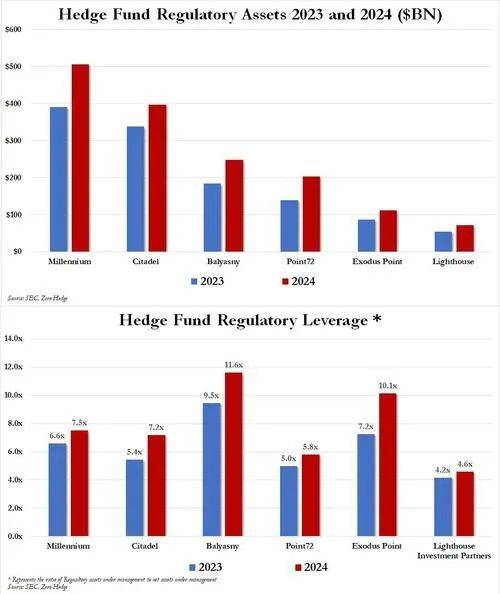
Core Viewpoint - The article highlights the alarming increase in leverage among major hedge funds involved in basis trading, raising concerns about potential market instability and the need for Federal Reserve intervention to prevent a crisis similar to past financial collapses [1][7][23]. Group 1: Hedge Fund Leverage and Basis Trading - Major hedge funds, including Millennium, Citadel, and Balyasny, have seen their regulatory leverage nearly double since the onset of the COVID-19 pandemic, approaching levels seen before the collapse of Long-Term Capital Management (LTCM) [1]. - The leverage used in these trades is reported to be around 20 times, indicating a high-risk environment for these institutions [4]. - A mere 5% loss in these leveraged positions could lead to catastrophic outcomes for the funds involved [7]. Group 2: Market Reactions and Implications - The current market conditions are characterized by a significant sell-off in U.S. Treasuries, with a record increase in yields, attributed to panic selling by hedge funds [12][14]. - The 10-year Treasury yield has surged by 50 basis points in just two days, reflecting the extreme volatility and fear in the market [14][16]. - The liquidity crisis is affecting all markets, leading to stock market declines and a potential dollar shortage due to the unwinding of synthetic dollar shorts [21]. Group 3: Federal Reserve's Role and Potential Actions - The Federal Reserve is under pressure to intervene, with discussions around potential measures such as rate cuts or quantitative easing to stabilize the market [18][22]. - There is a growing sentiment that the Fed may need to act soon, especially with significant events like the upcoming 10-year Treasury auction that could test market liquidity [21]. - The paradox exists where increasing liquidity issues could be misinterpreted as inflationary signals, complicating the Fed's decision-making process [21].