货币政策宽松

Search documents
刚刚,降息25个基点!
Zhong Guo Ji Jin Bao· 2025-11-24 15:10
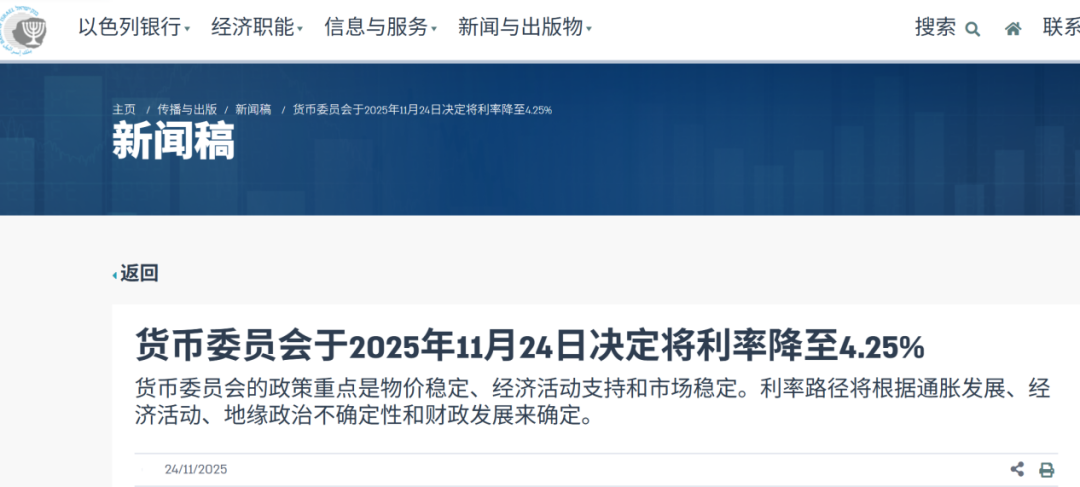
Core Viewpoint - The Bank of Israel has lowered its interest rate by 25 basis points to 4.25%, marking the first rate cut since January 2024, indicating a shift towards a more accommodative monetary policy [1][5]. Economic Indicators - The decision to cut rates aligns with market expectations, as 13 out of 14 economists predicted a reduction to 4.25% [5]. - The annual inflation rate in Israel has eased, stabilizing at 2.5% in October, with expectations for a slight increase by year-end before stabilizing within target ranges [5]. - The labor market remains tight, with a high ratio of job vacancies to unemployment and ongoing wage growth [5]. Market Reactions - The Israeli stock market has shown positive performance, with indices rising and risk premiums slightly above pre-war levels [5]. - The New Israeli Shekel has appreciated against the US dollar by 1.3% and against the euro by 2.9% since the last rate decision [6]. Economic Growth - Israel's GDP grew by 12.4% year-on-year in Q3 2025, significantly surpassing the expected 7.3%, driven by strong private consumption, exports, and fixed asset investment [6]. - Private consumption increased by 23%, fixed asset investment rose by 36.9%, and exports of goods and services grew by 23.3% in Q3 [6]. Future Outlook - The Bank of Israel's monetary policy will focus on price stability, supporting economic activity, and maintaining market stability, with future rate decisions influenced by inflation, economic activity, and geopolitical uncertainties [5].

中金:料明年金价升至每盎司4,500美元 周期性需求尚未见顶
Zhi Tong Cai Jing· 2025-11-24 06:33
Core Viewpoint - The recent surge in precious metals is primarily driven by cyclical demand for gold, with silver prices outpacing gold [1] Group 1: Price Projections - By 2026, COMEX gold prices are expected to reach $4,500 per ounce, while silver prices are projected to rise to $55 per ounce, indicating further upside potential from current levels [1] Group 2: Investment Demand - The cyclical investment demand for precious metals has not peaked, as the U.S. monetary policy may shift towards easing in the short term, and long-term inflation expectations could remain unanchored [1] Group 3: Structural Support - The unique value of physical gold and the strategic nature of silver are expected to provide structural support for global central bank gold purchases, private physical investments, and regional stockpiling [1]
中信证券:12月美联储议息会议后 美股有望重拾上行行情
智通财经网· 2025-11-23 09:41
Core Viewpoint - The overall outlook for the US stock market indicates a slight downward trend until the Federal Reserve's meeting on December 10-11, with a potential rebound expected in the latter half of December due to anticipated changes in monetary policy and tax cuts starting January 1 [1][9]. Market Trends - The US stock market experienced a decline, particularly in technology stocks, with the Nasdaq 100 and Philadelphia Semiconductor Index dropping by 2.4% and 4.8% respectively [2]. - Despite the downturn, the drop is attributed more to macroeconomic factors rather than panic selling related to an "AI bubble" [2]. Employment Data and Monetary Policy - The US added 119,000 non-farm jobs in September, exceeding market expectations of 51,000, which has raised tightening expectations for monetary policy [3]. - Hawkish statements from Federal Reserve officials have further fueled market expectations for a tightening of monetary policy, with indications that the Fed may maintain current interest rates in December [3][4]. Labor Market Insights - The unemployment rate increased from 4.3% in August to 4.4% in September, while the broader U6 unemployment rate decreased slightly to 8.0% [4]. - The labor market shows signs of marginal weakening, with potential future downward revisions of employment data for July and August [4]. AI Market Dynamics - The narrative of an "AI bubble" bursting is unlikely to manifest in the short term, as demand continues to grow amid competitive pressures and technological advancements [5][6]. - The commercial landscape for AI is evolving, with significant investments from major tech companies expected to drive growth in the sector [5]. Earnings Expectations - Earnings expectations for the US stock market have been revised upward, particularly in the information technology and healthcare sectors [7][8]. - The upward revisions in revenue and earnings growth are occurring despite a decline in stock prices, indicating a contraction in valuation multiples rather than a deterioration in earnings expectations [8]. Investment Recommendations - The company suggests focusing on sectors that are expected to benefit from the economic environment, including technology, manufacturing, military, healthcare, and financial services [1][9].

明年低波震荡,十年国债ETF(511260)或为配置核心
Mei Ri Jing Ji Xin Wen· 2025-11-20 01:22
Core Viewpoint - The bond market is expected to experience low volatility and a stable trend in 2024, primarily due to weak demand and a slow improvement in household income, indicating a longer-than-expected economic structural transition [1] Group 1: Economic Environment - The central government is expected to support structural demand during the transition, with fiscal measures increasing the deficit to stimulate economic demand [1] - The reliance on issuing long-term or ultra-long-term government bonds is highlighted, as significant increases in long-term interest rates would raise interest expenses for the fiscal department [1] - The risk of a substantial rise in bond yields is considered low under the current macroeconomic environment [1] Group 2: Interest Rate Outlook - A neutral judgment suggests a potential for around 20 basis points (BP) of interest rate cuts and 50-100 BP of reserve requirement ratio (RRR) cuts in 2024 [2] - The central tendency of interest rates is expected to decrease by 20 BP from the current 1.7%-1.8%, leading to a projected range of 1.5%-1.6% for the ten-year government bond yield [2] - The volatility in the bond market is anticipated to be lower in 2024 compared to 2023, with yields gradually declining as broader market interest rates decrease [2][3] Group 3: Fiscal Policy and Market Dynamics - The fiscal spending rhythm has shown significant differences year-on-year, with 2023 seeing a late surge in spending, while 2024 is expected to have a more proactive fiscal approach [3] - The effectiveness of fiscal measures in supporting the transition to a consumption-driven economy is under scrutiny, particularly regarding the implementation of consumer subsidies [3] - The bond market's performance will be closely tied to the pace of fiscal stimulus and inflation expectations, with two critical periods to monitor: significant fiscal spending and inflation trading phases [2][3] Group 4: Investment Opportunities - The introduction of the ten-year government bond ETF (511260) allows investors to easily access government bonds, with a duration of approximately 6.5-10 years [4] - The ETF offers high trading flexibility and is recommended for inclusion in investment portfolios during the current and upcoming favorable market conditions [4] - The bond market is seen as entering a period of low risk and high allocation value, with the ten-year government bond being particularly attractive for investors [4]
领涨,又是它!中国银行股价创历史新高!背后原因就是……
Mei Ri Shang Bao· 2025-11-19 12:22
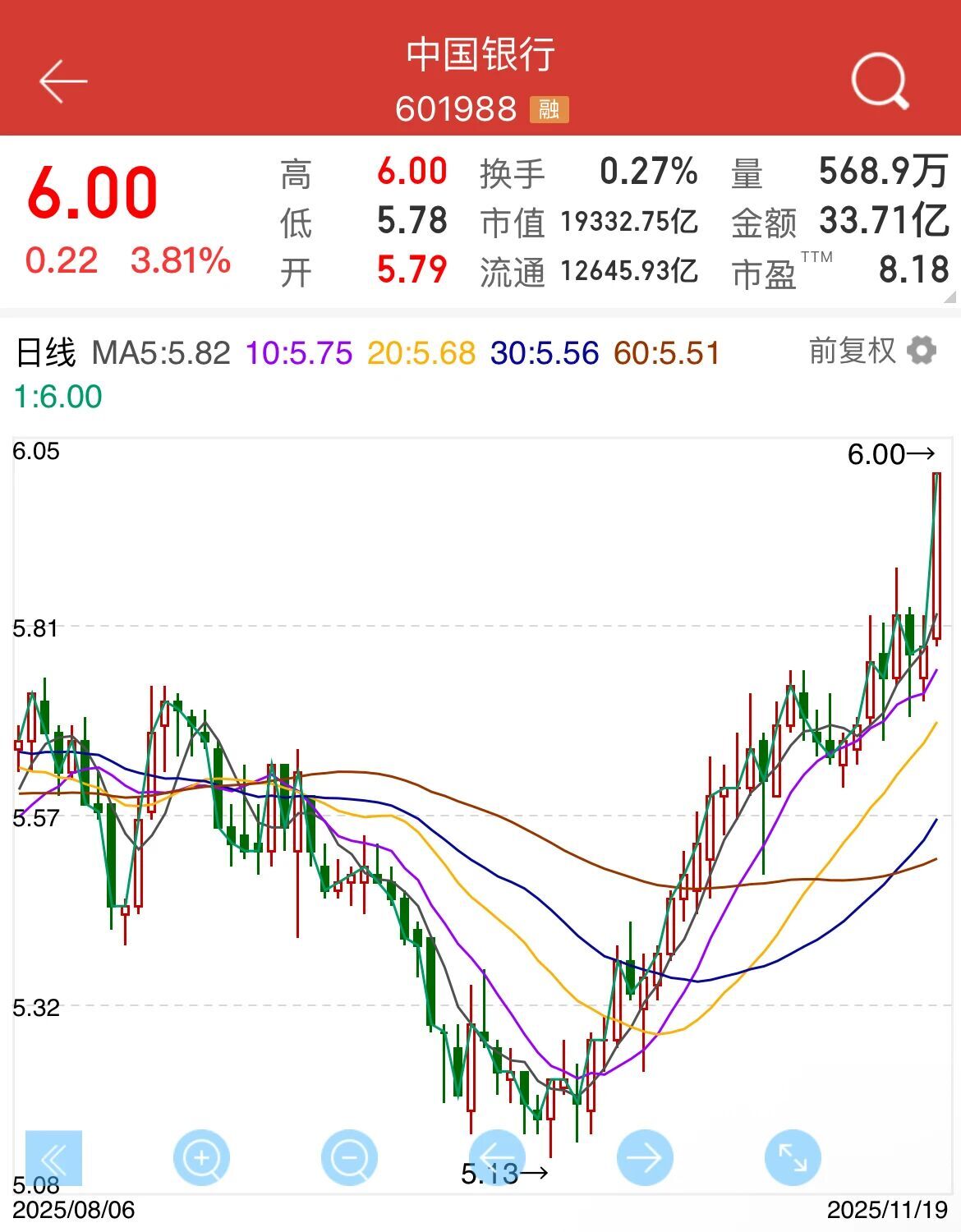
Core Viewpoint - The banking sector in A-shares has shown strong performance, with China Bank's stock price reaching a historical high, driven by rising risk aversion, institutional fund accumulation, and expectations of loose monetary policy [1][3][11]. Group 1: Market Performance - As of November 19, the A-share banking sector index rose by 0.63%, with China Bank leading the gains, closing up 3.81% [3][4]. - Other banks such as Everbright Bank, Ping An Bank, Jiangsu Bank, and CITIC Bank also saw significant increases in their stock prices [3][4]. Group 2: Factors Driving Performance - The recent rise in the banking sector is attributed to heightened risk aversion among investors, leading to a shift from high-volatility sectors like solar and semiconductors to low-valuation, high-dividend defensive sectors [11]. - The average dividend yield of the banking sector is approximately 6.5%, significantly higher than the 1.80% yield of 10-year government bonds, making it an attractive option for risk-averse funds [11]. Group 3: Institutional Investment Trends - Insurance funds have increased their holdings in bank stocks by 8.36 billion shares as of the end of Q3 2025, focusing on major state-owned banks and stable regional banks [11]. - Analysts believe that the combination of monetary policy easing and financial regulation aimed at reducing liability costs will support steady profit recovery for banks [12]. Group 4: Future Outlook - Institutions are optimistic about the banking sector's investment prospects, anticipating that the high dividend theme will continue to resonate in the market [12]. - The banking sector is expected to benefit from structural adjustments towards technology finance, green finance, and pension finance, which will enhance long-term growth potential and support valuation recovery [12].

瑞银仍认为12月将降息沪银高涨
Jin Tou Wang· 2025-11-19 07:55
Group 1 - Silver futures are currently trading above 12091, with an opening price of 11760 and a current price of 12147, reflecting a 2.18% increase [1] - The highest price reached today is 12162, while the lowest was 11760, indicating a short-term oscillating trend in silver futures [1] Group 2 - UBS economists report that the FOMC meeting minutes from October will reveal significant divisions among committee members regarding short-term monetary policy decisions, with a strong inclination towards a rate cut in December [3] - Despite concerns about inflation from some Federal Reserve officials, UBS believes there remains a slight majority favoring further easing policies [3] - President Trump has indicated that he has a preliminary candidate to replace current Fed Chair Powell, but noted that there are obstacles to this change [3]
10月社融数据点评:资金活化延续回升趋势
Yong Xing Zheng Quan· 2025-11-18 05:58
1. Report Industry Investment Rating No specific industry investment rating is provided in the given content. 2. Core Viewpoints - On November 13, 2025, the central bank announced the financial statistics for October 2025. M2 increased by 8.2% year - on - year, M1 increased by 6.2% year - on - year. The stock of social financing scale at the end of October 2025 increased by 8.5% year - on - year, and the cumulative increase in social financing scale in the first ten months of 2025 was 30.9 trillion yuan, 3.83 trillion yuan more than the same period last year [1][12]. - The year - on - year growth rate of social financing in October was 8.50%, with the growth rate falling for three consecutive months. New social financing was 81.5 billion yuan, 58.08 billion yuan less than the same period last year. Government bond financing slowed down, and credit demand was weak [2][13]. - M1 declined, and the gap between M1 and M2 widened slightly. However, the M1 - M2 gap has been narrowing overall this year, which is an important signal of capital activation and can boost the sentiment of the equity market in the short term [3][25]. 3. Summary by Relevant Catalogs 3.1 Social Financing Data Validates Bond Market Space - **Social Financing Growth Rate and Composition**: The year - on - year growth rate of social financing in October was 8.50%, with the growth rate falling for three consecutive months. New social financing was 81.5 billion yuan, 58.08 billion yuan less than the same period last year. Government bond net financing was 48.93 billion yuan, 56.02 billion yuan less than the same period last year. New RMB loans decreased by 2.01 billion yuan, 31.66 billion yuan more than the same period last year. In direct financing, corporate bond net financing was 24.69 billion yuan, 14.82 billion yuan more than the same period last year, and non - financial enterprise domestic stock financing was 6.96 billion yuan, 4.12 billion yuan more than the same period last year. The new non - standard financing decreased by 10.85 billion yuan, 3.58 billion yuan less than the same period last year [2][13]. - **Credit Demand**: New RMB loans by financial institutions in October were 22 billion yuan, 28 billion yuan less than the same period last year. Corporate loans increased by 35 billion yuan, 22 billion yuan more than the same period last year, with obvious bill impulse, and corporate medium - and long - term loans increased by 3 billion yuan, 14 billion yuan less than the same period last year. Resident loans decreased by 36.04 billion yuan, 52.04 billion yuan more than the same period last year, indicating weak demand in the real estate market [2][14]. 3.2 M1 - M2 Spread and Capital Activation - **M1 and M2 Trends**: In October, M2 increased by 8.20% year - on - year, down 0.2 percentage points, and M1 increased by 6.20% year - on - year, with the growth rate down 1.0 percentage point compared with the previous value. The absolute value of the M1 - M2 gap widened slightly to 2.00pct, but it has been narrowing overall this year, which is a signal of capital activation and can boost the equity market sentiment in the short term. The growth rate difference between social financing and M2 in October was 0.30pct [3][25]. - **Deposit Changes**: In October, household deposits decreased by 134 billion yuan, 77 billion yuan more than the same period last year; non - financial enterprise deposits decreased by 108.53 billion yuan, 35.53 billion yuan more than the same period last year; fiscal deposits increased by 72 billion yuan, 12.48 billion yuan more than the same period last year; non - banking financial institution deposits increased by 185 billion yuan, 77 billion yuan more than the same period last year, which may promote further capital activation [3][25]. 3.3 Investment Advice - **Equity Market**: The recent narrowing of the M1 - M2 gap is an important signal of capital activation, which can boost the equity market sentiment in the short term, but the sustainability of the rebound depends on fundamental improvement and policy coordination [4][35]. - **Bond Market**: The social financing data in October shows that the growth rate of social financing has declined. The data verifies the uncertainty of the economic recovery. The bond yield has declined recently, and there is still some room for further decline. In 2026, the central bank's monetary policy will continue the "moderately loose" tone. For the bond market, investors are advised to mainly conduct band operations on interest - rate bonds, pay attention to the structural opportunities of green bonds and technology bonds in credit bonds, dynamically adjust the stock - bond ratio, and pay attention to elastic assets such as pro - cyclical convertible bonds [4][38].
日本经济收缩日元表现弱势
Jin Tou Wang· 2025-11-17 03:50
Group 1 - The USD/JPY exchange rate is currently at 154.7300, with a slight increase of 0.12%, reflecting limited reaction to Japan's economic contraction in Q3, which was less severe than expected [1] - Japan's GDP contracted by 0.4% quarter-on-quarter and 1.8% year-on-year, indicating insufficient economic momentum and leading to lowered expectations for the Bank of Japan's interest rate hikes [1] - The Japanese government is promoting a new round of fiscal stimulus to alleviate rising living costs, suggesting continued expansionary fiscal policy and a likely maintenance of loose monetary policy, which may hinder the yen's ability to gain interest rate advantages [1] Group 2 - From a technical perspective, the USD/JPY maintains a bullish structure in the short term, with clear resistance levels identified [2] - A strong rebound occurred from the 153.60 level, breaking through the 154.45-154.50 resistance zone, indicating potential for further upward movement if the 155.00 psychological level is breached [2] - The support level at 154.00 remains intact; however, a drop below 153.60 could shift the short-term bias to bearish, targeting the 152.10 range [2]
10月经济数据点评:稳增长的重要性有所上升
Bank of China Securities· 2025-11-16 12:19
Economic Performance - In October, industrial added value grew by 4.9% year-on-year, down 1.6 percentage points from September and below the consensus expectation of 5.52%[3] - The cumulative year-on-year growth rate of fixed asset investment from January to October decreased by 1.7%, a decline of 1.2 percentage points compared to the first nine months[19] - Real estate investment from January to October fell by 14.7% year-on-year, with new construction area down 19.8%[24] Consumer Trends - Social retail sales in October increased by 2.9% year-on-year, marking the fifth consecutive month of decline, but was better than expected due to a high base last year[29] - Excluding automobiles, retail sales of consumer goods rose by 4.0% year-on-year, indicating a positive trend in non-auto consumption[12] - Jewelry consumption surged by 37.6% year-on-year in October, highlighting significant price effects on retail sales growth[29] Investment Insights - Cumulative fixed asset investment growth in the manufacturing sector from January to October was 2.7%, while infrastructure investment fell by 0.1%[21] - The cumulative year-on-year decline in private fixed asset investment reached 4.5% from January to October, indicating a weakening investment environment[19] - The government has pre-allocated 500 billion yuan in local government bonds to support infrastructure investment, reflecting a proactive fiscal policy stance[30] Policy Outlook - There is a potential for monetary policy easing in the short term, focusing on quantitative measures such as reserve requirement ratio cuts and structural monetary policy tools[30] - The emphasis on stabilizing growth suggests a reliance on domestic demand amid global economic uncertainties[30] Risks - Risks include a potential resurgence of global inflation, a faster-than-expected economic slowdown in Europe and the U.S., and increasing complexity in international relations[30]
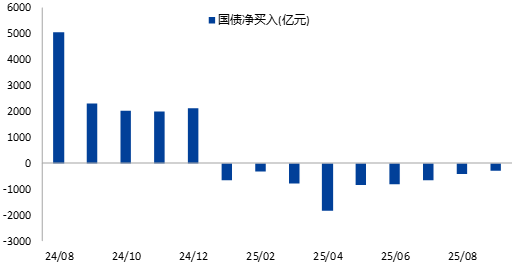
央行重启国债买卖,债牛是否回来了?
Sou Hu Cai Jing· 2025-11-13 08:23
Core Viewpoint - The People's Bank of China (PBOC) has announced the resumption of government bond trading operations, indicating a continuation of a loose monetary policy and coordination with fiscal debt issuance [1][2][3] Group 1: Event Overview - On October 27, 2025, PBOC Governor Pan Gongsheng stated that the bond market is currently operating well, leading to the decision to resume open market operations for government bonds [2] - The timing of the resumption slightly exceeded market expectations, resulting in a rapid decline in bond yields following the announcement [2] Group 2: Event Analysis - The resumption of government bond trading is aligned with a proactive fiscal policy and a continuation of a moderately loose monetary policy, as discussed in a recent meeting between the Ministry of Finance and the PBOC [3] - The necessity for resuming bond trading has increased due to the maturity of the previous round of bond purchases, which totaled 1 trillion yuan from August to December 2024, with approximately 700 billion yuan maturing by the end of September [3][6] Group 3: Market Conditions - The bond market has undergone sufficient adjustments, with interest rates returning to a relatively reasonable range after a significant upward shift in the yield curve since the beginning of the year [6] - The current market conditions provide a favorable environment for the resumption of government bond trading, as the short-end interest rates have shown significant recovery [12] Group 4: Trading Strategy - The resumption of government bond trading is expected to have a positive impact on the bond market, reducing adjustment risks in the short term [10] - It is recommended to lower the hedging ratio for those who previously used government bond futures for short hedging, while maintaining long positions in the TS2512 contract and exploring opportunities in the TF contract [10]