通胀

Search documents
食品和能源价格拖累,12月东京CPI超预期回落,创十四个月新低
Hua Er Jie Jian Wen· 2025-12-26 08:01
随着食品和能源价格带来的上涨压力消退,日本东京的通胀降幅超出市场预期。尽管通胀数据大幅回 落,但核心指标仍维持在日本央行2%的目标之上,这表明央行目前的政策紧缩路径并未受到实质性阻 碍,未来加息轨道依然清晰。 据日本总务省周五发布的数据,12月东京不含生鲜食品的消费者价格指数(CPI)同比上涨2.3%,较上 月2.8%的涨幅大幅放缓。这一数据表现明显低于经济学家此前预期的2.5%。 作为全国通胀趋势的前瞻性指标,东京的数据显示整体价格压力正在减轻。12月整体通胀率从上月的 2.7%放缓至2%,而剔除能源后的更深层通胀指标也同步减速至2.6%。 此次数据的发布正值市场密切审视日本价格轨迹之时,投资者试图据此评估日本央行下一步政策行动的 具体时机。 通胀普遍降温,但核心通胀指标依然位于目标上方 据彭博报道,东京通胀数据的回落主要受到食品和能源价格压力减弱的驱动。作为日本全国价格趋势的 领先指标,东京CPI的走势往往预示着全国范围内的通胀动向。 风险提示及免责条款 市场有风险,投资需谨慎。本文不构成个人投资建议,也未考虑到个别用户特殊的投资目标、财务状况或需要。用户应考虑本文中的任何 意见、观点或结论是否符合其特定 ...
国泰君安期货商品研究晨报:贵金属及基本金属-20251226
Guo Tai Jun An Qi Huo· 2025-12-26 07:34
Report Overview - Report Date: December 26, 2025 - Report Publisher: Guotai Junan Futures - Report Type: Commodity Research Morning Report - Precious Metals and Base Metals Industry Investment Ratings No industry investment ratings are provided in the report. Core Views - **Gold**: Inflation is moderately declining [2]. - **Silver**: Undergoing high - level adjustment [2]. - **Copper**: Positive market sentiment supports price increases [2]. - **Zinc**: Moving in a sideways range [2]. - **Lead**: Declining inventory supports prices [2]. - **Tin**: Supply is facing new disruptions [2]. - **Aluminum**: Showing a slightly upward - trending oscillation [2]. - **Alumina**: Continuously bottom - grinding [2]. - **Cast Aluminum Alloy**: Following the trend of electrolytic aluminum [2]. - **Platinum**: Bullish sentiment dominates [2]. - **Palladium**: Oscillating upward [2]. - **Nickel**: Intense capital game on the trading floor leads to wide - range price fluctuations [2]. - **Stainless Steel**: Both supply and demand in the fundamentals are weak, and news from Indonesian nickel mines causes disruptions [2]. Summary by Commodity Gold - **Price**: The closing price of Shanghai Gold 2602 was 1,014.24, up 1.34%; Gold T + D was 1,006.45, up 1.44%; Comex Gold 2602 was 4515.00, up 0.77% [4]. - **Trading Volume and Open Interest**: The trading volume of Shanghai Gold 2602 decreased by 2,375 to 276,418; the open interest decreased by 2,397 to 199,893. Comex Gold 2602's trading volume increased by 42,965 to 241,461, and open interest increased by 8,818 to 360,434 [4]. - **Inventory**: Shanghai Gold inventory increased by 1,995 to 93,711 kg; Comex Gold inventory (previous day) increased by 114,168 to 36,120,091 troy ounces [4]. - **Trend Strength**: 0 [8]. Silver - **Price**: The closing price of Shanghai Silver 2602 was 16441, up 1.50%; Silver T + D was 16420, up 1.52%; Comex Silver 2602 was 71.610, up 3.65% [4]. - **Trading Volume and Open Interest**: The trading volume of Shanghai Silver 2602 decreased by 474,555 to 1,230,157; the open interest decreased by 921 to 340,510. Comex Silver 2602's trading volume increased by 30,063 to 127,435, and open interest remained unchanged at 114,525 [4]. - **Inventory**: Shanghai Silver inventory decreased by 1805 to 899,663 kg; Comex Silver inventory (previous day) decreased by 3,083,409 to 450,643,486 troy ounces [4]. - **Trend Strength**: 0 [8]. Copper - **Price**: The closing price of Shanghai Copper's main contract was 96,210, up 0.11%; the night - session closing price was 97680, up 1.53%. LME Copper 3M was 12,133, up 0.65% [9]. - **Trading Volume and Open Interest**: The trading volume of Shanghai Copper Index decreased by 81,418 to 477,230; the open interest decreased by 7,370 to 651,557. LME Copper 3M's trading volume decreased by 8,111 to 18,195, and open interest decreased by 2,248 to 340,000 [9]. - **Inventory**: Shanghai Copper inventory increased by 6,861 to 59,083; LME Copper inventory decreased by 1,550 to 157,025, and the注销仓单 ratio was 29.63%, down 1.19% [9]. - **Trend Strength**: 2 [11]. Zinc - **Price**: The closing price of Shanghai Zinc's main contract was 23065, down 0.71%; LME Zinc 3M was 3086.5, down 0.32% [12]. - **Trading Volume and Open Interest**: The trading volume of Shanghai Zinc's main contract decreased by 46305 to 125213; the open interest decreased by 1875 to 93322. LME Zinc's trading volume decreased by 4941 to 5944, and open interest decreased by 646 to 227051 [12]. - **Inventory**: Shanghai Zinc futures inventory decreased by 1092 to 41319; LME Zinc inventory increased by 7900 to 106875 [12]. - **Trend Strength**: 0 [14]. Lead - **Price**: The closing price of Shanghai Lead's main contract was 17315, up 0.52%; LME Lead 3M was 1999.5, up 0.83% [15]. - **Trading Volume and Open Interest**: The trading volume of Shanghai Lead's main contract decreased by 12922 to 55100; the open interest decreased by 210 to 56328. LME Lead's trading volume decreased by 1794 to 3806, and open interest increased by 167 to 178155 [15]. - **Inventory**: Shanghai Lead futures inventory decreased by 900 to 11457; LME Lead inventory decreased by 4200 to 248900 [15]. - **Trend Strength**: 1 [16]. Tin - **Price**: The closing price of Shanghai Tin's main contract was 344,750, up 1.27%; LME Tin 3M was 42,835, up 0.25% [18]. - **Trading Volume and Open Interest**: The trading volume of Shanghai Tin's main contract decreased by 11,222 to 228,643; the open interest increased by 31,914 to 61,161. LME Tin 3M's trading volume decreased by 9 to 180, and open interest increased by 53 to 13,988 [18]. - **Inventory**: Shanghai Tin inventory increased by 655 to 8,340; LME Tin inventory increased by 50 to 4,675, and the注销仓单 ratio was 6.57%, down 0.38% [18]. - **Trend Strength**: 1 [21]. Aluminum, Alumina, and Cast Aluminum Alloy - **Aluminum** - **Price**: The closing price of Shanghai Aluminum's main contract was 22275, down 55; LME Aluminum 3M was 2957, unchanged [22]. - **Trading Volume and Open Interest**: The trading volume of Shanghai Aluminum's main contract decreased by 65183 to 229349; the open interest decreased by 6450 to 290474. LME Aluminum 3M's trading volume was unchanged at 11757 [22]. - **Trend Strength**: 1 [24]. - **Alumina** - **Price**: The closing price of Shanghai Alumina's main contract was 2646, up 92 [22]. - **Trend Strength**: 0 [24]. - **Cast Aluminum Alloy** - **Trend Strength**: 1 [24]. Platinum and Palladium - **Platinum** - **Price**: The closing price of Platinum Futures 2606 was 686.95, up 4.46%; the price of Gold Exchange Platinum was 591.25, down 2.59% [25]. - **Trading Volume and Open Interest**: The trading volume of Shanghai Platinum increased by 201,102 to 227.666; the open interest increased by 718 to 48.732. NYMEX Platinum's trading volume was 82,975, and open interest was 28,141 [25]. - **Trend Strength**: 1 [28]. - **Palladium** - **Price**: The closing price of Palladium Futures 2606 was 529.05, down 8.54%; the price of RMB Spot Palladium was 416.00, down 9.37% [25]. - **Trading Volume and Open Interest**: The trading volume of Shanghai Palladium decreased by 2,565 to 100.293; the open interest decreased by 2,067 to 23.862. NYMEX Palladium's trading volume was 48.123, and open interest was 67.992 [25]. - **Trend Strength**: 1 [28]. Nickel and Stainless Steel - **Nickel** - **Price**: The closing price of Shanghai Nickel's main contract was 125,410, down 2,590 [31]. - **Trend Strength**: 0 [35]. - **Stainless Steel** - **Price**: The closing price of Stainless Steel's main contract was 12,990, down 85 [31]. - **Trend Strength**: 0 [35].
从黄金的四大属性来理解涨跌逻辑 | 轻分享
高毅资产管理· 2025-12-26 07:30
Core Viewpoint - The article discusses the complexities of gold price fluctuations and emphasizes understanding its four core attributes: commodity, monetary, financial, and hedging properties, to clarify the underlying logic of its price movements [3][4]. Group 1: Gold's Four Core Attributes - **Commodity Property**: Gold prices are primarily determined by supply and demand dynamics, with demand influenced by economic cycles and market expectations. The main contributors to gold demand are jewelry, investment, and central bank purchases, while industrial demand is relatively low [5]. - **Monetary Property**: Gold is considered "hard currency" due to its scarcity, durability, and universal acceptance, serving as an effective store of value. Its price is closely linked to the US dollar index, typically decreasing when the dollar strengthens and increasing when the dollar weakens [6][9]. - **Financial Property**: Gold's investment value is shaped by real interest rates, expected inflation rates, and market liquidity. Lower real interest rates increase gold's attractiveness as a non-yielding asset, especially during periods of low interest rates or rate cuts by central banks [14][15]. - **Hedging Property**: Gold performs well in risk scenarios where market pessimism rises, making it a preferred asset over riskier investments. Historical events show that gold prices tend to rise during crises, highlighting its unique characteristics as a safe-haven asset [17][18]. Group 2: Historical Review of Gold Price Movements - Historical analysis indicates that significant price movements in gold are closely related to Federal Reserve policies, inflation changes, and central bank behaviors. Major price increases are driven by structural trends like de-dollarization and central bank diversification, alongside cyclical factors such as inflation and risk aversion [21][22]. - Price declines are often triggered by tightening monetary policies, rapid inflation declines, or central bank sell-offs. For instance, the period from 1983 to 1985 saw a drop of over 40% due to US economic recovery and interest rate hikes [23][24]. - The article highlights that current global challenges, including debt expansion and economic slowdown, have accentuated gold's monetary and hedging properties, leading to recent price surges. Notably, Ray Dalio views gold as a hedge against unsustainable debt levels, suggesting a reasonable allocation of 10% to 15% in investment portfolios [25].


繁荣之下的“定时炸弹”!盘点2026年还需小心的十大风险
Jin Shi Shu Ju· 2025-12-26 07:06
Group 1: AI Bubble and Market Valuation - The current valuation levels of US stocks, particularly in the AI sector, are approaching those seen during the 2000 dot-com bubble, raising concerns about sustainability [2] - Analysts predict a 10-13% earnings growth for the S&P 500 in 2025, with a 15% growth expected in 2026, but there are doubts whether this growth can support current valuations [2] - If major tech companies fail to deliver expected returns from AI investments, market confidence could collapse, leading to significant economic repercussions [2][3] Group 2: Consumer Spending and Economic Resilience - The top 20% of wealthy households in the US hold 70% of financial assets, and their spending accounts for nearly half of total US consumption [3] - A collapse of the AI bubble could lead to a rapid decrease in wealth for these households, resulting in a sharp contraction in consumer spending and a potential recession [3] Group 3: Labor Market and Inflation Risks - The construction of AI infrastructure has created numerous jobs, but a sudden halt in AI investment could lead to widespread job losses and a rise in unemployment [4] - Stricter immigration policies are exacerbating labor shortages, which could lead to increased wage inflation and further economic instability [5] Group 4: Fiscal and Trade Risks - The US federal budget deficit reached $1.8 trillion in the 2025 fiscal year, raising concerns about fiscal sustainability [6][7] - Proposed "tariff rebates" by the Trump administration could exacerbate the deficit, especially if they are not supported by corresponding revenue [6][7] Group 5: Federal Reserve Independence - The potential political influence over the Federal Reserve could undermine its independence, leading to uncontrolled inflation and rising long-term interest rates [10][11] - A loss of credibility for the Federal Reserve could result in a significant decline in the value of the US dollar and increased capital flight [12] Group 6: Bond Market Trust Crisis - The US federal deficit is expected to remain high, and any loss of investor confidence could trigger a sell-off in the bond market, affecting global financial stability [13] - European countries are also facing similar challenges, with rising defense spending and increasing public debt levels [14][15] Group 7: Japanese Policy and Global Impact - Japan's recent interest rate hikes could disrupt global financial markets, particularly affecting yen carry trades that have significant implications for liquidity [16][17] - A potential "rate hike-recession" cycle in Japan could further complicate global economic conditions [17] Group 8: Gold Valuation Risks - The significant disparity between the market value and the official valuation of US gold reserves poses risks if the government decides to revalue these assets [18][19] - A revaluation could lead to inflationary pressures and undermine the independence of the Federal Reserve [19][20] Group 9: Geopolitical Risks - The shift in US foreign policy could lead to increased volatility in global markets, particularly concerning energy prices and supply chains [21][22] - Ongoing conflicts in regions like the Middle East and Africa could disrupt critical trade routes, impacting global economic stability [23][25] Group 10: European Political Fragmentation - The rise of far-right parties in Europe and the erosion of EU unity could lead to increased political instability and economic challenges [26][27] - The potential for member states to act independently could weaken the EU's collective decision-making power and exacerbate existing tensions [28] Group 11: Private Credit Market Risks - The private credit market has grown significantly, but rising default rates and financial instability could lead to a broader financial crisis [29][30] - A collapse in this market could trigger a chain reaction affecting traditional financial systems and investor confidence [30]
日经225指数收涨0.7% 芯片股领涨
Xin Lang Cai Jing· 2025-12-26 06:41
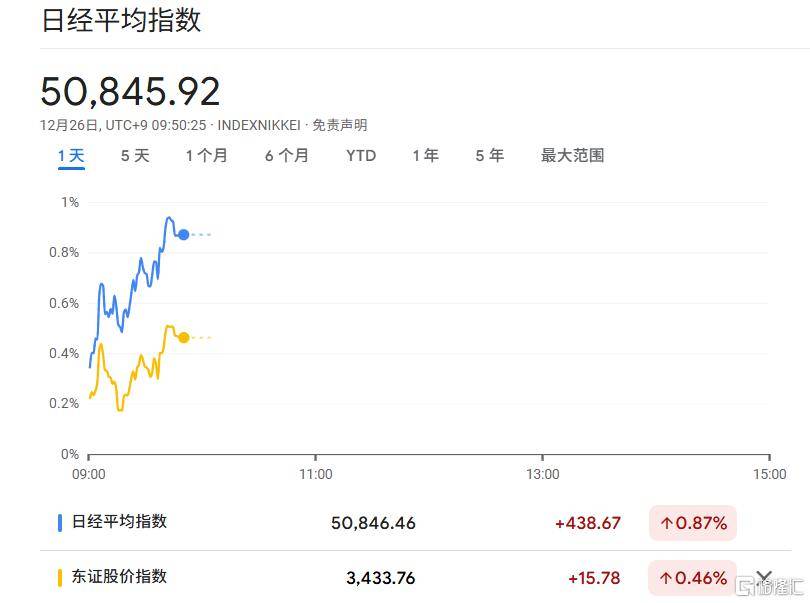
Group 1 - The Nikkei 225 index rose by 0.7%, closing at 50,750.39 points, with chip stocks leading the gains. Investors are closely monitoring comments from Japanese government officials regarding the recent depreciation of the yen and any developments in Prime Minister Fumio Kishida's economic plan [1][3] - The core Consumer Price Index (CPI) for Tokyo in December increased by 2.3% year-on-year, which is below the market expectation of 2.5% and a decrease from November's 2.8%. This slowdown in inflation is attributed to easing food cost pressures and the base effect from last year's utility price hikes [1][3] - The CPI excluding fresh food and fuel costs rose by 2.6% year-on-year in December, also lower than November's 2.8%. This measure is closely watched by the Bank of Japan as it reflects demand-driven price changes [1][3] Group 2 - Analysts warn that the renewed decline of the yen may lead companies to continue raising prices, potentially resulting in sustained cost-push inflation, which could accelerate the Bank of Japan's interest rate hikes. The data suggests that food inflation may have peaked, but a weak yen could provide justification for companies to increase food prices [2][4] - The Kishida administration approved a record budget of 7.85 trillion USD for the next fiscal year, aiming to balance aggressive fiscal policy with concerns over rising debt. The government emphasizes that it will not engage in irresponsible debt issuance or tax cuts [2][4] - The upcoming budget, to be submitted to the Diet early next year, totals a record 122.3 trillion yen (approximately 784.63 billion USD), exceeding this year's initial budget of 115.2 trillion yen. New debt issuance is expected to slightly increase from 28.6 trillion yen to 29.6 trillion yen, with the debt dependency ratio dropping to 24.2%, the lowest since 1998 [5]
有色金属日度策略-20251226
Fang Zheng Zhong Qi Qi Huo· 2025-12-26 05:49
Report Industry Investment Rating The report does not provide an overall investment rating for the industry. Core Viewpoints - The non - ferrous metals sector is strong but volatile. The overall direction of monetary easing and ongoing contradictions in the mining end continue to support non - ferrous metals. However, due to factors such as capital outflows during Christmas, the sector experiences a round of strong consolidation. There are differences in fundamentals among non - ferrous metals, leading to a differentiation in strength. It is recommended to focus on opportunities where macro and micro factors resonate [12]. - Copper prices are expected to have an upward - moving central value in the future, driven by its financial attributes, valuation repair, and the global inventory structural contradiction. It is advisable to gradually go long on Shanghai Copper on dips [3]. - Zinc is in an oscillatory state. As long as the lower support level holds, one can go long on dips [4]. - For the aluminum industry chain, it is recommended to adopt a wait - and - see or long - biased approach. For alumina, a high - selling strategy is suggested [5]. - Tin is recommended to be on the sidelines, and attention should be paid to the trends of other non - ferrous metals and policy regulations [6]. - Lead shows a short - term upward trend, and one can go long on dips [8]. - Nickel and stainless steel are in a short - term bullish state, but attention should be paid to macro - liquidity changes and the implementation of Indonesian policies [9]. Summary by Section Part 1: Non - ferrous Metals Operating Logic and Investment Recommendations - **Macro Logic**: The non - ferrous metals sector is strong but volatile. Monetary easing continues, and contradictions in the mining end support the sector. Japan's intervention in the foreign exchange market weakens the US dollar, which is beneficial for non - ferrous metals. However, the appreciation of the RMB may lead to relatively stronger performance in the external market. During Christmas, capital outflows increase volatility, and non - ferrous metals experience a round of strong consolidation. The US economic data shows mixed performance, and China's economic data such as power consumption is positive. The non - ferrous metals sector has adjusted but moved away from lows, with internal differentiation in strength. Copper, with its tight supply - demand situation, drives the sector upward. As weak - performing varieties make up for losses, the sector may experience profit - taking and increased volatility. Attention should be paid to spot - market feedback [12]. - **This Week's Focus**: This week, the US will release a large amount of economic data, with the focus on the third - quarter real GDP on December 23. China will release the November industrial enterprise profit data on December 27. The Christmas holiday leads to market closures in the UK and the US [13]. - **Non - ferrous Metals Strategy** - **Copper**: Driven by factors such as the high - than - expected US GDP and inflation, and the global inventory structural contradiction, copper prices are expected to rise. It is advisable to go long on dips, with a short - term upper pressure range of 97,000 - 98,000 yuan/ton and a lower support range of 92,000 - 93,000 yuan/ton. Options strategies can consider buying near - month slightly out - of - the - money call options [3]. - **Zinc**: With a relatively warm macro environment and a slowdown in the decline of processing fees, zinc is in an oscillatory recovery state. It can be bought on dips as long as the support level holds, with an upper pressure range of 23,500 - 23,600 yuan/ton and a lower support range of 22,800 - 23,000 yuan/ton [4]. - **Aluminum Industry Chain**: For electrolytic aluminum, it is recommended to wait and see or go long on dips, with an upper pressure range of 23,000 - 24,000 yuan/ton and a lower support range of 21,000 - 21,300 yuan/ton. For alumina, a high - selling strategy is recommended, with an upper pressure range of 2,800 - 3,000 yuan/ton and a lower support range of 2,000 - 2,200 yuan/ton. For recycled aluminum alloy, a wait - and - see or long - biased approach is suggested, with an upper pressure range of 21,500 - 21,800 yuan/ton and a lower support range of 20,000 - 20,400 yuan/ton [5]. - **Tin**: Affected by sector adjustment, policy利空, and nickel market resonance, it is recommended to wait and see, with an upper pressure range of 350,000 - 355,000 yuan/ton and a lower support range of 310,000 - 320,000 yuan/ton. Options strategies can consider buying out - of - the - money put options for protection [6][7]. - **Lead**: With a weak US dollar and cost support, lead prices are rising. It is advisable to go long in the short term, with a lower support range of 16,700 - 16,800 yuan/ton and an upper pressure range of 17,200 - 17,300 yuan/ton [8]. - **Nickel and Stainless Steel**: Affected by the expected reduction of Indonesian nickel ore quotas and potential policy changes, nickel and stainless steel are short - term bullish. For nickel, the upper pressure range is 128,000 - 130,000 yuan/ton, and the lower support range is 123,000 - 124,000 yuan/ton. For stainless steel, the upper pressure range is 13,000 - 13,200 yuan/ton, and the lower support range is 12,500 - 12,600 yuan/ton [9]. Part 2: Non - ferrous Metals Market Review - The report provides the closing prices and price changes of various non - ferrous metals futures, including copper, zinc, aluminum, alumina, tin, lead, nickel, stainless steel, and cast aluminum alloy [17]. Part 3: Non - ferrous Metals Position Analysis - The report presents the latest position analysis of the non - ferrous metals sector, including the price changes, net long - short strength comparison, net long - short position base values, changes in net long and short positions, and influencing factors of various varieties such as polysilicon, silver, lead, copper, lithium carbonate, aluminum alloy, aluminum, industrial silicon, gold, zinc, alumina, tin, and nickel [19]. Part 4: Non - ferrous Metals Spot Market - The report shows the spot prices and price changes of various non - ferrous metals, including copper, zinc, aluminum, alumina, nickel, stainless steel, tin, lead, and cast aluminum alloy [20][22]. Part 5: Non - ferrous Metals Industry Chain - The report provides relevant charts for each non - ferrous metal in the industry chain, including inventory changes, processing fees, price trends, and other aspects of copper, zinc, aluminum, alumina, tin, cast aluminum alloy, lead, nickel, and stainless steel [25][28][30] Part 6: Non - ferrous Metals Arbitrage - The report provides relevant charts for non - ferrous metals arbitrage, including the Shanghai - London ratio changes, basis spreads, and other aspects of copper, zinc, aluminum, alumina, tin, lead, nickel, and stainless steel [56][57][59] Part 7: Non - ferrous Metals Options - The report provides relevant charts for non - ferrous metals options, including historical volatility, weighted implied volatility, trading volume, open interest, and other aspects of copper, zinc, and aluminum [74][76][79]
野村陆挺:不引导人民币升值 利用窗口期扩内需|首席对策
Di Yi Cai Jing· 2025-12-26 05:16
12月25日,离岸人民币对美元升破7.0关口,为2024年9月以来首次;在岸人民币最高升至7.0061。当 天,中国人民银行授权中国外汇交易中心公布,银行间外汇市场人民币汇率中间价为1美元对人民币 7.0392元,相较前一交易日中间价7.0471元,调升79个基点,续创2024年10月来新高。 中央经济工作会议在部署2026年经济工作时指出,要保持人民币汇率在合理均衡水平上的基本稳定。人 民币在岸、离岸对美元汇率12月以来均保持强劲,这中间所涉及到的房地产、通胀、价差、利差等一系 列重要因素都不容忽视。野村中国首席经济学家陆挺认为,不如利用出口大幅增长带来的这一时间窗 口,通过结构性改革,来拉动内需,苦练内功,带动经济增长。 中美价差对人民币实际汇率形成怎样的支撑?物价水平将如何改变人民币实际汇率?房地产和汇率之间 存在着什么样的关系?需要引导人民币继续升值吗?汇率政策的安全边际应该如何界定?汇率政策在明 年整体的货币政策中的影响权重如何?明年美联储的货币政策调整对汇率有什么样的影响?第一财经 《首席对策》专访野村中国首席经济学家陆挺。 过去5年中美汇率变化不大 真正的差别表现在物价上 预言明年结束负通胀为时 ...
穆迪首席经济学家:美联储明年降息虽可期,但需保持耐心
Jin Shi Shu Ju· 2025-12-26 04:56
AI播客:换个方式听新闻 下载mp3 音频由扣子空间生成 在新冠疫情期间,美联储的加息来得又快又猛,而通胀拒绝配合,这让美联储感觉陷入了紧急模式。 在Zandi看来,这种奇怪的组合指向未来是一条渐进、谨慎的利率路径,而不是激进的降息周期。 首先要考虑的是裁员依然处于低位,Zandi认为这是"真正的好消息",但他同时指出企业根本没有在招 聘。他说,"就业增长充其量是持平的,我怀疑修正后甚至是下降的。失业率虽然仍属温和,但已明显 高于我认为的充分就业水平。" 作为参考,美国劳工统计局(BLS)的数据显示,2025年11月新增就业人数仅为6.4万人,该机构指 出,自4月以来就业人数显示的"净变化很小"。这种组合让经济处于一种奇怪的困境。 Zandi将目前的状况描述为"脆弱的增长",并指出总体GDP数据并没有讲述完整的故事,"如果我们不创 造就业机会,我不知道我们怎么能对目前的事态发展感到放心。" 因此,即使是消费者支出的小幅回落也可能导致失业。 通胀也让美联储的降息前景变得更加复杂。Zandi认为CPI更接近3%而非美联储的目标,这影响了决策 者采取行动的速度。官方数据支持了他的论点,2025年11月美国CPI同比 ...
英国经济隐忧英镑显著压制
Jin Tou Wang· 2025-12-26 02:44
英国央行货币政策动态成为驱动英镑走势的核心引擎。12月18日,英国央行宣布年内第四次降息,将基 准利率下调25个基点至3.75%,2025年累计降息幅度达100个基点,基准利率从年初的4.75%逐步回落。 值得关注的是,此次降息决策分歧巨大,货币政策委员会9名委员中仅5人支持降息,另有4人因通胀仍 高于2%的目标而主张维持利率不变,这种"鹰鸽对立"的格局向市场传递出政策宽松不会过度激进的信 号,有效支撑了英镑汇率。 截至2025年12月26日,英镑兑美元汇率报1.3518,微跌0.0370%,当日最高触及1.3522,最低下探 1.3497,延续近期强势格局。回溯近期走势,该货币对于12月23日上涨0.3%至1.3502,创下10月2日以 来新高,随后成功站稳1.35关键关口,年内累计涨幅已超8%,表现显著跑赢多数非美货币。此次英镑 走强,核心源于英国央行货币政策的谨慎态度与内部分歧,叠加美元指数持续走弱的外部助力,短期上 行势头明确。 对于后续走势,市场焦点将集中于两大方向:一是英国的通胀数据(尤其是薪资与服务业通胀)及经济 复苏信号,这将直接影响英国央行的政策路径调整;二是美联储的货币政策动向与美国经济表 ...
东京通胀降温,加息难停?日元陷政策博弈困局
Sou Hu Cai Jing· 2025-12-26 02:32
Group 1: Inflation Data - Tokyo's core CPI rose by 2.3% year-on-year in December, which is a significant slowdown from the previous month's 2.8% and below the market expectation of 2.5% [6][7] - This marks the first inflation slowdown since August, primarily reflecting a deceleration in food price increases and a decline in energy costs [7] - Excluding fresh food, food prices in Tokyo increased by 6.2% year-on-year, down from 6.5% in the previous month [8] Group 2: Energy Prices - Tokyo's energy prices fell by 3.4% year-on-year in December, contrasting with a 2.6% increase in the previous month [10] - Electricity prices decreased by 2.5%, city gas prices dropped by 4.7%, and gasoline prices fell by 6.4% compared to the same month last year [10] Group 3: Economic Indicators - Japan's industrial output fell by 2.6% in November, reversing a 1.5% increase in October, which was worse than the expected decline of 1.8% [11] - Despite the decline, companies expect output to rebound, forecasting a 1.3% increase in December and a significant 8.0% rise in January [11] Group 4: Monetary Policy and Currency - The Bank of Japan raised its policy interest rate to 0.75%, the highest level in 30 years, indicating a potential for further tightening of monetary policy [13] - Despite the interest rate hike, the yen remains weak, trading near its lowest levels against the dollar, which may increase import costs and exacerbate inflationary pressures [14] - The Japanese government is prepared to intervene in the foreign exchange market if necessary, as indicated by recent statements from officials [15] Group 5: Fiscal Policy - The Japanese cabinet approved a record budget of 122.3 trillion yen (approximately $785 billion) for the next fiscal year, aiming to balance active fiscal policies with concerns over rising debt [16] - The government has assured investors that it will not engage in irresponsible debt issuance or tax cuts amid rising national debt yields and a weak yen [16]