
股债跷跷板

Search documents
关于年内利率走势的展望分析
Sou Hu Cai Jing· 2025-09-23 03:09
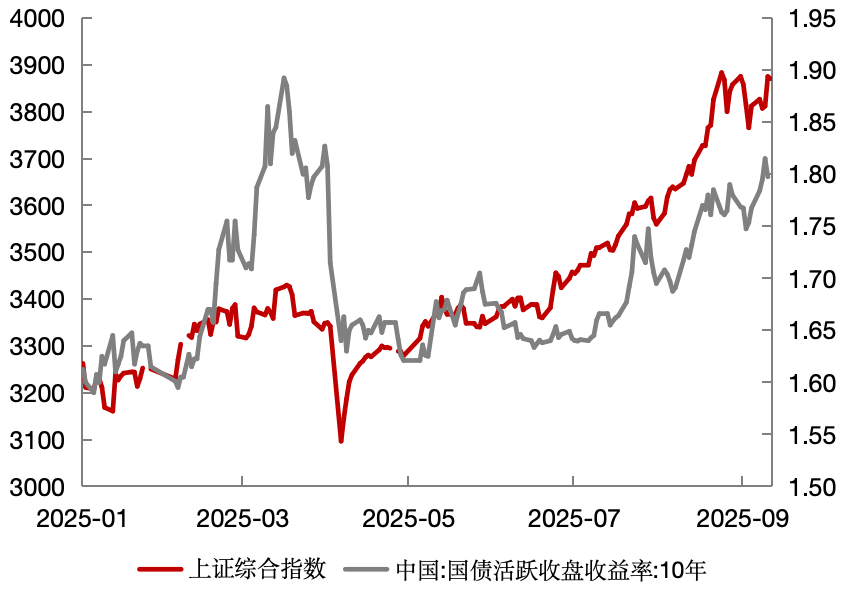
Group 1 - The bond market is currently in a chaotic phase, influenced by weak fundamentals and strong risk appetite, with expectations of two phases in market performance for the remainder of the year [1][2] - The first phase, from mid-September to October, is expected to see a recovery in the bond market, with the 10-year government bond yield potentially peaking around 1.85% [1][25] - The second phase, from November to mid-December, may see an increase in policy expectations, with the yield center likely to rise, potentially reaching a high of around 1.9% [1][26] Group 2 - Bond yields have fluctuated, with the 10-year government bond yield rising from 1.65% at the end of June to above 1.81%, before retreating to 1.79% by September 12 [2] - The "stock-bond seesaw" effect has been observed, where rising stock market performance leads to increased bond yields, as seen with the Shanghai Composite Index rising from 3440 to above 3880 [2][4] - The macroeconomic environment shows limited changes, with GDP growth in the first half of the year at 5.3%, but subsequent months showing weaker consumption and investment data [2][3] Group 3 - Monetary policy remains moderately accommodative, with potential for further interest rate cuts following the Federal Reserve's recent rate reduction [3] - Institutional behavior is impacting the bond market, with banks and insurance companies showing varied levels of bond purchasing activity [13][14][15] - Recent regulatory changes regarding fund sales fees are expected to increase redemption pressures on bond funds, potentially leading to higher bond yields [19][20] Group 4 - Historical analysis indicates that previous "stock-bond seesaw" phases have led to significant movements in both markets, with the current phase expected to be less impactful than past occurrences [7][9] - The bond market's sensitivity to stock market movements is anticipated to weaken, with the bond market's performance becoming less reactive to stock price changes [10][26] - The overall bond market is expected to maintain a stable yield environment, with predictions of slight fluctuations in the coming months [22][25]

中信证券:当前股市增量资金仍以高净值客群为主
Zhong Guo Jin Rong Xin Xi Wang· 2025-09-23 01:23
Core Insights - The trend of "deposit migration" is expected to gradually manifest from 2022 to 2025, driven by policy guidance, declining interest rates, narrowing bank net interest margins, and the pressure of deposit termization [1] - Although the overall proportion of deposit migration is limited, it presents a considerable incremental opportunity for non-bank asset management (including bank wealth management, insurance, public funds, etc.) [1] - Low-risk asset management products remain the mainstream allocation direction, but there is a recent trend of rising risk appetite, indicating a potential gradual increase in residents' risk preferences [1] Group 1 - The scale of bank wealth management's fixed income+ products has increased by over 1.1 trillion yuan in the first eight months [1] - Insurance capital has increased stock allocations by over 640 billion yuan in the first half of the year [1] - The incremental funds entering the stock market are primarily from high-net-worth individuals, with a significant number of ordinary residents not yet participating [1] Group 2 - There has not been a large-scale substantial flow of funds between stocks and bonds, indicating that the stock-bond dynamic is likely to become more muted [1] - The space for further declines in the bond market appears limited [1]

信用周观察系列:2025年两轮调整,有何不同?
HUAXI Securities· 2025-09-22 14:06
1. Report Industry Investment Rating No relevant content provided in the given text. 2. Core Viewpoints of the Report - This round of bond market adjustment since July 7 lasted for two and a half months, similar to the adjustment period in the first quarter of this year. The main contradictions in the two adjustments were different, leading to significant differences in secondary - market performance [1][9]. - The first - quarter adjustment was mainly due to the unexpected convergence of the capital market, while the adjustment since July was due to the over - heating of the commodity and equity markets, which increased institutional risk appetite and suppressed the bond market through the "stock - bond seesaw" effect [1][13]. - Before all uncertainties are verified, credit bond investment is recommended to focus on coupon - bearing varieties within 3 years for defense, especially 1 - 3 - year AA and AA(2) urban investment bonds [3]. 3. Summary According to the Directory 3.1 City Investment Bonds: Net Financing Recovered, Long - End Yields Reached New Highs for the Year - From September 1 - 21, 2025, city investment bonds issued 349.9 billion yuan, matured 303.7 billion yuan, and had a net inflow of 46.3 billion yuan. The net financing scale in Jiangxi, Sichuan, and Hunan was relatively large, exceeding 8 billion yuan. The proportion of long - term issuance decreased, with the proportion of over 3 - year issuance dropping to 35% and over 5 - year dropping to 3% [29]. - Except for the short - end, the issuance interest rate increased. The weighted average issuance interest rates for less than 1 - year, 1 - 3 - year, 3 - 5 - year, and over 5 - year city investment bonds were 1.8%, 2.32%, 2.75%, and 2.77% respectively. Only the less than 1 - year rate decreased by 1bp compared to August, while the others increased [30]. - In the secondary market, the short - and medium - term bonds were more resistant to decline, and the long - end yields reached new highs for the year. The long - end adjustment was large, with the yields of AAA and AA + 7 - year and above bonds rising by more than 4bp, and the 10 - year AAA city investment bond yield reaching a new high of 2.44% [33]. 3.2 Industrial Bonds: Net Financing Decreased Year - on - Year, Buying Sentiment Warmed Up - From September 1 - 21, 2025, industrial bonds issued 376.2 billion yuan, a year - on - year decrease of 86.6 billion yuan, and had a net financing of 62 billion yuan, a year - on - year decrease of 51.6 billion yuan. The net financing scale of the comprehensive and construction decoration industries was over 20 billion yuan, and that of the non - bank finance industry was over 15 billion yuan [37]. - The issuance sentiment weakened. The proportion of full - field multiples above 3 times decreased from 18% to 17%, and the proportion of 2 - 3 times decreased from 36% to 28%. The proportion of short - duration variety issuance decreased [37]. - From the broker transactions, the buying sentiment of industrial bonds warmed up. The TKN proportion increased from 62% to 71% month - on - month, and the low - valuation proportion increased from 32% to 46% [40]. 3.3 Bank Capital Bonds: Yields Fluctuated Narrowly, Short - and Medium - Duration Bonds Performed Better - From September 15 - 19, 2025, Agricultural Bank of China issued 35 billion yuan of 5 + 5 - year secondary capital bonds and 25 billion yuan of 10 + 5 - year secondary capital bonds, with issuance interest rates of 2.18% and 2.50% respectively. China Everbright Bank issued 40 billion yuan of 5 + N - year perpetual bonds, with an issuance interest rate of 2.29% [44]. - In the secondary market, bank capital bond yields fluctuated narrowly, and short - and medium - duration bonds performed better. From September 15 - 19, the yields of 1 - 3Y varieties decreased by 0 - 4bp, while the 10Y large - bank secondary capital bonds and 5Y small - and medium - bank capital bonds were weaker, with yields rising by 2 - 4bp [44]. - From the broker transactions, the trading sentiment of bank capital bonds warmed up. The TKN proportion rose above 60%, and the low - valuation proportions of secondary capital bonds and perpetual bonds increased by 31pct and 27pct respectively [47].
供需叠加股债跷跷板,期债中期震荡
Ning Zheng Qi Huo· 2025-09-22 08:40
1. Report Industry Investment Rating No information provided. 2. Core View The bond market is expected to oscillate in the medium term due to the combination of supply - demand factors and the stock - bond seesaw effect. Economic recovery in September is a long - term negative for the bond market, and the stock - bond seesaw logic may have a significant impact on the bond market. The operation of the bond market is likely to face increased difficulty [2][3][28]. 3. Summary by Directory Chapter 1: Market Review - In the third quarter, the accelerated pace of fiscal bond issuance and the tight balance of liquidity have a bearish impact on the bond market. The stock - bond seesaw logic has led the long - end bond market into a continuous downward trend, but this logic has become less obvious under the background of loose liquidity, increasing the difficulty of market operation [9]. Chapter 2: Overview of Important News - The second re - issuance of the fourth tranche of China's ultra - long - term special treasury bonds in 2025 has completed the tendering, with the overall issuance scale reaching 114.8 billion yuan and the issuance progress at 88.3% [10]. - At the end of August, M2 increased by 8.8% year - on - year, M1 increased by 6% year - on - year, and the M1 - M2 gap narrowed to - 2.8%, the lowest since June 2021 [10]. - Affected by the high base and food prices, China's CPI in August was flat month - on - month, down 0.4% year - on - year, the core CPI increased by 0.9% year - on - year, and the increase has expanded for the fourth consecutive month. PPI was down 2.9% year - on - year, with the decline narrowing by 0.7 percentage points from the previous month, and flat month - on - month, ending eight consecutive months of decline [14]. - In August, China's exports denominated in US dollars were up 4.4% year - on - year, lower than the Bloomberg consensus forecast of 5%, and imports were up 1.3% year - on - year, lower than the Bloomberg consensus forecast of 3% [14]. - The central bank adjusted the 14 - day reverse repurchase operation in the open market to fixed - quantity, interest - rate tendering, and multi - price winning bids, with the operation time and scale determined according to liquidity management needs [13]. - Market expectations for the restart of the central bank's treasury bond trading operations are gradually rising [14]. Chapter 3: Analysis of Important Influencing Factors 3.1 Economic Fundamentals - China's economic prosperity generally continued to expand. In August, the official manufacturing PMI, non - manufacturing PMI, and composite PMI were 49.4%, 50.3%, and 50.5% respectively, up 0.1, 0.2, and 0.3 percentage points month - on - month. The GDP in the second quarter was up 5.2% year - on - year and 1.1% quarter - on - quarter, both exceeding expectations. The economic data in August shows that the endogenous driving force of the economy is strengthening, and if counter - cyclical regulation continues to increase, the economic fundamentals will be bearish for the bond market in the long term [15]. 3.2 Policy Front - At the end of August, M2 increased by 8.8% year - on - year, M1 increased by 6% year - on - year, and the M1 - M2 gap narrowed to - 2.8%. The social financing stock reached 43.126 trillion yuan, up 9% year - on - year, with a slight increase of 0.1 percentage point in the growth rate. The narrowing of the M1 - M2 gap in August indicates strengthened economic activities [17]. 3.3 Capital Front - Since July 25, DR007 has been declining, reducing the cost of funds. The central bank will implement a moderately loose monetary policy to maintain sufficient liquidity. The Fed's interest rate cut in the second half of the year may open up more space for domestic monetary policy easing, but the adjustment of domestic monetary policy still depends on domestic demand. The probability of an unexpectedly loose monetary policy is low unless the economic downward pressure increases suddenly [17]. 3.4 Supply - Demand Front - The National Development and Reform Commission will allocate the third batch of funds for consumer goods trade - in this year and formulate a monthly and weekly plan for the use of national subsidy funds. The support from ultra - long - term special treasury bonds for equipment renewal is 200 billion yuan, with the first batch of about 173 billion yuan already allocated. The issuance of special bonds has accelerated recently, and the market is waiting for the effects and implementation of relevant policies [21]. 3.5 Sentiment Front - The stock - bond ratio has broken through the short - term oscillation range, indicating that the market pays more attention to the stock market and the risk appetite has increased. Although the stock - bond ratio has slightly declined recently, it is still at a high level. Short - term bonds are more affected by the capital front, while long - term bonds are more affected by the stock - bond seesaw [24]. Chapter 4: Market Outlook and Investment Strategy - In the third quarter, the bond market issuance has accelerated, increasing the supply and putting pressure on the liquidity of the inter - bank market. The tight balance of liquidity has increased the bearish factors for the bond market. After the Fed's interest rate cut, whether the risk appetite will continue to increase and whether the stock - bond seesaw will be bearish for the bond market need to be continuously observed. The combination of the stock - bond seesaw logic and loose liquidity may increase the difficulty of bond market operation [28].
股市科技?向占优,债市承压
Zhong Xin Qi Huo· 2025-09-19 05:17
Report Investment Rating The report does not explicitly mention the overall industry investment rating. However, for different financial derivatives, the outlooks are as follows: - **Stock Index Futures**: Oscillating with a slight upward bias [7] - **Stock Index Options**: Oscillating [8] - **Treasury Bond Futures**: Oscillating [8] Core Viewpoints - **Stock Index Futures**: The technology sector has a short - term advantage. Short - term adjustments are mainly due to capital reallocation, while the medium - term upward trend remains unchanged. Attention should be paid to the possibility of configuring IM long positions, as technology stocks have a comparative advantage [1][7] - **Stock Index Options**: Trading is driven by intraday reversals. It is recommended to use covered strategies and closely monitor volatility changes. When volatility rises abnormally, the selling side of options can temporarily exit the market [2][8] - **Treasury Bond Futures**: The impact of the stock - bond seesaw effect is weakening. In the short term, the central bank's attitude towards the capital market is supportive for the short - end, while the long - end yield of bonds is still affected by risk appetite and policy expectations. Short - term attention can be paid to long - end arbitrage opportunities and the opportunity for the yield curve to steepen [3][9] Summary by Relevant Catalogs 1. Market Views Stock Index Futures - **Market Performance**: The market first rose and then declined. The STAR Market once soared, and the technology sector continued to attract capital. However, the loss - making effect in the afternoon increased, and value stocks led the decline [1][7] - **Key Phenomena**: After the Fed's interest - rate meeting, commodities were generally weak, and the slightly hawkish stance boosted the US dollar, putting pressure on commodities and value stocks. Brokerages and stock - trading software were sluggish, and funds avoided areas with concentrated chips. The proportion of stocks outperforming the Wind All - A Index decreased, indicating that funds were flowing into relatively crowded areas, causing downward pressure on weak stocks [1][7] - **Operation Suggestion**: Hold IM [7] Stock Index Options - **Trading Volume**: The trading volume in the options market was 21.04 billion yuan, a 62.60% increase from the previous trading day, driven by intraday reversals [2][7] - **Market Characteristics**: The positive delta exposure of sellers decreased, and there were signs of a slight rebound in the skewness index and a significant increase in the ratio PCR. The implied volatility of some products decreased significantly at the end of the session, presumably due to the impact of intraday put - buying profit - taking [2][8] - **Operation Suggestion**: Use covered strategies [8] Treasury Bond Futures - **Market Performance**: Treasury bond futures closed down across the board, and the yields of major inter - bank interest - rate bonds generally rose, with a larger increase at the long - end [3][8] - **Capital Situation**: The central bank's net injection of 195 billion yuan did not ease the tight capital situation in the inter - bank market. The DR001 weighted average interest rate rose above 1.5%, which was negative for the short - end of the bond market. The decline in the equity market had limited impact on boosting the bond market sentiment, and the long - end yield rose more [3][9] - **Operation Suggestion**: Adopt a cautiously oscillating trend strategy. For hedging strategies, pay attention to short - hedging at low basis levels. For basis strategies, focus on long - end arbitrage opportunities. For curve strategies, pay attention to the opportunity for the yield curve to steepen [9] 2. Economic Calendar - The report provides the economic data of different regions from September 15 to September 19, 2025, including China's social consumer goods retail sales, industrial added value, the eurozone's economic sentiment index, the US retail sales, import price index, federal funds rate, and Japan's CPI [10] 3. Important Information and News Tracking - The Fed cut interest rates by 25bp in September, and the dot - plot median shows that there is still room for a 50bp interest - rate cut within the year. The Bank of England maintained its policy interest rate unchanged in September and slowed down the pace of quantitative tightening, warning of the risk of a wage - price spiral [11] 4. Derivatives Market Monitoring - The report includes data monitoring of stock index futures, stock index options, and treasury bond futures, but specific data details are not fully presented in the given text [12][16][28]
王天丰:“股债跷跷板”或将脱敏,债市后续怎么看?
Sou Hu Cai Jing· 2025-09-18 15:55
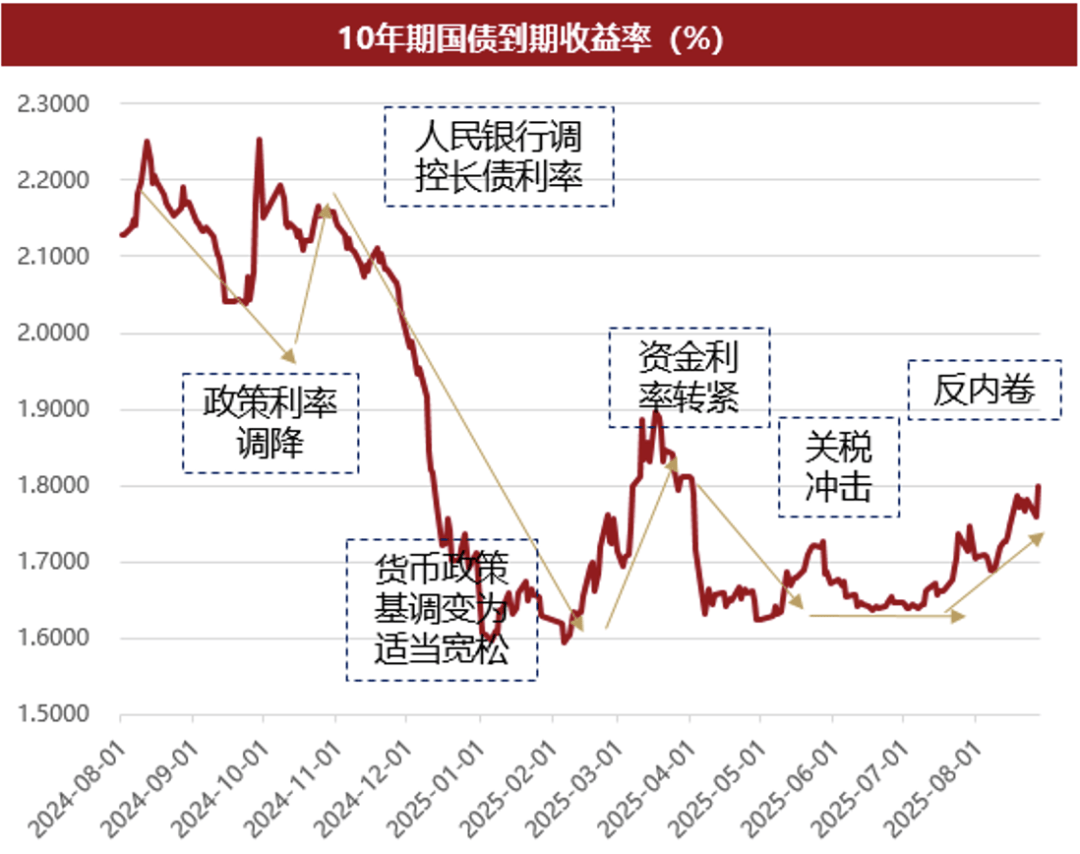
Group 1 - The bond market has shown a weak and fluctuating trend since Q3 2025, with the ten-year government bond yield rising from approximately 1.63% to 1.78%, an increase of about 15 basis points [1][3][8] - The yield curve has exhibited a rare "bear steepening" characteristic, indicating changes in growth and inflation expectations influenced by commodity and stock market movements [7][8] - Credit bonds have performed relatively well, with the funding environment remaining loose since mid-year, and market leverage returning to historical average levels [1][8] Group 2 - The Federal Reserve's policies are a key variable affecting the bond market, with expectations of multiple rate cuts in the second half of the year due to a weakening U.S. economy and a deteriorating labor market [1][9][14] - Domestic economic indicators, such as retail sales and fixed asset investment, have shown marginal weakness, with expectations that overall economic growth may fall below annual targets [1][20][24] - The "anti-involution" policy is being advanced towards legalization and marketization, which may have long-term implications for inflation and economic stability [1][28][29] Group 3 - The ten-year government bond ETF (511260) is highlighted as a valuable investment tool due to its low fees, transparency, and stable historical returns, making it a preferred choice for bond market allocation [2][35][39] - The ETF has consistently achieved positive returns from 2018 to 2024, making it suitable for long-term investment strategies [2][35] - The bond market's current yield levels are considered neutral to low, with limited downward space due to the central bank's stance, necessitating attention to the policy combination of "central bank easing + government bond issuance" [33][34]
宁证期货今日早评-20250918
Ning Zheng Qi Huo· 2025-09-18 02:07
Report Summary 1. Report Industry Investment Ratings No industry investment ratings are provided in the report. 2. Core Views - The Fed cut interest rates by 25 basis points to 4.00%-4.25%, the first cut this year and the first in nine months. After the FOMC statement, the probability of a Fed rate cut in October is over 90%. Precious metals may lack further upward momentum in the short term, and attention should be paid to potential reversal trends [1]. - International oil prices have risen for three consecutive days due to concerns about supply disruptions from drone attacks on Russian refineries and the possibility of a US central bank rate cut. However, supply pressure remains, and short - term trading should be cautious [1]. - Pig prices are expected to continue to decline in the short term due to oversupply, with attention needed on the slaughter rhythm of large farms and demand recovery [3]. - Domestic soybean prices are expected to be under pressure due to increased supply and weak demand, with attention on policies and new grain listing progress [3]. - Palm oil is expected to be under pressure in the short term due to high inventory at the origin and weak demand, despite a decline in production in Malaysia from September 1 - 15 [4]. - Iron ore prices are expected to fluctuate strongly. The demand for iron ore remains strong, and steel mills are expected to replenish stocks in mid - to - late September [4]. - Steel prices are expected to enter a narrow - range adjustment stage. Although steel demand recovery is slow, macro - friendly policies limit the decline [5]. - Silicon iron prices may have limited downward space in the short term but are expected to decline in the medium to long term as supply - demand relations tend to be loose [6]. - The bond market may be negatively affected by economic recovery in the long term but may be positively affected by the Fed rate cut in the short term [6]. - Silver prices may be affected by gold fluctuations, and attention should be paid to whether the post - rate - cut market follows the expected trend [6]. - Rubber prices should be treated with a wait - and - see attitude as they are in a situation of low inventory and weak demand [7]. - PTA should be observed as polyester inventory is accumulating slightly, and there is an expectation of increased supply [7]. - Methanol and soda ash are expected to fluctuate in the short term, and it is recommended to wait and see or make short - term trades [8][10]. - Plastic prices are expected to fluctuate in the short term, and it is recommended to wait and see or make short - term trades on dips [10]. 3. Summary by Variety Precious Metals - **Gold**: The Fed's rate cut is in place, and precious metals may lack short - term upward momentum. Attention should be paid to potential reversal trends [1]. - **Silver**: US construction investment is lower than expected, increasing economic downward pressure. Attention should be paid to the impact of gold fluctuations on silver [6]. Energy - **Crude Oil**: International oil prices have risen for three consecutive days. Supply pressure remains, and short - term trading should be cautious [1]. Agricultural Products - **Pigs**: Pig prices are expected to decline in the short term due to oversupply. Attention should be paid to the slaughter rhythm of large farms and demand recovery [3]. - **Soybeans**: Domestic soybean prices are expected to be under pressure due to increased supply and weak demand. Attention should be paid to policies and new grain listing progress [3]. - **Palm Oil**: The decline in Malaysian palm oil production from September 1 - 15 provides some support, but overall, it is expected to be weak in the short term due to high inventory and weak demand [4]. - **Rubber**: Rubber is in a situation of low inventory and weak demand. It should be treated with a wait - and - see attitude [7]. Industrial Metals - **Iron Ore**: Iron ore prices are expected to fluctuate strongly. The demand remains strong, and steel mills are expected to replenish stocks in mid - to - late September [4]. - **Steel (Rebar)**: Steel prices are expected to enter a narrow - range adjustment stage. Although demand recovery is slow, macro - friendly policies limit the decline [5]. - **Silicon Iron**: Silicon iron prices may have limited downward space in the short term but are expected to decline in the medium to long term as supply - demand relations tend to be loose [6]. Chemicals - **PTA**: Polyester inventory is accumulating slightly, and there is an expectation of increased supply. It is recommended to observe [7]. - **Methanol**: Domestic methanol is at a high - production level, and port inventory is accumulating. It is expected to fluctuate in the short term, and it is recommended to wait and see [8]. - **Soda Ash**: Soda ash is expected to fluctuate in the short term. It is recommended to wait and see or make short - term long trades [10]. - **Plastic**: Plastic prices are expected to fluctuate in the short term. It is recommended to wait and see or make short - term long trades on dips [10]. Bonds - **Long - and Medium - Term Treasury Bonds**: The bond market may be negatively affected by economic recovery in the long term but may be positively affected by the Fed rate cut in the short term [6].
股债跷跷板的成因、影响和策略应对
Orient Securities· 2025-09-17 15:23
Group 1 - The report identifies that the stock-bond seesaw effect is more common than both stocks and bonds being strong or weak simultaneously, with a higher probability of returning to the seesaw state after periods of dual strength or weakness [3][8]. - Growth expectations drive the stock-bond seesaw, while liquidity expectations can terminate it. Weak growth expectations lead to weak stocks and strong bonds, while strong growth expectations can result in strong stocks and weak bonds [3][8]. - A four-quadrant framework based on growth and interest rate expectations can be constructed to illustrate the relative relationship between stocks and bonds, showing how these expectations influence market dynamics [3][8]. Group 2 - The report suggests that when the stock-bond seesaw is present, there are strong price signals within equity sectors, allowing for effective industry strategies to be constructed [3][8]. - Current liquidity expectations are stable, indicating a foundation for a slow bull market, and the report continues to recommend a dynamic all-weather strategy under the seesaw market conditions [3][8]. - Historical data shows that fast bull markets are typically accompanied by rising equity volatility, while the current market exhibits stable equity volatility, supporting the slow bull market outlook [3][8]. Group 3 - The report outlines various scenarios following the stock-bond seesaw, including transitions from strong stocks and weak bonds to dual strength, and from weak stocks and strong bonds to dual weakness [21][37]. - The transition from strong stocks and weak bonds to weak stocks and strong bonds is often accompanied by a decline in growth expectations, while the reverse transition typically requires an increase in growth expectations [26][45]. - The report emphasizes that the core factors determining market direction after the seesaw are liquidity expectations and growth expectations, which can lead to different outcomes based on their movements [36][45].
连续5日收红,债市要走出新一轮上涨?静候变量打破僵局
券商中国· 2025-09-17 10:47
Core Viewpoint - The article discusses the current state of the domestic bond market in China, highlighting the impact of macroeconomic data and potential policy changes on bond yields and market trends [1][2][3]. Summary by Sections Economic Data and Market Reaction - August macroeconomic data showed weaker-than-expected performance, leading to increased expectations for "stabilizing growth" policies, which contributed to a five-day rise in 10-year government bond futures [2][3]. - The 10-year government bond futures main contract closed at 108.15 yuan, with a rise of 0.13%, while the yield on the 10-year active bond fell to 1.765%, down approximately 1.5 basis points [3]. Future Policy Expectations - Analysts suggest that the focus on stabilizing growth may lead to new incremental policies, with upcoming meetings such as the central bank's monetary policy committee and government press conferences being key events to watch [3][4]. - The financial outlook for the fourth quarter remains cautious, with potential downward pressure on the economy due to high base effects and policy uncertainties [4]. Central Bank's Role - There is ongoing debate about whether the central bank will resume bond purchases, which could significantly impact the bond market by pushing interest rates back into a downward trend [5][6]. - The central bank has not conducted bond buying operations for eight consecutive months, and the likelihood of resuming such operations is increasing due to market volatility and the need to stabilize bond prices [5][6]. Market Dynamics - The relationship between the stock and bond markets is crucial, with the stock market's performance affecting bond yields. If the stock market continues to rise, it may exert downward pressure on bond yields [7][8]. - Historical trends suggest that a bull market in stocks can positively influence consumption and credit data, potentially leading to higher bond yields if the current weak economic indicators improve [8].

央行会否重启买债?债市静候“变量”打破僵局
Zheng Quan Shi Bao· 2025-09-16 18:12
Core Viewpoint - The domestic market is experiencing mixed sentiments ahead of the Federal Reserve's interest rate decision, with increased expectations for enhanced growth-stabilizing policies following the release of August macroeconomic data [1] Group 1: Bond Market Trends - The domestic bond futures market saw a rise, with all but the 30-year government bond futures contracts increasing, particularly the 10-year government bond futures contract (T2512) which closed at 108 yuan, up 0.15% [2] - The yield on the 10-year government bond decreased by approximately 1.75 basis points to 1.780%, while the 30-year government bond yield fell to 2.075% [2] - Analysts suggest that the current fluctuations may indicate a potential new upward trend in the bond market, driven by a return to a focus on "stabilizing growth" policies [2][3] Group 2: Policy Expectations - There is speculation about the possibility of new incremental policies being introduced in the fourth quarter to support investment and consumption, as economic pressures remain [3] - The central bank's potential resumption of bond purchases is seen as a key variable that could break the current deadlock in the bond market, with expectations that it could lead to a sustained decline in interest rates [4] - The likelihood of the central bank restarting bond purchases is increasing, especially in light of fluctuating market sentiments and the need to stabilize bond prices [4][5] Group 3: Market Dynamics - The relationship between the stock and bond markets is crucial, with the current adjustment in the bond market primarily influenced by the relative attractiveness of stocks [6] - If the A-share market continues to perform well, it may exert upward pressure on bond yields, while a stabilization in the stock market could allow bond yields to realign with economic fundamentals [7] - Historical trends suggest that a bull market in stocks could positively impact consumption and credit data, potentially leading to a rise in bond yields if consumer expectations improve [7]