
货币政策

Search documents
现货成交相对清淡,铜价维持震荡格局
Hua Tai Qi Huo· 2025-12-17 02:49
1. Report Industry Investment Rating - Copper: Cautiously Bullish [6] - Arbitrage: On Hold [7] - Options: Short Put [7] 2. Core View of the Report The December Fed FOMC meeting cut interest rates by 25 basis points as expected, and copper prices remained strong. The closing out of short hedging positions at the end of the year also pushed copper prices higher. However, these factors will gradually fade next week, so the continuous sharp rise of copper prices may slow down. It is recommended to buy on dips for hedging, with the suggested range between 90,500 yuan/ton and 91,000 yuan/ton [6][7]. 3. Summary by Relevant Catalogs Market News and Important Data Futures Quotes On December 16, 2025, the main SHFE copper contract opened at 93,500 yuan/ton and closed at 91,920 yuan/ton, down 0.52% from the previous trading day's close. The overnight session opened at 92,210 yuan/ton and closed at 91,830 yuan/ton, down 0.10% from the afternoon close [1]. Spot Situation SMM's 1 electrolytic copper spot was quoted at a discount of 180 - 70 yuan/ton to the next - month 2601 contract, with an average discount of 125 yuan/ton, down 185 yuan from the previous day. The spot price ranged from 91,320 - 92,030 yuan/ton. Sellers were eager to sell, but buyers were reluctant to buy, leading to a continuous decline in spot premiums and light trading. After the 2512 contract was settled, spot is expected to remain at a large discount [2]. Important Information Summary - **Macro and Geopolitical**: In November, the US added 64,000 non - farm payrolls, higher than the expected 50,000, but the unemployment rate rose to 4.6%, the highest since September 2021. The average hourly wage increased by 3.5% year - on - year, the lowest since May 2021. The data strengthened the Fed's loose monetary policy path [3]. - **Economic Indicators**: The preliminary US S&P Global Manufacturing PMI in December dropped to 51.8, a 5 - month low. The Services PMI dropped from 54.1 to 52.9, and the Composite PMI dropped to 53, all 6 - month lows [3]. - **Mine End**: Exploration company Kavango Resources started evaluating strategic options for its Kalahari copper belt interests in Botswana, including potential joint - venture partners. The review is in the early stage, and the outcome is uncertain. The company's copper assets in Botswana cover about 6,200 square kilometers, and early exploration results are encouraging [4]. - **Smelting and Import**: In November, China's electrolytic copper production increased by 9.7% year - on - year to 1.103 million tons, while the import of unwrought copper and copper products decreased by 2.5% month - on - month to 427,000 tons due to the narrowing price difference. The cumulative import of copper ore concentrates increased by 8% year - on - year to 27.614 million tons. Codelco's 2026 refined copper annual contract premium soared by 275% compared to 2025, driving spot purchases to non - US regions, and LME copper inventories dropped to a record low of 165,800 tons [5]. - **Consumption**: In November 2025, China's copper industry prosperity index was 39.7, down 2.0 points from the previous month, remaining in the "normal" range. The leading index was 73.4, down 2.1 points, and the coincident index was 74.3, down 3.6 points [5]. - **Inventory and Warehouse Receipts**: LME warehouse receipts decreased by 25 tons to 166,600 tons. SHFE warehouse receipts increased by 3,558 tons to 45,784 tons. On December 16, the domestic electrolytic copper spot inventory was 164,500 tons, up 1,500 tons from the previous week [5]. Strategy - **Copper**: Cautiously bullish. It is recommended to buy on dips for hedging, with the suggested range between 90,500 yuan/ton and 91,000 yuan/ton [6][7]. - **Arbitrage**: On hold [7]. - **Options**: Short put [7].
中美贸易战掀桌子了!今日凌晨的四大消息全面爆发!
Sou Hu Cai Jing· 2025-12-17 02:39
Group 1: Economic Impact of Tariffs - The global economy is experiencing significant downturns, with Switzerland reporting the largest economic contraction since the COVID-19 pandemic began in 2020, attributed to the volatility in foreign trade linked to new U.S. tariff policies [3] - Japan's economy also contracted in the third quarter, primarily due to reduced exports, while Mexico's economy began to shrink as a result of the unpredictable trade policies of the Trump administration [4] - The Canadian manufacturing sector has lost 36,500 jobs since the beginning of the year, marking the lowest labor force number since September 2021, largely due to the impact of U.S. tariff policies [4][5] Group 2: Specific Industry Challenges - Brazilian coffee exporters are facing unprecedented challenges due to a 50% tariff on coffee exports to the U.S., resulting in a more than 50% decrease in U.S. imports of Brazilian coffee from August to November compared to the previous year [6] - China's exports to the U.S. fell by nearly 29% in November, while imports from the U.S. dropped by 19%, reflecting the ongoing trade tensions and high tariffs [7][8] - U.S. farmers, particularly soybean producers, have seen a significant drop in income due to China's tariff responses, although recent data indicates a resurgence in Chinese purchases of U.S. agricultural products [9][10] Group 3: Federal Reserve Actions - The Federal Reserve lowered the federal funds rate target range by 25 basis points to between 3.5% and 3.75%, marking the third consecutive rate cut since September and the sixth since the current easing cycle began [12] - Fed Chairman Powell indicated that inflation rates have exceeded the Fed's target, largely due to increased tariffs, and suggested that the current rate cuts may be sufficient, although worsening employment data raises expectations for further cuts [12][13] Group 4: Policy Adjustments - The Trump administration is expected to reverse many of the previous Biden administration's policies, including new offshore oil and gas leasing plans and changes to fuel economy standards for vehicles [14] - The Chinese government is implementing measures to support technological innovation and industry upgrades, emphasizing the importance of domestic demand and investment to counter external economic pressures [16][17] Group 5: Market Reactions and Future Outlook - Morgan Stanley predicts that China's share of the global export market will increase from 15% to 16.5%, driven by advancements in manufacturing and technology sectors [19] - The U.S. manufacturing sector showed signs of improvement, with the ISM manufacturing PMI reported at 49.3, exceeding market expectations [19] - The ongoing trade negotiations between the U.S. and China have led to speculation about a significant agreement, although no formal confirmation has been made regarding the claimed "trillions of dollars" in purchases [19][20]


固收- 不可忽视供给压力本身
2025-12-17 02:27
Summary of Key Points from Conference Call Industry Overview - The focus of current fiscal policy has shifted towards debt resolution rather than traditional demand stimulation, leading to direct impacts on bond supply and yield pricing. A slight change in bond issuance volume has limited effects on overall yield [1][4] - The anticipated government bond issuance for 2026 is expected to exceed 26 trillion, with a significant portion being long-term bonds. The capacity of banks to absorb this supply and the potential market impact remain to be observed [1][4] Core Insights and Arguments - **Fiscal Policy Impact**: The current fiscal policy aims primarily at debt resolution, which directly influences yield pricing. Even with a deficit rate above or below 4%, the resulting bond issuance variations of 1,000 to 3,000 billion will not drastically alter overall yields [4] - **Monetary Policy Role**: Recent interest rate cuts are primarily aimed at boosting market confidence rather than immediate market benefits. A potential rate cut is expected in Q1 2026, but it should not be interpreted as a signal for significant yield declines [5] - **Market Behavior of Large Banks**: The actions of large banks in the latter half of December are crucial. Continued selling of old bonds, especially long-term ones, indicates a need for better interest rate risk control. Conversely, buying behavior would suggest manageable risk levels [6][9] - **Market Volatility and Trading Strategy**: There is a defined volatility range in the market, and exceeding this range may indicate overvaluation, presenting a good exit point. Investors should adjust strategies based on market sentiment and stabilization forces [8][16] Additional Important Insights - **December Fiscal Spending**: The last two weeks of December are typically characterized by concentrated fiscal spending, with the tightest funding conditions usually occurring around mid-December. Increased fiscal spending towards the end of the month may alleviate some pressure [10][11] - **Interest Rate Spread**: The current spread between 10-year and 30-year government bonds is 40 basis points, with a low probability of significant deviation in the short term. The acceptable fluctuation range for the 10-year bond is 1.8%-1.85%, corresponding to 2.18%-2.27% for the 30-year bond [3][13] - **Central Bank Actions**: Recent central bank interventions have not significantly altered market rates, with the six-month marginal rate expected to remain stable. The current deposit certificate yield is projected to hold at around 1.65% [14] This summary encapsulates the critical insights and data points from the conference call, providing a comprehensive overview of the current state and expectations within the bond market and fiscal policy landscape.
美国10-12月最新经济数据密集出炉,非农高于预期、社零环比持平、PMI创阶段新低,对此你怎么看?
Sou Hu Cai Jing· 2025-12-17 02:12
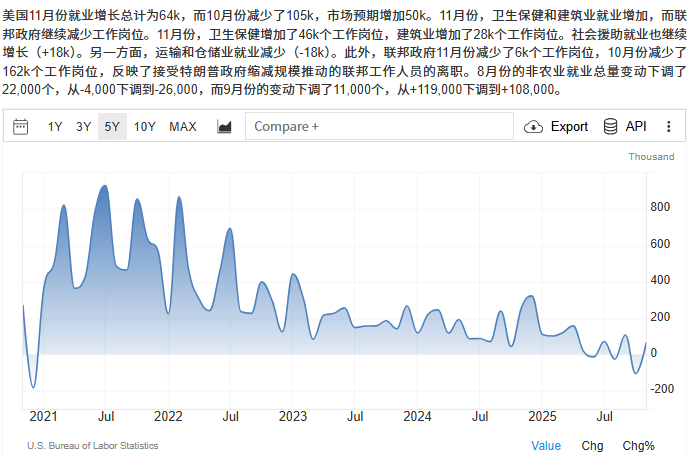
贝森特很乐观,因为美国这么折腾之下,预计2025年全年GDP增速将达到惊人的3.5%!我们先不说通胀、逆差、美债之类的老生常谈的问题,仅就 美国现在这个经济体量,又是消费主导的经济体现况而言,我不得不感慨一句:美国的经济韧性确实是强,有效需求确定是旺,所以投资下去的赚 钱效应明显,这种全世界唱衰,"明天就要崩盘"的预期下,一年下去,GDP涨了3.5%,也算经济史的奇迹2.0! 我们现在一起来看下昨天美国经济数据的一锅炖:美国11月非农就业人口增加6.4万人,高于市场预期的5万人;但失业率却意外升至4.6%,创下 2021年9月以来的新高!美国10月零售销售环比持平,略低于预期的0.1%增长!美国12月标普全球制造业PMI初值下滑至51.8,创5个月新低!这些 数据,似乎都在说:美国经济在高利率环境下"内部疲软因素上升"! 我们接下去就简单分析下: 一、就业市场:结构性问题 美国11月非农看似延续就业市场韧性,但失业率却意外攀升至4.6%,创下2021年9月以来的新高,同时前期数据大幅下修,10月非农就业从初值修正 为减少10.5万人,较预期的下降2.5万超出四倍,8月和9月合计下修3.3万人。这种"新增就业与 ...
宝城期货资讯早班车-20251217
Bao Cheng Qi Huo· 2025-12-17 01:40
Report Industry Investment Rating No relevant information provided. Core Viewpoints of the Report The overall economic situation shows a mixed picture. The external demand has improved, and prices have generally increased, but domestic demand is still bottom - seeking. Policies are expected to be more active in 2026 to support economic recovery, and the bond market is expected to have opportunities. Multiple institutions are optimistic about the continued rebound of Chinese assets in 2026 [24][25][30]. Summary by Directory 1. Macro Data - GDP in Q3 2025 grew at a 4.8% year - on - year rate, lower than the previous quarter's 5.2% but higher than the 4.6% of the same period last year [1]. - In November 2025, the manufacturing PMI was 49.2%, the non - manufacturing PMI for business activities was 49.5%, both showing certain trends compared to previous periods [1]. - Social financing scale in November 2025 was not provided, with previous values of 24,885 billion yuan and 8,161 billion yuan, and the same - period value last year of 23,288 billion yuan [1]. - CPI in November 2025 increased by 0.7% year - on - year, and PPI decreased by 2.2% year - on - year [1]. - Fixed - asset investment (excluding rural households) from January to November 2025 had a cumulative year - on - year decline of 2.6%, and the social consumer goods retail total had a cumulative year - on - year increase of 4.0% [1]. - Exports in November 2025 increased by 5.9% year - on - year, and imports increased by 1.9% year - on - year [1]. 2. Commodity Investment Reference Comprehensive - In 2026, expanding domestic demand is the top priority, and efforts will be made to boost consumption from both supply and demand sides. The real estate market will be stabilized from both supply and demand ends [2]. - Anti - dumping duties of 4.9% - 19.8% will be imposed on imported pork and pork by - products from the EU starting from December 17, 2025, for a period of 5 years [2]. - On December 16, 2025, 42 domestic commodity varieties had positive basis, and 25 had negative basis [2]. Metals - Copper prices soared to a record high, partly due to the large - scale copper hoarding by the US. The LME's three - month copper price reached a high of $11,952 per ton last Friday, currently around $11,626 per ton, up about 33% this year [4]. - On December 15, 2025, zinc, lead, tin, and copper inventories reached new highs, while nickel and aluminum inventories decreased [5]. - Morgan Stanley expects nickel prices to rebound to around $15,500 per ton in 2026 [5]. - Goldman Sachs raised its forecast for the average copper price in 2026 from $10,650 to $11,400 per ton, and there is a 55% probability that the Trump administration will announce a 15% copper import tariff in the first half of 2026, which may take effect in 2027 and increase to 30% in 2028 [6]. Coal, Coke, Steel, and Minerals - A series of measures to rectify the "involution - style" competition in the steel industry are being implemented, and the upstream coke and iron ore prices have declined [7]. - Yichun plans to cancel 27 mining licenses, including Jiangte Motor's Yifeng County Shiziling Lithium - bearing Porcelain Stone Mine [7]. - Rio Tinto will launch the first phase of a project in Western Australia, with an estimated iron ore production of 50 million tons per year by 2030 [8]. - Japan will cooperate with Malaysia in the exploration and development of rare earth and other mineral resources [8]. - In November 2025, Brazilian steel sales decreased by 3.5% year - on - year to 1.748 million tons. It is expected that in 2026, exports will decrease by 0.6% to 10.18 million tons, and imports will increase by 3.9% to 6.65 million tons [8]. - As of early December 2025, the prices of coke and coking coal in the circulation field declined [8]. Energy and Chemicals - The National Energy Administration will strengthen energy supervision and ensure the safety of the energy and power system in 2026 [9]. - Hungary signed a 5 - year LNG procurement agreement with Chevron for a total of 2 billion cubic meters [9]. - Last week, US API crude oil inventories decreased by 9.322 million barrels, exceeding expectations [9]. - The price discount of Venezuelan Merey crude oil widened to a $21 - per - barrel discount compared to Brent crude oil [9]. - JP Morgan will seek about $14 billion in funds for Argentina's LNG export project [9]. Agricultural Products - The Indian market regulatory body will propose to relax commodity derivatives rules, cancel the ban on agricultural product derivatives trading, and reduce margin requirements [10]. - As of December 14, 2025, EU's 2025/26 soft wheat exports were 10.5 million tons, barley exports were 5 million tons, corn imports were 7.5 million tons, and soybean meal imports were 8.3 million tons [10]. 3. Financial News Compilation Open Market - On December 16, 2025, the central bank conducted 135.3 billion yuan of 7 - day reverse repurchase operations, with a net investment of 18 billion yuan [11]. Key News - In 2026, expanding domestic demand is the top priority, and efforts will be made to boost consumption from both supply and demand sides. The real estate market will be stabilized from both supply and demand ends [12]. - The National Development and Reform Commission will take measures to stabilize bulk consumption, improve the social security system, and promote a fair market order [12]. - Shenzhen will prevent and resolve financial risks, support the reform of the GEM, and enhance the competitiveness of the capital market [13]. - In 2026, the central bank will continue to implement a moderately loose monetary policy and maintain financial market stability [13]. - The market expects the fiscal deficit rate in 2026 to be no less than 4% [14]. - BofA Securities expects the downward trend of the mainland real estate market to bottom out in 2026 [14]. - Vanke will hold a bondholder meeting to discuss the adjusted extension plan for "22 Vanke MTN004" [14]. - On December 16, 2025, the on - shore and off - shore RMB exchange rates against the US dollar reached new highs in 14 months, and the RMB is expected to appreciate moderately in 2026 [15]. - As of December 16, 2025, commercial banks issued 58 green financial bonds, with a total issuance scale of 458.2 billion yuan, a year - on - year increase of over 202% [15]. - The EU plans to issue about 90 billion euros in bonds in the first half of 2026 [15]. - The US Treasury Secretary is optimistic about the US economic outlook, expecting a 3.5% GDP growth in 2025 [16]. - In November 2025, the US added 64,000 non - farm jobs, but the unemployment rate rose to 4.6% [16]. Bond Market Review - Bond market sentiment improved slightly. Yields of major inter - bank interest - bearing bonds mostly declined slightly, and Treasury bond futures showed a differentiated trend [19]. - In the exchange - traded bond market, Vanke bonds generally rose, and the Wande Real Estate Bond 30 Index rose 0.58%, while the Wande High - Yield Urban Investment Bond Index fell 0.06% [19]. - The CSI Convertible Bond Index fell 0.72% to 478.64 points, with a trading volume of 55.556 billion yuan [20]. - On December 16, 2025, most money market interest rates rose, and Shibor short - term varieties showed a differentiated performance [20][21]. - Inter - bank repurchase fixed - rate bonds generally declined, and silver - silver inter - bank repurchase fixed - rate bonds showed a differentiated performance [21]. - The winning yields of Agricultural Development Bank's 2 - year financial bonds were 1.5899% and 1.6039% respectively [22]. - Most European and US bond yields declined [22]. Foreign Exchange Market - On December 16, 2025, the on - shore RMB exchange rate against the US dollar rose 80 points, and the RMB central parity rate against the US dollar rose 54 points [23]. - In New York, the US dollar index fell 0.06%, and most non - US currencies showed mixed performance [23]. Research Report Highlights - Huatai Fixed Income believes that in November 2025, external demand improved, prices rose, but domestic demand continued to bottom - seek. It is recommended to wait for opportunities in the bond market [24]. - Guosheng Fixed Income believes that in November 2025, the economy was weak in both production and demand. The bond market is expected to stabilize and start a trend - like market in the second half of the first quarter of 2026 [25]. - CICC Fixed Income believes that the November 2025 economic data was below expectations, and the bond market is expected to perform well in 2026. It is recommended to pay attention to the allocation opportunities from the end of this year to the first quarter of next year [25]. - CITIC Securities believes that the November 2025 economic data declined in both supply and demand. Policies in 2026 will be more coordinated and focused on implementation effects [26]. - Changjiang Fixed Income believes that the net investment of repurchase in December 2025 decreased. The money market may face some fluctuations due to tax payments [26]. - Xingzheng Fixed Income believes that credit bond ETFs should focus on product returns and consider individual bond attributes in portfolio selection [27]. 4. Stock Market Key News - On the day, the A - share market declined unilaterally, with nearly 4,300 stocks falling. The Shanghai Composite Index fell 1.11% to 3,824.81 points, and the market turnover was 1.75 trillion yuan [29]. - The Hong Kong Hang Seng Index fell 1.54% to 25,235.41 points, and the trading volume decreased slightly [29]. - Multiple institutions believe that Chinese assets have the basis for a continuous rebound in 2026, and overseas long - term funds have been flowing into the Chinese stock market since 2025 [30].
申万宏源证券晨会报告-20251217
Shenwan Hongyuan Securities· 2025-12-17 00:42
Group 1: Monetary Policy and Economic Outlook - The monetary policy in 2026 will continue to align with fiscal measures, supporting debt sustainability and fiscal health [2] - Interest rate cuts in 2026 may remain restrained due to reduced urgency from anti-involution trends [2] - The international economic struggle will have financial implications, particularly for the internationalization of the RMB amid intensified US-China tensions [2][13] Group 2: Misunderstandings about "Deposit Migration" - There are three main misunderstandings regarding "deposit migration": underestimating excess savings, the speed of market entry, and the investment attributes of excess savings [3][15] - The potential scale of household savings entering the stock market could exceed one trillion yuan, driven by a significant increase in excess savings [3][15] - The speed of funds entering the market may be underestimated due to reliance on non-bank deposit tracking, which does not accurately reflect the migration of household funds [3][15] Group 3: Huahai Pharmaceutical (600521) Insights - Huahai Pharmaceutical integrates raw materials and formulations, establishing a solid foundation for growth, with a projected revenue of 5.759 billion yuan in 2024 [4][14] - The company is focusing on innovative drug development in immunology and oncology, with over 70 patents filed and several projects in clinical stages [4][18] - The target market capitalization for Huahai Pharmaceutical is estimated at 34.4 billion yuan, indicating a potential upside of 30.04% [4][18] Group 4: Zhongxin Innovation (03931) Overview - Zhongxin Innovation is positioned to benefit from the growing demand for energy storage and electric vehicle batteries, with a revenue of 16.4 billion yuan in the first half of 2025 [19][20] - The company is expanding its market share and enhancing its product offerings, with a focus on high-end battery products and a global production network [19][20] - The projected net profit for Zhongxin Innovation is expected to grow significantly, reaching 3.84 billion yuan by 2027 [20]
澳洲消费者信心跌回悲观区间,澳币AUDUSD正在为“高通胀”重新定价
Xin Lang Cai Jing· 2025-12-16 23:42
Economic Overview - Australia's December PMI preliminary value shows a divergence in the private sector economy, with the composite PMI expansion momentum slowing to a seven-month low [1] - Manufacturing PMI increased from 51.6 in November to 52.2, supported by growth in new orders and strong exports, while the services PMI fell from 52.8 to 51.0, dragging down overall economic expansion [1][34] - The composite PMI dropped from 52.6 to 51.1, remaining above the 50 mark for the 15th consecutive month but marking the lowest growth rate in seven months [1][34] Market Insights - New orders in the Australian private sector remain solid, providing a foundation for output growth, although the overall growth rate has slowed [2] - Employment data continues to show growth as companies hire more staff to meet existing workloads, with business confidence rising to its highest level since June [2] - However, there is a divergence in backlogs, with manufacturing backlogs increasing while service sector backlogs have decreased for eight consecutive months, leading to an overall reduction in backlog volume [2] Cost and Pricing Dynamics - Input cost inflation has intensified in both sectors, with commodity input costs rising at the fastest pace in eight months, leading companies to pass some costs onto consumers, pushing sales price inflation to a three-month high [2][35] - The Australian dollar has depreciated against the US dollar, falling below the 0.662 mark due to the composite PMI slowdown and declining consumer confidence [2][35] Consumer Confidence - Consumer confidence in Australia has declined in December, reversing the previous month's gains, with the index dropping 9% to 94.5 points, indicating a return to pessimism [3][36] - Households are increasingly worried about inflation and interest rate prospects, with expectations for personal financial situations and economic outlooks declining significantly [3][36] US Retail Sales and Economic Activity - US retail sales in October remained flat, indicating consumer spending is under pressure, particularly affecting lower-income households, while high-income households continue to show spending resilience [4][37] - The October core retail sales, excluding volatile categories, increased by 0.8%, suggesting consumer spending is still supporting economic growth [5][38] - In December, US business activity slowed to a six-month low, with the composite PMI dropping to 53.0, indicating a weakening economic momentum [6][39] Inventory Trends - US business inventories grew by 0.2% in September, slightly above expectations, indicating potential support for GDP growth, but also reflecting underlying demand pressures [8][41] - Retail inventories increased by 0.4%, with significant growth in motor vehicle inventories, while wholesale inventories rose by 0.5% [9][42]

12月17日你需要知道的隔夜全球要闻
Sou Hu Cai Jing· 2025-12-16 23:27
Market Performance - US stock market closed with the Dow Jones down 0.6%, S&P 500 down 0.13%, and Nasdaq down 0.19% [1] - Tesla shares rose 3% to reach a historical high, Nvidia increased nearly 1%, and Circle surged nearly 10% [1] - Nasdaq China Golden Dragon Index fell 0.34%, with NetEase dropping nearly 2% [1] Oil and Gold Prices - International oil prices declined, with WTI crude futures falling below $55 per barrel, a daily drop of 3.22%; Brent crude fell below $59 per barrel, down 2.70% [1] - Shanghai gold main contract fell 0.14%; gold prices rebounded after the US November non-farm payroll report [1] Employment Data - US unemployment rate reached a four-year high of 4.6%, with 7.8 million unemployed; November adjusted non-farm payrolls recorded an increase of 64,000, exceeding expectations [1] - October non-farm payrolls saw a decrease of 105,000, marking the largest decline since the end of 2020 [1] Regulatory and Policy Developments - The US threatened to retaliate against EU companies regarding digital tax issues, specifically naming Accenture, Siemens, and Spotify, indicating potential fees and service restrictions if EU continues to limit US digital service providers [1] - Trump is set to interview potential Federal Reserve chair candidates, including Waller and former Fed governor Kevin Walsh, and will deliver a national address potentially outlining new year policies [1] Inventory and Manufacturing Data - US API crude oil inventory for the week ending December 12 recorded a drop of 9.322 million barrels, the largest decline since June 2025, significantly exceeding the expected drop of 2.197 million barrels [1] - US October retail sales month-on-month recorded 0%, below the expected 0.1%; December preliminary S&P Global Manufacturing PMI recorded 51.8, the lowest in five months; Services PMI preliminary value recorded 52.9, the lowest in six months [1] Company Developments - Apple plans to expand its iPhone product line from five to seven models by fall 2027 [1] Federal Reserve Insights - Federal Reserve's Bostic expressed a desire to maintain monetary policy unchanged in the last meeting, with no interest rate cuts anticipated in the 2026 forecast, believing the economy will perform stronger at around 2.5% GDP growth, necessitating a restrictive policy [1]


2026年货币政策将灵活高效精准发力
Zhong Guo Zheng Quan Bao· 2025-12-16 20:19
Core Viewpoint - The central theme of monetary policy remains "supportive," with a focus on enhancing financial support for the real economy and maintaining financial market stability in 2025 and beyond [1][3]. Group 1: Monetary Policy Implementation - The central bank has implemented a moderately loose monetary policy, utilizing various tools such as reserve requirement ratio cuts and open market operations to ensure ample liquidity in the financial system [1][2]. - In May, the central bank reduced the reserve requirement ratio by 50 basis points, releasing approximately 1 trillion yuan in long-term liquidity, which has effectively supported the real economy [2]. - The average interest rate for newly issued corporate loans was about 3.1% in November, down approximately 30 basis points year-on-year, indicating a historical low in financing costs [2]. Group 2: Future Monetary Policy Outlook - The supportive monetary policy stance is expected to continue into 2026, with an emphasis on flexible and precise implementation of tools like rate cuts and reserve requirement adjustments [3][4]. - Experts suggest that the central bank will focus on stabilizing economic growth and promoting reasonable price recovery, with rate cuts remaining a key option in the monetary policy toolkit [3][5]. Group 3: Structural Monetary Policy Tools - The central bank aims to enhance the effectiveness of structural monetary policy tools to direct financial resources towards key sectors and vulnerable areas of the economy [4][5]. - By increasing the quotas for loans supporting agriculture and small enterprises, as well as for technological innovation, the central bank is targeting specific areas to boost financial support [4]. Group 4: Financial Market Stability - The central bank has prioritized maintaining stable financial markets amid increasing global uncertainties, implementing measures to support stock market stability and enhance investor confidence [6][7]. - The yuan has shown a stable appreciation against the dollar, with a year-to-date increase of approximately 3.51% in the onshore market, reflecting a solid foundation for long-term currency stability [6][7]. - The restoration of government bond trading operations has improved market conditions, with the 10-year government bond yield stabilizing around 1.8%, facilitating financing for the real economy [6][7].
美联储博斯蒂克:进一步降息会将货币政策推向或进入宽松领域,从而使通胀和通胀预期面临风险。
Sou Hu Cai Jing· 2025-12-16 20:10
美联储博斯蒂克:进一步降息会将货币政策推向或进入宽松领域,从而使通胀和通胀预期面临风险。 来源:金融界AI电报 ...