
PPI

Search documents
国信证券:港股修复行情已开启 AI方向仍将被重点关注
智通财经网· 2026-01-05 06:05
Core Viewpoint - The market anticipates that the next interest rate cut by the Federal Reserve will be delayed until late April 2024, following the December rate cut, with a focus on employment data and inflation pressures [1][2]. Group 1: U.S. Economic Outlook - Inflation pressures are decreasing, and future focus will be on employment data due to the impact of government shutdowns on economic data quality [2]. - The real estate market is weak, and the employment market is relatively sluggish, indicating that inflation pressures will remain manageable in the near term [2]. Group 2: Domestic Market Focus - The two main themes that could change market expectations in 2026 are the release of the 14th Five-Year Plan during the Two Sessions and the continuous improvement of the Producer Price Index (PPI) [3]. - The 14th Five-Year Plan will provide clearer growth expectations and market capacity, while PPI improvements will be crucial for corporate profitability and market sentiment [3]. Group 3: Hong Kong Stock Market - The market outlook for the first half of 2026 is positive, driven by a weaker U.S. dollar and improved domestic liquidity, creating a dual-driven market [4]. - AI remains a key focus for 2026, with expectations for accelerated domestic semiconductor hardware production and increased AI application deployment, particularly in the Hang Seng Technology and Internet sectors [4]. - The recovery of corporate profits in 2026 is supported by a trend against excessive competition, benefiting upstream metals and certain industrial companies [4]. Group 4: Non-Banking Sector - Non-banking sector performance has been significantly upgraded recently, with insurance and brokerage firms expected to benefit from market stabilization [5]. Group 5: Innovative Pharmaceuticals and Consumer Sector - The innovative pharmaceutical sector shows stable performance and is worth holding, with potential for recovery upon the release of new business development projects [6]. - In the consumer sector, certain areas like collectible toys have seen valuations drop to around 15 times earnings for 2026, and ongoing government consumer subsidies are expected to support recovery [6].

股指注意回调风险,债市或震荡运行
Chang Jiang Qi Huo· 2026-01-05 03:43
Report Industry Investment Rating - Not provided in the content Core Viewpoints of the Report - The market's main line rotates rapidly, and stock index futures may fluctuate. Attention should be paid to the risk of correction. The follow - up trend needs to closely monitor the change in trading volume. If the trading volume remains at the current relatively high level, the index is still expected to continue to expand upward after fully digesting floating chips; otherwise, if the volume significantly shrinks, short - term correction risk should be vigilant. The bond market sentiment has been frustrated, and the future sustainability of the rebound in the manufacturing PMI in December remains to be observed. In 2026, as the starting year of the 14th Five - Year Plan, the pressure and necessity for stable growth are still relatively large, and it is highly likely that policies will be implemented at the beginning of the year to support the economy [9][11] Summary by Relevant Catalogs Financial Futures Strategy Recommendations Stock Index Strategy Recommendations - Stock index trend review: The Shanghai Composite Index rose 0.09% to close at 3968.84 points. For the whole year, the Shanghai Composite Index increased by 18.41% [9] - Core view: The manufacturing PMI in December rebounded to 50.1%, returning above the boom - bust line after 8 months and significantly higher than the consensus expectations of Bloomberg and Reuters. The rebound in the manufacturing PMI in December has strong certainty at the structural level but faces uncertainty at the aggregate level. The market's main line rotates rapidly, and stock index futures may fluctuate. Attention should be paid to the risk of correction [9] - Technical analysis: The MACD indicator shows that the broader market index may fluctuate [9] - Strategy outlook: Range - bound fluctuations [9] Treasury Bond Strategy Recommendations - Treasury bond trend review: The 30 - year main contract fell 0.35%, the 10 - year main contract fell 0.07%, the 5 - year main contract fell 0.04%, and the 2 - year main contract fell 0.03% [11] - Core view: The composite PMI, manufacturing PMI, and non - manufacturing PMI are all above the boom - bust line of 50, and the bond market sentiment has been frustrated. The rebound in the manufacturing PMI in December exceeded expectations, and its future sustainability remains to be observed. In 2026, as the starting year of the 14th Five - Year Plan, the pressure and necessity for stable growth are still relatively large. Whether it is the remaining fiscal resources at the end of the year or the room for monetary easing, it indicates that it is highly likely that policies will be implemented at the beginning of the year to support the economy. Attention should be paid to the stock - bond seesaw, whether the central bank's scale of treasury bond trading will further expand, and the implementation rhythm of monetary policies after the new year [11] - Technical analysis: The MACD indicator shows that the T main contract may fluctuate [11] - Strategy outlook: Fluctuating operation [11] Key Data Tracking PMI - In December, the manufacturing PMI rebounded to 50.1%, returning above the boom - bust line after 8 months [18] - It was significantly stronger than the seasonal trend. In previous Decembers, the manufacturing PMI decreased by an average of 0.3 pct compared with November, while it increased by 0.9 pct this month [18] - The PMI of high - tech manufacturing industries rebounded significantly by 2.4 pct to 52.5%, indicating a good growth trend in the industry [18] - Large and medium - sized enterprises led the improvement. Although the PMI of small enterprises declined, large and medium - sized enterprises' PMIs both rebounded significantly [18] CPI - In November, the year - on - year increase in CPI strengthened, and the month - on - month PPI remained positive, which was the result of the combined effects of seasonal factors, low - base effects, and "anti - involution" [21] - It is worth noting that the year - on - year CPI has fluctuated below 1% for 33 consecutive months, and the year - on - year PPI has been negative for 38 consecutive months, indicating that domestic demand is still relatively weak [21] - At the end of the year and during the Spring Festival, driven by seasonal effects and rising gold prices, the year - on - year CPI is expected to continue to fluctuate upward [21] - Since November 2024, the year - on - year base of PPI has entered a downward range again. Affected by low - base effects and the orderly progress of "anti - involution", the year - on - year PPI is also expected to rebound [21] Import and Export - In November, China's exports were $330.35 billion, imports were $218.67 billion, and the trade surplus was $111.68 billion [23] - In terms of representative export commodities, labor - intensive products, mechanical and electrical products, and high - tech products drove the overall export in November by - 1.33%, 5.81%, and 2.01% respectively, with the driving rates increasing by 1.03 pp, 5.06 pp, and 1.55 pp respectively compared with the previous month [23] - The strengthening of exports to the EU, Africa, and Latin America drove the year - on - year increase in exports this month, showing a relatively strong performance. Since November 9th, the year - on - year growth rates of global and US imports and China's container bookings to the US have continued to decline week by week, indicating a high probability of pressure on exports in December [24] Industrial Added Value - In November, the year - on - year growth rate of industrial added value dropped to 4.8%, and the service industry production index dropped to 4.2%. The production - end data has declined for two consecutive months [25] - There are two reasons for the weakening of industrial added value. First, "anti - involution" has begun to suppress the output of key industries. In November, the year - on - year growth rate of industrial added value in the automobile industry dropped by 4.9 pct to 11.9%, the year - on - year growth rate of industrial added value in the steel industry dropped by 0.5 pct to 0.9%, and the chemical industry dropped by 0.4 pct to 6.7%. In terms of microscopic output, the year - on - year output of automobiles, ethylene, and steel also weakened. Second, after the policy took effect on September 24th last year, the production increase established a relatively high base. From the perspective of the two - year compound growth rate, the year - on - year growth rate of industrial added value in November was basically the same as that in October [28] Fixed - Asset Investment - From January to November, the year - on - year growth rate of fixed - asset investment dropped by 2.6%. It is estimated that the year - on - year growth rate of fixed - asset investment in November was - 11.1%, a slight increase compared with October [31] - By type, the year - on - year growth rate of private investment rebounded to - 12.9%, and the year - on - year growth rate of public investment continued to drop to - 8.9% [31] - By expenditure direction, it is estimated that the year - on - year growth rates of construction and installation projects/equipment and tool purchases in November dropped to - 16.1% and 6.3% respectively, and the year - on - year growth rate of other expenses rebounded slightly to - 13.8% [31] - By the three major categories, the year - on - year growth rates of infrastructure and real estate investment are still declining at a low level, but manufacturing investment has a slight rebound [31] Social Retail - In November, the year - on - year growth rate of social retail sales dropped to 1.3%, lower than market expectations and the weakest since 2023 [34] - There are three factors for the weakening of social retail sales in November. First, after the weakening of national subsidy funds, the weakening of durable - goods consumption is the main drag. In November, the year - on - year growth rate of optional consumption dropped to - 10%, and among them, automobiles and home appliances cumulatively dragged down the year - on - year growth rate of social retail sales in that month by 1.2 pct. Second, the overall weak performance of the "Double Eleven" sales also dragged down the social retail sales for the whole month. In November, the online retail sales of physical goods dropped by 3.3 pct to 1.5%, and the two - year compound year - on - year growth rate turned negative for the first time this year. Third, the consumption in the post - real - estate cycle continued to be weak. Restricted by the long - term weak real - estate sales, the year - on - year growth rates of social retail sales of building materials and furniture both dropped and turned negative [34] Social Financing - In November, the new social financing was 2.5 trillion yuan, a year - on - year increase of 0.2 trillion yuan. Corporate bonds and non - standard financing were the main supports, while government bonds and credit were the main drags [37] - Bills continued to boost the volume, and the year - on - year increase in medium - and long - term loans for residents and enterprises continued to be less than the previous year [37] - In November, the year - on - year growth rate of social financing remained flat at 8.5%, and the growth rate of credit in the social financing caliber remained flat at 6.3% [37] - The growth rates of M1 and M2 declined. Attention should be paid to the process of deposit currentization in the future [37]
量化资产配置月报202601:经济指标出现转弱,PPI关注度维持最高-20260104
Shenwan Hongyuan Securities· 2026-01-04 14:44
Group 1 - The report indicates a shift towards a weaker economic outlook, with liquidity remaining slightly loose and credit indicators showing slight improvement. The macro dimensions suggest a continued trend of weak economy, loose liquidity, and credit contraction [2][8][14] - The asset allocation strategy emphasizes high dividend and low volatility configurations, focusing on factors that are insensitive to economic and credit conditions. The top scoring factors are centered around profitability and dividends, with significant improvements in dividend scores [5][9][30] - The report maintains a high allocation to gold, suggesting a 20% upper limit due to ongoing momentum, while bond views have improved but remain low due to other asset influences [2][27] Group 2 - Economic forward indicators are trending weak, entering the initial phase of a decline since December 2025, with expectations of continued downward movement. Key indicators such as PMI and retail sales are in a downward cycle [14][19] - Liquidity conditions have returned to a slightly loose state, with interest rates stabilizing and short-term rates slightly declining, indicating a shift back to a neutral signal [21][24] - Credit indicators show slight improvement in social financing year-on-year, although the structure of loans to households and enterprises has decreased, indicating a preference in credit indicators [25][26] Group 3 - The market focus remains on PPI, which has surpassed economic indicators in attention, highlighting market concerns regarding future demand recovery [28][29] - Industry selection is biased towards weak cyclical sectors, with top scoring industries including computer and food and beverage sectors, which are less sensitive to economic and credit fluctuations [30][31]
平安证券:26年1月利率债月报:再通胀对债市的影响路径-20260104
Ping An Securities· 2026-01-04 13:05
Report Industry Investment Rating - The report does not mention the industry investment rating. Core Viewpoints of the Report - In December 2025, the weakening of the US dollar and the improvement of risk appetite led to a steeper curve overseas, while in China, loose funds drove the yield curve to steepen. The bond market remained volatile due to the supply - demand contradiction at the long end [2]. - In 2026, the PPI is facing three positive factors: the tail - lifting factor, imported inflation, and the continued effectiveness of the "anti - involution" policy. Under the neutral scenario, the PPI is expected to turn positive in the second quarter of 2026 and reach around 1.2% by the end of the year. The mild re - inflation needs to resonate with other factors to significantly affect the bond market [3][55]. - Currently, the bond market is in a wait - and - see state. It is expected to remain volatile in the short term, lacking the motivation and space for trend trading. There are some structural opportunities, such as the follow - up rise opportunity of 5 - 7Y China Development Bank bonds and the compression opportunity of credit spreads [4]. Summary by Directory PART1: December 2025 - Curve Steepening Driven by Overseas and Domestic Factors Overseas - In December 2025, the Fed announced reserve management - style purchases (RMP) and continued to cut interest rates. The US dollar index weakened, liquidity improved, the US stock market rose, and risk appetite recovered. The US bond yield curve steepened due to factors like Fed's short - term bond purchase, market concerns about Fed independence, and rising commodity prices. Precious and industrial metals performed well, with copper benefiting from AI demand and gold and silver supported by geopolitical events [10][16]. Domestic - In November 2025, the domestic economic fundamentals showed a divergence between quantity and price, and in December, both supply and demand declined. The capital market was generally loose, and the overnight interest rate hit a new low for the year. The bond market remained volatile due to the long - end supply - demand contradiction, and the yield curve steepened [17][23]. - In terms of institutional behavior, large banks and insurance companies, as allocation players, increased their bond - buying in the secondary market in December. Large banks added some policy - related financial bonds and focused on 5 - 7 - year varieties. Insurance companies mainly added long - term treasury bonds. Trading players became conservative. Rural commercial banks mainly invested in certificates of deposit, funds reduced duration and mainly sold long - term treasury bonds, and wealth management products seasonally reduced bond allocation and slightly increased credit bond allocation [26][35][47]. PART2: How the 2026 Re - inflation Narrative May Affect the Bond Market 2026 PPI's Three Positive Factors - The tail - lifting factor can support the PPI to turn positive in the second half of 2026 even without new price - increasing factors [55]. - Imported inflation may occur as overseas capital expenditure and manufacturing investment are likely to rise in 2026. The US deficit rate may expand, and the Fed's new round of easing may release emerging market countries' capital expenditure demand [57]. - The "anti - involution" policy has shown a supporting effect on the PPI. Since August 2025, the month - on - month PPI of the mining industry has turned positive, driving the overall PPI to turn positive since October [60]. PPI Forecast under Different Scenarios - Under the pessimistic scenario, the PPI is expected to turn positive in the second half of 2026 with an average monthly PPI growth rate of 0%. Under the neutral scenario, with a monthly average PPI growth rate of 0.1%, the PPI is expected to turn positive in the second quarter of 2026 and reach around 1.2% by the end of the year. Under the optimistic scenario, with a monthly average PPI growth rate of 0.2%, the PPI is expected to turn positive in April 2026 and exceed 2% in the second half of the year [67]. PPI's Impact on the Bond Market - Historically, during the four PPI upward cycles since 2009, three typical upward periods were driven by the resonance of domestic and overseas demand or supply - demand. The PPI and the bond market generally move in the same direction, but there were several periods of divergence, mainly due to strong economic recovery expectations or PPI being mainly affected by the supply side while the domestic demand did not improve significantly and the monetary policy remained loose [69][71]. - In 2026, the mild re - inflation needs to resonate with other factors such as total demand, central bank's capital management, financial institutions' liability - side stability, and the flow of activated household deposits to significantly affect the bond market. The trading of typical total assets based on re - inflation may have limited odds [78]. PART3: Bond Market Strategy for January 2026 - In January 2026, the bond market may still be in a wait - and - see period. Potential risks include government bond supply pressure, the spring rally in the equity market, and the first - quarter credit boom. Potential positive factors include the possible relaxation of large banks' bond - allocation pressure and the relatively loose capital market, with a higher probability of a reserve - requirement ratio cut than an interest - rate cut in January [81]. - The bond market is expected to remain volatile in the short term, lacking the motivation and space for trend trading. Structurally, there are opportunities such as the follow - up rise of 5 - 7Y China Development Bank bonds and the compression of credit spreads in credit bonds [4][83].
港股1月投资策略:春季行情徐徐启动
Guoxin Securities· 2026-01-04 11:51
Group 1 - The report emphasizes that the Hong Kong stock market is expected to outperform the market, driven by a dual momentum of a weaker US dollar and improved domestic liquidity in the spring of 2026 [1][2] - The focus for 2026 is on two main themes: AI and PPI, which are anticipated to significantly influence market expectations and corporate profitability [1][2][51] - The report highlights that the AI sector remains a priority for 2026, with expectations for accelerated domestic semiconductor hardware production and increased AI application deployments, particularly in the Hang Seng Technology and Internet sectors [2][59] Group 2 - The report indicates that the recovery in the Hong Kong stock market has already begun, with significant gains observed during the New Year period, suggesting a positive shift in foreign capital inflow [2][73] - It notes that the performance of various sectors in December showed divergence, with materials and industrial sectors benefiting from the recovery, while sectors like innovative pharmaceuticals and consumer goods faced challenges [2][77][84] - The report mentions that the 2025 Hong Kong stock market had a remarkable performance, with the Hang Seng Index returning 27.8%, significantly outperforming A-shares and US stocks, and setting a record for southbound capital inflows [2][84][86] Group 3 - The report discusses the macroeconomic outlook for the US, highlighting a decrease in inflation pressure and a focus on employment data, which will influence future monetary policy decisions [9][12] - It points out that the US real estate market is currently weak, with a significant gap between sellers and buyers, which is expected to impact inflation and economic activity in 2026 [18][22][26] - The report also notes that corporate earnings per share (EPS) for listed companies continue to reach new highs, indicating strong underlying performance despite macroeconomic challenges [40][41] Group 4 - The report identifies that the domestic economic indicators in China have shown some decline, particularly in M1 and social financing, which may affect liquidity and investment sentiment [51][52] - It emphasizes the importance of the upcoming "14th Five-Year Plan" and its implications for technological advancements and industrial growth, particularly in AI and PPI sectors [59][61] - The report suggests that the PPI is expected to rise significantly in the first half of 2026, which will improve profitability for industrial enterprises and influence investment strategies [61][62]
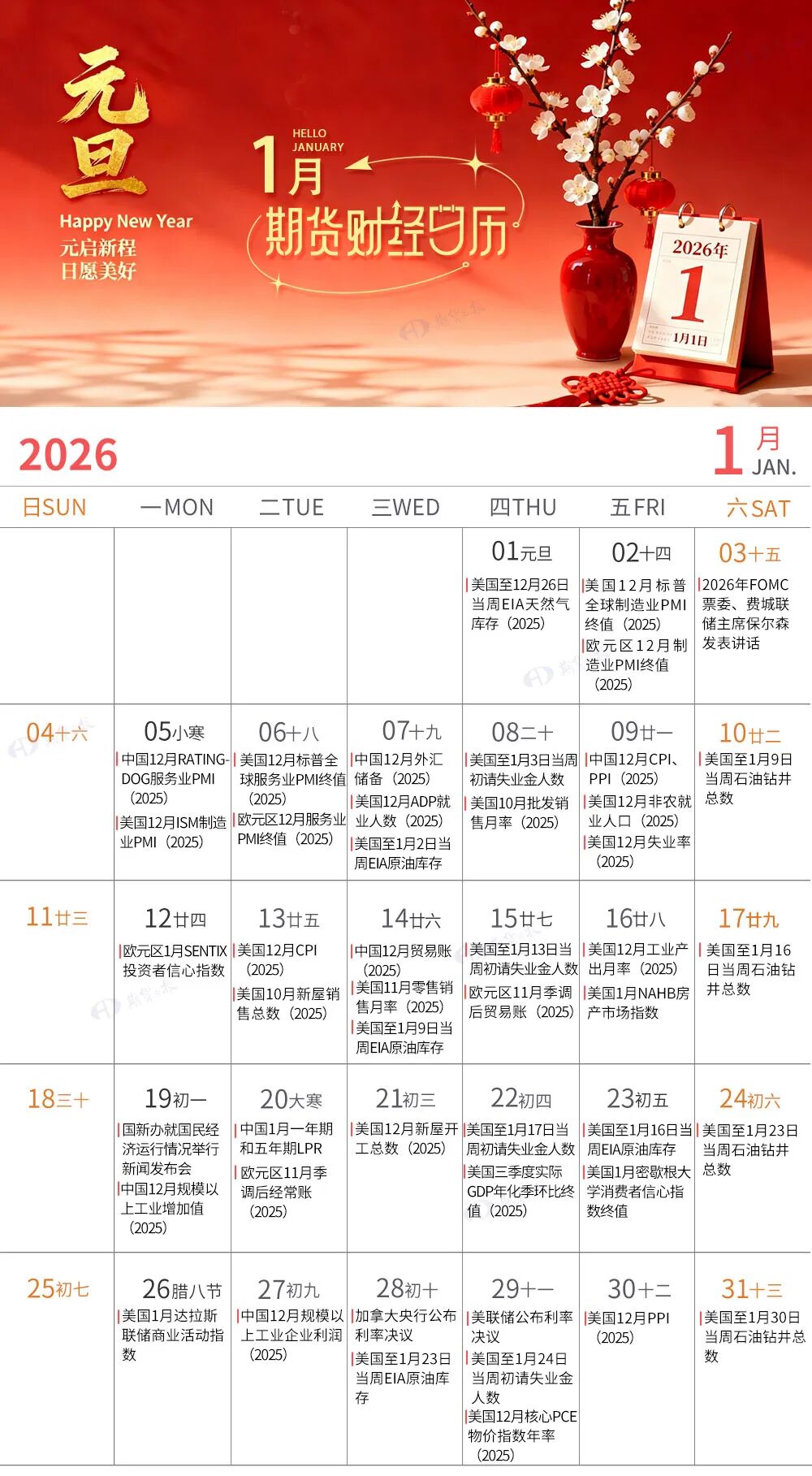
1月财经日历来了,请查收!
Xin Lang Cai Jing· 2026-01-01 00:15
Group 1 - The article discusses various economic indicators and events scheduled for the upcoming weeks, including the release of manufacturing and service sector PMIs in both the US and Eurozone [2] - Key dates include the US EIA natural gas inventory report and the final value of the global manufacturing PMI for December [2] - The article highlights the importance of the US non-farm payroll report and unemployment rate data, which are critical for assessing the labor market [2] Group 2 - The article mentions the upcoming release of China's December trade balance and industrial production data, which are essential for understanding the country's economic performance [3] - It notes the significance of the US Federal Reserve's interest rate decision and the implications for monetary policy [3] - The article also references the Canadian central bank's announcement, indicating a broader focus on North American economic conditions [3]

分析|产需两端明显回升,12月制造业PMI时隔8个月回升至扩张区间
Sou Hu Cai Jing· 2025-12-31 09:15
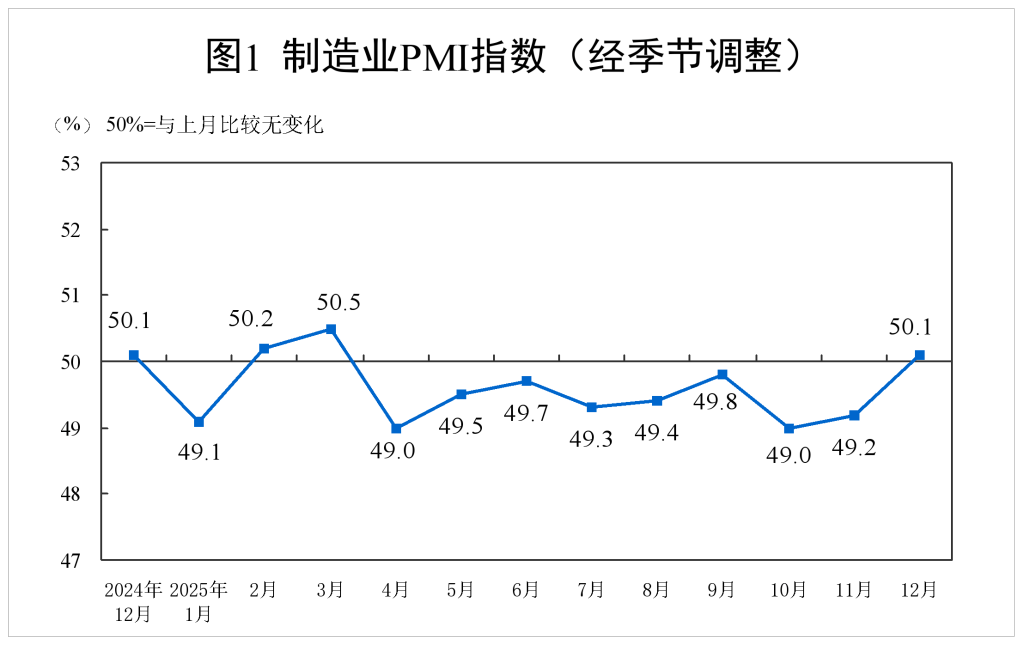
Group 1: Manufacturing Sector - In December, the Manufacturing Purchasing Managers' Index (PMI) rose to 50.1%, an increase of 0.9 percentage points from the previous month, marking the first time it has entered the expansion zone since April [8] - The production index reached 51.7%, up 1.7 percentage points, and the new orders index increased to 50.8%, up 1.6 percentage points, indicating significant improvement in manufacturing demand [8] - The new export orders index also improved to 49.0%, up 1.4 percentage points, suggesting a recovery in external demand [8] Group 2: Non-Manufacturing Sector - The Non-Manufacturing Business Activity Index rose to 50.2%, an increase of 0.7 percentage points, returning to the expansion zone [10] - The service sector's business activity index was at 49.7%, indicating it remains in the contraction zone despite a slight increase [11] - The construction sector showed improvement with a business activity index of 52.8%, up 3.2 percentage points, attributed to favorable weather and policy-driven infrastructure investments [12] Group 3: Economic Outlook - The overall economic activity in December showed signs of recovery, with both domestic and external demand improving due to effective growth stabilization policies [13] - The price indices showed mixed results, with the main raw material purchase price index decreasing by 0.5 percentage points to 53.1%, while the factory price index increased by 0.7 percentage points to 48.9%, indicating potential for improved corporate profits [9] - Looking ahead, the manufacturing PMI is expected to remain in the expansion zone into early 2026, supported by ongoing growth policies and a recovering market demand [13][14]
长债波段操作为主:债海观潮,大势研判
Guoxin Securities· 2025-12-30 13:53
Group 1 - The report indicates that in December, the yield rates of most bond varieties declined, with all interest rate bonds experiencing a decrease in yield rates, while credit bond spreads widened for most varieties [3][10][19] - The U.S. economy is showing signs of a slowdown, with the CPI inflation remaining moderate, and both European and Japanese inflation stabilizing [3][39][43] - Domestic economic growth continued to slow down in November, with a year-on-year GDP growth rate of approximately 4.1%, a decrease of 0.2 percentage points from October [3][49][53] Group 2 - The monetary policy review for the fourth quarter removed references to "low price levels" and emphasized ongoing challenges in the economy, such as the imbalance between supply and demand [3][103] - The report highlights that the current bond market is likely to experience greater volatility, suggesting a focus on long-term bond trading strategies [3][34][135] - The report notes that the "fixed income plus" strategy involves a combination of fixed income assets with other risk assets to enhance returns, with a focus on maintaining a balance between risk and return [105][106][120] Group 3 - The report provides insights into the performance of "fixed income plus" funds, indicating a significant increase in the allocation to equity assets, with stock allocation reaching 10.3% by the end of Q3 2025 [3][129] - The total scale of "fixed income plus" funds reached 27,826 billion, with an average fund size of 2 billion [125][126] - The report emphasizes that the performance of "fixed income plus" funds tends to be better during bull markets in the A-share market, with historical returns showing significant variability [114][118]
债海观潮,大势研判长债波段操作为主
Guoxin Securities· 2025-12-30 11:10
Group 1 - The report indicates that in December, the yield rates of most bond varieties declined, with all interest rate bonds experiencing a decrease in yield rates. In the credit bond sector, most credit bond varieties saw widening credit spreads, while the total amount of defaults significantly decreased in December [3][10][30] - The overseas economic fundamentals show a slowdown in the US economy, with a mild performance in CPI inflation. Both European and Japanese inflation rates have stabilized [3][39][43] - Domestic economic growth continued to slow down in November, with a year-on-year GDP growth rate of approximately 4.1%, a decrease of 0.2 percentage points from October. The forecast for GDP growth in Q4 2025 is about 4.3%, indicating a further decline from Q3 [3][49][91] Group 2 - The monetary policy review indicates that the fourth quarter monetary policy meeting removed references to "low inflation" and emphasized the challenges posed by the imbalance between supply and demand in the economy [3][103] - The report highlights that the "fixed income plus" strategy involves a combination of fixed income assets with other risk assets to enhance returns, with common assets including stocks, convertible bonds, derivatives, and commodities [105][106] - The performance of "fixed income plus" funds has shown a significant increase in equity allocation, with stock assets accounting for 10.3% of the total, while bond assets remain dominant at 85.4% [129]
11月经济数据解读:延续稳中有进发展态势
East Money Securities· 2025-12-30 09:54
Consumption - In November 2025, the total retail sales of consumer goods reached 43,898 billion yuan, with a year-on-year growth of 1.3%, down 1.6 percentage points from the previous value of 2.9%[12] - Sales of "two new" products and real estate-related consumption continued to decline, with automotive consumption down 8.3% and home appliances down 19.4% year-on-year[12] - Service retail sales grew by 5.4% year-on-year from January to November, indicating a gradual release of service consumption potential[14] Investment - Fixed asset investment continued to decline, with a year-on-year decrease of 2.6% in November, marking three consecutive months of negative growth[23] - Real estate development investment fell by 31.4% year-on-year in November, a significant increase in the decline compared to the previous month's 23.2%[23] - Equipment purchase investment showed a year-on-year growth of 6.3%, contributing 1.8 percentage points to overall investment growth[24] Trade - In November, exports increased by 5.9% year-on-year, rebounding from a previous decline of 1.1%[32] - Exports to the EU saw a significant recovery with a growth rate of 14.8%, while exports to the US decreased by 28.6%[32] - Imports rose slightly by 1.9% year-on-year, with notable increases in the import of integrated circuits and automatic data processing equipment[34]