扩内需政策

Search documents
大消费行业2025Q2基金持仓分析:大消费重仓比例持续回落,其中农牧、美护板块重仓比例环比提升
Wanlian Securities· 2025-08-08 10:11
Investment Rating - The report maintains a "Maintain Overweight" rating for the consumer sector, indicating a cautious optimism about potential recovery in consumer demand in 2025 [4]. Core Insights - The heavy allocation ratio in the consumer sector continues to decline, with a significant drop in the overweight ratio to 5.85%, which is well below the historical average of 11.37% [2][11]. - The report highlights a clear differentiation in heavy allocation ratios among sub-sectors, with agriculture, forestry, animal husbandry, and beauty care seeing slight increases, while other sectors experienced declines [2][15]. - The top 20 stocks in the market include three from the consumer sector, with notable changes in heavy allocation ratios for food and beverage stocks [3][28]. Summary by Sections Heavy Allocation Trends - The heavy allocation ratio in the consumer sector has decreased for four consecutive quarters, now at 5.85%, significantly lower than the historical average of 11.37% [11][12]. - The heavy allocation market value ratio has also declined to 15.33%, down 3.48 percentage points [12][18]. Sector Performance - The food and beverage sector's heavy allocation ratio has decreased to 3.38%, while home appliances and agriculture, forestry, and animal husbandry are at 1.38% and 0.46%, respectively [15][17]. - The beauty care sector is the only one among the consumer sectors to see an increase in heavy allocation, while others like retail and social services have declined [15][19]. Stock Holdings - In the top 20 stocks, the consumer sector holds three positions, down from four in the previous quarter, with notable stocks including Guizhou Moutai and Wuliangye [3][28]. - The heavy allocation ratios for Guizhou Moutai and Wuliangye are 1.74% and 0.38%, respectively, indicating a strong preference for high-quality assets in the consumer sector [28][32]. Investment Recommendations - The report suggests focusing on food and beverage, particularly in segments like dairy, beverages, snacks, and condiments, as well as sectors like social services and tourism, which are expected to benefit from policy support [4][7]. - For the jewelry sector, the report recommends attention to brands with strong product design and operational capabilities, especially in the context of rising gold prices [7][19].



广东各地市新一批以旧换新补贴额度将陆续上线
Nan Fang Ri Bao Wang Luo Ban· 2025-08-04 08:07
8月1日,据国家发展改革委消息,今年以旧换新已带动商品销售额超过1.7万亿元,上半年限额以上家 电、通讯器材零售额同比增长30.7%、24.1%,新能源汽车销量同比增长40.3%,各项扩内需政策正在落 地显效。 目前,今年第三批690亿元支持消费品以旧换新的超长期特别国债资金已下达完毕。同日,广东"粤焕 新"以旧换新公共服务平台小程序佛山领券通道于上午10时准时开启,20分钟后当日补贴额度已被全部 领取完毕。据省商务厅消息,其他地市的以旧换新资金也将陆续上线,请有意领取补贴的消费者随时关 注。 广东落地 细则明确 撬动显著 在广东,政策红利正加速转化为消费动能。根据广东省2025年加力扩围家电、数码产品消费补贴的政 策:今年广东对个人消费者购买单件销售价格不超过6000元的手机(含具有通话功能的有关产品)、平 板(含智能办公本和平板类学习机等)、智能手表手环(含智能儿童手表等)进行补贴,每名消费者每 类产品全国范围内可补贴一件,每件补贴比例为减去生产、流通环节及移动运营商所有优惠后最终销售 价格的15%,每件补贴不超过500元。 目前,"两新"政策持续显效,稳投资、扩消费、促转型、惠民生的关键作用进一步凸显, ...
如何用好发展机遇、潜力和优势(今日谈)
Ren Min Ri Bao· 2025-07-31 21:52
Group 1 - The core viewpoint emphasizes the importance of seizing development opportunities, potential, and advantages to consolidate and expand the positive momentum of economic recovery [1] - The ability to adapt and respond to changes is crucial in the face of technological revolutions and industrial transformations, where those who seize the initiative will gain an advantage [1] - Effective market mechanisms combined with proactive government actions are essential to stimulate potential, with domestic demand, particularly consumption, becoming the main driver of economic growth in the first half of the year [1] Group 2 - The article highlights the need to leverage advantages by maintaining determination and enhancing initiative, particularly through the rich talent resources that provide strong momentum for technological breakthroughs and innovative development [1] - It calls for increased efforts in reform and innovation, promoting education, technological advancement, and talent cultivation to secure both current and future success [1] - The transformation of potential into tangible results and advantages into competitive strengths is crucial for navigating risks and challenges while seizing opportunities to propel the Chinese economy forward [1]
我国7月制造业PMI出炉经济总体产出保持扩张
Qi Huo Ri Bao Wang· 2025-07-31 18:59
Group 1 - The manufacturing Purchasing Managers' Index (PMI) for July is reported at 49.3%, indicating a slight contraction, while the non-manufacturing business activity index and composite PMI output index are at 50.1% and 50.2%, respectively, suggesting overall economic expansion in China [1] - The production index remains in the expansion zone at 50.5%, despite a 0.5 percentage point decline from the previous month, indicating ongoing manufacturing activity [1] - Extreme weather conditions, including heatwaves and floods, have impacted outdoor construction and daily life, affecting market demand [1] Group 2 - Analysts suggest that the stabilization and recovery of manufacturing market prices are primarily driven by the basic raw materials sector, with recent price index trends showing improved market price coordination [2] - The Producer Price Index (PPI) is expected to turn positive month-on-month in July, with a year-on-year decline narrowing to approximately -3.0%, influenced by rising prices of coal and steel [2] - Manufacturing enterprises continue to face operational pressures, and while measures to counteract excessive low-cost competition may alleviate supply-demand mismatches, the sustainability of these effects depends on a consistent recovery in demand [2] Group 3 - The Central Political Bureau of the Communist Party of China emphasizes the need for stable and flexible economic policies to promote employment, businesses, and market expectations, aiming to achieve the annual economic and social development goals [3] - With the implementation of various policies aimed at expanding domestic demand, investment and consumption activities in China are expected to steadily recover [3] - Positive factors such as high-end manufacturing, green transformation, and digital upgrades are anticipated to gradually improve the manufacturing sector's prosperity, supporting the goal of around 5.0% economic growth for the year [3]
7月制造业PMI指数回落至49.3%!分析人士:下半年有望稳步回升
Qi Huo Ri Bao Wang· 2025-07-31 12:01
Core Insights - The manufacturing PMI for July 2025 is reported at 49.3%, indicating a decline of 0.4 percentage points from the previous month, reflecting a downturn in manufacturing activity [1] Manufacturing PMI Breakdown - The production index stands at 50.5%, down 0.5 percentage points, while the new orders index is at 49.4%, down 0.8 percentage points, indicating continued expansion in production but a slowdown in market demand [2] - The raw material inventory index is at 47.7%, down 0.3 percentage points, and the employment index is at 48.0%, up 0.1 percentage points, suggesting challenges in workforce levels [1][2] - The supplier delivery time index is at 50.3%, up 0.1 percentage points, indicating stable supply chain conditions [1] Price Index and Market Dynamics - The price index has risen, with the main raw material purchase price index at 51.5%, up 3.1 percentage points, and the factory price index at 48.3%, up 2.1 percentage points, indicating an overall improvement in manufacturing market prices [2] Large Enterprises and New Growth Drivers - Large enterprises maintain expansion with a PMI of 50.3%, down 0.9 percentage points, and their production and new orders indices at 52.1% and 50.7%, respectively, indicating a stable operational environment [2] - Emerging sectors such as equipment manufacturing and high-tech manufacturing show PMIs of 50.3% and 50.6%, respectively, both above the critical point, indicating ongoing growth in these areas [2] Market Expectations and Future Outlook - The production and business activity expectation index is at 52.6%, up 0.6 percentage points, reflecting increased confidence among manufacturing enterprises regarding market developments [2] - Analysts suggest that despite a decline in domestic demand, future policies aimed at boosting consumption and investment may lead to a recovery in economic activity [3] - The focus on new pillar industries and the stabilization of the capital market are expected to support the equity market, particularly in technology and consumer sectors [3]
2025年7月PMI分析:7月PMI为什么下降?
Yin He Zheng Quan· 2025-07-31 11:28
Group 1: PMI Overview - In July 2025, the manufacturing PMI decreased to 49.3%, down 0.4 percentage points from the previous month, indicating a decline in manufacturing activity[1] - The construction business activity index was at 50.6%, down from 52.8%, while the services business activity index remained stable at 50.0%, slightly down from 50.1%[1] Group 2: Production and Demand Factors - The production index for July was 50.5%, down from 51%, while the new orders index fell to 49.4% from 50.2%, indicating a contraction in new orders[2] - Extreme weather events in July, including heavy rains and heatwaves, impacted outdoor construction activities, contributing to the decline in production and new orders[2] - Passenger car sales dropped by 21.9% month-on-month in July, reflecting weakened consumer demand post the June shopping festival[2] Group 3: Price Indices and Inventory - The PMI output price index rose by 2.1 percentage points to 48.3%, and the raw material purchase price index increased by 3.1 percentage points to 51.5%, indicating rising input costs[3] - The gap between raw material prices and finished product prices widened to 3.2 percentage points, up from 2.2 percentage points, which is detrimental to corporate profit recovery[3] - The inventory indices for finished goods and raw materials both declined, with finished goods at 47.4% and raw materials at 47.7%, indicating a contraction in inventory levels[4] Group 4: Business Sentiment and Future Outlook - Small enterprises faced significant pressure, with their PMI dropping to 46.4%, while large and medium enterprises saw slight increases[4] - The outlook for future demand remains cautious, with businesses responding primarily to short-term orders and maintaining low inventory levels[5] - The political bureau meeting emphasized consolidating economic recovery and addressing prominent issues, with a focus on nurturing emerging industries and avoiding debt-driven growth[5]
学习7月政治局会议精神:增强政策灵活性预见性
Soochow Securities· 2025-07-30 10:26
Economic Overview - The political bureau meeting on July 30, 2025, acknowledged the economic growth of 5.3% in the first half of the year, laying a solid foundation for achieving the annual growth target of around 5%[1] - The meeting highlighted ongoing risks and challenges in the economy, necessitating continued macro policy support and effectiveness[1] Policy Directions - Macro policies are to "continue to exert force and timely increase strength," maintaining the focus on "stabilizing employment, enterprises, markets, and expectations" as key objectives[1] - The meeting emphasized the need for policy continuity and stability while enhancing flexibility and foresight[1] Demand Expansion - Policies to expand domestic demand will focus on two growth points in service consumption: general consumption and elderly/childcare consumption[1] - For general consumption, service consumption subsidies may replace "old-for-new" subsidies, potentially driving an additional 70 billion yuan in consumption annually, accounting for approximately 0.15% of social retail sales[1] Industrial Policy - The meeting stressed the importance of optimizing market competition order and addressing disorderly competition among enterprises[2] - The approach to capacity reduction will be guided rather than enforced, focusing on market-driven methods to minimize economic shocks[2] Monetary Policy - The monetary policy will prioritize structural support rather than broad easing, with a focus on supporting technology innovation, consumption, small and micro enterprises, and stabilizing foreign trade[2] - The potential introduction of policy financial tools is anticipated, with a timeline similar to previous years, aiming to support various sectors including traditional infrastructure and technology[2] Fiscal Policy - Fiscal measures in the first half of the year showed a 3.4% increase in expenditures, indicating a proactive fiscal stance[2] - The actual deficit rate for the first half reached 3.9%, suggesting significant fiscal effort, although further total policy increases may not be necessary unless economic pressures escalate in the latter half[2] Financial Market - The meeting called for enhancing the attractiveness and inclusiveness of the domestic capital market to sustain its recovery momentum[2] - This involves institutional innovation and market opening to better allocate resources and support various enterprises[2] Real Estate Policy - While not a primary focus, the meeting underscored the importance of implementing urban renewal and improving the real estate development model[2] - Future policies may include optimizing existing regulations and promoting urban renewal projects to stimulate housing demand[2] Risk Considerations - Risks include potential downturns in the real estate market, trade tensions, and the effectiveness of consumption stimulus measures[2]
上半年我国物流行业“稳中有进+质效双升” 成为国民经济稳中向好“强支撑”
Yang Shi Wang· 2025-07-29 08:33
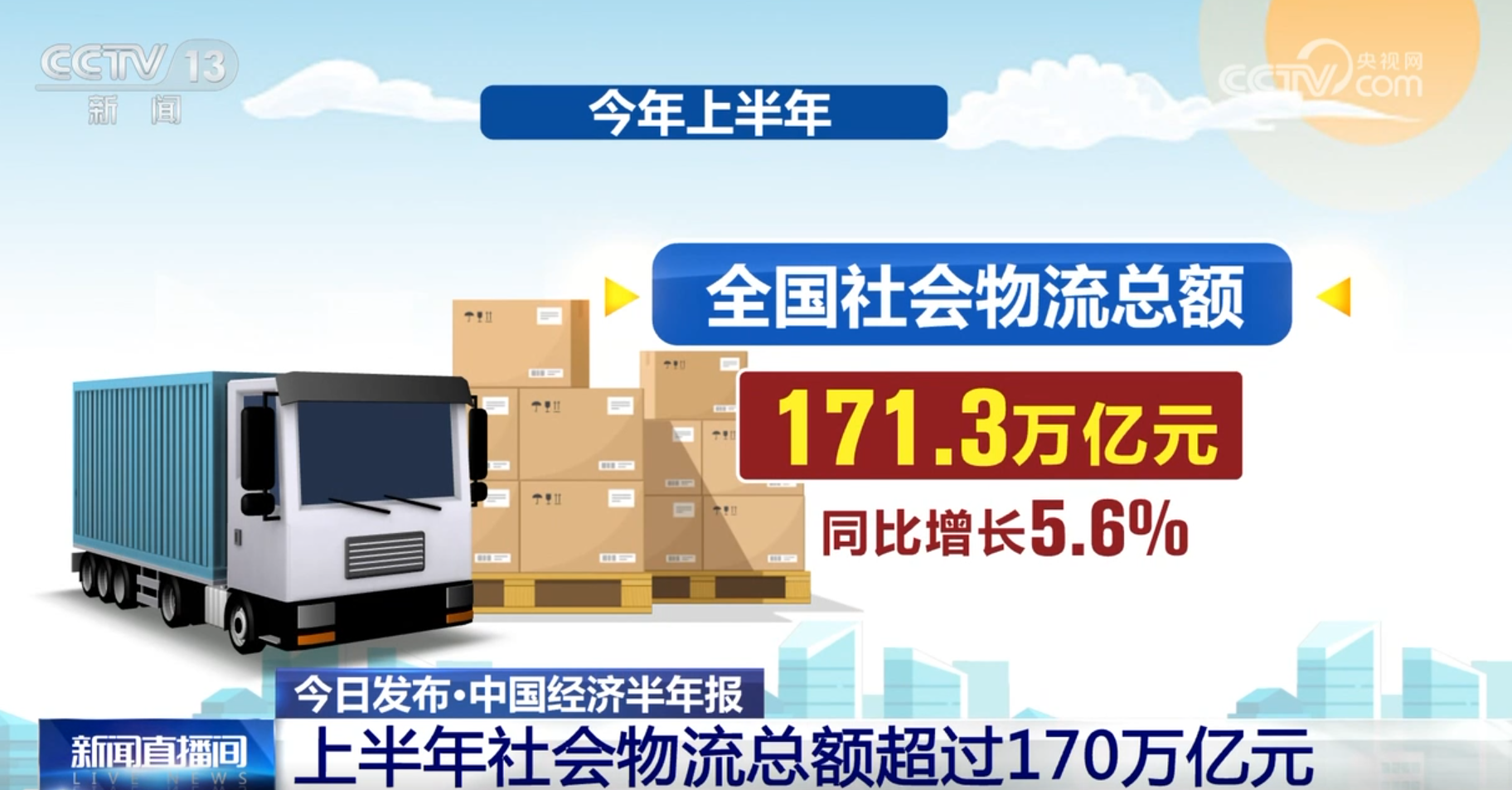
Core Viewpoint - The logistics industry in China is showing stable growth and improved quality and efficiency, with a total social logistics volume of 171.3 trillion yuan in the first half of the year, reflecting a year-on-year growth of 5.6% [1][3]. Logistics Industry Performance - The total social logistics volume reached 171.3 trillion yuan, with a growth rate of 5.6%, which is 0.3 percentage points higher than the GDP growth rate during the same period, indicating strong support from logistics demand for economic development [1]. - The logistics of industrial products grew by 5.8%, contributing 85% to the total social logistics growth, providing solid support for the stability of the industrial economy and the smooth operation of supply chains [5]. Emerging Industries and Digital Economy - The integration of the digital economy with the real economy has led to strong growth in logistics demand from emerging industries, with logistics demand in the equipment manufacturing sector increasing by 10.9% and high-tech manufacturing by 9.7% [5]. - The logistics volume related to 3D printing equipment and industrial robots saw a year-on-year increase of over 20% [5]. Foreign Trade and Import Logistics - With high-level opening up and diversification of foreign trade, the decline in import logistics volume has narrowed in the second quarter, with a recovery in the logistics volume of major commodities like crude oil and iron ore [7]. - The import of integrated circuits increased by 8.9%, with a growth rate improvement of 0.5 percentage points compared to the first five months of the year [7]. Consumer Logistics - Driven by various policies to expand domestic demand and promote consumption, the consumer market has become more active, with logistics volume for goods transported to units and residents growing by 6.1% in the first half of the year [9]. - Notable growth in logistics demand is observed in consumer goods related to trade-in programs, electronics, and travel, indicating a significant increase in consumer demand [11]. Recycling and Related Sectors - The logistics volume for renewable resources grew by 17%, with an acceleration of 1.2 percentage points compared to the first quarter [13]. - There is a dynamic trend forming in sectors such as automobiles and home appliances, with logistics volume for products like cars, tablets, smartphones, and washing machines all achieving growth rates exceeding 10% [13].

【新华解读】6月份我国规上工业企业利润边际改善 后期向好态势有望延续
Xin Hua Cai Jing· 2025-07-27 12:52
Core Viewpoint - In June, China's industrial enterprises showed signs of profit recovery, particularly in new momentum industries like equipment manufacturing, signaling a positive trend in the real economy [1][2]. Group 1: Profit and Revenue Trends - In June, the total profit of large-scale industrial enterprises in China reached 715.58 billion yuan, a year-on-year decrease of 4.3%, but the decline narrowed significantly by 4.8 percentage points compared to May [1]. - The revenue of large-scale industrial enterprises grew by 1.0% year-on-year in June, maintaining the same growth rate as in May [1]. - For the first half of the year, revenue increased by 2.5% year-on-year, while profits decreased by 1.8%, indicating a widening decline compared to the first five months but a narrowing decline compared to the end of 2024 [1]. Group 2: Factors Influencing Profitability - The overall decline in profits for large-scale industrial enterprises has been attributed to external environmental shocks, ongoing elimination of outdated capacity, low Producer Price Index (PPI), and insufficient domestic demand [2]. - The average accounts receivable collection period for large-scale industrial enterprises was 69.8 days at the end of June, a decrease of 0.7 days from the end of May, indicating improved cash flow [2]. Group 3: Policy Impact and Sector Performance - The implementation of the "Regulations on Payment of Funds to Small and Medium-sized Enterprises" since June 1 has improved overall collection efficiency for industrial enterprises, particularly benefiting private enterprises [3]. - In June, the profit growth rate for large-scale manufacturing enterprises shifted from a decline of 4.1% in May to an increase of 1.4%, driven by policies supporting equipment manufacturing and high-tech industries [3]. - Profits in the equipment manufacturing sector increased by 9.6% year-on-year in June, contributing significantly to the overall profit growth of large-scale industrial enterprises [3]. Group 4: Industry Trends and Future Outlook - The manufacturing sector is advancing towards high-end, intelligent, and green production, with significant profit increases in high-end equipment manufacturing and green manufacturing sectors [4]. - The profit growth rates for specific industries, such as electronic materials and lithium-ion battery manufacturing, reached 68.1% and 72.8% respectively in June [4]. - Looking ahead, the recovery of industrial enterprise profits is expected to continue, supported by domestic demand expansion and regulatory policies aimed at stabilizing market competition [5].
31省份6月CPI出炉,14省上涨
Huan Qiu Wang· 2025-07-24 03:31
Group 1 - The core viewpoint is that the national Consumer Price Index (CPI) in June 2025 has shown a new trend, with a year-on-year increase of 0.1%, ending a four-month decline, while the core CPI rose by 0.7%, reaching a 14-month high [1] - In June, 14 provinces experienced a year-on-year increase in CPI, while 10 provinces saw a decline, indicating a shift in regional price trends [1] - The analysis by Wang Qing from Dongfang Jincheng highlights three main driving forces for the CPI's positive change: seasonal rise in vegetable prices, an increase in domestic energy prices due to international oil price fluctuations, and the support from the "old-for-new" policy [2] Group 2 - Future CPI trends are expected to show a low and moderate recovery, supported by stable economic performance and effective domestic demand policies [4] - Factors contributing to price stability include ongoing economic expansion, effective policies to boost consumption, and regulatory actions to curb disorderly price competition in various industries [5] - The holiday effect is anticipated to further stabilize or increase service-related prices, with several upcoming holidays expected to have a noticeable impact [5]