
AI科技

Search documents
产品力100 | 2025年十大作品全国20强揭晓
克而瑞地产研究· 2025-12-03 11:15
Core Viewpoint - The real estate industry is transitioning towards high-quality development, with improvements in housing prices, land auction enthusiasm, and project sales, supported by policies promoting the construction of "good houses" for sustainable growth [4][15]. Group 1: Industry Trends - The real estate sector is experiencing a shift towards high-quality development, with a focus on delivering desirable housing to meet public demand [4]. - The implementation of the "Residential Project Standards" and the emphasis on high-quality development by the Fourth Plenary Session of the Central Committee set a positive tone for the industry's future [4]. - The market is moving from merely providing housing to enhancing the quality of living, indicating a competitive focus on product quality and customer satisfaction [15]. Group 2: Product Evaluation - The 2025 China Real Estate Product Evaluation has identified 60 shortlisted projects based on comprehensive data screening, product research, and evaluation models [5][14]. - The evaluation categories include "high-end," "light luxury," and "quality," with an additional focus on "China Good House" awards [13]. - The evaluation criteria encompass six dimensions: unit design, living space, interior decoration, homecoming paths, community space, and project awards [14]. Group 3: Notable Projects - A list of notable projects includes "Green City · Ningbo Fengqi Yunlu," "18815 Ruixi," and "Xiamen Poly Ankong Yucheng," among others, showcasing a variety of residential developments across different cities [7][9][10]. - The projects are set to have their first openings between November 15, 2024, and December 31, 2025, and are ranked alphabetically [7][10]. Group 4: Future Initiatives - The evaluation process will continue throughout 2025, with expert reviews and public voting scheduled to determine the final rankings of the top projects [14][16]. - The initiative aims to create a platform for showcasing and exchanging ideas on product quality, emphasizing the importance of meeting diverse housing needs and enhancing living standards [15].


布局AI科技正当时
2025-12-17 02:27
Summary of Conference Call Records Industry Overview - **Market Outlook**: Investors are generally optimistic about the market in 2026, expecting the index to reach 4,300-4,500 points in Q1 2026, providing a solid foundation for positioning in December after digesting negative factors [1][3][4] - **Computing Power Sector**: The overseas computing power sector experienced fluctuations from September to November, but stocks like NVIDIA have stabilized, indicating positive market sentiment for future prospects [1][4] Key Points and Arguments - **Catalysts for Q1 2026**: Multiple significant events are expected to drive the tech market, including Q4 earnings forecasts, CES, NVIDIA GTC conference, and OFC optical communication exhibition [1][4] - **Focus Stocks**: - **Zhongji Xuchuang**: Projected market value could reach 1 trillion to 1.2 trillion by mid-2026, reflecting high growth and explosive performance [1][5] - **New Yisheng**: High cost-performance ratio with conservative revenue estimates of 20 billion next year [1][5] - **Industrial Fulian and Shenghong Technology**: Companies related to 1.6T optical modules are also highlighted [1][5] Domestic and International Tech Companies - **Domestic Focus**: Companies like SMIC and Huahong Semiconductor in chip, liquid cooling, power supply, and switch sectors are expected to see performance inflection points in 2026 [1][7] - **International Recommendations**: Companies such as Sega Light, Yuanjie Technology, and others are recommended for investment [1][7] AI Chip Competition - **Market Shift**: The AI chip market is transitioning from pure computing power competition to system-level competition, with NVIDIA's NVLink leading in interconnect protocols [1][10] - **Google TPU Growth**: Driven by Gemini and nano banana models, leading to increased value in the PCB, copper, and optical module supply chains [1][10] Storage Market Insights - **DRAM Market**: Prices are expected to rise quarterly in 2026, with DDR5 projected to increase by 18%-23% and NAND prices expected to rise by 58%-63% throughout the year [2][14][15][16] - **AI Storage Software**: Companies like MongoDB are benefiting from the demand for external memory systems for large models, with a 22% stock price increase following their latest earnings report [2][21] Investment Opportunities in Vertical Fields - **AI Marketing and Healthcare**: Companies like Hand Information and JD Health are highlighted for their strong data capabilities [12][13] - **General Field**: Companies like Kingdee and Sun Xinfeng are also recommended for investment [12][13] Conclusion - The current market conditions and upcoming technological advancements present significant investment opportunities, particularly in the computing power and storage sectors, as well as in specific domestic and international tech companies. The focus on AI and system-level competition in the chip market indicates a shift that could reshape industry dynamics in the coming years [1][10][21]




港股投资价值深度解析:价值趋合理 稀缺资产成关注焦点
Zhong Guo Zheng Quan Bao· 2025-12-02 20:22
Market Overview - As of November 28, 2025, the Hong Kong Stock Exchange has 2,664 listed companies with a total market capitalization of approximately HKD 48 trillion [1] - The Hang Seng Index and the Hang Seng Tech Index have increased by 29% and 25% respectively this year, indicating significant market rotation [2][3] - The overall valuation of Hong Kong stocks is currently within a reasonable range, with a focus on scarce assets such as internet leaders and innovative pharmaceuticals [1][8] Market Structure - The market is characterized by a high concentration of value in large-cap companies, with 65% of companies having a market cap of HKD 0-20 billion, but only accounting for 1.80% of the total market capitalization [2] - Institutional investors dominate trading, contributing 85% of the transaction volume, with international investors making up 60% of the market [1][2] Valuation Insights - The AH premium index is currently at 121, which is historically low, indicating that Hong Kong stocks are not significantly overvalued nor is there substantial room for valuation recovery [3] - The valuation of the Hang Seng Index is at a historically high level compared to the CSI 300, while the Hang Seng Tech Index remains relatively low in absolute valuation terms [3] Asset Highlights - Key scarce assets in the Hong Kong market include internet leaders, innovative pharmaceuticals, new consumption, and dividend stocks, while high-end manufacturing is relatively weak [4][7] - Internet leaders like Tencent and Alibaba are seen as core highlights, with significant capital expenditures and a strong user ecosystem [4][5] - The innovative pharmaceutical sector is viewed as a "first-tier market" with a higher "innovation content" compared to A-shares, benefiting from favorable listing rules for biotech companies [5][6] Investment Dynamics - The investor structure is increasingly international, with a notable inflow of southbound funds, which have reached a cumulative net inflow of HKD 13,820 billion this year, a 90% increase year-on-year [7][8] - Despite the presence of quality assets, the market has passed the high-return investment phase, and the uncertainty of incremental capital inflows suggests a mixed outlook for future market performance [8]



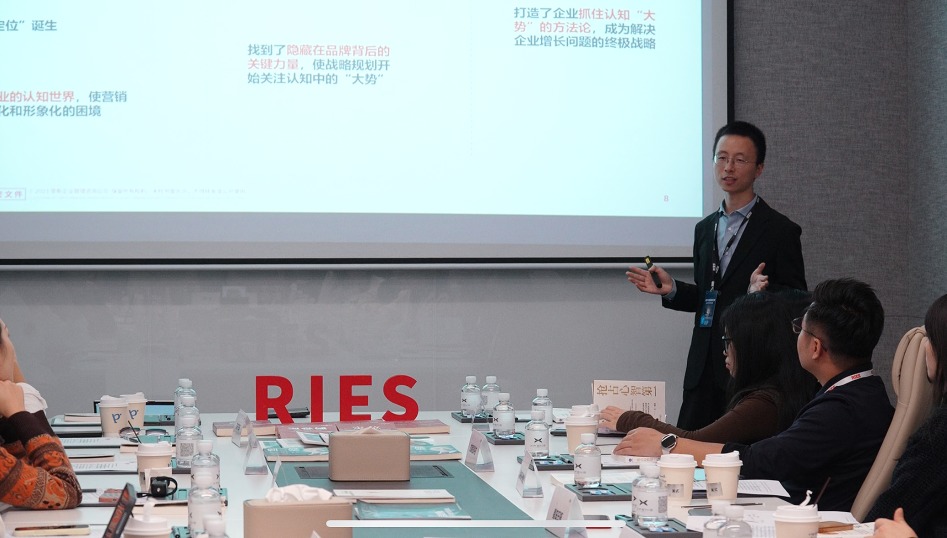
里斯咨询中国区副总裁罗贤亮:以“品类创新”赋能AI科技企业破局
Zhong Guo Jing Ying Bao· 2025-12-02 12:20
Core Insights - The current AI investment boom masks a critical fact: technology alone cannot build sustainable business barriers [1] - The emergence of AI super technologies has fundamentally disrupted traditional brand-building methods, shifting the focus to defining new categories and creating super tech brands [3] Industry Overview - The global AI application market is projected to exceed $500 billion by 2025, with China's AI application market experiencing explosive growth, particularly in mobile user adoption, which has surged by 101% [4] - As of April 2025, the number of AI-related companies in China has surpassed 4,500, indicating intense competition and emerging risks of technology homogenization [4] - IDC forecasts that global IT spending growth will decline from 10% to 5% by 2025 due to factors like tariff policies, highlighting the increasing competition in financing, technology, and product development [4] Company Strategy - In 2024, the company assisted XPeng in a strategic pivot, redefining it as a "global AI smart driving technology company" rather than a traditional car manufacturer [4] - The concept of the "world's first AI car" was defined, exemplified by the new P7+ model, which features "end-to-end AI smart driving" as a standard offering without additional costs [5] - Recent product launches include the second-generation VLA, XPeng Robotaxi, a new generation of Iron humanoid robots, and two flying car systems, reinforcing XPeng's position as a "super AI tech brand" [5][6] Brand Positioning - The branding strategy emphasizes differentiation, moving beyond mere product specifications to anchor on the core label of "AI technology," thus avoiding the pitfalls of direct competition with peers like NIO and Li Auto [8] - The success of Tesla illustrates the importance of brand narrative that transcends product identity, linking technological aspirations and founder innovation to create a robust brand ecosystem [7][8] - XPeng's strong technical foundation, rooted in the founder's engineering background, provides a competitive edge in research and development, supporting its innovative positioning in the market [8]

11月收官,12月A股能否迎来开门红?
Sou Hu Cai Jing· 2025-11-30 10:22
Group 1 - The market experienced a painful decline of 10% in the first three weeks of November, followed by a rebound of 3% in the last week, indicating a potential recovery phase [1] - A-shares saw a trading volume of 1.5977 trillion, which is half of the previously mentioned highest trading volume and the lowest since August 4 [1] - Market sentiment reached a low point on Friday, yet the market closed in the green, suggesting a weakening of short-selling pressure [1] Group 2 - There is a noticeable accumulation in AI technology stocks, particularly those starting with 688, as the market shifts its focus from AI bubble concerns to early-stage internet bubble discussions [1] - The anticipation of a rate cut by the Federal Reserve in December is contributing to a return of market confidence [1] - The upcoming events in December, particularly the market's expectations surrounding the ZC event, are raising optimism for potential market performance [1] Group 3 - Silver is facing a significant issue with global inventories at a ten-year low, combined with increased demand from AI and new energy sectors, leading to a forced buying situation in the futures market [3] - The upcoming Federal Reserve meeting on December 11 is expected to heighten market activity, particularly in A-share related sectors [3] - Recent negative news regarding brokerage firms, including issues with a brokerage starting with "T" and a reduction in holdings by "Oriental," may exert pressure on the brokerage sector [3][4] Group 4 - The success of the upcoming market rally in December hinges on the participation of brokerages, increased trading volume, and the strength of the technology sector [5] - The market is currently showing strong performance through a consolidation phase, with a potential breakout expected next week [8]
广发基金投顾团队:全球科技股迎来多空之争,未来是走是留?
Sou Hu Cai Jing· 2025-11-28 10:07
Group 1 - The core viewpoint of the article highlights the fluctuating performance of global tech stock indices, particularly those related to AI technology, which have shown similar patterns across A-shares, Hong Kong stocks, and U.S. stocks since October [1] - The recent volatility in tech stocks is attributed to two main factors: changes in interest rate expectations from the Federal Reserve and ongoing debates about the potential bubble in AI giants [1][2] - The financial aspect indicates a strong correlation between tech stock performance and shifts in interest rate expectations, with an 84.3% probability of a 25 basis point rate cut by the Federal Reserve in December, up from 69.4% the previous week [1] Group 2 - From a fundamental perspective, the valuations of U.S. AI tech giants are considered relatively high after a prolonged increase, raising concerns about potential bubble tendencies [2] - Comparisons are made between the current market and the 2000 internet bubble, noting that current AI leaders have more substantial revenue growth and a stronger economic impact, with tech contributing approximately 59% to the overall growth in the U.S. economy by mid-2025 [2] - Investment sentiment has not yet reached the peak levels seen during the internet bubble, with the dynamic P/E ratio of the "Magnificent Seven" around 30 times, significantly lower than the peak of over 60 times during the internet bubble [2] Group 3 - The analysis concludes that it may be premature to declare a bubble in U.S. AI tech stocks, although the market might be entering a "halftime" phase, suggesting potential shifts in leadership among companies [3] - While U.S. tech giants drive the industry wave, other markets may not diverge significantly in trends, but they are influenced by various macroeconomic, financial, and structural factors [3] - For investors concerned about tech stock volatility, diversification of asset allocation is recommended to mitigate portfolio fluctuations and enhance the investment experience [3]
港股速报|港股11月平稳收官 恒指今日微跌结束“四连涨”
Mei Ri Jing Ji Xin Wen· 2025-11-28 09:46
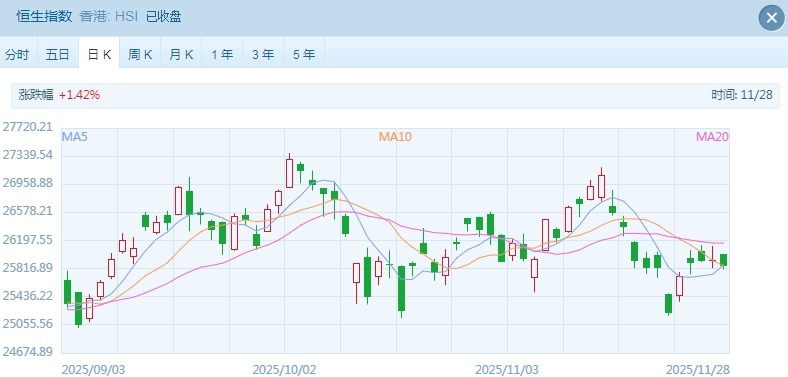
Market Overview - The Hang Seng Index ended a four-day rally with a slight decline, closing down 0.34% at 25,858.89 points, while the Hang Seng Index for November recorded a cumulative drop of 0.18% [1] - The Hang Seng Tech Index saw a more significant decline of 5.23% for the month, although it rose slightly by 0.02% on the last trading day, closing at 5,599.11 points [1][3] - Market turnover continued to shrink, with a total trading volume of only 1,462 million HKD [1] Notable Stock Movements - GAC Group (HK02238), Yuejiang (HK02432), and Dongfang Electric (HK01072) were among the top gainers, with increases of 16.62%, 9.75%, and 6.89% respectively [4] - GAC Group's recent launch of the "National Good Car" Aion UT Super has led to a satisfactory order volume since its listing on November 9 [4] - Conversely, stocks such as Zhou Sifu (HK06168), Lion Holding (HK02562), and Canggang Railway (HK02169) experienced notable declines, with drops of 5.01%, 4.42%, and 4% respectively [6] Sector Performance - Solid-state batteries and semiconductor sectors led the market, with Tianqi Lithium (HK09696) and Ganfeng Lithium (HK01772) rising by 3.57% and 2.13% respectively [6] - Newly listed Haiwei Co. (HK09609) saw a significant drop of 22.97%, closing at 11 HKD, below its initial offering price of 14.28 HKD [6] Capital Flow - The net inflow of funds through the Hong Kong Stock Connect increased to 2.727 billion HKD, up from 1.3 billion HKD the previous day [7] Future Outlook - According to Guotai Junan International, uncertainty in the macro environment and regulations has led some funds to withdraw from previously rebounding tech stocks, shifting towards relatively undervalued sectors with clearer policy support, such as consumption and high-end manufacturing [9] - Zheshang Securities highlighted that future policies will focus on technological innovation and expanding domestic demand, with a continued net inflow of southbound funds amid rising expectations for US interest rate cuts [9] - The firm is optimistic about sectors benefiting from policy support, including new energy, innovative pharmaceuticals, and AI technology, as well as undervalued state-owned enterprises and local Hong Kong banks, telecommunications, and utility stocks [9]

港股速报 | 港股11月平稳收官 恒指今日微跌结束“四连涨”
Mei Ri Jing Ji Xin Wen· 2025-11-28 09:21
Market Overview - The Hang Seng Index ended a four-day rally with a slight decline, closing down 0.34% at 25,858.89 points, while the Hang Seng Index for November recorded a cumulative drop of 0.18% [1] - The Hang Seng Technology Index saw a more significant decline of 5.23% for the month, although it rose slightly by 0.02% on the last trading day, closing at 5,599.11 points [1][3] - Market turnover continued to shrink, with a total trading volume of only 1,462 million HKD [1] Notable Stocks - GAC Group (HK02238), YUEJIANG (HK02432), and Dongfang Electric (HK01072) were among the top gainers, with increases of 16.62%, 9.75%, and 6.89% respectively [5] - GAC Group's A-shares hit the daily limit up after the successful delivery ceremony of the "National Good Car" - Aion UT super, which has seen satisfactory order volumes since its launch on November 9 [5] - On the downside, companies like Chow Tai Fook (HK06168), Lion Group (HK02562), and Canggang Railway (HK02169) experienced declines of 5.01%, 4.42%, and 4% respectively [7] Sector Performance - Solid-state batteries and semiconductor sectors led the market, with Tianqi Lithium (HK09696) and Ganfeng Lithium (HK01772) rising by 3.57% and 2.13% respectively [7] - Newly listed Haiwei Co. (HK09609) saw a significant drop of 22.97%, closing at 11 HKD, below its offering price of 14.28 HKD [7] Capital Flow - The net inflow of funds through the Hong Kong Stock Connect increased to 2.727 billion HKD, up from 1.3 billion HKD the previous day [8] Future Outlook - According to Guotai Junan International, some funds are shifting from previously rebounding tech stocks to relatively undervalued sectors with clearer policy support, such as consumer goods and high-end manufacturing [10] - Zheshang Securities highlighted that future policies will focus on technological innovation and expanding domestic demand, with a continued net inflow of southbound funds amid rising expectations for US interest rate cuts [10] - The firm is optimistic about sectors benefiting from policy support, including new energy, innovative pharmaceuticals, and AI technology, as well as undervalued state-owned enterprises and local Hong Kong banks, telecommunications, and utility stocks [10]
港股收评:三大指数涨跌互现!消费电子、黄金股走高,内房股低迷
Ge Long Hui· 2025-11-27 08:49
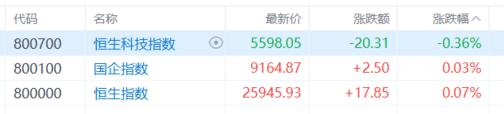
Market Overview - The Hong Kong stock market showed mixed results on November 27, with the Hang Seng Technology Index down by 0.36%, while the Hang Seng Index and the National Enterprises Index saw slight increases of 0.07% and 0.03% respectively [1][2]. Technology Sector - Major technology stocks exhibited divergent trends, with Xiaomi rising over 2% and JD.com increasing by over 1%, while Alibaba fell nearly 3% and Tencent and Baidu dropped more than 1% [2][3]. Consumer Goods - The consumer goods sector saw a boost, particularly in toys and leisure products, with companies like Blucor rising over 7%. The Ministry of Industry and Information Technology and other departments introduced new policies to promote consumption, which positively impacted this sector [5][6]. Electronics - The consumer electronics segment strengthened, with TCL Electronics increasing by over 6%. Other companies such as XinJia International and Skyworth also saw gains [6][7]. Gold Stocks - Gold stocks were active, with companies like Zhenfeng Gold rising over 5%. Analysts predict significant increases in gold prices, with estimates suggesting a rise to $5,000 per ounce next year, representing an approximate 20% increase from current levels [8][9]. New Energy Vehicles - Stocks in the new energy vehicle sector performed well, with companies like Leap Motor and Chery Automobile rising over 4%. The Ministry of Commerce announced plans to expand automotive consumption, which is expected to benefit this sector [10][11]. Apple-related Stocks - Apple-related stocks saw an uptick, with companies like GoerTek rising over 4%. The demand for new iPhone models is driving growth, with expectations of Apple regaining its position as the world's largest smartphone manufacturer [12][13]. Pharmaceutical Outsourcing - Pharmaceutical outsourcing stocks faced declines, with WuXi AppTec dropping over 3%. Other companies in this sector also experienced downturns [14]. Real Estate Sector - The real estate sector remained sluggish, with Vanke Enterprises falling over 7%. National statistics indicated a significant decline in real estate investment and new housing sales [15]. Individual Stock Highlights - Lai Kai Pharmaceutical saw a substantial increase of over 16% following the announcement of a significant licensing deal for a breast cancer drug, which could yield substantial revenue [16][18]. Market Outlook - Analysts suggest that the Hong Kong stock market may benefit from the anticipated soft landing of the U.S. economy and the potential for interest rate cuts, particularly favoring growth stocks and AI technology sectors [20].
中信期货2026年度策略会成功召开
Qi Huo Ri Bao· 2025-11-26 09:14
Group 1: Conference Overview - The 2026 Strategy Conference by CITIC Futures was successfully held on November 26, 2025, in Shanghai, focusing on the theme "Sailing Forward" [1] - The conference featured one main forum and eight sub-forums, discussing macroeconomic trends, equity, bonds, commodities, exchange rates, and overseas markets [1] - The event gathered investors from various sectors, promoting an exchange of ideas and insights [1] Group 2: Economic Outlook - The Vice President of the China Macroeconomic Society, Zhu Baoliang, projected a 5% economic growth for China in 2025, supported by growth policies and export activities [2] - Challenges such as insufficient domestic demand, a sluggish real estate market, and increasing local government debt were highlighted, indicating potential overcapacity in the economy [2] - Recommendations for 2026 include maintaining a stable economic growth target of around 5%, implementing proactive fiscal policies, and enhancing market confidence [2] Group 3: Global Economic Insights - CITIC Securities' Chief Macro Analyst, Cui Rong, noted that 2025's tariff disruptions would lead to a clearer global economic environment in 2026, with reduced uncertainties in geopolitics and monetary policies [3] - The forecast includes a cautious outlook on global financial market liquidity and lower returns on risk assets compared to 2025, despite a continued boom in AI technology [3] - Concerns regarding the fragility of AI financing cycles and potential economic risks related to the U.S. midterm elections were also mentioned [3] Group 4: Market and Asset Allocation - CITIC Futures' Deputy Director, Zeng Ning, expressed an optimistic macro outlook for 2026, driven by a sustained easing of global liquidity and fiscal expansions in the U.S. and Europe [4] - The asset allocation strategy suggests a balanced approach, with an emphasis on precious metals and commodities, while adjusting positions based on supply and demand dynamics [4] - Expectations for oil prices indicate a potential downward pressure on price levels, suggesting a cautious approach to oil investments [4]