
债券义警

Search documents
甲骨文(ORCL.US)财报成最新狙击点?美银:AI巨头举债太猛,“债券义警”伏击中
Zhi Tong Cai Jing· 2025-12-08 02:12
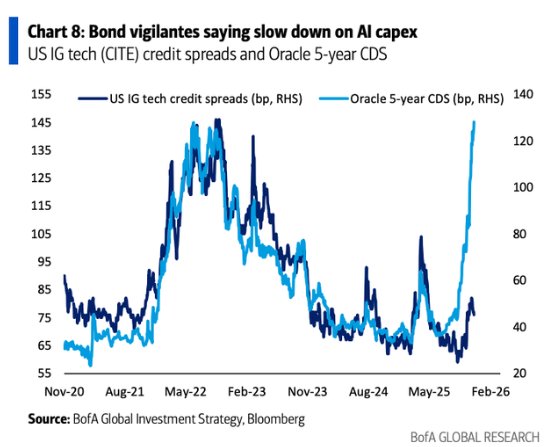
随着甲骨文(ORCL.US)本周三美股盘后将公布财报,且其资本支出计划备受关注,美国银行表示,在支 出方面,如今有了新的警长。美银策略师Michael Hartnett 在一份报告中表示,"债券义警"如今已成 为"人工智能资本支出的新监管者",他们正在释放"放缓增长"的信号。 Hartnett 表示,投资者应关注那些积极采用人工智能技术的企业,而非那些只是花钱购买相关技术的企 业,因为信贷息差的扩大正在抑制企业的资本支出。 他补充道,像甲骨文、亚马逊(AMZN.US)、微软(MSFT.US)、Alphabet(GOOGL.US)以及 Meta(META.US)这样的超大型企业,其资本支出将从 2024 年的 50%现金支出(2400 亿美元)跃升至 2026 年的 80%(5400 亿美元)。 市场此前担心甲骨文或将增发高达1000亿美元的债务为其AI雄心提供资金,利用衍生品保护甲骨文 (ORCL.US)债务免于违约的成本已升至2008年全球金融危机以来的最高水平。摩根士丹利已考虑使用重 大风险转移(一种针对贷款损失的保险形式)来分散其与科技公司借款人相关的部分风险。 最新债务发行的巨大规模加剧了对冲保护紧迫 ...


美国债市现“三十年罕见之分歧”:美联储降息前夜 美长债收益率却“不跌反涨”
Hua Er Jie Jian Wen· 2025-12-08 01:48
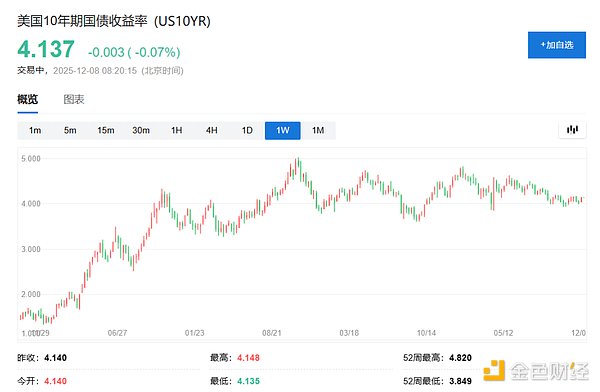
Core Viewpoint - The unexpected rise in long-term U.S. Treasury yields despite the Federal Reserve's interest rate cuts challenges traditional market logic and indicates a significant divergence in expectations between investors and the Fed [1][2]. Group 1: Interest Rate Cuts and Market Reactions - Since the Fed began its current rate-cutting cycle in September 2024, the benchmark interest rate has been reduced by 1.5 percentage points to a range of 3.75%-4% [1]. - Contrary to expectations, the 10-year U.S. Treasury yield has increased by nearly 0.5 percentage points to 4.1%, while the 30-year yield has risen by over 0.8 percentage points [1]. - Market participants anticipate another 25 basis point cut in the upcoming Fed meeting and expect two more similar cuts next year, targeting a policy rate around 3% [2]. Group 2: Historical Context and Comparisons - In the last 40 years, during non-recessionary rate-cutting cycles (1995 and 1998), the Fed only cut rates by 75 basis points, and the 10-year Treasury yields either fell or increased at a much lower rate than currently observed [5]. - The current situation is viewed as a potential return to pre-2008 financial crisis norms, moving away from the historically low rates established during the pandemic [8]. Group 3: Economic Outlook and Inflation Concerns - Analysts suggest that the rise in yields may reflect a market adjustment to the Fed's previous aggressive rate hikes aimed at curbing inflation, which has led to a ceiling on the decline of yields [8]. - Concerns about persistent inflation above the 2% target and the resilience of the economy have led to increased term premiums, indicating investor anxiety about the Fed's pace of rate cuts [9]. - Political pressures, particularly from President Trump, may further complicate the Fed's decision-making, with fears that aggressive rate cuts could lead to soaring mortgage rates [9]. Group 4: Structural Changes in the Bond Market - The current bond market dynamics are compared to the "Greenspan conundrum," where excessive government borrowing has shifted from a surplus of savings to an oversupply of bonds, exerting upward pressure on yields [10]. - The conclusion drawn is that the determination of long-term rates may be increasingly influenced by structural changes in the global economy rather than central bank policies [10].
美国债市现“三十年罕见之分歧”:美联储降息前夜,美长债收益率却“不跌反涨”
Hua Er Jie Jian Wen· 2025-12-08 00:45
Core Viewpoint - The recent unexpected rise in long-term U.S. Treasury yields, despite the Federal Reserve's rate cuts, indicates a significant divergence in market expectations regarding future interest rates and economic conditions [1][2]. Group 1: Interest Rate Cuts and Market Reactions - Since the Federal Reserve began its current rate-cutting cycle in September 2024, the benchmark interest rate has been reduced by 1.5 percentage points to a range of 3.75%-4% [1]. - Typically, a reduction in short-term rates by the Federal Reserve leads to a decline in long-term Treasury yields; however, the 10-year Treasury yield has increased by nearly 0.5 percentage points to 4.1%, and the 30-year yield has risen by over 0.8 percentage points [1][2]. - Market participants expect the Federal Reserve to cut rates by another 25 basis points in the upcoming meeting and anticipate two more similar cuts next year, targeting a policy rate around 3% [2]. Group 2: Diverging Economic Perspectives - Optimists view the yield increase as a sign of confidence that the economy will avoid recession, while neutral observers see it as a return to pre-2008 financial crisis norms [1][6]. - Pessimists express concern that the rise in yields reflects a return of "bond vigilantes," who are wary of rising national debt and potential inflation risks [1][7]. Group 3: Structural Changes in the Bond Market - Analysts suggest that the current situation may indicate a structural change in the bond market, with long-term rates no longer solely influenced by central bank policies [10]. - The concept of "term premium," which compensates investors for holding long-term bonds against inflation and default risks, has increased by nearly one percentage point since the start of the current rate-cutting cycle [7]. - The current environment is compared to the "Greenspan conundrum," where excessive government borrowing has shifted from a surplus of savings to an oversupply of bonds, exerting upward pressure on yields [9][10].
美国长债收益率“异常”上涨 “债券义警”拉响警报
2 1 Shi Ji Jing Ji Bao Dao· 2025-09-22 23:18
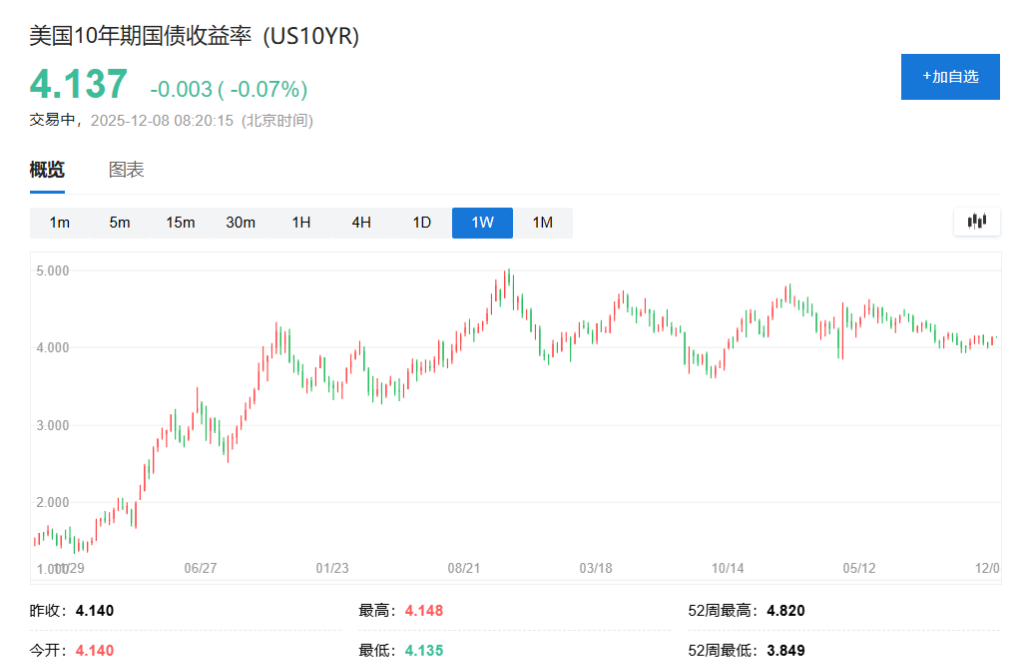
Group 1 - The 10-year U.S. Treasury yield rose to above 4.14% after the Federal Reserve's interest rate cut, despite expectations of a decline [1][2] - The stock market reached record highs with the S&P 500, Nasdaq 100, Dow Jones Industrial Average, and Russell 2000 indices all setting new records [1] - The rise in long-term bond yields is attributed to market behavior of "buying the expectation and selling the fact" following the Fed's rate cut [1][2] Group 2 - Concerns about persistent inflation are significant, as recent data indicates that inflation remains sticky, complicating the Fed's ability to lower rates further [2][5] - High long-term yields increase government interest payments, potentially exacerbating the fiscal deficit and creating a vicious cycle [3][6] - The current economic environment poses a challenge for sustaining long-term financing costs above 4% [3] Group 3 - Future downward potential for long-term yields may be limited, with the Fed's dot plot indicating a median forecast for the federal funds rate at 3.6% by the end of 2025 [4][5] - The Fed's cautious approach to rate cuts suggests that long-term Treasury yields may not quickly fall below 3% [5][6] - The market is adapting to a "higher for longer" interest rate environment, necessitating a reassessment of asset allocations [7]
美国国债意外成为赢家 “债券义警”暂时销声匿迹-美股-金融界
Jin Rong Jie· 2025-09-05 00:34
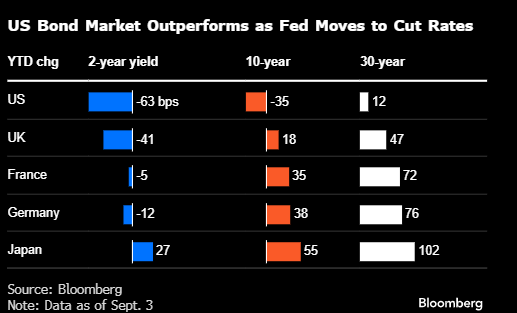
Group 1 - The U.S. Treasury market has shown remarkable resilience despite various pressures, including rising debt and aggressive tariff policies, unlike other countries' bond markets which have suffered due to fiscal concerns [1] - Year-to-date, the yield on 10-year U.S. Treasuries has decreased by over 0.3 percentage points, making it the only major bond market with a decline in 10-year yields [1][3] - The volatility of the U.S. bond market has been decreasing since April, with key volatility indicators nearing their lowest levels in three years [1] Group 2 - Recent data indicates a slowdown in job growth, which has contributed to a decline in 10-year Treasury yields, falling below 4.17% for the first time since early May [3] - Concerns regarding the independence of the Federal Reserve are reflected in rising inflation swap rates, which have reached a two-year high [5] - Despite concerns about the Fed's independence, U.S. bond investors have not shown significant alarm, allowing the Trump administration to breathe easier regarding the 10-year yield target [5] Group 3 - The U.S. Treasury Secretary hinted at limiting long-term bond issuance if buyer demand weakens, while data does not support claims of foreign capital fleeing U.S. assets, indicating strong demand for U.S. Treasuries [7] - The perception of the U.S. as a safe haven persists, with 5% being seen as a ceiling for 30-year Treasury yields, despite various challenges [8] - Market participants remain skeptical about the potential political influence on the Fed, with expectations that any new appointments will not drastically alter monetary policy [9] Group 4 - There is speculation that the White House may push the Fed to resume bond purchases, particularly long-term bonds, as a means to lower borrowing costs [10] - The current balance in the U.S. bond market is fragile, and without fiscal discipline from politicians, investors may express dissatisfaction through market actions [10] - The emergence of "bond vigilantes" in Europe and Japan could soon be mirrored in the U.S. if fiscal issues are not addressed [10]
夏季平静期宣告结束!关税与美联储忧虑重燃,华尔街迎波动9月
Jin Shi Shu Ju· 2025-09-03 07:33
Market Overview - The summer calm on Wall Street ended after Labor Day, with investors preparing for increased volatility as September is historically the worst month for U.S. stock markets [1] - Concerns over the independence of the Federal Reserve and uncertainties surrounding President Trump's tariffs have become focal points, impacting both stock and bond markets [1][2] - Long-standing worries about the bubble-like valuations of stocks and corporate bonds have intensified amid signs of an economic slowdown in the U.S. this summer [1] Bond Market Dynamics - The CBOE Volatility Index reached its highest level in over four weeks, while the S&P 500 index fell by 0.7% [2] - A global sell-off in bonds led to a significant rise in long-term U.S. Treasury yields, with the 10-year Treasury yield increasing nearly 5 basis points to 4.269% and the 30-year yield reaching its highest level since mid-July [2] - Rising Treasury yields may negatively affect the stock market as bond returns become more attractive, with a 10-year yield around 4.5% seen as a threshold for weakening stock demand [2] Economic and Seasonal Factors - September's seasonal weakness may be partly due to investors cleaning up their portfolios after summer vacations and making adjustments before year-end [4] - Historically, September has been the worst month for the S&P 500, averaging a decline of 0.8% over the past 35 years, with 18 out of those 35 months experiencing declines [4] - The recent surge in credit market debt issuance has exacerbated government debt sell-offs as investors reallocate funds to corporate bonds [4] Corporate Bond Market Insights - The corporate bond spread, which is the premium high-rated companies pay over U.S. Treasury yields, reached a historical low of 75 basis points last month [5] - Given the low volatility and tight spread levels, an increase in market volatility seems more likely [5] - The upcoming non-farm payroll data for August is crucial for investors assessing the Federal Reserve's potential rate cuts, although persistent inflation pressures may limit aggressive easing [5] Alternative Assets and Market Sentiment - Investors are seeking alternative assets to protect portfolios amid market turbulence, with gold prices rising close to historical highs of $3540 per ounce [5] - Both gold and Bitcoin have seen increases this year, suggesting a trend where both assets provide alternatives to fiat currency and a hedge against dollar depreciation [5]
格林大华期货早盘提示-20250716
Ge Lin Qi Huo· 2025-07-15 23:45
Report Summary 1. Report Industry Investment Rating - The rating for the global economy in the macro and financial sector is (Bullish) [1] 2. Core View of the Report - The report presents a series of global economic and financial news and analyzes their potential impacts. It shows that although there are certain risks in the global economic situation, such as the escalating Japanese debt crisis and potential trade disputes, there are also positive factors, including the resilience of China's exports and the improvement of domestic demand, the strong performance of the US economy, and the expansion of the European economy. 3. Summary by Relevant Catalog Important Information - The Japanese debt crisis has escalated, with the 10 - year yield approaching 1.6%, the highest since 2008. Market concerns about a change in fiscal policy may trigger a "bond vigilante" sell - off [1] - UK retail sales in June increased 3.1% year - on - year, exceeding the 1% growth in May and setting the second - largest monthly increase this year [1] - Meta has launched two giant AI clusters, Prometheus and Hyperion, to break through the computing power bottleneck. Prometheus has a scale of up to 1 GW [1] - A well - known asset management institution believes that the investment opportunity in emerging market bonds is "once - in - a - generation" [1] - Citi believes that China's exports in June showed resilience, and imports had their first year - on - year positive growth, reflecting improved domestic demand [1] - The EU is formulating a retaliatory plan and will propose a new tariff list covering about 72 billion euros of US imports [1] - Trump said that if the Russia - Ukraine conflict is not resolved within 50 days, the US will impose "very severe, about 100%" tariffs on Russia [1] Global Economic Logic - China's GDP grew 5.3% in the first half of the year. Asian exports are strong, and the US inventory has not increased, indicating strong end - demand [1] - The market expects the Fed to cut interest rates in September 2025 and accelerate rate cuts in 2026 [1] - The US Markit manufacturing PMI in June was 52.0, continuing to expand [1] - China's PMI production index continued to expand, and the new order index resumed expansion in June [1] - China's comprehensive rectification of involution - style competition is expected to boost listed company performance [1] - The European Central Bank has cut interest rates 8 times, and Germany is large - scale arming with a 30% military expansion [1]
不仅日债无人接盘,全球债市买家都在“罢工”
Hua Er Jie Jian Wen· 2025-06-05 06:35
Group 1 - A concerning trend is emerging in the global bond market, with investors showing unprecedented indifference to expanding government borrowing plans across major economies [1] - Recent long-term government bond auctions have faced significant demand issues, with Japan's 30-year bond auction recording a bid-to-cover ratio of only 2.92, well below the 12-month average of 3.39, marking the lowest level in 2023 [1] - Similar weak demand has been observed in Australia and South Korea, indicating a broader trend of investor reluctance towards government bonds [1] Group 2 - The rising debt levels are diminishing the attractiveness of long-term bonds, as investors are increasingly hesitant to support government spending plans amid persistent inflation and uncertain interest rate environments [3] - The Bloomberg global long-term deficit indicator has surged to its highest level since 2008, reflecting the ambitious funding needs of governments worldwide [3] - Some governments are reconsidering their borrowing strategies in response to weak demand, with Japan conducting surveys to gauge market participants' views on bond issuance [3] Group 3 - Concerns are growing that the situation may lead to a repeat of the 2022 bond market turmoil in the UK, triggered by significant tax cuts proposed by then-Prime Minister Liz Truss [2][3] - The International Monetary Fund (IMF) projects that the debt-to-GDP ratio will increase for four out of seven G7 economies over the next five years, highlighting the pressure on bond investors [3]
摩根大通戴蒙警告监管方:美国过度财政支出和QE会让债市崩溃,“你们会恐慌”
华尔街见闻· 2025-05-31 08:45
Core Viewpoint - Jamie Dimon, CEO of JPMorgan Chase, warns that excessive government spending and aggressive quantitative easing (QE) by the Federal Reserve have set the stage for a potential collapse of the bond market, indicating that the timing of this crisis is uncertain [1][2]. Group 1: Bond Market Concerns - Dimon believes that the U.S. government's previous large-scale spending and the Federal Reserve's extensive QE policies have created a "ticking time bomb" for the bond market, leading to an inevitable collapse [2]. - He expresses uncertainty about when this crisis will occur, suggesting it could be in six months or six years, and emphasizes the need for a change in the debt trajectory and market-making capabilities [2]. - Dimon acknowledges the return of "bond vigilantes," indicating a growing concern among investors regarding government debt levels [2]. Group 2: Internal Threats to the U.S. - Dimon identifies "internal enemies" as the greatest threat to the U.S., rather than foreign adversaries, highlighting issues such as mismanagement and the need for reform in various sectors including government regulation, immigration, and healthcare [3]. - He calls for improvements in governance and management to enhance the U.S. economy's growth potential, suggesting that addressing these issues could lead to an annual growth rate of 3% [3][4]. Group 3: Tax Policy Recommendations - Dimon supports taxing profits from arbitrage trading, aligning with recent efforts by the Trump administration to close tax loopholes in this area [6][7]. - He proposes using the revenue from this tax to increase income tax credits, potentially benefiting individuals without children, estimating an additional cost of $60 billion for this initiative [7]. - Dimon argues against allowing significant state and local tax (SALT) deductions and urges Congress to pass tax legislation before focusing on other growth issues [8].


全球债券市场拉响警报!政府债务高企引“债券义警”反击
智通财经网· 2025-05-23 03:10
Group 1 - The issuance of government bonds is facing significant challenges as "bond vigilantes" question excessive government spending and inflation prospects, leading to higher borrowing costs for governments in uncertain environments [1][2] - The recent auction of 20-year US Treasury bonds resulted in a high bid rate of 5.047%, marking a notable increase from the pre-issue rate and reflecting a decline in demand as evidenced by a drop in the bid-to-cover ratio [1][2] - Similar trends are observed in Japan, where the average bid-to-cover ratio for government bond auctions has decreased, indicating weak demand, with the 20-year bond auction showing the lowest participation since 2012 [2][5] Group 2 - The concept of "term premium" is highlighted as a key factor driving bond sell-offs, with the current term premium for US 10-year Treasuries estimated at 0.79%, which is considered low compared to historical levels during similar economic conditions [3][4] - Investors are reassessing their strategies in light of recent developments, with some shifting away from long-term bond investments due to concerns over fiscal policies and credit ratings [3][4] - The participation rate of foreign investors in US 30-year bond auctions has dropped to its lowest level since 2019, reflecting growing apprehension regarding US fiscal policies [4][5] Group 3 - The Japanese bond market is experiencing similar pressures, with rising yields on long-term bonds as investors anticipate potential interest rate hikes and reduced bond purchases by the Bank of Japan [5] - Germany is positioned to benefit from the global bond repricing process, as its debt-to-GDP ratio remains below 100%, making it an attractive option for investors seeking safety amid rising yields elsewhere [5]