
大宗商品周期

Search documents
大涨3%再创新高!“有色”牛气冲天:连续20个交易日吸金合计超12亿元
Mei Ri Jing Ji Xin Wen· 2026-01-28 02:32
Core Viewpoint - The non-ferrous metal sector is experiencing significant growth, with the Huabao Non-Ferrous ETF (159876) reaching a historical high and attracting substantial net inflows, indicating strong investor interest and confidence in the sector's future performance [1] Group 1: Market Performance - The Huabao Non-Ferrous ETF (159876) surged by 3%, setting a new historical high as of January 28 [1] - The ETF has seen real-time net subscriptions exceeding 1.25 billion units, with a total net inflow of over 1.2 billion yuan in the last 20 trading days, bringing its total fund size to 2.34 billion yuan [1] Group 2: Industry Outlook - China Galaxy Securities suggests capitalizing on the "AI leap + century change" resonance, indicating a super cycle in non-ferrous metals driven by macroeconomic narratives [1] - Historical patterns show that commodity cycles are lengthy, typically lasting 25 to 30 years, with upward trends lasting 8 to 10 years, suggesting a prolonged bullish phase for non-ferrous metals [1] - Institutions widely agree that the non-ferrous metal sector is likely to continue its upward trajectory, with expectations of a bull market driven by monetary, demand, and supply factors by 2026 [1] Group 3: ETF Coverage - The Huabao Non-Ferrous ETF (159876) and its linked fund (017140) comprehensively cover various sectors including copper, aluminum, gold, rare earths, and lithium, allowing for better exposure to the entire sector's beta performance [2]
有色疯狂新高!跳空大涨4%
Mei Ri Jing Ji Xin Wen· 2026-01-26 01:57
Group 1 - The core viewpoint is that the non-ferrous metal sector is experiencing a historical high, with the Huabao Non-Ferrous ETF (159876) rising over 4% and reaching a new historical peak, reflecting a year-on-year increase of over 128% in the index it tracks [1] - The Huabao Non-Ferrous ETF has seen a net subscription of over 78 million units in just 10 minutes, with a total net inflow of nearly 900 million yuan in the last 20 trading days [1] - China Galaxy Securities suggests capitalizing on the "AI leap + century change" resonance under the super cycle of non-ferrous metals, indicating that this cycle is supported by strong macro narratives [1] Group 2 - Historical experience indicates that each commodity cycle lasts long, typically 25-30 years, with upward trends lasting 8-10 years and downward trends lasting 15-20 years, suggesting that the current non-ferrous metal cycle is likely to continue for an extended period [2] - Institutions generally agree that the non-ferrous metal sector is expected to maintain a bullish trend, with expectations of a bull market driven by monetary, demand, and supply factors by 2026 [2] - The Huabao Non-Ferrous ETF (159876) and its linked fund (017140) cover a wide range of metals, including copper, aluminum, gold, rare earths, and lithium, allowing for better capture of the sector's beta performance [2]
首席话开局 | 莲华资产洪灏:黄金成全球资产估值锚 有色金属板块仍有机会
Shang Hai Zheng Quan Bao· 2026-01-23 18:21
Group 1: Precious Metals Outlook - The current precious metals market is not yet over, with gold prices remaining within a reasonable range and not showing signs of overvaluation, currently around $4,500 [2] - The strong performance of gold is transmitting to silver and other precious and base metals, driven by market concerns over the credibility of the dollar credit system [2] - Many commodities and metal prices are still at relatively low levels, indicating potential for upward movement as long as gold remains stable [2][3] Group 2: Chinese Capital Market - The Chinese capital market is expected to maintain steady operation in 2026, with clear policy directions focusing on technological innovation and consumption upgrades [4] - Historical data suggests that a strong start to the year, such as a nearly 3% increase in the Hang Seng Index, correlates with a 70% to 80% probability of annual gains [4] - The market's upward trend is supported by a noticeable rotation towards large financial stocks, indicating a shift of funds towards heavyweight sectors [4] Group 3: Asset Allocation Strategy - Both A-shares and Hong Kong stocks are considered to have investment value, with Hong Kong being one of the most attractively valued markets globally [5] - The phenomenon of H-shares trading at a premium to A-shares reflects a new pricing structure in the market, suggesting significant investment opportunities in A-shares [5] - A diversified "all-weather" investment portfolio is recommended, incorporating gold, bonds, and stocks to mitigate risks, although gold and stocks may not always move inversely [6]
莲华资产洪灏:黄金成全球资产估值锚有色金属板块仍有机会
Shang Hai Zheng Quan Bao· 2026-01-23 18:12
Group 1 - The core viewpoint is that gold is becoming a valuation anchor for global assets, with opportunities still present in the non-ferrous metals sector [1] - The commodity cycle is expected to follow the path of "precious metals - non-ferrous metals - energy," creating rotation opportunities within sectors [1][2] - The current precious metals market is not overvalued, with gold prices around $4,500 still within a reasonable range, indicating potential for further price increases in related commodities [2] Group 2 - The Chinese capital market is anticipated to maintain steady growth in 2026, supported by clear policy directions focusing on technological innovation and consumption upgrades [4] - Historical data suggests that a strong start to the year for stock indices, such as a nearly 3% increase in the Hang Seng Index, correlates with a high probability of overall annual gains [4] - The market is showing signs of rotation towards large-cap financial stocks, which could significantly impact overall index performance due to their substantial weight [4] Group 3 - Both A-shares and Hong Kong stocks are viewed as having investment value, with Hong Kong being one of the most attractively valued markets globally [5] - The phenomenon of H-shares trading at a premium to A-shares reflects a new pricing structure in the market, indicating potential for A-share appreciation [5] - The commodity cycle is expected to follow a specific sequence, starting with precious metals and extending to industrial metals and energy products, with strong performance in sectors like lithium carbonate [5]
ETF盘中资讯|倒车接人?金价跳水,黄金股领跌!资金逢跌抢筹,有色ETF华宝(159876)获实时净申购4380万份!
Jin Rong Jie· 2026-01-22 05:36
Group 1 - The core viewpoint of the news highlights the recent fluctuations in the precious metals market, particularly the performance of the Huabao ETF, which saw a significant drop in price despite a net subscription of 43.8 million units, indicating investor interest during price dips [1][4] - The Huabao ETF, which tracks the non-ferrous metal index, reached a record size of 1.736 billion yuan, making it the largest ETF tracking the index in the market [4][6] - The recent geopolitical tensions surrounding Greenland have led to a significant drop in gold prices, which fell from a historical high of 4,890 USD/ounce to around 4,800 USD, reflecting market reactions to easing geopolitical risks [3][4] Group 2 - Analysts suggest that four main factors could influence international gold prices by 2026: rising U.S. fiscal risks due to increasing national debt, global central banks' growing interest in gold reserves, ongoing U.S. interest rate cuts, and escalating geopolitical risks [3][4] - The report indicates that the current commodity cycle is expected to be long-lasting, with historical patterns suggesting that commodity cycles can last 25-30 years, with upward trends lasting 8-10 years [4][6] - The Huabao ETF covers a wide range of metals, including copper, aluminum, gold, rare earths, and lithium, allowing investors to capture various market cycles effectively [6]

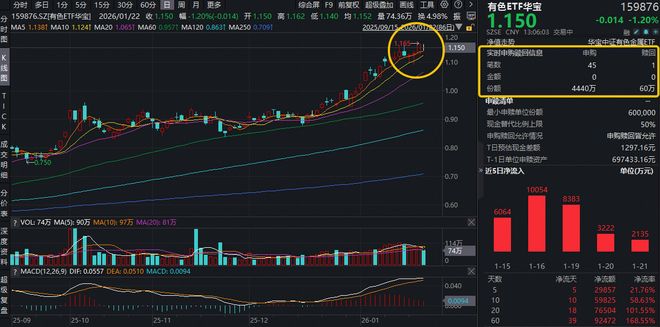
倒车接人?金价跳水,黄金股领跌!资金逢跌抢筹,有色ETF华宝(159876)获实时净申购4380万份!
Xin Lang Cai Jing· 2026-01-22 05:18
Group 1 - The core viewpoint of the news is the performance of the Huabao Nonferrous ETF (159876), which saw a price drop of nearly 2% but received a net subscription of 43.8 million units, indicating strong investor interest despite the decline [1][9] - The ETF's latest scale reached 1.736 billion yuan, marking a historical high and making it the largest ETF tracking the China Nonferrous Metals Index among three similar products [12][14] - The performance of constituent stocks varied, with silver stocks hitting the limit up, while gold stocks like Western Gold and Hengbang fell significantly, impacting the overall index performance [1][9] Group 2 - The London gold price reached a historical high of $4,890 per ounce on January 21 but retreated to around $4,800 due to easing geopolitical tensions related to Greenland [3][11] - Four main factors are expected to influence international gold prices by 2026: rising U.S. fiscal risks, increased gold allocation by global central banks, ongoing U.S. interest rate cuts, and heightened geopolitical risks [3][11][12] - The global geopolitical landscape is becoming more uncertain, with potential military interventions and resource competition expected to keep geopolitical risks elevated [4][12] Group 3 - The Huabao Nonferrous ETF and its linked funds cover a wide range of sectors including copper, aluminum, gold, rare earths, and lithium, allowing for better exposure to various market cycles [6][14] - The long-term commodity cycle is expected to last 25-30 years, with upward trends lasting 8-10 years and downward trends lasting 15-20 years, indicating a sustained period of growth once a direction is established [4][12]
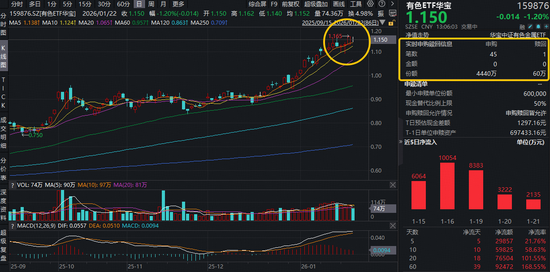
历史新高后回落,短短30分钟资金逆市净申购有色ETF华宝(159876)超3800万份!
Mei Ri Jing Ji Xin Wen· 2026-01-22 03:47
Group 1 - The core viewpoint is that the non-ferrous metal sector is experiencing a super cycle driven by the "AI leap" and "century change," with historical parallels to significant macroeconomic narratives [1] - The non-ferrous ETF Huabao (159876) has seen a net inflow of approximately 600 million yuan over the last 10 trading days, indicating strong investor interest [1] - Historical data suggests that commodity cycles are long, typically lasting 25-30 years, with upward trends lasting 8-10 years and downward trends lasting 15-20 years [1] Group 2 - The non-ferrous ETF Huabao (159876) and its linked fund (017140) cover a wide range of metals including copper, aluminum, gold, rare earths, and lithium, providing comprehensive exposure to different economic cycles [2] - As of January 21, the latest scale of the non-ferrous ETF Huabao (159876) reached 1.736 billion yuan, marking a new historical high and making it the largest ETF tracking the non-ferrous metal index in the market [2]
专访宏利投资管理:AI投资将从“赋能者”转向“受益者”,今年高配新兴市场债券
第一财经· 2026-01-21 13:36
Core Viewpoint - The article discusses the impact of geopolitical dynamics and Trump administration policies on global markets in 2026, highlighting key investment themes such as global monetary and fiscal dynamics, and a potential long-term commodity cycle [3][6]. Investment Themes - Geopolitical fragmentation will continue to influence markets, but asset class returns may not be significantly affected. The focus will remain on underlying fundamentals despite policy challenges [6][7]. - Global monetary policy is expected to remain accommodative, with predictions of three rate cuts by the Federal Reserve in 2026, while emerging market central banks may also lower rates [7][8]. - Fiscal policies are anticipated to support market conditions, with increased government spending, particularly in defense and infrastructure, contributing positively to risk assets [7][8]. Commodity Cycle - A potential long-term commodity cycle is beginning, with strong performances in precious metals like gold and silver, and industrial metals like copper expected to continue rising due to geopolitical dynamics and economic stability [8][9]. AI Investment Shift - The focus of AI investment is shifting from "AI enablers" to "AI beneficiaries," with sectors like healthcare expected to benefit significantly from AI applications, enhancing productivity and efficiency [10][11]. - The industrial and financial sectors are also seen as beneficiaries of AI investments, with industrial firms supporting infrastructure for AI-related energy demands and financial institutions leveraging AI for efficiency gains [11][12]. Bond Market Outlook - The bond market is experiencing a record issuance, with expectations of continued strong demand for government and corporate bonds. The yield curve is likely to steepen, favoring short- to medium-duration bonds [14][15]. - Emerging market bonds are viewed positively due to favorable absolute yields and increasing demand, with expectations of outperforming other debt instruments despite last year's strong performance [15][16].

专访宏利投资管理:AI投资将从“赋能者”转向“受益者”,今年高配新兴市场债券
Di Yi Cai Jing· 2026-01-21 03:11
Core Insights - The market is expected to shift from focusing on "AI enablers" to "AI beneficiaries," which are sectors and companies that will benefit from increased productivity and efficiency through AI applications [1][8]. Group 1: Geopolitical and Economic Dynamics - Geopolitical dynamics and the policies of the Trump administration will continue to influence global markets, but this does not necessarily mean asset class returns will be negatively impacted [4][5]. - Despite uncertainties, the market is expected to focus on underlying fundamentals and the responsiveness of global governments to market conditions [4][5]. Group 2: Monetary and Fiscal Policies - Global monetary policy is likely to remain accommodative, with expectations of further interest rate cuts from central banks, including three additional cuts from the Federal Reserve in 2026 [5][12]. - Fiscal policies are anticipated to support market conditions, with increased government spending, particularly in defense and infrastructure, contributing positively to risk assets [5][12]. Group 3: Commodity Cycles - A potential long-term commodity cycle is beginning, with strong performance expected from precious metals like gold and silver, as well as industrial metals such as copper [5][6]. - Geopolitical changes in natural resources may lead to price increases in oil and other commodities if global economic growth stabilizes [5][6]. Group 4: AI Investment Trends - The AI investment landscape is evolving, with a shift from "AI enablers" to "AI beneficiaries," particularly in sectors like healthcare, which can leverage AI for drug development and diagnostics [8][10]. - The industrial sector is expected to benefit indirectly from AI through infrastructure development and increased defense spending [9][10]. - The financial sector is also seen as a potential beneficiary of AI, with banks applying AI to enhance efficiency and productivity [10]. Group 5: Bond Market Insights - The beginning of 2026 has seen a record high in global bond issuance, with approximately $245 billion raised [11]. - Government and corporate bond issuance is expected to remain strong, with a focus on short- to medium-term assets due to anticipated steepening of yield curves [12][13]. - Emerging market bonds are viewed positively, with expectations of continued demand and attractive yields compared to other global debt instruments [13].

浙商证券浙商早知道-20260119
ZHESHANG SECURITIES· 2026-01-19 12:06
Market Overview - On January 19, the Shanghai Composite Index rose by 0.29%, the CSI 300 increased by 0.05%, the STAR Market 50 fell by 0.48%, the CSI 1000 rose by 0.4%, the ChiNext Index decreased by 0.7%, and the Hang Seng Index dropped by 1.05% [3][4] - The best-performing sectors on January 19 were basic chemicals (+2.7%), oil and petrochemicals (+2.08%), electric equipment (+1.84%), automobiles (+1.7%), and social services (+1.63%). The worst-performing sectors were computers (-1.55%), telecommunications (-0.96%), banking (-0.6%), pharmaceuticals and biology (-0.52%), and electronics (-0.49%) [3][4] - The total trading volume for the A-share market on January 19 was 27,322 billion yuan, with a net inflow of 2.292 billion Hong Kong dollars from southbound funds [3][4] Important Insights Macroeconomic Analysis - Latin America is characterized as an export-oriented economy for agricultural and mineral products while importing manufactured goods. The commodity cycle significantly influences total demand through both export and capital expenditure channels [5] - The market anticipates that exports may drive economic growth in 2026 [5] Fixed Income Analysis - The current R007 weighted interest rate is around 1.50%, which reflects both the central bank's preferred pricing (DR007) and liquidity friction between banks and non-banks (the spread between R007 and DR007). It is advised not to hold overly optimistic expectations [7][8] - The market sentiment is relatively optimistic, but there is a cautious stance compared to previous assessments [10]