大宗商品投资

Search documents
懵了,黄金史诗级崩盘,黄金基金紧急出手
Zhong Guo Ji Jin Bao· 2026-01-31 07:08
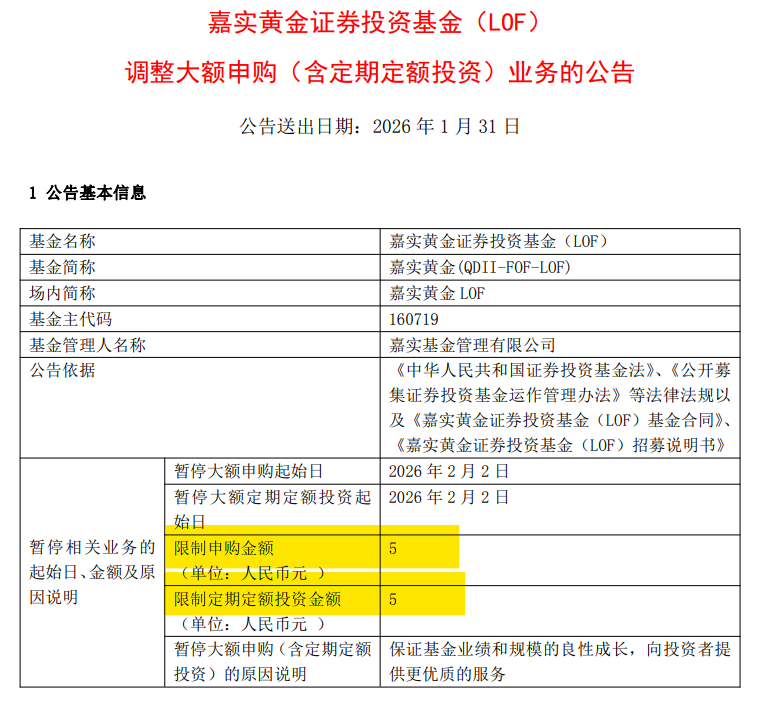
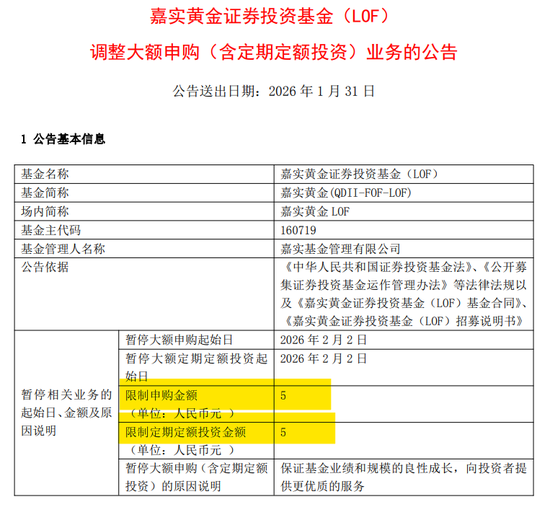
Core Viewpoint - The recent volatility in commodity markets has led to multiple LOF funds for gold and oil announcing significant purchase limits, with some funds setting daily purchase caps as low as 2 yuan [1][3]. Group 1: Fund Purchase Limits - Several funds, including 嘉实黄金 LOF and 嘉实原油 LOF, have announced that starting February 2, 2026, the maximum purchase amount per fund account per day will be limited to 5 yuan [4][6]. - 华安石油基金 LOF has implemented even stricter limits, reducing the daily purchase cap from 10 yuan to 2 yuan starting January 30 [7]. - Other funds, such as 华宝油气 LOF, have also announced limits, with a daily investment cap set at 200 yuan starting February 3 [7]. Group 2: Market Analysis - Industry insiders indicate that the imposition of purchase limits is aimed at ensuring healthy growth of fund performance and scale, while protecting investor interests [2][6]. - The recent sharp declines in gold and silver prices have been attributed to an overheated market, with significant risks accumulating due to large trading volumes prior to the downturn [2][11]. - The price of gold fell over 12% to a low of 4682 USD/oz, closing down 9.25% at 4880 USD/oz, while silver experienced a historic drop of over 36%, closing down 26.42% at 85.259 USD/oz [9][11]. Group 3: Investor Caution - Analysts warn that the precious metals market is currently in an overbought state, with increased volatility and profit-taking pressures [13]. - The upcoming Chinese New Year holiday may serve as a critical test for the silver market, as trading will be halted for two weeks, potentially impacting short-term traders [13]. - Investors are advised to remain rational and avoid blindly chasing high prices, as the rapid price increases in gold and silver are likely to lead to corrections [2][13].

懵了,黄金史诗级崩盘!黄金基金,紧急出手
Xin Lang Cai Jing· 2026-01-31 03:35
Group 1 - Multiple commodity LOF funds, including gold and oil, have announced limits on large subscriptions, with some funds setting daily purchase limits as low as 2 yuan [1][3][6] - The limits are intended to ensure the healthy growth of fund performance and scale, protecting investor interests amid increased market volatility [2][17] - The recent sharp declines in gold and silver prices have been attributed to an overheated market, with significant risks accumulated due to crowded trading [2][10][20] Group 2 - On January 30, the Jiashi Gold LOF announced a subscription limit of 5 yuan per account starting February 2, with similar restrictions applied to Jiashi Oil LOF [3][5][13] - Other funds, such as Huabao Oil and Gas LOF, have also implemented subscription limits, with Huazhong Oil Fund reducing its limit from 10 yuan to 2 yuan [6][16] - The premium rates for Huazhong Oil Fund LOF and Guangfa Oil Fund LOF reached 32.84% and 32.57% respectively, prompting the need for subscription limits to mitigate high premiums [17] Group 3 - On January 30, gold prices fell over 12%, closing down 9.25% at 4,880 USD per ounce, while silver experienced a historic drop of over 36% [8][20] - Analysts suggest that the rapid price increases in gold and silver have led to heightened technical correction risks, especially with the Federal Reserve maintaining interest rates [10][20] - The upcoming Chinese New Year holiday may impact silver demand, as industrial users may seek alternatives and price-sensitive consumers may reduce purchases [21]
紧急公告!多只LOF基金,暂停大额申购!
券商中国· 2026-01-31 00:48
Core Viewpoint - The article highlights the recent trend of strict purchase limits on cross-border LOF funds, particularly those related to commodities like gold and oil, due to market volatility and increased speculative investments [1][2]. Group 1: Fund Purchase Limits - Multiple funds, including the Jiashi Gold LOF and Jiashi Oil LOF, have announced significant purchase limits, with some funds capping daily investments to as low as 2 yuan [2]. - The imposition of these limits is attributed to the influx of short-term speculative capital during market downturns, which can lead to cash being idled if it exceeds the fund's investment capacity [2]. Group 2: Market Performance and Analysis - On January 30, the market saw a significant drop in commodity-related stocks, particularly in the precious metals sector, with declines of 8% to 9% observed in various ETFs [3]. - The Jiashi Gold LOF experienced a 7.5% drop on the same day, although it still recorded a year-to-date increase of 15.75% [4]. Group 3: Factors Influencing Market Movements - The market downturn is influenced by several factors, including anticipated changes in the Federal Reserve's leadership, which may affect interest rate expectations [5]. - High leverage positions were forced to liquidate due to increased margin requirements for futures contracts, contributing to market volatility [6]. - Technical indicators suggest that the market is currently crowded, with the gold-silver ratio reaching a low not seen since 2011, indicating potential price imbalances [6]. Group 4: Future Outlook - Despite the short-term corrections, some institutions remain optimistic about the long-term potential of gold and other precious metals, citing historical trends of recovery following sharp declines [7]. - The geopolitical landscape and structural supply-demand gaps are expected to support the prices of gold and other metals in the medium to long term [8]. - The article suggests that current market conditions may present a window of opportunity for reassessing the value of investments in precious metals like gold, silver, and copper [8].
谁是“聪明钱”?本轮金银史诗级牛市中,散户又给专业人士“上了一课”
Jin Shi Shu Ju· 2026-01-30 04:16
Core Insights - Gold, silver, and platinum prices have surged to historic highs, benefiting individual investors while professional traders face challenges [2] - Many hedge funds and large investors have reduced their positions, locking in profits as prices rose [2][4] - Individual investors have significantly increased their investments in precious metals, with record inflows into silver ETFs [3] Group 1: Price Movements - Gold prices have increased by 93% over the past year, while silver prices have skyrocketed by 265% [2] - Platinum contracts have risen by 28% this month and 168% over the past year [2] Group 2: Investor Behavior - Individual investors injected $921.8 million into silver ETFs from mid-December to mid-January, marking the largest buying spree in history [3] - Personal investors now hold 100.6 million ounces of gold and 835 million ounces of silver in ETFs, nearing historical highs [3] Group 3: Hedge Fund Activity - Hedge funds have been cautious, with many preferring to wait for price corrections before re-entering the market [4] - As of last week, hedge funds held 139,000 net long contracts in gold futures, down from 173,000 last summer [3] Group 4: Market Dynamics - The silver and platinum markets are relatively small, making it difficult for large investors to establish meaningful positions [5] - Recent trading patterns in silver have shown unprecedented volatility, with daily price swings reaching $20 [5][6]
多只资源品LOF出手降温:石油LOF限购2元,白银LOF停牌一天
Sou Hu Cai Jing· 2026-01-30 00:21
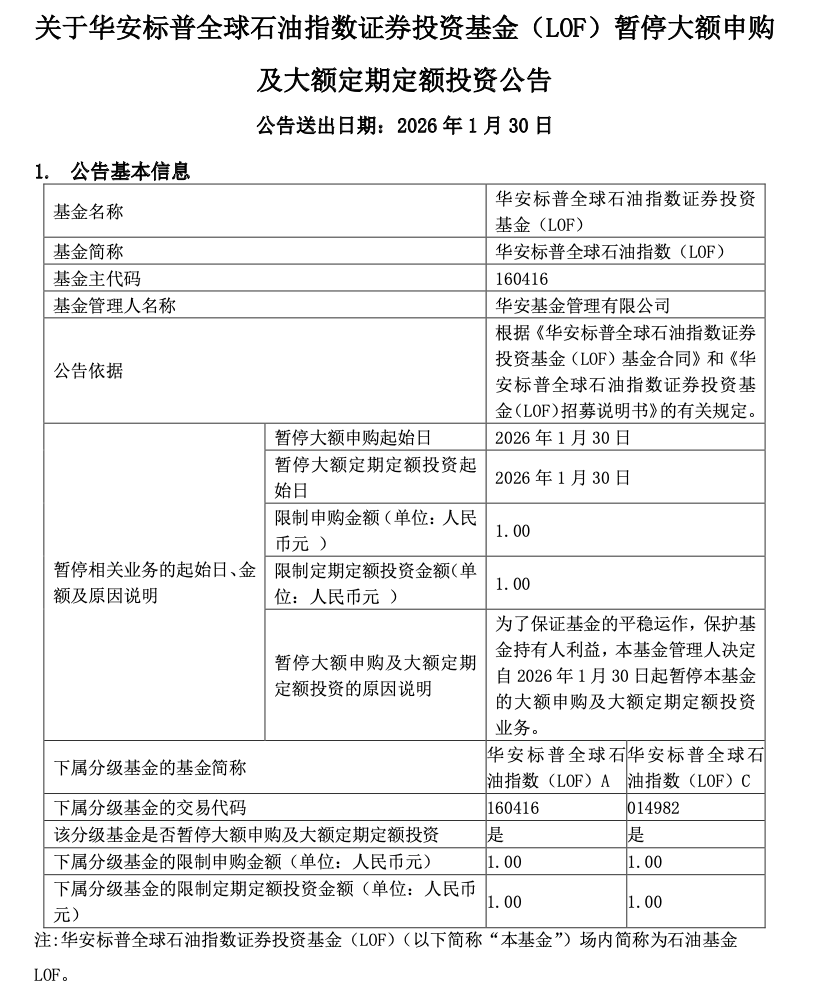
Group 1 - Major fund companies such as GF Fund, Harvest Fund, E Fund, and Huaan Fund announced adjustments to trading times and subscription amounts for their oil-related LOF funds due to rising geopolitical tensions and macroeconomic sentiments driving up commodity prices like oil, gold, and silver [1][5] - The trading prices of these LOF funds have significantly deviated from their net asset values, creating a substantial premium "bubble" [1][5] - Huaan Fund set a daily subscription limit of 1 RMB for its oil LOF funds, with a market price of 2.636 RMB and a premium rate of 49.69% as of January 29 [2][5] Group 2 - Multiple oil-themed LOF funds, including E Fund and Harvest Fund, experienced trading halts and issued premium risk warnings due to significant price premiums [5][6] - The premium phenomenon is closely linked to the unique trading mechanisms of LOF products, which can lead to price deviations from net asset values, especially when market activity is low [6] - The recent surge in oil prices is attributed to geopolitical factors, particularly increased risks related to the U.S. and Iran, alongside a general rise in macroeconomic sentiment [6][7] Group 3 - The gold LOF funds also implemented strict subscription limits, with E Fund halting subscriptions for its A-class shares and setting a limit of 100 RMB for the C-class shares [10][11] - The market for gold LOF funds has seen significant price fluctuations, with some investors facing potential short-term losses due to high entry prices during previous peaks [10][11] - Long-term optimism remains for gold, driven by expectations of U.S. monetary easing and increasing global uncertainties [14] Group 4 - The only major public fund investing in silver futures, Guotou Silver LOF, announced a trading halt due to high market demand and significant price premiums, with a premium rate of 64% as of January 29 [15][17] - The limited supply of silver public funds compared to more established gold ETFs has led to significant price deviations from net asset values during periods of high demand [17][18] - Analysts highlight the differences in investment characteristics between silver and gold, noting that silver lacks the same level of acceptance and clarity among investors, which affects its market dynamics [17][18]
连续第三周资金大幅流入大宗商品,高度集中于贵金属和农产品
Hua Er Jie Jian Wen· 2026-01-28 04:48
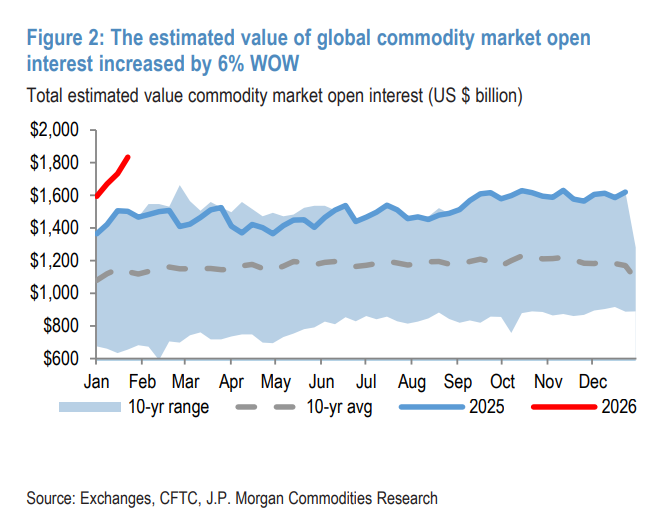
Core Insights - Global commodity markets are experiencing significant capital inflows, with a focus on precious metals and agricultural products, leading to a record high in open interest value [1][4] - As of January 23, 2023, the total value of open interest in global commodity markets increased by nearly 6% week-over-week, reaching $1.83 trillion [1] - Precious metals, particularly gold, are attracting substantial investment, with gold alone seeing a net inflow of approximately $158 billion [4] Group 1: Precious Metals - Precious metals are the primary beneficiaries of recent capital inflows, with a net inflow of about $36 billion in the week, and gold's price increased by approximately 8% [4] - The total value of open interest in the precious metals market surged by 16% week-over-week, amounting to $433 billion, making it the largest contributing sector [4] - The structural logic for gold remains clear, with analysts favoring gold over silver due to potential volatility in silver prices [5] Group 2: Energy and Natural Gas - The energy market's open interest value grew by 4.8% week-over-week, reaching $700 billion, driven by geopolitical factors and supply disruptions [8] - Despite a net outflow of about $2.5 billion in natural gas contracts, prices surged by approximately 70% due to severe cold weather in North America and Europe [8] - European natural gas inventory levels are historically low, contributing to rising prices amid increased heating demand [8] Group 3: Agricultural Products - The agricultural sector also saw increased investment, with open interest value rising by 2.4% to approximately $337 billion, driven by net inflows of $8.9 billion [11] - Price increases in grains, oilseeds, and livestock markets offset declines in soft commodities, indicating a robust interest in agricultural products [11] Group 4: Base Metals - The base metals market's open interest value increased by 2% week-over-week to $258.4 billion, although the sector experienced a net outflow of $400 million [15] - Despite inflows in copper and lead, overall outflows in other base metals led to a cautious outlook on copper prices due to rising inventory levels [15] - Investor positions in base metals are stabilizing, but some commodities are nearing "overheated" conditions, suggesting potential for a slowdown in buying momentum [15]


行情强劲势头下 资源品LOF限购升级!
Sou Hu Cai Jing· 2026-01-27 22:33
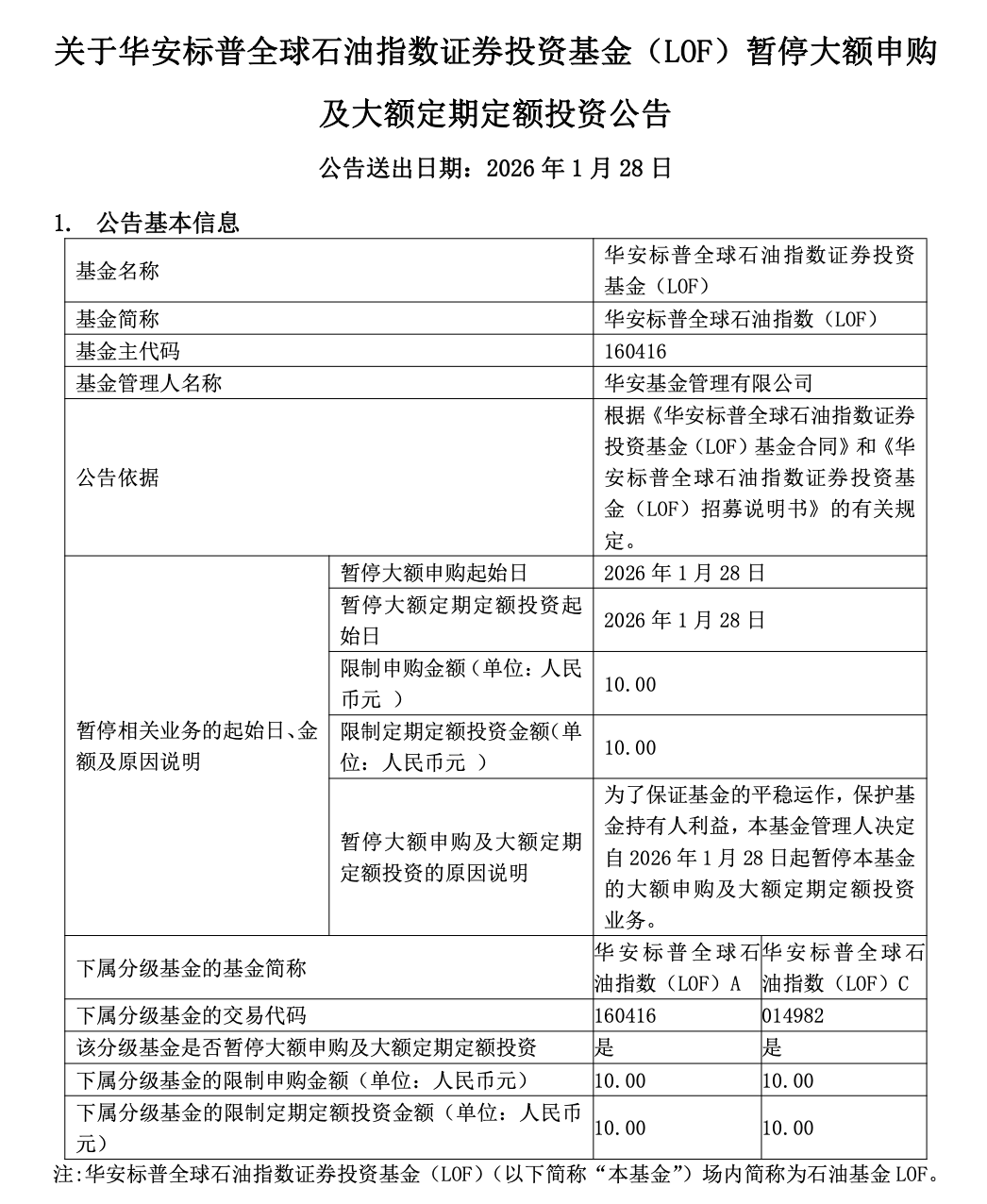
Core Viewpoint - The recent strong momentum in resource prices has led to an upgrade in the restrictions on large purchases of related LOF funds [1] Group 1: Fund Announcements - Huashan Fund announced the suspension of large purchases and large regular investment business for its oil fund LOF starting January 28, 2026, reducing the limit for each fund account from 100 RMB to 10 RMB [2][4] - The suspension aims to ensure the smooth operation of the fund and protect the interests of fund holders [2][4] Group 2: Market Conditions - The trading price of the oil fund LOF in the secondary market has shown a significant premium, with the premium rate rising from 8.29% to 18.88% between January 26 and January 27 [5] - The Southern Oil LOF also saw its premium rate increase to around 10%, prompting the fund manager to issue a warning about the premium risk [5] Group 3: Broader Commodity Trends - The commodity market has experienced a collective rise, with macroeconomic recovery expectations and factors like industrial demand and geopolitical disturbances reinforcing the long-term strategic value of resource products [6] - Precious metals, particularly gold and silver, have seen rapid price increases, with silver prices exceeding market expectations, indicating potential for short-term adjustments [6] Group 4: Additional Fund Actions - E Fund announced the suspension of subscriptions and regular investment for its gold-themed LOF starting January 28, while redemption services will continue as normal [7] - The National Investment Silver LOF has also suspended subscriptions and regular investments for its A and C class shares, with its premium rate exceeding 46% [7]
资源品LOF,限购升级!
Zhong Guo Zheng Quan Bao· 2026-01-27 14:26
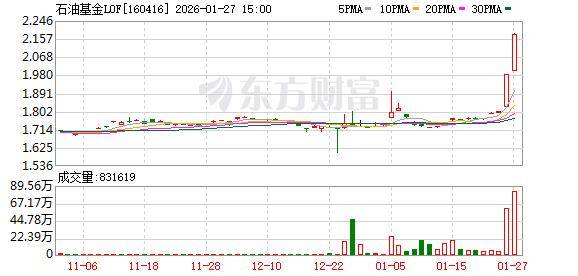
Group 1 - Huashan Fund announced the suspension of large subscriptions and large regular investment business for the Oil Fund LOF starting January 28, 2026, to ensure stable fund operations and protect the interests of fund holders [1][3] - The cumulative subscription and regular investment limit for each fund account has been reduced from 100 RMB to 10 RMB [1][3] - The decision is based on the fund contract and relevant regulations outlined in the prospectus [3] Group 2 - The Oil Fund LOF has experienced a significant increase in trading price premiums in the secondary market, with the premium rate rising from 8.29% to 18.88% between January 26 and January 27 [4][5] - Other funds, such as the Southern Oil LOF, have also seen premium rates around 10%, prompting their management to issue risk alerts to investors [5] - The recent surge in commodity prices, including precious metals, is attributed to macroeconomic recovery expectations and various industry factors, although there are concerns about potential short-term adjustments due to rapid price increases [5]
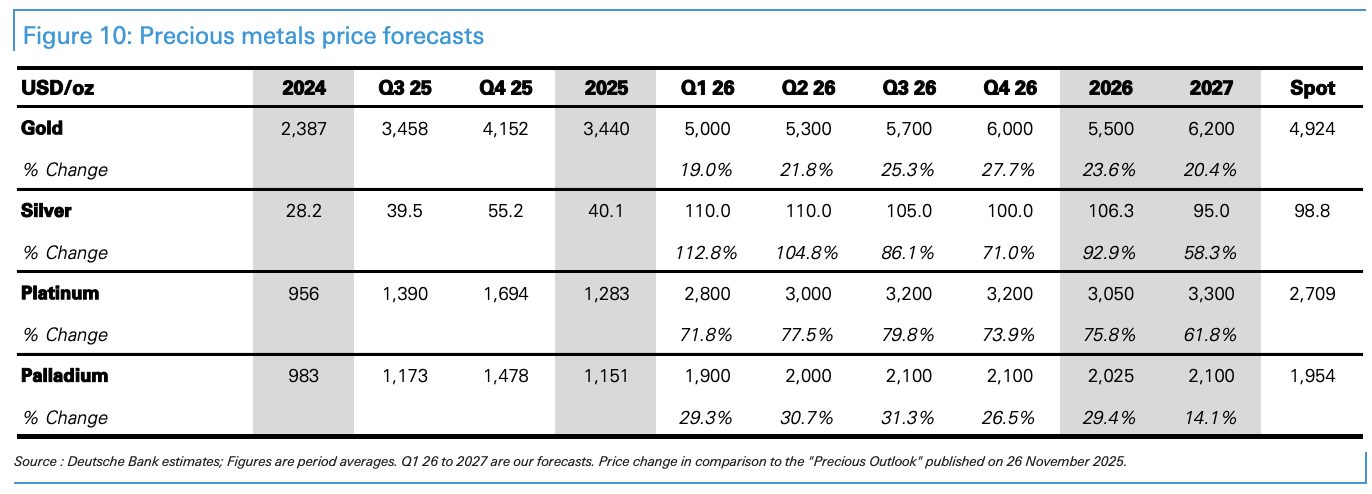
德银大宗商品展望:结构性牛市下,黄金6000美元是“合理区间”,白银行情难以长期脱离黄金
Hua Er Jie Jian Wen· 2026-01-27 08:40
Core Viewpoint - The report from Deutsche Bank indicates that ongoing geopolitical instability and rising government debt are expected to drive a bull market for gold, with projections suggesting gold could reach $6,000 per ounce by 2026, while silver's long-term gains may be limited by the historical gold-silver ratio [1][3][7]. Group 1: Macroeconomic Background - Geopolitical instability has become a norm, leading to increased demand for supply chain independence and higher costs [3]. - Rising military expenditures are worsening long-term government debt expectations, with projections indicating global government debt could reach 100% of GDP by 2029 [3]. - The expected depreciation of the US dollar by the end of 2026 supports the case for investing in precious metals and physical assets [3]. Group 2: Gold Market Insights - Central banks and ETFs are driving significant demand for gold, with a net increase of 965 tons expected from 2022 to 2026, while supply will only meet half of this demand [4]. - The demand for gold from central banks is expanding beyond traditional emerging markets, with countries like Finland, Brazil, and Poland showing strong purchasing activity [4]. - Despite a projected decline in global gold jewelry consumption, this demand has been offset by increased purchases from central banks and ETFs [4]. Group 3: Silver Market Insights - Short-term demand for silver is expected to rise due to increased investment from China and India, with India's central bank allowing silver to be used as collateral for loans [10]. - The industrial demand for silver is facing challenges, particularly from the solar industry, where silver's cost share in solar cells has increased significantly [13]. - Historical trends suggest that the gold-silver ratio will eventually revert to its mean, with projections indicating silver could reach approximately $95 per ounce by 2027 [10][13]. Group 4: Price Projections - Gold price projections indicate a potential rise to $6,000 per ounce under general conditions, with optimistic scenarios suggesting up to $6,900 per ounce [7]. - Silver is projected to experience substantial price increases, with estimates reaching $110 per ounce by 2026, although long-term growth may be constrained by the gold-silver ratio [2][10]. Group 5: Investment Implications - The structural bull market for gold is deemed more stable, with a target price of $6,000 being reasonable [16]. - While silver may benefit from short-term investment enthusiasm, its long-term growth is expected to be limited by the eventual return to the historical gold-silver ratio [16]. - Investors are advised to monitor technical indicators related to the gold-silver ratio and industrial demand changes for silver [16].
黄金白银大涨买不起 “投资铜条”能代替金银吗?
Zhong Guo Xin Wen Wang· 2026-01-27 03:06
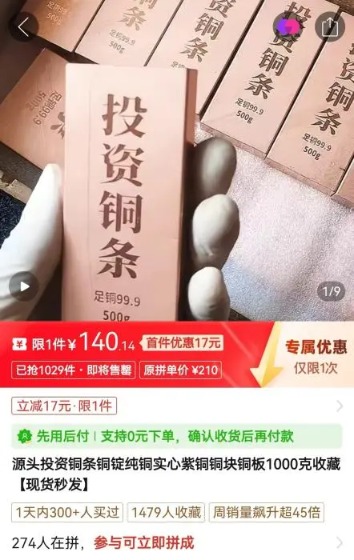
Group 1 - The rising silver prices have led consumers to seek alternatives, with "investment copper bars" gaining popularity as a substitute for gold and silver [1][2] - The price of investment copper bars in Shenzhen's Shui Bei market ranges from 180 to 288 yuan per kilogram, despite official prohibitions on their sale [3][4] - Various e-commerce platforms are also selling copper bars, with prices between 120 and 185 yuan per kilogram, indicating a significant market interest [6] Group 2 - The increase in copper prices is attributed to multiple factors, including supply constraints from major copper-producing countries and rising demand from sectors like AI, electric vehicles, and renewable energy [8] - Experts suggest that while copper has some investment value, it is not suitable for average investors due to its industrial nature and high volatility [11] - The lack of a mature recycling system and a unified repurchase pricing mechanism for copper bars poses additional risks for investors [11]