
自然利率

Search documents
日银加息在即,市场关注中性利率
NOMURA· 2025-12-14 13:50
Interest Rate Outlook - The Bank of Japan (BOJ) is expected to raise the policy interest rate from 0.5% to 0.75% during the monetary policy meeting on December 18-19, marking the highest rate since 1995[1] - Market expectations for an interest rate hike have exceeded 90% as of December 12, indicating that a rate increase is almost certain[1] Neutral Interest Rate Assessment - The BOJ is reassessing the neutral interest rate, which is crucial for evaluating monetary policy stance, with previous estimates placing it between 1% and 2.5%[1] - The estimated range for the natural interest rate is between -1% and 0.5%, suggesting a long-term downward trend[1] Implications of Rate Adjustments - If the BOJ raises the neutral interest rate estimate above the policy rate, it would indicate a continued accommodative financial environment, allowing for more future rate hikes[1] - The previous lower bound of 1% for the neutral interest rate may no longer serve as a cap for rate hikes, as the BOJ is increasingly confident in achieving its 2% inflation target[1] Risks and Uncertainties - There is uncertainty regarding the estimates of the natural interest rate, as different models show varying results, with some indicating values below zero since around 1995[1] - Financial market volatility and unexpected changes in BOJ monetary policy pose risks to the outlook[1]
中性利率迷雾:美联储陷入十年未见的激烈分歧
Sou Hu Cai Jing· 2025-12-02 13:22
Group 1 - The Federal Reserve is experiencing significant internal divisions regarding the "neutral interest rate," with estimates ranging from 2.6% to 3.9%, marking the widest divergence since 2012 [1][2] - This disagreement reflects fundamental differences in the assessment of the current U.S. economy, particularly whether more stimulus is needed to support the labor market or if measures should be taken to curb inflation and potential tariff impacts [1][2] - Federal Reserve Chairman Jerome Powell acknowledged strong disagreements within the committee on balancing "price stability" and "maximum employment," leading to a rare public policy debate on whether to cut rates again in the upcoming meeting [1][2] Group 2 - The divergence in estimates of the neutral interest rate among Federal Reserve officials has sharply increased over the past year, with the current range being unprecedented [2] - Some committee members with a more hawkish stance may view the upper limit of the estimated range as a binding ceiling, complicating future rate cut decisions [2] - The concept of the neutral interest rate, also known as "r-star," has been a theoretical challenge for economists for over a century, despite its importance in modern central banking [2][3] Group 3 - New York Fed President John Williams emphasizes the critical nature of accurately diagnosing the neutral interest rate and natural unemployment rate, warning of potential severe consequences from misjudgments [3] - Historical lessons from the 1960s and 1970s highlight the risks of incorrect assessments of these key parameters, which can lead to runaway inflation expectations [3] - The ongoing debate about the location of "r-star" is crucial not only for upcoming interest rate decisions but also for determining the appropriate economic trajectory for the U.S. and global economies [3]
负增长,日本央行行长发声
Zheng Quan Shi Bao· 2025-12-01 04:53
Economic Overview - The Bank of Japan's Governor, Kazuo Ueda, indicated that Japan's economy experienced its first negative growth in six quarters during Q3 2025, but this is viewed as a temporary adjustment rather than a long-term trend [1][5] - The overall economic recovery remains intact, with a projected annualized GDP growth rate of 0.9% from April to September 2025, surpassing the potential growth rate of approximately 0.5% [5] Global Economic Context - The global economy is showing "moderate growth with localized weaknesses," influenced by trade policies, but the impact of tariffs on the global economy has not been as significant as expected [3] - The International Monetary Fund (IMF) revised its global economic growth forecast for 2025 from 2.8% to 3.0%, with a further increase to 3.1% expected in 2026, driven by trade agreements and robust private consumption in the U.S. [3] Japanese Economic Performance - Japan's export sector remains resilient, with IT-related exports benefiting from global AI demand, despite fluctuations in automobile exports due to preemptive export strategies [5] - Corporate profits are stable, with a slight upward revision in profit forecasts for listed companies in FY2025, and fixed investment is expected to grow by 10.3%, focusing on R&D and labor-saving software [5] Inflation and Price Trends - Japan's core Consumer Price Index (CPI) is currently rising at approximately 3%, primarily driven by food prices and wage increases [6] - A temporary decline in core CPI below 2% is anticipated in the first half of FY2026, but long-term inflation is expected to align with the Bank of Japan's target of 2% due to economic recovery and labor shortages [6] Monetary Policy Direction - The Bank of Japan plans to gradually increase interest rates in response to economic and price improvements, with the spring 2026 labor negotiations being a critical observation point for policy adjustments [7][9] - Current conditions support wage increases, with the minimum wage rising over 5% in FY2025, and corporate profits providing a foundation for further wage growth [8][9] Future Considerations - The Bank of Japan is collecting data on corporate wage increase intentions and will assess the benefits and drawbacks of interest rate hikes in the upcoming monetary policy meeting scheduled for December 18-19 [9] - The goal is to achieve a stable 2% inflation target while maintaining financial stability and promoting long-term economic growth in Japan [9]
中金:美联储降息对我们是利好还是利空?
中金点睛· 2025-08-17 23:39
Core Viewpoint - The article discusses the implications of the Federal Reserve's interest rate cuts, particularly focusing on how these cuts may affect the Chinese market, suggesting that while there may be short-term benefits, the overall impact may not be as significant as commonly perceived [2][28]. Group 1: Impact of Federal Reserve Rate Cuts - The current probability of a rate cut by the Federal Reserve in September is 92% according to CME futures [3]. - The common belief is that a rate cut leads to a weakening of the US dollar and US Treasury yields, which would attract foreign capital into China [2][28]. - However, historical data shows that this assumption may not hold true, as past rate cuts have sometimes coincided with rising yields and a stronger dollar [2][8][12]. Group 2: Types of Rate Cuts - Rate cuts can be categorized into two types: recessionary cuts and preventive cuts. Recessionary cuts occur when the economy is under significant pressure, leading to a decline in yields and the dollar [8][10]. - Preventive cuts happen when economic pressure is less severe, allowing for smaller cuts that can quickly stimulate demand, often resulting in rising yields and a stronger dollar post-cut [12][15]. Group 3: Current Economic Context - The current economic indicators suggest that while there is pressure on the US economy, the situation is not dire enough to necessitate large rate cuts [25][28]. - Key metrics such as the ISM manufacturing PMI and housing sales indicate ongoing weakness, but the actual interest rates are close to natural rates, suggesting that minor cuts could suffice to stimulate the economy [19][25]. Group 4: Short-term vs Long-term Effects - In the short term, the anticipated rate cuts may provide liquidity and improve market sentiment, potentially benefiting the Chinese market [29][33]. - However, this short-term benefit may quickly reverse as the underlying economic conditions improve, leading to a potential rise in yields and the dollar, counteracting the initial positive effects [29][33]. Group 5: Strategic Opportunities - To maximize the benefits of the Federal Reserve's rate cuts, China could implement more aggressive monetary and fiscal policies to support credit expansion [34][38]. - Additionally, sectors related to the US real estate market and traditional manufacturing may see increased demand, presenting opportunities for Chinese exports and commodities [44].


中金研究 | 本周精选:宏观、策略、大类资产
中金点睛· 2025-08-09 01:07
Macroeconomy - Despite a slowdown in economic growth and low inflation in Q2, A-shares have experienced a rapid rise, likened to a "water buffalo" in the context of financial cycles [4] - The current economic indicators in China are still in need of improvement, but several factors support the stock market performance, suggesting a shift from traditional economic cycle perspectives to financial cycle perspectives may provide better insights [4] - Policies aimed at addressing debt issues are crucial during a financial cycle downturn, as they can enhance balance sheets and boost economic vitality, which is significant for capital markets [4] Strategy - Tariffs have contributed to a partial rebound in U.S. inflation, with seasonal adjustment methods underestimating inflation by nearly 20 basis points over the past two months; CPI readings may not yet reflect the true inflation rebound [6] - A turning point in CPI is anticipated within the next 1-2 months, with a potential confirmation date around August 12, and the CPI year-on-year upturn may last for about a year [6] - The low risk premium in U.S. equities is primarily due to rising real returns and investor enthusiasm for U.S. stocks amid a global "asset shortage"; adjustments in risk-free rates suggest there is still slight room for recovery in the risk premium [8] Macroeconomy - The central rate of interest in China has significant downward potential, but the rapid decline in the 10-year government bond yield over the past three years may not continue; short-term policy rate cuts may face limitations around 1% [10] - The 10-year government bond yield's term premium is unlikely to fall below 0.2%, indicating that other policy measures, such as fiscal expansion and central bank balance sheet expansion, may be more effective in stimulating growth [10] Macroeconomy - The U.S. dollar index has rebounded during a depreciation cycle, but this trend halted following the release of July's non-farm payroll data, leading to significant market fluctuations [12] - The U.S. economy appears to have bottomed out in June and showed signs of improvement in July, with a debt issuance wave beginning to absorb dollar liquidity [12] - Looking ahead, the impact of tariffs on inflation may become more apparent, and tightening dollar liquidity could negatively affect U.S. stock performance in August and September, with the 10-year Treasury yield potentially rising to around 4.8% [12]

中金:利率底部在哪 | 漫长的周期系列(二)
中金点睛· 2025-08-05 23:37
Core Viewpoint - The article discusses the ongoing interest rate reduction cycle in China, which began in 2019 and is expected to continue until 2025, drawing parallels with historical cycles and emphasizing the need to analyze the interaction between monetary policy, interest rates, asset prices, and overall demand [2][3]. Group 1: Natural Interest Rate and Monetary Policy - The natural interest rate in China has declined to near zero, indicating that there is significant room for further policy rate reductions to address low inflation [3][4]. - The article highlights two critical blind spots in the natural interest rate framework: the "effectiveness blind spot," which overlooks the impact of risk premiums on the effectiveness of rate cuts, and the "cost blind spot," which considers the financial safety and interests of savers as constraints on rate reductions [4][11]. - The analysis suggests that even with persistent low inflation, the 10-year Chinese government bond yield may not decline to the levels indicated by the natural interest rate due to these blind spots [6][10]. Group 2: Market Dynamics and Bond Pricing - The article argues that the low yield spread in the bond market is primarily due to reduced volatility rather than strong expectations of rate cuts, indicating a "pricing blind spot" in the natural interest rate perspective [5][41]. - The 10-year government bond yield's downward trend over the past three years may not continue, as the costs associated with rate cuts become more apparent and the lower limit of the yield spread is supported [6][70]. - The article emphasizes that the current economic environment and the potential for future rate cuts should be closely monitored, particularly in the context of market expectations and the behavior of financial institutions [61][69]. Group 3: Financial System Constraints - The Chinese banking sector's significant reliance on interest income and the high proportion of bank assets to GDP create constraints on further rate reductions, as banks prioritize maintaining net interest margins [26][29]. - The article notes that the interests of savers will also play a crucial role in determining the extent to which deposit rates can be lowered without causing public discontent [29][30]. - The ongoing global high-interest rate environment poses additional challenges for China's monetary policy, as it complicates the management of capital flows and the stability of the renminbi [32][38]. Group 4: Policy Alternatives and Economic Growth - The article suggests that there are alternative policy measures available to stimulate growth, such as fiscal expansion and structural reforms, which may be more effective than simply lowering interest rates [71][73]. - Recent changes in fiscal policy, including the use of special government bonds for consumption subsidies and an increase in the fiscal deficit ratio, indicate a shift towards more proactive fiscal measures to support economic growth [71][72]. - The potential for further structural reforms to enhance economic vitality is highlighted, with an emphasis on improving incentive mechanisms across various sectors [73].

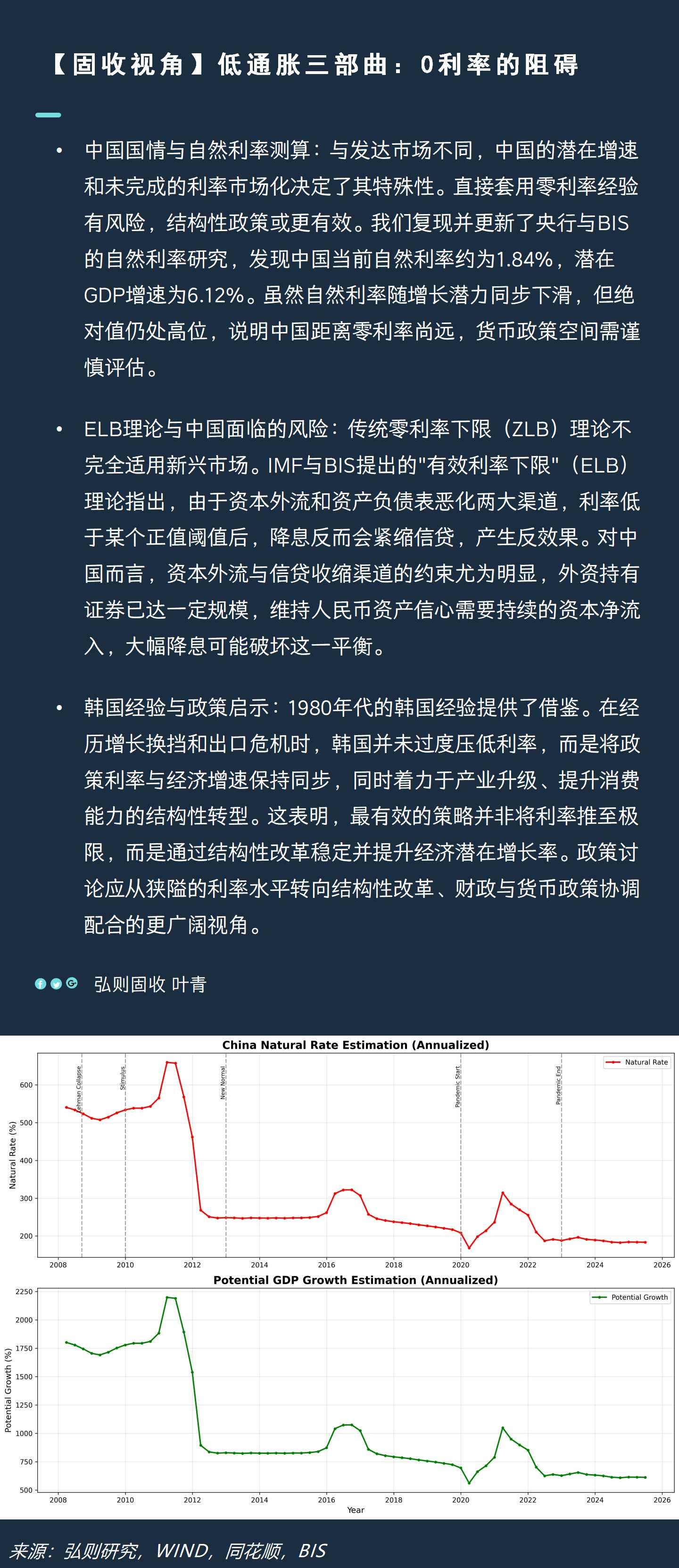
弘则固收叶青:低通胀三部曲 0利率的阻碍
news flash· 2025-06-25 23:58
Group 1 - The current natural interest rate in China is approximately 1.84%, which is significantly above zero, indicating that excessive interest rate cuts could lead to credit contraction, counterproductive to economic growth [1] - China's potential GDP growth rate is estimated at 6.12%, and while the natural interest rate declines with growth potential, it remains at a high level, suggesting that China is far from a zero interest rate environment [1] - The concept of Effective Lower Bound (ELB) is particularly relevant for China, as traditional zero lower bound (ZLB) theories do not fully apply to emerging markets; capital outflows and balance sheet deterioration can lead to credit tightening if rates fall below a certain positive threshold [1] Group 2 - The experience of South Korea in the 1980s serves as a valuable reference; during economic transitions and export crises, Korea did not excessively lower interest rates but instead synchronized policy rates with economic growth while focusing on structural reforms and industrial upgrades [2] - The most effective strategy for economic stability and growth is not merely pushing interest rates to their limits but rather implementing structural reforms that enhance potential economic growth [2] - Policy discussions should shift from a narrow focus on interest rate levels to a broader perspective that includes structural reforms and the coordination of fiscal and monetary policies [2]
蒋飞:论降息的重要性
Jing Ji Guan Cha Bao· 2025-05-28 14:47
Core Viewpoint - The discussion on whether to continue interest rate cuts after the central bank's reduction on May 8 remains ongoing, with optimists believing the economy has stabilized and pessimists arguing that economic pressures persist, indicating that the rate-cutting cycle is not over [1][3] Long-term Importance of Rate Cuts - Since 2018, China has entered a long-term interest rate cut cycle, which is expected to continue due to ongoing adjustments in population, debt, and real estate cycles [4] - The population is projected to decline, with a decrease of 1.39 million in 2024 compared to 2023, and a forecasted reduction of 20.4 million by 2054, impacting long-term economic growth [4] - The macro leverage ratio is approaching critical levels, with a projected 298.4% by Q1 2025, necessitating debt management strategies supported by interest rate cuts [4][5] - The real estate market is still adjusting, with the price-to-rent ratio remaining high, indicating potential downward pressure on housing prices until a more stable equilibrium is reached [5] Short-term Importance of Rate Cuts - The need for stable growth remains crucial, especially in the context of global economic uncertainties and rising protectionism, which necessitates internal stability [7] - The real estate market's recovery is contingent on continued interest rate support, as housing assets constitute 66.8% of urban residents' total assets, significantly influencing consumption and investment [8] - A strong savings tendency among residents has led to a disparity between loan and deposit growth rates, indicating a need for lower interest rates to stimulate demand [8] Issues Not Resolved by Rate Cuts - Rate cuts do not address the issues of ineffective interest rate transmission, as the market remains segmented and the sensitivity of loan rates to market rates is low [10][12] - The persistent rise in leverage ratios is not solely a result of low interest rates; rather, it is influenced by investment efficiency and institutional frameworks [10] - The narrowing of banks' net interest margins is attributed to supply-demand dynamics in the banking sector rather than solely to interest rate reductions [11] - The widening of domestic and international interest rate differentials is influenced by differing economic conditions, necessitating a focus on domestic monetary policy rather than maintaining international rate parity [12] Remaining Space for Rate Cuts - There is still room for further interest rate reductions, with projections indicating that to maintain the government leverage ratio by 2025, the real interest rate should decrease to 0.32%, significantly lower than the current rate of 4.52% [13]
宏观经济研究:论降息的重要性
Great Wall Securities· 2025-05-26 12:44
Long-term Importance of Rate Cuts - Since 2018, China has entered a long-term rate cut cycle, which is expected to continue due to ongoing adjustments in population, debt, and real estate cycles[8] - In 2024, China's total population is projected to be 1.408 billion, a decrease of 1.39 million from 2023, indicating a long-term trend of population decline[8] - By the first quarter of 2025, China's macro leverage ratio reached 298.4%, nearing the critical level of 300% identified as a potential financial crisis threshold[9] Short-term Importance of Rate Cuts - The contribution of net exports to GDP reached 38.9% in the first quarter, the highest since 2009, highlighting the need for internal stability amid external uncertainties[13] - Real estate assets account for 66.8% of urban residents' total assets, making housing market stability crucial for consumer spending and investment[14] - The current real estate interest rates remain high, suppressing demand, necessitating further rate cuts to stimulate the market[14] Limitations of Rate Cuts - Rate cuts cannot resolve issues such as poor interest rate transmission and rising leverage ratios, which require broader macroeconomic reforms[15] - The banking sector's net interest margin is under pressure not solely due to low rates but also due to a significant oversupply of capital in the market[16] - Domestic and international interest rate differentials are widening, with external factors influencing domestic monetary policy decisions[17] - To maintain a stable government leverage ratio by 2025, actual interest rates need to decrease to 0.32%, significantly lower than the current rate of 4.52%[17]
植田和男警告:特朗普关税通过三重渠道压制日本经济!
Jin Shi Shu Ju· 2025-05-01 08:28
Core Viewpoint - The Bank of Japan maintains interest rates while lowering economic growth forecasts due to uncertainties surrounding U.S. tariffs, but inflation is expected to remain on track to meet the 2% target, indicating that tariff risks may only delay rather than disrupt the rate hike plans [1] Economic Outlook - The uncertainty surrounding U.S. tariffs has heightened trade policy unpredictability, with expectations that trade negotiations will progress and global supply chains will not face major disruptions [2] - Japan's economy is expected to face downward pressure from tariffs through three channels: slowing global growth, damaging corporate profits, and increased uncertainty leading to delayed spending by households and businesses [2] - Despite these pressures, a gradual recovery in overseas economies is anticipated to alleviate some of the downward pressure over time [2] Inflation and Wage Growth - The Bank of Japan has revised down its growth forecasts for fiscal years 2025 and 2026, indicating a phase of synchronized slowdown in inflation and wage growth, although labor shortages will maintain a positive wage-inflation cycle [2] - The timeline for achieving the inflation target has been pushed back, and the current environment suggests a period of inflation stagnation, making it difficult to assess the likelihood of achieving baseline scenarios [2] - The probability of achieving baseline scenarios has significantly decreased, and developments in tariff situations may alter these scenarios, directly impacting monetary policy decisions [2] Interest Rate Considerations - The timing for the next interest rate hike may not automatically align with the delayed timeline for inflation approaching 2% [3] - The Bank of Japan continues to provide monetary support, albeit with adjustments, as inflation is expected to gradually approach the target within the three-year forecast period [3] - The potential impact of U.S. tariffs on terminal rates is uncertain and may depend on changes in Japan's natural interest rate [3][4] Consumer Resilience - Rising food prices are affecting processed food sectors and suppressing some consumer spending, yet overall consumption trends remain upward [3] - The impact of wage increases on nominal income has not significantly boosted real income due to unexpected food price hikes [4]