
资产估值

Search documents
南京化纤重大资产重组问询函回复:土地房产无需补缴出让金 置出资产估值增值30.84%
Xin Lang Cai Jing· 2025-12-22 13:06
Core Viewpoint - Nanjing Chemical Fiber Co., Ltd. is undergoing a significant asset swap and capital raising process, with responses from the evaluation agency addressing key issues related to asset compliance, valuation methods, and transitional profit and loss arrangements [1] Group 1: Asset Compliance and Valuation - The land and property at No. 329 Mochou Road, Nanjing, do not require additional land transfer fees as confirmed by local government authorities, ensuring no impact on the transaction's pricing and valuation [2] - The evaluation of the divested assets shows a book value of 557.38 million yuan and an assessed value of 729.27 million yuan, resulting in a 30.84% increase primarily due to the appreciation of land use rights in Nanjing [3] Group 2: Transitional Profit and Loss Arrangements - The transitional profit and loss during the period from the assessment date to the delivery date will be shared, with Nanjing Chemical Fiber bearing 40% and the new company assuming 60%, which is favorable for protecting minority investors [3] - The assessment differences for the divested assets are justified by changes in industry policies, with a shift from a revenue-based valuation method to an asset-based approach reflecting the actual operating conditions [3] Group 3: Asset Evaluation Methodology - The chosen asset-based valuation method for the incoming assets is deemed more stable, with a final assessed value of 1.6066757 billion yuan, as it accurately reflects the characteristics of fixed asset investments [4] - Rental income from the property is projected to grow at an annual rate of 1.5% from 2036 to 2054, based on historical rental growth rates and local GDP growth, which is considered reasonable [4] Group 4: Valuation Trends and Regulatory Compliance - The assessed values of Nanjing Craft have shown a decreasing growth rate over three evaluations, aligning with the logical changes in asset values due to fluctuations in intangible assets, inventory, and fixed assets [5] - The evaluation methods and parameters used have been confirmed to comply with regulatory requirements, which is beneficial for protecting the interests of minority investors [5]

全球资产配置每周聚焦(20251205-20251212):美联储降息落地,权益与商品分化涨跌互现-20251214
Shenwan Hongyuan Securities· 2025-12-14 13:09
Market Overview - The Federal Reserve announced a rate cut of 25 basis points, lowering the target range for the federal funds rate to 3.50%-3.75%[3] - The 10-year U.S. Treasury yield rose to 4.19%, increasing by 5 basis points this week[9] - The U.S. dollar index decreased by 0.59%, currently at 98.4[9] Equity Market Performance - The ChiNext, German, and Korean stock markets saw significant gains, while the Nasdaq and Hang Seng Tech indices declined[3] - The A-share market showed mixed results, with the ChiNext Index up by 2.7% and the Shanghai Composite Index down by 0.34%[8] Commodity Trends - Gold prices surged by 2.13% this week, while oil prices fell by 3.97% due to the resumption of production in key Iraqi oil fields[3] - The GSCI index for precious metals maintained a risk-adjusted return percentile of 100%[3] Capital Flows - In the week ending December 10, 2025, foreign capital inflow into the Chinese stock market was $4.29 million, while domestic capital outflow was $0.84 million[3] - U.S. fixed income funds saw a significant inflow of $51.3 billion this week[14] Valuation Metrics - The Shanghai Composite Index's valuation is at 83.8% of its historical average PE ratio over the past decade, indicating relative attractiveness compared to U.S. equities[3] - The risk-adjusted return percentile for the S&P 500 remains at 43%, while the Nasdaq's has decreased from 38% to 33%[3] Economic Indicators - The Michigan Consumer Sentiment Index for November dropped to 51.0, indicating weakening consumer confidence[3] - The probability of a 25 basis point rate cut in January 2026 is currently at 75.60%, down from 86.20% the previous week[3]
Mhmarkets迈汇:贵金属与美股的双高位隐忧
Xin Lang Cai Jing· 2025-12-10 11:39
Core Viewpoint - Gold and silver prices have been experiencing high volatility, with analysts expecting continued momentum in precious metals and the S&P 500, despite warnings from the Bank for International Settlements about potential dual bubbles [1][4]. Group 1: Market Performance - The S&P 500 has seen a year-to-date increase of over 16%, fluctuating around 6,850 points, while gold prices have recorded their best performance since 1979, with a year-to-date increase of over 50%, hovering around $4,200 per ounce [1][4]. - The S&P 500 has set over 20 record highs this year, and gold has nearly 50 new highs since breaking the $4,000 mark [1][4]. Group 2: Investor Behavior - The primary driving force behind the rise in both the stock and gold markets this year has been retail investors, who have been increasing their positions due to media hype and rising prices [2][5]. - There is a notable divergence between retail investors, who are seeing net inflows, and institutional investors, who have mostly chosen to reduce holdings or remain cautious [6]. Group 3: Market Risks - The influx of retail funds is not inherently problematic, but the divergence in direction from institutional investors may pose a risk for future volatility [2][6]. - The potential for emotional trading is heightened, as concentrated selling by retail investors could amplify price fluctuations and impact market stability [6]. Group 4: Fundamental Support - Despite gold prices entering overbought territory after surpassing $4,360 in October, the fundamental backdrop remains strong, with central banks expected to purchase approximately 900 tons of gold this year, which is still above the long-term average [3][6]. - The expectation of continued monetary easing by the Federal Reserve until 2026 is likely to support demand for precious metals through its effects on interest rates, long-term yields, and the dollar [3][6].
观点与策略:国泰君安期货商品研究晨报-贵金属及基本金属-20251124
Guo Tai Jun An Qi Huo· 2025-11-24 03:12
Report Information - Report Date: November 24, 2025 [1][4][9][12][15][18][22][25] - Report Title: Guotai Junan Futures Commodity Research Morning Report - Precious Metals and Base Metals - Analyst: Liu Yuxuan, Ji Xianfei, Wang Rong, Zhang Zaiyu - Contact: Wang Zongyuan Investment Ratings - No specific industry - wide investment ratings are provided in the report. Core Views - **Gold**: The expectation of interest - rate cuts has rebounded [2]. - **Silver**: It is in a state of oscillatory adjustment [2]. - **Copper**: The reduction in inventory supports the price [2]. - **Zinc**: It is in a range - bound oscillation [2]. - **Lead**: The reduction in inventory limits the price decline [2]. - **Tin**: The price has fallen from a high level [2]. - **Aluminum**: Attention should be paid to the lower support level [2]. - **Alumina**: There is still fundamental pressure [2]. - **Cast Aluminum Alloy**: It follows the trend of electrolytic aluminum [2]. - **Nickel**: The pace of inventory accumulation has slightly slowed down, with short - term disturbances from the macro - environment and news [2]. - **Stainless Steel**: The steel price is under pressure and oscillating at a low level, but the downside potential is limited [2]. Summary by Commodity Gold - **Price Performance**: The closing price of Shanghai Gold 2512 yesterday was 932.56, with a daily decline of 0.47%, and the night - session closing price was 933.90, with a night - session decline of 0.66% [4]. - **Macro News**: The "third - in - command" of the Federal Reserve signaled a dovish stance, saying there is still room for interest - rate cuts "in the near term", and the market's expectation of a December interest - rate cut exceeded 70% during the session [5]. - **Trend Intensity**: The trend intensity of gold is 0, indicating a neutral outlook [7]. Silver - **Price Performance**: The closing price of Shanghai Silver 2512 yesterday was 12046, with a daily decline of 0.81%, and the night - session closing price was 11967.00, with a night - session decline of 1.34% [4]. - **Trend Intensity**: The trend intensity of silver is 0, indicating a neutral outlook [7]. Copper - **Price Performance**: The closing price of the Shanghai Copper main contract yesterday was 85,660, with a daily decline of 0.55%, and the night - session closing price was 86180, with a night - session increase of 0.61% [9]. - **Inventory**: The inventory of Shanghai Copper decreased by 5,193 tons to 49,790 tons, and the inventory of London Copper decreased by 2,900 tons to 155,025 tons [9]. - **Macro and Industry News**: The "third - in - command" of the Federal Reserve signaled a dovish stance, and the US 11 - month S&P Global Composite PMI preliminary value reached a four - month high [9][11]. - **Trend Intensity**: The trend intensity of copper is 0, indicating a neutral outlook [11]. Zinc - **Price Performance**: The closing price of the Shanghai Zinc main contract was 22390, with a daily increase of 0.02%, and the closing price of the London Zinc 3M electronic disk was 2992, with a decline of 0.38% [12]. - **News**: Trump's "appointee" to the Fed, Stephen Miran, said the September non - farm payrolls report was "obviously dovish" [13]. - **Trend Intensity**: The trend intensity of zinc is 0, indicating a neutral outlook [14]. Lead - **Price Performance**: The closing price of the Shanghai Lead main contract was 17165, with a daily decline of 0.32%, and the closing price of the London Lead 3M electronic disk was 1989, with a decline of 0.80% [15]. - **Inventory**: The inventory of Shanghai Lead decreased by 601 tons to 29955 tons, and the inventory of London Lead decreased by 1800 tons to 262850 tons [15]. - **Macro News**: The "third - in - command" of the Federal Reserve signaled a dovish stance, and the US 11 - month S&P Global Composite PMI preliminary value reached a four - month high [16]. - **Trend Intensity**: The trend intensity of lead is 0, indicating a neutral outlook [16]. Tin - **Price Performance**: The closing price of the Shanghai Tin main contract was 292,030, with a daily decline of 0.46%, and the night - session closing price was 292,990, with a decline of 0.16% [19]. - **Inventory**: The inventory of Shanghai Tin increased by 31 tons to 5,991 tons, and the inventory of London Tin decreased by 50 tons to 3,065 tons [19]. - **Macro and Industry News**: The "third - in - command" of the Federal Reserve signaled a dovish stance, and the market's expectation of a December interest - rate cut exceeded 70% during the session [20]. - **Trend Intensity**: The trend intensity of tin is 0, indicating a neutral outlook [21]. Aluminum, Alumina, and Cast Aluminum Alloy - **Price Performance**: The closing price of the Shanghai Aluminum main contract was 21340, with a decline of 190; the closing price of the Shanghai Alumina main contract was 2713, with a decline of 19; the closing price of the cast aluminum alloy main contract was 20595, with a decline of 185 [22]. - **News**: The "third - in - command" of the Federal Reserve signaled a dovish stance, and the market's expectation of a December interest - rate cut exceeded 70% during the session [24]. - **Trend Intensity**: The trend intensities of aluminum, alumina, and cast aluminum alloy are all 0, indicating a neutral outlook [24]. Nickel and Stainless Steel - **Price Performance**: The closing price of the Shanghai Nickel main contract was 114,050, with a decline of 1,330; the closing price of the stainless - steel main contract was 12,290, with an increase of 5 [25]. - **Industry News**: The Indonesian forestry working group took over a nickel - mining area, and China suspended an unofficial subsidy for imported copper and nickel from Russia [25][26]. - **Trend Intensity**: The trend intensities of nickel and stainless steel are both +1, indicating a slightly bullish outlook [29].
一场演讲触发了本周全球市场巨震
Sou Hu Cai Jing· 2025-11-22 14:04
Core Insights - The current financial system remains resilient, supported by strong asset positions of households and businesses, as well as adequate capital levels in the banking sector [2][4] - The Federal Reserve's latest Financial Stability Report highlights ongoing risks and vulnerabilities, particularly in asset valuations, the structural shift of corporate lending from traditional banks to private credit, and the increasing role of hedge funds in the U.S. Treasury market [2][5][8] Group 1: Asset Valuation - Asset valuations for stocks, corporate bonds, leveraged loans, and real estate are currently above historical benchmarks, indicating a potential risk of price corrections [5][6] - The risk compensation expectations are at historically low levels, which could either revert to normal, remain subdued, or weaken further [5][6] - Despite the potential for asset price declines, the overall resilience of the financial system suggests that a repeat of systemic failures like those seen during the Great Recession is unlikely [5][6] Group 2: Private Credit Expansion - Private credit has doubled in size over the past five years, raising concerns about the rapid growth of non-bank lending to non-public companies [6][7] - The private credit model allows long-term investors to fund private companies, which may lack access to traditional bank financing, potentially enhancing financial stability and economic growth [6][7] - However, the complexity and interconnectedness of leveraged entities in this space could create pathways for unexpected losses to affect the broader financial system [6][7] Group 3: Hedge Funds in Treasury Market - Hedge funds have significantly increased their holdings in U.S. Treasury securities, with their share rising from 4.6% in Q1 2021 to 10.3% in Q1 2023, surpassing pre-pandemic levels [8][9] - The sensitivity of hedge fund positions to market changes poses a risk of liquidity crises if they are forced to sell off large amounts of Treasuries simultaneously [8][9] - The trading strategies employed by hedge funds, particularly relative value strategies, could amplify market instability during periods of stress [8][9] Group 4: Impact of Artificial Intelligence - The rapid development of AI in financial services presents both opportunities and challenges for financial stability, particularly in algorithmic trading [10][11] - Generative AI can analyze vast amounts of data and deploy complex trading strategies, which may introduce risks if not properly monitored [10][11] - While AI has the potential to enhance market efficiency, it also raises concerns about market manipulation and the opacity of decision-making processes [10][11][12]


帮主郑重:美联储库克发出警告!这4类资产要凉?你的钱袋危险了
Sou Hu Cai Jing· 2025-11-22 06:15
Core Viewpoint - The Federal Reserve Governor Cook has issued a warning about the high valuations of multiple asset classes, indicating an increased likelihood of significant price declines [1] Risk Points - Cook identified four key areas of concern: the stock market, corporate bonds, leveraged loans, and the real estate market, all of which are prone to sharp declines when liquidity tightens [3] - The proportion of U.S. Treasury holdings by hedge funds has surged to a record high of 10.3%, raising the risk of forced liquidations leading to a chain reaction of sell-offs if market conditions change [3] Private Credit Market - The private credit market, which accounts for 11% of U.S. GDP, is emerging as a new source of risk, with UBS predicting a potential 3 percentage point increase in default rates by 2026, surpassing leveraged loans and high-yield bonds [4] - The growing interconnection between private credit and banks/insurance institutions is concerning, as U.S. banks' loans to private credit firms have surged to nearly $300 billion, posing a risk of systemic issues if any segment falters [4] Financial System Resilience - Cook reassured that the current financial system is more resilient than in 2008, with higher bank capital adequacy ratios, making a repeat of a comprehensive crisis unlikely [5] Strategy for Long-term Investors - Investors are advised to avoid high-valuation sectors, particularly those reliant on low-cost financing such as leveraged buyouts and commercial real estate [6] - Monitoring liquidity indicators is crucial, as the Federal Reserve's reverse repo tool balance has plummeted from $2.55 trillion to $219 billion, indicating a thinner market buffer [6] - Holding cash for potential opportunities is recommended, as quality assets may be mispriced due to liquidity shocks, presenting long-term investment opportunities [6]

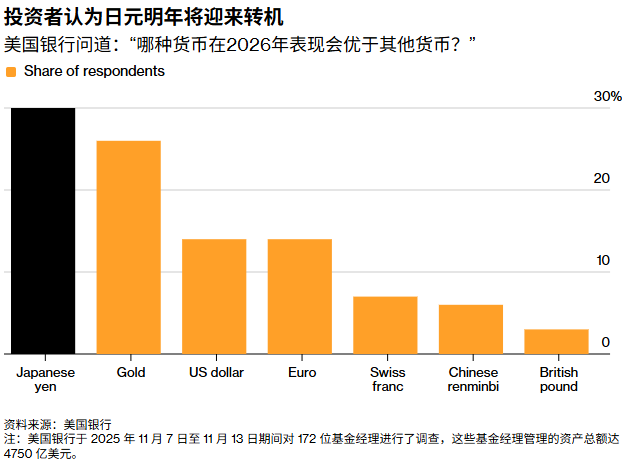
美银调查:全球投资者押注日元明年“逆袭”,黄金美元次之
Zhi Tong Cai Jing· 2025-11-19 00:58
Group 1 - The core viewpoint of the article is that global investors are optimistic about the Japanese yen's performance in 2024, expecting it to outperform major currencies after a tumultuous year [1][3]. - Approximately one-third of the 170 fund managers surveyed by Bank of America believe the yen will deliver the best returns next year, with gold and the US dollar following closely behind [1][6]. - The yen's current optimism contrasts sharply with its lackluster performance this year, where the USD/JPY pair has only risen by 1%, placing it at the bottom among G10 currencies [3]. Group 2 - Factors contributing to the yen's poor performance include the Bank of Japan's ambiguous stance on interest rate hikes and the newly elected Prime Minister's support for loose monetary policies, which are expected to lead to higher spending plans [4]. - Investors' optimism for the yen in 2026 may stem from its undervalued status, reflecting ongoing low investment in Japanese assets, with a net underweight in Japanese stocks of 4% among the surveyed investors [4]. - The potential for a rebound in the USD/JPY exchange rate may be highlighted in the upcoming macroeconomic and foreign exchange report from the US Treasury, which could shift focus back to monetary policy trends [4].

大类资产早报-20251113
Yong An Qi Huo· 2025-11-13 00:59
Group 1: Global Asset Market Performance - The latest yields of 10 - year government bonds in major economies: US 4.070, UK 4.397, France 3.376, Germany 2.642, Italy 3.370, Spain 3.139, Switzerland 0.140, Greece 3.251, Japan 1.684, Brazil 6.157, China 1.802, Australia 4.379, New Zealand 4.103 [3] - The latest yields of 2 - year government bonds in major economies: US 3.570, UK 3.723, Germany 1.995, Japan 0.933, Italy 2.174, China (1Y yield) 1.406, Australia 3.638 [3] - The latest exchange rates of the US dollar against major emerging - economy currencies: Brazil 5.292, South Africa zar 17.084, South Korean won 1471.050, Thai baht 32.507, Malaysian ringgit 4.134 [3] - The latest exchange rates of the RMB: on - shore RMB 7.111, off - shore RMB 7.113, RMB central parity 7.083, RMB 12 - month NDF 6.967 [3] - The latest values of major economies' stock indices: S&P 500 6850.920, Dow Jones Industrial Average 48254.820, NASDAQ 23406.460, Mexican stock index 63190.660, UK stock index 9911.420, French CAC 8241.240, German DAX 24381.460, Spanish stock index 16615.800, Japanese Nikkei 51063.310, Hong Kong Hang Seng Index 26922.730, Shanghai Composite Index 4000.140, Taiwan stock index 27947.090, South Korean stock index 4150.390, Indian stock index 8388.566, Thai stock index 1284.810, Malaysian stock index 1631.610, Australian stock index 9079.362, emerging - economy stock index 1407.730 [3] - The latest values of credit - bond indices: US investment - grade credit - bond index 3532.910, euro - zone investment - grade credit - bond index 266.387, emerging - economy investment - grade credit - bond index 289.760, US high - yield credit - bond index 2883.920, euro - zone high - yield credit - bond index 408.350, emerging - economy high - yield credit - bond index 1800.294 [3] Group 2: Stock Index Futures Trading Data - Index performance: A - share closing price 4000.14, down 0.07%; CSI 300 closing price 4645.91, down 0.13%; SSE 50 closing price 3044.30, up 0.32%; ChiNext closing price 3122.03, down 0.39%; CSI 500 closing price 7243.25, down 0.66% [4] - Valuation: PE (TTM) of CSI 300 is 14.31 with a 0.04环比 change, SSE 50 is 12.08 with a 0.10环比 change, CSI 500 is 33.14 with a - 0.15环比 change, S&P 500 is 28.44 with a - 0.02环比 change, German DAX is 20.17 with a 0.24环比 change [4] - Risk premium: 1/PE - 10 - year interest rate of S&P 500 is - 0.55 with a 0.05环比 change, German DAX is 2.32 with a - 0.04环比 change [4] - Fund flow: A - share latest value - 812.64, 5 - day average - 604.07; Main - board latest value - 611.85, 5 - day average - 412.64; ChiNext latest value - 166.55, 5 - day average - 149.18; CSI 300 latest value - 19.37, 5 - day average - 61.59 [4] Group 3: Transaction Data and Other Information - Transaction amount: The latest value of Shanghai and Shenzhen stock markets is 19450.34, CSI 300 is 4923.09, SSE 50 is 1368.90, small - and medium - sized board is 4021.64, ChiNext is 4878.35. The环比 changes are - 485.52, 146.80, 188.29, - 38.86, - 188.60 respectively [5] - Main contract basis and spread: IF basis - 17.91, amplitude - 0.39%; IH basis - 1.50, amplitude - 0.05%; IC basis - 88.05, amplitude - 1.22% [5] - Treasury futures trading data: T2303 closing price 108.52, up 0.04%; TF2303 closing price 105.97, up 0.03%; T2306 closing price 108.29, up 0.05%; TF2306 closing price 105.94, up 0.04% [5] - Fund interest rates: R001 is 1.4662% with a - 4.00 BP daily change, R007 is 1.5050% with a 0.00 BP daily change, SHIBOR - 3M is 1.5800% with a 0.00 BP daily change [5]
淮河能源20251111
2025-11-12 02:18
Summary of Huaihe Energy Conference Call Company Overview - **Company**: Huaihe Energy - **Industry**: Power Generation and Coal Mining Key Financial Metrics - **Electricity Generation**: 12.375 billion kWh in the first three quarters of 2025, a decrease of 9.63% year-on-year [2][3] - **Raw Coal Production**: 4.4629 million tons, an increase of 8.18% year-on-year [2][4] - **Commodity Coal Production**: 3.6106 million tons, an increase of 7.89% year-on-year [2][4] - **Electricity Trading Volume**: 9.423 billion kWh, a decrease of 3.25% year-on-year [2][4] - **Coal Trade Volume**: 26.28 million tons, an increase of 12% year-on-year [2][4] - **Revenue**: 21.3 billion CNY [3] - **Total Profit**: 928 million CNY [3] - **Net Profit**: 792 million CNY [3] - **Total Assets**: 23.847 billion CNY [3] - **Net Assets**: 12.307 billion CNY [3] - **Earnings Per Share**: 0.19 CNY [3] - **Debt Ratio**: 41.61% [3] Restructuring and Capacity Expansion - **Restructuring Status**: Application submitted to the CSRC, expected approval next week [2][5] - **Post-Reorganization Capacity**: - Controlling installed capacity will reach 11 million kW - Equity installed capacity will reach 14.8 million kW [2][6][10] - **New Projects**: - Panji Phase II and Xieqiao Power Plant have commenced operations [2][6] - Four new units expected to be operational by the end of the year [2][6] Profitability and Market Conditions - **Profit Level**: Panji Phase I profit per kWh is 0.055 CNY [7] - **Electricity Price Trends**: - Decrease in on-grid electricity price by 0.02 CNY, but cost per kWh also decreased by 0.01 CNY, maintaining overall profitability [7] - Uncertainty in 2026 electricity prices due to market pressures, but coal price recovery and national price stabilization policies provide support [7] Future Outlook - **Performance Expectations**: Optimistic outlook for future performance due to enhanced asset quality and shared cost advantages from new projects [8] - **Asset Valuation Method**: Utilizes asset-based valuation due to the capital-intensive nature of the coal and power industry [9] - **Coal Supply Assurance**: Coal supply primarily secured through company-owned mines, supplemented by long-term contracts with Huainan Mining [11] Dividend Policy - **Dividend Commitment**: Company commits to a minimum annual cash dividend of 0.19 CNY per share (before tax) from 2025 to 2027 [14]

美联储穆萨勒姆:美国经济将在明年初强劲反弹 进一步降息空间有限
智通财经网· 2025-11-11 00:07
Group 1 - The core viewpoint is that the Federal Reserve officials should exercise caution regarding further interest rate cuts, as a strong economic rebound is expected in early next year, driven by factors such as the end of government shutdowns and fiscal support [1][2] - The current Federal Reserve policy rate is nearing a level that will not exert downward pressure on inflation, indicating limited room for further rate cuts without risking overly accommodative monetary policy [1] - There is a growing economic pressure on low- and middle-income households, as many are increasingly seeking assistance from food banks and utility payment aid, highlighting the erosion of consumer purchasing power due to inflation [1][2] Group 2 - Approximately 40% of the inflation above the 2% target is attributed to tariff factors, and decision-makers need to address other price-increasing elements, including persistent service sector inflation [2] - Despite a softening labor market and potential increases in unemployment due to government shutdowns, employment is expected to stabilize near full employment levels [2] - Concerns about asset valuations have been raised, with indications that housing prices appear high relative to historical standards and stock prices are also elevated, reflecting the effects of a loose financial environment [2]