
资产再配置

Search documents
股市“四辩”︱2026年重阳投资策略报告
重阳投资· 2025-12-25 03:32
Core Viewpoint - In 2025, the Chinese stock market rebounded strongly, with the Shanghai Composite Index reaching a ten-year high, indicating a highly differentiated market structure. The article explores how to seize new opportunities in 2026 from four perspectives: future debate, allocation debate, current debate, and strategy debate [1]. Future Debate: Will China Repeat Japan's Lost Decade? - China is unlikely to follow Japan's trajectory of economic stagnation due to its superior innovation capabilities and irreplaceability in the global market. The historical context shows that Japan's economic decline was significantly influenced by China's rapid rise, which diminished Japan's industrial advantages. Currently, the Chinese market has shifted from being perceived as "uninvestable" to having "strategic allocation value" [5][6][9]. Allocation Debate: Where Will Incremental Funds for the Stock Market Come From? - The incremental funds for the stock market are expected to come from asset reallocation by residents and financial institutions in a low-interest-rate environment. For the first time in history, the real estate market is transitioning from a source of capital diversion to a driving force for the stock market, leading to a bull market in Chinese stocks [10][11][12]. High-net-worth individuals and insurance funds are the main drivers of this asset reallocation, which is characterized by rational and gradual behavior rather than a rush to invest [11][12][14]. Current Debate: Can AI Capital Expenditure Expectations Be Met? - AI is viewed as one of the most significant technological revolutions since the industrial revolution, but the high profit margins and massive capital expenditures in the industry come with strong macroeconomic assumptions. The article highlights the potential challenges in reconciling the gap between latent demand and effective demand in the AI sector, which may become a critical issue in 2026 [17][19][23]. Strategy Debate: What Directions to Focus On? - The outlook for 2026 remains positive, but investors should temper their return expectations. The strategy emphasizes a defensive approach to preserve the gains from the 2025 bull market while seeking further opportunities. Key sectors to focus on include technology, innovative pharmaceuticals, and advanced manufacturing, while also exploring opportunities in consumer, military, and real estate sectors that have been overlooked for a long time [24][25][26][27].


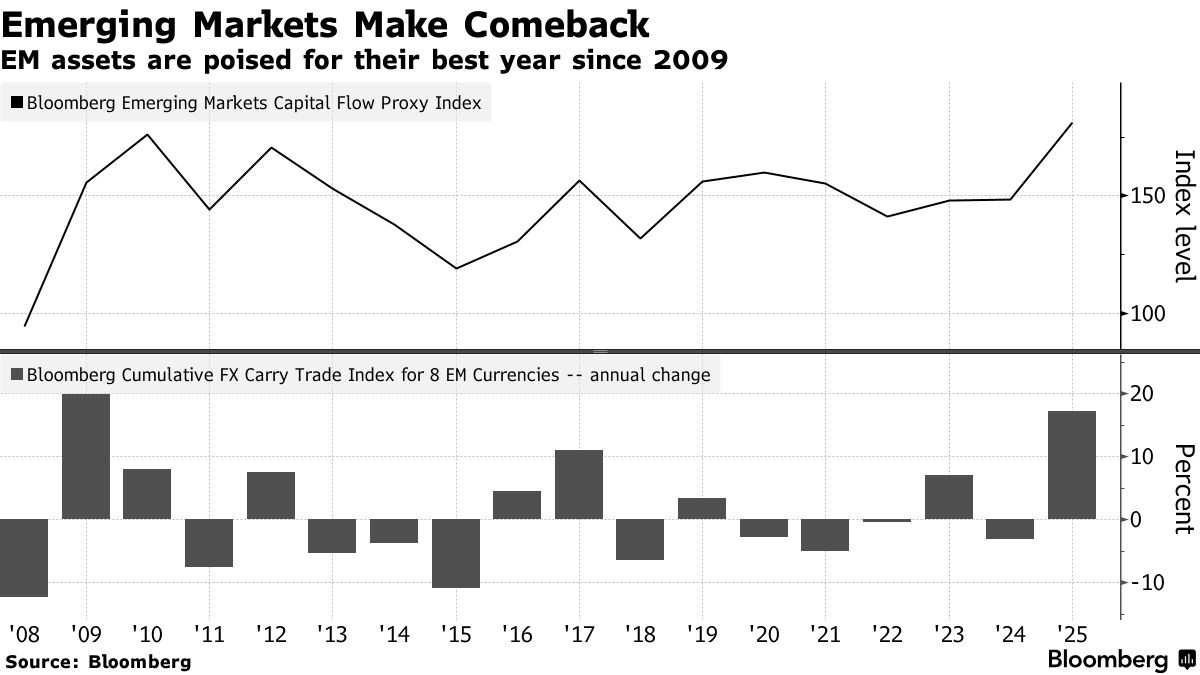
悲观论者“绝迹”!新兴市场证券创16年来最佳表现 华尔街押注“资金回流大周期”开启
智通财经网· 2025-12-22 00:34
Core Viewpoint - Emerging markets are expected to become favored by Wall Street by early 2026, with asset management firms betting on a prolonged inflow cycle that has already begun [1][3] Group 1: Market Performance - Capital inflows into emerging markets this year have reached the best performance since 2009, indicating a shift in investor sentiment towards this previously underperforming asset class [1] - Emerging market stocks have outperformed U.S. stocks for the first time since 2017, and the yield spread between emerging market bonds and U.S. Treasuries has narrowed to the lowest level in 11 years [1] - JPMorgan forecasts that emerging market bond funds could see inflows of up to $50 billion next year, with expectations of price appreciation and yield benefits from local currency bonds [4] Group 2: Investor Sentiment - A recent investment conference by Bank of America revealed that nearly all investors are optimistic about emerging markets, with no significant pessimism reported [3] - AllianceBernstein's Sammy Suzuki noted a shift in perception, stating that questions about the investment value of emerging markets have diminished [3] - Gama Asset Management's Rajeev De Mello believes there is still room for significant over-allocation towards emerging markets [5] Group 3: Global Capital Flows - There is a potential fundamental shift in global capital flows, with portfolio managers eager to diversify away from the U.S. and attracted by progress in debt reduction and inflation control in developing countries [3] - Despite recent rebounds, the overall scale of capital inflows remains relatively small compared to previous outflows, indicating that emerging markets still have insufficient representation in global portfolios [4] Group 4: Risks and Challenges - The recent rebound in emerging markets may mask underlying vulnerabilities, particularly concerning the U.S. dollar, which has declined by 8% this year, providing support for emerging market assets [6] - Citigroup suggests that investors should only buy emerging market assets that can withstand a potential strengthening of the dollar [6] - As of mid-December, emerging market bond funds saw a significant inflow of $4 billion, marking the largest weekly inflow since July [7]


3?500亿美元大挪移! 摩根大通撤出美联储账户 转向猛买美债 真金白银押注降息延续
Zhi Tong Cai Jing· 2025-12-18 03:07
(原标题:3?500亿美元大挪移! 摩根大通撤出美联储账户 转向猛买美债 真金白银押注降息延续) 智通财经APP获悉,据美国媒体报道,华尔街金融巨头摩根大通(JPM.US)自2023年以来已从其在美联储 的账户中撤出近3500亿美元现金,并几乎将同等规模的资金用于累计配置美国政府所发行的国债。摩根 大通此举可谓旨在为利率长期下行以及长期较低利率做准备工作,以对冲未来利率下行对净利息收入 (NII/NIM)的挤压,对于有着"全球资产定价之锚"称号的10年期美债收益率,以及更长期限的美债收益 率的下行趋势而言可谓边际利好。 有媒体援引行业数据追踪机构BankRegData汇编的数据报道称,这家资产规模超过4万亿美元的超级商 业银行,将其在美联储账户的余额从2023年末的4090亿美元降至2025年第三季度的630亿美元。 与此同时,媒体报道称,摩根大通将其美国国债市场的持有量从2310亿美元大幅提高至4500亿美元,这 也意味着即使美联储在特朗普提名的鸽派主席主导下持续下调利率也能确保较高收益率。 因此摩根大通在用实际的资产配置"押注降息大概率还会继续下去,至少推动短端美债收益率回落持 续"。从"长期限美债收益率 ...
3500亿美元大挪移! 摩根大通撤出美联储账户 转向猛买美债 真金白银押注降息延续
智通财经网· 2025-12-18 03:05
Core Viewpoint - JPMorgan Chase has withdrawn nearly $350 billion in cash from its Federal Reserve account since 2023, reallocating a similar amount into U.S. government bonds to prepare for a long-term decline in interest rates, which is expected to benefit net interest income [1][2] Group 1: JPMorgan's Cash Withdrawal and Bond Investment - JPMorgan has reduced its Federal Reserve account balance from $409 billion at the end of 2023 to $63 billion by Q3 2025 [1] - The bank has increased its holdings in U.S. Treasury securities from $231 billion to $450 billion, indicating a strategy to secure higher yields even as the Federal Reserve continues to lower interest rates [1][2] Group 2: Interest Rate Trends and Market Expectations - The Federal Reserve raised interest rates above 5% in response to the highest inflation in 40 years, but is expected to begin lowering rates by the end of 2024 as inflation pressures ease [2] - The target range for the federal funds rate has been lowered to 3.50%–3.75%, the lowest level in three years, which impacts the interest earned on reserves held at the Federal Reserve [2] Group 3: Market Reactions and Predictions - Large banks like JPMorgan increasing their Treasury holdings can create sustained buying pressure, which may raise bond prices and lower yields, benefiting long-term Treasury yields [3] - Market expectations suggest that the Federal Reserve may lower rates twice in 2026, totaling a 50 basis point reduction, while JPMorgan's economists predict only one rate cut [3][4]
“存款搬家”入市潜力被低估了?
第一财经· 2025-12-17 14:24
随着存款利率持续下行、权益市场热度提升,面对大量定期存款到期,银行一方面将在重定价中迎来 负债成本进一步下降,另一方面则面临存款流失压力。而作为"存款搬家"的一个重要方向,今年以 来资本市场对这一趋势的关注和讨论不断升温。 有机构测算结果显示,如果综合考虑历史经验和当前超额储蓄情况,未来"存款搬家"入市的潜在规 模至少是万亿级的。从定期存款到期规模来看,2024年之前存入、2026年之后到期的规模超过60 万亿元。但也有机构人士提示称,社会财富流向资本市场是一个长期过程,应该理性看待。相比之 下,超30万亿元规模的理财产品离资本市场更近,含权类理财的未来空间更值得关注。 2025.12. 17 本文字数:3361,阅读时长大约5分钟 作者 | 第一财经 亓宁 "女士,您有一笔定期存款快要到期了,目前我行3年期存款利率最高能到1.75%,1万(元)起存, 额度有限。一万(元)以下是1.6%,您可以考虑办理续存。"近期,家住北京的扬子(化名)收到 了来自某股份行客户经理的电话提示。这笔资金是她两年前以2.35%的年利率存入这家银行,手机 银行显示,目前该行2年期定存利率只有1.4%。 "存款 搬家"潜力来自哪里 ...

躺赢时代终结,五年期大额存单“消失”!
Jin Tou Wang· 2025-12-04 09:44
六大行集体停售5年期的大额存单,躺赚利息的时代可能真的要终结了。 最近,工行、农行、中行、建行、交行和邮储六大行的 App 上,五年期大额存单统一"看不见了"。不 少客户打电话去问,柜面也普遍回复:五年期大额存单暂停售卖,具体恢复时间未定。 这类产品突然消失,引发讨论并不意外,因为对很多人来说,大额存单是"稳、利息还不错"的配置方 式。但从银行业内看,这件事既是"早就该发生",也确实反映了行业一个更深层的变化。 现在六大行在售的大额存单最多只有三年期的,但是额度有限,还必须拼手速才能抢到。而仅剩的三年 期产品利率普遍降到1.5%至1.75%,且额度也不富裕。据悉,工商银行三年期大额存单门槛更是提升至 100万元。 现在银行对存款的态度非常矛盾,既担心客户不存,因为这会导致客源流失,而且银行存贷业务是一体 的,存款不够就是竭泽而渔影响长期运营,但同时又害怕存的太多增加利息支出,要知道,今年前10个 月住户存款增加了11.39万亿,足以让很多银行谈钱色变了。在这个背景下,大规模的削减高利率的存 款产品,只保留活期和少部分低利率的存款产品就是目前的最优解了。 所以,至少有一点是可以确认,那就是在贷款没有完全恢复之前 ...
中金:股市与宏观背离的新视角
Xin Lang Cai Jing· 2025-11-05 23:56
Group 1 - The core viewpoint of the articles indicates a divergence between stock market performance and macroeconomic fundamentals, with a notable increase in the proportion of stock investments among risk assets, which may be a key driver supporting the stock market [1][3][4] - A new phenomenon observed is the decline in consumer spending inclination alongside an increase in investment inclination, which is historically rare and its sustainability remains to be seen [1][3] - The current market rally is characterized by a stable wealth level among residents, with the average urban household asset remaining relatively unchanged compared to previous market uptrends [4][9] Group 2 - The analysis suggests that the stock market's long-term performance cannot decouple from economic fundamentals, as a "reallocation" phase may precede corporate profit improvements [3][4] - The proportion of investors willing to invest in stocks has increased from 13.5% in Q2 2024 to 17.2% in Q3 2025, indicating a rising risk appetite among those already invested in risk assets [16][23] - The relationship between the choice to invest in stocks and overall income sentiment is weak, suggesting that the stock market's performance may not directly correlate with macroeconomic conditions [16][34] Group 3 - The current market rally has seen a significant increase in the proportion of investors choosing to invest in stocks, reaching 17.2%, which is above the 70th percentile since 2019 [34][35] - The stock market's support factors, which are less correlated with fundamentals, may continue to bolster the market, but uncertainties could also rise [34][35] - The potential for policy support to enhance income confidence and stabilize wealth levels is crucial for further stock market support, particularly in addressing debt resolution [34][35]

利率专题:2025,债券资产重估之年
Tianfeng Securities· 2025-10-22 08:13
1. Report Industry Investment Rating No relevant content provided. 2. Core View of the Report In 2025, the bond market has shifted from a unilateral bull market in 2024 to a continuous wide - range oscillation pattern. Since the third quarter, due to factors such as the "anti - involution" policy, the stock - bond "see - saw" effect, and the fund fee rate new - rule solicitation, the bond market has experienced overall value re - evaluation. Looking forward to the fourth quarter, there are both positive and negative factors in the bond market, and it is expected to show an oscillatory pattern with limited trend - based market opportunities [1][9]. 3. Summary According to the Directory 3.1 Macro - narrative Changes and the Re - evaluation of Bond Assets - **Overall Market Change**: The bond market has shifted from a unilateral bull market in 2024 to a wide - range oscillation pattern. Since the third quarter, influenced by factors like the "anti - involution" policy and the fund fee rate new - rule solicitation, bond market interest rates have fluctuated upwards, and bond assets have undergone comprehensive value re - evaluation. As of October 20, 2025, the yields of 1 - year, 10 - year, and 30 - year treasury bonds have all increased compared to the beginning of the year [9]. - **Deviation from Fundamental and Liquidity**: In the third quarter, the weak fundamentals and loose liquidity could not explain the bond market's fluctuations. The bond market was mainly driven by the "asset re - allocation" logic and the "re - inflation" expectation under the "anti - involution" policy. Regulatory policies also had an impact on the bond market [11]. - **Investor Behavior Change**: Since the third quarter, both residents and institutions have adjusted their asset allocation, reducing the proportion of bond assets and increasing the allocation of equity assets. This has had an impact on the bond market's capital supply [12]. 3.2 "Triple" Re - evaluation of Interest - rate Bonds - **Obvious Interest Rate Callback**: Since the third quarter, affected by policies and regulatory changes, the bond market sentiment has been under pressure, and the yields of long - term and ultra - long - term bonds have increased significantly. As of October 20, 2025, the 10 - year and 30 - year treasury bond yields are at relatively high levels in 2025 [17]. - **Widening of Term Spreads**: The term spreads of 10 - year - 1 - year and 30 - year - 10 - year treasury bonds have widened, and the yield curve has evolved towards a bear - steep state [18]. - **Increase in Variety Spreads**: The 10 - year China Development Bank bond - treasury bond spread has been re - evaluated. Under the influence of the fund fee rate new - rule solicitation, the redemption pressure of bond funds may increase, and the spread between China Development Bank bonds and treasury bonds may widen [23]. 3.3 Differentiation and Remodeling of Credit Spreads - **Relatively Resistant Short - term Credit**: Short - term credit bonds are relatively resistant to decline. The yield increase of medium - and short - term general credit bonds is mostly within 10BP, and the credit spread has slightly narrowed [25]. - **Re - emergence of the "Interest Rate Amplifier" Attribute of Tier 2 and Perpetual Bonds**: The yields of long - term Tier 2 and perpetual bonds have increased significantly, and the current credit spread quantile is above 90% [25]. - **Value Remodeling of Long - term General Credit Bonds**: Under the influence of the fund fee rate new - rule solicitation, the demand for long - term general credit bonds is weak, and the adjustment range of ultra - long - term credit bonds is relatively large [25]. 3.4 High Premium Rate in the Convertible Bond Market - **Overall High Value in the Third Quarter**: In the context of the overall re - evaluation of the bond market, the valuation system of convertible bonds is also being remodeled, and their value in the third quarter is at a relatively high historical level [27]. - **Stable Average Pure Bond Value and Rising Pure Bond Premium Rate**: The pure bond value of the convertible bond market in the third quarter has remained stable, while the pure bond premium rate has risen, indicating that the equity nature of convertible bonds is stronger than the bond nature [27]. - **Increased Average Conversion Value and Relatively High Conversion Premium Rate**: The average conversion value of the whole market has increased, and the conversion premium rate is at a relatively high historical level [28]. 3.5 Tariff Hedging vs. Macro - narrative: Which Will Prevail? - **Fourth - quarter Bond Market Review**: In October, the bond market usually fluctuates greatly, and it is an important window for the introduction of fourth - quarter growth - stabilization and credit - easing policies. From November to December, the bond market usually enters a repair period [38]. - **Positive Factors for the Bond Market**: Tariff disturbances may bring hedging sentiment and easing expectations; the policy effect in the fourth quarter may weaken, and economic growth may slow down; the capital market is balanced and stable, and the central bank's supportive attitude remains; the bond market odds have improved, and the attractiveness to allocation - type funds may increase [3][41]. - **Negative Factors for the Bond Market**: The implementation of the fund sales fee rate reform may trigger redemption and position - adjustment behaviors; the "re - inflation" expectation and macro - narrative changes under the "anti - involution" policy may have a long - term impact on the bond market [3]. - **Outlook for the Bond Market**: In the fourth quarter, the bond market is expected to show an oscillatory pattern with a trading range for the 10 - year treasury bond yield between 1.7% - 1.9%. However, due to various factors, it is difficult to have a trend - based market [48].
高盛:中国股市将进入更为持久的上涨阶段,关注同类中更多人选择的中证A500ETF(159338)
Mei Ri Jing Ji Xin Wen· 2025-10-22 06:55
Core Viewpoint - Goldman Sachs predicts that the Chinese stock market will enter a more sustained upward phase, with key indices expected to rise by approximately 30% by the end of 2027, driven primarily by a 12% growth in earnings trends and a further revaluation potential of 5%-10% [1] Group 1 - Chinese stocks are still deeply discounted relative to global markets, with potential asset reallocation in China amounting to several trillion dollars [1] - Current market sentiment is influenced by the US-China rivalry, which suppresses risk appetite, and investors may need to wait for uncertainties to dissipate [1] - Key upcoming events such as the Fourth Plenary Session, the Federal Reserve's interest rate meeting, and the APEC summit are focal points for market participants regarding potential US-China leadership meetings [1] Group 2 - In the medium to long term, the bull market is unlikely to end, and any market corrections may present good opportunities for asset allocation [1]

上市公司控存款、增理财 机构预测千亿资金将搬家
Di Yi Cai Jing· 2025-09-22 01:31
Core Viewpoint - The trend of "deposit migration" among residents is increasing, with a significant shift of funds from traditional bank deposits to wealth management products and securities investments, driven by declining deposit rates and the attractiveness of financial markets [1][4][8]. Group 1: Deposit Trends - In August, new resident deposits increased by 110 billion yuan, a year-on-year decrease of 600 billion yuan, marking two consecutive months of negative growth [1]. - Non-bank deposits saw an increase of 1.18 trillion yuan in the same month, showing a substantial year-on-year growth despite a month-on-month decline [1]. - The trend of deposit migration is expected to continue, with an estimated scale of hundreds of billions of yuan moving into wealth management products over the next year [1][8]. Group 2: Corporate Wealth Management - Over the past year, listed companies have shown a structural change in their use of idle funds, with a decrease in the proportion of deposit products and a slight increase in bank wealth management and stock products [2]. - The total amount of wealth management products subscribed or planned by listed companies reached 3.734 trillion yuan, with 56.29% of this amount allocated to deposit products [2]. - The proportion of funds allocated to wealth management products has increased significantly, from 15.16% in the previous period to 28% in the current period [2]. Group 3: Investment in Securities - Some companies have increased their investments in secondary market stock-related products, with over 10 billion yuan invested in stock products in the past year [3]. - Companies like Liou Co. and Jilin Aodong have announced plans to invest significant amounts in securities, including new stock subscriptions and other investment activities [3]. Group 4: Market Conditions - The continuous decline in deposit rates has led to a lower yield on public deposits, with rates dropping to around 1% from over 3% in 2020 [6][8]. - The average annualized yield of bank wealth management products has reached 2.12%, creating a significant yield gap compared to deposit products [7][8]. - Asset management institutions are actively entering the corporate wealth management market, responding to the demand for safer and more liquid investment options [7][8].


