
反内卷政策

Search documents
德意志银行熊奕:创新能力和经贸竞争力强劲 中国经济增长动能持续增强
Shang Hai Zheng Quan Bao· 2026-01-15 18:01
在熊奕看来,从表现亮眼的港股与A股,到国际市场热烈讨论的"中国竞争力",都印证了这一变化。中 国的创新能力和在国际经贸体系中的竞争力,在过去一年获得了重新评估,并将成为中国经济未来发展 源源不断的动力。 站在"十五五"开局之际,熊奕着眼于中国经济长期的结构性变化,从供给、需求和货币三个维度阐述其 对于上述问题的思考。 创新能力和经贸竞争力获重估 从供给端来看,熊奕表示,中国的创新能力和在国际经贸体系中的竞争力,在过去一年中获得了重新评 估。 一方面,当前高质量人才储备建设是中国经济供给侧日益增长的竞争优势之一。"中国每年培养的工程 师数量在全球遥遥领先,在顶尖AI研究专家中,近半数本科毕业于中国高校。这些人力资本的深厚积 累,是中国创新能力持续增强的根本。"熊奕说。 竞争力不止来自人才,完整的市场生态和供应链体系同样关键。熊奕以中国智能手机行业的崛起为例表 示,得益于安卓系统的开放契机,大量企业依托中国庞大市场、快速迭代的消费需求和完善供应链展开 充分竞争,加速了知识流动与行业水平提升,最终使中国从行业追赶者成长为全球领先者之一。 熊奕表示,"大量顶尖人才""充分竞争的企业群体""超大且快速迭代的市场""高效 ...
小摩研判中国股市一季度行情:春季攻势12月提前启动,从结构性行情向全面性行情推进
Zhi Tong Cai Jing· 2026-01-15 14:08
Group 1 - The core viewpoint of the articles indicates that the A-share and Hong Kong stock markets are experiencing a significant turning point, with a shift from value/defensive stocks to growth and cyclical sectors, driven by macroeconomic recovery, policy support, improved liquidity, and easing geopolitical tensions [1][10] - Morgan Stanley maintains its core index target for MSCI China at 100 points (17% upside) and an optimistic target of 120 points (41% upside), while the CSI 300 index targets are set at 5200 points (10% upside) and 6000 points (27% upside) [2] - The shift in market style has been validated, with growth sectors such as communication services, information technology, and healthcare showing strong performance since mid-December, while A-share market turnover increased by 0.9 percentage points from November to December [2][3] Group 2 - Morgan Stanley upgraded its investment rating for consumer discretionary and healthcare sectors from "neutral" to "overweight," alongside previously upgraded sectors like communication services and information technology, forming a clear growth and cyclical allocation strategy [3][4] - The logic behind the overweight sectors includes recovery in consumer demand driven by policy implementation and rising income expectations, as well as the acceleration of innovative drug development in healthcare [4] - Key recommended stocks include leading companies across various sectors, such as NetEase, Baidu, and Pinduoduo in internet technology, Kweichow Moutai and Haitian Flavoring in consumer, and CATL and Zijin Mining in cyclical growth [4] Group 3 - The "4+1" thematic trading framework is expected to gain momentum in the first quarter of 2026, with multiple catalysts [5][6] - Key areas of focus include stable U.S.-China relations benefiting leading exporters, accelerated AI infrastructure and energy storage demand, and recovery in industries affected by overcapacity [6] - The real estate sector is expected to stabilize due to comprehensive support policies, with measures like lower mortgage rates and funding for project completion driving supply-demand balance [6] Group 4 - Morgan Stanley identifies two main sources of capital inflow supporting the Chinese stock market: the maturity of approximately 57% of onshore deposits in 2026 and the expanding trade surplus, which is projected to reach $1.1 trillion in 2025 [7][8] - The macroeconomic outlook is positive, with GDP growth rates expected to be 5.0% in 2025 and 4.5% in 2026, alongside the best earnings growth cycle since 2020 for MXCN and CSI 300 [8] - The easing of geopolitical tensions and the commencement of a U.S. interest rate cut cycle are anticipated to attract foreign capital inflows, with $27 billion in foreign net inflows recorded in December 2025 [8]
碳酸锂、多晶硅、工业硅日报-20260115
Tian Fu Qi Huo· 2026-01-15 12:01
Report Summary 1. Report Industry Investment Rating No industry investment rating is provided in the report. 2. Report Core View The report analyzes the market trends, core logics, technical aspects, and provides strategy suggestions for three commodities: lithium carbonate, polysilicon, and industrial silicon futures. It also lists the subsequent focus points for each commodity. 3. Summary by Commodity Lithium Carbonate - **Market Trend**: The lithium carbonate futures fluctuated. The main 2605 contract rose 0.79% from the previous trading day's closing price, reaching 163,220 yuan/ton [1]. - **Core Logic**: After the exchange's regulatory intervention on the 13th, market sentiment cooled. The sharp rise at the beginning of the week was due to the export tax - rebate policy, which might prompt battery companies to stock up, and the booming domestic energy - storage project bidding. However, the continuous decline in positions may lead to a risk of concentrated profit - taking by long positions [1]. - **Technical Analysis**: It is still controlled by long positions. The 5 - minute and overnight 2 - hour cycles show certain trends, with the long - short dividing line at 143,420 yuan/ton. The continuous decline in positions requires caution [2]. - **Strategy Suggestion**: In the context of "strong reality and strong expectation", the operation should be mainly to go long on dips. Avoid chasing highs directly and find good entry points according to certain methods. Listen to the 8:30 morning live - broadcast for specific operations [2][3]. - **Follow - up Focus**: The actual progress of battery exports in the first quarter, the recovery of new energy vehicle sales after subsidy extension, and the actual impact of geopolitical situations on lithium ore supply [4][5]. Polysilicon - **Market Trend**: The polysilicon futures continued to decline. The main 2605 contract fell 0.56% from the previous trading day's closing price, reaching 48,670 yuan/ton [10][12]. - **Core Logic**: After the market supervision department's约谈, the silicon material price will return to cost - based competition. The supply and demand are both weak, and the inventory is at a three - year high. The futures price may continue to fluctuate weakly, and it has reached a six - month low [12]. - **Technical Analysis**: The positions continued to decline. The 5 - minute and overnight 2 - hour cycles show certain trends, with the long - short dividing line at 53,610 yuan/ton [12]. - **Strategy Suggestion**: Wait for low - buying opportunities after stabilization as the decline amplitude is narrowing [12]. - **Follow - up Focus**: The subsequent policy direction of "anti - involution" [13]. Industrial Silicon - **Market Trend**: The industrial silicon futures fluctuated. The 2605 contract decreased 0.29% from the previous trading day's closing price, reaching 8,730 yuan/ton [16]. - **Core Logic**: It is controlled by short positions. The supply and demand are both weak, the downstream procurement is sluggish, and the inventory is at a three - year high. There is cost support below, and it is expected to continue to fluctuate in the short term [16]. - **Technical Analysis**: The overall positions continued to decline. The 5 - minute and overnight 2 - hour cycles show certain trends, with the long - short dividing line at 8,815 yuan/ton [16]. - **Strategy Suggestion**: In the middle of the oscillation range, short on rebounds. Long - term attention should be paid to the impact of polysilicon's return to cost - based pricing on industrial silicon. Refer to the band winner indicator in the 8:30 morning live - broadcast for intraday operations [16]. - **Follow - up Focus**: The subsequent policy direction of "anti - involution" [17].
利好政策延续!外资投资境内债券利息收入继续免征所得税和增值税
Xin Lang Cai Jing· 2026-01-15 10:11
Group 1 - The Ministry of Finance and the State Taxation Administration announced a temporary exemption from corporate income tax and value-added tax on interest income from bonds obtained by foreign institutions investing in the domestic bond market from January 1, 2026, to December 31, 2027 [1] - The exemption does not apply to interest income from bonds related to institutions or places established by foreign entities within China [1] - Recent activities include the issuance of 1.5 billion yuan panda bonds by Henkel Group in the interbank bond market, and Barclays Bank initiating a 4 billion yuan panda bond issuance, indicating foreign capital's recognition of RMB bond assets [1] Group 2 - Foreign institutional investors are collectively optimistic about Chinese assets, with Goldman Sachs projecting a 4.8% growth in China's real GDP for 2026, surpassing the market consensus of 4.5% [2] - The MSCI China Index and the CSI 300 Index are expected to rise by 20% and 12% respectively within the year, with a potential 38% increase in the Chinese stock market by the end of 2027 [2] - UBS forecasts an increase in A-share earnings growth from 6% in 2025 to 8% in 2026, driven by nominal GDP growth, corporate revenue increases, supportive policies, and the promotion of "anti-involution" policies [2] Group 3 - China is intensifying efforts to stabilize foreign investment, with a national foreign investment work conference held on January 14-15, 2026, emphasizing the promotion of foreign investment and the creation of an "Invest in China" brand [3] - The "Encouragement of Foreign Investment Industry Catalog (2025 Edition)" will expand to 1,679 items, guiding foreign investment towards advanced manufacturing, modern services, and high-tech sectors, particularly in central and western regions, Northeast China, and Hainan [3] - Investments in these areas will benefit from incentives related to tariffs, land use, and taxes [3]
化工行业ETF易方达(516570)上涨2.05%,冲击3连涨,“反内卷”政策发力改善供需,化工行业盈利修复路径清晰
Xin Lang Cai Jing· 2026-01-15 03:58
Group 1 - The chemical industry is experiencing a strong upward trend, with the Zhongzheng Petrochemical Industry Index rising by 1.90% and the E Fund Chemical Industry ETF increasing by 2.05%, indicating a significant market movement [1] - Tianfeng Securities highlights that the chemical industry has entered a historical bottom phase, with supply-side adjustments gaining weight under the "anti-involution" policy, shifting the focus from capacity expansion to stock optimization [1] - Key sub-sectors such as coal chemical, organic silicon, spandex, and pesticides are expected to achieve a supply-demand reversal, supported by technological upgrades and high-value product layouts, leading to potential profit recovery for leading enterprises [1] Group 2 - Guangfa Securities anticipates that the chemical industry will enter a phase of profit cycle reversal, driven by the advancement of anti-involution policies, a decline in capital expenditure, and the onset of overseas interest rate cuts [1] - In growth areas, the solid-state battery industrialization is approaching, and the trend of upgrading new battery materials like sulfides is clear, positioning them as important development directions within the lithium battery supply chain [1] - The E Fund Chemical Industry ETF (516570) offers a cost-effective investment option with a management and custody fee rate of 0.15% + 0.05% per year, significantly lower than similar ETF products in the petrochemical sector, thus reducing investor costs [2]
化工行业供需格局发生边际改善,化工ETF嘉实(159129)聚焦化工板块投资机遇
Xin Lang Cai Jing· 2026-01-15 03:52
Group 1 - The chemical materials and fine chemicals sectors experienced a strong rally, with the CSI sub-index for the chemical industry rising by 2.11% as of 10:36 AM on January 15, 2026, with notable stock performances including Hongda Co. up 8.95%, Guangdong Hongda up 6.06%, and Yuntianhua up 4.64% [1] - Since 2021, high prices of chemical products have led to increased capital expenditures by petrochemical and chemical companies, initiating a new round of capacity expansion. However, from 2022 onwards, as new capacities were released and oil prices fell from their peaks, many chemical product prices have continued to decline, resulting in decreased profitability for some companies [1] - Starting in 2024, most chemical product prices are stabilizing at the bottom, and while corporate profitability remains under pressure, the introduction of growth stabilization plans is expected to lead to the elimination of some outdated capacities, improving the overall supply-demand dynamics in the industry and enhancing product profitability [1] Group 2 - Guohai Securities suggests that the anti-involution policy may lead to a re-evaluation of the Chinese chemical industry, with a significant slowdown in global capacity expansion expected. The Chinese chemical industry has ample net cash flow from operating activities, and the slowdown in capacity expansion is likely to enhance potential dividend yields, shifting the industry from a capital-consuming model to a profit-returning one [1] - The optimization of the supply side is anticipated to drive a recovery in industry sentiment, with chemical stocks exhibiting high elasticity and dividend advantages [1] - As of December 31, 2025, the top ten weighted stocks in the CSI sub-index for the chemical industry accounted for 45.31% of the index, including companies like Wanhua Chemical and Yanhua Co. [2]




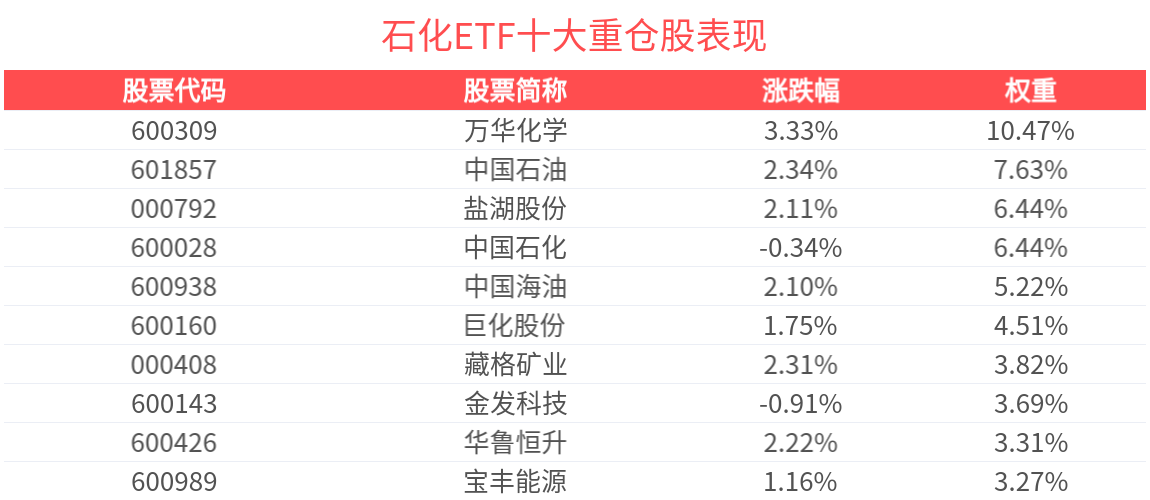
涨超1.4%,石化ETF(159731)冲击3连涨,连续6日合计“吸金”1.25亿元
Xin Lang Cai Jing· 2026-01-15 02:17
Group 1 - The core viewpoint of the articles highlights a strong performance in the petrochemical sector, with the China Petrochemical Industry Index rising by 1.76% and significant gains in individual stocks such as Guangdong Hongda and Yuntianhua [1][2] - The Petrochemical ETF (159731) has seen a continuous inflow of funds, totaling 125 million yuan over the past six days, reaching a new high in size at 379 million yuan [1] - The Petrochemical ETF has achieved a net value increase of 51.84% over the past two years, with a maximum monthly return of 15.86% since its inception [1] Group 2 - Guohai Securities indicates that anti-involution policies are expected to re-evaluate the Chinese chemical industry, with a significant slowdown in global chemical capacity expansion [2] - The Chinese chemical industry is characterized by ample operating cash flow, and the slowdown in capacity expansion is anticipated to enhance potential dividend yields, shifting the industry from capital consumption to profit return [2] - Key sectors to focus on include petrochemicals, coal chemicals, organic silicon, phosphate chemicals, and glyphosate, with leading companies entering a long-term performance upcycle [2]

黑色金属专场-2026年年度策略会议-恒中有变-观复顺时
2026-01-15 01:06
黑色金属专场 - 2026 年年度策略会议 · 恒中有变,观复 顺时 20260114 摘要 2025 年房地产市场疲软,投资、销售和新开工面积大幅下降,对钢材 需求形成拖累,一线城市房价下跌加剧市场情绪冲击。 预计 2026 年房地产政策以稳定为主,但内生动能不足,主要指标延续 下降趋势,房地产用钢需求预计下降 10%左右,但边际影响减小。 2025 年基建投资增速不及预期,今年预计基建投资增速在 5%左右,用 钢需求与去年基本持平,对钢材需求形成一定支撑。 制造业整体表现优于建筑业,两新政策和反内卷政策有望推动 PPI 回升, 改善工业企业利润,预计 2026 年制造业用钢需求增长约 2%。 钢材出口大幅上升,预计全年出口接近 1.2 亿吨,创历史新高,但面临 反倾销调查和贸易摩擦加剧等挑战,2026 年出口增速可能放缓。 2026 年国内粗钢产量预计下降约 1%,供应总体偏宽松,炉料价格中枢 下移,吨钢利润可能边际修复,整体供需格局偏宽松,以震荡筑底为主。 预计 2026 年铁矿石全球供应增量约 4,200 万吨,中国进口增量保持高 位,但国内需求可能下滑,港口库存将继续累积,61 指数均价约 92 美 ...
热卷日报:震荡整理-20260114
Guan Tong Qi Huo· 2026-01-14 11:13
Report Industry Investment Rating - Not provided Core Viewpoints - The current production pressure of hot-rolled coils is not significant. The anti-involution policy still has expectations, providing strong support at the bottom. Although the weekly apparent consumption has slightly declined, it remains strong year-on-year. It is normal for the demand to decline slightly in the off-season. The warming up of winter storage sentiment may drive a wave of demand. The total inventory is relatively high, exerting some pressure. The hot-rolled coil futures have briefly fallen below the 5-day moving average, and attention should be paid to the support near the 10-day and 20-day moving averages. It is recommended to adopt a cautiously bullish approach and consider buying on dips. However, note that the oscillation range has not been completely broken yet [5]. Summary by Relevant Catalogs Market行情回顾 - Futures prices: On Wednesday, the open interest of the main hot-rolled coil futures contract increased by 8,625 lots, with a trading volume of 309,018 lots, showing a decline compared to the previous trading day. The intraday low was 3,297 yuan, and the high was 3,316 yuan. It showed an intraday increase in open interest and oscillated. In terms of the daily moving average, it briefly fell below the 5-day moving average but remained above the 10-day and 20-day moving averages, closing at 3,306 yuan/ton, down 3 yuan/ton, a decrease of 0.09% [1]. - Spot prices: The price of hot-rolled coils in the mainstream Shanghai area was reported at 3,290 yuan/ton, remaining stable compared to the previous trading day [2]. - Basis: The futures-spot basis was -16 yuan, with the futures slightly at a premium to the spot [3]. Fundamental Data - Supply: As of January 8, the weekly output of hot-rolled coils increased by 10,000 tons to 3.0551 million tons compared to the previous week. It was 16,200 tons higher year-on-year. The output has rebounded for three consecutive weeks, mainly due to the improvement in steel mill profitability, increased production enthusiasm, the transfer of some steel mill hot metal from building materials to plates, and the intensified resumption of production after the end of the annual maintenance of steel mills, driving the supply to recover. The subsequent recovery strength needs to be observed [4]. - Demand: As of January 8, the weekly apparent consumption decreased by 24,300 tons to 3.0834 million tons compared to the previous week. The apparent demand slightly declined, but it was 72,500 tons higher year-on-year, indicating that the demand still has resilience [4]. - Inventory: As of January 8, the total inventory decreased by 28,300 tons to 3.6813 million tons compared to the previous week (the social inventory increased by 21,700 tons, and the steel mill inventory decreased by 50,000 tons, resulting in a total inventory decrease of 28,300 tons). The total inventory continued to be destocked, but the destocking amplitude narrowed. The total inventory is at a high level in the past five years, and the inventory still exerts a suppressing effect on prices [4]. - Policy: The new regulations on the export license management of steel products have been introduced. In the short term, it will lead to fluctuations in exports, an increase in supply, and price pressure. In the long term, it will promote industrial upgrading, structural optimization, and competitiveness improvement. The Central Economic Work Conference held in December proposed an active fiscal policy and a moderately loose monetary policy. Deeply rectifying involution-style competition was listed as a key task for 2026, which is beneficial to prices and industry profitability. Efforts will be made to stabilize the real estate market and expand domestic demand [4]. Market Driving Factor Analysis - Bullish factors: A decline in supply-side production, the expectation of the start of winter storage demand, the rush to export, policy support ("14th Five-Year Plan", infrastructure investment), and the strength of iron ore as a furnace charge [5]. - Bearish factors: The resumption of production by steel mills in January exceeded expectations, the seasonal weakening of demand, insufficient manufacturing orders, and the suppression of prices by inventory accumulation [5].
化工龙头ETF(516220)盘中涨超1%,行业供需格局引关注
Mei Ri Jing Ji Xin Wen· 2026-01-14 06:23
Core Viewpoint - The anti-involution policy is expected to reassess the Chinese chemical industry, leading to a significant slowdown in global chemical capacity expansion [1] Group 1: Industry Outlook - The Chinese chemical industry has abundant net operating cash flow, and the slowdown in capacity expansion will significantly enhance potential dividend yields, shifting the industry from a capital consumption model to a profit return model [1] - Supply-side optimization is anticipated to drive a rebound in industry prosperity, with chemical stocks exhibiting high elasticity and high dividend advantages [1] - Key areas of focus include petrochemicals, coal chemicals, organic silicon, phosphate chemicals, and glyphosate [1] Group 2: Opportunities and Trends - The industry presents four major opportunities: low-cost expansion, improvement in prosperity, breakthroughs in new materials, and high-dividend stocks [1] - The chromium salt industry is experiencing a value reassessment due to increased power demand from AI data centers and commercial aircraft engine demand, with a projected supply-demand gap of 340,900 tons by 2028, representing a 32% gap ratio [1] Group 3: Investment Index - The chemical leader ETF (516220) tracks the sub-sector chemical index (000813), which selects listed companies focused on the manufacturing of fertilizers, pesticides, and plastic products to reflect the overall performance of related listed companies in the chemical industry [1] - This index features cyclical and growth characteristics, concentrating on investment opportunities within the chemical sub-sectors [1]