
货币宽松

Search documents
金荣中国:美国地区银行再现危机,金价破位上行单边走高
Sou Hu Cai Jing· 2025-10-17 03:01
Market Overview - International gold prices saw a significant increase, opening at $4,190.53 per ounce and closing at $4,273.52 per ounce, with a peak of $4,275.99 per ounce on October 16 [1] Economic Indicators - The Philadelphia Fed Manufacturing Index for October recorded -12.8, falling short of the market expectation of 8.5 and down from the previous value of 23.2 [3] - New York Fed reported a decline in service sector activity, with the index dropping 4.2 points to -23.6, marking the worst performance since January 2021 [3] - Employment indicators in the New York region have declined for two consecutive months, reflecting a deteriorating business environment [3] Federal Reserve Insights - Federal Reserve Governor Waller supports further rate cuts later in the month, but notes significant uncertainty due to the government shutdown and lack of official economic data [4] - Waller highlighted conflicting signals in the economic outlook, with strong growth but a tightening labor market [4] Commodity Outlook - HSBC's commodity outlook report suggests that gold's upward momentum may continue until 2026, driven by strong central bank purchases, ongoing fiscal concerns in the U.S., and expectations of further monetary easing [5] - The report emphasizes that the U.S. fiscal deficit is a key driver of gold demand, as investors increasingly view gold as a hedge against debt sustainability risks [5] Banking Sector Concerns - U.S. regional banks are facing renewed crises, with Zions Bancorp and Western Alliance Bancorp reporting significant stock price declines due to loan fraud related to bad commercial mortgages [6] - The KBW Bank Index fell by 3.6% following these developments [6] Consumer Spending Trends - Recent data indicates a slowdown in U.S. consumer demand, with spending on non-essential items like furniture and electronics decreasing [8] - Economic analysts note a trend of reduced retail activity following a strong growth period earlier in the year [8] Government Shutdown - The U.S. Senate failed to advance a temporary funding bill, resulting in a continued government shutdown, with the Republican party needing 60 votes to proceed [9] Geopolitical Developments - President Trump announced productive discussions with President Putin regarding the Ukraine conflict and future trade relations, indicating ongoing diplomatic efforts [10] - The SPDR Gold Trust saw an increase in holdings by 12.02 tons, the largest increase in a month, bringing total holdings to 1,034.62 tons [10] Upcoming Economic Data - Key economic indicators to be released include Eurozone CPI, U.S. new housing starts, building permits, and industrial production [11]


A股指数集体低开:沪指跌0.11%,液态金属、培育钻石等板块跌幅居前
Feng Huang Wang Cai Jing· 2025-10-17 01:38
Market Overview - The three major indices in China opened lower, with the Shanghai Composite Index down 0.11%, the Shenzhen Component down 0.20%, and the ChiNext Index down 0.36% [1][2] - The liquid metal, HBM, and cultivated diamond sectors experienced significant declines [1] External Market - U.S. stock indices closed lower, with the Dow Jones down 301.07 points (0.65%) at 45,952.24 points, the Nasdaq down 107.54 points (0.47%) at 22,562.54 points, and the S&P 500 down 41.99 points (0.63%) at 6,629.07 points [3] - The Nasdaq Golden Dragon China Index fell by 0.91%, with most popular Chinese concept stocks declining, including Century Internet down over 5% and Kingsoft Cloud down over 2% [3] Industry Insights - CITIC Securities highlighted the "Three-Year Doubling" plan for electric vehicle charging infrastructure, aiming to establish 28 million charging facilities by the end of 2027, which will significantly boost demand for high-power fast charging equipment [4] - CITIC Jiantou noted that the capital market may see a rotation of sectors in the short to medium term (2025-2026), focusing on opportunities in elderly care, infrastructure, and new consumption sectors [5] - Huatai Securities indicated that the aviation sector is expected to maintain a positive outlook, with passenger load factors improving and ticket prices showing signs of recovery [6] - China Galaxy Securities suggested that monetary easing in the fourth quarter may exceed expectations, driven by economic data showing signs of weakness and the need for lower interest rates to support growth [7]

中国银河证券:四季度货币宽松或超预期
Di Yi Cai Jing· 2025-10-17 00:08
Core Viewpoint - The report from China Galaxy Securities indicates that monetary easing in the fourth quarter may exceed expectations due to signs of economic weakening in the third quarter and the onset of a new policy waiting period [1] Group 1: Economic Indicators - There are signs of weakening in the third quarter economic data, leading to a lack of consensus on interest rate cuts for the fourth quarter [1] - The challenges of low price levels and high real interest rates necessitate a potential reduction in rates [1] Group 2: Policy Measures - The government is expected to implement coordinated fiscal policies, with 500 billion yuan in policy financial tools accelerating deployment and around 1 trillion yuan in debt-related tools potentially being introduced in the fourth quarter [1] - The primary goals of monetary policy in the fourth quarter will focus on economic growth and full employment, suggesting that monetary easing may be more aggressive than anticipated [1] Group 3: Central Bank Actions - The central bank is likely to adopt a proactive approach to monetary easing, potentially implementing a 10-20 basis point interest rate cut to guide the Loan Prime Rate (LPR) downward, which would further reduce loan and deposit rates [1] - There is also a possibility of restarting government bond transactions as part of the monetary policy strategy [1]

固收-债市“收官战”,预计Q4债市表现优于Q
2025-10-16 15:11
Summary of Conference Call on Bond Market Outlook Industry Overview - The conference call focuses on the bond market, specifically the performance and outlook for the fourth quarter of 2025. Key Points and Arguments Bond Market Performance - The bond market experienced a prolonged adjustment in Q3, with a minor decline in yields, contrasting with the rapid adjustments seen at the beginning of the year [1][3] - It is anticipated that the bond market will perform better in Q4 compared to Q3, with the 10-year government bond yield expected to reach 1.7% initially, and potentially drop to 1.65% if it breaks through [1][4] Economic Indicators - China's economy showed a quarter-on-quarter growth of over 1% and a year-on-year growth exceeding 5% in the first three quarters, indicating that the economy has not significantly weakened [1][5] - A low interest rate environment is aligned with the current economic fundamentals, but further weakening of the fundamentals is necessary for lower interest rates [1][5] Impact of U.S.-China Trade Tensions - Ongoing uncertainties regarding U.S.-China trade tensions could affect the capital and bond markets, necessitating caution in investment strategies [1][6] - The market currently expects a tough stance from the Trump administration, but there is significant uncertainty regarding future trade policies [1][7] Market Dynamics - Trade tensions influence the bond market through equity market fluctuations and monetary easing [1][8] - The correlation between the equity and bond markets has weakened as the stock market rises above 3,900 points, indicating that further equity gains may have limited negative impacts on the bond market [1][8] Fund Sales and Redemption Fees - The most significant impact from increased fund sales and redemption fees has already passed, with redemption fees fully accounted for in fund assets, thus not significantly affecting overall market points [1][9] - However, certain bond types, such as long credit bonds, may still face some pressure [1][9] Future Outlook - The expected recovery range for Q4 is between 1.65% and 1.7%, with no significant risks or changes in odds currently visible [1][10] - A detailed outlook for 2026 will be provided in the annual strategy report [2][10]
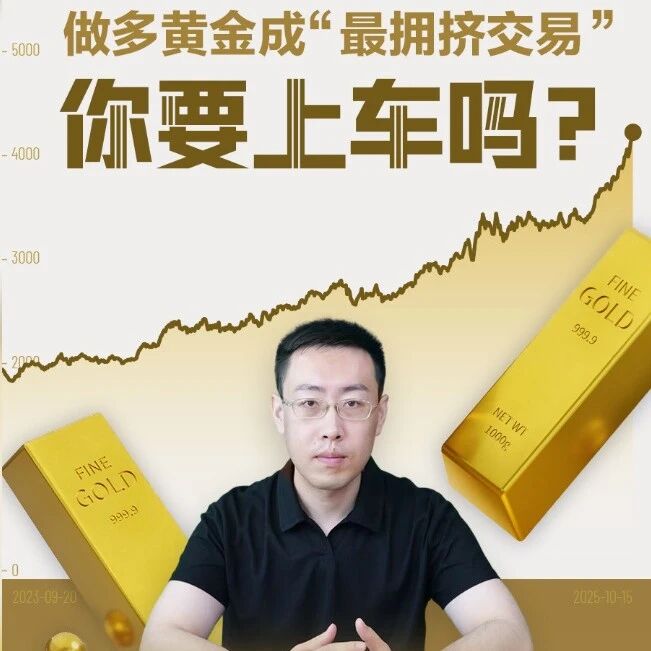
做多黄金成“最拥挤交易”,你要上车吗
2 1 Shi Ji Jing Ji Bao Dao· 2025-10-16 14:45
Core Viewpoint - The international spot gold price reached a historic high of $4,220 on October 16, with a weekly increase of $200, raising questions about whether this is the peak [1] Group 1: Market Sentiment - A recent Bank of America survey revealed that 43% of investors consider "going long on gold" to be the most crowded trade, surpassing the 39% for "long on the seven major U.S. stocks" [1] - Despite the crowded trade sentiment, 39% of fund managers reported near-zero gold positions, with an average allocation of only 2.4%, indicating a potential for further investment in gold [1] Group 2: Driving Factors - The dovish stance of the Federal Reserve is a key driver for the influx of capital into gold, with indications that monetary tightening may soon end, leading to increased liquidity in the financial system [2] - Heightened geopolitical risks and uncertainties in trade, including the U.S. government's announcement of increased tariffs, have prompted investors to seek gold as a safe haven [2] Group 3: Market Dynamics - The phenomenon of "crowded trades" can create a self-reinforcing cycle, where rising prices lead to increased buying, further driving up prices [2] - Goldman Sachs has significantly raised its gold price target for the end of 2026 by $600 to $4,900 per ounce, reflecting renewed confidence in gold's resilience [2] Group 4: Dual Market Peaks - The simultaneous historical highs in both gold and U.S. stocks represent a complex market scenario, characterized by extreme optimism in tech growth and deep concerns over macroeconomic risks [3] - This "dual peak" situation may persist, but investors should remain vigilant regarding key indicators such as U.S. inflation, employment, and economic growth data, which could influence future market directions [3]
国投期货贵金属日报-20251016
Guo Tou Qi Huo· 2025-10-16 14:45
Report Investment Ratings - Gold: ★☆★, indicating a short - term multi/empty trend in a relatively balanced state with poor operability on the current market, suggesting a wait - and - see approach [1] - Silver: ★☆☆, representing a bullish bias, with a driving force for an upward trend but poor operability on the market [1] Core Viewpoints - Overnight, gold and silver continued to be strong with large intraday fluctuations. The US government shutdown and tariff frictions increased market uncertainty, and the approaching end of the Fed's balance - sheet reduction strengthened the expectation of monetary easing. The medium - to - long - term upward logic of precious metals is solid, but in the short term, the rising speed of gold and silver is too fast, with obvious overbought signs on the disk and high volatility risks, so it is advisable to wait and see [1] - Fed Governor Milan called for an accelerated pace of interest - rate cuts, but the (single) rate - cut amplitude should not exceed 50BP, and he said that two more rate cuts this year are realistic; apart from gold, there is no risk premium in the market [1] Other Summaries US Economic Situation - The Federal Reserve said that US economic activity has changed little in recent weeks, and the employment level has generally remained stable. Overall consumer spending has declined slightly, while prices continue to rise, and several Fed districts reported an accelerated increase in input costs. The cost increase caused by tariffs has been reported in many districts, but the degree of transmission of these higher costs to final prices varies [2] International Events - The Trump administration authorized the CIA to conduct secret operations in Venezuela, and Trump confirmed this news. Trump threatened that if Hamas does not abide by the cease - fire agreement, Israel will resume operations at his order [2]
做多黄金成“最拥挤交易”,你要上车吗
21世纪经济报道· 2025-10-16 14:08
Core Insights - The article discusses the recent surge in gold prices, reaching a historical high of $4,220, with a notable increase of $200 within the week, raising questions about whether this is a peak [1] - A global fund manager survey by Bank of America indicates that 43% of investors view "going long on gold" as the most crowded trade, surpassing the 39% for "going long on the seven major U.S. stocks," suggesting a significant institutional shift towards gold [1] - Despite the crowded trade sentiment, many fund managers have low gold positions, with 39% reporting near-zero exposure and an average allocation of only 2.4%, indicating potential for further price increases as funds may still enter the market [1] Market Dynamics - The primary driver for the influx of capital into gold is the dovish stance of the Federal Reserve, signaling an end to the current monetary tightening cycle and a potential return to liquidity, which diminishes the attractiveness of the dollar [2] - Geopolitical risks and uncertainties in trade policies, such as increased tariffs from the U.S. government, have heightened global economic uncertainty, prompting investors to seek gold as a safe haven [2] - The phenomenon of "crowded trades" can create a self-reinforcing cycle, where rising prices lead to increased buying, further driving up prices, with institutions like Goldman Sachs projecting a significant increase in gold prices to $4,900 per ounce by the end of 2026 [2] Dual Market Behavior - The simultaneous rise of both gold and U.S. equities is a rare occurrence, reminiscent of the early 1970s, reflecting a complex investor sentiment that balances optimism in tech growth with deep concerns over macroeconomic risks [3] - This "dual peak" scenario may persist, but investors should remain vigilant regarding key economic indicators such as inflation, employment, and growth data in the U.S., which could influence future market directions [3]
信贷社融同步降温,货币宽松空间打开:金融数据速评(2025.9)
Huafu Securities· 2025-10-16 05:41
Credit and Financing Trends - New loans in September amounted to 1.29 trillion RMB, a year-on-year decrease of 300 billion RMB, with an average monthly decline of 3.067 billion RMB in Q3 compared to H1[2] - In September, new household loans totaled 389 billion RMB, down 111 billion RMB year-on-year, with short-term loans decreasing by 127.9 billion RMB[2] - New corporate medium to long-term loans reached 910 billion RMB, a slight year-on-year decrease of 50 billion RMB, indicating a stable growth trend amidst rising uncertainties in US-China trade relations[2] Social Financing and Monetary Policy - In September, total social financing reached 3.53 trillion RMB, but still saw a year-on-year decrease of 233.5 billion RMB due to a high base effect from the previous year[3] - New government bond financing was 1.19 trillion RMB, down 345.7 billion RMB year-on-year, reflecting a significant drop against last year's issuance peak[3] - M2 growth rate fell by 0.4 percentage points to 8.4% in September, while M1 surged by 1.2 percentage points to 7.2%[3] Economic Outlook and Risks - The divergence in credit and social financing remains unaddressed, with the real estate market still not bottoming out and local government debt pressures persisting[4] - The upcoming end of the second round of tariff easing in mid-November adds to the uncertainty in US-China trade, necessitating effective domestic demand stimulation[4] - A potential small interest rate cut of 10 basis points is anticipated to stabilize real estate market expectations and boost durable consumption[4]
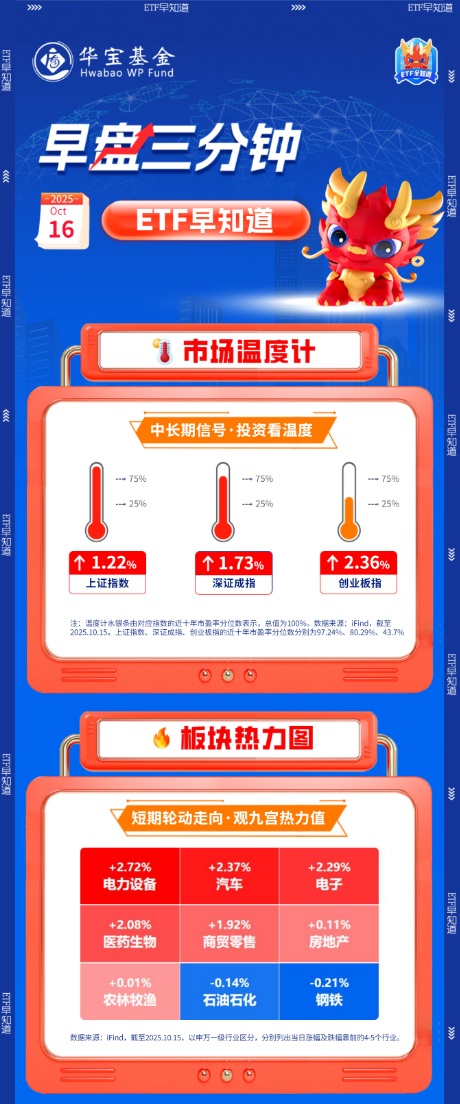
【盘前三分钟】10月16日ETF早知道
Xin Lang Ji Jin· 2025-10-16 01:12
Group 1 - The article highlights a potential rebound in the Hong Kong internet sector, driven by attractive valuations and the influence of AI technology, following indications from the Federal Reserve about possible interest rate cuts [4] - The Hong Kong internet index saw a significant increase of over 2% on October 15, 2025, reflecting a positive market sentiment towards internet stocks [4] - The food and beverage sector continues to show upward momentum, with the food and beverage index recording gains for two consecutive days, indicating a recovery in domestic demand [4] Group 2 - The top three sectors for capital inflow include pharmaceuticals with 2.548 billion, home appliances with 1.591 billion, and food and beverages with 0.597 billion [2] - The sectors experiencing the most significant capital outflow are non-ferrous metals at -4.939 billion, telecommunications at -2.096 billion, and defense and military at -1.717 billion [2] - The article notes that the food and beverage sector is characterized by low base, low holdings, and low expectations, suggesting that any changes in supply and demand could significantly impact stock prices [4]
国投期货贵金属日报-20251015
Guo Tou Qi Huo· 2025-10-15 14:38
Report Investment Ratings - Gold: ★☆☆, indicating a bullish bias but poor operability on the trading floor [1] - Silver: ★☆★, with the white star suggesting a relatively balanced short - term trend and poor operability, advising to wait and see [1] Core Viewpoints - Overnight, gold and silver fluctuated violently at historical highs, hitting new highs after a brief correction. Uncertainties in the market are intensified by the progress of Sino - US trade and the deadlock in the US government shutdown negotiations. Powell's speech boosts the expectation of monetary easing. The medium - to - long - term upward logic of precious metals is solid, and the upward trend will continue. However, in the short term, the rapid rise of gold and silver has led to obvious overbought signs on the trading floor, with high volatility risks, so it is advisable to wait and see [1] Summary by Related Information Fed Statements - Powell: The liquidity in the money market is gradually tightening, and the balance - sheet reduction may end in the next few months. Recent economic activity data is stronger than expected, but it has not translated into an improvement in recruitment, and the downside risk in the job market is rising. Acting too slowly on interest - rate cuts may suppress employment, while acting too fast may cause the inflation - fighting task to fail halfway. Despite the government shutdown, he believes there is enough information for the end - of - the - month interest - rate meeting but is worried about missing October data [2] - Bowman: Continues to expect two more interest - rate cuts by the end of this year [2] IMF World Economic Outlook Report - In 2025, the global economy is expected to grow by 3.2%, 0.2 percentage points higher than the July forecast; in 2026, it will grow by 3.1%, the same as the July forecast. Developed economies are expected to grow by 1.6% this year and next. The US and the Eurozone are expected to grow by 2% and 1.2% this year, and 2.1% and 1.1% next year respectively. Emerging markets and developing economies are expected to grow by 4.2% this year and 4% next year [3] - The main reason for the upward revision of the global economic growth forecast this year is that the economic impact of tariffs is less than expected, thanks to importers' advance purchases due to US tariff policies, trade agreements reached through negotiations between some countries and the US, and most countries' efforts to maintain the openness and stability of the global trading system. However, the high effective US tariff rate (about 19%) and trade policy uncertainties still cast a shadow over the global economy. The IMF expects global economic growth to slow down in the second half of this year, and the outlook is not optimistic [3]