
市场情绪

Search documents
黄金、比特币大震荡:传统投资逻辑不灵了?
2 1 Shi Ji Jing Ji Bao Dao· 2025-11-20 02:33
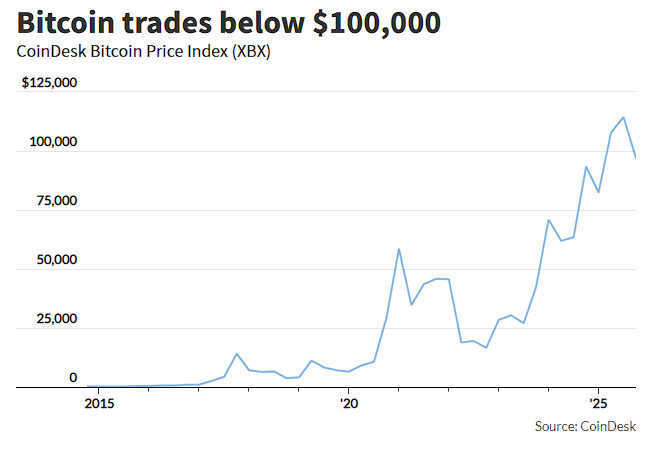
Group 1 - Bitcoin experienced a significant drop, falling below $90,000 for the first time in seven months after reaching a record high of over $126,000 on October 6 [1][2] - The decline in Bitcoin's price is attributed to changing macroeconomic expectations, particularly regarding the Federal Reserve's interest rate decisions, which have led to increased market uncertainty [2][3] - Institutional investors are reducing leverage and selling off high-risk assets like Bitcoin in response to rising funding costs, creating initial selling pressure [2][3] Group 2 - The anticipated favorable regulatory environment for cryptocurrencies has not materialized, leading to a loss of bullish sentiment in the market [3] - The simultaneous decline of gold, traditionally viewed as a safe-haven asset, is unusual and indicates a broader liquidity crisis in the market [4] - The strengthening of the US dollar and systemic tightening of liquidity have forced investors to liquidate various assets, including gold, to secure cash [4]
行业比较框架系列(一)大宗周期篇:价格景气为锚,情绪博弈为帆
Ping An Securities· 2025-11-19 03:21
Investment Rating - The report emphasizes the importance of timing in investing in the cyclical industry due to its high volatility and low long-term compound returns [2][16][18] Core Insights - The cyclical industry, which includes coal, steel, petrochemicals, non-ferrous metals, and basic chemicals, is closely linked to macroeconomic performance, with nominal GDP growth serving as a synchronous or lagging indicator, while new social financing growth is a leading indicator [2][15] - Commodity prices are direct indicators of the cyclical industry's prosperity, typically leading or synchronizing with stock price bottoms but lagging at peaks [2][35] - Market sentiment is assessed through valuation extremes and trading volume, with high trading volumes indicating potential market reversals [2][40] Summary by Sections Industry Classification - The cyclical sector encompasses coal, steel, petrochemicals, basic chemicals, and non-ferrous metals, with a total market capitalization share of 13.5% as of October 2025 [10][8] Market Characteristics - The cyclical industry exhibits high volatility and lower long-term returns, necessitating a focus on timing for investments [16][18] - Historical data shows that significant excess returns in the cyclical sector often coincide with periods of rising commodity prices, particularly in 2007, 2009, 2016, and 2021 [19][20] Industry Prosperity - Policy changes significantly impact the cyclical industry's performance, with supply-side constraints playing a crucial role [23][26] - Commodity prices are critical indicators of industry health, with manufacturing PMI and the South China index serving as leading or synchronous macro indicators [35][36] Market Sentiment - Valuation extremes signal potential market reversals, while trading volume and turnover rates provide insights into market participation [2][40] - The cyclical sector's performance is influenced by overall market risk appetite, with high-dividend sectors like coal and steel gaining traction during defensive market phases [2][40] Outlook - The cyclical sector's investment value is expected to improve with a recovery in sentiment and economic conditions, particularly in non-ferrous metals, coal, and steel [2][19]
黄金:降息预期回升白银:震荡调整铜:内外库存增加,价格承压
Guo Tai Jun An Qi Huo· 2025-11-19 02:43
1. Report Industry Investment Ratings No specific industry investment ratings are provided in the report. 2. Core Views of the Report - The report presents the trend judgments and fundamental data of various commodities, including precious metals, base metals, energy, chemicals, and agricultural products, on November 19, 2025. These judgments are based on factors such as inventory changes, supply - demand relationships, and macro - industry news [2][5]. 3. Summaries by Commodity Precious Metals - **Gold**: The expectation of interest rate cuts has rebounded. The trend strength is 0, indicating a neutral view. Yesterday, the prices of domestic and foreign gold futures showed different trends, and the inventory of Comex gold decreased [6]. - **Silver**: It is in a state of shock adjustment. The trend strength is 0. The prices of domestic and foreign silver futures also had different performances, and the inventory of Comex silver decreased significantly [6]. Base Metals - **Copper**: The increase in domestic and foreign inventories has put pressure on prices. The trend strength is 0. Peru's copper production increased in September, while China's copper product output in October decreased [10][12]. - **Zinc**: It is in a range - bound shock. The trend strength is 0. The prices of domestic and foreign zinc futures declined, and LME zinc inventory increased [13][14]. - **Lead**: The decrease in inventory limits the price decline. The trend strength is 0. The prices of domestic and foreign lead futures fell, and both domestic and LME lead inventories decreased [17]. - **Tin**: It has fallen from a high level. The trend strength is - 1, indicating a bearish view. The prices of domestic and foreign tin futures decreased slightly, and the inventory of Shanghai tin decreased [20]. - **Aluminum**: It has slightly stabilized. The trend strength is 0. The price of electrolytic aluminum decreased slightly, and the inventory of LME aluminum decreased [23]. - **Alumina**: It is in a range - bound shock. The trend strength is 0. The price of alumina decreased, and the inventory data showed different trends [23]. - **Nickel**: The nickel price has broken through the support level and is under pressure to fluctuate. The trend strength is 0. The prices of domestic and foreign nickel futures declined, and some nickel - related news affected the market [26][27]. - **Stainless Steel**: The weak reality suppresses the steel price, but the downward space is limited. The trend strength is 0. The price of stainless - steel futures decreased, and the market was affected by multiple factors [27]. Energy and Chemicals - **Carbonate Lithium**: It may have a short - term correction. The trend strength is - 1. The prices of carbonate lithium futures decreased, and the inventory of warehouse receipts decreased [32][33]. - **Industrial Silicon**: Organic silicon may cut production to support prices in the future. The trend strength is 0. The price of industrial silicon futures decreased, and the inventory of industrial silicon decreased [37][38]. - **Polysilicon**: It is in a weak shock pattern. The trend strength is - 1. The price of polysilicon futures decreased, and the inventory of polysilicon increased [38]. - **Iron Ore**: The downstream demand space is limited, and the valuation is high. The trend strength is - 1. The price of iron - ore futures increased slightly, and the prices of imported and domestic iron ores decreased [41]. - **Rebar**: It is in a wide - range shock. The trend strength is 0. The price of rebar futures increased, and the inventory of rebar decreased [44][45]. - **Hot - Rolled Coil**: It is in a wide - range shock. The trend strength is 0. The price of hot - rolled coil futures increased slightly, and the inventory of hot - rolled coil increased slightly [45]. - **Silicon Iron and Manganese Silicon**: The market sentiment has weakened, and the alloys are making up for the decline. The trend strength of both is - 1. The prices of silicon - iron and manganese - silicon futures decreased, and the price differences showed different trends [51][52]. - **Coke and Coking Coal**: Both are in a wide - range shock. The trend strength of both is 0. The prices of coke and coking - coal futures decreased, and the prices of spot coking coal and coke were stable [55]. - **Log**: It is in a repeated shock. The trend strength is 0. The prices of log futures showed different trends, and the inventory data was not provided [57][58]. - **Para - Xylene and PTA**: Both are in a single - sided shock market, and it is not recommended to chase high. The trend strength is not provided. The prices of para - xylene and PTA futures decreased [62][64]. - **MEG**: There is still supply pressure, and the trend is weak. The trend strength is not provided. The price of MEG futures decreased [62][64]. Agricultural Products - **Palm Oil**: The short - term negative factors have been fully reflected, and attention should be paid to the inventory reduction process in the producing areas. The trend strength is not provided [5]. - **Soybean Oil**: The price of US soybeans has stabilized, and soybean oil is in a relatively strong shock. The trend strength is not provided [5]. - **Soybean Meal and Soybean No. 1**: Both are in an adjustment shock. The trend strength is not provided [5]. - **Corn**: It is in a shock operation. The trend strength is not provided [5]. - **Sugar**: It is in a range adjustment. The trend strength is not provided [5]. - **Cotton**: The pressure of new cotton listing still suppresses the futures price. The trend strength is not provided [5]. - **Egg**: The near - term is weak, and the far - term is strong, showing a reverse - spread pattern. The trend strength is not provided [5]. - **Live Pig**: The expectation of price increase due to cooling has failed, and the pressure is gradually being released. The trend strength is not provided [5]. - **Peanut**: Attention should be paid to the spot market. The trend strength is not provided [5].
量化择时周报:市场情绪进一步修复,价量一致性与行业涨跌持续性双双回升-20251116
Shenwan Hongyuan Securities· 2025-11-16 09:46
Group 1: Market Sentiment Model Insights - The market sentiment score has rapidly increased to 3.9 as of November 14, up from 3 the previous week, indicating a further recovery in market sentiment and a bullish outlook [2][8] - The price-volume consistency indicator has stabilized and rebounded, showing a phase of sentiment recovery after a previous decline, with increased trading activity and a positive correlation between price elasticity and attention to stocks [11][12] - The overall trading volume for the entire A-share market increased by 1.56% week-on-week, with an average daily trading volume of 20,438.27 billion yuan, indicating sustained market activity [15] Group 2: Industry Trends and Performance - The short-term trend scores for industries such as beauty care, pharmaceuticals, banking, food and beverage, and textiles have shown upward momentum, with steel, electric equipment, construction decoration, environmental protection, and coal being the strongest short-term performers [40][41] - The industry trend consistency has significantly improved, breaking through the upper Bollinger Band, indicating a stronger consensus on industry outlooks and enhancing the beta effect of sector indices [25][28] - The financing balance ratio continues to rise, reflecting an increase in market leverage sentiment and a more active trading atmosphere in the financing market [29][31] Group 3: Industry Crowding and Investment Opportunities - The correlation coefficient between industry crowding and weekly price changes is 0.60, indicating a significant positive relationship, with high crowding in sectors like basic chemicals, agriculture, and forestry, which have seen high price increases [44][46] - Sectors with high crowding but low price increases, such as electric equipment and environmental protection, may have potential for catch-up gains if fundamental catalysts arise [44] - Low crowding sectors like communication, electronics, and computers, which have seen lower price increases, present opportunities for gradual long-term investment as risk appetite improves [44][46]
黄金、科技股都有人抄底 只有比特币“一蹶不振”
智通财经网· 2025-11-15 09:48
Core Viewpoint - The cryptocurrency market, particularly Bitcoin, is experiencing significant declines while traditional tech stocks are rebounding, highlighting a stark contrast in market behavior and sentiment [1][3][4]. Group 1: Market Performance - On November 14, the U.S. stock market saw a dramatic reversal, with the Nasdaq and S&P 500 indices rebounding after initial panic selling, while Bitcoin fell 5%, dropping below $94,000, marking a six-month low [1][4]. - Bitcoin has now declined for three consecutive weeks, with a total market cap loss exceeding $1 trillion since the October 10 flash crash [3][8]. - The Nasdaq 100 index and S&P 500 index rebounded strongly after hitting key support levels, while Bitcoin's performance diverged negatively from these indices [4][8]. Group 2: Bitcoin Market Dynamics - Bitcoin's correlation with the Nasdaq 100 remains high at 0.8, but it exhibits a "larger drop and weaker rise" characteristic, indicating a lack of upward momentum despite market recoveries [11][14]. - The cryptocurrency market is facing extreme pessimism, with the fear and greed index dropping to 15, the lowest level since February, suggesting a potential for further declines [15][18]. - Long-term holders have sold approximately 815,000 Bitcoins in the past 30 days, the highest level of selling activity since early 2024, indicating a significant shift in market sentiment [20][21]. Group 3: Institutional and Retail Investor Behavior - ETF trading activity has surged, accounting for 37% of the day's trading volume, significantly higher than the 27% average for the year, reflecting a strong interest in tech stocks [7]. - The outflow from Bitcoin ETFs has reached $311.3 million this week, marking the fifth consecutive week of net outflows, totaling $2.6 billion over the past five weeks [21]. - The Trump family's investments in cryptocurrency-related assets have also suffered, with declines of approximately 30% since Bitcoin's peak on October 5 [24][25].

《有色》日报-20251114
Guang Fa Qi Huo· 2025-11-14 02:34
1. Report Industry Investment Ratings No industry investment ratings are provided in the reports. 2. Core Views Zinc - The fundamentals and macro - environment have limited changes. The supply is generally loose, and the subsequent supply pressure may be limited due to the decline in smelting profits. The demand is average, and the domestic zinc ingot remains at a discount. The LME zinc has upward pressure, while the export window of zinc ingots may boost the domestic zinc price. The Shanghai - London ratio may be repaired, with the main contract referring to 22300 - 23000 [2]. Copper - After the implementation of interest - rate cuts and tariffs, the market may enter a macro "vacuum period" in November. The supply of copper ore is in short supply, and the downstream demand has strong resilience. The medium - and long - term supply - demand contradiction supports the upward movement of the copper price bottom. The main contract refers to 86500 - 88000 [4]. Tin - The supply of tin ore is tight, and the demand shows regional differentiation. The fundamentals are strong, and long positions should be held. Attention should be paid to macro - level changes and the supply recovery in Myanmar [7]. Aluminum - The alumina market is in a state of loose supply and demand, and the price is expected to maintain a weak shock pattern. The electrolytic aluminum market is driven by the macro - environment, but the fundamentals are weak. The aluminum price will fluctuate between macro - level benefits and weak fundamentals in the short term, and attention should be paid to the risk of high - level callback [9]. Aluminum Alloy - The cost of aluminum alloy is strongly supported, and the demand is differentiated. The inventory is accumulating. The ADC12 price is expected to maintain a strong shock pattern, with the main contract referring to 20800 - 21400 [11]. Nickel - The nickel market is in a state of long - short interweaving. The refined nickel production is at a high level, and the supply of nickel ore is generally stable. The nickel - iron price is under pressure, and the stainless - steel demand is weak. The nickel price is expected to maintain a weak shock pattern, with the main contract referring to 118000 - 124000 [13]. Stainless Steel - The stainless - steel market is in a weak shock state. The macro - level drive is weakened, the nickel - ore market is temporarily stable, and the nickel - iron price is under pressure. The supply is under pressure, and the demand is insufficient. The price is expected to continue to be weak and volatile, with the main contract referring to 12400 - 12800 [16]. Lithium Carbonate - The lithium carbonate market is running strongly. The supply is increasing, and the demand is optimistic. The short - term supply and demand are expected to increase simultaneously, but attention should be paid to the sustainability of demand improvement. The price may fluctuate and adjust in the short term [17]. Industrial Silicon - The industrial silicon spot price is stable, and the futures price is falling. If the organic silicon enterprises cut production, the inventory pressure will increase. The price is expected to fluctuate at a low level, with the main price range being 8500 - 9500 [18]. Polysilicon - The polysilicon spot price is stable, and the futures price is rising. The supply and demand are both weak. The price is expected to fluctuate in a high - level range. Attention should be paid to the support of the spot price and the digestion of warehouse receipts [19]. 3. Summaries According to Relevant Catalogs Zinc - **Price and Spread**: The SMM 0 zinc ingot price increased by 0.09% to 22630 yuan/ton, and the import loss was - 4587 yuan/ton. The Shanghai - London ratio decreased to 7.36 [2]. - **Fundamental Data**: In October, the refined zinc output was 61.72 million tons, a month - on - month increase of 2.85%. The galvanizing and other开工 rates showed different changes [2]. Copper - **Price and Basis**: The SMM 1 electrolytic copper price increased by 0.48% to 87210 yuan/ton, and the import loss was - 827 yuan/ton [4]. - **Fundamental Data**: In October, the electrolytic copper output was 109.16 million tons, a month - on - month decrease of 2.62%. The copper rod and other开工 rates increased [4]. Tin - **Spot Price and Basis**: The SMM 1 tin price increased by 1.72% to 296000 yuan/ton, and the import loss was - 15428.41 yuan/ton [7]. - **Fundamental Data (Monthly)**: In September, the tin ore import decreased by 15.13%, and the SMM refined tin output in October increased by 53.09% [7]. Aluminum - **Price and Spread**: The SMM A00 aluminum price increased by 1.15% to 21920 yuan/ton, and the alumina price in some regions decreased slightly [9]. - **Fundamental Data**: In October, the alumina output was 778.53 million tons, a month - on - month increase of 2.39%, and the electrolytic aluminum output was 374.21 million tons, a month - on - month increase of 3.52% [9]. Aluminum Alloy - **Price and Spread**: The SMM ADC12 price increased by 0.70% to 21650 yuan/ton, and the scrap - to - refined aluminum price difference in some regions increased [11]. - **Fundamental Data**: In October, the recycled aluminum alloy ingot output decreased by 2.42%, and the primary aluminum alloy ingot output increased by 1.06% [11]. Nickel - **Price and Basis**: The SMM 1 electrolytic nickel price increased by 0.17% to 120650 yuan/ton, and the import loss was - 1765 yuan/ton [13]. - **Supply and Inventory**: The domestic refined nickel output increased, and the LME inventory decreased by 0.47% [13]. Stainless Steel - **Price and Spread**: The 304/2B (Wuxi Hongwang 2.0 coil) price increased by 0.39% to 12750 yuan/ton, and the nickel - iron price decreased by 0.22% [16]. - **Fundamental Data**: The 300 - series stainless - steel crude steel output in China increased by 0.38%, and the social inventory increased by 1.73% [16]. Lithium Carbonate - **Price and Basis**: The SMM battery - grade lithium carbonate price increased by 1.26% to 84350 yuan/ton, and the lithium spodumene concentrate price increased by 1.73% [17]. - **Fundamental Data**: In October, the lithium carbonate output was 92260 tons, a month - on - month increase of 5.73%, and the demand increased by 8.70% [17]. Industrial Silicon - **Spot Price and Basis**: The East China oxygen - containing S15530 industrial silicon price remained unchanged at 9500 yuan/ton, and the basis increased [18]. - **Fundamental Data (Monthly)**: The national industrial silicon output was 45.22 million tons, a month - on - month increase of 7.46%, and the social inventory decreased by 1.09% [18]. Polysilicon - **Spot Price and Basis**: The N - type re - feed material average price remained unchanged at 52150 yuan/ton, and the N - type silicon wafer price was stable [19]. - **Fundamental Data**: The polysilicon output was 13.40 million tons, a month - on - month increase of 3.08%, and the inventory increased by 3.09% [19].
光大期货碳酸锂日报-20251113
Guang Da Qi Huo· 2025-11-13 06:33
1. Report Industry Investment Rating No relevant content provided. 2. Core Viewpoints of the Report - On November 12, 2025, the lithium carbonate futures 2601 contract dropped 0.21% to 86,580 yuan/ton. The average price of battery - grade lithium carbonate rose 1,000 yuan/ton to 83,300 yuan/ton, and the average price of industrial - grade lithium carbonate rose 1,000 yuan/ton to 81,100 yuan/ton. The battery - grade lithium hydroxide (coarse particles) rose 50 yuan/ton to 75,970 yuan/ton. The warehouse receipt inventory increased 188 tons to 28,287 tons [3]. - On the supply side, the weekly production increased 454 tons to 21,534 tons. In November, the expected lithium carbonate production is forecast to decline 0.2% to 92,080 tons. On the demand side, the production of ternary materials in November increased 1% to 85,000 tons, and the production of lithium iron phosphate increased 4% to 410,000 tons. The weekly inventory decreased 3,406 tons to 123,953 tons [3]. - Demand drives prices and supports them from below. Currently, there are significant differences between bulls and bears in the futures market, and market sentiment has weakened. Short - term prices may fluctuate widely, and attention should be paid to market sentiment, positions, actual project restart times, and potential off - seasons in the power sector [3]. 3. Summary by Relevant Catalogs 3.1 Daily Data Monitoring - The prices of various products in the lithium - battery industry chain showed different changes on November 12, 2025. For example, the closing price of the main futures contract increased 40 yuan/ton to 86,580 yuan/ton, and the price of battery - grade lithium carbonate rose 1,000 yuan/ton to 83,300 yuan/ton [5]. 3.2 Chart Analysis 3.2.1 Ore Prices - Charts show the price trends of lithium - containing ores such as lithium spodumene concentrate, lithium mica, and lithium - phosphorus - aluminum stone from 2024 to 2025 [6][8][9]. 3.2.2 Lithium and Lithium Salt Prices - Charts display the price trends of lithium metal, battery - grade lithium carbonate, industrial - grade lithium carbonate, battery - grade lithium hydroxide, industrial - grade lithium hydroxide, and lithium hexafluorophosphate from 2024 to 2025 [10][11][13]. 3.2.3 Price Spreads - Charts present the price spreads between battery - grade lithium hydroxide and battery - grade lithium carbonate, battery - grade lithium carbonate and industrial - grade lithium carbonate, etc., from 2024 to 2025 [17][18][20]. 3.2.4 Precursors and Cathode Materials - Charts show the price trends of ternary precursors, ternary materials, lithium iron phosphate, lithium manganate, and lithium cobalt oxide from 2024 to 2025 [24][25][27]. 3.2.5 Lithium Battery Prices - Charts display the price trends of 523 square ternary cells, square lithium iron phosphate cells, lithium cobalt oxide cells, and square lithium iron phosphate batteries from 2024 to 2025 [33][34][36]. 3.2.6 Inventory - Charts show the inventory trends of downstream, smelters, and other sectors from March to November 2025 [37][38][39]. 3.2.7 Production Costs - The chart shows the production profit trends of lithium carbonate from different raw materials such as外购三元极片黑粉,外购磷酸铁锂极片黑粉,外购锂云母精矿, and外购锂辉石精矿 from 2024 to 2025 [41][42]
《有色》日报-20251113
Guang Fa Qi Huo· 2025-11-13 01:22
1. Report Industry Investment Ratings No information about industry investment ratings is provided in the content. 2. Core Views of the Reports Tin - Market sentiment has improved, and the fundamentals are strong. Hold long positions and monitor macro - end changes and the supply recovery in Myanmar in the fourth quarter. If Myanmar's supply recovers smoothly, tin prices may weaken; otherwise, they are expected to remain strong [2]. Industrial Silicon - The spot price of industrial silicon is stable, while the futures price fluctuates downward. In November, there is still a risk of inventory accumulation, but the pressure is reduced compared to October. The price is expected to fluctuate at a low level, with the main price range between 8,500 - 9,500 yuan/ton [4]. Polysilicon - The market remains in a state of high - level price fluctuations. There is an expectation of inventory accumulation in all links. Pay attention to the support level of the spot price, the establishment of the platform company, production control, and demand - side orders. For trading, focus on the 50,000 support level for futures, and hold and observe ETFs/related stocks [5]. Copper - The copper market is in a wait - and - see mode. Macro factors such as interest rate cuts, tariffs, and overseas liquidity will affect copper prices. Fundamentally, the supply of copper ore is tight, and downstream demand is resilient. The bottom of copper prices is expected to gradually rise, with the main contract focusing on the 86,500 support level [8]. Zinc - The fundamentals and macro factors of zinc have limited changes. The supply is expected to face less pressure, and the demand is average. The LME zinc price has an upper - bound pressure, while the export of zinc ingots may boost domestic zinc prices. The main contract of Shanghai zinc is expected to range between 22,300 - 23,000 [10]. Nickel - The nickel market is in a state of long - short entanglement. Macro factors exert pressure, and the supply of refined nickel is high. The supply of nickel ore is stable, and the price of nickel - iron is under pressure. The market is expected to fluctuate weakly, with the main contract ranging between 118,000 - 124,000 [11]. Stainless Steel - The stainless - steel market is weak. Macro driving forces are weakening, the supply of nickel ore is stable, and the price of nickel - iron is under pressure. The supply is still under pressure, and demand is insufficient. The market is expected to fluctuate weakly, with the main contract ranging between 12,400 - 12,800 [12]. Aluminum Alloy - The casting aluminum - alloy market has reached a new high. The cost is strongly supported, but demand is weak due to high prices. Inventory is accumulating. The price of ADC12 is expected to fluctuate strongly, with the main contract ranging between 20,800 - 21,400 yuan/ton [15][17]. Lithium Carbonate - The lithium - carbonate market fluctuates widely. The supply is gradually increasing, and demand is optimistic. The price is expected to fluctuate in the short term. Pay attention to the resumption of production of large factories and downstream demand changes [20]. Aluminum - The alumina market is in a weak - supply and weak - demand situation, with prices expected to fluctuate weakly. The electrolytic aluminum market is driven by macro factors, with strong capital sentiment but weak fundamentals. The price may test the 22,000 pressure level [21]. 3. Summaries According to Relevant Catalogs Tin - **Price and Basis**: SMM 1 tin price increased by 1.15% to 291,000 yuan/ton, and the LME 0 - 3 premium increased by 155.03% to 85.00 dollars/ton [2]. - **Fundamentals**: In September, domestic tin ore imports decreased by 15.13% month - on - month. In October, SMM refined tin production increased by 53.09% [2]. - **Inventory**: SHEF inventory increased by 1.23% to 5,992.0 tons, and social inventory increased by 5.22% to 7,033.0 tons [2]. Industrial Silicon - **Price and Basis**: The price of East China oxygen - permeable SI5530 industrial silicon remained unchanged at 9,500 yuan/ton, and the basis increased by 52.38% [4]. - **Fundamentals**: In October, the national industrial silicon production increased by 7.46% to 45.22 million tons, and the national operating rate increased by 9.98% to 68.12% [4]. - **Inventory**: The weekly social inventory decreased by 1.08% to 55.20 million tons [4]. Polysilicon - **Price and Basis**: The average price of N - type granular silicon remained unchanged at 50,500 yuan/ton, and the N - type material basis increased by 117.76% [5]. - **Fundamentals**: In October, polysilicon production increased by 3.08% to 13.40 million tons, and the import volume increased by 28.46% to 0.13 million tons [5]. - **Inventory**: The polysilicon inventory decreased by 0.77% to 25.90 million tons [5]. Copper - **Price and Basis**: The price of SMM 1 electrolytic copper increased by 0.03% to 86,795 yuan/ton, and the import profit and loss increased by 84.77 yuan/ton [8][9]. - **Fundamentals**: In October, electrolytic copper production decreased by 2.62% to 109.16 million tons, and the electrolytic copper rod operating rate increased by 1.54 percentage points [8]. - **Inventory**: The domestic social inventory decreased by 2.10% to 19.59 million tons, and the SHFE inventory decreased by 0.95% to 11.50 million tons [8]. Zinc - **Price and Basis**: The price of SMM 0 zinc ingot decreased by 0.22% to 22,610 yuan/ton, and the import profit and loss increased by 542.25 yuan/ton [10]. - **Fundamentals**: In October, refined zinc production increased by 2.85% to 61.72 million tons, and the galvanizing operating rate decreased by 2.41 percentage points [10]. - **Inventory**: The seven - region social inventory of Chinese zinc ingots decreased by 1.30% to 15.96 million tons, and the LME inventory increased by 1.63% to 3.6 million tons [10]. Nickel - **Price and Basis**: The price of SMM 1 electrolytic nickel decreased by 0.70% to 120,450 yuan/ton, and the LME 0 - 3 decreased by 2.10% to - 201 dollars/ton [11]. - **Fundamentals**: The production of Chinese refined nickel increased by 0.84% to 35,900 tons, and the import volume increased by 124.36% [11]. - **Inventory**: The SHFE inventory increased by 1.19% to 37,187 tons, and the social inventory increased by 2.14% to 49,133 tons [11]. Stainless Steel - **Price and Basis**: The price of 304/2B (Wuxi Hongwang 2.0 coil) decreased by 0.39% to 12,700 yuan/ton, and the basis decreased by 2.20% [12]. - **Fundamentals**: The production of Chinese 300 - series stainless - steel crude steel increased by 0.38% to 182.17 million tons, and the import volume increased by 2.70% [12]. - **Inventory**: The social inventory of 300 - series stainless steel decreased by 0.65% to 48.89 million tons, and the SHFE warehouse receipt decreased by 0.42% to 7.14 million tons [12]. Aluminum Alloy - **Price and Basis**: The price of SMM aluminum alloy ADC12 remained unchanged at 21,500 yuan/ton, and the refined - scrap spread of Foshan crushed aluminum increased by 2.42% [15][17]. - **Fundamentals**: In October, the production of recycled aluminum alloy ingots decreased by 2.42% to 64.50 million tons, and the operating rate of recycled aluminum alloy decreased by 2.95% [15][17]. - **Inventory**: The weekly social inventory of recycled aluminum alloy ingots increased by 1.82% to 5.58 million tons [15][17]. Lithium Carbonate - **Price and Basis**: The average price of SMM battery - grade lithium carbonate increased by 1.22% to 83,300 yuan/ton, and the basis (based on SMM battery - grade lithium carbonate) increased by 30.17% [20]. - **Fundamentals**: In October, the production of lithium carbonate increased by 5.73% to 92,260 tons, and the demand increased by 8.70% [20]. - **Inventory**: The total inventory of lithium carbonate in October decreased by 10.90% to 84,234 tons [20]. Aluminum - **Price and Basis**: The price of SMM A00 aluminum increased by 0.23% to 21,670 yuan/ton, and the import profit and loss increased by 170.1 yuan/ton [21]. - **Fundamentals**: In October, the production of alumina increased by 2.39% to 778.53 million tons, and the production of electrolytic aluminum increased by 3.52% to 374.21 million tons [21]. - **Inventory**: The social inventory of Chinese electrolytic aluminum remained unchanged at 62.70 million tons, and the LME inventory decreased by 0.21% to 54.4 million tons [21].
行业间交易波动率上升,市场情绪继续修复:——量化择时周报20251107-20251110
Shenwan Hongyuan Securities· 2025-11-10 08:10
Group 1 - Market sentiment score has continued to rise, reaching 3 as of November 7, up from 2.7 the previous week, indicating further recovery in market sentiment and a generally bullish outlook [1][6] - The trading volume of the entire A-share market slightly decreased this week, with an average daily trading volume of 20,123.50 billion yuan, showing a decline in market activity [1][12] - The industry trend scores have shown significant improvement, with utilities, power equipment, coal, environmental protection, and steel being the strongest short-term trends, particularly utilities with a score of 100 [1][33] Group 2 - The short-term trend scores for the steel industry have rapidly increased, maintaining a dominant position for value and large-cap styles [1][33] - The banking sector also saw a quick rise in short-term trend scores, reinforcing the dominance of value and large-cap styles [1][33] - The model indicates that the overall market and value styles are currently favored, with signals suggesting a potential strengthening of these trends in the future [1][44] Group 3 - The inter-industry trading volatility has risen sharply, indicating increased activity and liquidity in sector switching, with the index breaking through the upper Bollinger band [1][16] - The correlation between funding attention and stock price increases has shown a rebound, suggesting a marginal improvement in short-term market sentiment [1][11] - The financing balance ratio continues to rise, reflecting an increase in market leverage and a more active trading atmosphere [1][22] Group 4 - The model's overall indicators suggest that the market is currently experiencing a structural shift, with high trading congestion in sectors like power equipment, transportation, and coal, while sectors like computers and food and beverage show lower congestion levels [1][36][40] - The report highlights that high congestion in sectors with significant price increases may pose volatility risks, while low congestion sectors could present opportunities for excess returns if conditions improve [1][36][40] - The report emphasizes the importance of tracking industry congestion to identify potential structural risks and optimize asset allocation strategies [1][36]
量化择时周报:行业间交易波动率上升,市场情绪继续修复-20251110
Shenwan Hongyuan Securities· 2025-11-10 07:40
Group 1 - Market sentiment score has continued to rise, reaching 3 as of November 7, up from 2.7 the previous week, indicating further recovery in market sentiment and a bullish outlook [7][11][19] - The trading volatility between industries has increased rapidly, breaking through the upper Bollinger Band, suggesting accelerated sector switching and a short-term improvement in sentiment [19][22] - The average daily trading volume for the entire A-share market decreased slightly to 20,123.50 billion yuan, with the highest trading day on November 3 at 21,329.04 billion yuan [14][18] Group 2 - The short-term trend scores for industries such as banking, petrochemicals, light manufacturing, electric equipment, and steel have shown significant upward movement, with utilities currently having the highest short-term score of 100 [38][39] - The crowdedness of capital in sectors like electric equipment, steel, and coal has increased, indicating potential volatility risks due to high valuations and sentiment corrections [40][44] - The model indicates a preference for large-cap and value styles, with signals suggesting that these styles may strengthen in the future [49][56]