
规模效应

Search documents
天坛生物(600161):收入维持稳定增长,重八放量在即
CMS· 2025-08-26 08:05
Investment Rating - The investment rating for the company is "Accumulate" [4] Core Views - The company reported stable revenue growth with a total revenue of 3.11 billion yuan in H1 2025, representing a year-on-year increase of 9.47%. However, the net profit attributable to shareholders decreased by 12.88% to 633 million yuan [1] - The company is experiencing a temporary pressure on profit margins due to price declines in product sales, but it is leveraging its brand strength and nationwide distribution network to adjust sales strategies and maintain revenue growth [7] - The company has a stable plasma collection volume and is gradually ramping up production at three new facilities, which is expected to enhance capacity and mitigate price pressures in the future [7] Financial Data and Valuation - The projected total revenue for the company is expected to grow from 51.80 billion yuan in 2023 to 72.38 billion yuan in 2025, with a compound annual growth rate (CAGR) of 20% [3] - The net profit attributable to shareholders is projected to increase from 11.10 billion yuan in 2023 to 15.91 billion yuan in 2025, with a corresponding PE ratio decreasing from 36.8 to 25.6 [3][10] - The company maintains a low debt ratio of 9.3% and a return on equity (ROE) of 12.6% [4][10] Revenue Breakdown - In H1 2025, the revenue from human albumin was 1.34 billion yuan, a year-on-year increase of 20.79%, while the revenue from immunoglobulin was 1.43 billion yuan, up 6.56% [7] - The revenue from other blood products decreased by 13.16% to 328 million yuan [7] Production Capacity and R&D - The company has 107 plasma collection stations, with 85 currently operational, achieving a plasma collection of 1,361 tons, maintaining a market share of approximately 20% [7] - New production facilities are expected to increase total design capacity to over 5,000 tons, with new products in the pipeline, including high-concentration immunoglobulin and recombinant coagulation factors [7] Profit Forecast and Investment Recommendation - The company is expected to gradually increase its revenue and profit margins as it adjusts its sales strategies and ramps up production of new products, with net profits projected at 15.91 billion yuan for 2025 [7]

销量不足万辆,氢燃料电池企业集体自救
Hu Xiu· 2025-08-26 05:28
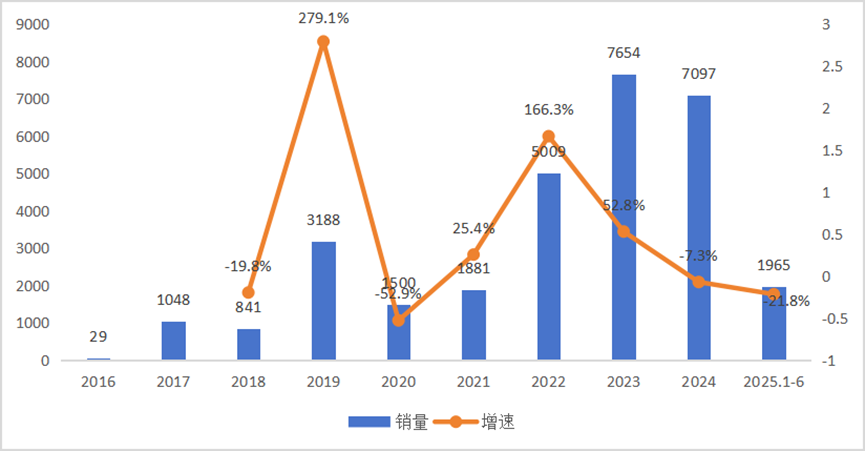
Core Viewpoint - The fuel cell vehicle market in China is struggling with low sales and high competition, leading to significant financial losses for many companies in the sector [2][4][8]. Industry Overview - In 2024, the sales of fuel cell vehicles in China were only 7,075 units, far below the millions of electric vehicles sold annually, indicating a weak market demand [2][18]. - By mid-2025, the total number of fuel cell vehicles in China reached 30,212, but this still fell short of the target of 50,000 set by the national hydrogen energy development plan [3][18]. - The market is characterized by a high number of suppliers (96 in 2024), but over 80% of them sold fewer than 100 units, leading to intense competition and financial strain across the industry [7][8]. Financial Performance - Leading companies like Yihuatong and Reshape Energy reported significant revenue declines and increased losses in 2024, with Yihuatong's revenue dropping by 54.21% and net profit falling by 87.68% [10][12]. - Reshape Energy's revenue for the first half of 2025 was approximately 107 million RMB, a decrease of about 9.9% compared to the same period in 2024, with a negative gross profit indicating unsustainable operations [14][18]. Market Dynamics - The fuel cell vehicle market is highly fragmented, with sales concentrated in a few cities and lacking large-scale, stable orders, which hampers production efficiency and cost reduction [19][20]. - The industry faces a "chicken or egg" dilemma, where the lack of hydrogen refueling infrastructure (only about 500 stations by the end of 2024) limits vehicle sales, while low sales further discourage infrastructure investment [23][24]. Policy and Future Outlook - 2025 marks the end of the current fuel cell vehicle subsidy policies, shifting the focus from government-driven incentives to market-driven growth, which introduces uncertainty for companies reliant on subsidies [15][32]. - Companies are urged to innovate and diversify their business models, moving beyond just vehicle sales to include hydrogen production and broader applications in various sectors [35][36][37]. Strategic Responses - Leading firms are exploring vertical integration by acquiring upstream hydrogen production capabilities and expanding into non-automotive applications to mitigate risks associated with the automotive market [36][40]. - The shift towards a comprehensive hydrogen energy solution provider model is seen as a necessary strategy for long-term sustainability and growth in the industry [38][43].


零跑汽车(09863):中报业绩优异,规模效应持续释放,未来可期
Guotou Securities· 2025-08-26 03:04
Investment Rating - The investment rating for the company is "Buy-A" with a target price of 84.5 HKD for the next 6 months [7]. Core Insights - The company reported excellent mid-year performance for 2025, achieving a revenue of 24.25 billion RMB, a year-on-year increase of 174.0%, and a net profit of 30 million RMB, with an adjusted net profit of 330 million RMB, marking a turnaround from losses [1]. - In Q2 2025, the company achieved a revenue of 14.23 billion RMB, reflecting a year-on-year growth of 165.5% and a quarter-on-quarter increase of 42.0%, driven by new vehicle launches and strategic partnerships [2]. - The company demonstrated further scale effects with a gross margin of 13.6% in Q2 2025, an increase of 10.8 percentage points year-on-year, while optimizing its expense ratios across sales, management, and R&D [3]. - The company is accelerating its global expansion, having exported 20,000 vehicles in H1 2025, leading the new energy vehicle sector, and localizing production in Malaysia [4]. Financial Projections - Revenue projections for the company from 2025 to 2027 are 64.67 billion RMB, 103.79 billion RMB, and 129.74 billion RMB, respectively, with corresponding price-to-sales ratios of 1.4, 0.9, and 0.7 [4]. - The company is expected to achieve a net profit of 886 million RMB in 2025, with a projected net profit margin of 1.4% [10]. - The earnings per share (EPS) is forecasted to be 0.66 RMB in 2025, increasing to 4.89 RMB by 2027 [10].

【绿城服务(2869.HK)】核心利润同比增长25%,盈利改善趋势明确——2025年中期业绩点评(何缅南/韦勇强)
光大证券研究· 2025-08-25 23:06
Core Viewpoint - Greentown Service reported a 25% year-on-year increase in core operating profit for the first half of 2025, indicating strong operational performance and profitability improvement [3][4]. Financial Performance - The company achieved revenue of 9.3 billion yuan, a year-on-year increase of 6.1%, with a gross profit of 1.8 billion yuan, up 8.9%, resulting in a gross margin of 19.5%, an increase of 0.5 percentage points [3]. - Core operating profit reached 1.07 billion yuan, reflecting a growth of 25.3%, while net profit attributable to shareholders was 610 million yuan, up 22.6% [3]. Business Segments - Revenue from property management, park services, and consulting services was 6.63 billion yuan, 1.36 billion yuan, and 1.30 billion yuan respectively, with property management contributing 71.4% to total revenue [4]. - The company focused on core regions for expansion, achieving a new project revenue of 1.52 billion yuan, with non-residential projects accounting for 52.5% [4]. Profitability and Shareholder Returns - The overall gross margin for the first half of 2025 was 19.5%, with property management, park services, and consulting services gross margins at 15.3%, 26.6%, and 33.1% respectively [5]. - The management expense ratio decreased to 6.4%, down 1.0 percentage points, due to cost control measures [5]. - The company repurchased 17.17 million shares, representing 0.5% of issued shares, and has a history of high dividend payout ratios, enhancing its investment value [6].

福耀玻璃(600660):规模效应叠加量价齐升,业绩表现超预期,首次中期分红
Changjiang Securities· 2025-08-25 15:25
Investment Rating - The investment rating for the company is "Buy" and is maintained [4]. Core Views - The company achieved a revenue of 11.54 billion yuan in Q2 2025, representing a year-on-year increase of 21.4%, and a net profit attributable to shareholders of 2.77 billion yuan, up 31.5% year-on-year. The performance exceeded expectations due to scale effects and a decrease in raw material costs [2][4]. - The company is positioned as a leading global automotive glass manufacturer, with a widening competitive moat and significant long-term investment value [2][7]. Summary by Relevant Sections Financial Performance - In Q2 2025, the company reported a revenue of 11.54 billion yuan, a 21.4% increase year-on-year, and a net profit of 2.77 billion yuan, reflecting a 31.5% year-on-year growth. The gross profit margin reached 38.5%, an increase of 3.5 percentage points year-on-year [2][7]. - The company plans to distribute a cash dividend of 2.35 billion yuan for the mid-year report, with a payout ratio of 48.9% [7]. Market Position and Growth Potential - The company benefits from a high penetration rate of high-value-added products and an increasing global market share. The automotive glass market is expected to expand rapidly over the next decade, with the company poised to gain significantly [2][7]. - The company’s high-value products accounted for an increased revenue share, with a notable rise in the penetration of advanced glass technologies [7]. Future Outlook - The company is expected to continue its rapid growth, driven by the increasing demand for advanced automotive glass products. Projections for net profit attributable to shareholders are 9.88 billion yuan, 11.34 billion yuan, and 13.17 billion yuan for 2025, 2026, and 2027, respectively [7].

甬矽电子(688362.SH):上半年净利润3031.91万元 同比增长150.45%
Ge Long Hui A P P· 2025-08-25 11:31
Core Insights - The company, Yongxi Electronics (688362.SH), reported a significant increase in revenue and net profit for the first half of 2025, driven by breakthroughs with overseas major clients and rapid growth among existing core customers [1] Financial Performance - The company achieved operating revenue of 2,010.29 million yuan, representing a year-on-year growth of 23.37% [1] - The net profit attributable to shareholders reached 30.32 million yuan, a substantial increase of 150.45% compared to the same period last year [1] Client Base and Market Position - During the reporting period, the company had 13 clients with sales exceeding 50 million yuan, including 4 clients with sales over 100 million yuan, indicating an optimization of the client structure [1] - Notably, there was significant growth in orders from two leading design companies in Taiwan among the top five clients [1] Cost Efficiency and Profitability - The company experienced a noticeable decrease in expense ratios as revenue grew, with the management expense ratio declining from 8.00% in the first half of 2024 to 6.61% [1] - The financial expense ratio also decreased from 6.07% to 5.15% year-on-year, reflecting improved profitability [1] Gross Margin - The overall gross margin for the first half of 2025 reached 15.61%, with a quarterly gross margin of 16.87% in Q2 2025, an increase of 2.68 percentage points compared to the previous quarter [1]

便利店+商超=烘焙新势力?全球商超烘焙市场给中国的启示
东京烘焙职业人· 2025-08-22 08:34
Core Viewpoint - The Chinese baking market is experiencing a shift from independent bakeries to new retail channels such as supermarkets and convenience stores, indicating a change in consumer demand despite stable market demand [1]. Group 1: Market Dynamics - In 2024, the number of baking stores in China saw a net growth of nearly zero, with 92,000 new stores and 91,000 closures, highlighting a stagnation in traditional bakery growth [1]. - New retail channels are showcasing strong sales, with examples including Sam's Club's Swiss roll sales exceeding 1 billion yuan, Hema's strawberry box cake generating 200 million yuan in seasonal sales, and Pang Donglai's mooncake sales estimated at 200 million yuan [1]. Group 2: International Comparisons - The trends observed in the Chinese baking market are not unique but are part of a broader global phenomenon influenced by the development of industrial food technology and rapid market expansion [4]. - Mature baking markets in Japan, South Korea, Europe, and North America have established stable supermarket baking models that meet consumer needs while continuously creating popular products [5]. Group 3: Asian Market Insights - Japan and South Korea serve as benchmarks in the Asian baking market, characterized by high-frequency purchases and a preference for soft bread, with a supply chain model centered around short shelf-life products [6]. - The emphasis on freshness is a common principle in Japanese and Korean supermarkets, supported by a mature "factory collaboration + regional distribution" system [7]. Group 4: Consumer Preferences - In Japan, 82.8% of consumers prefer to buy bread from supermarkets, while in South Korea, this figure is 76%, indicating a strong consumer preference for supermarket-bought baked goods [11]. - Health considerations have become essential, with products like "no added sugar toast" and "low GI whole grain bread" dominating sales in Japan and South Korea [12]. Group 5: North American Market Characteristics - The U.S. baking market is characterized by family-oriented consumption, with supermarkets catering to bulk purchases and family needs, leading to a unique model of large packaging and high cost-effectiveness [23]. - Supermarkets in the U.S. account for approximately 70% of total bread sales, with a focus on stable quality and low prices, although they lack the innovative marketing strategies seen in Japanese convenience stores [30]. Group 6: European Market Trends - The European baking market is projected to reach $157.36 billion by 2025, with supermarkets contributing approximately 60%-70% of sales, reflecting a high dependency on supermarket channels [31]. - Different countries in Europe have tailored their baking strategies based on local consumer preferences, with Germany focusing on cost control through self-owned factories and local ingredients [33]. Group 7: Strategic Recommendations for China - Chinese supermarkets and chain brands can learn from international practices by adopting strategies such as fine segmentation, local sourcing, and fresh product delivery to enhance consumer trust and satisfaction [42][43]. - Emphasizing family-oriented products and transparent labeling can help build consumer confidence and cater to local market demands [44][46].
巴比食品(605338):公司事件点评报告:单店回正趋势向上,推进并购释放产能
Huaxin Securities· 2025-08-22 08:28
Investment Rating - The report maintains a "Buy" investment rating for the company [9] Core Views - The company shows an upward trend in single-store performance and is advancing mergers and acquisitions to release production capacity [5][6] - The company reported a total revenue of 835 million yuan for H1 2025, representing a 9% year-on-year increase, and a net profit of 132 million yuan, up 18% year-on-year [4] - The gross margin improved by 2 percentage points to 28.23% in Q2 2025, driven by cost optimization and scale effects [5] - The company has successfully integrated the supply chain for the "Manxiangren" brand and is deepening market penetration in East China [6] Summary by Sections Financial Performance - For Q2 2025, total revenue reached 465 million yuan, a 14% increase year-on-year, with net profit rising by 31% to 94 million yuan [4][5] - The company’s EPS forecasts for 2025-2027 have been adjusted to 1.21, 1.32, and 1.42 yuan respectively, with corresponding PE ratios of 18, 17, and 16 times [9] Business Development - The company’s food revenue in Q2 2025 was 421 million yuan, with significant growth in customized filling products [6] - The franchise sales revenue reached 348 million yuan in Q2 2025, marking a 10% increase year-on-year, with a total of 5,685 franchise stores by the end of Q2 2025 [6] Market Strategy - The company is enhancing cooperation with major clients, achieving a 26% increase in group meal revenue to 106 million yuan in Q2 2025 [7] - Retail sales through channels like Hema and Tmall saw substantial growth, with increases of approximately 187% and 20% respectively in H1 2025 [7]

途虎-W(09690):收入利润好于预期,市占率持续巩固
HTSC· 2025-08-22 02:45
Investment Rating - The report maintains a "Buy" rating for the company [7][14]. Core Views - The company's total revenue for 1H25 reached 7.88 billion RMB, a year-on-year increase of 10.5%, exceeding the consensus estimate of 7.80 billion RMB [1][2]. - Non-IFRS net profit for 1H25 was 410 million RMB, also above the consensus estimate of 360 million RMB, with a corresponding non-IFRS net profit margin of 5.2%, up 0.2 percentage points year-on-year [1][2]. - The company is expected to continue its revenue growth momentum into 2H25, with guidance indicating stable gross margins [1]. Summary by Sections Revenue and Profitability - The company's revenue from automotive products and services increased by 10.8% to 7.36 billion RMB, slightly above the consensus estimate of 7.28 billion RMB [2]. - The gross margin for the automotive service segment was 22.8%, down 0.9 percentage points year-on-year, primarily due to external trade demand fluctuations and industry supply pressures [2]. User and Store Metrics - The number of transaction users reached 26.5 million, a year-on-year increase of 23.8%, with registered users totaling 150 million, up 18.8% [3]. - The company has expanded its store count to 7,205, with a net addition of 894 stores year-on-year, achieving a 70% coverage rate in county-level cities with over 20,000 vehicles [3]. Operational Efficiency - The adjusted operating expense ratio improved slightly by 10 basis points to 22.4% in 1H25, despite increased investments in AI and other areas [4]. - The company has established a comprehensive logistics network, enhancing delivery efficiency with a same-day/next-day delivery rate of 83%, up 6 percentage points year-on-year [4]. Profit Forecast and Valuation - The report maintains the 2025 non-IFRS net profit forecast at 760 million RMB, while slightly lowering the 2026 and 2027 forecasts by 11.1% and 7.8% respectively [5][12]. - The target price is set at 25.13 HKD, reflecting a 25x target non-IFRS PE, which is a premium compared to the comparable companies' average of 23.6x [5][14].
甬金股份(603995):2025年半年度报告点评:业绩环比改善明显,盈利能力有望修复
Orient Securities· 2025-08-22 02:17
Investment Rating - The report maintains a "Buy" rating for the company with a target price of 25.87 CNY, based on a PE valuation of 13X for comparable companies [3][5]. Core Views - The company's performance has shown significant improvement on a quarter-on-quarter basis, with a gradual recovery in profitability expected. The net profit attributable to the parent company for the first half of 2025 was 313 million CNY, a year-on-year decrease of 29.14%, but a quarter-on-quarter increase of 92.63% in Q2 2025 [9]. - The company is experiencing a recovery in demand for its cold-rolled stainless steel products, with production and sales volumes increasing by 11.68% and 13.74% respectively in Q2 2025. This has led to an increase in capacity utilization and a rise in gross margin to 5.90% [9]. - The company is expanding its production capacity, with new projects underway that are expected to enhance profit margins as downstream demand gradually recovers. The company’s projects, such as the 1.2 million tons per year high-quality wide stainless steel strip project, are beginning to ramp up production [9]. Financial Summary - The company’s revenue is projected to grow from 39.874 billion CNY in 2023 to 50.900 billion CNY by 2027, with a compound annual growth rate (CAGR) of approximately 8.8% [4]. - The net profit attributable to the parent company is expected to increase from 453 million CNY in 2023 to 948 million CNY in 2027, reflecting a significant recovery in profitability [4]. - The earnings per share (EPS) forecast for 2025-2027 is adjusted to 1.99 CNY, 2.25 CNY, and 2.59 CNY respectively, down from previous estimates [3][4].
