
市场情绪

Search documents
风险月报 | 情绪大幅降温,估值与预期走出分化
中泰证券资管· 2025-10-23 11:32
Market Overview - The risk scoring for the stock market by Zhongtai Asset Management is 45.79, a significant drop from 62.77 last month, primarily due to a notable decline in market sentiment [2] - The valuation of the CSI 300 index has increased to 64.74 from 61.90 last month, marking a continuous rise in the overall valuation center for six months [2] - There is a clear differentiation in valuations across sectors, with industries like steel, electronics, real estate, and others remaining above the historical 60th percentile, while the agriculture sector remains below the 10th percentile [2] Economic Indicators - Market expectation scores have slightly improved to 55.00 from 50.00 last month, driven by better-than-expected import and export growth in September [3] - Economic growth has slowed since Q3, but there is no acceleration in the downturn compared to the same period last year [3] - The global liquidity environment is becoming more accommodative due to the Federal Reserve's preventive rate cuts, but geopolitical conflicts and uneven recovery among major economies add uncertainty to the domestic economic environment [3] Market Sentiment - Market sentiment has experienced a drastic decline to 22.24 from 70.03 last month, indicating a shift from a significantly positive to a low sentiment range [5] - Various sentiment indicators have shown a cooling trend, with margin financing scores dropping significantly and retail fund inflows into the equity market slowing down [5] - The current market presents a mixed pattern of rising valuation centers, stable expectations, and sharply declining sentiment, suggesting a need for investors to approach market indicators with rationality [5] Bond Market Analysis - The risk scoring for the bond market is 61.7, reflecting a continuation of weak economic data, particularly in consumption [7] - Fixed asset investment growth has turned negative for the first time since the pandemic, with a cumulative year-on-year decline of 0.5% [8] - The overall liquidity in the market has shown signs of marginal weakening, with a decline in social financing growth since July [9] Key Economic Data - In Q3 2025, the actual GDP growth rate is 4.8%, with nominal GDP growth at 3.7% [8] - The industrial value-added growth in September is reported at 6.5%, while retail sales growth is at 3.0% [8] - The total social financing in September is 3.53 trillion yuan, with new RMB loans amounting to 1.61 trillion yuan [9]


黑色建材日报-20251023
Wu Kuang Qi Huo· 2025-10-23 01:21
1. Report Industry Investment Rating No relevant content provided. 2. Core Viewpoints of the Report - In the context of a gradually loosening macro - environment, the long - term trend of steel prices remains unchanged. In the short term, the weak real - demand pattern of steel is difficult to improve significantly. Attention should be paid to the policy strength and direction around the Fourth Plenary Session [2]. - Due to factors such as the decline in steel mill profits and high inventory pressure, iron ore prices are under pressure. With weak terminal demand and continuous macro - disturbances, ore prices are expected to fluctuate weakly, with attention on the support level of 760 - 765 yuan/ton [5]. - For the black sector, it is not pessimistic about the future. It is considered more cost - effective to look for callback positions to make rebounds rather than shorting. Manganese silicon and ferrosilicon are likely to follow the black sector's market [9][10]. - Industrial silicon prices are weakly operating and are expected to be in short - term consolidation, following the overall commodity environment due to supply pressure and uncertain demand [13]. - After the end of expected pricing, polysilicon prices have fallen again. With existing real - world constraints, it is currently a phased correction within the oscillation range, with attention on the support level of 48,000 yuan/ton for the 11 - contract [16]. - Glass is in the traditional peak - season end, with weak demand and increasing supply, and the market is expected to remain weakly operating in the short term [19]. - Soda ash has a pattern of strong supply and weak demand, with high inventory and weak downstream support. It is expected to continue to oscillate weakly in the short term [21]. 3. Summary by Related Catalogs Steel Market Information - The closing price of the rebar main contract was 3,068 yuan/ton, up 21 yuan/ton (0.689%) from the previous trading day. The registered warehouse receipts decreased by 2,414 tons, and the main - contract open interest decreased by 18,322 lots. In the spot market, the Tianjin aggregated price remained unchanged, and the Shanghai aggregated price increased by 10 yuan/ton [1]. - The closing price of the hot - rolled coil main contract was 3,247 yuan/ton, up 28 yuan/ton (0.869%) from the previous trading day. The registered warehouse receipts decreased by 896 tons, and the main - contract open interest decreased by 8,822 lots. In the spot market, the Lecong and Shanghai aggregated prices increased by 20 yuan/ton and 10 yuan/ton respectively [1]. Strategy Viewpoints - The overall atmosphere in the commodity market was weak yesterday, and steel product prices showed weak oscillations. The Fourth Plenary Session is expected to guide the macro - economic trend. Rebar production decreased slightly, and post - holiday demand led to a small reduction in inventory, but demand recovery was insufficient. Hot - rolled coil production continued to decline, and post - holiday demand also increased, but the inventory level was still high, with prominent fundamental contradictions [2]. Iron Ore Market Information - The main iron ore contract (I2601) closed at 774.00 yuan/ton, up 0.58% (+4.50), with the open interest changing to 558,200 lots, a decrease of 4,570 lots. The weighted open interest was 937,000 lots. The spot price of PB fines at Qingdao Port was 781 yuan/wet ton, with a basis of 56.13 yuan/ton and a basis rate of 6.76% [4]. Strategy Viewpoints - Supply: The latest overseas iron ore shipments increased month - on - month and were at a high level in the same period. Shipments from Australia, Brazil, and non - mainstream countries all increased. The near - end arrival volume decreased month - on - month. - Demand: The latest average daily hot - metal output was 240.95 tons, a decrease of 0.59 tons month - on - month. Some blast furnaces started maintenance due to profit decline, and the steel mill profitability continued to decline. - Overall: Affected by factors such as profit decline and high inventory, iron ore prices are under pressure. With weak terminal demand and macro - disturbances, ore prices are expected to fluctuate weakly [5]. Manganese Silicon and Ferrosilicon Market Information - On October 22, the main manganese silicon contract (SM601) closed up 1.11% at 5,810 yuan/ton. The spot price of 6517 manganese silicon in Tianjin was 5,720 yuan/ton, with a premium of 100 yuan/ton over the futures. - The main ferrosilicon contract (SF601) closed up 1.17% at 5,558 yuan/ton. The spot price of 72 ferrosilicon in Tianjin was 5,650 yuan/ton, with a premium of 112 yuan/ton over the futures. - Manganese silicon and ferrosilicon prices are in an oscillation range, and attention should be paid to the price direction at the current trend line [7][8]. Strategy Viewpoints - Current factors such as weak real - demand and the resurgence of Sino - US trade frictions have pressured prices. However, the market has insufficient trading of expectations for subsequent important meetings. There may be an expected difference. - It is not pessimistic about the future of the black sector. It is considered more cost - effective to look for callback positions to make rebounds. Manganese silicon and ferrosilicon are likely to follow the black - sector market [9][10]. Industrial Silicon Market Information - The closing price of the main industrial silicon contract (SI2511) was 8,485 yuan/ton, down 0.24% (-20). The weighted - contract open interest increased to 438,479 lots, an increase of 2,236 lots. In the spot market, the price of East China non - oxygen - permeable 553 remained unchanged, and the price of 421 decreased by 50 yuan/ton [12]. Strategy Viewpoints - Affected by the overall market environment, industrial silicon prices are weakly operating. The supply shows a pattern of "increasing in the north and decreasing in the south", with overall supply pressure. The demand has potential risks of weakening support. Cost factors provide some support. Overall, it is expected to be in short - term consolidation and follow the commodity environment [13]. Polysilicon Market Information - The closing price of the main polysilicon contract (PS2511) was 50,310 yuan/ton, down 0.80% (-405). The weighted - contract open interest decreased to 247,499 lots, a decrease of 3,171 lots. The average spot prices of N - type granular silicon, N - type dense material, and N - type re - feed material remained unchanged, with a basis of 2,690 yuan/ton for the main contract [14][15]. Strategy Viewpoints - After the end of expected pricing, polysilicon prices have fallen again. With factors such as over - expected production increase and reduced downstream production scheduling, there is real - world inventory pressure. It is currently a phased correction within the oscillation range, with attention on the support level of 48,000 yuan/ton for the 11 - contract [16]. Glass Market Information - On Wednesday afternoon at 15:00, the main glass contract closed at 1,094 yuan/ton, up 0.64% (+7). The inventory of float - glass sample enterprises increased by 2.31% week - on - week. The top 20 long - position holders reduced 372 long positions, and the top 20 short - position holders reduced 9,410 short positions [18]. Strategy Viewpoints - Entering the end of the traditional peak season, demand is weakening, and supply is increasing. The market's supply - demand contradiction is difficult to resolve in the short term, and it is expected to remain weakly operating without external stimuli [19]. Soda Ash Market Information - On Wednesday afternoon at 15:00, the main soda ash contract closed at 1,223 yuan/ton, up 1.07% (+13). The inventory of soda ash sample enterprises increased by 2.31% week - on - week. The top 20 long - position holders increased 2,351 long positions, and the top 20 short - position holders reduced 12,374 short positions [20]. Strategy Viewpoints - The soda ash industry has a pattern of strong supply and weak demand, with high inventory and weak downstream support. It is expected to continue to oscillate weakly in the short term [21].
期货眼日迹:每日早盘观察-20251021
Yin He Qi Huo· 2025-10-21 01:47
1. Report Industry Investment Ratings No industry investment ratings are provided in the report. 2. Core Views of the Report - The report analyzes various commodities including agricultural products, black metals, non - ferrous metals, and energy chemicals. Each commodity has its own supply - demand situation, price trends, and corresponding trading strategies based on factors such as macro - environment, seasonal changes, and policy impacts [5][7][9]. 3. Summary by Commodity Categories Agricultural Products - **Bean Meal**: The macro - environment affects the market. International soybean pressure is high, and domestic bean meal may face supply pressure and price decline. Suggestions include shorting the 05 contract, conducting M11 - 1 positive arbitrage, and selling call options at high points [17]. - **Sugar**: International raw sugar prices are weak, and domestic sugar is expected to follow. It is recommended to short at high prices [20][21]. - **Oils and Fats**: The market is expected to remain volatile in the short term. It is advisable to wait and consider going long on dips [24][25]. - **Corn/Corn Starch**: New grain prices are rebounding, and the market is expected to be strong and volatile. It is recommended to go long on the 12, 01, 05, and 07 contracts [28][29]. - **Hogs**: Supply pressure persists, and prices may face some downward pressure. It is recommended to wait and use a short - straddle strategy for options [30][32]. - **Peanuts**: There is a reduction in production, and the market is expected to be strong and volatile in the short term. It is recommended to go long on dips for the 01 and 05 contracts and sell the pk601 - P - 7600 option [34]. - **Eggs**: Demand is fair, but the egg price is still under pressure. It is recommended to close out short positions and wait [38]. - **Apples**: The high - quality fruit rate is average, and prices are expected to be stable with a slight increase. It is recommended to go long on the 11 - month contract and short the 1 - month contract [41][42]. - **Cotton - Cotton Yarn**: New cotton acquisition is accelerating, and the market is expected to be volatile. It is recommended to wait [45]. Black Metals - **Steel**: Demand is weak, and valuations are low. Steel prices are expected to fluctuate within a range. It is recommended to conduct long - short spread arbitrage on the volume - screw difference [48][49]. - **Coking Coal and Coke**: Market sentiment is cooling, and prices are expected to fluctuate within a range. It is recommended to go long on dips for coking coal [51]. - **Iron Ore**: It is recommended to take a bearish view in the medium term and conduct cash - futures reverse arbitrage [52][54]. - **Ferroalloys**: Demand is expected to be weak, but valuations and costs provide support. It is recommended to sell out - of - the - money straddle option combinations [55][56]. Non - Ferrous Metals - **Precious Metals**: Due to the U.S. government shutdown and high expectations of Fed rate cuts, precious metals are expected to rise. It is recommended to hold long positions and buy deep - out - of - the - money call options [59][60][63]. - **Copper**: The market is expected to consolidate in the short term, and the long - term trend remains unchanged. It is recommended to go long on dips and conduct cross - market positive arbitrage [64][65]. - **Alumina**: Supply is showing marginal changes, and prices are expected to bottom - out at low levels. It is recommended to wait and observe [69][71]. - **Electrolytic Aluminum**: The medium - term upward trend remains unchanged. It is recommended to go long on dips [74][76]. - **Cast Aluminum Alloy**: The price is expected to be strong and volatile. It is recommended to go long on dips [78]. - **Zinc**: It is recommended to wait and observe. Consider short - selling LME zinc and buying SHFE zinc if the ratio deteriorates [84]. - **Lead**: Supply is gradually recovering, and prices may decline. It is recommended to hold short positions [86][89]. - **Nickel**: Accumulating inventories indicate an oversupply, and prices are under pressure. It is recommended to short at the upper limit of the shock range and sell a wide - straddle option combination [89][91]. - **Stainless Steel**: Demand is weak, and prices may be in a weak and volatile pattern. It is recommended to wait and observe [94][95]. Other Commodities - **Industrial Silicon**: The price is expected to fluctuate narrowly in the short term. It is recommended to wait for a full correction [96][97]. - **Polysilicon**: It is recommended to avoid long positions in the short term and conduct reverse arbitrage for the 2511 and 2512 contracts [99]. - **Lithium Carbonate**: Demand provides support, and supply has risks. Lithium prices are expected to rise [100].
下降逾45%!公募新基金发行环比降温
Guo Ji Jin Rong Bao· 2025-10-20 14:23
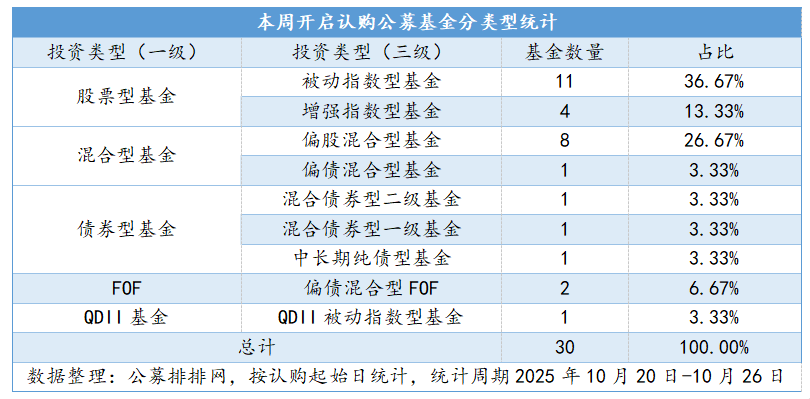
Core Viewpoint - The public fund market is experiencing a significant decrease in new fund subscriptions, with a 45.45% week-on-week decline in the number of funds available for subscription from October 20 to October 26, 2023, and an average subscription period extended to 27.8 days [1]. Fund Type Analysis - A total of 30 public funds are open for subscription this week, with 23 of them being equity funds, accounting for 76.67% of the total [2][3]. - Among the equity funds, passive index funds are particularly popular, with 11 out of 15 stock-type funds being passive index funds, representing 73.33% of the stock-type total [3]. - The bond fund issuance remains stable, with 3 new bond funds opening for subscription this week, maintaining the same level as the previous week [3]. - QDII (Qualified Domestic Institutional Investor) funds have seen a slight recovery, with 1 new QDII fund opening for subscription this week, compared to none the previous week [3]. Institutional Participation - This week, 27 public fund institutions have new funds available for subscription, with 24 institutions offering only 1 new fund each, while 3 institutions have 2 new funds [3]. - Notably, Huatai-PineBridge Fund and Harvest Fund each launched 2 new funds, with a mix of mixed and stock-type funds [3]. Market Sentiment and Strategy - The overall issuance of public products has cooled down, attributed to two main factors: market sentiment pressure due to high previous gains in the technology growth sector and a stable issuance strategy from public funds [3]. - Investors are showing concerns about the sustainability of earnings, leading to a contraction in risk appetite, which has resulted in fewer new products being launched and longer fundraising periods [3].
廖市无双:系统性“慢”牛被终结了吗?
2025-10-19 15:58
Summary of Conference Call Records Industry or Company Involved - The discussion revolves around the broader market trends and investment strategies, particularly focusing on the "slow bull" market dynamics in 2025. Core Points and Arguments 1. **Market Strategy Adjustments** In July-August 2025, the strategy shifted from short-term bearish and medium-term bullish to both short-term and medium-term bullish, maintaining positions until a trend line break occurs [1][2][3] 2. **Market Reactions and Emotional Dynamics** After a market pullback in early September, the strategy involved changing industry allocations to capture gains amidst market volatility. By mid-September, significant capital pressure on large financial sectors led to a shift of funds towards emerging sectors, causing a stark divide between established and newer stocks [1][2][3] 3. **Extreme Market Sentiment** By late September, a mismatch between industry allocations and investor sentiment resulted in heightened reactions, indicating extreme market emotions that could signal a potential turning point [1][2][4] 4. **Technical Indicators Monitoring** On October 10, a critical observation was made regarding the emerging sectors breaking their trend lines, necessitating close monitoring of whether they could recover within two days to maintain an upward trend. Failure to do so would confirm a break [1][2][4] 5. **Outlook on the Slow Bull Market** Despite the observed fluctuations, it is believed that the systemic slow bull market has not yet concluded, but vigilance regarding key technical indicators and market sentiment is essential for timely strategy adjustments [1][2][4] Other Important but Possibly Overlooked Content 1. **Risk Management** Emphasis was placed on managing risks to navigate potential uncertainties in the market environment, highlighting the importance of being prepared for unexpected market movements [4][5] 2. **Performance Evaluation** The strategy adjustments made in June and July were noted to have been effective, with minimal errors in timing and a strong performance in holding positions until necessary adjustments were made [3] 3. **Investor Sentiment Fluctuations** The rapid changes in investor sentiment from excitement to apprehension reflect broader uncertainties about the market's future trajectory, necessitating a cautious approach [2][4]
量化择时周报:市场情绪波动提升,主力买入力量指标五月来首次回落-20251019
Shenwan Hongyuan Securities· 2025-10-19 13:45
Group 1: Market Sentiment Model Insights - The market sentiment score slightly rebounded to 1.9 as of October 17, up from 1.75 the previous week, indicating a neutral sentiment perspective [10][4] - Multiple indicators have turned negative this week, with a rapid decline in price-volume consistency, suggesting a significant drop in the degree of price-volume matching [13][16] - The total trading volume of the A-share market decreased significantly compared to the previous week, indicating a decline in market activity, with the highest trading volume recorded at 25,965.85 billion RMB on October 14 [16][4] Group 2: Sector Performance and Trends - The banking, coal, steel, public utilities, and environmental protection sectors have shown an upward trend in short-term scores, indicating strong short-term trends [37][38] - The short-term score for non-ferrous metals is currently the highest at 89.83, reflecting strong short-term performance in this sector [37][38] - The model indicates that sectors with high trading congestion, such as banking and coal, are experiencing high volatility risks due to valuation and sentiment adjustments [47][42] Group 3: Investment Style and Strategy - The model suggests a preference for large-cap stocks, with signals indicating a shift towards large-cap style dominance, although the strength of this signal is weak [52][51] - The model maintains a value style preference, with increasing strength in the signal, suggesting that value stocks may outperform in the near term [52][51] - The relative strength index (RSI) indicates a shift towards caution in market sentiment, with a decrease in buying momentum and a potential for short-term adjustments [30][33]
广发基金刘志辉:在顺势中保持理性在波动中追求稳健
Shang Hai Zheng Quan Bao· 2025-10-19 12:31
Core Viewpoint - Liu Zhihui emphasizes a rational approach to investment amidst market volatility, focusing on macroeconomic cycles and industry allocation to achieve steady returns [2][3] Investment Philosophy - Liu's investment framework consists of three core elements: understanding macro cycles, assessing odds, and respecting market signals [3] - The investment philosophy includes "Investment Way," "Investment Method," and "Investment Technique," focusing on market trends, macro and industry analysis, and specific trading strategies [4] Multi-Asset Framework - Liu's investment strategy spans fixed income, equities, and convertible bonds, aiming for absolute returns through flexible allocation and odds thinking [5] - In bond investment, Liu adjusts duration and leverage based on macro analysis, credit environment, and market sentiment [6] Stock and Convertible Bond Strategy - Liu captures industry trends and cyclical turning points through sector rotation and concentrated allocation, focusing on both intrinsic value and market pricing signals [6] - For convertible bonds, Liu only allocates when they exhibit characteristics of downside protection and upside potential, guided by macroeconomic fundamentals [6] Recent Market Actions - In response to market adjustments, Liu increased exposure to sectors like innovative pharmaceuticals and AI, while also considering undervalued sectors such as machinery and real estate [7] - Liu maintains a neutral stance on the bond market, focusing on short-duration government bonds and high-rated credit bonds due to low yield levels [7]
国泰海通|金工:量化择时和拥挤度预警周报(20251017)
国泰海通证券研究· 2025-10-19 10:43
Core Viewpoint - The recent instability in the Sino-US trade environment has led to a valuation correction in certain stocks, resulting in a rise in market risk aversion. The market is expected to maintain a volatile trend in the short term [1]. Market Overview - The market is anticipated to remain volatile in the short term. The liquidity shock indicator for the CSI 300 index was 1.57, higher than the previous week's 1.36, indicating current market liquidity is 1.57 times the average level over the past year [2]. - The put-call ratio for the SSE 50 ETF options increased to 1.07 from 0.85, reflecting heightened caution among investors regarding the short-term performance of the SSE 50 ETF [2]. - The five-day average turnover rates for the SSE Composite Index and Wind All A were 1.42% and 1.93%, respectively, consistent with the trading activity levels since 2005 [2]. - The RMB exchange rate fluctuated last week, with onshore and offshore rates showing weekly changes of -0.05% and 0.29%, respectively [2]. - In September, China's CPI decreased by 0.3% year-on-year, slightly better than the previous -0.4%, but worse than the consensus expectation of -0.15%. The PPI was -2.3%, also better than the previous -2.9% but below the expected -2.4% [2]. - New RMB loans in September amounted to 1.29 trillion yuan, lower than the expected 1.39 trillion yuan but higher than the previous 590 billion yuan. M2 growth was 8.4%, below both the expected 8.51% and the previous 8.8% [2]. Technical Analysis - The SAR indicator for the Wind All A index broke downwards on October 17, indicating a bearish trend [2]. - The market score based on the moving average strength index is currently at 141, which is at the 49.9% percentile for 2023 [2]. - The sentiment model score is 2 out of 5, indicating moderate market sentiment, while the trend model signal is positive and the weighted model signal is negative [2]. Performance Summary - For the week of October 13-17, the SSE 50 index fell by 0.24%, the CSI 300 index dropped by 2.22%, the CSI 500 index decreased by 5.17%, and the ChiNext index declined by 5.71% [3]. - The overall market PE (TTM) stands at 22.0 times, which is at the 74.0% percentile since 2005 [3]. Industry Insights - The industry crowding levels are relatively high in sectors such as non-ferrous metals, comprehensive, power equipment, telecommunications, and electronics. The crowding levels in the steel and public utilities sectors have increased significantly [4].

豪鹏科技:公司股价波动受宏观经济环境等多重因素影响
Zheng Quan Ri Bao Wang· 2025-10-17 10:44
Core Viewpoint - The stock price fluctuations of Haopeng Technology (001283) are influenced by multiple factors including macroeconomic environment, industry cycles, and market sentiment [1] Group 1 - The company emphasizes adherence to information disclosure rules and fulfilling obligations [1] - Specific performance and business conditions should be referenced from the company's announcements [1]
六九一二:公司股价受多方面因素影响
Zheng Quan Ri Bao Wang· 2025-10-17 09:12
Core Viewpoint - The company's stock price is influenced by various factors including macroeconomic environment, industry policies, and market sentiment, while it is actively working to enhance operational efficiency through management optimization and technological innovation to solidify its long-term value foundation [1] Group 1 - The company acknowledges that its stock price is affected by multiple external factors [1] - The company is focused on improving operational quality and efficiency [1] - Management optimization and technological innovation are key strategies for the company to strengthen its long-term value [1]