
供需缺口

Search documents
首席点评:欲加之罪何患无辞,贵金属一枝独秀
Shen Yin Wan Guo Qi Huo· 2026-01-21 02:43
Report Industry Investment Rating - Cautious bearish: Crude oil, methanol, apple, rebar, hot-rolled coil, iron ore, container shipping to Europe [5] - Cautiously bullish: Stock index (IH, IF, IC, IM), rubber, coking coal, coke, manganese silicon, ferrosilicon, gold, silver, aluminum, lithium carbonate, cotton, corn [5] Core View of the Report - The stock market is expected to continue its upward trend in 2026 due to factors such as the technology cycle, policy dividends, economic recovery, and overseas capital inflows [13] - Precious metals are likely to maintain a long-term upward trend, supported by geopolitical risks, inflation expectations, and central bank gold purchases [3][4] - The oil market's geopolitical risk premium has decreased, but the demand for OPEC+ crude oil is expected to increase in 2026 and 2027 [2][16] - The copper market may experience a phased correction due to supply disruptions and weakening downstream demand [2][23] Summary by Directory 1. Main News on the Day - **International News:** US Treasury Secretary revealed that Trump is close to nominating the next Fed chair and has narrowed the candidates to four, with the final decision possibly announced next week. He also responded to the "kill line" phenomenon and blamed the Biden administration [7] - **Domestic News:** In 2026, China's macro policies will focus on strengthening the domestic cycle and expanding domestic demand, including optimizing policies, formulating plans, and promoting high-tech industries [8] - **Industry News:** During the 15th Five-Year Plan period, China will improve water resource management and conservation, aiming for an irrigation water utilization coefficient of over 0.6 and a water-saving industry scale of over 1.2 trillion yuan by 2030 [10] 2. Daily Returns of Overseas Markets - The S&P 500, European STOXX 50, and FTSE China A50 futures all declined, while the US dollar index also fell [11] - London gold and silver prices rose, while most base metals and agricultural products declined [11] 3. Morning Comments on Major Varieties - **Financial:** The stock market is expected to continue its upward trend, while the bond market has stabilized due to policy support and a cooling equity market [13][15] - **Energy and Chemicals:** Crude oil prices may be under pressure due to reduced geopolitical risks and increased supply expectations. Methanol prices are expected to rise in the short term, while rubber prices may be volatile [16][17][18] - **Metals:** Precious metals are likely to maintain a long-term upward trend, while copper and zinc prices may experience a phased correction. Aluminum prices may be supported by low inventory in the long term [22][23][24][26] - **Black Metals:** Coking coal and steel prices may be strong in the short term, while iron ore prices are expected to remain stable [28][29][30] - **Agricultural Products:** Protein meal prices may be under pressure due to high inventory and a bumper harvest in South America. Vegetable oil prices may be supported by strong exports and policy expectations [31][32] - **Shipping Index:** Container shipping rates to Europe are expected to decline before the Spring Festival due to increased supply and weak demand [35]
2026年黄金还能持续飙升吗?3大核心因素决定行情走向
Sou Hu Cai Jing· 2026-01-18 16:44
Group 1 - The core point of the article discusses the potential for gold prices to continue rising in 2026 after a significant increase in 2025, driven by factors such as Federal Reserve interest rate cuts and global demand for gold [1][3][4] Group 2 - The first pillar indicates that the Federal Reserve's interest rate cuts, which dropped rates from 5.5% to 3.25%, were a major driver for the gold price surge in 2025, but future cuts may be limited due to persistent inflation [1][3] - The second pillar highlights that countries like China, Russia, and Turkey purchased a record 1,200 tons of gold in 2025, as they seek to reduce reliance on the US dollar amid geopolitical tensions [3][4] - The third pillar points out that global gold mining output has been declining for five consecutive years, with production dropping to 3,600 tons in 2025, while demand continues to rise, creating a significant supply-demand gap [4][6] Group 3 - The article advises investors to be cautious, suggesting that they should not exceed 10% of their total assets in gold investments and to set stop-loss and take-profit levels [6][9] - It warns against the risks of speculative trading in gold, citing past instances where prices dropped sharply following interest rate hikes by the Federal Reserve [7][9] - The article concludes that gold should be viewed as a safe haven asset rather than a quick profit opportunity, emphasizing the importance of a long-term investment perspective [9]

STARTRADER外汇:5万亿市值白银超英伟达成全球第二资产 还能追?
Sou Hu Cai Jing· 2026-01-15 07:08
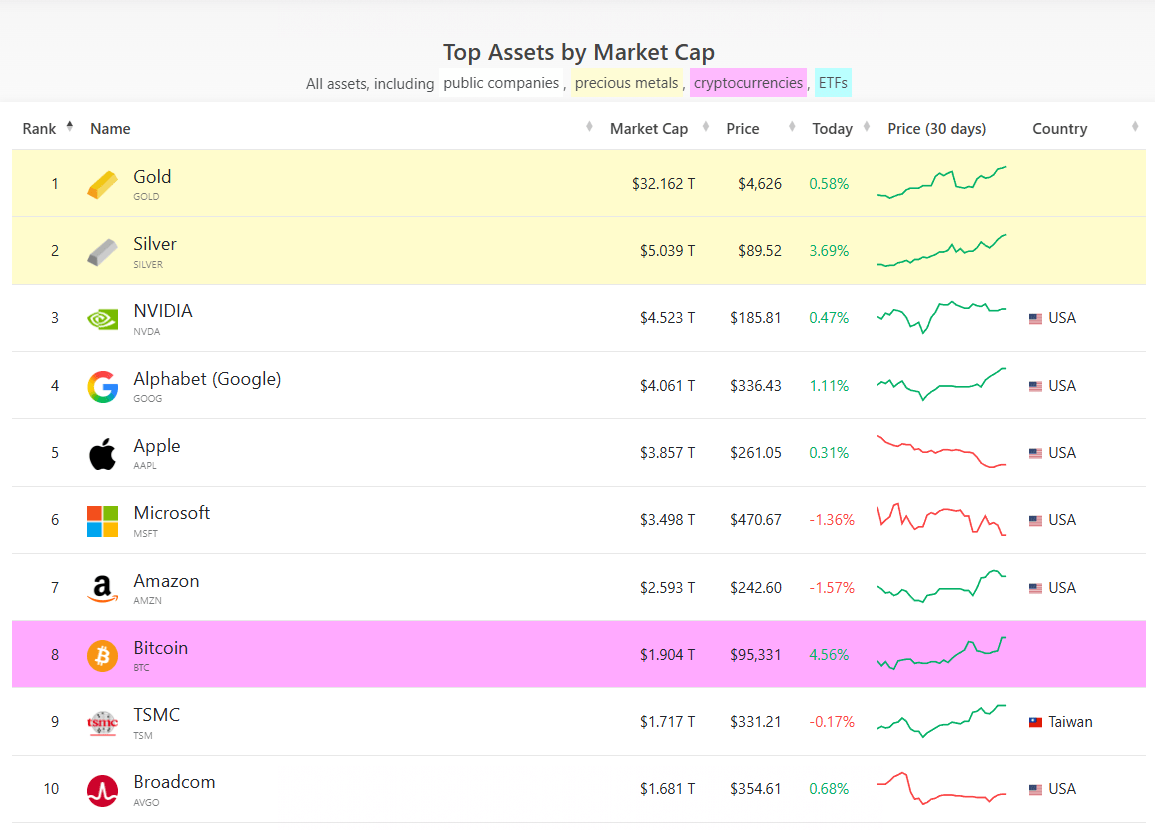
Core Viewpoint - The global asset landscape is undergoing a historic transformation as silver prices have surpassed $90 per ounce for the first time, elevating its market capitalization to $5.039 trillion, making it the second-largest asset globally, following gold [1][3]. Market Dynamics - The surge in silver's market value is attributed to a dual resonance of its financial and industrial properties. Financially, expectations of global liquidity easing and heightened risk aversion are driving investment into precious metals. Geopolitical tensions, such as the U.S.-Iran and U.S.-Venezuela situations, further enhance silver's appeal as a safe-haven asset [3]. - On the industrial side, there is a significant demand gap for silver, driven by its essential role in emerging industries like photovoltaics, electric vehicles, and AI data centers. Projections indicate that global photovoltaic installations will exceed 600 GW by 2026, leading to a silver paste demand of 8,900 tons. Additionally, the silver consumption in electric vehicles is expected to surpass 3,600 tons annually, and AI servers will require three times more silver than traditional servers, with a year-on-year growth rate of approximately 26% in the AI sector [3]. Supply Constraints - The supply side is tightening, with global silver shortages persisting for five consecutive years. The anticipated shortfall is expected to widen to 6,300 tons by 2026, while independent silver mines account for only 28% of production. Low capital expenditure and aging mines have led to stagnation in supply growth, with visible inventories at major exchanges dropping to a ten-year low, resulting in a consumption-to-inventory ratio of only 0.68 [3]. Market Sentiment - The market's enthusiasm for silver is reflected in the significant inflows into the largest silver ETF, iShares Silver Trust, which recently increased its holdings by 39.47 tons, reaching a historical high of 16,347.95 tons. This indicates strong institutional confidence in long-term allocations [4]. - In the futures market, speculative sentiment is high, with the main silver futures contract's open interest rising to 344,700 lots. However, measures have been implemented to cool the market, including raising margin requirements and limiting intraday positions [4]. Diverging Views - There is a clear divide in market sentiment regarding whether to chase the rising silver prices. The bullish camp believes in the continuation of the strong trend, supported by the long-term supply-demand gap and macroeconomic benefits. Institutions like BNP Paribas and Morgan Stanley have set price targets of $100 per ounce, citing ongoing geopolitical risks and physical shortages as key support factors [4]. - Conversely, the bearish camp warns of potential high-level corrections. JPMorgan has predicted an average silver price of $40.2 per ounce in 2026, citing factors such as index weight adjustments leading to $7 billion in sell orders and the potential for profit-taking due to cooling measures. Other firms, like TD Securities, have established short positions betting on a drop to $40 [5]. Short-Term Outlook - Despite differing opinions, most institutions agree that silver is likely to experience a short-term correction in Q1 2026. Factors such as index adjustments and a low probability of Fed rate cuts could lead to a rebound in the dollar, suppressing precious metal prices. The expected correction range is between $55 and $60 per ounce, with a potential decline of 20-30% [6]. - Key variables influencing silver's future include inventory changes at major exchanges and monthly data on global photovoltaic installations, which reflect the tightness of the physical market and industrial demand resilience. Additionally, the direction of U.S. monetary policy and tariffs on key minerals will play a crucial role in shaping silver's financial attributes [6].


宏观行情重新走强 胶价下方空间有限
Jin Tou Wang· 2026-01-15 07:03
Group 1 - The main contract for 20 rubber futures experienced a sharp decline, reaching a low of 12,715.00 yuan, with a current price of 12,765.00 yuan, reflecting a drop of 2.18% [1] Group 2 - Zhongcai Futures indicates that recent rubber prices are primarily influenced by macroeconomic factors, showing a wide fluctuation after breaking out of a converging range. There may still be production pressure in January, with domestic inventory levels potentially exceeding last year's high points. However, a long-term supply-demand gap may gradually manifest during this year's destocking cycle, suggesting that rubber is suitable for low long positions and spread trading under favorable macro conditions [2] - Guangzhou Futures notes that while supply from Southeast Asia is increasing during the high production season, cooler temperatures in northeastern Thailand may lead to a temporary halt in production. The inventory accumulation of natural rubber is slowing down, but the finished product inventory for semi-steel tires remains high, indicating limited downside potential for rubber prices [2]
白银首次站上90美元,市值突破5万亿美元,超过英伟达成全球第二大资产
21世纪经济报道· 2026-01-14 03:49
今年以来,白银价格在9个交易日内已涨超25%。中辉期货在最新研报中表示,建议对白银"长 期持有",认为短期彭博指数调仓结束、避险、交割逻辑、资源品紧张预期持续。长期降息、 供需缺口连续5年,全球大财政均对白银长期有利,长期滚动做多逻辑不变。 白银价格延续去年走势,继续"高歌猛进"。 1月14日,现货白银开盘强势拉升,盘中一度涨3.55%,首次站上90美元关口,再创历史新 高。 受银价提振,白银总市值首次站上5万亿美元大关,已超越英伟达成为全球第二大资产。根据 市值数据平台CompaniesMarketCap的数据,目前白银市值为5.039万亿美元;黄金以32.162万 亿美元的市值位居榜首,芯片巨头英伟达以4.523万亿美元的市值滑落至第三。前十名榜单如 下: | | | | Top Assets by Market Cap | | | | | | | --- | --- | --- | --- | --- | --- | --- | --- | --- | | | | | All assets, including public companies, precious metals, cryptocurre ...

白银首次站上90美元,市值突破5万亿美元,已成为全球第二大资产
Sou Hu Cai Jing· 2026-01-14 03:11
白银价格延续去年走势,继续"高歌猛进"。 1月14日周三,现货白银开盘强势拉升,盘中一度涨3.55%,首次站上90美元关口,再创历史新高。 受银价提振,白银总市值首次站上5万亿美元大关,已超越英伟达成为全球第二大资产。根据市值数据平台CompaniesMarketCap的数据,目前白银市值为 5.039万亿美元;黄金以32.162万亿美元的市值位居榜首,芯片巨头英伟达以4.523万亿美元的市值滑落至第三。前十名榜单如下: | | | | Top Assets by Market Cap | | | | | | | --- | --- | --- | --- | --- | --- | --- | --- | --- | | | | | All assets, including public companies, precious metals, cryptocurrencies, ETFs | | | | | | | Rank ♦ | Name | | 0 Market Cap | | Price | � Today | Price (30 days) | Country | | 1 | | Gold GO ...
日度策略参考-20260112
Guo Mao Qi Huo· 2026-01-12 06:48
Report Industry Investment Ratings - Bullish: Gold, Palladium, Platinum, Polycrystalline Silicon, Lithium Carbonate, Rebar, Hot Rolled Coil, Coke, BR Rubber, PTA, LPG [1] - Bearish: Industrial Silicon, Palm Oil, Rapeseed Oil, Crude Oil, Fuel Oil, Asphalt, PVC [1] - Neutral: Nickel, Stainless Steel, Tin, Iron Ore, Black Metals, Glass, Soda Ash, Coking Coal, Soybean Oil, Pulp, Logs, Live Pigs, Ethylene Glycol, Asian Styrene, Propylene, Butadiene [1] Core Viewpoints - The stock index is expected to maintain an upward trend in the short - term, driven by sufficient market funds and positive macro - fundamentals [1]. - The bond futures are favored by the asset shortage and weak economy, but the central bank has recently warned of interest - rate risks [1]. - Different commodities have different price trends based on their own supply - demand situations, policy factors, and macro - economic conditions [1]. Summary by Categories Stock Index - The stock index broke through strongly with heavy volume last week, opening up a new upward space. With positive macro - fundamental data, it is expected to maintain an upward pattern in the short - term [1]. Bond Futures - Asset shortage and weak economy are beneficial to bond futures, but the central bank has recently warned of interest - rate risks, and attention should be paid to the Bank of Japan's interest - rate decision [1]. Non - ferrous Metals - Copper prices are expected to stabilize and rebound despite a recent high - level decline [1]. - Aluminum prices are expected to be strong due to supply - side restrictions [1]. - Alumina prices are expected to fluctuate as they are near the cost line despite weak industrial fundamentals [1]. - Zinc prices have risen recently due to good macro - sentiment, but caution is needed regarding the upside space [1]. - Nickel prices are expected to fluctuate at a high level with increased risk, and attention should be paid to Indonesian policies, macro - sentiment, and futures positions [1]. - Stainless steel futures are expected to fluctuate at a high level, and short - term operations are recommended [1]. - Tin prices are affected by market sentiment, and caution is needed for capital withdrawal [1]. Precious Metals and New Energy - Precious metals are expected to be strong in the short - term but with significant fluctuations [1]. - The short - term pattern of weak platinum and strong palladium may continue, and platinum can be bought at low prices or a [long platinum, short palladium] arbitrage strategy can be considered in the long - term [1]. - Industrial silicon is bearish due to production changes and reduced production schedules in related industries [1]. - Polycrystalline silicon has factors such as a traditional peak season for new energy vehicles,旺盛 demand for energy storage, and increased supply resumption [1]. - Lithium carbonate prices are expected to rise rapidly in the short - term [1]. Black Metals - Rebar and hot - rolled coil: Short - term sentiment and funds play a greater role than industrial contradictions, and long positions with stop - losses can be considered [1]. - Iron ore has obvious upward pressure, and chasing long positions is not recommended [1]. - Black metals are in a situation of weak reality and strong expectations, with potential supply disturbances [1]. - Glass prices are supported in the short - term but face over - supply pressure in the medium - term [1]. - Soda ash prices follow glass and are more loosely supplied in the medium - term, facing pressure [1]. - Coking coal may have room to rise if the "capacity reduction" expectation continues, but the actual increase is hard to judge [1]. - Coke has a similar logic to coking coal [1]. Oils - Palm oil is expected to be bearish in December according to MPOB data but may reverse later, and short - term rebounds due to macro - sentiment should be watched [1]. - Soybean oil has a strong fundamental and is recommended for long - allocation in oils [1]. - Rapeseed oil may have a trading logic change, and there is still room for price decline [1]. Agricultural Products - Cotton is in a situation of having support but no driving force, and future policies and market conditions should be watched [1]. - Sugar has a global surplus and increased domestic supply, and attention should be paid to capital changes [1]. - Corn sales progress has slowed but is still fast year - on - year, and the spot price is firm in the short - term [1]. - Bean粕 is expected to fluctuate, and attention should be paid to the USDA report [1]. - Pulp prices are affected by macro - commodity fluctuations, and cautious observation is recommended [1]. - Log prices are expected to fluctuate in a certain range [1]. - Live pigs' supply capacity still needs further release [1]. Energy and Chemicals - Crude oil has a risk of rising due to geopolitical factors, but there are also factors such as increased supply and weakening demand [1]. - Fuel oil is affected by factors similar to crude oil [1]. - Asphalt has factors such as high profit and potential supply changes [1]. - BR rubber has factors such as reduced upward momentum in the short - term and positive factors for future butadiene exports [1]. - PTA has a recent price increase not due to fundamental changes but has fundamental support in the future [1]. - Ethylene glycol rebounded due to supply - side news [1]. - Asian styrene is in a weak - balance state, and short - term upward momentum depends on overseas markets [1]. - Propylene has cost support and geopolitical risks [1]. - PVC is expected to face over - supply in 2026, and there is a possibility of capacity clearance [1]. - LPG has factors such as increased import costs, geopolitical risks, and changing inventory trends [1].
日度策略参考-20260109
Guo Mao Qi Huo· 2026-01-09 05:51
Report Industry Investment Rating No relevant content provided. Core View of the Report - The market sentiment cooled slightly yesterday, with the commodity market weakening significantly and the stock index showing a volatile trend. The trading volume also contracted. After a rapid rise, the stock index has entered a stage of shock consolidation. There are no obvious macro-level negatives at present, and the short-term outlook for the stock index remains bullish. The bond futures are favored by the asset shortage and weak economy, but the central bank has recently warned of interest rate risks. Attention should be paid to the Bank of Japan's interest rate decision. [1] - The prices of various commodities are affected by different factors, such as supply and demand, policy changes, and macro sentiment. The report provides trend judgments and trading suggestions for each commodity, including metals, energy, chemicals, and agricultural products. [1] Summary by Related Catalogs Macro Finance - Stock Index: After a rapid rise, the stock index has entered a stage of shock consolidation. There are no obvious macro-level negatives at present, and the short-term outlook for the stock index remains bullish. Attention should be paid to capital flows and market sentiment changes. [1] - Treasury Bonds: The bond futures are favored by the asset shortage and weak economy, but the central bank has recently warned of interest rate risks. Attention should be paid to the Bank of Japan's interest rate decision. [1] Non-Ferrous Metals - Copper: The copper price has fallen from its recent high, but there are still disruptions in the mining end. The downside space for the copper price is expected to be limited. [1] - Aluminum: There has been an accumulation of domestic electrolytic aluminum stocks recently, and the industrial driving force is limited. The macro anti-involution sentiment has ebbed, and the aluminum price has fallen from its high. [1] - Alumina: The supply side of alumina still has a large release space, and the industrial side exerts downward pressure on the price. However, the current price is basically near the cost line, and the price is expected to fluctuate. [1] - Zinc: The fundamentals of zinc have improved, and the cost center has shifted upward. The recent macro sentiment has been good, and the zinc price has risen. However, considering the still existing pressure on the fundamentals, caution is advised regarding the upside space. [1] - Nickel: The market's concerns about nickel supply have significantly cooled, and the LME nickel inventory has increased significantly recently. The nickel price has corrected from its high. Since Indonesia has not disclosed the specific amount and said that it is still in the process of accounting, there is still uncertainty about the implementation of the subsequent policy. The short-term volatility risk of the nickel price has increased. Attention should be paid to the implementation of Indonesia's policy, changes in macro sentiment, and changes in futures positions, and risk control should be done well. [1] Precious Metals and New Energy - Gold and Silver: The annual weight adjustment of the BCOM index has officially started, and the exchange has introduced multiple risk control measures for silver to suppress speculative enthusiasm. The prices of precious metals have fallen across the board, with a significant decline in silver. In the short term, gold and silver are expected to continue to be weak and volatile. In the medium and long term, attention can be paid to the opportunity to buy on dips after this round of risk release. [1] - Platinum and Palladium: Platinum and palladium have followed the weakening of precious metals. In the short term, they are expected to be in a wide-range volatile pattern. In the medium and long term, with the still existing supply-demand gap for platinum and the tendency of palladium to have a loose supply, platinum can still be bought on dips or a [long platinum, short palladium] arbitrage strategy can be adopted. [1] Industrial Products - Industrial Silicon: There is an increase in production in the northwest and a decrease in production in the southwest. The production schedules for polysilicon and organic silicon in December have decreased. [1] - Polysilicon: It is the traditional peak season for new energy vehicles. The demand for energy storage is strong. The supply side has increased production resumption. There is a short-term rapid increase. [1] - Rebar and Hot Rolled Coil: In the short term, sentiment and capital have a greater influence than industrial contradictions. One can try to follow long positions with a stop-loss; for futures-spot trading, participate in positive spread positions. [1] - Iron Ore: There is sector rotation, but the upside pressure on iron ore is obvious. It is not recommended to chase long positions at this level. [1] - Non-Ferrous Metals: There is a combination of weak reality and strong expectations. The current supply and demand situation remains weak, but in terms of expectations, energy consumption double control and anti-involution may have an impact on supply. [1] - Soda Ash: Soda ash follows the trend of glass. In the medium term, the supply and demand situation will be more relaxed, and the price will be under pressure. [1] - Coking Coal and Coke: If the "capacity reduction" expectation continues to ferment and there is pre-holiday restocking of spot goods, coking coal may still have room to rise. However, since the current market's "capacity reduction" expectation mainly comes from online rumors, it is difficult to judge the actual upside space. After a significant increase, the volatility will intensify, and caution should be exercised. The logic for coke is the same as that for coking coal. [1] Agricultural Products - Palm Oil: The MPOB December data is expected to be bearish for palm oil, but palm oil will reverse under the themes of seasonal production reduction, the B50 policy, and US biodiesel in the future. Short-term rebounds due to macro sentiment should be watched out for. [1] - Soybean Oil: The fundamentals of soybean oil are relatively strong. It is recommended to allocate more in the oil sector and consider a long Y, short P spread. Wait for the January USDA report. [1] - Rapeseed Oil: The trade relationship between China and Canada may improve, and Australian rapeseed will be imported smoothly. After the rapeseed trade flow is opened up, the trading logic of rapeseed oil will gradually shift from the domestic tight supply situation to the global rapeseed production increase expectation. There is still room for the price to fall. Short-term rebounds due to macro sentiment should be watched out for. [1] - Cotton: There is a strong expectation of a good harvest for domestic new crops, and the purchase price of seed cotton supports the cost of lint cotton. The downstream operating rate remains low, but the inventory of yarn mills is not high, and there is a rigid demand for restocking. Considering the growth of spinning capacity, the demand for cotton in the new crop market year is relatively resilient. Currently, the cotton market is in a situation of "having support but no driving force." Future attention should be paid to the tone of the No. 1 Central Document in the first quarter of next year regarding the direct subsidy price and cotton planting area, the intention of cotton planting area next year, the weather during the planting period, and the demand during the "Golden Three and Silver Four" peak season. [1] - Sugar: Currently, there is a global surplus of sugar, and the supply of domestic new crops has increased. The short-selling consensus is relatively strong. If the futures price continues to fall, there will be strong cost support below. However, there is a lack of continuous driving force in the short-term fundamentals. Attention should be paid to changes in the capital side. [1] - Corn: The fundamentals of corn have not changed significantly. The spot price remains firm, and the progress of grain sales at the grassroots level is relatively fast. Most traders have not yet strategically built inventories, and feed enterprises maintain a safe inventory. There is a certain restocking demand before the holiday. The short-term outlook for CO3 is expected to be oscillating and slightly bullish. Attention should be paid to the dynamics of policy grain auctions. [1] - Soybean Meal: The domestic market may restart the auction of imported soybeans; the relationship between China and Canada is expected to ease, and China is expected to suspend the tax on Canadian rapeseed meal; the macro sentiment has cooled, and the domestic market has returned to the fundamentals and shown a significant decline. Recently, it has been greatly affected by policy news. The soybean meal futures price is expected to be mainly oscillating in the short term. Attention should be paid to the adjustment of the January USDA supply and demand report and the trend of the Brazilian premium. [1] - Pulp: Pulp has fallen today due to the decline in the commodity macro market. The overall price has not broken through the oscillating range. The short-term commodity sentiment fluctuates greatly, and it is recommended to observe cautiously. [1] - Logs: The spot price of logs has shown a certain sign of bottoming out and rebounding recently. The further downside space for the futures price is expected to be limited. However, the January overseas quotation has still slightly declined, and the log futures and spot markets lack upward driving factors. It is expected to oscillate in the range of 760 - 790 yuan/m³. [1] - Hogs: Recently, the spot price has gradually stabilized. Supported by demand and with the出栏体重 not yet fully cleared, the production capacity still needs to be further released. [1] Energy and Chemicals - Crude Oil: OPEC+ has suspended production increases until the end of 2026. There is uncertainty about the Russia-Ukraine peace agreement. The United States has imposed sanctions on Venezuela's crude oil exports. [1] - Fuel Oil: In the short term, the supply-demand contradiction is not prominent, and it follows the trend of crude oil. The probability of the 14th Five-Year Plan's rush demand being falsified is high, and the supply of Ma Rui crude oil is not short. The profit of asphalt is relatively high. [1] - BR Rubber: The futures position has declined, and the number of new warehouse receipts has increased. The increase in BR has slowed down temporarily. The spot price has led the rise to repair the basis, and BR continues to focus on the upward momentum above the 12,000 yuan line. The listed prices of BD/BR have been continuously raised, and the processing profit of butadiene rubber has narrowed. The overseas cracking device capacity has been cleared, which is beneficial to the long-term export expectation of domestic butadiene. The tax on naphtha also has a positive impact on the butadiene price. Fundamentally, butadiene rubber maintains high production and high inventory operation, and the trading center is generally average. Styrene-butadiene rubber is relatively better than butadiene rubber. [1] - PX and PTA: The PX market has experienced a rapid rise, but this round of rise is not due to a fundamental change. The fundamentals of PX do have support, and the market is expected to continue to tighten in 2026, driven by the new PTA production capacity in India and the organic growth of demand. Domestic PTA maintains high production. The gasoline spread is still at a high level, which supports aromatics. [1] - Ethylene Glycol: There is news that two sets of MEG plants in Taiwan, China, with a total annual capacity of 720,000 tons, plan to stop production next month due to efficiency reasons. Ethylene glycol has rebounded rapidly during the continuous decline, stimulated by supply-side news. The current operating rate of the polyester downstream remains above 90%, and the demand performance is slightly better than expected. [1] - Short Fiber: The PX market has experienced a rapid rise, but this round of rise is not due to a fundamental change. Domestic PTA maintains high production, and the domestic polyester load has declined. The short fiber price continues to closely follow the cost fluctuations. [1] - Styrene: The Asian styrene market is generally stable. Suppliers are reluctant to lower prices due to continuous losses, while buyers insist on pressing prices due to weak downstream polymer demand and compressed profits. Although the downstream demand is weak, the domestic market has a strong bullish sentiment due to export support. The market is in a weak balance state, and the short-term upward momentum needs to be driven by the overseas market. [1] - Urea: The export sentiment has slightly eased, and there is limited upside space due to insufficient domestic demand. There is support from anti-involution and the cost side below. [1] - PF: Geopolitical conflicts have intensified, and there is a risk of an increase in crude oil prices. There are fewer maintenance activities, the operating load is at a high level, and there are overseas arrivals, so the supply has increased. The downstream demand operating rate has weakened. In 2026, there will be more new production capacity, and the supply-demand surplus will further intensify, and the market expectation is weak. [1] - Propylene: There are fewer maintenance activities, the operating load is relatively high, and the supply pressure is relatively large. The improvement in the downstream is less than expected. The propylene monomer price is at a high level, the crude oil price has risen, and the cost support is strong. Geopolitical conflicts have intensified, and there is a risk of an increase in crude oil prices. [1] - PVC: In 2026, there will be less global new production capacity, and the future expectation is relatively optimistic. Currently, there are fewer maintenance activities, new production capacity is being released, and the supply pressure is increasing. The demand has weakened, and the orders are not good. The differential electricity price in the northwest region is expected to be implemented, which will force the clearance of PVC production capacity. [1] - LPG: The January CP has risen more than expected, and the cost support for imported gas is relatively strong. The geopolitical conflicts between the United States, Venezuela, and the Middle East have escalated, and the short-term risk premium has increased. The trend of inventory accumulation in the EIA weekly C3 inventory has slowed down, and it is expected to gradually turn to inventory reduction. The domestic port inventory has also decreased. Domestic PDH maintains high production and deep losses. There is a rigid demand for global civil combustion, and the demand for MTBE from overseas olefin blending for gasoline has declined temporarily. Since January 1, 2026, naphtha has been re-taxed, and the long-term demand expectation for light cracking raw materials such as LPG has increased, and the performance of downstream olefin products is relatively strong. [1] Shipping - Container Shipping - European Line: It is expected to peak in mid-January. Airlines are still relatively cautious in their trial reflights. The pre-holiday restocking demand still exists. [1]
日度策略参考-20260108
Guo Mao Qi Huo· 2026-01-08 02:26
Report Industry Investment Rating No specific industry investment ratings were provided in the report. Core Viewpoints of the Report - A-share market is expected to continue its upward trend in the short term and may rise further in 2026 compared to 2025, supported by macro policies, inflation, capital market reforms, and the role of Central Huijin [1]. - The bond market is favored by asset shortages and weak economic conditions, but the central bank has recently warned of interest rate risks [1]. - Metal prices are influenced by factors such as supply disruptions, macro sentiment, and cost changes. Some metals are expected to have upward trends, while others may experience volatility or are subject to supply concerns [1]. - Energy and chemical product prices are affected by factors such as geopolitical conflicts, supply and demand, and cost support. Some products are expected to have upward trends, while others may experience volatility [1]. - Agricultural product prices are influenced by factors such as seasonal changes, policy support, and supply and demand. Some products are expected to have upward trends, while others may experience volatility [1]. Summary by Category A-shares - A-share market has continuous trading volume increase. Short-term, the index is expected to remain strong. In 2026, the index may continue to rise on the basis of 2025, supported by macro policies, inflation, capital market reforms, and Central Huijin [1]. Bonds - Asset shortages and weak economic conditions are favorable for bond futures, but the central bank has recently warned of interest rate risks. Attention should be paid to the Bank of Japan's interest rate decision [1]. Metals - Copper: Supply disruptions and improved macro sentiment have led to a rise in copper prices, and the upward trend is expected to continue [1]. - Aluminum: Domestic electrolytic aluminum has accumulated inventory, but macro sentiment is positive, and global aluminum ingot supply is expected to tighten, leading to a strong aluminum price [1]. - Alumina: Supply has significant release potential, putting pressure on prices. However, the current price is close to the cost line, and the price is expected to oscillate [1]. - Zinc: Fundamentals have improved, and the cost center has shifted upward. With positive macro sentiment, zinc prices have risen, but the upside space is limited due to fundamental pressure [1]. - Nickel: Supply concerns have led to a significant increase in nickel prices and an increase in positions. The short-term price may be strongly oscillating, but high risks and volatility are present at high price levels. Attention should be paid to Indonesian policies and macro sentiment [1]. Industrial and Energy Chemicals - Polycrystalline silicon: Northwest production has increased, while southwest production has decreased. December production schedules for polycrystalline silicon and organic silicon have declined [1]. - Carbonate lithium: It is the traditional peak season for new energy vehicles, with strong energy storage demand and increased supply from restarts. Prices have risen rapidly in the short term [1]. - Rebar and hot-rolled coil: Futures-spot arbitrage positions can be rolled for profit-taking. The price valuation is not high, and short-selling is not recommended [1]. - Iron ore: Near-term contracts are restricted by production cuts, but the commodity sentiment is positive, and there is still an upward opportunity for far-term contracts [1]. - Silicone and ferrosilicon: There is a combination of weak reality and strong expectations. In the short term, expectations dominate, and energy consumption control and anti-involution may disrupt supply [1]. - Soda ash: The market sentiment has improved, and the supply and demand are supportive. The price is low and expected to be strong in the short term [1]. - Coking coal and coke: If the "capacity reduction" expectation continues to ferment and there is pre-holiday restocking of spot goods, there may still be room for price increases, but the actual increase is difficult to judge, and volatility increases after a significant rise [1]. Agricultural Products - Palm oil: The December MPOB data is expected to be bearish, but the price is expected to reverse under themes such as seasonal production cuts, the B50 policy, and US biofuels. Short-term rebounds due to macro sentiment should be watched out for [1]. - Soybean oil: The fundamentals are strong, and it is recommended to be overweight in the oil market. Consider the spread between soybean oil and palm oil [1]. - Cotton: There is support but no driving force in the short term. Future attention should be paid to the central government's No. 1 document in the first quarter of next year, planting area intentions, weather during the planting period, and peak season demand [1]. - Sugar: There is a global surplus and increased domestic supply. The short side consensus is strong. If the price continues to fall, there is strong cost support, but there is a lack of continuous driving force in the short term [1]. - Corn: With the release of reserve and imported grains, the supply has increased. The spot price is expected to be firm in the short term, and the futures price will oscillate within a range [1]. - Pulp: The 05 contract is expected to oscillate between 5400 - 5700 yuan/ton due to the tug-of-war between "strong supply" and "weak demand" [1]. - Logs: The spot price has shown signs of bottoming out and rebounding, and the downward space for the futures price is limited. However, the January overseas quotation has slightly declined, and there is a lack of upward driving factors. The price is expected to oscillate between 760 - 790 yuan/m³ [1]. Energy and Chemicals - Crude oil: OPEC+ has suspended production increases until the end of 2026. The uncertainty of the Russia-Ukraine peace agreement and US sanctions on Venezuelan oil exports have an impact [1]. - Fuel oil: Follows the trend of crude oil in the short term, with no prominent supply-demand contradictions [1]. - Asphalt: The "14th Five-Year Plan" rush demand is likely to be disproven, and the supply of Ma Rui crude oil is sufficient. The profit margin is high [1]. - Natural rubber: The raw material cost provides strong support, the futures-spot price difference has rebounded significantly, and the midstream inventory has increased substantially [1]. - BR rubber: The upward momentum has slowed down, the spot price has led the recovery of the basis, and the processing profit has narrowed. There are positive factors for future domestic butadiene exports [1]. - PTA: The PX market has experienced a sharp rise, and the PTA market is expected to remain tight in 2026. Domestic PTA maintains high production, and the gasoline spread provides support for aromatics [1]. - Ethylene glycol: Two MEG plants in Taiwan, China, plan to shut down next month. The price has rebounded rapidly due to supply-side news, and the downstream demand is slightly better than expected [1]. - Styrene: The Asian market is stable, with suppliers reluctant to cut prices due to losses and buyers pressing for lower prices due to weak downstream demand. The market is in a weak balance, and the upward momentum depends on overseas markets [1]. - Urea: The export sentiment has eased, and the upside space is limited due to insufficient domestic demand. There is support from anti-involution and the cost side [1]. - PE: There is a risk of rising crude oil prices due to geopolitical conflicts. The supply pressure is high, and the market expectation is weak due to planned production increases in 2026 [1]. - PP: The supply pressure is high, and the downstream improvement is less than expected. The cost is supported by high propylene monomer and crude oil prices [1]. - PVC: The global production is expected to be low in 2026, but the current supply pressure is rising. The demand is weak, and the implementation of differential electricity prices in the northwest may force the clearance of PVC production capacity [1]. - LPG: The January CP has risen unexpectedly, and the import cost provides strong support. Geopolitical conflicts have increased the risk premium. The inventory accumulation trend has slowed down, and the domestic port inventory is decreasing. The long-term demand for LPG is expected to increase [1]. Aviation - It is expected to peak in mid-January. Airlines are still cautious about trial resumptions [1].
供需缺口+政策催化共振,稀土ETF嘉实(516150)领涨有色赛道
Jin Rong Jie· 2026-01-07 04:05
Group 1 - The core viewpoint of the news highlights the increasing demand and supply constraints in the rare earth industry, leading to price increases and investment opportunities [2][3]. Group 2 - As of January 7, the Shanghai Composite Index fell by 0.02%, while the rare earth industry index rose by 2.55%, with several stocks experiencing significant gains, including Zhong Rare Earth and Greenland Technology [1]. - The rare earth ETF managed by Jiashi (516150) increased by 2.66%, with a trading volume of 228 million yuan and a turnover rate of 2.79%. Over the past six months, this fund has seen a growth of 64.35% [1]. Group 3 - China is considering tightening export license reviews for medium and heavy rare earths, which could significantly impact Japan, as it relies almost entirely on China for these materials. If restrictions last for three months, Japan could face a loss of 660 billion yen, escalating to 2.6 trillion yen if prolonged for a year [2]. - Myanmar's Kachin State plans to halt all rare earth mining activities by December 31, 2025, which previously contributed about 40% of the global supply of medium and heavy rare earths. This will lead to an 80% year-on-year decline in rare earth exports to China [2]. Group 4 - The domestic mining quota for medium and heavy rare earths has been frozen at 19,200 tons per year for five consecutive years, with no increase planned for 2026. The global demand for medium and heavy rare earths is projected to exceed 40,000 tons in 2026, while supply is estimated at around 24,000 tons, resulting in a supply gap of 16,000 to 20,000 tons [2]. Group 5 - Prices for rare earth elements are rising due to supply constraints, with the average price of dysprosium reported at 1,762,500 yuan per ton, increasing by 10,000 yuan in a single day. The average price of dysprosium oxide is 1,352,500 yuan per ton, up by 2,500 yuan [2]. Group 6 - Demand for rare earths is surging in sectors such as electric vehicles, wind power, and humanoid robots, with projected demand for rare earth permanent magnets in the electric vehicle sector reaching 88,000 tons by 2026, and 44,000 tons in the wind power sector [3]. - The overall strength in the non-ferrous metals sector is expected to create a synergistic effect, with upward adjustments in economic growth forecasts for major global economies and a weaker US dollar providing a favorable macro environment for rising prices [3].