债市修复

Search documents
中信证券:债市仍有修复空间
Sou Hu Cai Jing· 2025-12-24 00:45
Core Viewpoint - The bond market sentiment has improved recently, with the yield on 10-year government bonds stabilizing below 1.85%, and a recovery trend observed in long-term bonds, particularly a 6 basis points decline in the yield of 30-year government bonds from its recent high, reigniting expectations for a "cross-year market" [1] Group 1 - The recent strengthening of the RMB exchange rate has positively impacted the bond market, enhancing the attractiveness of RMB-denominated assets [1] - The monetary easing space has opened up, indicating potential for further recovery in the bond market [1] - Long-term bonds are expected to benefit from the narrowing of the term spread, making them more cost-effective [1]

债市日报:12月23日
Xin Hua Cai Jing· 2025-12-23 09:20
Core Viewpoint - The bond market showed slight recovery on December 23, with short-term bonds performing better, as the main government bond futures all closed higher and interbank bond yields fell by 1-2 basis points [1] Market Performance - Government bond futures closed higher across the board, with the 30-year main contract rising by 0.89% to 112.83, the 10-year main contract up by 0.26% to 108.22, the 5-year main contract increasing by 0.17% to 106.025, and the 2-year main contract rising by 0.07% to 102.526 [2] - Interbank major interest rate bond yields generally declined, with the 30-year government bond yield down by 1.3 basis points to 2.2245%, the 10-year policy bank bond yield down by 1.15 basis points to 1.895%, and the 7-year government bond yield down by 2.2 basis points to 1.7% [2] International Market Trends - In North America, U.S. Treasury yields collectively rose on December 22, with the 2-year yield increasing by 2.32 basis points to 3.509%, and the 10-year yield rising by 2.35 basis points to 4.161% [3] - In Asia, Japanese bond yields fell across the board, with the 10-year yield down by 4.3 basis points to 2.04% [4] - In the Eurozone, the 10-year French bond yield remained flat at 3.610%, while the 10-year German bond yield rose by 0.2 basis points to 2.896% [4] Funding Conditions - The central bank conducted a 7-day reverse repurchase operation of 593 billion yuan at a fixed rate of 1.40%, with a net withdrawal of 760 billion yuan for the day [6] - The Shibor short-term rates mostly declined, with the overnight rate unchanged at 1.272%, and the 7-day rate down by 1.8 basis points to 1.399%, marking a new low since January 2023 [6] Institutional Insights - Huaxi Securities noted that recent funding disturbances are mainly due to tax periods, with manageable pressure expected as December is not a traditional tax month [7] - CITIC Securities expressed concerns over excessive worries regarding banks' capacity to hold long-term bonds, suggesting that the compression of long-term yield spreads may be challenging [8]
债市温和修复方向保持不变,关注十年国债ETF(511260)
Sou Hu Cai Jing· 2025-12-23 01:20
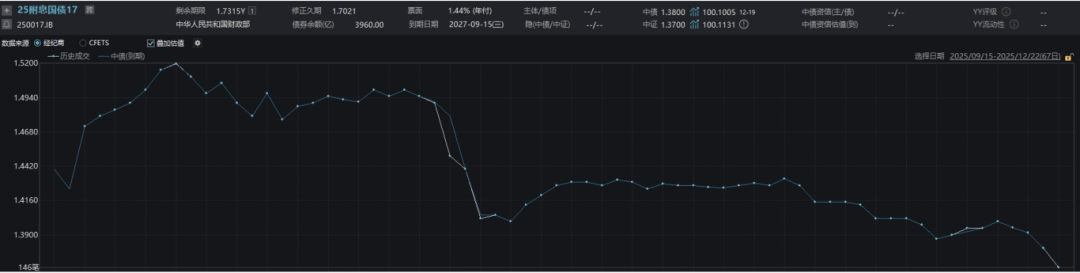
Group 1 - Recent funding rates have declined rapidly, with overnight rates dropping to 1.27%. The yield on the 2-year active bond 250017 has also decreased to a new low of 1.3650%, indicating a continued loose funding environment [1] - The long-end rates have shown fluctuations due to trading influences, with the 10-year rate slightly rebounding to 1.8450%. The low funding rates reflect the central bank's supportive stance towards the bond market, suggesting a moderate recovery in the bond market moving forward [1] - Recent economic data indicates that domestic total demand is still in need of repair, and the foundation for inflation recovery remains unstable, which is marginally beneficial for the bond market. The widening term spread is unfavorable for monetary policy transmission, but the continued loose liquidity environment may allow short-term rate declines to transmit to long-term rates [3] Group 2 - Considering the manageable fiscal pressure for the next year and the pending implementation of broad monetary tools, long-term bonds still hold investment value. It is recommended to pay attention to the 10-year government bond ETF (511260) and consider allocation opportunities after short-term rate adjustments [3]

【公募基金】情绪持续修复,仍偏震荡思维——泛固收类公募基金指数跟踪周报(2025.12.15-2025.12.19)
华宝财富魔方· 2025-12-22 09:04
Market Review - The bond market showed signs of recovery last week (December 15-19, 2025), with the 1-year government bond yield decreasing by 3.32 basis points to 1.35%, the 10-year yield down by 0.88 basis points to 1.83%, and the 30-year yield down by 2.35 basis points to 2.23%. There is a noticeable improvement in bullish sentiment across various maturities as negative factors are gradually being digested [3][13] - The U.S. Treasury yields also declined across the board during the same period, with the 1-year yield down by 3 basis points to 3.51%, the 2-year yield down by 4 basis points to 3.48%, and the 10-year yield down by 3 basis points to 4.16%. The release of a non-farm employment report indicated higher-than-expected job creation but also a higher unemployment rate, while a core CPI increase of 2.6% year-on-year suggested a notable cooling of inflation, contributing to the decline in U.S. Treasury yields [13] Public Fund Market Dynamics - The yield of money market funds has continued to decline this year, with the median 7-day annualized yield dropping to 1.24% as of December 16, 2025. Many money market funds have announced purchase limits to protect the interests of existing holders, with some limits as low as 10,000 yuan [4][16] Fund Index Performance Tracking - The Money Enhancement Index rose by 0.03% last week, with a cumulative return of 4.43% since inception [5][18] - The Short-term Bond Fund Index increased by 0.04% last week, with a cumulative return of 4.57% since inception [6][18] - The Mid-to-Long-term Bond Fund Index rose by 0.08% last week, with a cumulative return of 6.77% since inception [7][18] - The Low Volatility Fixed Income + Fund Index increased by 0.22% last week, with a cumulative return of 4.49% since inception [8][18] - The Medium Volatility Fixed Income + Fund Index rose by 0.12% last week, with a cumulative return of 6.25% since inception [9][18] - The High Volatility Fixed Income + Fund Index increased by 0.13% last week, with a cumulative return of 8.00% since inception [10][18] - The Convertible Bond Fund Index rose by 0.01% last week, with a cumulative return of 22.42% since inception [11][18] - The QDII Bond Fund Index increased by 0.05% last week, with a cumulative return of 10.05% since inception [11][18] - The REITs Fund Index fell by 2.22% last week, with a cumulative return of 29.35% since inception [11][18] Fund Index Positioning - The Money Enhancement Strategy Index aims for liquidity management and seeks to outperform money market funds while maintaining a smooth upward curve [19][21] - The Short-term Bond Fund Index focuses on liquidity management while ensuring controlled drawdowns and aims for a smooth upward curve [21][23] - The Mid-to-Long-term Bond Fund Index targets stable returns while controlling drawdowns, selecting funds that balance yield and risk management [23][25] - The Low Volatility Fixed Income + Index targets a 10% equity center and selects funds with a historical equity center within 15% [25][27] - The Medium Volatility Fixed Income + Index targets a 20% equity center and selects funds with a historical equity center between 15% and 25% [27][29] - The High Volatility Fixed Income + Index targets a 30% equity center and selects funds with a historical equity center between 25% and 35% [29][31] - The Convertible Bond Fund Index focuses on funds with a significant allocation to convertible bonds and evaluates based on long-term performance and risk-adjusted returns [31][32] - The QDII Bond Fund Index includes overseas bonds and selects funds based on credit ratings and risk control [32][36] - The REITs Fund Index focuses on mature, stable infrastructure projects with predictable cash flows and selects funds based on operational stability and valuation [36]

情绪好转,债市有望温和修复
Dong Zheng Qi Huo· 2025-12-21 09:14
1. Report Industry Investment Rating - The trend rating for treasury bonds is "oscillation" [1] 2. Core Viewpoints of the Report - The bond market is expected to gradually shift from a rapid decline to a mild recovery. The fragile trading structure in the market will be temporarily repaired, the year - end steady - growth policies are in line with market expectations, and the market funds will be relatively balanced next week [2][12][13] 3. Summary by Relevant Catalogs 3.1 One - week Review and Views 3.1.1 This Week's Trend Review - From December 15th to 21st, treasury bond futures showed a pattern of short - term strength and long - term weakness. By December 19th, the settlement prices of the main contracts of 2 - year, 5 - year, 10 - year, and 30 - year treasury bond futures were 102.480, 105.925, 108.080, and 112.290 yuan respectively, with changes of +0.018, +0.105, +0.085, and - 0.350 yuan compared to last weekend [1][11] 3.1.2 Next Week's Views - With the increasing expectations of LPR rate cuts and the rise of the central bank's bond - buying scale, the bond market strengthened this week. Next week, due to the increasing expectation of the central bank's bond - buying scale, the relatively balanced capital situation, and the lack of further negative news at the macro - level, the bond market is expected to recover mildly [12] 3.2 Weekly Observation of Interest - rate Bonds 3.2.1 Primary Market - This week, 35 interest - rate bonds were issued, with a total issuance of 376.087 billion yuan and a net financing of 20.874 billion yuan. The net financing of local government bonds decreased slightly, while that of inter - bank certificates of deposit increased slightly [19] 3.2.2 Secondary Market - Treasury bond yields declined. By December 19th, the yields of 2 - year, 5 - year, 10 - year, and 30 - year treasury bonds were 1.38%, 1.60%, 1.83%, and 2.22% respectively, with changes of - 1.96, - 2.08, - 1.20, and - 1.85 basis points compared to last weekend. The 10Y - 1Y and 10Y - 5Y spreads widened, while the 30Y - 10Y spread narrowed [23] 3.3 Treasury Bond Futures 3.3.1 Price, Trading Volume, and Open Interest - Treasury bond futures showed short - term strength and long - term weakness. By December 19th, the settlement prices of the main contracts of 2 - year, 5 - year, 10 - year, and 30 - year treasury bond futures were 102.480, 105.925, 108.080, and 112.290 yuan respectively, with changes of +0.018, +0.105, +0.085, and - 0.350 yuan compared to last weekend. The trading volumes of 2 - year, 5 - year, 10 - year, and 30 - year treasury bond futures this week were 33,189, 66,776, 80,379, and 141,799 lots respectively, with changes of - 2,122, - 315, - 6,115, and - 5,287 lots compared to last week. The open interests were 76,891, 143,991, 234,915, and 165,346 lots respectively, with changes of +4,459, +5,550, +1,151, and - 1,753 lots compared to last week [33][36] 3.3.2 Basis and IRR - This week, the basis of TL fluctuated significantly, while the basis of other varieties showed slight oscillations. Next week, with balanced funds and a mild market recovery expected, the basis is expected to converge slightly. The IRR of the TF2603 contract has been continuously high, and positive arbitrage opportunities are recommended [40] 3.3.3 Inter - period and Inter - variety Spreads - By December 19th, the inter - period spreads of the 2603 - 2606 contracts of 2 - year, 5 - year, 10 - year, and 30 - year treasury bond futures were - 0.040, +0.000, - 0.020, and - 0.190 yuan respectively, with changes of - 0.018, +0.005, - 0.010, and - 0.010 yuan compared to last weekend [45] 3.4 Weekly Observation of the Capital Market - This week, the central bank conducted 657.5 billion yuan of reverse repurchase operations, with 668.5 billion yuan of reverse repurchases maturing, resulting in a net withdrawal of 11 billion yuan. The central bank also conducted 600 billion yuan of 182 - day term repurchase operations. As of December 19th, R007, DR007, SHIBOR overnight, and SHIBOR 1 - week were 1.51%, 1.44%, 1.27%, and 1.43% respectively, with changes of +0.73, - 2.78, - 0.57, and - 1.99 basis points compared to last weekend. The average daily trading volume of inter - bank pledged repurchase was 8.48 trillion yuan, an increase of 0.40 trillion yuan from last week [48][51][53] 3.5 Weekly Overseas Observation - The US dollar index strengthened slightly, and the yield of 10Y US treasury bonds declined slightly. By December 19th, the US dollar index rose 0.32% to 98.7125 compared to last weekend, and the yield of 10Y US treasury bonds was 4.16%, a decline of 3 basis points compared to last weekend. The yield spread between 10Y Chinese and US treasury bonds was inverted by 233.1 basis points [57][58] 3.6 Weekly Observation of High - frequency Inflation Data - This week, industrial product prices rose across the board. By December 19th, the South China Industrial Product Index, Metal Index, and Energy and Chemical Index were 3,460.46, 6,672.06, and 1,497.21 points respectively, with increases of 33.31, 91.81, and 13.46 points compared to last weekend. Agricultural product prices showed mixed trends. By December 19th, the prices of pork, 28 key vegetables, and 7 key fruits were 17.53, 5.87, and 7.68 yuan per kilogram respectively, with changes of +0.03, - 0.08, and +0.12 yuan per kilogram compared to last weekend [61] 3.7 Investment Recommendations - The bond market is expected to recover mildly, but the volatility of TL is relatively large, so caution is needed when participating in TL trading. Short - selling hedging positions can be gradually exited. Positive arbitrage opportunities for the TF2603 contract are recommended, and curve strategies should be on the sidelines for now [2][15][16]
固定收益点评:融资依然存在放缓压力
GOLDEN SUN SECURITIES· 2025-12-14 06:32
1. Report Industry Investment Rating No industry investment rating is provided in the report. 2. Core View of the Report - The financing situation shows a slow - down pressure, while the supply of funds increases, and the bond market is expected to gradually recover. The positive stance of the Central Economic Work Conference on macro - policies helps ease market adjustment pressure. The future interest rate trend depends on whether fiscal policies can drive the recovery of social financing growth. If the fiscal strength is limited and the social financing growth rate continues to decline, the interest rate will fall. The slowdown in real - estate sales leads to more residents' savings flowing into fixed - income assets, which is beneficial for the bond market [5][20]. 3. Summary by Related Content Credit Situation - In November, the loan growth rate continued to slow down, with obvious bill - padding characteristics. New credit was 39 billion yuan, 19 billion yuan less than the same period last year, and the new credit scale has been lower than the same period last year for 5 consecutive months. Corporate credit increased by 61 billion yuan, mainly due to the increase in short - term loans. Corporate medium - and long - term loans increased by 17 billion yuan, 4 billion yuan less than the same period last year, while bill financing increased by 33.42 billion yuan, 21.19 billion yuan more than the same period last year. Resident loans decreased by 20.63 billion yuan, 47.63 billion yuan more than the same period last year, which is consistent with the slowdown in real - estate sales [1][8]. Social Financing Situation - In November, new social financing was 2.49 trillion yuan, 159.7 billion yuan more than the same period last year, and the year - on - year growth rate of social financing stock was 8.5%, the same as last month. Corporate bonds contributed significantly to the year - on - year increase in social financing, with a net financing of 41.69 billion yuan, 17.88 billion yuan more than the same period last year. Government bond issuance was stable, with a new scale of 1.2041 trillion yuan, a slight year - on - year decrease of 104.8 billion yuan under a high base [2][10]. - Looking ahead, the social financing growth rate may face pressure. The increase in social financing growth rate in the first half of this year was mainly driven by the year - on - year increase in government bonds. However, the fiscal increment scale next year may not reach this year's level. It is expected that the social financing growth rate may slow down from the current 8.5% to about 7.5% by June next year [3][11]. M1 and M2 Situation - In November, the year - on - year growth rate of M2 was 8.0%, 0.2 percentage points lower than last month, which was consistent with the slowdown in deposit growth. The year - on - year growth rate of M1 also declined, dropping from 6.2% to 4.9%, and its two - year compound growth rate was stable at about 2%, indicating that the fluctuations were mainly due to the base effect [3][13]. Deposit Situation - In November, new deposits were 1.4 trillion yuan, 760 billion yuan less than the same period last year. Fiscal deposits decreased by 5 billion yuan, 19 billion yuan more than the same period last year. Resident deposits increased by 67 billion yuan, 12 billion yuan less than the same period last year, and corporate deposits increased by 64.53 billion yuan, 9.47 billion yuan less than the same period last year. Non - bank deposits increased by 8 billion yuan, 10 billion yuan less than the same period last year. The slowdown in deposit growth may be due to the central bank's increased capital injection [4][15].
国盛固收:黄金有色影响较大,物价有待继续观察
Ge Long Hui· 2025-11-10 01:40
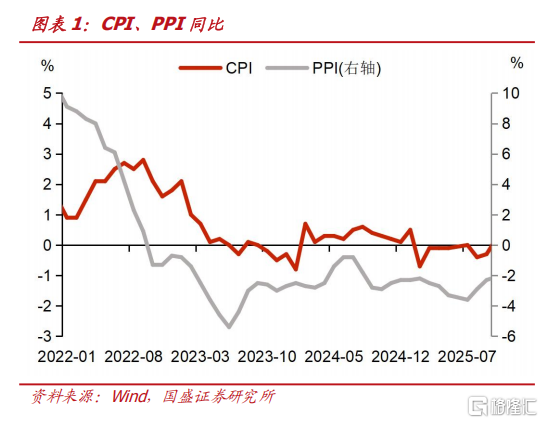
Core Insights - October inflation data shows a shift in CPI from decline to increase, with PPI's rate of decline narrowing, significantly influenced by prices of gold and non-ferrous metals [1][4][25] - October CPI increased by 0.2% year-on-year, reversing a 0.3% decline from the previous month, marking the highest value since February of this year [1][6] - PPI's year-on-year decline narrowed by 0.2 percentage points to -2.1%, marking the third consecutive month of narrowing [1][21] CPI Analysis - Food prices showed slight improvement, with a 2.9% decline, but the drop was less severe than the previous month, impacting CPI by approximately 0.54 percentage points [2][14] - Core CPI rose by 1.2% year-on-year, the highest since March 2024, with gold prices being a major driver [2][10] - Domestic gold futures prices increased by 52.8% year-on-year, significantly higher than the previous month's growth rate [2][10] PPI Analysis - PPI for October showed a year-on-year decline of 2.1%, with notable performance in the non-ferrous sector, particularly in mining and metal processing [3][21] - The prices in the non-ferrous mining and metal processing industries increased by 5.3% and 2.4% respectively, the highest among all sectors [3][21] - Life goods PPI decreased by 1.4% year-on-year, with a narrowing decline compared to the previous month [3][21] Market Outlook - The rise in prices is influenced by multiple factors, including the increase in gold prices and extreme weather affecting vegetable prices, leading to an unexpected overall price increase [4][25] - Future price trends remain uncertain, with a potential decline in gold prices in early November and weak terminal demand affecting price transmission from upstream to downstream sectors [4][26] - The bond market is entering a recovery phase, with a recommendation for a barbell strategy to manage risks and capitalize on potential interest rate declines [4][26]
黄金有色影响较大,物价有待继续观察
GOLDEN SUN SECURITIES· 2025-11-09 12:38
Group 1: Inflation Trends - In October, the Consumer Price Index (CPI) shifted from a decrease of 0.3% to an increase of 0.2%, marking the highest value since February of this year, with a seasonal level higher than the previous two years [1][8] - The Producer Price Index (PPI) saw a narrowing decline of 0.2 percentage points to -2.1%, marking the third consecutive month of narrowing [1][8] - Gold prices significantly impacted both CPI and PPI, with domestic gold futures prices increasing by 52.8% year-on-year, a substantial rise of 9.5 percentage points compared to September [2][12] Group 2: Food Prices and Core CPI - Food prices decreased by 2.9%, with the decline narrowing by 1.5 percentage points from the previous month, affecting CPI by approximately 0.54 percentage points [2][16] - Core CPI rose by 1.2%, the highest since March 2024, with a month-on-month increase of 0.2% [2][9] - The increase in core CPI was primarily driven by gold prices, with other goods and services related to gold also showing a significant year-on-year increase of 12.8% [2][12] Group 3: PPI and Industry Performance - The PPI for October showed a year-on-year decline of 2.1%, with notable performance in the non-ferrous industry, where prices increased by 5.3% and 2.4% for mining and metal processing, respectively [3][21] - The narrowing decline in PPI was attributed to ongoing capacity management and increased demand for coal mining and washing, with a reduction in the decline of 1.2 percentage points compared to the previous month [3][21] - Life goods PPI decreased by 1.4%, with the decline narrowing by 0.3 percentage points from the previous month [3][21] Group 4: Market Outlook and Strategy - The rise in prices is influenced by multiple factors, including the increase in gold prices and weather-related impacts on vegetable prices, leading to an unexpected overall price increase [4][23] - The bond market is entering a recovery phase, with a recommendation for a barbell strategy to manage risks while benefiting from potential interest rate declines [4][25] - The 10-year government bond yield is expected to recover to a range of 1.6%-1.65% by the end of the year [4][25]
中加基金权益周报︱国债买卖重启落地,债市走强
Xin Lang Ji Jin· 2025-11-06 07:46
Market Overview and Analysis - The primary market saw the issuance of government bonds, local government bonds, and policy financial bonds amounting to 0 billion, 270.7 billion, and 142 billion respectively, with net financing of 0 billion, 178 billion, and 142 billion [1] - Financial bonds (excluding policy financial bonds) totaled an issuance of 92.1 billion with a net financing of 24.7 billion, while non-financial credit bonds had an issuance of 218.7 billion and a net financing of 3.6 billion [1] Secondary Market Review - The central bank announced the resumption of government bond trading operations, leading to a decline in bond market yields, influenced by signals of monetary easing and weak economic data [2] Liquidity Tracking - As the month-end approaches, the funding environment remains stable, with R001 and R007 rates rising by 2.7 basis points each compared to the previous week [3] Policy and Fundamentals - The October manufacturing PMI indicates significant downward pressure on traditional industries, with high-frequency data showing stable production at month-end, continued weakness in real estate consumption, and a mixed price performance [4] Overseas Market - The trade sentiment between China and the U.S. has improved, while Federal Reserve Chairman Powell has adopted a hawkish stance. The 10-year U.S. Treasury yield closed at 4.11%, up 9 basis points from the previous week [5] Equity Market - A-shares experienced a pullback after initially rising due to positive developments in U.S.-China negotiations and overcrowding in the tech sector. The Wind All A index fell by 0.52%, with power equipment and non-ferrous metals leading gains, while communications lagged [6] - The average daily trading volume increased significantly to 2.33 trillion, with a weekly average decrease of 528.02 billion. As of October 30, 2025, the total financing balance for all A-shares was 24,811.49 billion, an increase of 47.25 billion from October 23 [6] Bond Market Strategy Outlook - The resumption of government bond trading is expected to lead to a recovery period in the bond market, but caution is advised against chasing high prices. The central bank's focus on medium to short-term bonds is more certain, while long-term bonds may not perform as strongly in the short term [7] - In the credit bond sector, increased liquidity suggests a potential for higher allocation in flexible medium-duration investment-grade bonds and secondary capital bonds to capture capital gain opportunities [7] - For convertible bonds, the market has shown volatility influenced by U.S.-China tensions and domestic policy expectations, making it challenging to navigate. A risk-reward framework is recommended, focusing on dividend and value convertible bonds when the index approaches the upper range and on high-growth technology and export sectors when nearing the lower range [7]
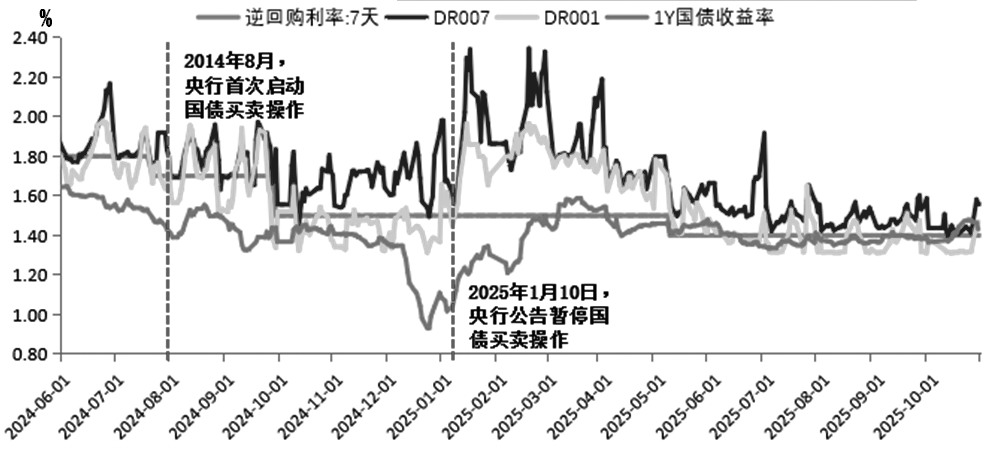
央行重启买债操作 债市延续修复
Qi Huo Ri Bao· 2025-11-04 18:06
Group 1 - The core viewpoint of the articles indicates that the bond market is experiencing a recovery trend, supported by the central bank's resumption of government bond trading operations and improved market sentiment following the recent US-China summit [1][2][4]. - The 10-year government bond yield has broken below the 1.8% mark, reflecting a positive shift in market expectations and a return to fundamental trading logic [1][5]. - The central bank's decision to restart government bond trading is expected to enhance liquidity in the banking system and stabilize market expectations, which is crucial for the bond market's recovery [2][5]. Group 2 - Recent economic data shows that the manufacturing PMI has dropped to 49% in October, indicating ongoing demand-side pressures, despite some seasonal effects [3][4]. - The central government's fiscal measures, including the allocation of 500 billion yuan to local governments, aim to support economic recovery and complement monetary policy [2][4]. - The bond market has largely priced in recent negative factors, including the easing of US-China trade tensions and the impact of new fund redemption regulations [4][5]. Group 3 - The overall macroeconomic environment for the bond market in the fourth quarter suggests limited upward movement in interest rates, with the 10-year government bond yield expected to range between 1.8% and 1.9% [5]. - The bond market's upward potential is constrained by a cautious approach from the central bank regarding risk control, making it unlikely for interest rates to replicate the significant declines seen in December of the previous year [5].