
名义GDP

Search documents
星石投资郭希淳:牛市走到什么阶段了?
Sou Hu Cai Jing· 2025-08-25 01:39
Market Stage Analysis - The current market has been in a bullish phase for nearly a year, driven by proactive monetary and fiscal policies, despite weak economic fundamentals reflected in declining PPI and nominal GDP [1][2] - The downtrend in PPI is nearing its end, indicating a potential turning point for economic recovery and corporate earnings growth in the coming year [2] Sector Focus: Technology Stocks - Market liquidity is strong, with funds gravitating towards sectors with solid fundamentals, particularly technology stocks, leading to significant sectoral divergence [3] - As PPI stabilizes and nominal GDP accelerates, broader market participation across various sectors is expected [3] Anti-Overwork Policy Opportunities - The anti-overwork policy is gaining traction, similar to past supply-side reforms, indicating a shift towards a more balanced economic model focusing on both production and consumption [4][5] - Industries with high entry barriers or oligopolistic structures are likely to benefit more from this policy, enhancing profit margins and performance [5] Market Capitalization Insights - Small-cap stocks have outperformed due to increased quantitative fund inflows, but traditional funds may shift focus towards mid and large-cap stocks as market conditions stabilize [6] Innovation Drug Sector - The innovation drug sector is experiencing robust growth, with record-high licensing agreements, indicating a strong fundamental trend [7] - However, some companies in this sector may face high valuations based on optimistic expectations, necessitating careful selection of fundamentally strong candidates [7] Military Industry Outlook - The military sector is showing signs of recovery, with companies returning to normal growth trajectories, presenting opportunities for investment in reasonably valued firms [8] Non-Ferrous Metals Sector - Certain areas within non-ferrous metals, particularly smelting, are benefiting from the anti-overwork policy, while resource segments are influenced by global liquidity and economic demand [9] Economic Data and Market Comparison - Current market conditions share similarities with 2015, characterized by liquidity-driven rallies and weak economic fundamentals, but lessons learned from past experiences may lead to a more stable market trajectory [10][11] Consumer Sector Analysis - The consumer sector faces challenges due to macroeconomic pressures, but supply-side adjustments and potential demand recovery could enhance performance in certain areas [12][13] Wealth Diversification and Stock Market - The trend of diversifying asset allocation among residents is expected to increase stock market participation, positioning it as a key vehicle for wealth accumulation [15] U.S. Monetary Policy and Dollar Outlook - Uncertainties remain regarding the Federal Reserve's interest rate decisions, with potential for a downward trend in the dollar due to expansive fiscal and monetary policies [15] U.S. Market Dynamics - The U.S. stock market is primarily driven by top-tier companies, with a need to monitor employment trends and recession signals for future performance [16]
2025年7月宏观数据解读:经济延续弱修复态势
ZHESHANG SECURITIES· 2025-08-15 11:37
Economic Overview - The economy in July shows signs of weak recovery, with a potential trend of high-to-low performance throughout the year, indicating increased volatility due to external uncertainties[1] - The nominal GDP is projected to reach around 140 trillion yuan, with limited elasticity in growth rates and GDP deflator index in the second half of the year[12] Industrial Growth - In July, the industrial added value increased by 5.7% year-on-year, slightly below market expectations, while month-on-month growth was 0.38%[14] - Manufacturing demand is recovering but showing signs of marginal slowdown, with the new orders index at 49.4%, indicating a decrease in manufacturing market demand[16] Consumer Spending - The retail sales of consumer goods in July grew by 3.7% year-on-year, down from 4.8% in June, with a notable decline of 1.1 percentage points[19] - Factors affecting retail sales include reduced funding for the "old-for-new" policy, which decreased from 162 billion yuan in the first half of 2025 to 138 billion yuan in the second half[21] Fixed Asset Investment - From January to July, fixed asset investment (excluding rural households) totaled 288.229 billion yuan, growing by 1.6%, which is below market expectations of 2.7%[29] - Infrastructure investment grew by 3.2%, while real estate development investment saw a significant decline of 12.0%[29] Employment Trends - The urban surveyed unemployment rate in July was 5.2%, slightly up from the previous month, reflecting seasonal pressures from the graduation season[6] - Employment policies are being implemented to mitigate youth unemployment, including support for job creation in various sectors[6] Investment Outlook - Manufacturing investment growth was 6.2% year-on-year, but July recorded a negative growth of -0.3%, the first negative reading since July 2020, primarily due to high base effects and uncertainties from trade tensions[45] - The overall investment environment remains cautious, with private investment declining by 1.5% year-on-year, particularly in the real estate sector[29]
股市跑赢GDP:分析框架和中外镜鉴
Minsheng Securities· 2025-08-08 13:12
Group 1: Market Performance - The A-share market has outperformed GDP growth for four consecutive quarters since Q3 2024, marking the first time since the second half of 2021[3] - The probability of the stock market outperforming GDP in China since 2000 is approximately 32%, with an average duration of about 6 quarters[4] - In contrast, the U.S. stock market has outperformed GDP over 60% of the time since 2000, indicating a stronger correlation between stock performance and economic growth in the U.S.[4] Group 2: Economic Context - The report emphasizes the importance of nominal GDP in the context of inflation and debt cycles, suggesting that nominal GDP reflects the economic value created across industries[3] - The analysis introduces a two-dimensional framework of real GDP and inflation, indicating that stock market outperformance is more likely during periods of "volume increase and price decrease" or "simultaneous volume and price increase"[4] - Historical examples show that when real GDP rises and the GDP deflator remains low, the probability and duration of stock market outperformance increase, as seen in the U.S. during the 1990s tech boom[7] Group 3: Factors Influencing Stock Performance - The report identifies two main factors contributing to stock market outperformance: earnings expectations (E) and non-earnings factors (PE) such as market sentiment and liquidity[4] - In the current context, the A-share market's outperformance is notable due to significant re-inflation pressures, which is relatively rare based on historical precedents[5] - The report suggests that future market trends could follow two paths: a technology-driven slow growth route or a cyclical recovery route with rising real GDP and inflation[10]
海合会国家2024年第四季度名义GDP达4563亿美元
Shang Wu Bu Wang Zhan· 2025-08-06 16:07
Group 1 - The nominal GDP of Gulf Cooperation Council (GCC) countries is projected to reach $456.3 billion by the end of Q4 2024, an increase from $442.3 billion at the end of Q4 2023, representing a growth rate of 3.3% [1] - Non-oil activities contribute 70.6% to the GCC's nominal GDP, while oil activities account for 29.4% [1]
7月“软数据”放缓
Sou Hu Cai Jing· 2025-07-31 07:45
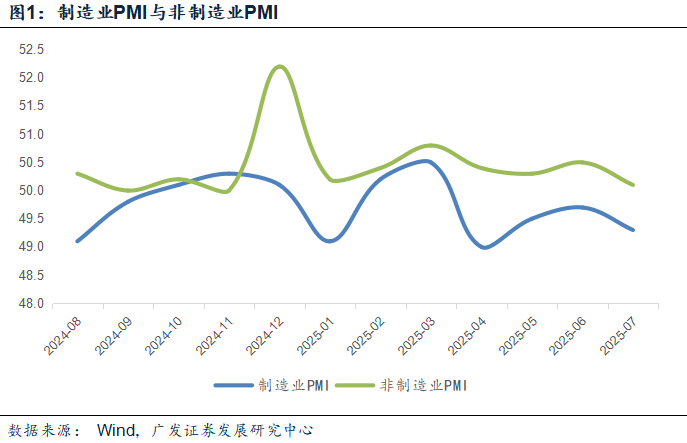
Group 1 - Manufacturing and non-manufacturing PMI both showed a decline in July, with manufacturing PMI at 49.3 and non-manufacturing PMI at 50.1, indicating a seasonal slowdown slightly greater than historical averages [4][6] - The decline in orders was slightly greater than production, suggesting a transmission of slowdown from demand to supply, with new orders index at 49.4 and production index at 50.5 [6][7][8] - Despite the decline in quantity indicators, price indicators showed initial expansion, with raw material purchase price index rising by 3.1 points and factory price index rising by 2.1 points, indicating effective transmission from upstream to downstream [8][9] Group 2 - Business activity expectations reached a four-month high, with the PMI production activity expectation index at 52.6, suggesting a positive impact of price elasticity on business expectations as long as the contraction in quantity is manageable [11] - The construction industry showed a month-on-month decline, attributed to adverse weather conditions and pressures from real estate sales, with construction PMI at 50.6 and new orders index at 42.7 [12][13] - The Business Confidence Index (BCI) fell by 1.6 points to 47.7, reflecting a distribution of "declining sales, rising profits" consistent with the logic of slowing real GDP and improving nominal GDP [13][14] Group 3 - The EPMI, PMI, and BCI all pointed in the same direction, indicating a need to adjust investment strategies to focus on areas benefiting from nominal GDP improvement and structural policy cues [18]

【广发宏观郭磊】7月“软数据”放缓
郭磊宏观茶座· 2025-07-31 07:06
Core Viewpoint - The manufacturing and non-manufacturing PMI both showed a decline in July, indicating a seasonal slowdown that is slightly more pronounced than in previous years. The decline in orders is greater than that in production, suggesting a transmission of slowdown from demand to supply [1][4][5]. Group 1: Manufacturing and Non-Manufacturing PMI - In July, the manufacturing PMI was recorded at 49.3, down from 49.7, while the non-manufacturing PMI was at 50.1, down from 50.5. The historical average for July over the past 5 and 10 years was -0.3 and -0.2 respectively, indicating this year's decline is slightly above seasonal norms [5][4]. - The new orders index for manufacturing was 49.4, lower than the previous 50.2, and the new export orders index was 47.1, down from 47.7 [6]. Group 2: Demand Factors - The slowdown in orders is attributed to several factors: a decrease in durable goods demand, with automotive retail sales dropping 19% month-on-month and 9% year-on-year; a decline in real estate sales, with a 21.2% year-on-year drop in transactions across 30 cities; and a potential contraction in production activities in some industrial sectors due to rising "anti-involution" sentiments [1][5]. Group 3: Price Indicators - Despite the decline in quantity indicators, price indicators showed initial expansion, with the raw material purchase price index and factory price index rising by 3.1 and 2.1 points respectively. This suggests that the "anti-involution" policy is starting to take effect and that there is some effective transmission from upstream to downstream [2][7][8]. - The production activity expectation index for July reached its highest level in four months at 52.6, indicating a positive correlation with nominal GDP as long as the contraction in quantity remains manageable [8]. Group 4: Construction Sector - The construction sector showed a decline, with the construction PMI at 50.6, down from 52.8. This decline is attributed to adverse weather conditions and pressures from real estate sales and fiscal spending on infrastructure [9][10]. - The new orders index for construction was 42.7, down from 44.9, indicating a weakening in demand within the sector [11]. Group 5: Business Confidence Index (BCI) - The BCI fell by 1.6 points from June, with a current value of 47.7. The index reflects a trend of "sales declining, profits rising," which aligns with the logic of slowing real GDP and improving nominal GDP [12][13]. - The forward-looking indices for consumer goods and intermediate goods prices unexpectedly declined, indicating that while short-term prices may rebound, the medium-term expectations for price increases are not yet solidified [12][15].

【招银研究】“反内卷”进行时——宏观与策略周度前瞻(2025.07.14-07.18)
招商银行研究· 2025-07-14 10:09
Group 1: Economic Overview - Investment remains a drag on the US economy, with the Atlanta Fed's GDPNOW model predicting a 2.6% annualized growth rate for Q2, entirely driven by a reduction in imports [2] - Employment market shows resilience, with weekly initial jobless claims decreasing by 6,000 to 227,000, remaining at seasonal lows [2] - Fiscal policy remains expansionary, with a weekly fiscal deficit of $131.1 billion, higher than seasonal levels and stronger than historical averages [2] Group 2: US Market Performance - US stock market experienced a slight increase of 0.02%, driven by mixed signals from Federal Reserve officials regarding interest rate outlook and differing expectations on tariffs' impact on inflation [3] - The outlook for US stocks suggests a potential return to a bullish trend, supported by corporate earnings resilience, although high valuations and increased tariffs may limit upward potential [3] Group 3: Bond Market Insights - Short-term focus on liquidity tightening pressure following the increase of the debt ceiling, with a maintained view of high volatility in US bond yields [3] - Strategy suggests maintaining a high allocation to short- to medium-term US bonds, with attention to potential opportunities if yields rise [3] Group 4: Currency Analysis - The US dollar is experiencing short-term support due to delayed tariffs and economic resilience, but medium-term trends remain weak due to uncertainties in tariff policies and fiscal pressures [3] - The Chinese yuan is expected to maintain a neutral trend, influenced by mixed factors including tariff impacts and ongoing interest rate differentials with the US [3] Group 5: Gold Market Dynamics - Short-term gold prices may remain volatile due to geopolitical issues and cooling interest rate expectations, but medium-term support is expected from central bank gold purchases [4] Group 6: Chinese Economic Trends - Anticipated Q2 economic growth of approximately 5.2%, with nominal GDP growth around 4% and a GDP deflator potentially declining to -1.2% [6] - Retail price competition continues, with significant growth in instant retail orders and a notable increase in passenger vehicle sales, despite challenges in the automotive sector [6] Group 7: External Demand and Pricing Pressure - Global manufacturing PMI rose to 49.5%, indicating ongoing recovery in global manufacturing and demand [7] - Chinese exports to the US are cooling, while exports to non-US regions remain strong, although pricing pressures are evident across various sectors [7] Group 8: Policy Developments - Recent government policies aim to stabilize employment and support businesses, including increased unemployment insurance and social security subsidies [7] Group 9: Domestic Market Strategy - Domestic market sentiment is improving, with a focus on "anti-involution" policies and urban renewal expectations, leading to a stronger stock market performance [9] - Bond market shows weakness, with a rise in 10-year government bond yields to 1.66%, influenced by risk appetite and tightening liquidity [9] Group 10: Stock Market Outlook - A-shares are experiencing upward movement driven by various factors, including easing US-China trade tensions and urban renewal policies, although the market remains vulnerable to corrections [10] - The Hong Kong stock market is facing risks of volatility, with current valuations at high levels and requiring further catalysts for upward movement [10]
【广发宏观郭磊】物价仍是宏观面关键变量
郭磊宏观茶座· 2025-06-09 23:54
Core Viewpoint - The article discusses the weak performance of CPI and PPI in May 2025, highlighting a deflationary trend and the factors contributing to this situation, including energy and food prices, as well as the broader economic implications for GDP growth and investment opportunities [1][4][11]. CPI Analysis - In May 2025, the CPI year-on-year was -0.1%, unchanged from the previous value, while the PPI year-on-year was -3.3%, lower than the previous -2.7% [1][4]. - The simulated deflation index, based on CPI and PPI weights of 60% and 40%, was -1.38%, the lowest in the past 16 months [1][4]. - The decline in CPI is attributed to a 1.7% month-on-month decrease in energy prices, which negatively impacted CPI by approximately 0.13 percentage points, primarily due to the transmission of commodity price declines influenced by tariffs [6][7]. - Food prices also saw a month-on-month decrease of 0.2%, contributing to a 0.04 percentage point drag on CPI, with weak demand in the restaurant sector being a significant factor [6][7]. PPI Analysis - The PPI decline was exacerbated by two main factors: a decrease in global pricing raw materials and weak domestic construction product pricing [8][9]. - The oil extraction, processing, and chemical industries experienced expanded declines due to falling oil prices, with year-on-year price drops of -17.3% for oil extraction and -14.7% for oil processing [8][9]. - New industry products made a slight positive contribution to PPI, with some sectors like automotive and electronics showing a slight narrowing in their year-on-year decline [8][9]. Future Price Trends - Looking ahead, there is a potential for a slight narrowing of PPI declines in June due to recent rebounds in oil and copper prices, indicating a possible improvement in global pricing factors [10]. - However, to significantly alter the low PPI situation, prices in the construction and emerging industries need to exit the negative growth range, which requires effective local government investment strategies [10]. Economic Outlook - The macroeconomic environment since the "924" policy has shown signs of stabilization, with actual GDP growth expected to remain above 5% in the second quarter of 2025, despite pressures from exports to the U.S. [11]. - The current economic challenges are primarily related to low prices and nominal GDP, leading to high real interest rates and a heavier debt burden, which could affect investment and consumption opportunities [11].

日本首相石破茂:力争日本2040年名义GDP达到1000万亿日元。
news flash· 2025-06-09 09:46
Core Viewpoint - Japanese Prime Minister Shigeru Ishiba aims for Japan's nominal GDP to reach 1,000 trillion yen by 2040, indicating a significant economic growth target for the country [1] Economic Goals - The target of 1,000 trillion yen represents a substantial increase from current GDP levels, reflecting an ambitious economic strategy [1] - This goal aligns with broader efforts to revitalize the Japanese economy and enhance its global competitiveness [1]
国内观察:2025年5月通胀数据:价格压力持续,亟待政策破局
Donghai Securities· 2025-06-09 09:16
Inflation Data Summary - In May 2025, the CPI year-on-year was -0.1%, unchanged from the previous month, while the month-on-month change was -0.2%, down from 0.1%[3] - The PPI year-on-year decreased to -3.3% from -2.7%, with a month-on-month change of -0.4%, consistent with the previous month[3] CPI Analysis - The CPI month-on-month decline of -0.2% aligns with the seasonal average over the past four years[3] - Food prices showed resilience with a month-on-month change of -0.2%, better than the four-year average of -0.9%, while non-food prices also fell by -0.2%, below the average of 0.0%[3] - Pork prices have remained stable, contributing less to CPI changes, with fresh vegetables and fruits showing stronger seasonal performance[3] PPI Insights - The PPI has broken below the previous range of -2.0% to -3.0%, indicating a significant downward trend[3] - Production materials have seen a month-on-month decline for five consecutive months, with a year-on-year drop of -4.0%[3] - Energy prices fell by 1.7% month-on-month, contributing approximately 0.13 percentage points to the CPI decline, accounting for nearly 70% of the total decrease[3] Economic Outlook - Actual GDP is expected to remain resilient in Q2, but nominal GDP may face pressure, impacting equity market potential[3] - The report highlights the need for increased policy measures to stimulate demand and address supply-side competition issues[3] Risk Factors - Potential risks include slower-than-expected domestic policy implementation, unexpected declines in real estate investment, and inflationary pressures from the U.S.[3]