品牌高端化

Search documents
服饰鞋履卷设计,家居内衣“拼体感”|世研消费指数品牌榜Vol.96
3 6 Ke· 2026-01-12 06:12
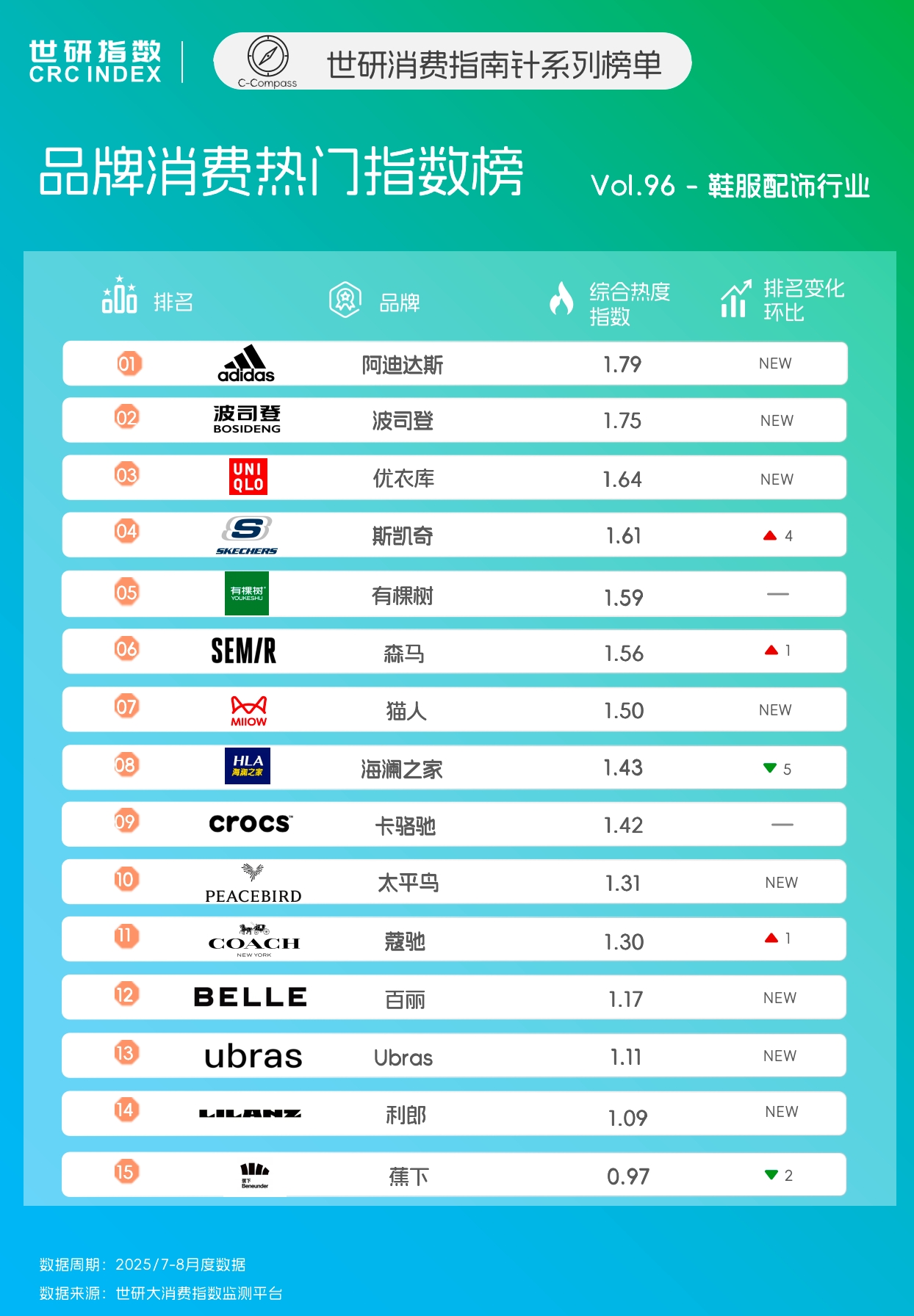
Group 1: Industry Trends - The footwear and apparel industry is undergoing a transformation from "external expression" to "internal experience," with a diverse consumption pattern that includes both basic styles and design-oriented products [1] - Brands are leveraging cultural integration to break into high-end markets, while the innerwear and homewear segments are driven by both technological experiences and emotional values [1] - As competition shifts from functionality to emotional and lifestyle aspects, brands must build an irreplaceable connection with consumers [1] Group 2: Brand Performance - Adidas, Bosideng, and Uniqlo lead the comprehensive popularity index with scores of 1.79, 1.75, and 1.64 respectively [4][5] - The demand for high-cost performance basic items and comfortable products with design elements is strong among consumers, particularly for brands like Uniqlo and Semir [5] - Taiping Bird has launched a high-end series that combines New York ready-to-wear language with Eastern aesthetics, targeting younger consumers born in the 1980s and 1990s [5] Group 3: Footwear Segment Insights - Young consumers are no longer satisfied with just durable shoes; they seek comfort and aesthetics, using footwear to express emotions and identity [5] - Belle, a mature national brand, connects product functionality with emotional values and has expanded into the "fashion leisure" segment, creating memorable shoe models that resonate with users [5] Group 4: Homewear and Innerwear Innovations - The focus in homewear and innerwear consumption is shifting from external design to internal experience, with "perceptible technology" becoming a key factor [6] - Brands like Catman and Ubras are innovating by emphasizing technological advancements and emotional connections, with Catman focusing on "tech innerwear" and Ubras promoting a "female value co-builder" concept [6] - Ubras has upgraded its signature breast health initiative and opened a "Comfort Aesthetics Collection Store," enhancing its offline presence and high-end experience [6]



小米公关部点燃了小米
3 6 Ke· 2026-01-07 09:29
Core Viewpoint - Xiaomi's recent public relations misstep, involving a failed collaboration with a controversial influencer, has led to significant internal repercussions, including the forfeiture of bonuses by top executives, highlighting the tension between its core fanbase and new target demographics [1][2][9]. Group 1: Public Relations and Brand Management - The attempt to engage a polarizing influencer backfired, resulting in a backlash from Xiaomi's dedicated fanbase, which has historically been a crucial support system for the brand [1][4]. - The public relations strategy appears outdated, relying on traditional methods that do not resonate with the current digital landscape, leading to a disconnect with both core fans and potential new customers [10][12]. - The internal conflict between the 40% of extreme fans and the 60% of middle-class consumers seeking a more refined brand image is creating a challenging environment for Xiaomi's brand evolution [5][7]. Group 2: Market Reaction and Investor Sentiment - The market has reacted negatively to Xiaomi's public relations blunders, leading to increased volatility in its stock price, which is now heavily influenced by public sentiment rather than just financial performance [14][15]. - Investors are concerned about the company's management capabilities, particularly in handling public relations crises, which could affect long-term valuation and trust in the brand [16][17]. - The loss of trust and the perception of insincerity in Xiaomi's brand messaging are causing a reevaluation of its market position, potentially shifting it from a high-growth tech brand to a more traditional electronics manufacturer [16][18]. Group 3: Future Brand Strategy - Xiaomi needs to diversify its engagement strategy beyond its core fanbase, incorporating voices from outside its traditional circles to appeal to a broader audience [20][21]. - The company should focus on creating authentic content that resonates with ordinary users, rather than relying solely on influencer partnerships that may not align with its brand values [19][22]. - A balanced approach that respects the legacy of its fan culture while also appealing to non-fans is essential for Xiaomi's sustainable growth and brand perception in the future [23][24].

东方证券:维持吉利汽车(00175)买入评级 目标价23.02港元
智通财经网· 2026-01-05 09:32
Core Viewpoint - Geely Auto is leveraging a "dual fuel" strategy to mitigate the impact of declining new energy subsidies and is accelerating its overseas expansion, targeting an export volume of 1 million units by 2027 [1] Group 1: Sales Performance - Geely Auto achieved a sales target of 3 million units, with a goal of 3.45 million units by 2026 [2] - In December, Geely's total sales reached 236,800 units, a year-on-year increase of 12.7%, with new energy vehicle sales at 154,300 units, up 38.7% [2] - The company expects to sell 3.02 million units in 2025, a 39.0% year-on-year increase, and aims for 3.45 million units in 2026, representing a 14.1% growth [2] Group 2: Strategic Initiatives - The "dual fuel" strategy is expected to counteract the effects of subsidy reductions in 2026, with plans to sell 2.22 million new energy vehicles, a 31.5% increase [3] - Geely's exports in December reached 40,300 units, a 49.0% year-on-year increase, with total annual exports at 420,100 units, up 1.3% [3] - The company is expanding into 13 new international markets, including the UK, Italy, and Brazil, with significant progress in local production facilities [3] Group 3: Brand Development - The premium brands Zeekr and Lynk & Co showed strong sales in December, with Zeekr selling 30,300 units (up 11.3%) and Lynk & Co selling 33,800 units (up 29.4%) [4] - The average transaction price for Zeekr 9X exceeded 530,000 yuan, making it a leader in the large SUV segment, while Lynk & Co 900 has delivered over 50,000 units in six months [4] - Following the privatization of Zeekr, the integration is expected to enhance strategic synergy and scale effects, supporting brand elevation and profitability [4] Group 4: Financial Projections - The forecasted net profit for Geely Auto is 17.04 billion yuan in 2025, 20.60 billion yuan in 2026, and 24.32 billion yuan in 2027 [5] - The target price is set at 20.79 yuan per share, equivalent to 23.02 HKD, maintaining a buy rating [5]


魏建军回应“魏牌”人事更迭:我们都有高估能力的幻觉
2 1 Shi Ji Jing Ji Bao Dao· 2025-12-31 12:43
Core Viewpoint - Great Wall Motors is undergoing significant changes in leadership and strategy for its premium brand Wey, aiming to enhance its market position and address challenges in high-end vehicle branding [2][4][5]. Group 1: Leadership Changes - Great Wall Motors has appointed Zhao Yongpo, the general manager of Haval, as the CEO of Wey, marking the tenth leadership change in eight years for the brand [2][4]. - The frequent changes in leadership reflect the complexities and challenges of managing a high-end automotive brand [8][9]. Group 2: Sales Performance - Wey's sales have surged, with 89,000 units sold in the first eleven months of the year, representing a 93.34% year-on-year increase, while other brands like Tank and Haval saw much lower growth rates of 1.18% and 11.13% respectively [4][5]. - The overall sales for Great Wall Motors reached 1.1997 million units in the same period, showing a 9.26% increase year-on-year [7]. Group 3: Investment and Financials - The company has invested at least 2 billion yuan in direct sales channels, contributing to a significant increase in sales expenses, which rose to 7.95 billion yuan in the first three quarters, a 55.6% increase year-on-year [5][6]. - Revenue for the first three quarters was 153.58 billion yuan, up 7.96%, while net profit attributable to shareholders fell by 16.97% to 8.635 billion yuan [5]. Group 4: Brand Strategy and Market Position - Great Wall Motors is focusing on high-end positioning for Wey, emphasizing the need for a clear value proposition in the minds of consumers [5][14]. - The average selling price of Great Wall vehicles exceeds 180,000 yuan in international markets and 200,000 yuan domestically, positioning it as the highest among traditional Chinese automakers [6][14]. Group 5: Future Goals and Challenges - The company has set ambitious targets for 2026, aiming for sales of at least 1.8 million units and a net profit of no less than 10 billion yuan [6][7]. - The challenge remains in establishing a sustainable and replicable growth model for the brand, particularly in the context of high-end market dynamics [7].

“加拿大巴菲特”暴力抄底安德玛(UAA.US) 超16% 股权,释放何种信号?
智通财经网· 2025-12-31 02:36
Group 1 - The core point of the article highlights Under Armour's stock price has risen for the ninth time in ten trading days, primarily due to Fairfax Financial Holdings increasing its stake in the company to over 30 million shares, representing 16.1% of its outstanding shares, a significant increase from the previously disclosed 9% [1] - Despite the increased stake, the market does not expect Fairfax to initiate a proxy fight or push for management changes, as the firm is known for its long-term value investment approach [1] - Under Armour's latest Q2 earnings exceeded market expectations, with a 5% year-over-year decline in sales and a loss of $0.04 per share. The company has revised its revenue guidance for FY2026 to a decline of 4%-5%, narrowing from the previous 6%-7% forecast, while expected earnings per share have been raised to $0.03-$0.05, significantly above the prior range of $0.01-$0.02 [1] Group 2 - The upward revision of the FY2026 guidance reflects the company's "brand premiumization" strategy, focusing on the top 10 core products for efficient resource allocation, strengthening direct-to-consumer channels, and systematically reducing reliance on traditional high-discount promotional models [2] - As of the latest close, Under Armour's stock price increased by 7.53% to $5.14, although it has declined nearly 40% year-to-date [3]

迪桑特不想只赚东北人的钱
3 6 Ke· 2025-12-31 01:40
Core Insights - Descente has become one of the most popular brands in the Northeast region of China, particularly in ski resorts, following its joint venture with Anta Group in 2016 [1][4] - The brand's rapid growth in the Northeast is attributed to its high-end positioning and the cultural significance it holds among local consumers [3][6] Sales Performance - The Descente store in Changchun has ranked first in sales nationally multiple times, achieving over 100 million yuan in sales for 2023 [2] - From January 1 to March 16, 2023, the store generated 30 million yuan in sales, and by the third quarter, the cumulative sales reached 100 million yuan [2] Brand Positioning - Descente's core products are priced between 1,000 yuan and 4,000 yuan, with ski apparel typically ranging from 5,000 yuan to 9,000 yuan, indicating a clear high-end market positioning [3] - The brand is perceived as a "hard currency" in social settings in Northeast China, reflecting a consumer preference for high-end brands [3] Market Expansion - As of December 30, 2023, Descente has 59 stores in Northeast China, with plans to expand its total store count in China and Southeast Asia to 260-270 by the end of 2025 [5][6] - The brand is also expanding into southern markets, with 48 stores in Jiangsu, Zhejiang, and Shanghai, indicating a strategic move to diversify its market presence [7] Financial Growth - In 2023, Descente's retail sales exceeded 5 billion yuan, contributing nearly 72% to its segment's revenue [5] - The brand aims for a compound annual growth rate of 20%-25% from 2024 to 2026, targeting annual sales of 10 billion yuan [9] Competitive Landscape - Descente faces challenges in diversifying beyond its winter sports image and competing in the southern market against established brands [8][11] - The brand's growth is heavily reliant on channel expansion, with a focus on high-performance stores and flagship locations [9]
21对话|魏建军回应魏牌“八年十帅”:我们都有高估能力的幻觉
2 1 Shi Ji Jing Ji Bao Dao· 2025-12-29 11:06
Core Viewpoint - The leadership changes at Wey brand reflect the challenges of establishing a high-end automotive brand in China, with the company striving to find a sustainable path for growth and brand identity [2][3][4]. Group 1: Leadership Changes and Strategy - Wey brand has undergone its tenth leadership change in eight years, indicating a struggle to establish a stable brand identity and operational strategy [2][3]. - The recent appointment of Zhao Yongpo as CEO aims to leverage the efficiency of the main brand's system and user base to enhance Wey's performance [4][5]. - The company acknowledges the complexity of managing a high-end brand, emphasizing the need for comprehensive skills in leadership [7][8]. Group 2: Sales Performance and Financials - Wey brand's sales reached 89,000 units in the first eleven months of the year, marking a 93.34% year-on-year increase, significantly outpacing other brands like Tank and Haval [3]. - Despite revenue growth, Great Wall Motors reported a decline in net profit, with sales expenses rising to 7.95 billion yuan, a 55.6% increase from the previous year [3][5]. - The company has invested at least 2 billion yuan in direct sales channels to support its high-end strategy [3][4]. Group 3: Brand Positioning and Market Strategy - The high-end positioning of Wey brand remains unchanged, focusing on the "large six-seat SUV" category and expanding direct sales channels to unify pricing and service standards [3][4]. - Great Wall Motors claims the highest average selling price among Chinese automotive companies, with prices exceeding 180,000 yuan in international markets and 200,000 yuan domestically [4][15]. - The company is working to establish a clear value proposition in the minds of consumers, emphasizing the importance of brand perception in achieving high-end status [4][14]. Group 4: Technological Advancements and Future Products - Great Wall Motors is accelerating its efforts in smart technology, with the launch of the new Blue Mountain intelligent version featuring advanced driving assistance systems [4][16]. - The company plans to introduce a range of products with multiple powertrain options, including gasoline, HEV, PHEV, and electric vehicles, under a unified design [18][19]. - The focus on mechanical quality and emotional value remains a core aspect of the brand's identity, with plans to incorporate powerful engine options like V6 and V8 in future models [19].
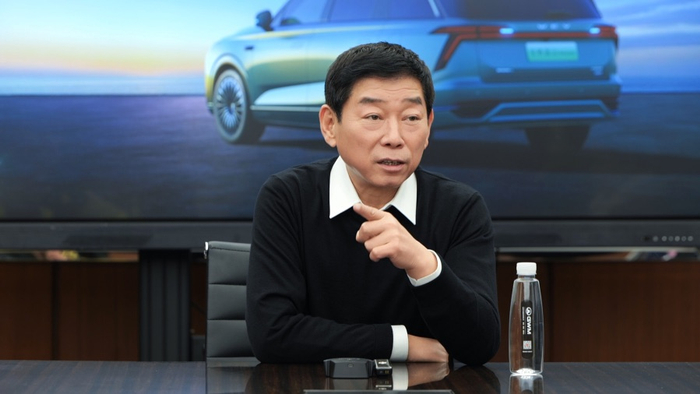
魏建军回应魏牌“八年十帅”:我们都有高估能力的幻觉
2 1 Shi Ji Jing Ji Bao Dao· 2025-12-29 11:06
Core Insights - The core viewpoint of the articles revolves around the challenges and strategies of WEY brand under Great Wall Motors, particularly focusing on its high-end positioning and the frequent changes in leadership, which reflect the complexities of establishing a successful luxury automotive brand in China [1][5][12]. Group 1: Leadership Changes and Challenges - WEY brand has undergone its tenth leadership change in eight years, indicating a struggle to establish a stable and effective management team [1][6]. - The frequent changes in leadership are attributed to the high expectations and pressures associated with managing a luxury brand, which requires a comprehensive skill set [6][7]. - The current CEO, Zhao Yongpo, aims to leverage the efficiencies from the main brand, Haval, to enhance WEY's performance [3][4]. Group 2: Sales Performance and Strategy - WEY brand has shifted its strategy to focus on the "large six-seat SUV" segment, launching new models and investing heavily in direct sales channels, resulting in a significant sales increase of 93.34% year-on-year, totaling 89,000 units in the first eleven months of the year [2][4]. - Despite the sales growth, Great Wall Motors reported a decline in net profit by 16.97% year-on-year, highlighting the financial pressures from increased sales and marketing expenses, which rose to 7.95 billion yuan [2][4]. Group 3: Brand Positioning and Market Perception - The brand's high-end positioning remains unchanged, with a focus on creating a clear value proposition that resonates with consumers, emphasizing that luxury is not merely a label but must be recognized by the public [3][12]. - Great Wall Motors claims the highest average selling price among traditional Chinese automotive companies, with an average price exceeding 180,000 yuan in international markets and 200,000 yuan domestically [3][12]. Group 4: Future Outlook and Innovations - The company is preparing for the tenth anniversary of WEY in 2026, with ambitious sales targets set at 1.8 million units and a net profit of 10 billion yuan [4]. - Great Wall Motors is also focusing on technological advancements, including the launch of the new Blue Mountain intelligent model, which incorporates advanced AI capabilities for enhanced safety and driving experience [3][14][18].
海尔泰国总经理:家电出海的下半场是做强品牌和中高端
2 1 Shi Ji Jing Ji Bao Dao· 2025-12-29 10:11
Core Viewpoint - The article highlights Haier's successful growth in the Thai market despite a challenging international trade environment, emphasizing the company's strategic focus on localization and user-centric product development [2][10]. Group 1: Company Performance - Haier's overseas market revenue grew by 10.5% in the first three quarters of 2025, with Southeast Asia seeing over 15% growth [3]. - In the Thai white goods market, Haier achieved a 29% growth while the overall market declined by 4.9%, making it the leading brand in Thailand [3]. - The company has established a significant market presence in Thailand over 23 years, overcoming initial brand recognition challenges [6]. Group 2: Strategic Development - Haier's strategic evolution in Thailand can be divided into three phases: exploration (2002-2007), localization (2007-2020), and brand premiumization (2020 onwards) [7]. - The acquisition of Sanyo's white goods division in 2007 marked a turning point, allowing Haier to implement a localized strategy in R&D, manufacturing, and marketing [7]. Group 3: Market Potential - The Thai market is viewed as a strategic hub for Haier due to its large domestic demand and favorable geographic location [5]. - There remains significant potential for growth in understanding user needs and improving market share in retail outlets [9]. Group 4: Competitive Landscape - Despite intense competition from Japanese, Korean, and other Chinese brands, Haier maintains a focus on user-centric strategies and product differentiation [10]. - The company aims to expand its market presence beyond major cities like Bangkok, targeting rural areas with a comprehensive distribution strategy [11]. Group 5: Brand Perception - Consumer perceptions of Chinese brands are shifting from "value for money" to recognizing the technological advancements and differentiated product offerings [12]. - Haier's high-end products, such as the L+ series washing machine priced at 90,000 Thai Baht, demonstrate the brand's ability to compete at premium price points [11]. Group 6: Future Outlook - Haier plans to enhance its brand recognition and user engagement through deeper interactions and a focus on high-end product development [14]. - The company emphasizes the importance of a localized supply chain to adapt to external market changes and support both local and export demands [13].


21专访丨海尔泰国总经理董建平:家电出海的下半场是做强品牌和中高端
2 1 Shi Ji Jing Ji Bao Dao· 2025-12-26 23:14
Core Viewpoint - The article highlights Haier's successful growth in the Thai market despite a challenging international trade environment, emphasizing the importance of understanding local consumer needs and maintaining a strong brand presence [2][10]. Group 1: Company Performance - Haier's overseas market revenue grew by 10.5% in the first three quarters of 2025, with Southeast Asia experiencing over 15% growth [3]. - In the Thai white goods market, Haier achieved a 29% growth while the overall market declined by 4.9%, making it the leading brand in Thailand [3][10]. - The company has established a significant market presence in Thailand over 23 years, overcoming initial challenges related to brand recognition and product-market fit [6][7]. Group 2: Strategic Importance of Thailand - Thailand is viewed as a strategic market for Haier due to its large domestic demand and favorable geographic location, serving as a "bridgehead" for the company's global operations [5]. - The company has implemented a localized strategy since acquiring Sanyo's white goods business in 2007, focusing on local R&D, manufacturing, and marketing [7][14]. Group 3: Market Opportunities - There remains substantial potential in the Thai market, particularly in understanding user needs and enhancing product offerings [8][10]. - Haier aims to increase its market share in retail outlets, where it currently does not hold the top position in every store [9]. - The company is also focused on improving operational efficiency and expanding its service network to capture more market opportunities [10]. Group 4: Product Strategy and Brand Perception - Haier's strategy includes launching high-end products tailored to specific consumer needs, such as the AI Voice air conditioner that addresses local climate challenges [8][11]. - The perception of Chinese brands is shifting, with Haier's brand recognition and user conversion rates now comparable to Korean brands, indicating a move away from the "cheap and cheerful" stereotype [11][12]. - The company emphasizes rapid product iteration and technological advancement, allowing it to respond quickly to market demands compared to traditional brands [12]. Group 5: Future Challenges and Goals - To become a top international brand, Haier recognizes the need for deep user engagement and brand loyalty [14]. - The company aims to strengthen its brand positioning and develop mid-to-high-end products as part of its long-term strategy [14]. - Haier's commitment to a "In Thailand, For Thailand" approach underscores its focus on local market integration and sustainability [14].