
季节性因素

Search documents
能源化策略报:煤油价格延续震荡整理,聚烯烃基差?幅?弱
Zhong Xin Qi Huo· 2025-12-25 01:14
Group 1: Report Industry Investment Rating - Not available Group 2: Core Views of the Report - Geopolitical disturbances affect the crude oil market, and the rebound of the chemical industry will be tortuous. The industry is expected to face challenges due to high inventories of liquid chemicals and geopolitical uncertainties [2][7] - Different energy and chemical products are expected to show various trends, including oscillation, rebound, and weakening, depending on factors such as supply - demand, geopolitical situations, and cost support [3] Group 3: Summary by Variety Crude Oil - **View**: Russia's crude oil exports reach a two - and - a - half - year high, with high floating storage. Oil prices should be treated with an oscillatory approach [9] - **Main Logic**: International crude oil futures continue to oscillate. Geopolitical trends are crucial. More refineries start to buy Russian oil as the discount narrows, but floating storage is increasing. Refined oil crack spreads are weak, and the oil price should be seen as oscillatory [12] - **Outlook**: The crude oil market may return to a pattern of weak supply - demand and continuous inventory accumulation after geopolitical tensions ease. Investors should adopt an oscillatory view [12] Asphalt - **View**: South China asphalt spot is at a discount to Shandong, and asphalt futures prices oscillate [13] - **Main Logic**: OPEC+增产 in December, the possibility of a Russia - Ukraine agreement exists, and the escalation of the US - Venezuela situation leads to expectations of raw material supply disruptions. The futures price oscillates widely. Also, high production in Hainan, South China's spot discount, and weak supply - demand all affect the price [13][14] - **Outlook**: The absolute price of asphalt is overvalued [14] High - Sulfur Fuel Oil - **View**: High - sulfur fuel oil futures prices oscillate widely [3] - **Main Logic**: OPEC+增产, the possibility of a Russia - Ukraine agreement, and the tense US - Venezuela situation drive the rebound. However, high floating storage in the Asia - Pacific region suppresses demand, and refinery demand is weak in the off - season [14] - **Outlook**: Supply - demand is weak [14] Low - Sulfur Fuel Oil - **View**: Low - sulfur fuel oil follows crude oil to oscillate [14] - **Main Logic**: It follows crude oil, has strong product attributes, but faces negative factors such as falling shipping demand, green energy substitution, and high - sulfur substitution. Currently, the supply has unexpectedly decreased, pushing up the valuation [14] - **Outlook**: It follows crude oil fluctuations due to low valuation and various negative factors [14] PX - **View**: Rumors of polyester factories continue to ferment, and the increase in the price of PX has narrowed [16] - **Main Logic**: International oil prices oscillate upwards, providing cost support. The rise of downstream PTA also supports PX, but rumors of polyester factory production cuts limit the increase. The supply of PX is sufficient [16] - **Outlook**: The short - term price will maintain high - level oscillation, with high profits. Caution is needed when chasing the price or short - selling [17] PTA - **View**: Rumors of polyester factory production cuts ferment, and the upward space is gradually narrowing [17] - **Main Logic**: The upstream cost is high, and PTA's spot and processing fees have recovered. However, rumors of production cuts in polyester factories may limit the continuous increase [18] - **Outlook**: The price follows the cost to oscillate at a high level, and the processing fee will operate within a range [18] Pure Benzene - **View**: Supported by the strong external market, pure benzene oscillates [19] - **Main Logic**: The support comes from the external market, with US devices restarting. However, the domestic situation is poor, with high inventory pressure and a downward - adjusted future expectation [21] - **Outlook**: There is still inventory pressure, and the external market provides temporary support [21] Styrene - **View**: There are constraints on both rising and falling, and styrene oscillates [22] - **Main Logic**: It has been oscillating weakly recently due to negative feedback from downstream ABS. The lower support comes from the external pure benzene market, while the upper limit is due to pure benzene inventory pressure and the upcoming inventory build - up of styrene [23] - **Outlook**: It is about to enter a period of inventory build - up, with obvious upper - limit constraints. Export transactions may stimulate short - term rebounds [23] Ethylene Glycol - **View**: Overseas device shutdowns and capital sentiment disturbances lead to a low - level rebound of ethylene glycol [24] - **Main Logic**: After hitting a new low, the price rebounds due to supply adjustments such as the planned shutdown of Taiwan's devices. However, the inventory build - up period has not ended, and demand may be dragged down by polyester factory production cuts [26] - **Outlook**: The short - term price will maintain range - bound oscillation, and the rebound height is limited [26] Short - Fiber - **View**: The pattern of strong upstream and weak downstream is prominent, with serious differentiation and compressed profits [27] - **Main Logic**: The upstream cost is strong, but the downstream demand is weak, resulting in compressed profits. The absolute price follows the upstream cost to oscillate [28] - **Outlook**: The price follows the upstream to oscillate strongly, and the processing fee is under short - term pressure [28] Polyester Bottle - Chip - **View**: The price is supported by upstream raw material costs [29] - **Main Logic**: The upstream costs of TA and EG increase, providing support. The market trading atmosphere is okay, and the price follows the raw materials to oscillate strongly in the short term [29] - **Outlook**: The absolute price fluctuates with the raw materials, and the processing fee has stronger support [29] Methanol - **View**: The inland market is weak, and the coastal market is stalemate. Methanol should be seen as oscillatory [32] - **Main Logic**: There is a significant differentiation between the inland and coastal markets. The inland supply is abundant, and the coastal inventory is high, suppressing the price [33] - **Outlook**: Short - term wide - range oscillation [33] Urea - **View**: Supported by compound fertilizer and export demand, the futures price oscillates strongly [33] - **Main Logic**: Environmental restrictions on supply end have ended, and demand from compound fertilizer and exports provides support. The inventory has decreased [34] - **Outlook**: Short - term oscillation is strong, but it may not last long. Attention should be paid to inventory reduction, off - season storage progress, and compound fertilizer factory operations [34] LLDPE (Plastic) - **View**: The futures price rebounds, the basis weakens, and LLDPE should be treated with an oscillatory view [37] - **Main Logic**: The futures price rebounds. Geopolitical factors cause short - term fluctuations, while the fundamental support is limited. The demand is entering the off - season [37] - **Outlook**: Short - term oscillation [38] PP - **View**: Slight increase in maintenance, PP oscillates [38] - **Main Logic**: PDH profits are under pressure, and there is an expectation of increased maintenance. Geopolitical factors affect short - term fluctuations, and the supply pressure is high due to the off - season and high inventory [38] - **Outlook**: Short - term oscillation [39] PL - **View**: Supported by PDH maintenance expectations, PL oscillates [39] - **Main Logic**: PDH maintenance expectations boost the price. The enterprise shipment pressure is high, and the downstream purchases at low prices. The powder profit is under pressure, and the low start - up rate has a negative impact [39] - **Outlook**: Short - term oscillation [39] PVC - **View**: The market sentiment is positive, and the short - term futures price is strong [40] - **Main Logic**: Macro - level sentiment boosts, and micro - level supply - demand has marginal improvement, but the oversupply expectation cannot be reversed. The production may stabilize, downstream demand is weak seasonally, and the cost is expected to be weak [40] - **Outlook**: Although the supply has marginal improvement, the rebound space may be limited. The market may return to weakness if marginal enterprises resume production [40] Caustic Soda - **View**: Supported by low valuation, caustic soda rebounds at a low level [42] - **Main Logic**: Macro - level sentiment boosts, but short - term inventory reduction may not change the oversupply situation. The demand from alumina and non - aluminum industries has different trends, and the cost is relatively stable [42] - **Outlook**: The short - term market sentiment is positive, and the price rebounds. However, the medium - term market may be under pressure if upstream production reduction is limited [42] Group 4: Variety Data Monitoring Inter - Period Spreads - The report provides inter - period spread data for multiple varieties such as Brent, Dubai, PX, PTA, etc., showing the changes in different time - period spreads [44] Basis and Warehouse Receipts - Data on the basis and warehouse receipts of various varieties like asphalt, high - sulfur fuel oil, and low - sulfur fuel oil are presented, reflecting the relationship between spot and futures prices and the quantity of warehouse receipts [45] Inter - Variety Spreads - Inter - variety spread data, including spreads between PP and methanol, PTA and EG, etc., are given, indicating the relative price relationships between different varieties [46] Group 5: Commodity Index - The comprehensive index, specialty index, and sector index of CITIC Futures commodities on December 24, 2025, are reported, showing the performance of different indices and their historical and recent fluctuations [287][288]
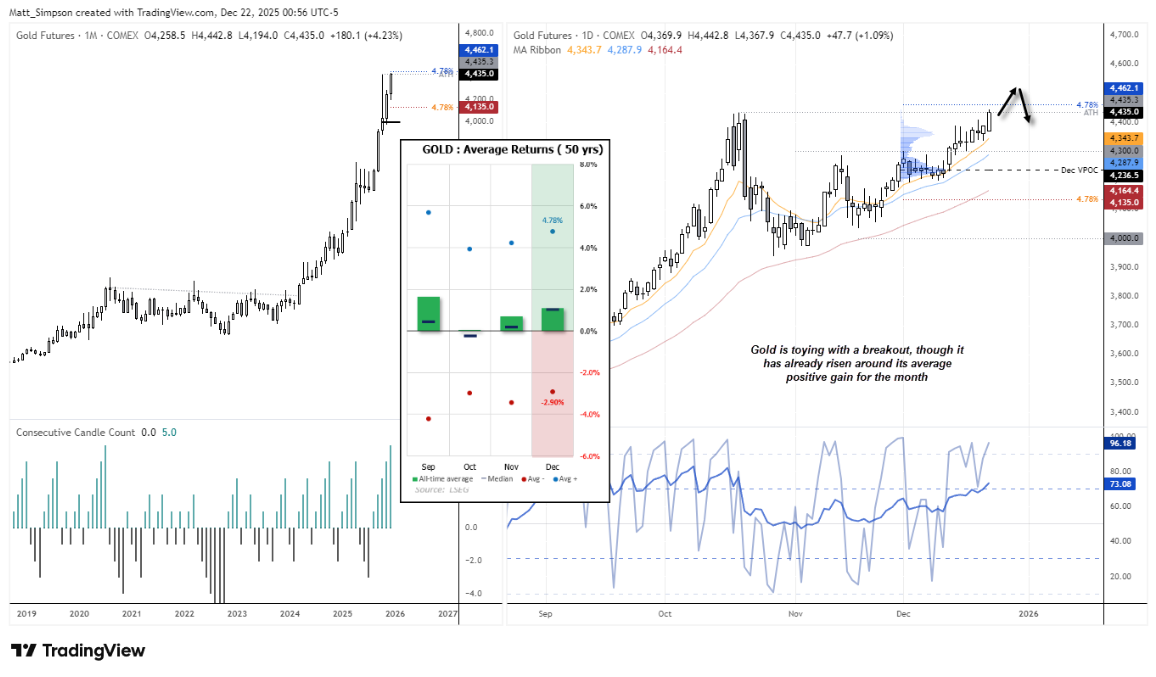
意外突破!缺乏催化剂的金价为何仍能狂飙?
Jin Shi Shu Ju· 2025-12-22 08:21
Core Viewpoint - Despite a quiet market, gold prices have reached a historic high, indicating strong upward momentum driven by seasonal factors and a focus on whether bullish trends can continue into the year-end [1]. Group 1: Market Performance - Gold prices broke the historical high set in October, with gold futures following suit shortly after [1]. - As of the time of writing, gold has risen over 4.5% in December, with only about a week of trading left in the year [4]. - Seasonal data shows that gold has an average return of 1.1% in December over the past 50 years, with a 52% probability of an increase [1]. Group 2: Technical Analysis - The Relative Strength Index (RSI) has just entered the overbought territory, which is typical for a healthy upward trend [4]. - The average positive return for gold in December is 4.78%, while the average return during the 48% of months that saw declines is -2.9% [1]. Group 3: Seasonal Factors - Gold tends to perform well in the second half of December, particularly around Christmas, with a high probability of price increases during this period [4][5]. - The average daily return for gold in December indicates a tendency for prices to rise before and after Christmas, suggesting potential for further upward movement before year-end profit-taking begins [4].

Watch for Crude Oil "Washout" Before Bottom Hits, Plunge to $15 Possible
Youtube· 2025-12-19 19:00
Core Viewpoint - The outlook for crude oil prices in 2026 appears bleak, with expectations of continued downward pressure and potential for prices to drop significantly unless a major market shift occurs [2][6][10]. Crude Oil Market Analysis - Historical trends indicate that the current bearish market for crude oil is the fourth in two decades, with previous downturns ending in significant price drops [5][6]. - A short-term bounce in crude oil prices is anticipated due to seasonal factors and a weak dollar, but this is not expected to lead to a sustained recovery [3][4]. - The market has experienced a risk premium due to geopolitical tensions, particularly related to the Russia-Ukraine conflict, which could influence future pricing [9][10]. - Analysts suggest that a capitulation in price and sentiment is necessary to identify a true market bottom, with potential for prices to reach $40 per barrel if conditions worsen [7][10]. Natural Gas Market Analysis - Natural gas prices are influenced by seasonal factors, with a historical pivot point around $3.60; prices above this level tend to be bullish, while those below are bearish [13][14]. - Current natural gas prices around $4 may seem high compared to recent lows but are significantly lower than the peaks seen in previous years [16][17]. - Expectations for natural gas prices should be tempered, with projections suggesting a trading range of $2 to $5.50 in the near future [17].

高盛对冲基金主管分享“市场历史中的一些经验教训”
Goldman Sachs· 2025-12-17 15:50
Investment Rating - The report does not explicitly provide an investment rating for the industry. Core Insights - The S&P 500 index has an average annual total return of +13% since 1945, with 79% of years yielding positive returns, indicating a high probability of profit in the stock market [4][5] - Investing $1,000 in the S&P 500 index in 1945 would result in approximately $7.3 million today, highlighting the power of compounding and the impact of seasonal investment strategies [5][6] - U.S. household net worth increased by 52% from $110 trillion at the end of 2019 to $167 trillion by mid-2023, indicating significant wealth accumulation [5] - The top 10% of U.S. households own 87% of the stock market, while the top 1% own 50%, reflecting wealth concentration in the equity market [6] - Since March 2009, the Nasdaq 100 index has seen a total return of +2,753%, with notable investment opportunities arising during market downturns [7] - The market capitalization of the seven largest tech companies has grown from $1 trillion to $21 trillion over the past thirteen years, indicating robust growth in the tech sector [7] - The average age of first-time homebuyers in the U.S. has reached a record high of 40 years, compared to 31 years in 1999, suggesting changing demographics in the housing market [12] Summary by Sections Historical Performance - The S&P 500 index has consistently provided positive returns, with a total return of +17% year-to-date, placing it in the 56th percentile historically [4] - The significant difference in returns based on investment timing emphasizes the importance of market timing and seasonal factors [5] Wealth Distribution - U.S. households, through direct ownership or funds, hold over 50% of the U.S. stock market, contrasting sharply with hedge funds that hold only 2% [5] - The concentration of stock ownership among the wealthiest households raises questions about market dynamics and accessibility for average investors [6] Economic Indicators - The increase in U.S. household net worth and the growth of the tech sector reflect broader economic trends and potential investment opportunities [5][7] - The projected growth of U.S. nominal GDP by nearly 280% by 2050 indicates a long-term positive outlook for the economy [11]

从12月起,这4类商品价格或将明显上涨,老百姓要提前做好准备
Sou Hu Cai Jing· 2025-12-12 17:07
Group 1 - The domestic economy is expected to remain in a deflationary cycle into 2025, with prices of various goods such as housing, vehicles, small appliances, electronic products, and pork experiencing declines, which will lower consumer spending costs significantly [1] - Starting from December, prices of four categories of goods are predicted to rise significantly, prompting consumers to prepare in advance [1] Group 2 - Winter agricultural product prices are experiencing an increase, particularly in vegetables, with prices for items like green vegetables rising from 2.5 yuan per jin to 4-5 yuan per jin, tomatoes from 4.5 yuan per jin to 6-7 yuan per jin, and spinach from 5-6 yuan per jin to 8-9 yuan per jin [4] - The increase in vegetable prices is attributed to higher production costs due to winter greenhouse farming and increased transportation costs as many vegetables must be sourced from distant southern regions [4] Group 3 - Heating costs are expected to rise by 5%-10% in northern cities as centralized heating begins in December, leading to additional expenses of 50-200 yuan for an average two-bedroom apartment [5][7] - The rise in heating costs is driven by peak demand during winter and increased energy prices, particularly coal [7] Group 4 - Prices for winter clothing and accessories such as coats, hats, scarves, and gloves are also expected to rise due to increased demand and higher production costs for materials like down and cotton [9] - The demand for winter clothing surges as the cold season arrives, leading to a supply-demand imbalance that drives prices up [9] Group 5 - Prices for beef and lamb are increasing, with lamb rising from 55 yuan per jin to 68 yuan per jin and beef from 45 yuan per jin to 56 yuan per jin [11] - The price increase is driven by higher consumer demand for these meats during winter, as well as increased purchases by restaurants and canteens for winter dishes [11]


The Big 3: MMM, GOOGL, NXT
Youtube· 2025-12-11 18:00
Group 1: Market Overview - The recent Fed rate cut decision has led to mixed market responses, with small caps benefiting from the perception of potentially lower rates [1][3] - The market is experiencing a broadening rally, indicating strength beyond just the major names, although new highs have not yet been established [4] Group 2: 3M Company - 3M has seen a year-to-date increase of over 30%, attributed to its exposure in the industrial sector and semiconductor materials [5][6] - The stock is currently trading around 169.22, with recent highs near 173-175, indicating potential for a short-term trade to capture upward movement [7][8] - Technical analysis shows a support level around 159.50 and a resistance ceiling near 173, with a potential consolidation phase before the next upward movement [11][12] Group 3: Alphabet Inc. - Alphabet is currently under pressure, trading around 314.86, approximately 4.5% off recent highs, with expectations of regaining footing in the market [18][28] - The stock has shown a rising wedge pattern, typically considered bearish, but recent price action indicates a potential for an upside breakout [20][21] - A trade example involves buying a call spread (315-335) to capture potential upward movement while defining downside risk [29][30] Group 4: Next Power - Next Power has experienced a significant increase of nearly 150% over the past year, primarily in the solar panel sector [31][32] - The stock is currently in a consolidation phase, with support around 84 and resistance at 93, indicating a potential pivot point for future price action [36][37] - A trade example suggests selling a January put spread to collect premium while positioning for a potential entry at a better price level [41][42]


人民币汇率突破7.08创年内新高,多重因素推动升值走势
Sou Hu Cai Jing· 2025-11-27 03:55
Core Viewpoint - The recent appreciation of the Renminbi (RMB) against the US dollar is driven by multiple factors, including policy guidance, economic fundamentals, and external environment changes [1][2]. Group 1: Policy Guidance - The People's Bank of China (PBOC) has been signaling a stronger RMB through the continuous adjustment of the central parity rate, which was set at 7.0796 yuan per dollar, up by 30 basis points from the previous trading day [1]. - The current exchange rate regulation is aimed at promoting a stable environment for foreign trade enterprises, with the CFETS RMB exchange rate index showing moderate upward movement [1]. Group 2: Economic Fundamentals - The RMB's appreciation is supported by robust economic fundamentals, with exports exceeding expectations and a noticeable recovery in the capital markets since July [1]. - Increased demand for foreign exchange settlements from enterprises has boosted market confidence in the RMB, while cross-border capital flows remain stable and orderly [1]. Group 3: External Environment - The Federal Reserve has entered a rate-cutting cycle, with market expectations for another rate cut in December, contributing to a limited upward space for the US dollar index [1][2]. - Weakening US economic data, including slowing retail sales growth and signs of a softening labor market, have heightened concerns about the economic outlook, further supporting the RMB's strength [1]. Group 4: Seasonal Factors - Seasonal factors are also at play, as the fourth quarter typically sees a peak in foreign exchange settlements, maintaining high corporate settlement intentions [2]. - The ongoing trend of cross-border capital inflows provides additional momentum for the RMB's appreciation [2]. Group 5: Future Outlook - The RMB is expected to maintain a steady and strong trend, with limited volatility against the US dollar due to the Fed's rate cut expectations and significant depreciation of the dollar since the beginning of the year [2]. - The RMB's exchange rate is likely to remain stable, exhibiting a reverse fluctuation pattern with the US dollar, with relatively small amplitude [2].
9月非农数据点评:迟来的指引,摇摆的降息
Guoxin Securities· 2025-11-24 11:04
Employment Data Overview - In September, the U.S. added 119,000 non-farm jobs, significantly exceeding the expected 50,000[2] - The unemployment rate rose slightly to 4.4%, up from 4.3% in August[2] - The combined job additions for July and August were revised down by 33,000[5] Sector Performance - The private sector contributed 97,000 jobs, with notable gains in education and healthcare (59,000 jobs) and leisure and hospitality (47,000 jobs)[11] - Manufacturing, mining, and transportation sectors continued to decline, with losses of 6,000, 3,000, and 25,300 jobs respectively[12] - The construction sector showed improvement, adding 19,000 jobs, reversing previous declines[12] Wage and Inflation Insights - Average hourly earnings in the service sector increased by 3.8% year-on-year, while goods-producing sectors saw a 4.0% increase[24] - Overall wage growth lacks significant upward momentum, indicating limited inflationary pressure from wages[24] Federal Reserve Outlook - The September non-farm data is critical for the December FOMC meeting, influencing interest rate decisions[4] - Market expectations suggest a 25 basis point rate cut in December, though internal divisions within the Fed complicate the decision[26] - The recent data, while positive, may not be sufficient to shift the Fed's stance decisively towards rate cuts[26]
能源化工日报:2025-11-10-20251110
Wu Kuang Qi Huo· 2025-11-10 01:07
Group 1: Report Industry Investment Rating - No relevant information provided Group 2: Core Views of the Report - For crude oil, although the geopolitical premium has disappeared and OPEC's production increase is minimal, supply has not yet increased significantly, so short - term bearish sentiment on oil prices should be cautious. Maintain a range - trading strategy of buying low and selling high, but currently wait and see to test OPEC's export price - support intention [2] - For methanol, with rising domestic production and high imports, supply pressure increases. Demand is weak, leading to high enterprise and port inventories. The weak reality remains unchanged, and the high - inventory problem of the 01 contract may further suppress the spot price. It is recommended to wait and see [3] - For urea, prices are consolidating at a low level with low volatility. The fundamentals lack drivers, and supply and demand are relatively loose. There is limited upward momentum, but the downside space is also limited at current low prices. It is advisable to wait and see [5] - For rubber, prices are rebounding as expected. Set stop - losses and conduct short - term long trades on pullbacks. Partially build positions for the hedge of buying RU2601 and selling RU2609 [11] - For PVC, the supply is strong and demand is weak, with poor export prospects. There is continuous inventory accumulation pressure. It is recommended to consider short - selling on rallies in the medium term [13] - For pure benzene and styrene, pure benzene prices are falling, while styrene futures prices are rising. The BZN spread has room for upward repair. Styrene prices may stop falling in the short term due to high - level inventory reduction [16] - For polyethylene, the PE valuation has limited downward space, but high - level warehouse receipts suppress the market. With the arrival of the seasonal peak season, prices may remain range - bound at a low level [19] - For polypropylene, in a context of weak supply and demand with high inventory pressure, there is no prominent short - term contradiction. The price may be supported when the supply - surplus situation of the cost side changes in the first quarter of next year [22] - For PX, it is expected to have a slight inventory increase in November, with prices mainly following crude oil fluctuations. There may be opportunities for valuation increases in the medium term [25] - For PTA, continuous inventory accumulation is expected in November, and processing fees are under pressure. There may be opportunities for PTA to strengthen driven by the increase in PXN in the medium term [28] - For ethylene glycol, there is expected to be continuous inventory accumulation in the fourth quarter. It is recommended to short on rallies [30] Group 3: Summary by Related Catalogs Crude Oil - **Market Information**: INE's main crude oil futures closed up 0.10 yuan/barrel, a 0.02% increase, at 460.60 yuan/barrel. Singapore's ESG gasoline inventory decreased by 0.56 million barrels to 12.78 million barrels, a 4.17% decrease; diesel inventory increased by 0.69 million barrels to 9.22 million barrels, an 8.14% increase; fuel oil inventory decreased by 0.30 million barrels to 24.48 million barrels, a 1.21% decrease; total refined oil inventory decreased by 0.16 million barrels to 46.48 million barrels, a 0.35% decrease [5][6] Methanol - **Market Information**: The price in Taicang increased by 17, remained stable in Inner Mongolia, and increased by 15 in southern Shandong. The 01 contract of the futures market decreased by 13 yuan to 2112 yuan/ton, with a basis of - 15. The 1 - 5 spread remained stable at - 101 [2] Urea - **Market Information**: Spot prices in Shandong, Henan, and Hubei increased by 30, 30, and 20 respectively. The 01 contract of the futures market increased by 23 yuan to 1667 yuan, with a basis of - 67. The 1 - 5 spread increased by 16 to - 67 due to news of new export quotas [4] Rubber - **Market Information**: Rubber prices were oscillating. The expected resolution of the US government shutdown and the expected easing of Fed funds are macro - bullish factors. As of November 6, 2025, the operating rate of all - steel tires in Shandong tire enterprises was 65.54%, up 0.21 percentage points from last week and 5.35 percentage points from the same period last year; the operating rate of semi - steel tires in domestic tire enterprises was 74.45%, down 0.24 percentage points from last week and 4.37 percentage points from the same period last year. Semi - steel tire exports slowed down. As of November 2, 2025, China's natural rubber social inventory was 105.6 tons, an increase of 1.7 tons or 1.6% [9][10] PVC - **Market Information**: The PVC01 contract decreased by 19 yuan to 4611 yuan. The spot price of Changzhou SG - 5 was 4520 yuan/ton, with a basis of - 91 (+19) yuan/ton. The 1 - 5 spread was - 304 (-1) yuan/ton. The overall operating rate of PVC was 80.8%, up 2.5%; the operating rate of the calcium carbide method was 81.2%, up 3.8%; the operating rate of the ethylene method was 79.7%, down 0.5%. The overall downstream operating rate was 49.6%, down 0.9%. Factory inventory was 33.5 tons (-0.3), and social inventory was 104 tons (+1.2) [11] Pure Benzene and Styrene - **Market Information**: The spot price of pure benzene in East China was 5310 yuan/ton, a decrease of 112 yuan/ton; the closing price of the active contract was 5422 yuan/ton, a decrease of 112 yuan/ton; the basis was - 112 yuan/ton, a narrowing of 24 yuan/ton. The spot price of styrene was 6350 yuan/ton, unchanged; the closing price of the active contract was 6317 yuan/ton, an increase of 17 yuan/ton; the basis was 33 yuan/ton, a weakening of 17 yuan/ton. The BZN spread was 88.25 yuan/ton, a decrease of 1.25 yuan/ton; the profit of non - integrated EB plants was - 471.9 yuan/ton, an increase of 25 yuan/ton; the spread between EB continuous 1 and continuous 2 was 69 yuan/ton, a narrowing of 19 yuan/ton. The upstream operating rate was 66.94%, up 0.22%; the inventory at Jiangsu ports was 17.93 tons, a decrease of 1.37 tons. The weighted operating rate of three S products was 40.79%, down 1.29%; the operating rate of PS was 53.50%, up 1.50%; the operating rate of EPS was 53.95%, down 8.30%; the operating rate of ABS was 71.60%, down 0.50% [15] Polyethylene - **Market Information**: The closing price of the main contract was 6802 yuan/ton, a decrease of 3 yuan/ton; the spot price was 6850 yuan/ton, a decrease of 25 yuan/ton; the basis was 48 yuan/ton, a weakening of 22 yuan/ton. The upstream operating rate was 83.43%, down 0.31%. The production enterprise inventory was 49.02 tons, an increase of 7.42 tons; the trader inventory was 5.01 tons, an increase of 0.03 tons. The downstream average operating rate was 44.85%, down 0.52%. The LL1 - 5 spread was - 79 yuan/ton, an expansion of 2 yuan/ton [18] Polypropylene - **Market Information**: The closing price of the main contract was 6464 yuan/ton, a decrease of 7 yuan/ton; the spot price was 6510 yuan/ton, a decrease of 20 yuan/ton; the basis was 46 yuan/ton, a weakening of 13 yuan/ton. The upstream operating rate was 77.94%, down 0.61%. The production enterprise inventory was 59.99 tons, an increase of 0.48 tons; the trader inventory was 22.86 tons, an increase of 1.5 tons; the port inventory was 6.46 tons, a decrease of 0.07 tons. The downstream average operating rate was 53.14%, up 0.52%. The LL - PP spread was 338 yuan/ton, an expansion of 4 yuan/ton [21] PX - **Market Information**: The PX01 contract decreased by 40 yuan to 6780 yuan; PX CFR decreased by 3 dollars to 823 dollars; the basis was - 61 yuan (+12); the 1 - 3 spread was 2 yuan (+6). The PX load in China was 89.8%, up 2.8%; the Asian load was 80.2%, up 2.1%. The FJDH plant in China and the FCFC plant in Taiwan restarted. The PTA load was 76.4%, down 1.2%. In October, South Korea's PX exports to China were 42.6 tons, an increase of 4.7 tons year - on - year. The inventory at the end of September was 402.6 tons, an increase of 10.8 tons month - on - month. The PXN was 250 dollars (+11), the South Korean PX - MX was 110 dollars (+5), and the naphtha crack spread was 110 dollars (-2) [24] PTA - **Market Information**: The PTA01 contract decreased by 24 yuan to 4664 yuan. The East China spot price increased by 35 yuan/ton to 4575 yuan. The basis was - 78 yuan (+2), and the 1 - 5 spread was - 64 yuan (-2). The PTA load was 76.4%, down 1.2%. The downstream load was 91.5%, down 0.2%. The social inventory (excluding credit warehouse receipts) on October 31 was 220.7 tons, an increase of 0.6 tons. The spot processing fee of PTA increased by 53 yuan to 167 yuan, and the futures processing fee increased by 2 yuan to 216 yuan [26] Ethylene Glycol - **Market Information**: The EG01 contract increased by 18 yuan to 3942 yuan. The East China spot price increased by 41 yuan to 4013 yuan. The basis was 70 yuan (-4), and the 1 - 5 spread was - 77 yuan (+3). The ethylene glycol load was 72.4%, down 3.8%; the load of synthetic gas production was 71.9%, down 11.5%; the load of ethylene production was 72.7%, up 0.7%. The import arrival forecast was 18.9 tons, and the East China departure on November 6 was 1.1 tons. The port inventory was 56.2 tons, an increase of 3.9 tons. The profit of naphtha - based production was - 825 yuan, the profit of domestic ethylene - based production was - 649 yuan, and the profit of coal - based production was 628 yuan. The cost of ethylene remained unchanged at 740 dollars, and the price of Yulin pit - mouth bituminous coal fines decreased to 540 yuan [29]
10月通胀数据点评:CPI、PPI均回升
Changjiang Securities· 2025-11-09 11:43
Group 1: CPI Analysis - In October, the Consumer Price Index (CPI) increased by 0.2% year-on-year and 0.2% month-on-month, surpassing market expectations of -0.1%[8] - The core CPI rose by 1.2% year-on-year, marking the highest increase since March 2024, with a month-on-month increase of 0.2%[11] - Food prices decreased by 2.9% year-on-year, contributing approximately -0.5 percentage points to the CPI, while energy prices fell by 2.4%, impacting the CPI by about -0.2 percentage points[11] Group 2: PPI Analysis - The Producer Price Index (PPI) fell by 2.1% year-on-year but increased by 0.1% month-on-month, marking the first rise in 2025[8] - The year-on-year decline in PPI narrowed by 0.2 percentage points, influenced by low base effects and "anti-involution" measures[11] - In October, 30 sub-industries saw PPI month-on-month declines, with 17 remaining unchanged from the previous month[11] Group 3: Economic Outlook - CPI is expected to reach 2% year-on-year by year-end, while PPI is anticipated to turn positive, contingent on demand-side policy support[11] - The implementation of 500 billion yuan in policy financial tools and an equivalent amount in government bond limits is expected to support short-term CPI and PPI recovery[11] - Domestic demand remains weak, as indicated by CPI being below 1% for 32 consecutive months and PPI being negative for 37 months[11]