市场供需

Search documents
光大期货:1月30日能源化工日报
Xin Lang Cai Jing· 2026-01-30 01:06
Oil Market - Oil prices surged significantly on Thursday, with WTI March contract closing at $65.42 per barrel, up $2.21 (3.50%) and Brent March contract closing at $70.71 per barrel, up $2.31 (3.38%) [3][14] - The U.S. Navy has increased its presence in the Middle East, with a total of six destroyers now deployed, alongside an aircraft carrier and three other combat ships [3][14] - OPEC+ is expected to maintain its production freeze policy during the upcoming meeting, with major members like Saudi Arabia and Russia reviewing supply policies for March [3][16] Fuel Oil - The main fuel oil contract FU2603 rose by 4% to 2831 yuan/ton, while low-sulfur fuel oil contract LU2604 increased by 3.09% to 3307 yuan/ton [4][17] - Singapore's onshore fuel oil inventory decreased by 3.44 million barrels (14.71%) to 19.938 million barrels, while Fujairah's inventory increased by 125.8 thousand barrels (12.36%) [4][17] - The low-sulfur fuel oil market remains strong due to recovering downstream demand, but an increase in supply may create pressure in the coming month [4][17] Asphalt - The main asphalt contract BU2603 rose by 3.39% to 3478 yuan/ton, with domestic asphalt shipments decreasing by 6.6% to 341,000 tons [6][18] - The capacity utilization rate for modified asphalt producers is at 5.7%, down 0.6% week-on-week but up 3% year-on-year [6][18] - Demand remains weak due to seasonal factors and adverse weather conditions, with a focus on inventory accumulation [6][18] Rubber - The main rubber contract RU2605 increased by 330 yuan/ton to 16,690 yuan/ton, with NR and BR contracts also showing gains [7][19] - Global natural rubber production is expected to decline by 10.8% to 1.416 million tons in December, while consumption is projected to rise by 2.9% to 1.307 million tons [7][19] - The market is experiencing increased volatility, with prices influenced by macroeconomic factors [7][19] PX, PTA, and MEG - TA605 closed at 5332 yuan/ton, down 0.71%, while EG2605 closed at 3957 yuan/ton, down 0.33% [8][20] - PX futures closed at 7380 yuan/ton, down 0.16%, with spot prices at $921/ton [8][21] - The polyester sector is facing weak demand, with production disruptions expected to continue [8][21] Methanol - Methanol prices in Taicang are at 2282 yuan/ton, with CFR China prices ranging from $265 to $269/ton [9][22] - Domestic supply remains stable, but demand is weakening due to reduced operating rates in MTO facilities [9][22] - The market is expected to maintain a bottom range due to ongoing pressure from inventory levels [9][22] Polyolefins - Polypropylene prices are fluctuating, with production margins for various methods showing negative values [10][23] - HDPE and LDPE prices have seen slight declines, while LLDPE prices increased by 99 yuan/ton [10][23] - The market is expected to face inventory accumulation as demand weakens ahead of the Chinese New Year [10][23] PVC - PVC prices are experiencing slight adjustments, with the market remaining under pressure from high supply and slowing demand [11][24] - The overall market sentiment is weak, with expectations of price stabilization in the short term [11][24] Urea - Urea futures prices are stable, with the main contract closing at 1817 yuan/ton, showing a slight increase [12][25] - Supply is expected to rise as production ramps up, but demand is softening ahead of the holiday season [12][25] - The market is likely to remain in a high-level fluctuation range due to seasonal demand pressures [12][25] Soda Ash - Soda ash futures prices are showing a strong upward trend, closing at 1224 yuan/ton, with a 2.6% increase [13][26] - The market is facing increased supply pressure, with production rates declining slightly [13][26] - Demand is expected to weaken as the holiday approaches, leading to potential inventory accumulation [13][26] Glass - Glass futures prices are stable, closing at 1087 yuan/ton, with a 1.78% increase [14][27] - The market is experiencing steady supply, but demand is beginning to weaken as the holiday approaches [14][27] - Inventory levels are decreasing, which may support prices in the short term [14][27]


化工日报-20260128
Guo Tou Qi Huo· 2026-01-28 11:14
Report Industry Investment Ratings - Propylene: No specific rating mentioned but market shows strength [2] - Polyethylene and Polypropylene: No specific rating mentioned, mixed signals in market [2] - PX and PTA: Positive in the first half of the year, but with inventory concerns around the Spring Festival [3] - Ethylene Glycol: Potential for short - term improvement in the second quarter, long - term pressure [3] - Short Fibre: Price follows raw materials, weak downstream demand [3] - Bottle Chip: Consider spread opportunities after the Spring Festival, long - term capacity pressure [3] - Pure Benzene: Short - term uncertainty, potential downward pressure with increased supply [5] - Styrene: Short - term price pressure [5] - Methanol: Short - term bullish, medium - long - term port inventory expected to decline slowly [6] - Urea: Price fluctuates within a range [6] - PVC: Monitor export and cost factors, inventory pressure exists [7] - Caustic Soda: Weak reality, potential for production cut, profit compression [7] - Soda Ash: High - altitude shorting strategy, long - term oversupply pressure [8] - Glass: Seasonal inventory build - up expected, follow macro sentiment [8] Core Viewpoints - The chemical market is influenced by multiple factors including geopolitical situations, cost changes, supply - demand dynamics, and seasonal factors. Different products show different trends and investment opportunities, with some facing short - term uncertainties and others having long - term capacity pressures [2][3][5] Summary by Directory Olefins - Polyolefins - Propylene futures rose, with low enterprise inventory and increased buying due to strong futures and downstream restocking [2] - Polyethylene has supply pressure and decreasing demand, while polypropylene has cost support and reduced inventory pressure but weak new orders [2] Polyester - PX and PTA may be bullish in the first half, but inventory may accumulate around the Spring Festival. Consider positive spreads in the second quarter [3] - Ethylene Glycol may improve in the second quarter but is under long - term pressure [3] - Short Fibre price follows raw materials with weak downstream demand [3] - Bottle Chip may have spread opportunities after the Spring Festival, long - term capacity pressure exists [3] Pure Benzene - Styrene - Pure Benzene price is strong but may face downward pressure with increased supply [5] - Styrene has cost support but short - term price pressure [5] Coal Chemical Industry - Methanol is expected to be bullish in the short term, with medium - long - term port inventory expected to decline [6] - Urea price fluctuates within a range due to demand and supply factors [6] Chlor - Alkali Industry - PVC has inventory pressure, and its price is affected by exports and costs [7] - Caustic Soda has high inventory and profit compression, with potential for production cuts [7] Soda Ash - Glass - Soda Ash has inventory pressure and long - term oversupply, use a high - altitude shorting strategy [8] - Glass may have seasonal inventory build - up and follow macro sentiment [8]
板块窄幅震荡,等待政策驱动
Hua Tai Qi Huo· 2026-01-27 05:20
Group 1: Report's Industry Investment Rating - All three commodities (cotton, sugar, and pulp) are rated neutral [3][5][6] Group 2: Report's Core Views - The cotton market is in a narrow - range oscillation, waiting for policy drivers. The global cotton supply - demand pattern is still loose in the short - term, but the US cotton is in a low - valuation range. The domestic cotton market has increased production and consumption, with a possible tight inventory at the end of the year [1][2] - The sugar market has a short - term tight trade flow in the first quarter, which may support the price. In the second quarter, the supply will be more abundant. In the long - term, the sugar price is not overly pessimistic. The domestic sugar is in the inventory accumulation stage with limited downward space [3][4] - The pulp market has continuous overseas supply disturbances and rising foreign quotes, but the domestic fundamentals have not improved significantly, and the pulp price is expected to continue to oscillate at a low level [5][6] Group 3: Cotton Summary Market News and Important Data - The closing price of cotton 2605 contract was 14,650 yuan/ton, down 45 yuan/ton (-0.31%) from the previous day. The Xinjiang arrival price of 3128B cotton was 15,717 yuan/ton, up 122 yuan/ton, and the national average price was 15,995 yuan/ton, up 125 yuan/ton [1] - In December 2025, the export volume of cotton yarn was 25,500 tons, a month - on - month increase of 1.33% and a year - on - year decrease of 20.78%. The export amount was 98 million US dollars, a month - on - month increase of 2.45% and a year - on - year decrease of 20.42%. From January to December 2025, the cumulative export volume of cotton yarn was 332,200 tons, a year - on - year increase of 9.48%, and the export amount was 1.262 billion US dollars, a year - on - year increase of 4.23% [1] Market Analysis - The Zhengzhou cotton futures price oscillated and closed down. The global cotton supply - demand pattern is still loose in the short - term, and the US cotton export signing progress is slow. In the long - term, the US cotton is in a low - valuation range. The domestic cotton production has increased significantly, and the commercial inventory has increased seasonally. Although the downstream yarn spindle capacity has expanded, the new orders have decreased, and the finished product inventory is at a relatively high level [2] Strategy - The short - term pre - holiday stocking still supports the cotton price, but the domestic market faces downstream transmission pressure and internal - external price difference pressure. It is expected to oscillate strongly. The medium - and long - term trend depends on the implementation of target price policy and area - reduction policy [3] Group 4: Sugar Summary Market News and Important Data - The closing price of sugar 2605 contract was 5,172 yuan/ton, down 8 yuan/ton (-0.15%) from the previous day. The spot price of sugar in Nanning, Guangxi was 5,270 yuan/ton, down 10 yuan/ton, and in Kunming, Yunnan was 5,165 yuan/ton, down 5 yuan/ton [3] - As of January 24, 2025/26 sugar - crushing season, 41 sugar mills in Punjab, Pakistan were in operation, with a cumulative crushing of 24.89 million tons of sugarcane and a production of 2.329 million tons of refined sugar, an increase of 266,000 tons compared with the same period of the previous season. The paid sugarcane payment reached 92.57% of the total payable amount, higher than 87.81% in the same period of the previous season [3] Market Analysis - The Zhengzhou sugar futures price was in a narrow - range consolidation. The Brazilian sugar inventory is decreasing, and the short - term export in the Northern Hemisphere is restricted, which may support the raw sugar price in the first quarter. In the second quarter, the supply will be more abundant. In the long - term, the sugar price is not overly pessimistic. The domestic sugar is in the inventory accumulation stage with limited downward space [4] Strategy - The short - and medium - term sugar price should be treated with an oscillation - bottoming - building idea, and attention should be paid to macro - sentiment and capital disturbances [3] Group 5: Pulp Summary Market News and Important Data - The closing price of pulp 2605 contract was 5,374 yuan/ton, down 24 yuan/ton (-0.44%) from the previous day. The spot price of Chilean Silver Star softwood pulp in Shandong was 5,400 yuan/ton, down 10 yuan/ton, and the spot price of Russian softwood pulp was 4,975 yuan/ton, down 25 yuan/ton [5] - The import pulp spot market price showed a downward trend. The prices of some grades in different regions decreased to varying degrees [5] Market Analysis - The pulp futures price was weakly consolidated. The overseas pulp mills' shutdown and maintenance news and the increase in foreign quotes promoted the pulp price rebound, but the global wood pulp inventory is still accumulating. The European port pulp inventory decreased in November, but the domestic terminal demand is insufficient, and the port inventory is at a historical high [6] Strategy - Although there are continuous overseas supply disturbances and rising foreign quotes, the domestic fundamentals have not improved significantly, and the pulp price is expected to continue to oscillate at a low level [6]
《农产品》日报-20260126
Guang Fa Qi Huo· 2026-01-26 06:24
Group 1: General Information - The reports are from Guangfa Futures and cover various industries including oils, cotton, sugar, jujube, apple, corn, hog, meal, and egg, dated January 26, 2026 [1][2][3] Group 2: Oils Industry Investment Rating - Not provided Core View - For soybean oil, the speculation of favorable US biodiesel policy boosts CBOT soybean oil, but domestic pre - Spring Festival factors limit continuous long positions. Supply is sufficient, and the basis quote may still decline in the short - term [1] - Malaysian palm oil may continue to strengthen after a short correction. Domestic port inventory decline and pre - Spring Festival stocking expectations support the market [1] - Rapeseed oil maintains a wide - range shock. The 05 contract faces hedging pressure, and the basis quote of reserve rapeseed oil slightly declines [1] Data Summary - Soybean oil: The price of Y2605 on January 23 was 8094 yuan, up 0.12% from the previous day. The basis was 476 yuan, down 7.75% [1] - Palm oil: The price of P2605 on January 23 was 8910 yuan, down 0.38%. The basis increased by 53.85% [1] - Rapeseed oil: The price of OIROS on January 23 was 8991 yuan, down 0.12%. The basis remained unchanged [1] Group 3: Cotton Industry Investment Rating - Not provided Core View - US cotton maintains a low - level shock. Domestic cotton consumption is high due to high - capacity downstream spinning mills, and the basis is strong. The expected adjustment of the 2026 planting area provides support. Attention should be paid to the support around 14,500 yuan [2] Data Summary - Cotton 2605 on January 23 was 14,695 yuan/ton, down 0.24%. The main contract's open interest increased by 1.62% [2] - Spot prices such as Xinjiang 3128B increased, and the basis of 3128B - 05 contract increased by 9.36% [2] Group 4: Sugar Industry Investment Rating - Not provided Core View - Internationally, Brazilian sugar production in late December decreased year - on - year, but the cumulative production increased. Thai sugar production is slow. Raw sugar is expected to remain in a low - level shock between 14 - 15 cents. Domestically, sugar prices are expected to maintain a low - level shock this week due to factors such as insufficient peak - season consumption and approaching the end of Spring Festival stocking [3] Data Summary - Sugar 2605 on January 23 was 5180 yuan/ton, up 0.43%. The national cumulative sugar production decreased by 16.43% year - on - year [3] Group 5: Jujube Industry Investment Rating - Not provided Core View - The market focuses on peak - season consumption. Sellers are actively shipping, and pre - holiday stocking may drive up spot prices. The price is expected to rebound from the bottom, but the upside is limited by hedging pressure [4] Data Summary - Jujube 2605 on January 23 was 8800 yuan/ton, up 0.63%. The open interest decreased by 2.38% [4] Group 6: Apple Industry Investment Rating - Not provided Core View - With the arrival of the pre - Spring Festival stocking period, the stocking atmosphere in some producing areas has improved. Good - quality apples have firm prices, while poor - quality ones face high inventory pressure. The futures price is expected to be strong due to low good - fruit rate, low inventory, and short - covering [5] Data Summary - Apple 2605 on January 23 was 9535 yuan/ton, up 0.48%. The national cold - storage inventory decreased by 3.11% week - on - week [5] Group 7: Corn Industry Investment Rating - Not provided Core View - The supply of corn is relatively tight in the short - term, and pre - holiday stocking demand supports the price. However, continuous policy corn auctions and limited high - price transmission restrict the upside. Attention should be paid to the enterprise stocking rhythm and policy release intensity [7] Data Summary - Corn 2603 on January 23 was 2300 yuan/ton, up 0.22%. The open interest increased by 2.33% [7] Group 8: Hog Industry Investment Rating - Not provided Core View - Spot prices are strengthening again, but the supply pressure will increase after the snow - weather passes. The market is expected to maintain a bottom - range shock as the main focus is on the post - holiday off - season [10] Data Summary - The main hog contract on January 23 was 1685 yuan, up 5.31%. The slaughter volume increased by 1.79% [10] Group 9: Meal Industry Investment Rating - Not provided Core View - US soybeans are expected to be strong due to macro factors and biodiesel policy. Domestic supply is abundant, but the first - quarter arrival expectation is low, and the meal price is expected to be in a shock range [13] Data Summary - The price of Jiangsu soybean meal on January 23 was 3080 yuan, unchanged. The basis of M2605 increased by 5.45% [13] Group 10: Egg Industry Investment Rating - Not provided Core View - Egg production is stable and sufficient. The demand may weaken as the Spring Festival stocking nears the end and group purchases decrease. Attention should be paid to the digestion ability of high - price eggs [14] Data Summary - The egg 03 contract on January 23 was 3046 yuan/500KG, down 1.58%. The basis increased by 26.72% [14]
螺矿产业链周度报告-20260123
Zhong Hang Qi Huo· 2026-01-23 10:59
1. Report Industry Investment Rating No relevant content provided. 2. Core Views of the Report - Steel prices continued to fluctuate within a range this week, affected by steel mill safety accidents. Macroscopically, the commodity market cooled down under the influence of Trump's policy risks, but geopolitical interference persisted. The domestic central bank released policy benefits, which may provide some support for prices. Fundamentally, the resumption of steel production was disrupted by safety accidents, which was a short - term positive for prices. However, there was no improvement in steel demand, and it remained in the seasonal off - season. Steel mill inventories accumulated, making it difficult to drive prices up. The subsequent demand performance still depends on export conditions. Overall, short - term supply disruptions are unlikely to improve the supply - demand pattern, and steel prices will continue to fluctuate within the range [5][58]. - Iron ore prices fell from their highs this week, mainly due to the weakened expectation of hot metal production resumption caused by steel mill safety accidents. In terms of supply, iron ore shipments and arrivals decreased this week. In terms of demand, hot metal production increased slightly this week, and subsequent safety inspections may continue to cause disruptions. Previously, the market expected steel mills to replenish their iron ore inventories before the Spring Festival when the inventory was low, so iron ore prices remained strong. However, as the Spring Festival approaches, the logic of steel mill inventory replenishment may weaken, and high port inventories under pressure on demand may put pressure on the market again. It is expected that iron ore prices will continue to fluctuate at high levels before the Spring Festival and may face downward pressure after the Spring Festival [5][60]. 3. Summary According to the Directory 3.1 Report Summary - **Market Focus**: In 2026, the People's Bank of China will continue to implement a moderately loose monetary policy, with promoting stable economic growth and reasonable price recovery as important considerations. There is still room for reserve requirement ratio cuts and interest rate cuts this year. The National Development and Reform Commission will formulate an implementation plan for the strategy of expanding domestic demand from 2026 - 2030, implement a more active fiscal policy and a moderately loose monetary policy, and address low - price and disorderly competition among enterprises. Trump's policies pose risks to the commodity market, and he threatened to retaliate strongly if European countries sell US assets due to Greenland - related tariff threats [5]. - **Key Data**: In 2025, China's GDP grew by 5.0% year - on - year, reaching 140.19 trillion yuan. The added value of industrial enterprises above the designated size increased by 5.9%. The total retail sales of consumer goods increased by 3.7%. Fixed - asset investment decreased by 3.8%, with real estate development investment down 17.2%. In January 2026, the 5 - year LPR was 3.5%, and the 1 - year LPR was 3%, both remaining unchanged. In the third quarter of 2025, the US GDP grew at an annualized rate of 4.4% quarter - on - quarter. The US core PCE price index in November 2025 met expectations, and the number of initial jobless claims last week was 200,000, lower than expected [5]. - **Main Views**: Steel prices continued to fluctuate within a range, affected by safety accidents. Macro factors and domestic policy benefits may support prices, but weak demand and inventory accumulation limit upward potential. Iron ore prices fell from highs due to safety - related factors. Supply decreased, and demand was subject to safety inspections. The pre - Spring Festival inventory replenishment logic may weaken, and high port inventories may lead to downward pressure after the Spring Festival [5]. 3.2 Multi - Empty Focus - **For Steel (Thread)**: Bullish factors include the continuation of domestic loose policies, production interference from accidents and maintenance, and cost support. Bearish factors are the off - season for steel demand, inventory accumulation in steel mills, and uncertainties regarding export licenses [8]. - **For Iron Ore**: Bullish factors are positive macro sentiment, the continuation of domestic loose policies, and a decrease in shipments this week. Bearish factors are production interference from steel mill accidents, the impact of safety accidents on hot metal production resumption, high port inventories, and the weakening of the inventory replenishment logic [9]. 3.3 Data Analysis - **Macro**: In December 2025, China's social消费品 retail sales grew by 0.9% year - on - year, lower than expected. Fixed - asset investment decreased by 3.8% in 2025, with real estate development investment down 17.2%. The GDP growth rate in 2025 was 5%, and the industrial added value in December increased by 5.2% year - on - year, better than expected [10][12]. - **Terminal - Automobile**: In 2025, China's automobile production and sales reached 34.531 million and 34.4 million vehicles respectively, a year - on - year increase of 10.4% and 9.4%. New energy vehicle production and sales exceeded 16 million, accounting for over 50% of domestic new car sales. Automobile exports exceeded 7 million. It is expected that the total automobile sales in 2026 will reach 34.75 million, a year - on - year increase of 1%. Since January 1, 2026, the new energy vehicle purchase tax has been halved [15]. - **Terminal - Engineering Machinery**: In 2025, the engineering machinery industry recovered significantly. In December, the sales of various excavators were 23,095 units, a year - on - year increase of 19.2%. The annual cumulative sales reached 235,257 units, a year - on - year increase of 17%. In 2025, China's shipbuilding industry maintained growth, with new orders accounting for 67.0% of the world market share [19]. - **Terminal - Steel Export**: In December 2025, steel exports increased significantly. The annual cumulative steel exports reached 119.019 million tons, a year - on - year increase of 7.5%. The increase in December was due to the rush to export before the implementation of export licenses and year - end factors. In January, export plans have returned to normal levels, and export orders have declined [20][21]. - **Supply**: In December 2025, China's crude steel production was 68.18 million tons, a year - on - year decrease of 10.3%. The annual crude steel production was 960.81 million tons, a year - on - year decrease of 4.4% [25]. - **(Thread) Spot**: The spot price of steel decreased, and the basis continued to narrow [26]. - **Profit**: The profitability of steel mills increased by 0.86 percentage points to 40.69% this week [28]. - **Output**: The blast furnace and electric furnace operating rates decreased. The five - type building material output was 8.1959 million tons, with thread output at 1.9955 million tons and hot - rolled coil output at 3.0541 million tons. Some short - process steel mills in Guangxi and Guangdong are on holiday, and production will resume after the Lantern Festival [30][34]. - **Table Demand**: The apparent demand for five - type building materials was 8.0952 million tons, with thread at 1.8552 million tons and hot - rolled coil at 3.0996 million tons. The winter storage enthusiasm in Shandong and Anhui decreased [37]. - **Inventory**: Thread inventory accumulated, and hot - rolled coil inventory remained at a high level. The total inventory of five - type building materials was 12.5708 million tons, with thread at 4.521 million tons and hot - rolled coil at 3.5778 million tons [40]. - **(Iron Ore) Spot**: The spot price of iron ore decreased, and the basis fluctuated within a narrow range [41]. - **Import and Shipment**: In December 2025, China imported 119.647 million tons of iron ore, a month - on - month increase of 8.2%. From January 12 - 18, 2026, the global iron ore shipment decreased by 2.511 million tons [45]. - **Shipment**: In the fourth quarter of 2025, the production and sales of major iron ore mines generally increased. BHP, Rio Tinto, and Fenix Resources all reported growth in production and sales [46]. - **Arrival**: From January 12 - 18, 2026, the arrival of iron ore at Chinese ports decreased. The 47 - port arrival was 28.977 million tons, a month - on - month decrease of 1.173 million tons [47]. - **Hot Metal Production**: The daily average hot metal production of 247 steel mills was 2.281 million tons this week, a slight increase [49]. - **Port Inventory**: The inventory of imported iron ore at 45 ports increased to 167.6653 million tons, and the daily average port clearance decreased to 3.1073 million tons [53]. - **Steel Mill Consumption and Inventory**: The inventory of imported iron ore in steel mills increased to 93.8882 million tons, the daily consumption was 2.819 million tons, and the inventory - to - consumption ratio was 33.31 days [55]. 3.4后市研判 - **Steel**: Short - term supply disruptions cannot improve the supply - demand pattern, and steel prices will continue to fluctuate within the range [58]. - **Iron Ore**: Iron ore prices may continue to fluctuate at high levels before the Spring Festival and face downward pressure after the Spring Festival [60].
市场供需两端均存在变数 PTA期货价格震荡
Jin Tou Wang· 2026-01-22 07:00
Core Viewpoint - The domestic futures market in the energy and chemical sector showed significant gains, with PTA futures experiencing a notable increase of 2.60% to reach 5290.00 yuan/ton [1] Group 1: Cost Side - Brent crude oil prices have maintained a strong technical position after breaking through key levels, supported by geopolitical factors [2] - Despite relatively low oil prices, currency depreciation is expected to provide support for oil prices, alongside a marginal easing of restrictions on fuel vehicles in Europe and the US [2] Group 2: Supply Side - CCF data indicates that the restart of 3 million tons of production in Dushan is underway, while 3.6 million tons of new material facilities are currently offline [2] - PTA operating rates are at 76.9%, reflecting a month-on-month decline of 1.3% [2] Group 3: Demand Side - Downstream demand is experiencing seasonal weakness, with polyester operating rates declining from previous highs; CCF polyester operating rates fell to 88.3% from 90.8%, a decrease of 2.5 percentage points [2] - Major polyester manufacturers have announced maintenance plans for January and February, with a total maintenance volume of approximately 1.538 million tons [2] - Weaving operating rates continue to decline, particularly in Jiangsu and Zhejiang, with ongoing weakness in orders [2] Group 4: Market Outlook - The PTA supply side faces uncertainties due to maintenance activities at facilities operated by INEOS and Yisheng New Materials, which may impact supply [2] - Increased production cuts in downstream polyester and significant influences from the cost side are expected to lead to price fluctuations in the market [2]
综合晨报-20260122
Guo Tou Qi Huo· 2026-01-22 02:20
Report Summary 1. Report Industry Investment Ratings - Not provided in the given content. 2. Core Views of the Report - Short - term geopolitical tensions and a weakening dollar support oil prices, but inventory accumulation limits the upside potential [2]. - Precious metals are likely to remain strong in the medium - term, with short - term adjustments to fix overbought technical indicators [3]. - Most commodities are expected to show a pattern of short - term fluctuations, and investors need to pay attention to supply - demand changes, geopolitical risks, and policy impacts [2][3][4]. 3. Summary by Commodity Categories Energy - **Crude Oil**: The US strengthens military deployment in the Middle East. Kazakhstan's oil production may be suspended. The IEA raises the 2026 demand forecast, with reduced first - quarter supply surplus. Venezuelan exports are slow, and oil price rebound is limited [2]. - **Fuel Oil & Low - Sulfur Fuel Oil**: Geopolitical factors are dominant. High - sulfur fuel oil is supported in the short - term but pressured in the medium - term. Low - sulfur fuel oil has winter demand support but faces supply pressure [22]. - **Asphalt**: Military actions in the Middle East and oil price rebounds drive asphalt up. There are concerns about future raw material shortages [23]. Metals - **Precious Metals**: Overnight, precious metals fluctuated downward. The medium - term strength remains unchanged, with short - term adjustments [3]. - **Base Metals** - **Copper**: Overnight, LME copper fell. The US market premium cooled, and a short - position strategy is recommended in the domestic market [4]. - **Aluminum**: Overnight, Shanghai aluminum continued to fluctuate. The 23,800 - yuan level is supported, and it's advisable to wait and see [5]. - **Zinc**: Supply - side pressure is limited, but high prices have a negative impact on consumption. Zinc is expected to fluctuate at a high level in the short - term, with a medium - term short - selling strategy [8]. - **Lead**: The lead price fluctuates between 17,000 - 17,800 yuan/ton. Low - buying is recommended [9]. - **Nickel and Stainless Steel**: Shanghai nickel fluctuates at a high level. The negative feedback risk of stainless - steel consumption is increasing, but the short - term is still dominated by policy sentiment, and a long - position strategy is maintained [10]. - **Tin**: Overnight, tin prices opened high and closed low. A strategy of selling call options at a high level is recommended [11]. - **Carbonate Lithium**: It has risen sharply, but the downstream acceptance is low. The price is in a high - level shock, and risk prevention is needed [12]. - **Industrial Silicon**: The futures fluctuate. The supply reduction expectation is controversial, and the demand has no clear increase. The price is expected to fluctuate, and the implementation of major factory production cuts should be tracked [13]. - **Polysilicon**: The market is light. Production is expected to decline, and the futures fluctuate around 50,000 yuan/ton. Wait for the exchange's guidance [14]. - **Iron and Steel** - **Rebar & Hot - Rolled Coil**: Night - session steel prices rebounded slightly. Rebar demand is weak, and hot - rolled coil de - stocking is slow. The market will fluctuate in a range [15]. - **Iron Ore**: The global shipping volume decreased, and the domestic arrival volume declined. The port inventory is increasing. It is expected to fluctuate in the short - term [16]. - **Coke**: The price rebounded slightly. The supply is abundant, and it is likely to follow a weak - shock pattern [17]. - **Coking Coal**: The price rebounded slightly. The supply is abundant, and it is likely to follow a weak - shock pattern [18]. - **Manganese Silicon**: The price fluctuated downward. Manganese ore prices rose, and iron - water production decreased. A short - selling strategy on rebounds is recommended [19]. - **Silicon Iron**: The price fluctuated downward. Affected by policies, the demand is resilient, and a short - selling strategy on rebounds is recommended [20]. Chemicals - **Urea**: The spot price is weakly stable. Production increases, demand starts, and the long - term decline space is limited [24]. - **Methanol**: The futures fluctuate strongly. Demand decreases, inventory accumulates, but there is support from reduced imports in Q1, and it is expected to be in a stalemate [25]. - **Pure Benzene**: The night - session price rose. Supply decreases, demand increases, and the short - term trend is strong [26]. - **Styrene**: Some domestic producers' sales are good, and the supply is tight, providing support [27]. - **Polypropylene, Plastic & Propylene**: Supply and demand are both weak. Some markets have supply shortages, but downstream demand is weak [28]. - **PVC & Caustic Soda**: PVC is weak, and there is a possibility of capacity reduction. Caustic soda is also weak with high inventory [29]. - **PX & PTA**: There is pressure in the short - term, but there are opportunities for PX processing spreads and month - spreads in Q2 [30]. - **Ethylene Glycol**: Supply is expected to increase domestically and decrease overseas. There is a short - term inventory accumulation expectation, but improvement is expected in Q2 [31]. - **Short - Fiber & Bottle Chips**: Short - fiber follows cost fluctuations, and bottle - chip processing spreads have improved, but long - term capacity pressure exists [32]. Agricultural Products - **Grains and Oils** - **Soybeans & Soybean Meal**: US soybeans fluctuate strongly at the bottom. South American weather is improving, and the focus is on export and weather [36]. - **Soybean Oil & Palm Oil**: US bio - fuel policies are positive for soybean oil. Indonesian palm oil policies are uncertain, and Malaysian palm oil supply - demand improves marginally [37]. - **Rapeseed Meal & Rapeseed Oil**: The external market rises, the domestic supply is tight in the short - term, and the price is expected to fluctuate at the bottom [38]. - **Soybean No.1**: The price of domestic soybeans fell. Pay attention to policy and spot guidance [39]. - **Corn**: The supply is relatively sufficient. The futures are expected to fluctuate, and pay attention to sales progress and auctions [40]. - **Livestock and Poultry** - **Pigs**: The futures fell for three consecutive days. The short - term rebound may end, and there may be a low point next year [41]. - **Eggs**: The futures fluctuate. The long - term fundamental improvement is expected, and a long - position strategy is recommended on dips [42]. - **Other Agricultural Products** - **Cotton**: US cotton fell, and Zheng cotton fluctuates at a high level. The demand is stable, and the supply reduction policy has uncertainties [43]. - **Sugar**: International production varies, and domestic production progress is different. The short - term price faces pressure [44]. - **Apples**: The futures price回调. The focus is on demand, and the de - stocking speed may be affected [45]. - **Timber**: The price is low. Low inventory provides support, and it's advisable to wait and see [46]. - **Paper Pulp**: The futures fell slightly. The demand is weak, inventory accumulates, and it's advisable to wait and see [47]. Others - **Container Shipping Index (European Line)**: Spot prices are expected to decline, and near - term contracts have limited downside. The market will enter an observation period before the Spring Festival, and the focus of far - term contracts is the resumption of navigation [21]. Financial Instruments - **Stock Index**: A - share indexes rose, and the short - term trend is expected to be upward. The medium - term trend depends on the transition to profit - driven [48]. - **Treasury Bonds**: 30 - year treasury bond futures rose. Pay attention to potential curve - flattening opportunities and market warming signals [49].
光大期货能化商品日报(2026年1月20日)-20260120
Guang Da Qi Huo· 2026-01-20 06:11
1. Report Industry Investment Rating - No information about the industry investment rating is provided in the report. 2. Core Views of the Report - The prices of various energy and chemical products are expected to fluctuate in a range. For example, crude oil, fuel oil, asphalt, polyester, rubber, methanol, polyolefins, and PVC are all forecasted to show an oscillatory trend [1][2][4]. - Geopolitical factors such as the situation in Iran, the confrontation over Greenland, and the US Supreme Court's decision on tariffs are significant drivers of price fluctuations in the energy and chemical markets [1]. - The supply and demand dynamics of each product also play a crucial role in price movements. For instance, the supply of low - sulfur fuel oil is sufficient, while the demand for asphalt is weak in the short term [2]. 3. Summary by Relevant Catalogs 3.1 Research Views - **Crude Oil**: On Monday, Brent March contract closed down $0.19 to $63.94 per barrel, a 0.30% decline. SC2603 closed at 440.3 yuan/barrel, down 2.3 yuan/barrel, a 0.52% decline. The end of the unrest in Iran reduces the risk of supply disruptions. Market attention has shifted to the Greenland issue, and the US Supreme Court's upcoming decision on tariffs also adds uncertainty. In 2025, China's industrial crude oil production was 216.05 million tons, a 1.5% year - on - year increase, and the processing volume was 737.59 million tons, a 4.1% year - on - year increase. Currently, the market demand is divided, and the prices are expected to oscillate [1]. - **Fuel Oil**: On Monday, the main fuel oil contracts on the SHFE showed slight increases. The supply of low - sulfur fuel oil is sufficient, but the demand has some support. The high - sulfur fuel oil market structure has strengthened slightly, but the inflow of Venezuelan resources may be negative. The prices of FU and LU are likely to follow the trend of crude oil, with FU having higher volatility [2]. - **Asphalt**: On Monday, the main asphalt contract on the SHFE closed up 0.29% at 3142 yuan/ton. Concerns about raw materials have eased slightly. The price is mainly driven by the impact of the Iranian situation on crude oil. The demand will further shrink due to bad weather, and the market is in a game between "weak demand reality" and "strong cost expectation" [2]. - **Polyester**: TA605 closed up 0.24% at 5030 yuan/ton, while EG2605 closed down 1.08% at 3755 yuan/ton. PX prices have some support due to supply contractions. The polyester and terminal industries are expected to reduce their production loads. TA prices are expected to follow raw material prices, and EG prices are expected to oscillate at a low level [4]. - **Rubber**: On Monday, the main rubber contracts on the SHFE declined. In 2025, China's rubber tire exports increased in both volume and value. The inventory in Qingdao has increased seasonally, and the prices are expected to oscillate widely in the short term [4][6]. - **Methanol**: The supply is at a high - level oscillation, and the overseas supply from Iran remains low. The demand has weakened due to the shutdown of some MTO plants. The port de - stocking is still under pressure, and the prices are expected to oscillate at the bottom [6]. - **Polyolefins**: The production margins of various polyolefin production methods are mostly negative. The supply will decrease slightly in January, and the demand will decline as the Spring Festival approaches. The prices are expected to oscillate at the bottom [6][8]. - **Polyvinyl Chloride (PVC)**: The market prices in East, North, and South China have adjusted. The supply is at a high - level oscillation, and the domestic demand is slowing down. The 05 contract has a large premium, and the prices are expected to oscillate at the bottom [8]. 3.2 Daily Data Monitoring - The report provides the basis data of various energy and chemical products, including spot prices, futures prices, basis, basis rates, and their changes on January 19th and January 16th, as well as the historical quantiles of the latest basis rates [9]. 3.3 Market News - The end of the unrest in Iran reduces the risk of supply disruptions. The market is concerned about the confrontation over Greenland, where the US may impose tariffs on EU countries, and the EU is prepared to retaliate [11]. - The US Supreme Court may rule on tariffs in the coming weeks, which is a major test of the president's power [11]. 3.4 Chart Analysis - **4.1 Main Contract Prices**: The report presents the closing price charts of main contracts for various energy and chemical products from 2022 to 2026, including crude oil, fuel oil, low - sulfur fuel oil, asphalt, LPG, PTA, ethylene glycol, short - fiber, LLDPE, polypropylene, PVC, methanol, styrene, 20 - number rubber, natural rubber, synthetic rubber, European line container shipping, and p - xylene [13][15][17][19][21][23][25][27]. - **4.2 Main Contract Basis**: The basis charts of main contracts for various products are provided, such as crude oil, fuel oil, low - sulfur fuel oil, asphalt, ethylene glycol, PP, LLDPE, natural rubber, 20 - number rubber, p - xylene, synthetic rubber, and bottle chips [31][33][37][38][41][43]. - **4.3 Inter - period Contract Spreads**: The report shows the spread charts between different contracts for various products, including fuel oil, asphalt, European line container shipping index, PTA, ethylene glycol, PP, LLDPE, and natural rubber [44][46][49][52][54][56][58]. - **4.4 Inter - variety Spreads**: The spread and ratio charts between different varieties are presented, such as crude oil internal and external markets, crude oil B - W spread, fuel oil high - low sulfur spread, fuel oil/asphalt ratio, BU/SC ratio, ethylene glycol - PTA spread, PP - LLDPE spread, and natural rubber - 20 - number rubber spread [60][64][65][66]. - **4.5 Production Profits**: The production profit and processing fee charts for various products are provided, including LLDPE, PP, PTA, and ethylene - based ethylene glycol cash flow [68][70].
山金期货黑色板块日报-20260120
Shan Jin Qi Huo· 2026-01-20 00:52
Report Industry Investment Rating - Not provided in the content Core Viewpoints of the Report - For the steel sector, the improvement in apparent demand provides some support for futures prices, and the central bank's reduction in re - loan and re - discount rates boosts market confidence to some extent. However, the market is in the off - season, and the improvement in demand may be due to year - end rush construction and lack strong sustainability. Steel mill production may continue to decline in the short term. [2] - For the iron ore sector, demand is affected by the seasonal decline in molten iron production, and the improvement in steel apparent demand is likely due to year - end rush construction. The accident at a rolling mill of Baotou Steel Group may disrupt iron ore demand. Supply has decreased in global shipments, and rising port inventories suppress futures prices, while the sharp rebound of coking coal and coke supports iron ore prices. [3] Summary by Relevant Catalogs 1. Thread and Hot - Rolled Coil - **Supply and Demand Situation**: Last week, thread production decreased, overall inventory continued to decline, and the apparent demand for thread and the five major steel products rebounded. The market is in the off - season, and the improvement in demand may be due to year - end rush construction. Short - term steel mill production may continue to decline. [2] - **Technical Analysis**: Futures prices rose and then fell, forming a short - term downward breakthrough and facing significant pressure. [2] - **Operation Suggestion**: Reduce long positions, wait for futures prices to fall to the lower edge of the oscillation range and then add positions on dips for mid - line trading. Avoid chasing highs or selling lows. [2] - **Data Summary**: - **Prices**: Thread steel and hot - rolled coil futures and spot prices generally declined. For example, the closing price of the thread steel main contract was 3140 yuan/ton, down 0.79% from last week. [2] - **Basis and Spreads**: The basis and spreads of thread steel and hot - rolled coil futures showed different changes. For example, the main basis of thread steel was 150 yuan/ton, up 5 from last week. [2] - **Production and Inventory**: The production of some products changed, and inventory also showed different trends. For example, the production of thread steel by national building material steel mills was 190.30 tons, down 0.39% from last week. The social inventory of thread steel was 295.41 tons, up 1.80% from last week. [2] 2. Iron Ore - **Demand Situation**: The overall production of the five major steel products remained basically unchanged last week, and apparent demand rebounded. Molten iron production is likely to decline seasonally. The improvement in steel apparent demand is due to year - end rush construction, and steel and molten iron production will not rise significantly but also have limited decline space. The accident at a rolling mill of Baotou Steel Group may affect iron ore demand. [3] - **Supply Situation**: Global shipments have decreased, and rising port inventories suppress futures prices. [3] - **Price Support Factor**: The sharp rebound of coking coal and coke supports iron ore prices. [3] - **Technical Analysis**: Futures prices broke through the recent oscillation range and rose strongly but have adjusted significantly in the past two days, falling below the support of the 10 - day moving average, indicating the end of the mid - line upward trend. [3] - **Operation Suggestion**: Hold long positions and reduce or liquidate positions in a timely manner when the price rises in the future. [3] - **Data Summary**: - **Prices**: Iron ore spot and futures prices generally declined. For example, the settlement price of the DCE iron ore main contract was 794 yuan/dry ton, down 3.47% from last week. [4] - **Basis and Spreads**: The basis and spreads of iron ore futures showed different changes. For example, the DCE iron ore futures 9 - 1 spread was 14 yuan/dry ton, up 75 from last week. [4] - **Supply - related Data**: Overseas shipments decreased, and port inventories increased. For example, Australian iron ore shipments were 1440.1 tons, down 13.22% from last week, and port inventory was 16555.1 tons, up 1.72% from last week. [4] 3. Industry News - From January 12th to 18th, 2026, the total arrival volume of iron ore at 47 ports in China was 2897.7 tons, a decrease of 117.3 tons from the previous period. [6] - From January 12th to 18th, 2026, the global iron ore shipment volume was 2929.8 tons, a decrease of 251.1 tons from the previous period. [6] - In December 2025, the crude steel output was 6818 tons, a year - on - year decrease of 10.3% and a month - on - month decrease of 2.4%. [6] - In December 2025, the raw coal output was 43703 tons, a year - on - year decrease of 1.0% and a month - on - month increase of 2.4%. [6]
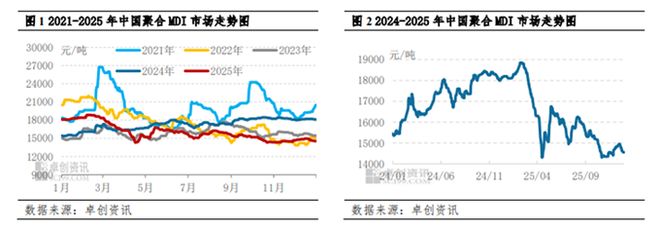
聚合MDI:四季度倒“N”型走势 一季度或难乐观
Jin Rong Jie· 2026-01-19 06:08
Core Viewpoint - The fourth quarter of China's polymer MDI market experienced a decline followed by fluctuations and a subsequent drop, influenced by weak downstream demand and stable import supply, with cautious stocking behavior expected ahead of the new year [1][9]. Group 1: Market Performance - In the fourth quarter, the average price in the East China market was 14,617 yuan/ton, a decrease of 6.26% month-on-month and 18.26% year-on-year [1]. - The market saw a high point in mid-December at 14,950 yuan/ton and a low point in late October at 14,300 yuan/ton [1]. - The market dynamics included a decline in October, weak fluctuations from late October to November, and a rise followed by a drop in December [1]. Group 2: Downstream Demand - Overall downstream demand was weak in the fourth quarter, with outdoor engineering demand declining due to continuous rainfall in October and entering a traditional off-season in November [3]. - The refrigerator and freezer industry faced a production decrease of 6.07% year-on-year, with output around 23.4 million units in October and November due to tightened consumer subsidy policies and increased tariffs in the U.S. [3]. - Export performance was poor, with a 35.63% year-on-year decrease in polymer MDI exports to 128,100 tons in October and November [3]. Group 3: Supply Factors - In mid-December, domestic and international manufacturers raised prices, and several MDI facilities were scheduled for maintenance, which provided some market support [4][6]. - Stable import supply during November and December, particularly from Covestro's Japanese sources, contributed to a bearish market sentiment, especially in late December [7]. Group 4: Future Outlook - Supply pressure is expected to increase in the first quarter of 2026 as three domestic MDI facilities with a total capacity of 2.06 million tons restart operations [8]. - Caution in stocking behavior from downstream and traders is anticipated, influenced by previous market experiences and the upcoming Chinese New Year [8][9]. - The overall trading environment may remain subdued, potentially leading to inventory accumulation by March 2026, with ongoing supply-demand imbalances in the polymer MDI market [9].