春节错位

Search documents
广发宏观:高频数据下的1月经济:数量篇
GF SECURITIES· 2026-02-02 07:53
| 分析师: [Tabl | 郭磊 | 分析师: | 贺骁束 | | --- | --- | --- | --- | | e_Author] | SAC 执证号:S0260516070002 | | SAC 执证号:S0260517030003 | | | SFC CE.no: BNY419 | | | | | 021-38003572 | | 021-38003589 | | | guolei@gf.com.cn | | hexiaoshu@gf.com.cn | | | 请注意,贺骁束并非香港证券及期货事务监察委员会的注册持牌人,不可在香港从事受监管活动。 | | | [Table_Summary] 报告摘要: [Table_Page] 宏观经济研究报告 2026 年 2 月 2 日 证券研究报告 [Table_Title] 广发宏观 高频数据下的 1 月经济:数量篇 中电联口径截至 1 月 22 日,纳入统计的发电集团燃煤电厂本月累计发电量同比增长 4.6%(去年 12 月同比为 -8.5%)。春节错位可能是关键影响因素之一,去年春节在 1 月底;而今年春节在 2 月中下旬,1 月企业普遍处 于正常开工 ...
【广发宏观贺骁束】高频数据下的1月经济:数量篇
郭磊宏观茶座· 2026-02-02 06:36
Core Viewpoint - The article highlights the impact of the Lunar New Year timing on various economic indicators, suggesting that January's data may show favorable year-on-year comparisons due to the earlier holiday last year [1][5]. Group 1: Power Generation and Industrial Activity - As of January 22, coal-fired power plants in China reported a cumulative power generation increase of 4.6% year-on-year, contrasting with a decline of 8.5% in December [1][6]. - Industrial operating rates showed mixed results, with steel production rates improving year-on-year, while chemical production rates declined. Notably, the operating rate for automotive steel tires increased significantly [1][7]. - By the end of January, the average operating rate for high furnaces across 247 enterprises rose by 1.4 percentage points year-on-year, while coking enterprises saw a decline of 1.7 percentage points [7][8]. Group 2: Steel Production - Key enterprises in the steel sector experienced a month-on-month increase in crude steel production of 11.3%, with a year-on-year decline of 4.5% [2][9]. - As of January 30, rebar production from major steel mills increased by 6.4% month-on-month and 1.0% year-on-year, while hot-rolled coil production saw a month-on-month rise of 1.5% but a year-on-year decline of 1.8% [2][9]. Group 3: Construction and Infrastructure - The funding availability rate for construction sites decreased by 0.2 percentage points, indicating a lack of momentum in physical work [11][12]. - The asphalt operating rate fell to 26.2% in January, down 2.2 percentage points month-on-month, reflecting a decline in construction activity [11][12]. Group 4: Consumer Demand and Sales - Passenger vehicle retail sales saw a significant year-on-year decline of 28% in early January, attributed to the end of tax exemptions and the timing of the Lunar New Year [18][19]. - Home appliance sales continued to show negative growth, with online sales of air conditioners, refrigerators, and washing machines declining by 37.5% to 22.2% year-on-year during the first half of January [19][20]. Group 5: External Demand and Trade - External demand remained relatively stable, with domestic ports reporting a 7.7% year-on-year increase in container throughput from January 5 to 25 [21][22]. - The shipping volume of containers from China to the U.S. decreased by 9.5% year-on-year, indicating some challenges in international trade [21][22]. Group 6: Summary Insights - January's high-frequency data suggests that industrial sectors may show notable year-on-year improvements due to the Lunar New Year timing, while external demand remains stable. However, the durable consumer goods sector may face high base pressures [25].


未知机构:1月第二周高频数据回顾出行和消费1月上旬以旧换新相关商品-20260120
未知机构· 2026-01-20 02:05
Summary of Key Points from Conference Call Records Industry Overview Automotive and Consumer Sector - Sales of trade-in related products remained weak in early January - From January 1 to January 11, national retail sales of passenger cars decreased by 32% year-on-year [1] - As of January 9, sales of eight categories of home appliances fell by 41.9% year-on-year [1] Production and Construction - Production remained stable in the second week of January, with attention on the impact of the upcoming Spring Festival on production growth - The utilization rate of coking capacity was 77.5%, slightly down from 77.7% previously - The apparent consumption of major steel products was 9.377 million tons this week, up from 9.071 million tons previously [2] Real Estate - New and second-hand housing transaction volumes were weak in the second week of January - From January 10 to January 16, the average daily transaction area of commercial housing in 30 major cities was 195,000 square meters, roughly unchanged from the previous week but down 43.3% year-on-year - In third-tier cities, the year-on-year decline was 50% [3] Trade and Exports - In the second week of January, shipping rates from Shanghai to the East Coast of the U.S. increased by 1.2%, while rates to the West Coast decreased by 1.1% - The export freight index (CCFI) rose by 1.3% week-on-week, while the SCFI fell by 4.4% - In the first ten days of January, South Korea's export value decreased by 2.3% year-on-year, and import value fell by 4.5% [4] Economic Forecast - GDP growth for December 2025 is estimated at 4.6% based on statistical bureau data, while January 2026 is estimated at 4.3% based on high-frequency data - The impact of the Spring Festival is expected to lead to a significant increase in year-on-year data in the future [4] Liquidity - In the second week of January, funding rates showed a marginal increase, with the average weekly DR007 rate at 1.51%, up from 1.45% - The net financing of government bonds was -233.64 billion yuan, while net financing of credit bonds was 49.04 billion yuan [5] Prices - In the second week of January, commodity prices showed divergence, with coking coal and coke prices decreasing by 2.1% and 1.8% respectively - Food prices for pork, eggs, vegetables, and fruits increased by 0.6%, 3.3%, 0.2%, and 1.9% respectively [6] U.S. High-Frequency Data - In the second week of January, U.S. consumer spending continued to grow - The Redbook commercial retail sales increased by 5.7% year-on-year, down from 7.1% previously - TSA checkpoint numbers increased by 3.8% year-on-year, up from 2.1% [7]
中国宏观周报(2026年1月第3周):春节错位扰动消费出行-20260119
Ping An Securities· 2026-01-19 01:06
Industrial Sector - Weekly average pig iron production decreased, while the apparent demand for major steel products increased[4] - Cement clinker capacity utilization rate showed a seasonal decline this week[11] - The operating rate of float glass remained stable, with inventory levels decreasing[13] Real Estate - New home sales in 30 major cities decreased by 29.0% year-on-year as of January 15, with a slight improvement in growth rate compared to the previous week[21] - The second-hand housing listing price index fell by 1.39%, with the decline expanding by 0.53 percentage points compared to the previous value[25] Domestic Demand - Retail sales of home appliances decreased by 28.5% year-on-year as of January 2, although this was an improvement of 8.4 percentage points from the previous value[31] - The number of domestic flights decreased by 4.9% year-on-year, with a significant drop in growth rate compared to the previous week[30] External Demand - Port container throughput remained high, with a year-on-year increase of 7.3% as of January 11, although this was a slight decline from the previous value[39] - Export container freight rates increased this week, indicating resilience in external demand[39] Price Trends - The Nanhua Industrial Price Index fell by 0.4%, while the Nanhua Non-ferrous Metal Index rose by 0.9%[43] - The agricultural product wholesale price index decreased slightly, indicating mixed price trends in the agricultural sector[43]
【广发宏观贺骁束】1月经济初窥
郭磊宏观茶座· 2026-01-18 08:56
Core Viewpoint - The article discusses the current state of various industries in China, highlighting the impact of the Lunar New Year timing on production and sales, as well as the mixed performance across different sectors. Group 1: Power Generation and Industrial Activity - As of January 8, the cumulative power generation from coal-fired power plants increased by 2.6% year-on-year, contrasting with a decline of 8.5% in December [1][6] - The industrial operating rates show mixed trends, with steel production rates improving while chemical production rates decline. The average operating rate of 247 blast furnaces rose by 1.4 percentage points year-on-year [7][8] - The average daily crude steel production from key enterprises increased by 11.8% month-on-month but decreased by 4.1% year-on-year as of January 10 [2][9] Group 2: Construction and Funding - The funding availability rate for construction sites decreased by 0.3 percentage points, indicating a lack of momentum in physical work [11] - The asphalt operating rate fell to 26.3%, down 2.1 percentage points month-on-month, reflecting a decline in construction activity [11][12] Group 3: Consumer Behavior and Sales - The average daily subway ridership in major cities increased by 15.8% year-on-year due to the Lunar New Year timing, indicating a slight recovery in consumer mobility [3][12] - Real estate sales showed a significant decline, with a 38.6% drop in daily average transactions in major cities compared to the same period last year [15] - Retail sales of passenger vehicles fell by 32% year-on-year, with wholesale volumes down by 40% [16] Group 4: Industry-Specific Insights - The photovoltaic industry manager index decreased to 133.0 points, reflecting a slight decline in industry sentiment [13] - The BPI index for industrial products reached a near one-year high, with significant price increases in coal and chemical products [22][23] - Port container throughput increased by 6.3% year-on-year, indicating resilience in logistics despite fluctuations in shipping volumes to the U.S. [18][20]

1月经济初窥-20260118
GF SECURITIES· 2026-01-18 02:26
Power Generation and Industrial Activity - As of January 8, the cumulative power generation from coal-fired power plants increased by 2.6% year-on-year, compared to a decrease of 8.5% in December[3] - The cumulative heating supply from coal-fired power plants rose by 5.1% year-on-year[3] - The operating rate of 247 blast furnaces nationwide increased by 1.4 percentage points year-on-year, reaching 79.0%[3] - The average daily crude steel output from key enterprises increased by 11.8% month-on-month but decreased by 4.1% year-on-year, averaging 1.997 million tons per day[4] Construction and Real Estate - The funding availability rate for construction sites decreased by 0.3 percentage points to 59.6% as of January 13[5] - The average daily transaction area of commercial housing in 30 major cities fell by 38.6% year-on-year from January 1 to January 16[8] - The year-on-year decline in second-hand housing agency subscriptions in 80 cities was 20.8%[10] Consumer Goods and Retail - Retail sales of passenger vehicles from January 1 to January 11 dropped by 32% year-on-year, with wholesale sales down by 40%[10] - The average wholesale price of pork increased by 2.7% to 18.1 yuan per kilogram as of January 16[16] - The production of household appliances showed a positive growth of 6% year-on-year, with air conditioner production up by 11%[11] Economic Indicators - The Business Price Index (BPI) rose by 3.8% to 933 points as of January 16, indicating a broad price increase across various sectors[13] - The photovoltaic manager index (SMI) decreased by 1.3 percentage points to 133.0 points, reflecting a decline in upstream manufacturing activity[7]
为何3月出口大幅反弹?
赵伟宏观探索· 2025-04-15 14:26
以下文章来源于申万宏源宏观 ,作者赵伟 屠强等 申万宏源宏观 . 申万宏源证券研究所 | 宏观研究部 作者: 赵伟 申万宏源证券首席经济学家 屠强 资深高级宏观分析师 联系人: 屠强、浦聚颖、耿佩璇 摘要 事件: 4月14日,海关公布3月进出口数据,出口(美元计价)同比12.4%、预期3.5%、前值2.3%;进口 (美元计价)同比-4.3%、预期-4.3%、前值-8.4%。 展望4月,关税冲击落地以及春节错位扰动消退后,出口增速读数或有所回落。 4月13日的港口货运吞吐 量同比下滑10.6%,显示"对等关税"压力已显现。此外,春节错位对出口的支撑作用将在4月消散。然 而,仍需密切关注"抢出口"现象。一方面,豁免清单的不确定性依然存在。4月10日公布的消费电子豁免 清单虽在短期内缓解了关税压力,但该豁免措施具有临时性,未来两个月或将出台新的特定税率。另一 方面,特朗普政府对新兴经济体的关税暂停措施也仅为90天,同样存在不确定性。在上述两个因素的共 同作用下,短期内,企业的"抢出口"行为将进一步加剧。 常规跟踪:出口大幅回升,进口继续走弱 出口商品:消费品出口分化, 3月自动数据处理设备(-20.6pct至2.3 ...
北京大学国民经济研究中心-CPI、PPI点评报告:受春节错位影响,CPI增速下行
Bei Da Guo Min Jing Ji Yan Jiu Zhong Xin· 2025-03-14 09:54
Investment Rating - The report does not explicitly provide an investment rating for the industry Core Insights - The CPI growth rate for February 2025 is -0.7%, a decrease of 1.2 percentage points from January 2025, indicating a significant decline due to the timing of the Spring Festival [20][24] - The PPI for February 2025 decreased by 2.2% year-on-year, reflecting ongoing insufficient demand and economic pressure, despite a slight narrowing of the decline compared to January [20][51] - The report suggests that the current economic structure adjustments and insufficient effective demand require further stimulus to stabilize the economy [51][64] Summary by Sections CPI Analysis - The CPI year-on-year growth rate for February 2025 is -0.7%, down from 0.5% in January, with a month-on-month decrease of 0.2% [20][24] - The decline in CPI is attributed to the Spring Festival's timing and a warm winter that increased the supply of fruits and vegetables, suppressing price increases [26][28] - Food prices showed a significant year-on-year decline, with fresh vegetables down 12.6% and overall food prices down 3.3% [29][32] PPI Analysis - The PPI year-on-year decline of 2.2% in February 2025 is a slight improvement from January, indicating persistent low demand and economic pressure [20][51] - The report highlights a divergence in price trends between traditional industries and high-tech sectors, with black metal prices down 10.6% and non-ferrous metal prices up 9.5% [51][64] - The PPI for production materials decreased by 2.6%, while living materials saw a decline of 1.2%, reflecting ongoing economic challenges [56][59] Future Outlook - The report anticipates a potential increase in CPI in 2025 due to "stabilizing growth and promoting consumption" policies, but warns of persistent economic pressures and insufficient internal demand [64] - The PPI may see slight increases in 2025 due to global economic recovery and low base effects, but domestic economic pressures remain significant [64]
【招银研究|宏观点评】季节性回落——中国物价数据点评(2025年2月)
招商银行研究· 2025-03-10 10:19
Group 1: CPI Inflation Analysis - February CPI inflation recorded at -0.7%, significantly lower than the previous value of 0.5% and market expectation of -0.4% [1] - The decline in CPI is primarily attributed to the high base effect from the Spring Festival and weak post-holiday demand, particularly in food prices, which fell by 0.5% month-on-month and saw a year-on-year decrease of 3.7 percentage points to -3.3% [2][4] - Core CPI inflation ended a four-month rise, dropping to -0.1%, the lowest level for the same period since 2015, with service prices declining significantly due to reduced demand post-holiday [4][5] Group 2: PPI Inflation Analysis - February PPI inflation stood at -2.2%, showing a slight recovery of 0.1 percentage points, while month-on-month it decreased by 0.1% [6] - The slow resumption of work post-holiday has led to weak prices for finished goods, with production materials and living materials prices remaining stable [6][7] - The outlook for PPI inflation suggests potential recovery as construction project funding pressures ease, which may accelerate project progress [8] Group 3: Forward-Looking Insights - The February inflation data fell short of expectations due to high base effects and slow resumption of work, with the government setting a CPI inflation target of around 2% for 2025, indicating ongoing pressure for price recovery [6][8] - The expected CPI inflation midpoint for the first quarter is around 0.2%, with an annual midpoint projected at 0.5%, while PPI inflation is anticipated to rise to around -2.0% in the first quarter and converge towards -1.6% for the year [8]

“春节调整”后的出口成色?——1-2月外贸数据点评
申万宏源宏观· 2025-03-08 06:58
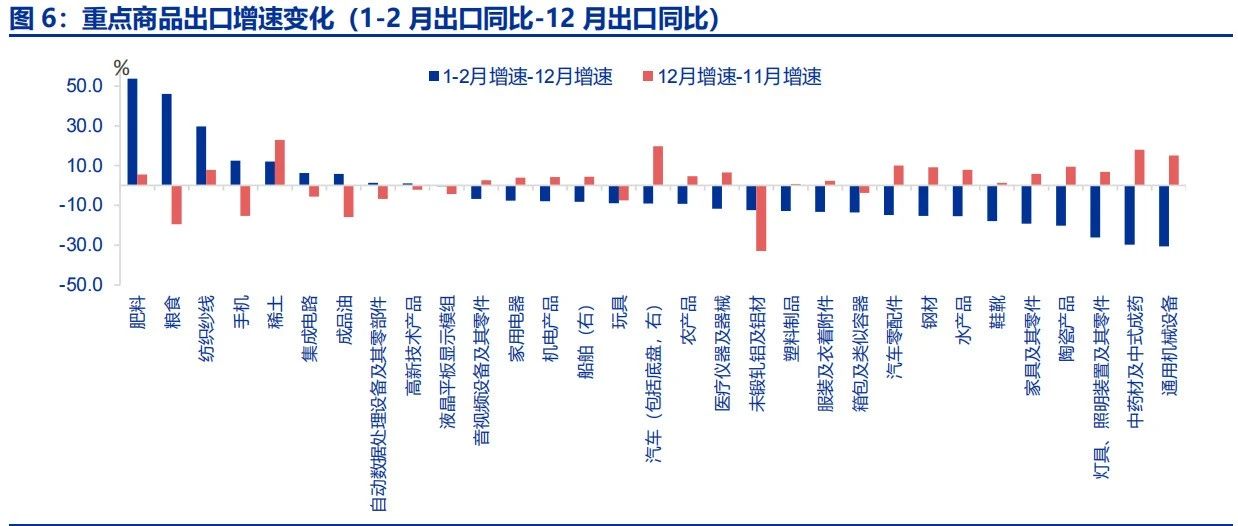
Core Viewpoint - The significant decline in exports in January-February is primarily attributed to the end of the "export rush" rather than weak external demand, with the Spring Festival misalignment having a lesser impact [2][10][11] Export Data Analysis - January-February exports decreased by 8.4 percentage points compared to December, dropping to 2.3%, partly due to the Spring Festival misalignment, which is estimated to have reduced the growth rate by approximately 1.5 percentage points [2][10][11] - The end of the "export rush" is more pronounced, particularly in exports to the U.S., which fell by 12.5 percentage points to 3.2%, and to emerging markets, indicating a slowdown in the restructuring of overseas supply chains [2][11][12] - Specific categories that experienced significant declines include high-dependence goods like footwear, which saw a drop of 18.0 percentage points to -18.7%, and general machinery, which fell by 30.6 percentage points to -1.6% [3][12][16] Import Data Analysis - Imports in January-February saw a substantial decline of 9.4 percentage points to -8.4%, primarily due to a drop in both processing trade-related electromechanical products and bulk commodities reflecting weak domestic demand [7][18] - Electromechanical product imports rebounded slightly but were still negatively impacted by integrated circuits, which fell by 7.3 percentage points to 2.3% [18] Future Outlook - The Spring Festival misalignment is expected to continue affecting year-on-year growth rates, with a potential rebound in March exports estimated to increase by 6.6 percentage points due to this effect, outweighing the negative impacts from the end of the "export rush" and tariff imposition [4][14] - However, actual exports in March may still face significant pressure when excluding the Spring Festival effect [5][14] Structural Changes in Exports - There is a noticeable divergence in export performance across different categories, with consumer electronics like mobile phones and integrated circuits showing recovery, while textiles and furniture exports have significantly declined [15][16] - Capital goods exports have generally decreased, with notable declines in general machinery and automotive parts, while some intermediate goods like fertilizers have shown a rebound [16]