结构性行情

Search documents
公募加仓非银金融,后市机会如何?
券商中国· 2026-01-31 06:03
Core Viewpoint - Public funds are increasing their allocation to non-bank financials, particularly insurance and brokerage stocks, indicating a shift in investment strategy towards these sectors [2][3]. Group 1: Fund Allocation Trends - In Q4 2025, public funds raised their non-bank financial positions by 1 percentage point, making it the fourth largest sector increase after metals, communications, and basic chemicals [2][3]. - Notable stocks such as China Ping An and China Pacific Insurance received significant over-allocations from funds [3]. - The insurance index saw a substantial increase of 23.42% in Q4 of the previous year, outperforming traditional dividend-paying bank stocks [3]. Group 2: Brokerage Performance Expectations - Several listed brokerages have announced expected net profit increases for 2025, with many projecting year-on-year growth exceeding 50% [4]. - Notable forecasts include CITIC Securities expecting a net profit of 8.542 billion to 10.535 billion yuan, and Dongwu Securities projecting a net profit of 3.431 billion to 3.668 billion yuan, both showing significant growth [4]. - Despite the increase in fund allocations, non-bank financials remain underweight compared to historical averages, currently around 30% [4]. Group 3: Structural Opportunities in the Market - The trading volume in the Shanghai and Shenzhen markets has been increasing, suggesting a continuation of favorable market conditions for brokerage stocks [5]. - Analysts recommend focusing on brokerages with strong retail business shares and those that contribute significantly to profits, as individual stock opportunities may outweigh overall market trends [5]. - The insurance sector is benefiting from the performance of equity markets and a shift in deposit funds, with a stable interest rate environment enhancing its investment appeal [6].





A股惊魂一日!沪指巨震险守4100点,黄金股大面积跌停,发生了什么?
Hua Xia Shi Bao· 2026-01-30 13:05
Market Overview - On January 30, the A-share market experienced significant volatility, with the Shanghai Composite Index dropping over 2% at one point, falling below the 4100-point mark, and ultimately closing down 0.96% at 4117.95 points [2][3] - The ChiNext Index showed a notable V-shaped recovery, initially declining 1.5% but closing up 1.27% [2][3] - The total trading volume for the day reached 2.86 trillion yuan, a decrease of nearly 400 billion yuan from the previous day, marking the 20th consecutive trading day above 2.5 trillion yuan [4] Sector Performance - Most of the 31 first-level industry sectors saw declines, with telecommunications, electronics, and agriculture sectors leading gains at 3.44%, 0.68%, and 0.65% respectively [4] - Conversely, the non-ferrous metals, steel, and food and beverage sectors faced significant losses, dropping 7.8%, 2.83%, and 2.78% respectively [4] - The net inflow of capital was highest in telecommunications equipment, batteries, and agriculture, with net inflows of 6.534 billion yuan, 1.088 billion yuan, and 0.886 billion yuan respectively [4] Gold and Silver Market - Gold and silver stocks experienced a sharp decline, with several companies, including Chifeng Jilong Gold and Zhongjin Lingnan Nonfemet Company, hitting their daily limit down [6][7] - On January 30, international gold prices fell over 5%, dropping below 5100 USD per ounce, while silver prices plummeted over 10%, nearing 103 USD per ounce [6] Market Sentiment and Future Outlook - Analysts suggest that the recent volatility in the A-share market is linked to multiple uncertainties in the external environment, including geopolitical tensions and the strengthening of the US dollar [2][8] - The market is expected to stabilize and become more rational after experiencing significant fluctuations and sector rotations [2][9] - There are still medium-term investment opportunities in the A-share market, driven by trends such as the migration of household deposits and performance realizations across multiple industries [9] - Caution is advised regarding potential risks of short-term pullbacks, especially as the market approaches the Chinese New Year, which may lead to seasonal tightening of liquidity [10]





狂掀跌停潮!贵金属市场上演史诗级巨震!当前需警惕哪些风险?
Xin Lang Cai Jing· 2026-01-30 10:13
Core Viewpoint - The precious metals market experienced a significant shock on January 30, leading to a sharp decline in prices and raising questions about the sustainability of the bull market [1][4]. Group 1: Market Performance - On January 30, gold prices fell nearly 5%, dropping below $5200 per ounce, and closed at $5030.88 per ounce [3][11]. - Silver prices saw a decline of nearly 7%, falling below the $110 mark, and closed at $104.185 per ounce, with a total drop of 8.95% [3][11]. - The A-share precious metals sector opened significantly lower, with over 40 stocks hitting the daily limit down, and the sector closed down 8.39% with 32 stocks at the limit down [3][11]. Group 2: Causes of the Decline - Analysts attribute the decline to a combination of factors, including profit-taking after a period of overheated sentiment and regulatory measures aimed at curbing excessive trading in non-ferrous metal futures [5][12]. - The volatility in the precious metals sector has a direct impact on market sentiment, leading to declines in related sectors such as industrial metals and small metals [5][12]. Group 3: Future Outlook - Market analysts suggest that while the structural trend in the precious metals sector may continue, internal dynamics will likely diverge, and volatility will become a norm [6][13]. - Short-term expectations indicate a continuation of a fluctuating adjustment pattern, with a focus on whether prices can stabilize at key support levels [6][14]. - Long-term projections highlight that by 2026, demand for non-ferrous metals like copper, aluminum, lithium, and rare earths will be driven by supply-demand imbalances and the transition to green energy [6][14].

大切换 | 谈股论金
水皮More· 2026-01-29 09:07
Market Overview - The A-share market showed mixed performance today, with the Shanghai Composite Index rising by 0.16% to close at 4157.98 points, while the Shenzhen Component Index fell by 0.30% to 14300.08 points, and the ChiNext Index decreased by 0.57% to 3304.51 points [2][9] - The total trading volume in the Shanghai, Shenzhen, and Beijing markets reached 32,597 billion, an increase of 2,671 billion compared to the previous day [2][9] Sector Performance - Despite adjustments by large institutions targeting the CSI 300 ETF and the SSE 50 ETF, these ETFs performed well, with the SSE 50 ETF rising by 1.85% and the CSI 300 ETF increasing by 0.91% [3] - The liquor sector, particularly Kweichow Moutai and Wuliangye, saw significant gains, with many stocks in this sector hitting the daily limit [3] - The "three barrels of oil" nearly reached new highs, while the banking sector rose by 1.82%, the securities sector by 1.08%, and the insurance sector surged by 3.44% [3] - The precious metals sector experienced a surge, driven by international gold prices exceeding $5,500 per ounce, leading to a wave of limit-up stocks [3] - The real estate sector unexpectedly saw a limit-up trend, and AI application sectors also showed a resurgence with several stocks hitting the daily limit [3] Market Dynamics - The market exhibited a clear divergence, with 1,744 stocks rising and 3,398 stocks falling, indicating a split sentiment among investors [4] - The Shanghai Composite Index and the CSI 300 Index both showed upward movement, while the ChiNext 50 Index experienced a decline of over 3% [4] - The market's trading volume remained around 30 trillion, suggesting that it has not yet entered a cooling phase, although the intensity of individual stock speculation appears to be waning [5] Capital Flow - There was a significant net outflow of 90 billion in main funds today, with a trend of "more outflows than inflows" across sectors [6] - The liquor sector led in capital inflow with 8.6 billion, followed by the cultural media sector with 7.4 billion, while the semiconductor sector saw the highest outflow of 22.4 billion [6] - The electronic components sector experienced an outflow of 9.89 billion, and even the previously strong precious metals sector saw a net outflow of 5.1 billion [6] Conclusion - The market is characterized by structural volatility, with a need for investors to adapt their strategies to avoid potential pitfalls [5] - The performance of the Hang Seng Index, which reached a new high, may provide guidance for the future trends of the A-share market [6]



光控资本:A股春季行情仍有望延续 整体将以结构性行情为主
Sou Hu Cai Jing· 2026-01-29 06:31
Group 1 - The A-share market experienced narrow fluctuations, with a focus on potential interest rate cuts by the Federal Reserve and the possibility of a reserve requirement ratio reduction in China [1][4] - The macroeconomic improvement and rising corporate earnings are seen as the main drivers for the market's mid-term upward trend, although a comprehensive bull market requires solid fundamental support [1][4] - The recent regulatory measures aim to temper speculative sentiment in the market, promoting a healthier and more sustainable "slow bull" market [4][5] Group 2 - The A-share market showed significant sector rotation, with resource-related cyclical stocks rising while technology-focused stocks experienced a decline [5] - The market is expected to maintain a small upward trend, with investors advised to closely monitor macroeconomic data and changes in overseas liquidity [4][5] - There are structural opportunities in the market despite the rapid rotation, and a cautious approach is recommended when the index rises too quickly or approaches support levels [5]

又是“煤飞色舞”的一天,投资者还能上车吗?由“题材炒作”转向“业绩支撑”
Guo Ji Jin Rong Bao· 2026-01-29 00:26
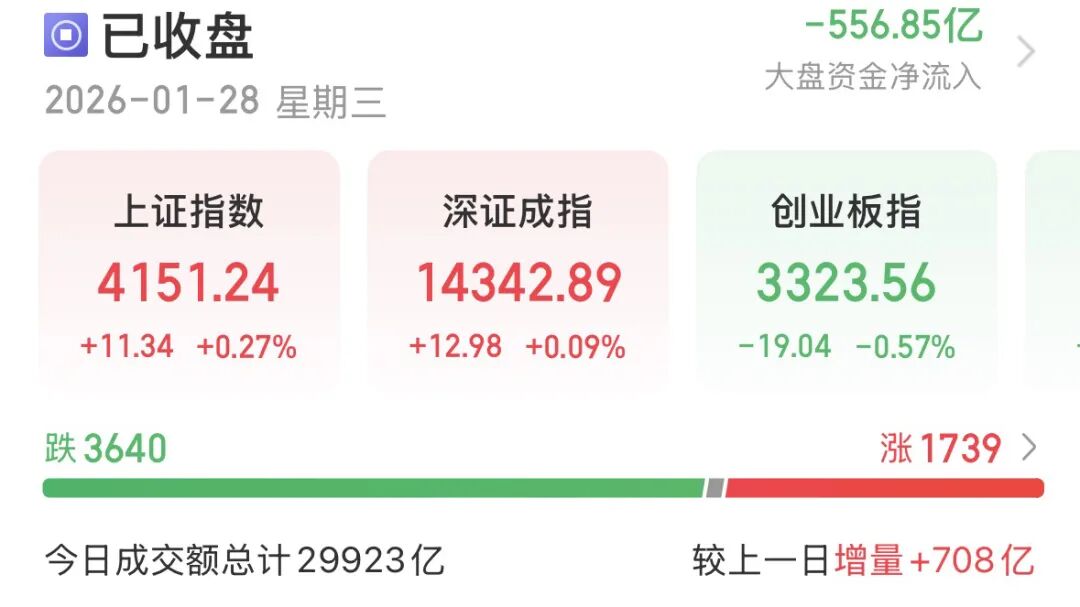
Market Overview - A-shares showed mixed performance on January 28, with the Shanghai Composite Index closing up 0.27% at 4151.24 points, while the ChiNext Index fell 0.57% to 3323.56 points, indicating a significant number of stocks declined, with 3640 stocks closing down [1][4][11]. Sector Performance - Resource stocks, particularly in non-ferrous metals, coal, and petrochemicals, experienced strong gains, with non-ferrous metals rising by 5.92% and coal by 3.42% [8][9]. - The small metals concept, rare resources, and phosphoric chemicals also saw substantial increases, while technology stocks faced volatility, with aerospace equipment and medical devices declining [6][11]. - The consumer sector, including major consumption stocks, remained weak, with declines in media, defense, automotive, and machinery sectors exceeding 1% [8][11]. Investment Sentiment - The market is transitioning from speculative trading to performance-driven investments, with a focus on earnings support rather than mere hype [3][13]. - Investors are advised to manage positions carefully, especially as earnings reports are expected to be released, which may reveal significant performance risks for individual stocks [3][13]. Capital Flow - As of January 27, the margin financing balance in the Shanghai and Shenzhen markets stood at 2.72 trillion yuan, indicating a cautious approach among investors [5]. - The market is expected to maintain a structural trend, with funds likely to flow into sectors supported by government policies and those showing improved performance [16][17]. Future Outlook - Analysts predict that the market may continue to experience fluctuations, with a potential shift towards value stocks as earnings reports are released [17]. - The overall sentiment remains cautious, with expectations of a long-term bullish trend despite short-term volatility [14][16].



午评:沪指涨0.49%,石油、半导体等板块拉升,黄金概念活跃
Sou Hu Cai Jing· 2026-01-28 04:09
Core Viewpoint - The A-share market is experiencing fluctuations, with over 3,500 stocks in the red, while the Shanghai Composite Index shows a slight increase, indicating a mixed market sentiment [1] Market Performance - As of the midday close, the Shanghai Composite Index rose by 0.49%, and the Shenzhen Component Index increased by 0.09%. In contrast, the ChiNext Index fell by 0.37%, and the STAR Market 50 Index decreased by 0.73% [1] - The total trading volume across the Shanghai, Shenzhen, and Beijing markets reached approximately 1.93 trillion yuan [1] Sector Analysis - The pharmaceutical, automotive, and retail sectors experienced declines, while the oil, non-ferrous metals, coal, semiconductor, and brokerage sectors saw gains. Additionally, gold and disperse dye concepts were active [1] Investment Strategy - Dongguan Securities suggests that short-term indices may continue to fluctuate around moving averages, with an accelerated rotation of sectors. However, the spring market for A-shares is expected to continue, primarily characterized by structural trends [1] - Recommended investment strategies include balanced allocation, focusing on undervalued assets with stable earnings, technology sectors leading new productivity, and domestic demand expansion under the backdrop of a strong domestic market [1]
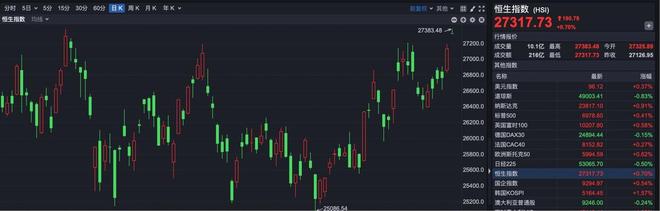
港股速报|港股高开 恒指突破去年高点 创近4年半来新高
Mei Ri Jing Ji Xin Wen· 2026-01-28 02:53
1月28日,港股市场小幅高开。 新股方面,鸣鸣很忙(HK01768)上市首日高开超88%,股价报445港元,总市值达959亿港元。 | 鸣鸣很忙 (01768) CAS | | | | | | | --- | --- | --- | --- | --- | --- | | 445 01010 1208.400 | | +88.08% | | + @ | | | 行情报价 | | | | | | | 成交量 | 300万股 | 最高 | 445.000 今开 | | 445.000 | | 成交额 | 12.9亿 | 最低 | 445.000 昨收 | | 236.600 | | 买量 | 200股 | 振幅 | 0.00% 换手 | | 1.40% | | 变量 | 12600股 | 均价 | 430.674 | | | | 每股收益TTM 9.561 | | 市盈率TM | 46.54 | 每股净资产 36.706 | | | 总股本 总市值 959亿港元 | 2.16亿 | | 市净率 | | 12.123 | | 港股股本 2.14亿 港股市值 950亿港元 | | | | | | 鸣鸣很忙是一家成熟且 ...
港股上市公司回购热度持续 机构称市场有望震荡上行
Zhong Guo Zheng Quan Bao· 2026-01-27 22:00
● 本报记者 吴玉华 港股大额回购频现 分析人士认为,上市公司回购释放出一个重要积极信号,有助于维护公司价值。在流动性持续宽裕的背 景下,投资者风险偏好有望回暖,港股有望震荡上行。 从2026年以来港股上市公司回购金额来看,腾讯控股、小米集团-W、舜宇光学科技、吉利汽车、泡泡 玛特、巨子生物、先声药业、快手-W、百胜中国、百融云-W位居前十,回购金额分别为63.58亿港元、 23.90亿港元、8.69亿港元、5.60亿港元、3.48亿港元、1.40亿港元、1.26亿港元、1.00亿港元、0.85亿港 元、0.83亿港元。从行业分布情况来看,其中既有腾讯控股、快手-W这样的互联网科技公司,也有吉 利汽车、泡泡玛特这样的非必需性消费公司,还有巨子生物、先声药业这样的生物医药公司。 从回购金额最大的腾讯控股来看,2026年以来,腾讯控股在10个交易日出现回购,每个交易日的回购金 额均超过6.3亿港元,保持了持续稳定的回购态势。 业内人士认为,对于投资者而言,上市公司回购是一个重要的积极信号,往往体现公司对盈利能力增长 和盈利质量改善的信心,有助于维护公司价值;同时也能够向投资者释放积极信号,提振投资者对上市 公司后 ...
帮主郑重午评:3700股下跌却藏黄金坑!午后这样操作,精准踩中结构性机会
Sou Hu Cai Jing· 2026-01-27 04:23
朋友们中午好,我是帮主郑重,做20年财经记者专做中长线投资,早盘行情是不是看懵了?沪指微涨 0.03%,创业板指飘红0.44%,但全市场超3700只个股下跌,一半以上的朋友可能都在亏钱,可黄金、 半导体却涨疯了,湖南黄金、紫金矿业创历史新高,东芯股份直接20cm涨停,这就是典型的结构性行 情,资金全往有硬逻辑的赛道挤! 再分享个实操小技巧,也是我多年来坚守的原则:结构性行情里,别追着热点乱换股,要么抱紧有长期 逻辑的龙头,要么耐心等回调布局,频繁操作反而容易两边挨打。就像黄金板块,虽然强势,但短期涨 太快,有持仓的朋友可以把止盈位设在5日均线,没持仓的别盲目追高,等回调到10日均线附近再考 虑;半导体赛道则可以关注研发投入高的龙头,比如天孚通信、中际旭创,它们跟着AI算力需求走, 中长期逻辑很通顺。 聊到这里,肯定有朋友问,午后到底该咋操作?帮主给大家三个明确的行动指令,简单好执行。第一, 对于黄金、半导体这些强势板块,有持仓的继续持有,设好止盈不贪心,没持仓的坚决不追高,宁可错 过也别做错,中长线有的是机会;第二,对于电池、白酒等弱势板块,没持仓的千万别抄底,有持仓的 如果基本面没改善,不如趁反弹减仓,把资 ...