输入性通胀

Search documents
韩元连跌十日、逼近金融危机边缘 韩国汇率“保卫战”压力骤增
Zhi Tong Cai Jing· 2026-01-14 06:37
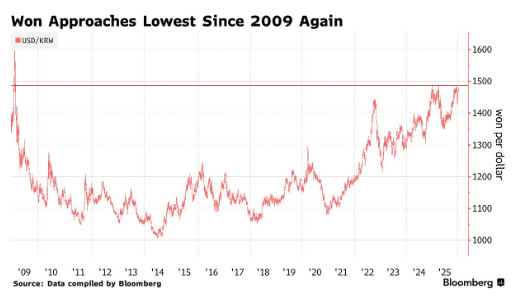
Core Viewpoint - The South Korean won is experiencing significant depreciation, nearing its lowest level since the global financial crisis, primarily due to accelerated capital outflows by domestic investors and strong demand for US dollars [1][3]. Group 1: Currency Performance - The won has depreciated against the US dollar, reaching 1,479.3 won per dollar, marking a 0.25% drop and continuing a ten-day decline [1]. - The year-to-date decline of the won against the dollar exceeds 2.6%, making it the worst-performing currency in Asia and placing it among the weakest globally [3]. Group 2: Market Dynamics - Domestic investors have significantly increased their investments in US stocks, with approximately $2.2 billion purchased by retail investors as of January 13 [1]. - Foreign investors are accelerating their sell-off of South Korean stocks, further intensifying the downward pressure on the won [1]. Group 3: Government Response - The South Korean authorities have implemented measures such as verbal interventions and the exemption of foreign exchange stability taxes to support the won, but these efforts have not effectively halted its decline [3]. - There is growing concern that the continued depreciation of the won may exacerbate imported inflation and suppress consumer demand, prompting the need for stronger policy responses [3].

显微镜下的中国经济(2026年第1期):输入性通胀压力面临上升风险
CMS· 2026-01-12 07:03
Group 1: Economic Overview - Input inflation pressure in China is at risk of rising due to the U.S. intention to strengthen control over resource supply[1] - The U.S. aims to manage energy prices to prevent domestic inflation from spiraling out of control, especially in an election year[1] - China, as a major importer of commodities, may need to increase raw material inventories to counteract U.S. control over resource exports from South America[1] Group 2: Market Trends - Current domestic demand is still recovering, and external inflation pressure may not be smoothly transmitted domestically, negatively impacting midstream industries[1] - The People's Bank of China has been guiding the RMB to appreciate to partially offset input inflation pressure from rising commodity prices[1] Group 3: Risks and Challenges - Geopolitical risks, domestic policy implementation falling short of expectations, and potential global recession could pose significant risks[1] - The U.S. domestic macroeconomic policy may increase demand for commodities, leading to significant price hikes and further input inflation pressure in China[1]
数据点评 | 输入性通胀的影响在升温(申万宏观·赵伟团队)
Xin Lang Cai Jing· 2026-01-09 16:42
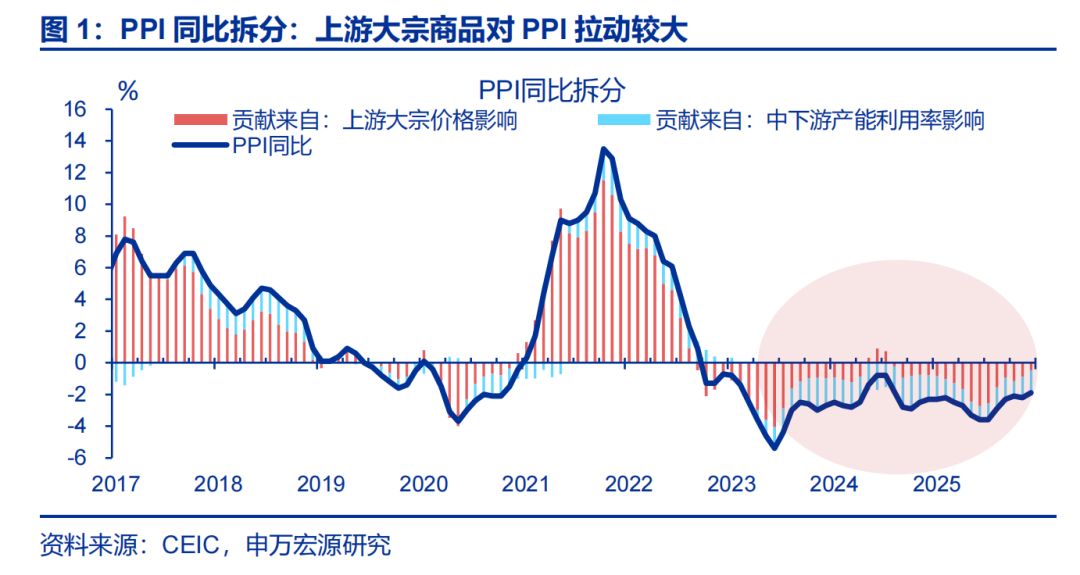
Core Insights - The inflation data for December 2025 shows a year-on-year CPI increase of 0.8%, up from 0.7% in the previous month, and a PPI decrease of -1.9%, improving from -2.2% [1][4] CPI Analysis - The CPI increase is primarily driven by rising gold prices, which have a significant impact on core goods CPI, while excluding gold, the core goods CPI remains low [2][11] - The food CPI rose by 1.1%, with a notable increase of 0.9 percentage points from the previous month, largely due to supply constraints affecting fresh vegetables and fruits [16][38] - The core service CPI decreased by 0.1 percentage points to 1%, influenced by weak rental demand, which has led to a decline in rental prices [22][48] PPI Analysis - The PPI increase is mainly attributed to rising copper prices, which rose by 7.9% month-on-month, contributing positively to the PPI [1][4] - Other commodity prices and downstream PPI performance remain weak, with the overall PPI showing a month-on-month increase of 0.2% [1][4] - The decline in international oil prices negatively impacted domestic oil prices, contributing to a PPI decrease of -0.05% [1][4] Future Outlook - The effectiveness of anti-involution policies in stimulating downstream prices is crucial for future PPI performance, as commodity prices have only explained about 30% of PPI fluctuations in the past three years [30] - The high gold prices and improvements in service consumption may support a rise in core CPI, but the high base effect from the Spring Festival may limit the CPI increase in January [30]
数据点评 | 输入性通胀的影响在升温(申万宏观·赵伟团队)
赵伟宏观探索· 2026-01-09 16:03
Core Viewpoints - The surge in copper and gold prices, influenced by input factors, has led to a continued rise in inflation for December [2][8] - December's PPI increased primarily due to the rise in copper prices, while other commodity prices and mid-to-lower stream PPI showed weak performance [2][8] - The CPI for December rose year-on-year, supported by high gold prices, although core CPI excluding gold remained low [2][16] Inflation Data Summary - The National Bureau of Statistics reported December CPI at 0.8% year-on-year, up from 0.7% in the previous month, and a month-on-month increase of 0.2% [1][7] - December PPI was reported at -1.9% year-on-year, an improvement from -2.2% previously, with a month-on-month increase of 0.2% [1][7] PPI Analysis - The increase in PPI was driven by a 7.9% rise in copper prices, contributing significantly to the PPI increase [2][8] - Coal prices had a minor positive contribution to PPI, while the decline in international oil prices negatively impacted domestic oil prices, dragging PPI down by -0.05% [2][8] - The underutilization of mid-to-lower stream capacity hindered the transmission of upstream price increases, further affecting PPI negatively [2][8] CPI Breakdown - Food CPI rose by 0.9 percentage points to 1.1% year-on-year, with fresh vegetables and fruits seeing significant price increases due to supply constraints [3][23] - The price of pork, heavily influenced by anti-involution effects, remained low, with pork CPI at -14.6% [3][23] - Service CPI decreased by 0.1 percentage points to 0.6%, primarily due to weak rental demand affecting housing costs [3][29] Future Outlook - The ability of anti-involution policies to sustain price increases in the mid-to-lower stream is critical, with ongoing monitoring of policy effects [4][40] - Commodity prices have only explained about 30% of PPI fluctuations in the past three years, with more influence from mid-to-lower stream price declines [4][40] - High gold prices and improvements in service consumption may support core CPI increases, although the high base effect from the Spring Festival may limit January's CPI growth [4][40] Regular Monitoring - December CPI showed a continued rise, with significant contributions from food items [4][74] - Non-food CPI categories such as household appliances and transportation also saw increases, while overall service CPI experienced a decline [4][74]
通胀数据点评:输入性通胀的影响在升温
Shenwan Hongyuan Securities· 2026-01-09 14:42
Inflation Data Summary - The CPI for December 2025 increased by 0.8% year-on-year, up from 0.7% in the previous month, matching expectations, and rose by 0.2% month-on-month[1][7] - The PPI for December 2025 recorded a year-on-year decline of -1.9%, an improvement from -2.2% previously, with a month-on-month increase of 0.2%[1][7] Key Influences on CPI and PPI - Copper and gold prices significantly influenced the December inflation, with copper prices rising 7.9% month-on-month, contributing positively to PPI[2][8] - The contribution of coal prices to PPI was relatively minor, while international oil prices declined, negatively impacting domestic oil prices and dragging PPI down by -0.05%[2][8] Food and Service CPI Trends - Food CPI rose by 1.1% year-on-year, with a notable increase of 0.9 percentage points from the previous month, driven by supply constraints in fresh vegetables and fruits[3][23] - Service CPI decreased by 0.1 percentage points to 0.6%, primarily due to weak rental demand affecting housing costs[25] Future Outlook - The ability of anti-involution policies to sustain upward pressure on downstream prices is critical, as commodity prices have only explained about 30% of PPI fluctuations in the past three years[4][29] - High gold prices and improvements in service consumption may support a rise in core CPI, but the high base effect from the Spring Festival could limit January's CPI increase[4][29]
数据点评 | 输入性通胀的影响在升温(申万宏观·赵伟团队)
申万宏源宏观· 2026-01-09 14:30
Core Viewpoint - The surge in copper and gold prices, influenced by input factors, has led to a continued rise in inflation for December [2][8] - December's PPI increased primarily due to the rise in copper prices, while other commodity prices and mid-to-lower stream PPI showed weak performance [2][8] - The CPI for December rose year-on-year, supported by high gold prices, although core CPI excluding gold remained low [2][8] Inflation Data Summary - On January 9, the National Bureau of Statistics released December 2025 inflation data: CPI year-on-year at 0.8%, previous value 0.7%, expected 0.8%, month-on-month at 0.2%; PPI year-on-year at -1.9%, previous value -2.2%, expected -2%, month-on-month at 0.2 [1][7][71] PPI Analysis - December PPI increased by 0.2% month-on-month, driven by a 7.9% rise in copper prices, which was the strongest contributing factor [2][8] - Coal prices contributed positively to PPI, while international oil prices declined, negatively impacting domestic oil prices [2][8] - The utilization rate in mid-to-lower stream sectors did not improve significantly, leading to a failure in price transmission from upstream to downstream [2][8] CPI Analysis - December CPI rose year-on-year by 0.1 percentage points to 0.8%, with core CPI rising to 2% mainly due to high gold prices [2][8] - Excluding gold, the remaining core CPI continued to decline, with a slight increase of 0.1 percentage points to -0.7% [2][8] - The CPI for food items increased by 0.9 percentage points to 1.1%, with fresh vegetables and fruits seeing significant price increases due to supply constraints [3][23][72] Service CPI Insights - The service CPI fell by 0.1 percentage points to 0.6%, with weak rental demand dragging down housing rent CPI [3][29][72] - Core service CPI also decreased by 0.1 percentage points to 1%, while dining out CPI saw a slight decline [3][29][72] Future Outlook - The ability of anti-involution policies to sustain price increases in mid-to-lower stream sectors is crucial for future inflation trends [4][40] - Over the past three years, commodity prices have only explained about 30% of PPI fluctuations, with more influence from price "over-declines" in mid-to-lower stream sectors [4][40] - High gold prices and improvements in service consumption may support core CPI, but the high base effect from the Spring Festival may limit January's CPI increase [4][40]
通胀压力顽固,日元持续疲软,加息给日本带来“双重考验”
Huan Qiu Shi Bao· 2025-12-21 23:01
Group 1 - The Bank of Japan raised its policy interest rate by 25 basis points to 0.75%, marking the highest level in 30 years, signaling a significant shift in monetary policy [2][5] - The central bank indicated that there is room for further rate increases as long as the economic growth outlook does not change significantly [2] - The recent depreciation of the yen, which fell to a 10-month low against the dollar, was a key factor prompting the rate hike, as it has led to rising import-driven inflation [2][6] Group 2 - The Bank of Japan aims to stabilize inflation around 2% while promoting real wage growth, which has been negative, to achieve sustained economic growth [3] - Concerns have been raised that the rate hike could exacerbate economic downturn risks, particularly for small and medium-sized enterprises facing increased financing costs [4] - The rising interest rates are expected to negatively impact household finances, with estimates suggesting an annual increase in expenses for indebted households [4] Group 3 - Despite the interest rate hike, the yen's exchange rate did not improve and continued to depreciate, reflecting a lack of confidence in the effectiveness of the monetary tightening [6] - Japan's trade balance has shown a deficit for four consecutive years, contributing to ongoing depreciation pressures on the yen [6][7] - The government's recent economic stimulus plan, amounting to 18.3 trillion yen, has raised concerns about fiscal discipline and could further undermine the yen's credibility [7]

日本央行加息至30年来最高点 专家警示“危险一跃”
Sou Hu Cai Jing· 2025-12-19 23:28
Group 1: Monetary Policy Changes - The Bank of Japan raised its policy interest rate by 25 basis points from 0.5% to 0.75%, marking the highest level in 30 years [1] - This increase follows a long period of loose monetary policy, including negative interest rates, which were in place since September 1995 [1] - The decision to raise rates is influenced by inflation data exceeding the 2% target for 44 consecutive months and ongoing depreciation of the yen, leading to imported inflation pressures [1] Group 2: Economic Implications - The revised GDP data indicates a contraction of 0.6% in Q3, with an annualized decline of 2.3%, surpassing previous market expectations of 2.0% [2] - Continuous negative growth could lead Japan into a technical recession, raising concerns about the effectiveness of the current monetary tightening combined with expansive fiscal policies [2] - Experts warn that the contradiction between tight monetary policy and loose fiscal policy may increase government debt financing costs and exacerbate fiscal risks [2] Group 3: Currency and Market Reactions - The interest rate hike may challenge the yen's status as a safe-haven currency, potentially weakening its appeal due to increased volatility in exchange rates [3] - The normalization of Japan's monetary policy could undermine the profitability of yen carry trades, which are based on borrowing in low-interest currencies to invest in higher-yielding assets [3] - Analysts suggest that the impact of the rate hike on global liquidity will be limited, with more focus needed on the future trajectory of interest rate adjustments [3][4] Group 4: Global Context - The divergence in monetary policy between the Federal Reserve and the Bank of Japan is seen as a key factor influencing global liquidity and the pricing of dollar assets [4] - Despite potential short-term volatility from Japan's rate hike, the long-term trend of global monetary easing is expected to continue [4] - Changes in China's export surplus and potential rate cuts by the Federal Reserve may lead to a long-term appreciation trend for the Chinese yuan [4]
(财经天下)日本央行加息至30年来最高点 专家警示“危险一跃”
Xin Lang Cai Jing· 2025-12-19 14:22
Group 1 - The Bank of Japan raised its policy interest rate by 25 basis points to 0.75%, the highest level in 30 years, amid contradictory fiscal and monetary policies [1] - Japan's inflation has exceeded the 2% target for 44 consecutive months, and the government has passed a supplementary budget for fiscal year 2025, indicating a mismatch in policy [1][2] - The recent adjustment in interest rates may suppress consumption, investment, and exports, potentially leading to further contraction in Japan's GDP [1][2] Group 2 - The revised GDP data shows a contraction of 0.6% in Q3, with an annualized decline of 2.3%, exceeding previous market expectations [2] - The combination of tight monetary policy and expansive fiscal policy may increase government debt financing costs and exacerbate fiscal risks [2] - Analysts suggest that the recent interest rate hike may challenge the yen's status as a safe-haven currency, as it undermines the low-interest environment that supports carry trades [3] Group 3 - The normalization of monetary policy in Japan could increase volatility in the yen's exchange rate, affecting its long-term value and undermining its safe-haven appeal [3] - Global market participants have anticipated the Bank of Japan's rate hike, leading to a withdrawal of speculative funds, which may limit the impact on global liquidity [3][4] - Despite potential short-term turbulence from the rate hike, the long-term trend of global monetary easing is expected to continue [4]
美元退潮,资产大变局!美联储降息后,留学生、股民和黄金投资者必须看清的三个真相
Sou Hu Cai Jing· 2025-12-12 04:29
Group 1 - The Federal Reserve's decision to cut interest rates from a target range of 4.25-4.5% to 4.0-4.25% is a "risk management" move focused on the employment market [1] - The shift in U.S. monetary policy from aggressive anti-inflation measures to a more cautious approach aimed at preventing recession is evident [3] - Global market reactions to the rate cut were mixed, with U.S. stock indices showing varied performance and concerns about the pace of future rate cuts [3] Group 2 - The rate cut has opened the channel for global financial conditions to ease, leading to a decrease in borrowing costs for the U.S. dollar, which is the primary global financing currency [5] - Japanese and South Korean stock indices rose over 1% on the day of the rate cut, indicating early positive effects on these markets [5] Group 3 - For China, the external changes present more opportunities than challenges, particularly in reducing depreciation pressure on the yuan against the dollar [7] - The stabilization and appreciation of the yuan provide cost relief for Chinese importers, especially in energy and raw materials [7] - The People's Bank of China gains more monetary policy flexibility, allowing for potential rate cuts or reserve requirement reductions to support economic growth [7] Group 4 - China's capital markets are expected to benefit directly from increased global risk appetite and capital inflows into emerging markets [9] - Historical data suggests that during the Fed's preemptive rate cuts, growth sectors in A-shares and Hong Kong stocks tend to perform well [9] - However, a weaker dollar may increase input inflation pressures for China, and rapid yuan appreciation could challenge the competitiveness of export-oriented industries [9] Group 5 - China's response strategy is clear, focusing on a self-directed regulatory approach rather than simply following the Fed's lead [11] - Monetary policy will remain flexible and appropriate, directing financial resources towards key areas such as technological innovation, green transformation, and small and medium enterprises [11]