金融数据

Search documents
2025年11月金融数据解读:存款流向改变
Yin He Zheng Quan· 2025-12-12 13:11
Monetary Supply Trends - M1 growth rate decreased to 4.9% year-on-year in November 2025, down from 6.2% in the previous month[1] - M2 growth rate also fell to 8.0% year-on-year, compared to 8.2% previously[1] - New social financing (社融) reached 2.49 trillion yuan, an increase of 159.7 billion yuan year-on-year, maintaining a growth rate of 8.5%[1] Deposit and Loan Dynamics - New RMB loans amounted to 390 billion yuan in November, a decrease of 190 billion yuan year-on-year, with a growth rate of 6.4%[1] - Resident deposit growth rate continued to decline, estimated at 9.56% in November, down from 9.69%[1] - Total new deposits in financial institutions were 1.41 trillion yuan, with resident deposits increasing by 670 billion yuan and corporate deposits by 645.3 billion yuan[3] Social Financing Insights - The increase in social financing was primarily driven by corporate bond financing and off-balance-sheet financing, while government bond financing and RMB loans to the real economy were the main drag[4] - Effective social financing growth rate (excluding government financing) was 6.00%, up from 5.92%[6] - Government bond financing growth rate fell to 18.8%, down from 19.2%[6] Market and Policy Outlook - The central bank is expected to maintain a moderately loose monetary policy in 2026, with potential interest rate cuts and reserve requirement ratio reductions anticipated[7] - The central economic work conference emphasized the importance of promoting stable economic growth and reasonable price recovery as key considerations for monetary policy[7] - The market expects 1-2 interest rate cuts in 2026, totaling a reduction of 10-20 basis points[7]
下周关注:CPI、PPI数据将公布 这些投资机会最靠谱
Di Yi Cai Jing· 2025-12-07 01:56
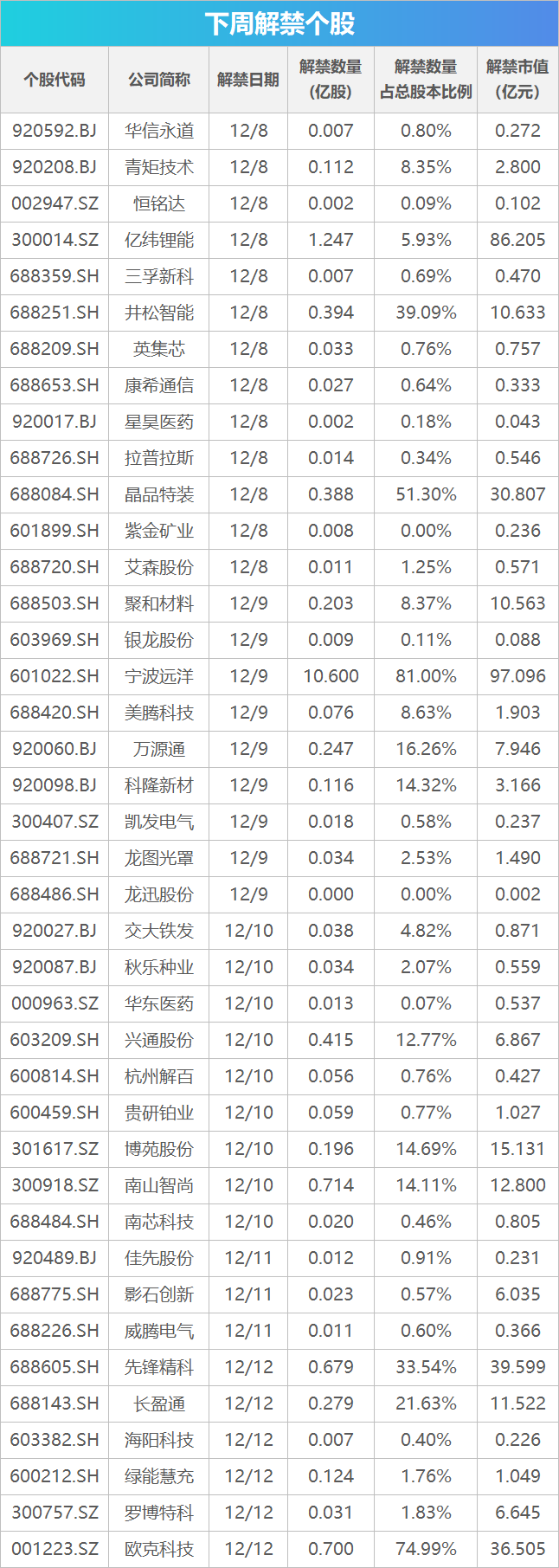
Price Adjustment - The next price adjustment window for refined oil will open at 24:00 on December 8, following the "ten working days" principle. The last adjustment on November 24 saw domestic gasoline and diesel prices decrease by 70 yuan/ton and 65 yuan/ton respectively [1] CPI and PPI Data - The National Bureau of Statistics will release the CPI and PPI data for November on December 10. Huachuang Securities predicts that the CPI year-on-year growth rate will rebound from 0.2% last month to around 0.7%, primarily due to fluctuations in food prices. The food price index in November is expected to rise by 1.1% month-on-month, compared to a decrease of 2.7% in the same month last year, which was the lowest in the past decade [2] Financial Data Release - In addition to CPI and PPI, financial data for November, including new loans, M2, and social financing, is also expected to be released next week. Zhejiang Merchants Securities estimates that new RMB loans will increase by 300 billion yuan in November, a decrease of 280 billion yuan year-on-year, with a growth rate drop of 0.1 percentage points to 6.4%. Social financing is expected to increase by 2.2 trillion yuan, down approximately 342 billion yuan year-on-year, with a growth rate drop of 0.1 percentage points to 8.4%. M2 growth is projected at 8.0%, down 0.2 percentage points, while M1 growth is expected to be 5.3%, down 0.9 percentage points [3] Federal Reserve Meeting - The Federal Reserve will hold a monetary policy meeting next week. As of December 5, the probability of a 25 basis point rate cut in December is 87%, while the probability of maintaining the current rate is 13%. Additionally, there is a 64% chance of a cumulative 25 basis point cut by January, a 9% chance of maintaining the rate, and a 27% chance of a cumulative 50 basis point cut [4] Stock Unlocking - Next week, 40 stocks will have their lock-up shares released, with a total market value of nearly 40 billion yuan based on Friday's closing prices. Ten companies have lock-up shares valued at over 1 billion yuan each, including Ningbo Ocean, Yiwei Lithium Energy, and others [5] New Stock Opportunities - Five new stocks are set to be issued next week, including one from the Shanghai main board, one from the Sci-Tech Innovation Board, one from the Shenzhen main board, and two from the Growth Enterprise Market. The specific issuance dates are December 8 for Youxun Co. and Nabichuan, December 9 for Yuanchuang Co., and December 12 for Xihua Technology and Tiansu Measurement [8]

下周看点:CPI等数据将公布,新股发行增至5只,美联储将举行议息会议
Sou Hu Cai Jing· 2025-12-06 00:02
Group 1: Oil Price Adjustment - The next price adjustment window for refined oil is set for December 8, with a projected decrease of 60 CNY per ton for gasoline and diesel due to a -1.26% change in the average price of crude oil [2] - Market expectations of a Federal Reserve rate cut and stalled peace talks in the Russia-Ukraine conflict have weakened the outlook for Russian oil exports [2] - Despite OPEC+ agreeing to increase production in November, actual output has declined due to some member countries' production halts, leading to a supply shortfall [2] Group 2: CPI and PPI Data - The National Bureau of Statistics will release November CPI and PPI data on December 10, with an expected CPI year-on-year growth rate increase from 0.2% to around 0.7% [3] - The rise in CPI is attributed to fluctuations in food prices, particularly due to adverse weather conditions affecting vegetable supply [3] - Predictions indicate that the CPI's tail effect for next year will be approximately 0%, higher than this year's -0.4% [3] Group 3: Financial Data Release - November financial data, including new loans, M2, and social financing, is expected to be released next week, with new loans projected at 300 billion CNY, a year-on-year decrease of 280 billion CNY [4] - Social financing is anticipated to increase by 2.2 trillion CNY, down by approximately 342 billion CNY year-on-year, with a growth rate of 8.4% [4] - M2 growth is expected to be 8.0%, a decrease of 0.2 percentage points, while M1 growth is projected at 5.3%, down 0.9 percentage points [4] Group 4: Federal Reserve Meeting - The Federal Reserve is scheduled to hold a meeting next week, with an 87% probability of a 25 basis point rate cut [5] - Economic indicators suggest a cooling labor market, reinforcing expectations for a rate cut [5] - Projections for 2026 indicate potential economic growth of 2% to 2.5%, with uncertainty surrounding the Fed's rate cut trajectory [6] Group 5: New Stock Issuance - Five new stocks are set to be issued next week, raising approximately 4.297 billion CNY, with a total of 184 million shares [7] - Companies involved include Youxun Co., focusing on optical communication chips, and Nabachuan, specializing in thermal management for electric vehicle batteries [7] - Other companies include Yuanchuang, a major player in rubber tracks, and Xihua Technology, which manufactures specialized components for high-end equipment [7]
股市即将变盘的逻辑,财富洗牌的前夜
Sou Hu Cai Jing· 2025-11-27 05:11
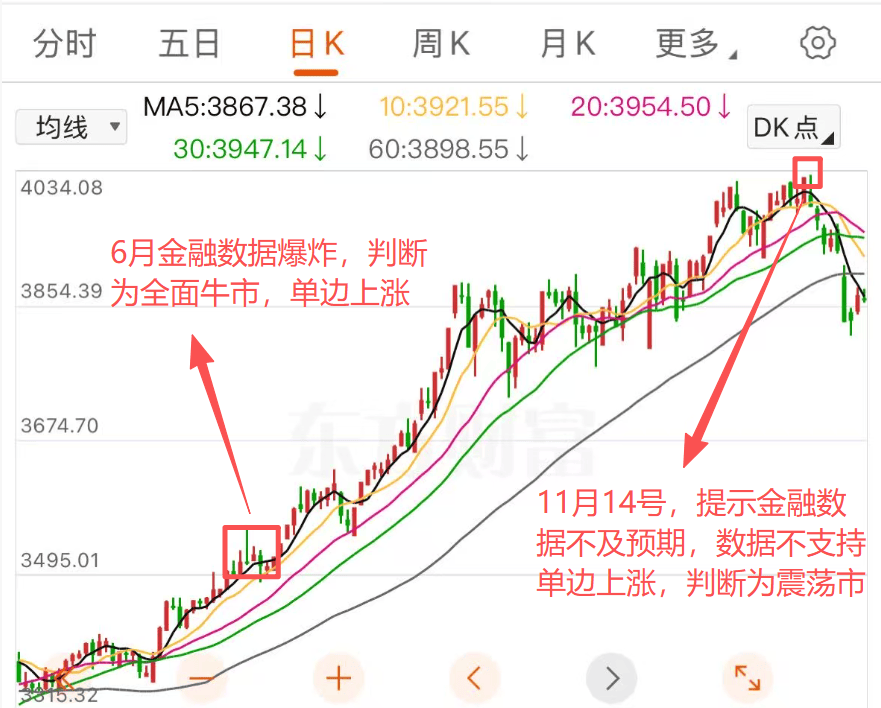
Core Viewpoint - The stock market began a downward trend starting November 14, triggered by the release of disappointing financial data for October on November 13, which did not meet expectations [1][3]. Financial Data Analysis - On July 14, the central bank released June financial data that significantly exceeded expectations, leading to a bullish market trend [3]. - The October financial data released on November 13 was below expectations, resulting in a noticeable decline in the stock market starting November 14 [3][4]. - The primary reason for the explosive data in July was the unexpected increase in money supply driven by bond purchases, while the October data reflected a downturn in bond issuance, impacting money supply growth [5][12]. Monetary Mechanism Explanation - The central bank is the issuer of currency, and the total money supply (M2) is determined by the base currency and the reserve requirement ratio [5][7]. - Commercial banks can create money through asset expansion, which includes buying bonds, but they must first attract deposits [6][9]. - The difference between commercial banks and the central bank in money creation lies in the need for deposits and the type of money created (derived vs. base money) [9][10]. Market Outlook - The recent data indicated a turning point for both M1 and M2, primarily due to a decline in bond issuance [13]. - Despite the downward pressure, the market is expected to stabilize rather than enter a prolonged decline, as the bond market can be adjusted by issuers in response to economic conditions [13]. - The long-term outlook remains optimistic, with confidence in the market's potential for recovery driven by bond issuance mechanisms [13][14]. Sector Focus - Future national development priorities include technology, new productive forces, and industrial upgrades, which may lead to high valuations in tech sectors [15]. - Traditional sectors, while not the focus of future growth, have lower valuations and may present safer investment opportunities [15][16].
货币政策将更加注重精准、协同和均衡丨董希淼专栏
2 1 Shi Ji Jing Ji Bao Dao· 2025-11-18 23:17
Core Viewpoint - The financial data for October indicates a stable development in the banking sector, with a need for a more precise and coordinated monetary policy moving forward [2][6]. Monetary Supply and Financing Structure - As of October 2025, the broad money supply (M2) grew by 8.2% year-on-year, maintaining a high growth rate despite a higher base from the previous year [2]. - Narrow money supply (M1) increased by 6.2%, showing a recovery from previous lows, indicating improved business activity and consumer demand [2]. - The M1-M2 spread narrowed to 2%, reflecting a shift towards demand deposits [2]. Total Financing and Loan Growth - The cumulative increase in social financing for the first ten months reached 30.9 trillion yuan, exceeding the previous year's figure by 3.83 trillion yuan [3]. - In October, social financing and RMB loans increased by 815 billion yuan and 220 billion yuan, respectively, both showing a year-on-year decrease [3]. - The weighted average interest rate for new corporate loans was 3.1%, down approximately 40 basis points from the previous year, indicating a decline in overall financing costs [3]. Direct Financing and Policy Tools - Direct financing through corporate bonds and stock financing showed positive growth, with net bond financing up by 1.482 billion yuan and stock financing up by 412 billion yuan in October [4]. - The introduction of new policy financial tools contributed to an increase in entrusted loans by 165.3 billion yuan, indicating a stronger collaboration between fiscal and monetary policies [5]. Economic Demand and Loan Trends - There is a noted decline in household loans, with a reduction of 360.4 billion yuan in October, reflecting weak consumer demand [5]. - Corporate loan growth was primarily supported by bill financing, while long-term loans showed only a slight increase, indicating insufficient effective demand from businesses [5]. Banking Sector Indicators - The net interest margin for commercial banks remained stable at 1.42%, but there are concerns about rising non-performing loans [6]. - The potential for further interest rate cuts by the central bank is being discussed, but significant reductions are unlikely in the short term [6]. Future Monetary Policy Direction - Future monetary policy is expected to focus on precision, coordination, and balance, with an emphasis on directing financial resources to key sectors such as technology and green initiatives [7]. - The central bank aims to maintain reasonable interest rate relationships to enhance the effectiveness of monetary policy transmission [7].

彭博与国泰海通签署战略合作协议
Xin Lang Cai Jing· 2025-11-18 06:24
Core Insights - Bloomberg and Guotai Junan Securities signed a two-year strategic cooperation agreement on November 17, aiming to enhance collaboration in financial data, fintech, and market expansion [1] Group 1: Strategic Cooperation - The partnership will support Guotai Junan in international business, global data governance, wealth management, and overseas family office services [1] - The collaboration seeks to explore new paths for expanding research content dissemination and brand building, enhancing Guotai Junan's global market influence and investor communication efficiency [1] - Bloomberg will leverage Guotai Junan's local market experience and comprehensive financial service capabilities to support its business expansion in the Chinese market [1]


数据点评 | “存款搬家”再现(申万宏观·赵伟团队)
申万宏源宏观· 2025-11-14 14:15
Core Viewpoint - The phenomenon of "deposit migration" has re-emerged, with a significant decrease in resident deposits and a corresponding increase in non-bank institution deposits, indicating a shift in financial asset allocation [2][10][47]. Financial Data Overview - In October 2025, the credit balance decreased by 0.1 percentage points to 6.5%, social financing stock fell by 0.2 percentage points to 8.5%, and M1 decreased by 1.0 percentage point to 6.2% [1][9][46]. - Resident deposits decreased by approximately 770 billion yuan, while non-bank institution deposits increased by the same amount, reflecting a "seesaw" relationship [2][10][47]. Loan and Financing Trends - Short-term financing remains dominant in corporate loans, with a 0.6 percentage point increase in short-term loans and bill financing to 10.0%, while medium to long-term loans decreased by 0.1 percentage points to 7.7% [3][19][48]. - The decline in social financing growth is primarily due to a decrease in net government bond financing, which fell by 560.2 billion yuan in October [3][23][48]. Future Outlook - The stability of social financing is expected to improve with the implementation of two fiscal policies: the full deployment of 500 billion yuan in new policy financial tools and the issuance of 500 billion yuan in local government bond limits [4][26][49]. - These policies aim to stabilize economic operations towards the end of the year and align with early 2026 government bond issuances, creating favorable conditions for economic growth [4][26][49]. Regular Monitoring - In October, new credit totaled 220 billion yuan, a decrease of 280 billion yuan year-on-year, primarily from the residential sector [5][27][50]. - The total social financing added was 815 billion yuan, down 597 billion yuan year-on-year, largely due to declines in government bonds and RMB loans [5][32][50]. - M2 growth fell by 0.2 percentage points to 8.2%, while M1 decreased by 1 percentage point to 6.2%, with significant reductions in both resident and corporate deposits [5][38][50].

基差方向周度预测-20251114
Guo Tai Jun An Qi Huo· 2025-11-14 11:31
1. Report Industry Investment Rating - No relevant content provided 2. Core Viewpoints of the Report - The central bank's third - quarter monetary policy implementation report indicates a natural decline in financial aggregate growth, and mentions points such as downplaying monetary policy quantity targets, maintaining a reasonable interest - rate ratio, and vigorously developing the bond market's "science and technology board". [2] - In October, both CPI and PPI increased year - on - year and month - on - month. Besides the contribution of the low - base effect, the effects of monetary and fiscal policies and industrial policies like anti - involution and capacity reduction are evident, especially in industries such as non - ferrous metals, building materials, and new energy. [2] - October financial data shows a slowdown in social financing and credit growth, with insufficient credit demand. At the same time, non - bank deposits increased by 77 billion yuan year - on - year, and the process of deposit transfer continues. [2] - The US federal government's temporary appropriation bill was passed, ending the 6 - week shutdown. The shutdown pulled down the US fourth - quarter annualized GDP growth rate by 1.5%, and the secondary impact on residents' lives is hard to estimate. The annual appropriation is still undetermined, and there may be another shutdown in two months. [2] - After the shutdown ended, the market trading theme shifted to interest - rate cuts. Hawkish remarks from Fed officials led to a significant decline in the market's expectation of a December interest - rate cut, triggering a sharp drop in US stocks and an increase in US bonds. [2] - This week's full - A trading volume was basically flat compared to last week, maintaining at around 2 trillion yuan per day. The margin trading balance rose slightly to nearly 2.5 trillion yuan. The Shanghai Composite Index once reached a new high since 4000 points but fell back at the end of Friday's session, declining 0.18% for the whole week. Major broad - based indexes turned negative at the end of Friday's session, with the CSI 300 and CSI 500 falling more than 1% for the week, the SSE 50 closing flat, and micro - cap stocks performing outstandingly. The correction of the STAR Market and ChiNext continues. [2] - In terms of basis, the recent basis fluctuation range is still small. The annualized basis of each variety has decreased compared to last week. The IH has switched to a slight discount state, and the annualized discounts of IF, IC, and IM have reached around 3%, 11%, and 14% respectively, with the term structure becoming steeper, and far - month contracts having a greater advantage in hedging costs. [2] 3. Summary According to the Catalog 3.1 Weekly Forecast Conclusion - This week's model predicts that the movement directions of the basis for IH, IF, IC, and IM next week are strengthening, weakening, weakening, and weakening respectively [4]
2025年10月金融数据点评:债券市场或已对金融数据回落有所预期
KAIYUAN SECURITIES· 2025-11-14 09:12
Report Overview - The report is a commentary on the financial data for October 2025, focusing on the bond market's expectations of the decline in financial data and the internal structural highlights of the data [1][4]. Report's Core View - The bond market may have anticipated the decline in October's financial data. The economic growth rate is not expected to decline significantly in the second half of 2025, and structural issues such as prices are expected to improve. There will be a continued shift in the stock - bond allocation, with bond yields and the stock market expected to rise [4][7]. Summary by Related Catalog Reasons for the Expected Decline in Financial Data - Local government debt resolution will temporarily reduce loan growth. Since 2024, local governments have issued 4 trillion yuan in special refinancing bonds, with about 60 - 70% used to repay bank loans [4]. - The government sector is increasing leverage to offset the de - leveraging of the household sector. As of the end of the third quarter of 2025, the government sector's leverage ratio was 67.5%, up 8.8 pct from the same period in 2024, while the household sector's leverage ratio was 60.4%, down 1.2 pct [4]. - Due to weak demand, household loans declined in October. Household loans decreased by 360.4 billion yuan, with short - term loans down 286.6 billion yuan and long - term loans down 70 billion yuan [4]. - The government bond issuance rhythm in 2025 was advanced compared to 2024, causing a 53.4% year - on - year decline in net government bond financing in October [5]. - The bond market may have anticipated the decline in financial data, as indicated by the significant bill impulse at the end of October and the explanations in the third - quarter monetary policy report [5]. Structural Highlights in the Data - Non - bank institutions' new deposits increased significantly in October, with an 185 billion yuan increase and a 71.3% year - on - year growth, possibly related to the strengthening of the equity market and the increase in residents' willingness to invest in wealth management products [6]. - The credit structure continued to optimize. The balance of inclusive small and micro loans was 35.77 trillion yuan, with an 11.6% year - on - year growth, and the balance of medium - and long - term loans in the manufacturing industry was 14.97 trillion yuan, with a 7.9% year - on - year growth [6]. - 500 billion yuan of new policy - based financial instruments have been fully disbursed, with a total project investment of about 7 trillion yuan, which may support subsequent loans [6]. Bond Market Outlook - Against the backdrop of revised economic expectations, bond yields are expected to rise trend - wise. The report maintains the view that in the second half of 2025, the economic growth rate will not decline significantly, structural issues will improve, and there will be a continued shift in the stock - bond allocation [7].
社融和存款的变化预示什么?——10月金融数据点评
一瑜中的· 2025-11-14 08:47
Core Viewpoints - The financial data for October shows a mixed trend, with a decrease in corporate medium to long-term loans indicating a potential improvement in supply-demand balance, while a decline in household loans suggests a shift in consumer behavior [4][6][37] - The overall outlook for the A-share market remains optimistic in the medium term, despite short-term fluctuations expected in the fourth quarter due to changes in economic indicators [4][6] - The increase in non-bank deposits and the decline in M1 suggest a structural shift in the financial landscape, with implications for market liquidity and investment behavior [7][29] Group 1: Social Financing Observations - Corporate medium to long-term loans have decreased for four consecutive months, which may help improve the balance between supply and demand in the market [6][13] - Household loans have also seen a decline, with a notable drop in operational loans, indicating a shift towards production-related borrowing [6][17] - The significant increase in entrusted loans is likely linked to the deployment of policy financial tools, although the impact on the balance sheet of policy banks remains limited [6][21] - Direct financing through corporate bonds and domestic stock financing has shown continuous growth, benefiting high-tech and innovative enterprises [6][23] Group 2: Deposit Observations - Non-bank financial institution deposits increased significantly in October, indicating a stable environment for equity market transactions [7][26] - The decline in M1 year-on-year is attributed to seasonal factors, with expectations of continued downward trends in the old M1 measure [7][29][30] - Economic cycle indicators are showing a fluctuating trend, suggesting a potential slowdown in economic activity [7][33][34] Group 3: October Financial Data - The total social financing scale increased by 815 billion yuan in October, with a year-on-year growth rate of 8.5%, reflecting a mixed performance in credit allocation [6][38] - Household loans decreased by 360.4 billion yuan, with a notable drop in both short-term and medium to long-term loans [6][37] - M2 growth rate fell to 8.2%, indicating a broader trend of declining liquidity in the financial system [6][39]