
反内卷

Search documents
反内卷+地产复苏双主线!138亿主力资金杀入,化工ETF(516020)上探3.02%!“春季攻势”启动?
Xin Lang Cai Jing· 2026-02-11 11:46
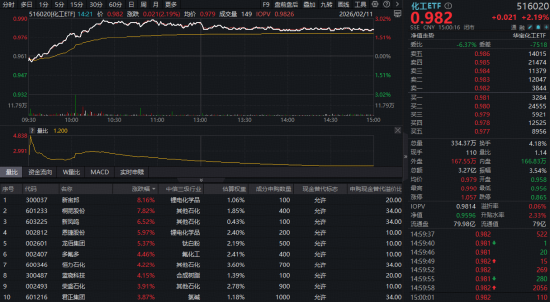
Group 1 - The chemical sector continues to show strong performance, with the Chemical ETF (516020) experiencing a price increase of 2.19% by the end of trading on February 11, after reaching a peak increase of 3.02% during the day [1][7] - Key stocks in the sector include New Zobang, which surged by 8.16%, and Tongkun Co., which rose by 7.82%, along with other notable increases from companies like Xin Fengming and Enjie [1][7] - The basic chemical sector attracted significant capital inflow, with a net inflow of 13.862 billion yuan, ranking second among 30 major sectors [9][10] Group 2 - The Shanghai second-hand housing market has shown signs of recovery, with January transactions reaching a five-year high and listings dropping below 150,000, indicating a warming trend [10] - Analysts suggest that the real estate sector is stabilizing, which may present investment opportunities in the chemical real estate chain [10] - Recommendations include focusing on industries benefiting from anti-involution policies, such as chlor-alkali, pesticides, and polyester filament, as well as coal chemical sectors benefiting from rising oil prices [10][11] Group 3 - The Chemical ETF (516020) tracks the CSI sub-sector chemical industry index, covering popular themes such as AI computing power, anti-involution, robotics, and new energy [10][11] - Investors can also consider Chemical ETF linked funds (Class A 012537/Class C 012538) for exposure to the chemical sector [10][11]

1月通胀数据点评:核心通胀回升渐入佳境
HTSC· 2026-02-11 11:06
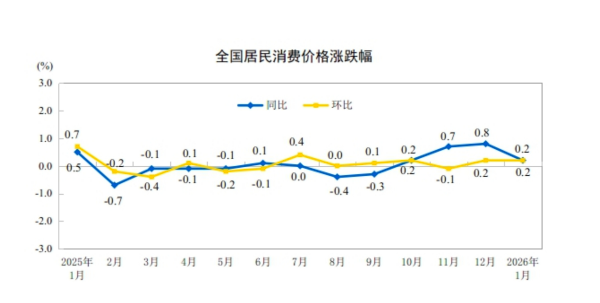
Group 1: Inflation Data Overview - In January 2026, China's CPI increased by 0.2% year-on-year, down from 0.8% in December 2025, and below Bloomberg's consensus expectation of 0.4%[1] - The PPI in January 2026 decreased by 1.4% year-on-year, an improvement from the previous month's decline of 1.9%, slightly above the expected decline of 1.5%[1] - Month-on-month, the CPI remained flat at 0.2%, while the PPI increased from 0.2% in December to 0.4% in January[1] Group 2: Seasonal Effects and Core Inflation - The late timing of the Spring Festival in 2026 is expected to suppress January's CPI readings but boost February's figures significantly[2] - Core CPI showed a month-on-month recovery from 0.2% in December to 0.3% in January, marking a six-month high, indicating a gradual recovery in domestic demand[2] - The food CPI turned negative at -0.7% year-on-year in January, down from 1.1% in December, impacting the overall CPI negatively[7] Group 3: PPI Trends and Industry Insights - The PPI's year-on-year decline has narrowed for six consecutive months, with notable improvements in upstream prices for non-ferrous and black metals[8] - The PPI for production materials decreased by 1.3% year-on-year, while the living materials PPI saw a wider decline of 1.7%[8] - The ongoing "anti-involution" market reforms are contributing to price stabilization in certain sectors, with significant increases in prices for educational and entertainment products[8]
收官“十四五”布局“十五五” 法士特以自主创新坚定不移角逐行业新赛道
Zhong Guo Qi Che Bao Wang· 2026-02-11 10:19
Core Viewpoint - The article highlights the achievements and future strategies of Faw Jiefang, a leading company in the commercial vehicle transmission sector, during the "14th Five-Year Plan" and outlines its focus for the upcoming "15th Five-Year Plan" period. Group 1: Achievements During the "14th Five-Year Plan" - The company achieved a cumulative operating income exceeding 88 billion yuan during the "14th Five-Year Plan" period, with overseas sales revenue surpassing 1.09 billion USD [4] - A total of over 4.35 million transmission products were sold, marking a successful conclusion to the "14th Five-Year Plan" [4] Group 2: Focus Areas for the "15th Five-Year Plan" - The company will concentrate on the development trends of "new four modernizations" in the industry, focusing on eight key sectors including automotive transmission, automotive safety, and new energy [4] - Plans include strengthening the leading position in transmission products, accelerating the expansion of automotive safety and braking business, and rapidly scaling up the new energy components industry [4] Group 3: Challenges and Strategic Responses - The company faces challenges such as rising raw material costs, a downturn in international markets, and intensified competition within the industry [5] - To mitigate these pressures, the company is implementing various internal measures like raw material channel management and cost reduction, while also expanding into new fields and business models [5] - The company is actively combating unfair competition through complaints and reports to industry associations and government regulatory bodies, aiming to maintain a fair competitive environment [5]

化工板块现积极信号,细分领域提价潮起,化工ETF国泰(516220)涨超2%
Sou Hu Cai Jing· 2026-02-11 08:02
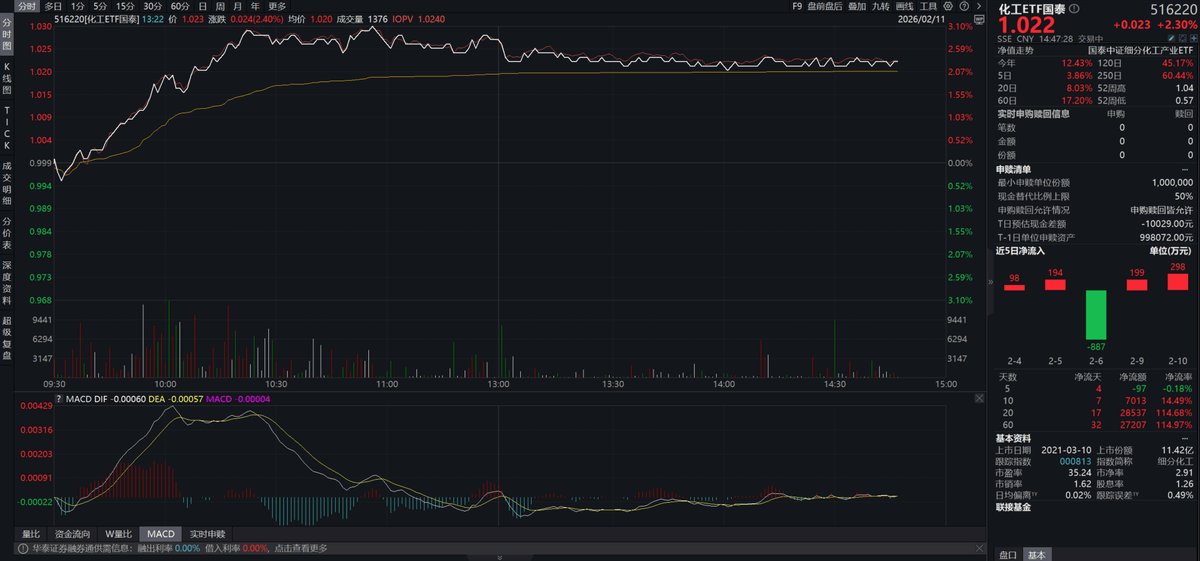
Core Viewpoint - The chemical sector is experiencing a revival, with price increases in various subcategories such as dyes, PVA, and vitamins, indicating a potential recovery in the industry [2][3][10] Short-term Logic - The influx of capital into the chemical sector reflects market expectations of a turning point, supported by stable core costs like oil and coal prices, which provide a clear bottom support for chemical product prices [4][10] - The stabilization of raw material costs is crucial for the midstream chemical industry, as it narrows profit volatility and clarifies price support [4][6] Medium to Long-term Perspective - The chemical industry is undergoing significant changes in supply and demand dynamics, driven by domestic "anti-involution" policies and global capacity restructuring, leading to a shift from simple cyclical fluctuations to a combination of cyclical recovery and growth premium [5][6] - A profound "Supply-side Reform 2.0" is underway, with policies accelerating the elimination of outdated capacity and enhancing the competitive landscape among leading companies [6][10] Demand Dynamics - Traditional downstream sectors face pressure, but sectors like automotive and home appliances are expected to improve marginally due to policy support [7] - Emerging industries such as semiconductors and renewable energy are driving new demand, creating a "second curve" of growth for the chemical sector [7][10] Investment Mapping - The Guotai Chemical ETF (516220) offers a convenient way for investors to gain exposure to the chemical sector, capturing both cyclical recovery and structural upgrade benefits [8][9] - The ETF includes leading companies benefiting from "anti-involution" and global capacity restructuring, providing significant profit elasticity during industry recoveries [9] - The ETF's diversified approach mitigates risks associated with individual stocks and allows investors to capitalize on overall industry trends [9][10]
2026年1月通胀数据点评:开年通胀:回升的绿芽
Guolian Minsheng Securities· 2026-02-11 07:09
Inflation Data Overview - In January 2026, the Consumer Price Index (CPI) increased by 0.2% month-on-month and year-on-year, while the core CPI (excluding food and energy) rose by 0.8% year-on-year[4] - The Producer Price Index (PPI) saw a month-on-month increase of 0.4% but a year-on-year decrease of 1.4%[4] Seasonal Effects and Consumer Demand - The January CPI year-on-year drop to 0.2% was influenced by the late timing of the Spring Festival, which typically weakens food price increases[4] - Historical data suggests that seasonal disturbances like this are often corrected in February, indicating potential recovery in CPI[5] Core CPI and Consumer Recovery - The core CPI's month-on-month increase of 0.3% marks a six-month high, reflecting improving consumer demand supported by effective consumption policies[4] - Price increases in household goods and services, such as travel and entertainment, indicate a robust recovery in service consumption[4] PPI Trends and Influences - The PPI's year-on-year decline narrowed to -1.4%, with a month-on-month increase of 0.4%, both reaching their highest values since October 2023[4] - Factors contributing to PPI recovery include the "anti-involution" policy and international commodity price increases[4] Risks and Future Outlook - Potential risks include policy measures falling short of expectations, unexpected changes in the domestic economy, and fluctuations in exports[4]
春节错月致1月CPI同比涨幅回落,反内卷带动相关领域价格改善
第一财经· 2026-02-11 06:23
Core Viewpoint - The article discusses the recent trends in China's Consumer Price Index (CPI) and Producer Price Index (PPI), highlighting a decline in CPI and an improvement in PPI due to various factors including seasonal effects and policy implementations [3][5]. CPI Analysis - In January, the CPI increased by 0.2% month-on-month and year-on-year, with a notable decrease of 0.6 percentage points compared to December [3][5]. - The decline in CPI is attributed to the high base effect from the previous year's Spring Festival and a significant drop in energy prices, which fell by 5.0%, contributing approximately 0.34 percentage points to the CPI decrease [5][7]. - Core CPI, excluding food and energy, rose by 0.8% year-on-year and 0.3% month-on-month, marking the highest increase in six months, indicating a steady recovery in consumer demand [5][7]. PPI Analysis - The PPI rose by 0.4% month-on-month in January, marking the fourth consecutive month of increase, with the growth rate expanding by 0.2 percentage points from the previous month [7][8]. - Key factors driving PPI growth include the ongoing construction of a unified national market and increased demand in certain industries, leading to price increases in sectors such as photovoltaic, power batteries, cement, and steel [7][8]. - Specific price changes include a 0.1% increase in cement and lithium-ion battery manufacturing, a 1.9% increase in photovoltaic equipment manufacturing, and a 0.5% increase in computer and communication equipment manufacturing due to rising demand for digital technologies [7][8]. Future Price Trends - The National Bureau of Statistics indicates that favorable factors for moderate price recovery are accumulating, with expectations for expanded consumer demand supported by fiscal and financial policies [8]. - The emphasis on industry self-discipline and capacity management is expected to continue, contributing to price stabilization and recovery [8].

“反内卷”催化化工盈利底部修复,化工ETF国泰(516220)大涨超2%
Mei Ri Jing Ji Xin Wen· 2026-02-11 06:02
Group 1 - The core viewpoint is that the current expansion phase in the basic chemical and chemical products industry is nearing its end, and measures such as "anti-involution" are expected to catalyze a recovery in industry profitability by 2026 [1] - The new materials sector is anticipated to benefit from rapid growth in downstream demand, potentially initiating a new phase of high growth [1] - Traditional chemical industry leaders are showing resilience in operations and are enhancing their competitive capabilities by expanding into new materials, which may lead to improvements in both performance and valuation as industry conditions improve [1] Group 2 - Continuous catalysts such as "anti-involution" should be monitored, particularly in sub-industries where supply and demand dynamics are improving, including refining, polyester, dyes, organic silicon, pesticides, refrigerants, and phosphorus chemicals [1] - The rapid development of downstream industries provides significant growth opportunities for companies in the new materials sector [1] - The Guotai Chemical ETF (516220) tracks a sub-index of the chemical industry (000813), which selects listed companies from various segments such as fertilizers, pesticides, and coatings to reflect the overall performance of high-growth and specialized chemical enterprises [1]
产品力提升+智能化预期带来增量,港股汽车ETF国泰(520720)涨超1.8%
Mei Ri Jing Ji Xin Wen· 2026-02-11 05:59
Group 1 - The market is beginning to trade in advance for the Q1-Q2 new car cycle, driven mainly by product enhancements from new technologies [1] - Intelligent driving is expected to be a major growth area this year, with expectations for Full Self-Driving (FSD) technology entering the Chinese market [1] - Domestic cost pressures are significant, but there is optimism regarding overseas export opportunities [1] Group 2 - The Hong Kong Stock ETF, Cathay (520720), tracks the Hong Kong Stock Connect Automobile Index (931239), which selects listed companies in the automotive industry, focusing on smart driving and new energy vehicles [1] - The index components are concentrated in the automotive sector, showcasing high growth potential and international characteristics, while highlighting the representation of new energy vehicle companies and smart driving new forces [1]
春节错月致1月CPI同比涨幅回落,反内卷带动相关领域价格改善
Di Yi Cai Jing· 2026-02-11 04:17
Group 1: Consumer Price Index (CPI) - In January, the CPI increased by 0.2% month-on-month and year-on-year, reflecting a decrease of 0.6 percentage points compared to December [1] - The decline in CPI is attributed to the Spring Festival timing and a significant drop in energy prices, which decreased by 5.0%, impacting CPI by approximately 0.34 percentage points [3] - Core CPI, excluding food and energy, rose by 0.8% year-on-year and 0.3% month-on-month, marking the highest increase in six months, indicating a steady recovery in consumer demand [3] Group 2: Producer Price Index (PPI) - The PPI rose by 0.4% month-on-month in January, marking the fourth consecutive month of increase, with an expansion of 0.2 percentage points from the previous month [5] - Factors contributing to the PPI increase include the ongoing construction of a unified national market and rising demand in certain industries [5] - Prices in sectors such as photovoltaic, battery, cement, and steel have shown positive improvements due to the "anti-involution" policies implemented last year [5] Group 3: Industry-Specific Price Changes - In January, prices for cement manufacturing and lithium-ion battery manufacturing increased by 0.1%, continuing a four-month upward trend [5] - The price of photovoltaic equipment and components shifted from a 0.2% decrease to a 1.9% increase, while basic chemical raw materials saw a 0.7% increase [5] - The prices of non-ferrous metal mining and smelting industries rose significantly, with silver smelting prices increasing by 38.2% and copper smelting by 8.4% [6] Group 4: Future Price Trends - The National Bureau of Statistics indicates that favorable factors for moderate price recovery are accumulating, supported by policies aimed at boosting consumption and stabilizing market expectations [6] - The implementation of coordinated fiscal and financial policies is expected to gradually expand consumer demand, providing a foundation for stable price operations [6] - Emphasis on industry self-regulation and capacity management is anticipated to further enhance price recovery in key sectors [6]
日度策略参考-20260211
Guo Mao Qi Huo· 2026-02-11 03:30
1. Report Industry Investment Rating No relevant content provided. 2. Core Views of the Report - In the short - term, before the Spring Festival, stock index futures are expected to oscillate strongly to accumulate strength for further upward movement, and long - term long positions in stock index futures should be held [1]. - Asset shortage and weak economy are beneficial to bond futures, but the central bank has recently warned of interest rate risks, and attention should be paid to the Bank of Japan's interest rate decision [1]. - Before the Spring Festival, downstream demand is still weak, market participation has declined, and copper, aluminum, and alumina prices are expected to oscillate [1]. - The cost center of zinc fundamentals is stabilizing. Due to the increasing risk - aversion sentiment in the market, zinc prices are expected to decline and then stabilize, and it is recommended to wait and see [1]. - Market sentiment has improved. Indonesia's ESDM has issued a nickel ore RKAB quota of 2.6 - 2.7 billion tons in 2026, and the approval of nickel ore quotas has been slow recently, increasing concerns about future nickel ore supply. In the short - term, nickel prices are expected to be strong, but are still affected by the resonance of the non - ferrous metal sector. It is recommended to pay attention to Indonesian policies and macro - sentiment. In the medium - to long - term, the high global nickel inventory may still have a suppressing effect [1]. - The raw material end of stainless steel still has support, and with the improvement of macro - sentiment, stainless steel futures are expected to oscillate strongly. It is recommended to go long at low prices in the short - term and hold light positions during the holiday [1]. - In the short - term, macro - negative factors have been exhausted, but the volatility of tin prices is still large. In the short - term, investors are advised to focus on risk management and profit protection [1]. - The weak US dollar index, uncertain geopolitical situation in the Middle East, and China's continuous gold purchases for 15 months support precious metal prices. However, before the Spring Festival, market funds may be cautious, and precious metals are expected to stabilize and oscillate in the short - term [1]. - The weak US dollar index supports platinum and palladium prices, but the US Trade Representative's discussion of an agreement on critical minerals may cause fluctuations in platinum and palladium prices, so they are expected to fluctuate widely in the short - term [1]. - In the cement industry, production has increased in the Northwest and decreased in the Southwest. The production of polysilicon and organic silicon in December has declined [1]. - In the new energy vehicle industry, it is the off - season, but energy storage demand is strong, and there is a rush to export batteries. The price has risen significantly and there is a need for a correction [1]. - For rebar and hot - rolled coils, the expectation is strong, but the spot market is weak, and the upward momentum is insufficient. It is recommended to exit long positions and participate in cash - and - carry arbitrage [1]. - For iron ore, there is obvious upward pressure, and it is not recommended to chase the long position at this level [1]. - For silicon iron and glass, the reality is weak, but the expectation is strong. Energy consumption control and anti - involution may affect supply [1]. - Soda ash follows glass, and its medium - term supply and demand are more relaxed, so the price is under pressure [1]. - For coking coal and coke, during the off - season of the black industry, before the Spring Festival, the inventory replenishment is almost over. The market pays more attention to capital sentiment. It is recommended to cash in on the spot when the market rises and establish cash - and - carry arbitrage positions [1]. - For palm oil, the MPOB monthly report data has a positive expected difference, but the subsequent fundamentals still have pressure, and it is recommended to wait and see before the Spring Festival [1]. - For soybean oil, the cost is supported by the strong US soybean market. There is no abnormal weather in South America, and it is recommended to pay more attention to Sino - US soybean trade trends. It is expected to oscillate in the short - term [1]. - For rapeseed oil, after the anti - dumping final ruling on Canadian rapeseed, the tariff is expected to be adjusted to about 15% after March, and the supply contradiction is expected to ease [1]. - For cotton, there is support but no driving force in the short - term. Future attention should be paid to the central government's No. 1 document in the first quarter of next year, planting area intentions, weather during the planting period, and peak - season demand [1]. - For sugar, there is a global surplus and an increase in domestic new - crop supply. There is a strong consensus among short - sellers. If the price continues to fall, there is strong cost support, but there is a lack of continuous driving force in the short - term [1]. - For corn, before the Spring Festival, trading is coming to an end, and the price fluctuation is limited. After the festival, attention should be paid to the selling pressure of ground - stored grain, policy - grain release, import arrivals, and new - season wheat growth. It is expected to oscillate within a range [1]. - For soybeans, the increase in US soybean export expectations boosts the US market, but the decline in Brazilian discounts partially offsets the impact. The domestic market is weaker than the overseas market. It is recommended to pay attention to the subsequent selling pressure of Brazilian discounts and consider going long on M2609 at a low level [1]. - For pulp, there are disturbances on the supply side, but the demand side weakens after inventory replenishment. It is recommended to wait and see when the commodity sentiment fluctuates significantly [1]. - For logs, the spot price has risen, the arrival volume in February is expected to decline, and the external quotation is expected to rise, so the futures price has an upward driving force [1]. - For live pigs, the spot price is gradually stabilizing, demand is supported, but the production capacity has not been fully released [1]. - For fuel oil, OPEC+ has suspended production increases until the end of 2026, the geopolitical situation in the Middle East may cool down, and the commodity market sentiment has turned bearish. In the short - term, it follows crude oil [1]. - For asphalt, the supply of raw material Ma Rui crude oil is sufficient, the profit is high, and the demand for the 14th Five - Year Plan construction may be falsified [1]. - For natural rubber, the raw material cost has strong support, the market sentiment has turned bearish, the downstream demand before the Spring Festival has weakened, and the basis has widened to a high level [1]. - For BR rubber, the cost of butadiene has strong support, private cis - butadiene rubber plants may reduce production due to losses, but the high inventory of cis - butadiene rubber is a potential negative factor. In the short - term, the price is expected to fluctuate widely, and there is an upward expectation in the long - term [1]. - For PTA, the PX - mixed xylene spread has narrowed, PX maintains fundamental resilience, the downstream PTA industry is strong, and the domestic PTA production in January is expected to reach a new high with no planned production cuts during the Spring Festival and no new capacity throughout the year [1]. - For ethylene glycol, the production profit of naphtha cracking has declined, several Korean ethylene producers plan to maintain the operating rate of cracking units in February, and the price is waiting at a low level [1]. - For pure benzene, the inventory is high and the import demand is weak. The Asia - US spread is not enough to open the arbitrage window. The Asian styrene price and economic situation are recovering, supported by supply tightening, unexpected Middle East shutdowns, surging export demand, and rising costs [1]. - For urea, the export sentiment has eased, the domestic demand has limited upside, but there is anti - involution and cost support [1]. - For methanol, it is affected by the situation in Iran, with expected import reduction, but there is obvious downstream negative feedback. The downstream MTO leading device has stopped, and some enterprises have reduced production, but Fude restarted on January 25th. The situation in Iran has eased, but risks cannot be completely ruled out. Inland transportation costs have risen due to cold air, and northwest enterprises have large inventory - clearing pressure and are selling at reduced prices [2]. - For crude oil, it oscillates strongly, the price has returned to a reasonable range, and the pre - festival inventory replenishment has ended, with flat demand during the holiday [2]. - For PVC, there is less global production in 2026, the differential electricity price in the northwest region is expected to be implemented, forcing the elimination of PVC production capacity, and the future expectation is optimistic, but the current fundamentals are poor, and the rush to export has slowed down [2]. - For liquid chlorine, the macro - sentiment has temporarily subsided, the market is trading fundamentals again, the fundamentals are weak, the absolute price is at a low level, the price of liquid chlorine has weakened, and the spot price has risen slightly [2]. - For LPG, the CP price in February has risen, the purchase in March is still relatively tight, the short - term risk premium of the Middle East geopolitical conflict has declined, the driving logic of the overseas cold wave has gradually slowed down, the market expectation is weakening, the basis is expected to widen, the domestic PDH operating rate has declined, the profit is expected to recover seasonally, and the demand side is short - term bearish, suppressing the upward movement of the futures price. The ports are continuously reducing inventory, but the domestic civil gas is sufficient, showing a divergence between propane and PG [2]. - For container shipping, the pre - festival freight rate has peaked and declined, airlines are still cautious about trial resumption of flights, and airlines expect to stop the price decline and raise prices strongly after the off - season in March [2]. 3. Summary by Relevant Catalogs Macro - finance - Stock index futures: Short - term strong oscillation before the Spring Festival, long - term long positions held [1]. - Bond futures: Asset shortage and weak economy are beneficial, but central bank warns of interest rate risks, attention on Bank of Japan's interest rate decision [1]. Non - ferrous metals - Copper, aluminum, alumina: Oscillation due to weak downstream demand and increased risk - aversion sentiment [1]. - Zinc: Cost center stabilizes, price expected to decline and then stabilize, wait - and - see recommended [1]. - Nickel: Short - term strong due to supply concerns and improved macro - sentiment, long - term suppression from high inventory [1]. - Stainless steel: Raw material support and improved macro - sentiment, short - term long at low prices, light positions during holiday [1]. - Tin: High short - term volatility, focus on risk management and profit protection [1]. - Precious metals: Supported by various factors, but cautious market funds before Spring Festival, short - term stable oscillation [1]. - Platinum and palladium: Supported by weak US dollar, but agreement discussion may cause fluctuations, short - term wide - range fluctuation [1]. New energy and related industries - Polysilicon and organic silicon: December production decline [1]. - New energy vehicles: Off - season, but strong energy storage demand and battery export rush, price correction needed [1]. Building materials - Cement: Production increase in Northwest and decrease in Southwest [1]. - Rebar and hot - rolled coils: Strong expectation but weak spot, insufficient upward momentum, exit long positions and do cash - and - carry arbitrage [1]. - Iron ore: Upward pressure, not recommended to chase long [1]. - Silicon iron and glass: Weak reality, strong expectation, supply may be affected by energy consumption control and anti - involution [1]. - Soda ash: Follows glass, medium - term supply - demand relaxation, price under pressure [1]. - Coking coal and coke: Off - season, focus on capital sentiment, cash in on spot when rising and do cash - and - carry arbitrage [1]. Agricultural products - Palm oil: MPOB report has positive difference, but subsequent fundamentals have pressure, wait - and - see before Spring Festival [1]. - Soybean oil: Cost supported by US soybeans, no abnormal South American weather, short - term oscillation [1]. - Rapeseed oil: Anti - dumping ruling, supply contradiction expected to ease [1]. - Cotton: Short - term support but no driving force, attention on future policies and market conditions [1]. - Sugar: Global surplus, domestic new - crop supply increase, short - seller consensus, cost support if price falls, lack of short - term driving force [1]. - Corn: Pre - festival trading end, post - festival attention on selling pressure, policies, and wheat growth, range oscillation [1]. - Soybeans: US export boost, Brazilian discount impact, domestic market weaker, consider long on M2609 at low level [1]. Forest products - Pulp: Supply disturbances, demand weakens after inventory replenishment, wait - and - see during significant commodity sentiment fluctuations [1]. - Logs: Spot price rise, expected decline in February arrivals and rise in external quotation, upward driving force for futures [1]. Livestock - Live pigs: Spot price stabilizing, demand support, production capacity not fully released [1]. Energy and chemicals - Fuel oil: OPEC+ suspension, Middle East geopolitical cooling, short - term follows crude oil [1]. - Asphalt: Sufficient raw material supply, high profit, demand falsification possibility [1]. - Natural rubber: Cost support, bearish market sentiment, weak pre - festival downstream demand, widened basis [1]. - BR rubber: Butadiene cost support, plant production reduction expectation, high inventory risk, short - term wide - range fluctuation, long - term upward expectation [1]. - PTA: PX spread narrowing, PX resilience, strong downstream industry, high production and no new capacity [1]. - Ethylene glycol: Naphtha cracking profit decline, Korean producers maintain operating rate, low - price waiting [1]. - Pure benzene: High inventory, weak import demand, Asia - US spread not enough for arbitrage, styrene recovery [1]. - Urea: Export sentiment easing, limited domestic upside, anti - involution and cost support [1]. - Methanol: Affected by Iran, import reduction expected, downstream negative feedback, device changes, Iran situation and inland inventory - clearing [2]. - Crude oil: Strong oscillation, price in reasonable range, pre - festival inventory replenishment end, flat holiday demand [2]. - PVC: Future optimism with capacity elimination, current poor fundamentals, slowed export rush [2]. - Liquid chlorine: Macro - sentiment subsides, trading fundamentals, weak fundamentals, low price, liquid chlorine weakening, spot rise [2]. - LPG: Rising CP price, tight March purchase, declining risk premium, weakening expectation, basis widening, bearish demand, port inventory reduction and domestic gas sufficiency [2]. Shipping - Container shipping: Pre - festival freight rate decline, cautious airline resumption, expected post - off - season price increase [2].