去美元化

Search documents
赤峰黄金股价异动下跌,短期受国际金价回调及资金流出影响
Jing Ji Guan Cha Wang· 2026-02-14 04:11
Core Viewpoint - The recent decline in Chifeng Gold's stock price is primarily attributed to significant fluctuations in international gold prices and the outflow of leveraged funds, despite the company's strong fundamental performance and growth prospects [2][3][4]. Group 1: Stock Performance - As of February 13, 2026, Chifeng Gold's stock closed at 37.30 yuan, down 2.48%, with a trading volume of 1.852 billion yuan and a turnover rate of 2.95% [1]. - Over the past five trading days, the stock has increased by 0.78%, but it has risen by 15.48% over the last twenty trading days, while the precious metals sector has declined by 2.63% and the Shanghai Composite Index has fallen by 1.26% [1]. - The stock experienced a trading range on February 13, with a high of 38.23 yuan and a low of 37.25 yuan, resulting in a volatility of 2.56% [1]. Group 2: Market Influences - On February 12, 2026 (Eastern Time), spot gold prices fell by 3.26% to $4918.36 per ounce, while silver plummeted by 10.89%, driven by algorithmic trading and forced liquidation by investors to meet liquidity needs [2]. - As of February 13, 2026, Chifeng Gold's financing balance has decreased for five consecutive days, totaling a reduction of 210 million yuan, a decline of 9.71%, indicating heightened risk aversion among leveraged investors [2]. - The stock price fell below the 20-day moving average of 39.25 yuan on February 13, with the MACD histogram dropping to -1.266 and the KDJ indicator J line at 48.39, suggesting weak short-term technical indicators [2]. Group 3: Company Fundamentals - Chifeng Gold reported a 140.98% year-on-year increase in net profit attributable to shareholders for the third quarter of 2025, with a total net profit of 2.058 billion yuan for the first three quarters, reflecting an 86.21% increase [3]. - The company's revenue grew by 38.91% year-on-year, benefiting from rising gold prices [3]. - Long-term outlook remains positive, with institutions like BNP Paribas citing geopolitical risks, central bank gold purchases, and de-dollarization trends as supportive of long-term gold price increases, with some target prices reaching $6000 per ounce [3]. - Financial structure has improved, with cash and cash equivalents rising to 4.995 billion yuan and total liabilities decreasing to 7.946 billion yuan by the end of the third quarter of 2025, alongside a net cash flow from operating activities of 3.036 billion yuan, up 51.54% year-on-year [3]. Group 4: Event Impact - The recent stock price decline is mainly influenced by short-term external market volatility and funding behaviors, characterized as a "risk-off" scenario driven by algorithmic trading sell-offs [4]. - Domestic gold stocks closely follow international gold price movements, with the Shanghai Gold Exchange's Au(T+D) reaching a high of 1136.5 yuan per gram on February 13, before retreating alongside international market corrections [4].

贵金属价格强劲反弹!现货黄金收涨2.39% 重回5000美元上方
Xin Lang Cai Jing· 2026-02-14 03:49
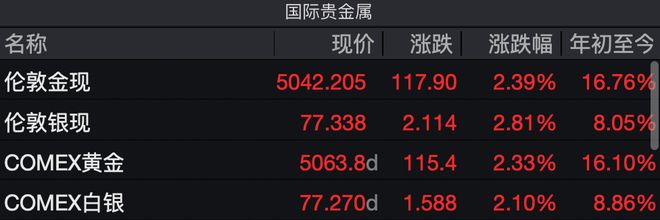
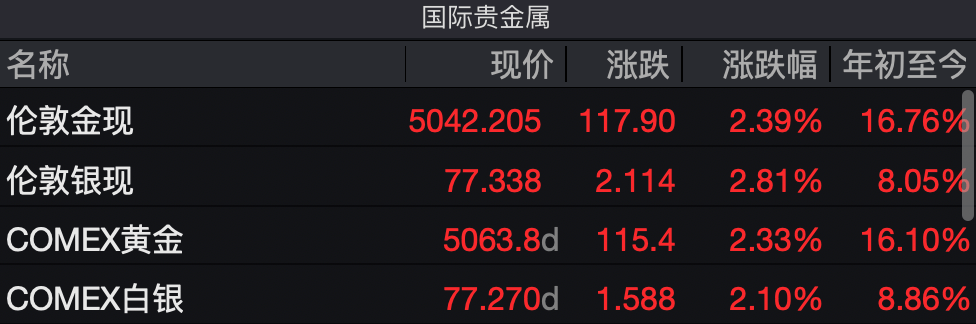
Group 1: Precious Metals Performance - Spot gold rebounded strongly, rising 2.39% to $5042.205 per ounce, with a year-to-date increase of 16.76% [1][2] - Spot silver increased by 2.81% to $77.338 per ounce, with a year-to-date rise of 8.05% [1][2] - COMEX gold futures rose 2.33% to $5063.80 per ounce, with a weekly increase of 1.51% [1][2] - COMEX silver futures increased by 2.10% to $77.27 per ounce, but experienced a weekly decline of 0.33% [1][2] Group 2: Economic Indicators and Federal Reserve Outlook - The U.S. January CPI fell to 2.4% year-on-year, below expectations, while core CPI dropped to 2.5%, the lowest since 2021 [2] - Analysts suggest that the positive reaction to inflation data is limited by the improving job market, reducing the necessity for further rate cuts by the Federal Reserve [2] - Expectations indicate that the Federal Reserve may cut rates twice this year, with the next potential cut in June [2] Group 3: Geopolitical Factors and Market Sentiment - Geopolitical tensions, particularly U.S. military actions in the Middle East, are enhancing the attractiveness of precious metals [3] - The current rise in gold prices is driven by de-dollarization expectations, increased central bank gold purchases, and geopolitical risk premiums [3] - Several Wall Street institutions have raised their gold price targets, with expectations for gold to reach $6000 per ounce by year-end [3] Group 4: Market Analysis and Future Projections - Analysts view recent price corrections as healthy adjustments following a strong upward trend, predicting a consolidation phase [4] - Future projections for gold prices have been raised to a range of $6100-$6300 per ounce by 2026, driven by ongoing geopolitical uncertainty and macroeconomic volatility [4] - The gold-silver ratio is expected to continue rising, indicating further potential for gold to provide unique value compared to silver [3][4]

2026年2月12日金价反转企稳,现在买金真的合适吗?
Sou Hu Cai Jing· 2026-02-14 03:37
Core Viewpoint - The gold market has stabilized as prices have stopped declining after a significant drop, indicating a shift in market sentiment [1][3][6]. Domestic Gold Prices - The domestic base gold price is approximately 1123 CNY per gram, with bank investment gold bars priced between 1136 CNY and 1141 CNY per gram [1][3]. - Brand jewelry stores like Chow Tai Fook and Lao Feng Xiang are selling gold jewelry at prices ranging from 1550 CNY to 1560 CNY per gram [1][4][6]. - The gold buyback price from dealers is around 1088 CNY per gram, indicating a significant loss for consumers when selling back [1][6]. International Gold Prices - International spot gold prices are fluctuating between 5056 USD and 5095 USD per ounce, with COMEX futures around 5105 USD [3][7]. - Gold prices have rebounded from a low of over 4400 USD after a drop from 5600 USD at the end of January, reflecting reduced panic in the market [3][7]. Market Dynamics - The stabilization in gold prices is attributed to technical recovery needs after a sharp decline and strong U.S. employment data that altered interest rate expectations [6][7]. - Central banks continue to purchase gold, with China's central bank increasing reserves by 40,000 ounces in January 2026, marking the 15th consecutive month of increases [7][9]. Price Predictions - Various institutions have differing views on future gold prices, with optimistic forecasts suggesting prices could reach 6000 USD by the end of 2026, while cautious predictions suggest a range of 4800 USD to 5200 USD [9][10]. - The World Gold Council indicates that 95% of surveyed central banks expect to continue increasing gold reserves, highlighting a structural shift in asset allocation [18]. Consumer Behavior - For consumers purchasing gold for jewelry, the high prices are less of a concern due to the intrinsic value of the items, while investment buyers are advised to consider different tools like bank gold bars or ETFs [10][12]. - The gold recovery market is complex, with consumers advised to be cautious of misleading offers and to ensure proper verification of gold purity [13]. Market Risks - The volatility in the gold market is significant, with recent fluctuations prompting increased margin requirements from exchanges to mitigate risks [16][19]. - The Federal Reserve's monetary policy remains a critical factor influencing gold prices, with expectations of potential interest rate cuts in 2026 [19][21].
贵金属价格强劲反弹!现货黄金收涨2.39%,重回5000美元上方
Sou Hu Cai Jing· 2026-02-14 02:56
Group 1 - Gold and silver prices have rebounded strongly, with spot gold rising 2.39% to $5042.205 per ounce and year-to-date gains of 16.76%, while spot silver increased by 2.81% to $77.338 per ounce with a year-to-date rise of 8.05% [1][2] - COMEX gold futures rose 2.33% to $5063.80 per ounce, with a weekly increase of 1.51%, while COMEX silver futures increased by 2.10% to $77.27 per ounce, experiencing a weekly decline of 0.33% [1][2] - The recent rise in precious metals prices is attributed to geopolitical tensions, particularly the U.S. military's deployment of a second aircraft carrier strike group to the Middle East, which has increased the appeal of gold and silver as safe-haven assets [3] Group 2 - The U.S. January CPI data showed a year-on-year decline to 2.4%, with core CPI dropping to 2.5%, the lowest level since 2021, which has influenced market sentiment regarding interest rate adjustments by the Federal Reserve [2] - Analysts from Nomura and Goldman Sachs suggest that the Fed's path for rate normalization appears clearer, with expectations of two rate cuts this year, potentially starting in June, depending on the labor market's performance [2] - Several Wall Street institutions have raised their gold price targets, with BNP Paribas predicting gold could reach $6000 per ounce by year-end due to ongoing macroeconomic and geopolitical risks [3]
CA Markets:降息预期升温施压,美元指数微跌收窄,短期震荡难改
Sou Hu Cai Jing· 2026-02-14 01:26
Core Viewpoint - The slight decline of the US dollar index on February 14, 2026, reflects a combination of factors including easing inflation data, rising expectations for Federal Reserve rate cuts, and ongoing geopolitical uncertainties, indicating a cautious market sentiment [1][6][16]. Market Overview - On February 14, the US dollar index opened at 96.935, peaked at 96.985, and fell to a low of 96.871, closing at 96.922, down 0.01% [4][5]. - Trading volume was approximately 28,000 contracts, showing a slight decrease from the previous day, while open interest remained around 33,000 contracts, indicating cautious positioning by institutional investors [4][5]. Core Drivers - The primary driver for the dollar index's decline is the easing inflation data in the US, which has led to increased expectations for rate cuts by the Federal Reserve [6][10]. - The market anticipates that the core PCE price index for January will fall to 2.8%, close to the Fed's 2% target, reinforcing the belief in a downward trend in inflation [6][7]. - The probability of a 25 basis point rate cut by March is estimated at 19.6%, increasing to 49.3% by June, which diminishes the attractiveness of dollar-denominated assets [7][8]. Additional Pressures - Global monetary policy easing and the trend of de-dollarization are also contributing to the pressure on the dollar index [10][11]. - The ongoing geopolitical uncertainties, particularly related to sanctions against Russia, have heightened market volatility and reduced the dollar's traditional safe-haven appeal [12][13]. Institutional Insights - Financial institutions predict that the dollar index will continue to experience a range-bound movement, with a trading range of 96.5 to 97.5, as the market grapples with conflicting signals from Fed officials and economic resilience [13][14]. - Analysts suggest that while the dollar's long-term weakness is evident, short-term fluctuations may occur based on inflation data and Fed communications [16][18].
中金研途 | 缪延亮:货币的秩序——我研究生涯的又一次攀登
中金点睛· 2026-02-14 01:17
Core Viewpoint - The article emphasizes the importance of understanding the evolution of the international monetary order and the opportunities it presents for China, as articulated by Dr. Miao Yanliang, a senior strategist at CICC [2][12]. Research Origin - The interest in the international monetary system began in 2005 during a class at Princeton University, where Dr. Miao was encouraged by Professor Peter Kenen, a leading expert in the field [4]. - Dr. Miao's career has been centered around the international monetary order, having worked at the International Monetary Fund and the State Administration of Foreign Exchange [4]. Research Development - In early 2023, Dr. Miao completed a book titled "The Game of Confidence: Modern Central Banks and Macroeconomics," which received positive feedback, prompting him to consider writing another book titled "The Order of Money" [5]. - The rapid changes in the global landscape, including the AI revolution and shifts in U.S. trade policy, have created a unique opportunity for research on the international monetary order [5][14]. Key Observations - In June 2025, Dr. Miao presented at a strategy meeting, stating that the forces driving the reconstruction of the international monetary order are significantly stronger than the basic fundamentals of any single country or market [6]. - He noted that the restructuring is moving towards fragmentation and diversification, with capital returning to its home countries, as evidenced by the decline in Chinese holdings of U.S. stocks from $383 billion to $329 billion [7]. Research Methodology - Dr. Miao's insights are based on extensive research and validation through interactions with central banks and investment institutions, including participation in high-level conferences [9][10]. - He emphasizes the importance of cross-verifying perspectives from academic, market, and policy viewpoints to strengthen his research conclusions [11]. Conclusion on Currency Competition - The article concludes that the highest form of competition among nations is currency competition, which relies on trust supported by economic, financial, institutional, and technological factors [13]. - The article highlights the significance of advancing the internationalization of the Renminbi, especially during strategic windows of opportunity [14][16]. Research Series Overview - The article lists a series of research reports focusing on various aspects of the international monetary system, including the role of the Renminbi, the dynamics of gold pricing, and the implications of de-dollarization [20].

黄金、白银大涨!
Xin Lang Cai Jing· 2026-02-14 00:31
当地时间2月13日,美国三大股指收盘涨跌不一,道琼斯工业指数涨0.1%报49500.93点,标普500指数涨 0.05%报6836.17点,纳斯达克指数跌0.22%报22546.67点。本周,道琼斯工业指数跌1.23%,标普500指 数跌1.39%,纳斯达克指数跌2.1%。 美国CPI数据公布后,市场对美联储降息的概率预期上升,美元指数回落,支撑贵金属资产吸引力。 COMEX黄金期货涨2.33%报5063.80美元/盎司,COMEX白银期货涨2.10%报77.27美元/盎司。 欧洲三大股指收盘涨跌不一,德国DAX指数涨0.25%报24914.88点,法国CAC40指数跌0.35%报8311.74 点,英国富时100指数涨0.42%报10446.35点。本周,德国DAX指数涨0.78%,法国CAC40指数涨 0.46%,英国富时100指数涨0.74%。 中概股涨跌不一,纳斯达克中国金龙指数跌0.10%,万得中概科技龙头指数涨0.15%。热门中概股方 面,再鼎医药涨超6%,腾讯音乐涨逾4%,百胜中国涨超3%,涂鸦智能涨逾2%,禾赛科技涨超2%,网 易涨逾2%。跌幅方面,晶科能源跌近3%,阿特斯太阳能跌超2%,金山 ...
黄金、白银大涨!
证券时报· 2026-02-14 00:28
Group 1 - The U.S. stock indices closed mixed on February 13, with the Dow Jones Industrial Average up 0.1% at 49,500.93 points, the S&P 500 up 0.05% at 6,836.17 points, and the Nasdaq down 0.22% at 22,546.67 points. For the week, the Dow Jones fell 1.23%, the S&P 500 fell 1.39%, and the Nasdaq fell 2.1% [1] - The U.S. CPI data released showed a year-on-year increase of 2.4% in January, down from 2.7% in December, and below the economist's expectation of 2.5%. The core CPI rose 2.5% year-on-year and 0.3% month-on-month [4] - Following the CPI report, traders increased their bets on the Federal Reserve cutting interest rates three times this year, with a 50% chance of a rate cut by the end of the year [4][5] Group 2 - International precious metal futures saw widespread gains, with COMEX gold futures rising 2.33% to $5,063.80 per ounce and COMEX silver futures up 2.10% to $77.27 per ounce [2][7] - The rise in precious metal prices is attributed to multiple factors, including increased expectations for Federal Reserve rate cuts and a decline in the U.S. dollar index, enhancing the attractiveness of precious metals [8] - The oil market showed mixed results, with U.S. crude oil futures down 0.05% at $62.81 per barrel and Brent crude oil futures up 0.24% at $67.68 per barrel [9]
埃氏金业股价上涨5.29%,受国际金价反弹及板块情绪带动
Jing Ji Guan Cha Wang· 2026-02-13 19:48
Group 1 - The core viewpoint of the article highlights that EGO.N's stock price increased by 5.29% on February 13, 2026, driven by a rebound in international gold prices and overall positive sentiment in the gold sector [1][2]. Group 2 - On February 13, international gold prices rebounded significantly after a sharp decline the previous day, with spot gold rising 1.01% to $4,973.82 per ounce, following a drop of over 3% on February 12 [2]. - The gold mining sector experienced a collective increase, with the U.S. gold sector rising by 3.52% on the same day, positively impacting EGO.N as a constituent stock [2][3]. Group 3 - EGO.N closed at $47.54 with a trading volume of approximately $111 million, outperforming the average sector performance [3]. - Other gold mining stocks, such as AUMN.PS, also saw gains, with a 4.69% increase, indicating a broad rally within the sector [3]. Group 4 - Market analysis suggests that the rebound in gold prices is supported by ongoing geopolitical risks and sustained demand for gold from global central banks, with key factors like de-dollarization and central bank purchases remaining intact [4].
游戏落幕,中国囤储2308吨黄金!赶在访华前,特朗想试探中方口风
Sou Hu Cai Jing· 2026-02-13 17:55
Group 1 - Trump is set to visit China in the first week of April, with his team preparing to ensure a smooth meeting and stabilize the situation [1] - U.S. Treasury Secretary Becerra revealed that high-level U.S. officials recently visited China for in-depth discussions, indicating a focus on economic issues ahead of Trump's visit [1] - The absence of Secretary of State Rubio, who is on a sanctions list, suggests that the discussions will primarily revolve around economic matters rather than broader diplomatic issues [1] Group 2 - The U.S. is increasing its debt through new bond issuance, leading to a growing debt burden that now exceeds $38 trillion, over 125% of GDP, raising concerns about repayment capacity [3] - China is actively reducing its holdings of U.S. Treasury bonds while increasing its gold reserves to 2,308 tons, using gold as a hedge against the credit risk of the dollar [3] - The ongoing geopolitical tensions, including the Russia-Ukraine conflict and tensions in the Middle East and South China Sea, are driving China to favor gold over dollar assets as a safer investment [5][6] Group 3 - The independence of the Federal Reserve was threatened during Trump's presidency, with potential changes in leadership that may lead to more accommodative monetary policies, increasing dollar liquidity volatility [5] - China's strategy of selling U.S. bonds and converting proceeds into gold is a method of asset exchange aimed at enhancing financial security without causing market panic [6] - To support the internationalization of the renminbi, China is building a solid value foundation through increased gold reserves and establishing mechanisms for gold trading in renminbi, thereby avoiding the dollar system [8]