
经济衰退

Search documents
狂欢背后暗藏危机?华尔街担心美股泡沫风险上升
Jin Shi Shu Ju· 2025-07-02 09:23
Group 1 - The S&P 500 index closed the first half of the year at a historic high, raising concerns among some Wall Street professionals about potential market overheating [2] - Barclays strategist Stefano Pascale warned of "bubble" risks, citing the Barclays stock frenzy indicator, which has returned to early-year peak levels, reminiscent of the meme stock craze and the dot-com bubble [2][3] - The resurgence of SPAC IPOs has been notable, with issuance in 2023 already matching the total for the 2023/24 period [2] - The ARK Innovation ETF (ARKK) has seen a significant rebound, surging over 44% in the past three months, second only to the post-COVID spike [2] Group 2 - Benson Durham from Piper Sandler noted that overvaluation is not limited to individual stocks favored by retail investors, but is present across all sectors of the S&P 500 [2] - Despite the current market rally being driven more by liquidity than fundamentals, predicting market bubbles remains challenging, as they often last longer than expected [3] - Economic indicators suggest a potential cooling, with slowing job growth and weakening housing demand, yet the market continues to rise [3] - Stephanie Roth from Wolf Research highlighted that investors may be underestimating economic downturn risks, with the model predicting a less than 5% chance of recession, significantly lower than the historical average of 16% [3]
金融市场上半年总结:贸易摩擦推动市场在波动中创纪录
Sou Hu Cai Jing· 2025-07-02 08:05
Market Overview - The financial markets experienced significant volatility in the first half of the year due to rapidly changing trade dynamics under President Trump, concerns over a potential economic recession, and worries about the expanding deficit threatening the U.S. safe-haven status [1] Currency Market - The U.S. dollar recorded its longest monthly decline since 2017 in June, with a year-to-date drop of approximately 10.8%, marking the worst first half since 1973 [3] - The euro appreciated by about 3.8% in June, with a cumulative increase of 13.8% in the first half, driven by concerns over tariffs impacting the economy and a weaker dollar [6] - The British pound saw a nearly 10% increase against the dollar in the first half, supported by a pause in interest rate cuts by the Bank of England and improving economic outlook [6] Gold Market - Gold prices rose by 25.8% in the first half of the year, with gold ETFs increasing by 25.9%, driven by geopolitical tensions and trade disputes boosting safe-haven demand [7] - Silver prices also surged, with a 24.9% increase in the first half, supported by both safe-haven and industrial demand [7] Oil Market - Crude oil prices experienced significant fluctuations, with an overall decline of about 9.6% in the first half, impacted by trade tensions and oversupply concerns from OPEC+ [9] - In June, oil prices briefly spiked to $80 due to tensions in the Middle East but quickly retreated as the situation stabilized [9] Equity Market - By the end of June, U.S. stock markets reached historical highs, driven by expectations of a trade agreement and renewed interest rate cuts from the Federal Reserve [11] - The S&P 500 index surpassed the 6200-point mark, reflecting a 25% increase from its April low, primarily fueled by strong performance in technology stocks [11] Market Resilience - Despite geopolitical shocks and trade uncertainties, the market demonstrated remarkable adaptability and resilience, attributed to stable economic and profit conditions [13] - Investors are advised to maintain diversified portfolios to navigate the high uncertainty period ahead of the upcoming earnings season [13]


德国破产潮掀危机,美欧贸易战升级,经济趋势堪比火烧连环
Sou Hu Cai Jing· 2025-07-02 05:43
文︱陆弃 近日,德国企业破产潮不断升级,已达到十年来最高水平,数据显示,2025年上半年共有约1.19万家企 业宣告破产,涉及员工14.1万人。这组令人震惊的数字不仅揭示了德国经济正在经历的严重衰退,更暴 露出其深层次的结构性危机和对外依赖的脆弱性。而这一切背后,美欧之间复杂且充满不确定性的贸易 博弈,正如烈焰一般,烧穿了这个"欧洲经济引擎"的肌理。 德国经济曾被誉为欧洲的支柱,制造业和出口导向型经济模式长期支撑着其稳定增长。然而,这个曾经 的经济奇迹如今却陷入了沉重的困境。数据显示,企业破产率比去年同期激增9.4%,而这背后的根 源,绝非偶然。需求疲软、成本上升、全球贸易不确定性叠加,成为压垮这座经济大厦的最后一根稻 草。尤其是美国对德国商品出口的潜在关税威胁,更是给德国出口商蒙上了巨大的阴影,使得本就脆弱 的德国经济雪上加霜。 德国国内生产总值第一季度虽然小幅增长0.2%,但这并不能掩盖经济深层次的病症。作为德国最大的 贸易伙伴,美国与欧盟之间悬而未决的贸易谈判,充满了不确定性和对抗色彩。慕尼黑经济研究所指 出,关税威胁的阴云仍笼罩在谈判桌上,出口商的信心指数从5月的-5.0继续下滑至-7.4,明显表现出 ...
如果美国失业率升至4
2025-07-02 01:24
Summary of Key Points from the Conference Call Industry Overview - The discussion primarily revolves around the **U.S. labor market** and its implications for the economy, particularly focusing on the **unemployment rate** and its potential impact on market dynamics. Core Insights and Arguments - The **current unemployment rate** in the U.S. is fluctuating between **3.6% and 4.0%**, nearing the threshold that could trigger the **"Summer Rule,"** indicating a risk of economic recession, similar to the market reactions observed in **Q3 2024** [1][2] - The **labor market** has cooled to pre-pandemic levels, with a significant decrease in the ratio of job vacancies to unemployed individuals, suggesting weakened hiring intentions among businesses [1][3] - **Immigration policies** have a dual impact on the job market: initially filling labor shortages but later increasing competition with native workers, leading to a rise in the unemployment rate among immigrants [1][4] - Leading indicators show a continued weakening in employment demand, with key metrics like non-farm payroll data indicating a potential acceleration in labor market cooling in the latter half of the year [1][5] Additional Important Content - The **Trump administration** saw a historic high in immigration detentions, but the overcapacity of detention facilities limited the effectiveness of deportations on the job market [1][8] - The **impact of tariffs** on the U.S. economy and job market is significant, with broader and stronger tariffs potentially leading to a **1% economic shock** and an increase in the unemployment rate by **0.3% to 0.7%** [1][10] - Market expectations suggest that the unemployment rate could reach around **4.5%** by the end of the year, with a possibility of hitting **4.6%**, which may trigger the **Summer Rule** [2][11] - The **Summer Rule** indicates that if the unemployment rate rises by **0.5 percentage points**, it signals a recession, with potential market reactions including stock market declines and increased expectations for Federal Reserve rate cuts [2][12] - If the **Summer Rule** is triggered in the latter half of the year, it could lead to significant market changes, including a drop in stock prices and commodity prices, alongside a rise in expectations for Federal Reserve rate cuts [2][13] - There are internal divisions within the **Federal Reserve** regarding inflation and employment, with differing views on whether to prioritize inflation control or employment protection [2][14]
高盛金价年度目标3700美元,2025年底强化预测或实现
Sou Hu Cai Jing· 2025-07-01 20:16
Core Viewpoint - Goldman Sachs maintains a target price of $3,700 per ounce for gold by the end of 2025, driven by central bank gold purchases, economic recession risks, and weakening dollar credibility [1][3]. Group 1: Forecast Timeframe - Key timeframe for the target price is set for the end of 2025, with potential for earlier achievement if central bank purchases exceed expectations or if recession risks intensify, possibly reaching $3,810 to $3,880 [1]. - An extreme scenario predicts a mid-2026 price of $4,000 per ounce under conditions of strong central bank purchases and geopolitical tensions [2]. Group 2: Current Progress and Supporting Logic - Central banks exceeded expectations with a purchase of 106 tons in February 2025, significantly above historical averages, with emerging markets like China and India driving diversification of foreign reserves [3]. - Goldman Sachs assesses a 45% probability of a U.S. recession within the next 12 months, which could lead to increased inflows into gold ETFs, thereby boosting prices [3]. - Factors such as anticipated interest rate cuts by the Federal Reserve and geopolitical instability are diminishing the attractiveness of the dollar [3]. Group 3: Market Performance Validation - Gold prices surpassed $3,500 in April 2025 but retreated to $3,278 by the end of June, before rebounding above $3,320 in early July, indicating strong market support [4]. - Central bank purchases and investment demand, such as daily sales of bank gold bars exceeding 5 tons, provide long-term support for gold prices [5]. Group 4: Institutional Perspectives - Various institutions have differing target prices for gold by the end of 2025, with Goldman Sachs at $3,700, UBS at $3,500, Citigroup at $2,500-$2,700, and Deutsche Bank at $3,400, reflecting a range of views on market dynamics [8][9]. Group 5: Recommendations for Retail Investors - Investors are advised to monitor key indicators such as monthly central bank gold purchase data, with a sustained rate above 80 tons per month significantly increasing the likelihood of reaching the $3,700 target [9]. - The Federal Reserve's policy decisions, particularly a potential rate cut in September, could act as a catalyst for gold price breakthroughs [10].
大摩警告:关税已对美国企业利润率构成严重威胁,可能成为经济衰退的前兆
Hua Er Jie Jian Wen· 2025-07-01 12:50
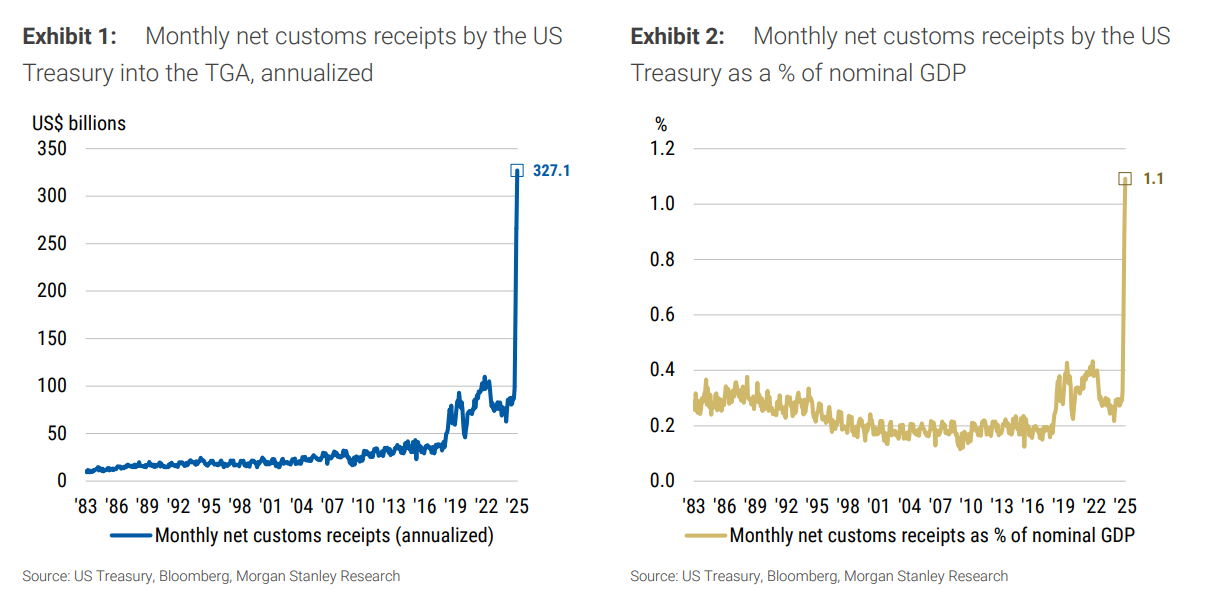
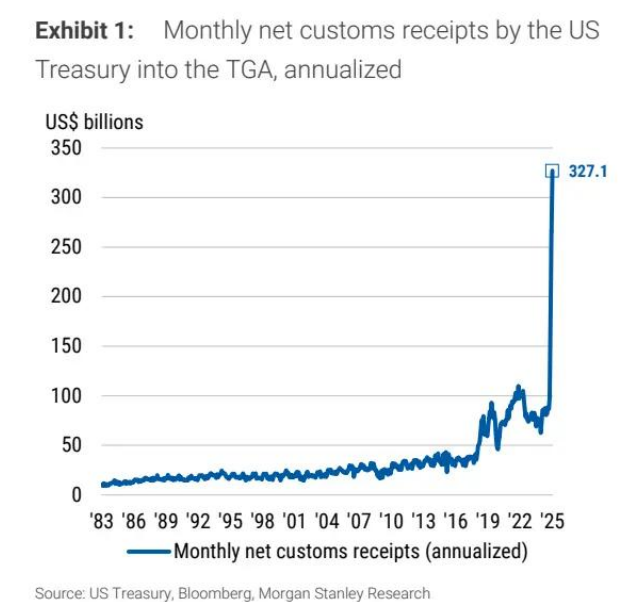
收税来了,并且可能长期驻留 摩根士丹利表示,财政部数据显示,美国净关税收入呈现急剧上升趋势:4月份为156亿美元,5月份为222亿美元,6月份截至26日已达273亿美元。6月份数 据年化后达到3270亿美元,占一季度名义GDP年化值的1.1%。 美国进口关税已成为经济重负,关税影响达到"奇点"。 据追风交易台消息,摩根士丹利在6月30日的报告中表示,美国关税收入已达到惊人规模,6月份年化关税收入达3270亿美元,相当于美国GDP的1.1%。 这一惊人数字对经济和企业构成多重压力,若企业完全吸收关税成本,利润率将从13.8%降至11.7%,低于15年移动平均线12.2%。若全部转嫁给消费者,将 加剧通胀压力。 从税收角度审视,6月份年化关税收入相当于:相当于企业所得税收入的65%;相当于个人预扣税/社保税收入的10%;相当于个人非预扣税收入的32%。 分析师警告,当投资者纠结于消费者还是生产者将承担更多关税、以及这何时会在企业财报或消费者通胀中显现时,他们忽略了一个更大、更重要的事实: 美国进口商已经开始支付大量关税,而且规模惊人。 如果企业完全承担关税成本,将对利润率造成显著冲击。非金融企业一季度税后利润为2 ...

大摩:关税奇点!告诉你为什么要继续做多美国国债,做空美元
Zhi Tong Cai Jing· 2025-07-01 09:30
Group 1 - The core argument of the report is that tariffs are not a zero-sum game and have significant implications for U.S. Treasury securities and the U.S. dollar, with a focus on the broader economic impact rather than just the immediate costs to producers and consumers [1][2] - Tariffs paid by U.S. importers are projected to amount to $327 billion annually, which represents 1% of the nominal GDP for 2025 [2][6] - If companies fully absorb the tariff costs, profit margins could drop from 13.8% to 11.7% in Q1 2025, significantly below the 15-year moving average of 12.2% [2][12] Group 2 - The report highlights that if 75% of the tariffs are passed on to consumers, profit margins could exceed the 15-year moving average by 1.1 percentage points [12][13] - The analysis indicates that the current economic environment is leaning towards downside risks, with a noted decline in air passenger traffic compared to previous years [17] - The report suggests that despite some foreign investors increasing their holdings in U.S. stocks, there is a notable trend of U.S. domestic investors reducing their exposure, indicating a potential reallocation of assets [34][36]
3大坏消息袭来,特朗普有求于中国,日媒:中国打算邀他参加阅兵
Sou Hu Cai Jing· 2025-06-30 06:00
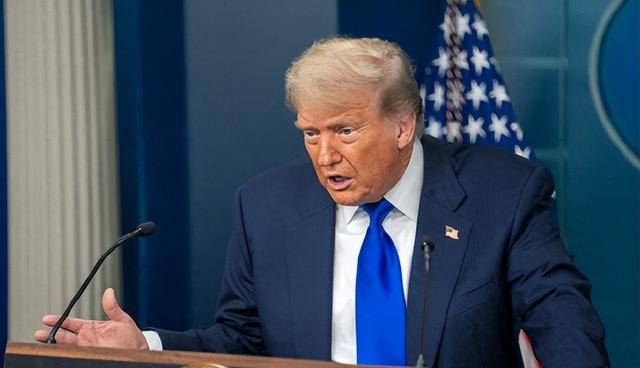
Group 1 - The Trump administration is under significant pressure due to plummeting approval ratings, primarily attributed to the negative impact of tariffs on American consumers [1][3] - A Bloomberg poll indicates that over half of respondents feel tariffs have directly affected their financial situation, with 69% expecting continued price increases on daily goods [1] - The first quarter GDP contracted by 0.3%, contradicting the White House's claims of economic prosperity, leading to a loss of trust among independent voters [1][3] Group 2 - Consumer spending growth has sharply declined from 4% in Q4 of the previous year to 1.8%, while business investment has also significantly decreased due to tariff uncertainties [3][4] - The EU is preparing to impose retaliatory tariffs on $95 billion worth of U.S. goods, with strong opposition from allies like Japan and India regarding U.S. tariff demands [4][7] - The U.S. trade deficit surged to a record $162 billion in March, with imports rising significantly while exports saw only a slight increase, raising recession probabilities to 60% according to Goldman Sachs [11] Group 3 - China has extended an invitation to Trump to attend a military parade, which could serve as a strategic move to soften U.S. stances on trade and tariffs [12][19] - The invitation is seen as a way to leverage China's control over rare earth elements, which are critical for U.S. military technology, potentially influencing trade negotiations [12][19] - The Trump administration is reportedly preparing for a significant visit to China, indicating a shift towards more cooperative trade relations [17][19]
赶快储油!伊朗会议通过:关闭霍尔木兹海峡,对全球能源有何影响
Sou Hu Cai Jing· 2025-06-30 05:19
Core Viewpoint - The escalating conflict between Iran and Israel, coupled with U.S. involvement, has led to increased tensions, particularly regarding the potential closure of the strategic Strait of Hormuz, which could have significant implications for global energy markets. Group 1: Oil Supply Impact - The Strait of Hormuz is a critical oil transport route, with approximately 20 million barrels of oil passing through daily, accounting for 30% of global seaborne oil trade and about 20% of global oil liquid consumption. A closure could result in a supply reduction of over 18 million barrels per day, nearly a 20% drop in global supply, potentially driving oil prices to $100 per barrel [3][4][6]. Group 2: LNG Trade Disruption - The Strait is also vital for liquefied natural gas (LNG) trade, with around 95% of LNG exports from Qatar and the UAE relying on this route. A closure could lead to a 20% decrease in global LNG supply, significantly impacting energy markets in Europe and Asia, particularly raising prices in these regions [3][4]. Group 3: Economic and Geopolitical Risks - Closing the Strait would likely trigger a global energy crisis, exacerbating geopolitical tensions. The economies of the U.S. and Europe heavily depend on Middle Eastern oil imports, and a blockage could lead to soaring energy prices and inflation, threatening economic stability, especially in Europe, which is already facing energy supply challenges due to the Russia-Ukraine conflict [4][6]. Group 4: Limitations of Alternative Routes - While Saudi Arabia and the UAE have some pipelines that bypass the Strait, their combined nominal capacity is only 6.7 million barrels per day, with 4.3 million barrels per day currently idle. This is insufficient to meet the daily demand of 17 million barrels, indicating that alternative routes cannot adequately mitigate the impact of a closure [6][7]. Group 5: Military and Energy Security Risks - Iran's threat to close the Strait could provoke military conflict with the U.S., which has deployed significant military resources in the region to ensure the passage remains open. Iran's growing military capabilities pose a risk of interference in the Strait, potentially escalating international tensions and complicating regional security [7].

小摩2025年中期全球经济展望:规避衰退,终结例外主义
智通财经网· 2025-06-27 12:38
Group 1 - Morgan Stanley's report indicates that the trade war will lead to stagflation tendencies in the second half of 2025, with global GDP growth expected to slow to an annualized rate of 1.4% and core inflation rising to 3.4% due to inflation driven by U.S. tariffs [2][3] - The commodity production sector is expected to be the first to feel the impact of economic slowdown, with global factory output and capital spending projected to contract [2] - Despite rising inflation in the U.S., lower-than-expected growth is likely to drive moderate deflation in other regions, with the Eurozone's core inflation rate expected to fall below 2% [2] Group 2 - Morgan Stanley assesses that the global GDP growth has an upward risk bias for the second half of 2025, driven by a positive evaluation of the private sector's health, a supportive financial environment, and expected fiscal policy easing [3] - The risk of a significant growth surprise is skewed to the downside, with a 40% probability of the U.S. entering a recession, driven by concerns over household purchasing power and low corporate sentiment [3] - The behavior of a still-healthy corporate sector, particularly avoiding layoffs, is crucial for maintaining U.S. economic expansion, although this may come at the cost of profit margin compression [3]
