Workflow
美元信用
icon
Search documents
全球资产配置策略系列(1):黄金和美股世纪大复盘:冰火之歌还是星辉互映?
Changjiang Securities· 2025-12-03 15:03
Core Insights - The report focuses on two historical gold bull market cycles: 1975-1980 and 2005-2011, analyzing the correlation and divergence between gold and U.S. equities during different phases and the underlying driving mechanisms [3][17]. - Three core variables influencing the relationship between gold and U.S. equities are identified: U.S. dollar credit, monetary policy cycles, and the evolution of risk events [3][17]. Framework 1: Major Asset Allocation Strategy - Utilizing Martin J. Pring's business cycle framework, the U.S. economy from 1975 to present is segmented into six cycles: depression, recovery, prosperity, overheating, stagflation, and recession [6][29]. - In the depression phase, bonds outperform due to declining economic and inflation conditions; during recovery, equities become the core allocation as economic stability and declining inflation support growth [6][29]. Framework 2: Global Monetary Easing and Asset Rotation Strategy - Historical data reveals that post-economic crises, the recovery sequence of various resource prices follows their proximity to end-user demand [7][18]. - After the 2008 financial crisis, gold stabilized first due to its safe-haven attributes, followed by commodities with both financial and industrial characteristics, and finally assets closely tied to real demand [7][18]. Gold Bull Market Cycle Analysis - The first gold bull market (1975-1980) was driven by stagflation, with gold prices increasing by 242%, significantly outperforming the S&P 500's 98% rise [32][37]. - The second bull market (2005-2011) was characterized by the subprime crisis and quantitative easing, evolving through four phases: pre-crisis coordination, crisis-induced divergence, policy-driven coordination, and renewed divergence amid rising risks [17][32]. Future Outlook - The Federal Reserve's potential interest rate cuts may benefit both U.S. equities and gold, with a favorable monetary environment likely to boost equity valuations and resource prices [9][18]. - However, there is a caution regarding the internal conflict between gold and technology stocks, particularly if AI investments do not enhance productivity and fiscal sustainability, which could lead to market volatility [9][18].
突发特讯!美总统宣告:已选定下任美联储主席,言辞引发热议
Sou Hu Cai Jing· 2025-12-01 05:58
Core Viewpoint - Trump's announcement regarding the next Federal Reserve Chair has created significant tension and speculation in the financial markets, marking a departure from traditional practices in U.S. politics [1][3][15] Group 1: Political Dynamics - Trump's relationship with current Chair Powell has been strained, with past public disputes and pressure for more aggressive interest rate cuts [3][10] - The announcement appears to be a strategic move to exert influence over the Federal Reserve's decision-making process, raising concerns about the independence of the institution [3][8][15] - The political maneuvering surrounding the Fed Chair position reflects broader tensions between domestic politics and global economic stability [15][17] Group 2: Market Reactions - The uncertainty surrounding the new Chair's alignment with White House interests has heightened market sensitivity, with potential implications for the dollar's value and global inflation [5][12][15] - Investors are on high alert, as changes in Fed leadership can lead to significant shifts in monetary policy, affecting capital flows and market confidence [5][14][15] - The market's reaction to the new Chair will depend on their perceived independence and ability to maintain the Fed's credibility [17] Group 3: Institutional Integrity - The Federal Reserve's independence is crucial for maintaining market confidence, and any perceived political interference could undermine its authority [8][9][10] - Historical precedents show that previous administrations respected the Fed's autonomy, making Trump's approach particularly notable [14][15] - The potential for the Fed to become a tool of the White House raises concerns about the long-term implications for U.S. monetary policy and global economic stability [10][15]
半夏投资创始人李蓓:资产配置遇“乱世”,A股港股现“小确幸”,大牛市可期
Xin Lang Zheng Quan· 2025-11-28 09:12
Core Insights - The 2025 Analyst Conference highlighted the current chaotic state of global asset allocation, with a focus on the potential for a bull market in A-shares and Hong Kong stocks [3][4] - Li Bei, founder of Hanxia Investment, emphasized the challenges in asset allocation due to various global uncertainties, including high fiscal deficits in the US and concerns over asset safety [3][4] Market Performance - The past year saw decent performance across various asset classes, but the difficulty in asset allocation has increased significantly [3][6] - A-shares and Hong Kong stocks are viewed as "small fortunes" with the CSI 300 index currently at a PE ratio of approximately 13 times, implying a 7% return [4][10] - Despite ongoing economic deflation, the core index's ROE has stabilized, indicating resilience in leading companies' profitability [4][10] Sector Analysis - Leading companies in struggling sectors, such as construction and real estate, have begun to see profit recovery, with some construction leaders achieving net profit margins of 6% [4][11] - Real estate firms are gaining improved bargaining power in land acquisition, leading to net profit margins exceeding 10% for new projects [4][11] Future Outlook - There is optimism for a bull market in A-shares and Hong Kong stocks, driven by the potential migration of capital into Chinese assets as domestic economic stability improves [4][12] - The current low risk appetite among Chinese residents, with significant wealth concentrated in fixed income, presents a potential catalyst for future asset reallocation [4][12] - The mismatch between China's manufacturing share and its international reserve status suggests that a recovery in the economy could lead to increased RMB settlement and reserve ratios [4][15]
贵金属:贵金属日报-20251128
Wu Kuang Qi Huo· 2025-11-28 01:42
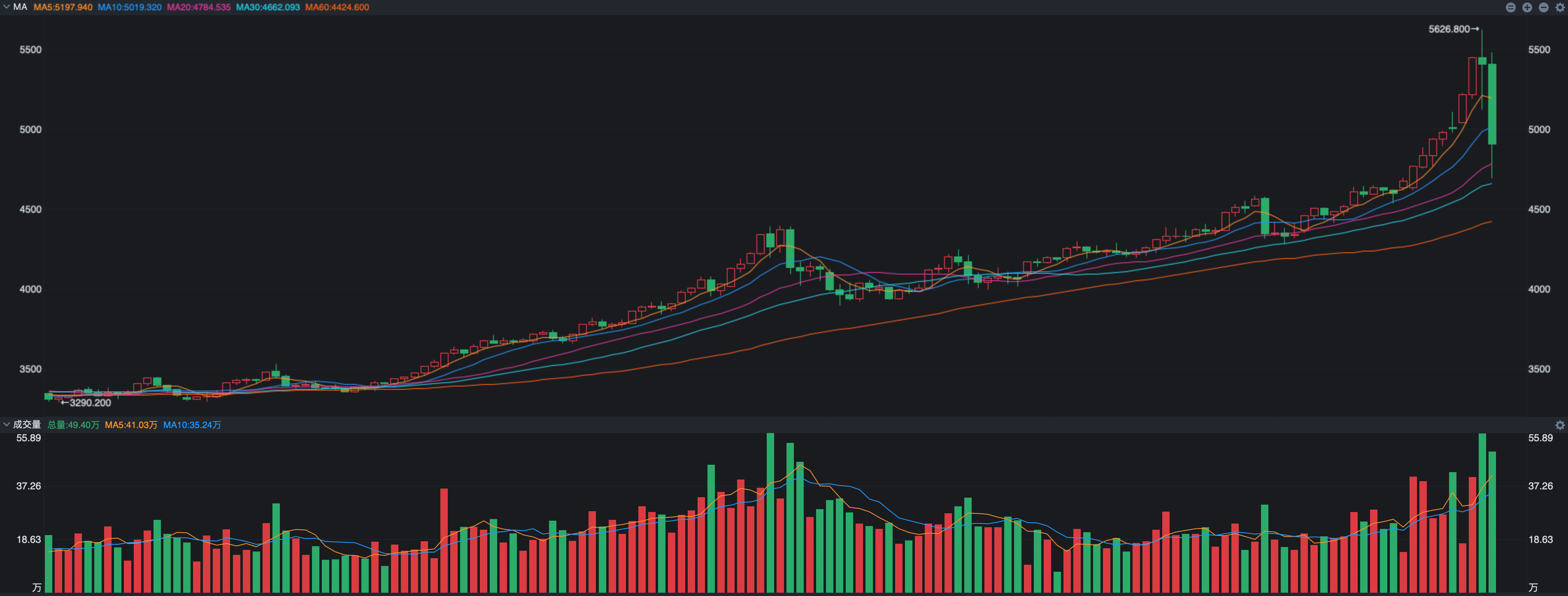
1. Report Industry Investment Rating - No information provided regarding the report industry investment rating 2. Core Viewpoints of the Report - The current focus of the precious metals market is the subsequent personnel changes at the Federal Reserve and the resulting monetary policy expectations, making gold and silver prices prone to rise and difficult to fall [1] - If Hassett is officially nominated as the new Federal Reserve Chairman next month, the market will further trade the impact of the weakened independence and influence of the Federal Reserve on the US dollar's credit [2] - The expectation of the Federal Reserve's loose monetary policy has significantly rebounded after the speeches of key voting members of the Fed, and the overseas interest - rate cut cycle will continue. The further driving force will be concentrated in December. It is recommended to buy on dips in the precious metals strategy [3] 3. Summary According to Related Contents Market Quotes - On November 28, 2025, Shanghai gold rose 0.02% to 946.90 yuan/g, Shanghai silver rose 1.29% to 12,490.00 yuan/kg; COMEX gold was reported at 4,194.00 US dollars/ounce, COMEX silver was reported at 53.82 US dollars/ounce; the US 10 - year Treasury yield was reported at 4%, and the US dollar index was reported at 99.53 [1] Federal Reserve Personnel and Policy Expectations - Foreign media reported that Hassett, the current director of the White House Economic Council, is the most popular candidate for the next Federal Reserve Chairman. His appointment would bring Trump's intentions into the Federal Reserve, greatly impacting its monetary policy independence. He said this month that he would cut interest rates if he were the Fed Chairman now [2] - Trump's policy team members, US Treasury Secretary Bessent and current Fed Governor Milan, expressed the need for the Fed to conduct "natural balance - sheet reduction" while buying US Treasuries, aiming to weaken the Fed's influence on the economy [2] - The CME interest - rate observer shows that the market expects an 86.9% probability of a 25 - basis - point interest - rate cut at the Fed's December meeting and a 13.1% probability of keeping the interest rate unchanged [2] Strategy Suggestions - The expectation of the Federal Reserve's loose monetary policy has significantly rebounded, and the overseas interest - rate cut cycle will continue. The further driving force will be concentrated in December. On December 10, the Fed will hold its last interest - rate meeting of the year and release an economic outlook report. Trump will probably complete the selection of the new Fed Chairman in late December [3] - It is recommended to buy on dips in the precious metals strategy. The reference operating range for the main contract of Shanghai gold is 917 - 967 yuan/g, and for the main contract of Shanghai silver is 12,036 - 13,000 yuan/kg [3] Data Summary - For gold on November 27, 2025, compared with the previous day, COMEX gold's closing price, trading volume, and open interest increased, while inventory decreased slightly; LBMA gold's closing price increased; SHFE gold's closing price, open interest, and precipitation funds increased, while trading volume decreased; AuT + D's closing price and open interest increased, while trading volume decreased [5] - For silver on November 27, 2025, compared with the previous day, COMEX silver's closing price, open interest, and trading volume increased, while inventory decreased; LBMA silver's closing price increased; SHFE silver's closing price, open interest, trading volume, and precipitation funds increased, while inventory increased; AgT + D's closing price and trading volume increased, while open interest decreased [5]
美联储内部分歧加剧,贵金属承压回落
Guo Mao Qi Huo· 2025-11-24 08:18
投资咨询业务资格:证监许可【2012】31号 【贵金属周报(AU、AG)】 美联储内部分歧加剧,贵金属承压回落 国贸期货 贵金属与新能源研究中心 2025-11-24 白素娜 从业资格证号:F3023916 投资咨询证号:Z0013700 本报告非期货交易咨询业务项下服务,其中的观点和信息仅供参考,不构成任何投资建议;期市有风险,投资需谨慎 周度观点摘要 ◆ 上周贵金属有所承压,周线整体收跌。主要影响因素分析如下:(1)美联储官员上 半周表态偏鹰,加上美联储10月会议纪要进一步暴露美联储内部对于12月降息的分歧日益 加剧,同时美国政府明确10月非农、CPI数据均不公布,这意味着美联储官员在年内最后 一次会议前可能将同时失去就业、通胀两项关键经济数据,不得不促使美联储谨慎控制降 息节奏。受此影响,美联储12月降息概率骤降,美股、比特币等资产全线下挫,流动性紧 缩下贵金属价格亦承压下挫。但随着恐慌指数回升,上周五晚间,美联储官员安抚市场, 称预计未来还会进一步降息,且有官员表态预计不久美联储将重新扩表,美联储降息预期 再度回升,流动性紧缩风险有所缓和,贵金属跌幅收窄。(2)俄罗斯央行开始抛售实物 黄金,一度对金价 ...
资管一线|专访瑞士百达陈东:长线外资仍有较大空间配置中国资产
Xin Hua Cai Jing· 2025-11-22 06:02
Group 1 - The core viewpoint is that 2025 is expected to be a pivotal year for foreign capital reassessing Chinese assets, driven by the erosion of dollar credit and the valuation advantages of Chinese tech stocks [1][5]. - Foreign capital inflow into Chinese stocks reached its highest level in four years, with a total of $50.6 billion from January to October 2023, significantly higher than the $11.4 billion in 2024 [5]. - The Chinese stock market's performance has been bolstered by the AI boom, particularly due to breakthroughs in large models, leading to a shift in foreign investors' perceptions of Chinese tech [5][6]. Group 2 - The dollar is facing long-term downward pressure due to rising domestic policy uncertainty and high fiscal deficits in the U.S., which are impacting its global standing [2][3]. - The U.S. Treasury bond yields are expected to stabilize around 4% to 5%, challenging the traditional view of U.S. bonds as risk-free assets [3]. - The overall valuation of U.S. stocks is at a global high, and any reduction in foreign capital inflow due to declining dollar credit could compress these valuations [3][4]. Group 3 - The financial sector is expected to present medium to long-term investment opportunities, with banks showing signs of improved profitability and stable dividend yields above 5% [7]. - The MSCI China Index is projected to see earnings growth exceeding 10% in 2026, indicating potential for upward movement driven by earnings rather than just valuation [6][7]. - The Chinese stock market's overall valuation has returned to the average level of the past 15 years, remaining relatively reasonable compared to other emerging markets [6][7].
国泰海通|宏观:破“7”之旅——2026年人民币汇率展望
Core Insights - The article discusses the expected fluctuations of the RMB exchange rate in 2025 and 2026, highlighting the central bank's effective liquidity management that helps mitigate risks [1] Group 1: 2025 RMB Exchange Rate Outlook - The appreciation of the RMB in 2025 is driven by two main factors: cracks in USD credit and the Federal Reserve's easing measures. However, the appreciation expectation is not straightforward, with significant volatility observed [2] - In April 2025, trade frictions led to a depreciation expectation exceeding 7.5, while the onset of the Fed's rate cut cycle in September brought the appreciation expectation closer to 7.0. This reflects investor uncertainty in a still fragile internal economic environment [2] - A key factor supporting the RMB's appreciation is the reversal of foreign trade enterprises' willingness to settle in RMB. The weakening belief in a strong USD has led to a historic level of cross-border capital inflow, primarily driven by these enterprises [3] Group 2: Central Bank's Management and Policy - The central bank's management of exchange rate controls is described as "brilliant," effectively balancing the optimism of currency holders and the hesitance of currency exchangers. This includes lowering swap market premiums to manage foreign capital inflow and guiding domestic expectations through the central parity rate [4] - The central bank aims to align domestic and foreign pricing expectations, achieving a "three-price unification" where both domestic and foreign asset pricing converge towards the central bank's expectations [4] Group 3: 2026 RMB Exchange Rate Expectations - The article raises the question of whether global easing will continue into 2026, noting a significant "K-shaped" economic divergence in the U.S. This divergence affects high-net-worth individuals and new borrowers differently, impacting credit expansion and overall economic conditions [5] - The central bank's willingness to allow the RMB to break the 7.0 mark is questioned, with indications that it is managing the pace of appreciation through historical low swap premiums. The central bank's focus appears to be on fundamental factors rather than credit-driven factors [6] - The future decoupling of the RMB exchange rate from the USD index is anticipated, with both fundamental and policy support for the RMB to break the 7.0 level. However, the article emphasizes that fundamental changes will be the core variable supporting long-term RMB strength [6]
总统位置不香了,特朗普还想另谋其职,美元百年信用命悬一线
Sou Hu Cai Jing· 2025-11-19 10:43
Core Viewpoint - The article discusses the shifting power dynamics between the U.S. presidency and the Federal Reserve, highlighting how Trump's actions and rhetoric have raised concerns about the independence of the Fed and the stability of the U.S. dollar's creditworthiness [1][10]. Group 1: Federal Reserve's Role and Independence - The Federal Reserve is described as a powerful institution that influences both the U.S. economy and global financial markets, with its decisions impacting over $70 trillion in financial assets [2]. - The independence of the Federal Reserve is crucial for maintaining confidence in the U.S. dollar, as it prevents monetary policy from being swayed by short-term political interests [3][5]. - Trump's public criticism of Fed Chairman Jerome Powell reflects a significant challenge to this independence, as he seeks to influence monetary policy to benefit his political agenda [4][10]. Group 2: Political and Economic Implications - Trump's desire for low interest rates and loose monetary policy is aimed at boosting the stock market and economic growth to enhance his political standing, which conflicts with Powell's focus on inflation and employment [4][8]. - The potential for Trump to replace Powell raises alarms about the Fed becoming a political tool, which could undermine the dollar's status as the world's reserve currency [4][10]. - The article warns that if the Fed loses its independence, it could lead to a loss of trust in the U.S. financial system, resulting in a significant shift in global capital flows and a potential financial crisis [9][10]. Group 3: Global Financial Landscape - The ongoing debate about the Fed's independence has led to increased volatility in the dollar index and a trend towards "de-dollarization" among various economies, indicating a growing distrust in the U.S. financial system [9][10]. - The article emphasizes that the stability of the global financial system relies on the credibility of the U.S. dollar, which is threatened by political interference in monetary policy [10][12]. - Countries are increasingly exploring alternatives to the dollar, which could reshape the global financial landscape and reduce reliance on U.S. monetary policy [13][14].
瑞达期货贵金属产业日报-20251118
Rui Da Qi Huo· 2025-11-18 09:02
Report Industry Investment Rating No relevant content provided Core Viewpoints - The precious metals market continues to be under pressure and in a correction trend, with the London gold price once breaking below the significant $4000 mark. Uncertainty over the release of the US CPI data for October, combined with previous warnings from Fed officials about the risk of inflation rebounding, has significantly reduced the probability of rate cuts in December and January next year. The rebound of the US dollar and the 10-year US Treasury yield, as well as the sharp correction in the US stock and cryptocurrency markets, have also intensified liquidity risks, posing resistance to the upward movement of gold and silver prices [2]. - In the short term, the correction in the US stock market may exacerbate market liquidity risks and cause short-term shocks to the gold price. The Fed's stance is more hawkish than expected, and the rate cut expectation is under pressure, which is a potential negative for the gold price. However, geopolitical risks may continue to provide price support, and the possibility of a significant decline in the gold market in the short term is relatively limited [2]. - In the medium to long term, the US debt pressure continues to intensify, and investors' confidence in the US dollar tends to weaken. Gold, as the preferred asset for hedging against US dollar credit, remains attractive. Coupled with the continuous intervention of central banks buying gold at low prices, the central price of gold may further increase [2]. - Technically, the short-term upward momentum has significantly weakened, and the $4000 and $50 integer marks for London gold and silver prices form key supports. The Shanghai gold 2512 contract should focus on the range of 900 - 950 yuan/gram; the Shanghai silver 2602 contract should focus on the range of 11300 - 12000 yuan/kilogram [2]. Summary by Relevant Catalogs 1. Market Data - **Futures Market**: The closing price of the Shanghai gold main contract was 918.52 yuan/gram, down 10.94 yuan; the closing price of the Shanghai silver main contract was 11699 yuan/kilogram, down 234 yuan. The main contract positions of Shanghai gold decreased by 10851 hands to 90872 hands, while those of Shanghai silver increased by 10886 hands to 322401 hands. The net positions of the top 20 in the Shanghai gold main contract decreased by 473 hands to 107875 hands, and those of Shanghai silver decreased by 12386 hands to 93067 hands. The warehouse receipt quantity of gold and silver both decreased to 0, with a decrease of 90426 kilograms for gold and 569355 kilograms for silver [2]. - **Spot Market**: The Shanghai Nonferrous Metals Network gold spot price was 917.3 yuan/gram, down 14.15 yuan; the silver spot price was 11787 yuan/kilogram, down 190 yuan. The basis of the Shanghai gold main contract was -1.22 yuan/gram, down 3.21 yuan; the basis of the Shanghai silver main contract was 88 yuan/kilogram, up 44 yuan [2]. - **Supply - Demand Situation**: Gold ETF holdings decreased by 2.57 tons to 1041.43 tons, while silver ETF holdings remained unchanged at 15218.42 tons. The non - commercial net positions of gold and silver in the CFTC increased, with an increase of 339 contracts for gold to 266749 contracts and an increase of 738 contracts for silver to 52276 contracts. The quarterly total supply and demand of gold were both 1313.01 tons, with an increase of 54.84 tons in supply and 54.83 tons in demand. The annual total supply of silver was 987.8 million troy ounces, down 21.4 million troy ounces, and the global total demand was 1195 million ounces, down 47.4 million ounces [2]. - **Option Market**: The 20 - day historical volatility of gold decreased by 0.58% to 27.02%, and the 40 - day historical volatility increased by 0.93% to 28.14%. The implied volatility of at - the - money call and put options for gold both increased by 2.17% to 28.93% [2]. 2. Industry News - Fed Vice Chair Jefferson believes that the downside risk to employment has increased, and the upside risk to inflation may have slightly decreased recently. He also reiterated that as interest rates approach the neutral level, policymakers need to be more cautious and proceed slowly. Fed Governor Waller believes that the Fed should cut rates again at the December meeting due to the weak US labor market and the harm of monetary policy to low - and middle - income consumers [2]. - US White House National Economic Council Director Hasset pointed out that the job market shows "mixed signals", suggesting that the labor market may be slowing down [2]. - According to CME's "FedWatch", the probability of the Fed cutting rates by 25 basis points in December is 42.9%, and the probability of keeping rates unchanged is 57.1%. The probability of the Fed cutting rates by a cumulative 25 basis points by January next year is 48.2%, the probability of keeping rates unchanged is 35.6%, and the probability of a cumulative 50 - basis - point cut is 16.1% [2].
金价短期受到压制,但全球央行购金趋势未变
Huan Qiu Wang· 2025-11-18 01:08
Group 1 - International precious metal futures experienced a general decline, with COMEX gold futures down 1.20% to $4045.10 per ounce and COMEX silver futures down 1.25% to $50.05 per ounce [1] - Analysts suggest that precious metal prices may continue to be pressured by a strengthening dollar and expectations regarding Federal Reserve policies, but the long-term trend of global central bank gold purchases remains unchanged, providing support for precious metals [1] - Since 2022, the traditional negative correlation between gold prices and the real interest rates of the dollar has weakened, with the driving force behind rising gold prices being unprecedented gold purchasing by central banks, particularly in emerging markets [1] Group 2 - The natural supply constraints of gold, due to the scarcity of mineral resources and the lengthy exploration and extraction cycles, have resulted in a relatively rigid supply, with global gold production remaining between 3400-3700 tons since 2018 [4] - The marginal changes in demand have become the core driving force reshaping gold pricing logic, as gold and the dollar are in a competitive relationship, with central banks replacing dollars with gold when dollar credit declines [4] - From 2022 to 2024, the average annual net gold purchases by global central banks are expected to reach 1073 tons, accounting for 23% of total global gold demand, with Goldman Sachs predicting that gold prices could rise to $4900 by the end of 2026 [4]