宏观经济

Search documents
【广发宏观郭磊】经济数据延续放缓,政策加力概率上升
郭磊宏观茶座· 2025-09-15 08:13
Economic Overview - August economic data shows continued slowdown, with six major indicators (exports, industrial output, services, retail sales, investment, and real estate sales) all below previous values. GDP estimates based on production and expenditure methods are approximately 4.67%, lower than July's 4.91% [1][7][8] Industrial Performance - Industrial added value in August grew by 5.2%, down from 5.7% in the previous month. The slowdown in export delivery value, which saw a year-on-year decline of 0.4%, is a significant drag on industrial performance [2][12] - High-tech industries continue to show resilience, with added value increasing by 9.3%. Key products like new energy vehicles and solar cells maintain high growth rates [2][13] Retail Sales - Retail sales growth in August was 3.4%, a decrease from 3.7% in July. Notable trends include accelerated rural consumption and a slowdown in urban consumption [3][14] - Categories with relatively high growth include sports and entertainment, jewelry, and home appliances, driven by service consumption trends and policy benefits [3][15] Fixed Asset Investment - Fixed asset investment saw a significant decline, with cumulative year-on-year growth dropping from 1.6% to 0.5%, and a monthly decline of 6.3%, worsening from -5.2% previously. Real estate, manufacturing, and infrastructure investments are all contributing to this downturn [4][16] - Manufacturing investment showed a year-on-year decline of 1.3%, indicating a slowdown in equipment updates [4][16] Real Estate Market - The real estate sector is experiencing a downward trend, with sales area, new starts, construction, and investment all showing increased year-on-year declines. The new housing price index in 70 major cities fell by 0.3% month-on-month, consistent with previous values [5][20][21] - Real estate investment in August saw a year-on-year decline of 19.4%, with new construction area down by 20.3% [5][20] Economic Phases - The economic rhythm of this year can be divided into three phases: strong growth in Q1 driven by exports and real estate, a resilient Q2 despite external disturbances, and a noticeable slowdown in July and August [5][22] - If Q3 GDP is estimated at 4.8%, achieving the annual target of 5.0% will require a Q4 growth rate of approximately 4.64% [5][22] Policy Outlook - Current macroeconomic policy is in the second phase, focusing on stabilizing cash flow and profit statements. The government is expected to continue its counter-cyclical adjustments following the release of August economic data [6][23]


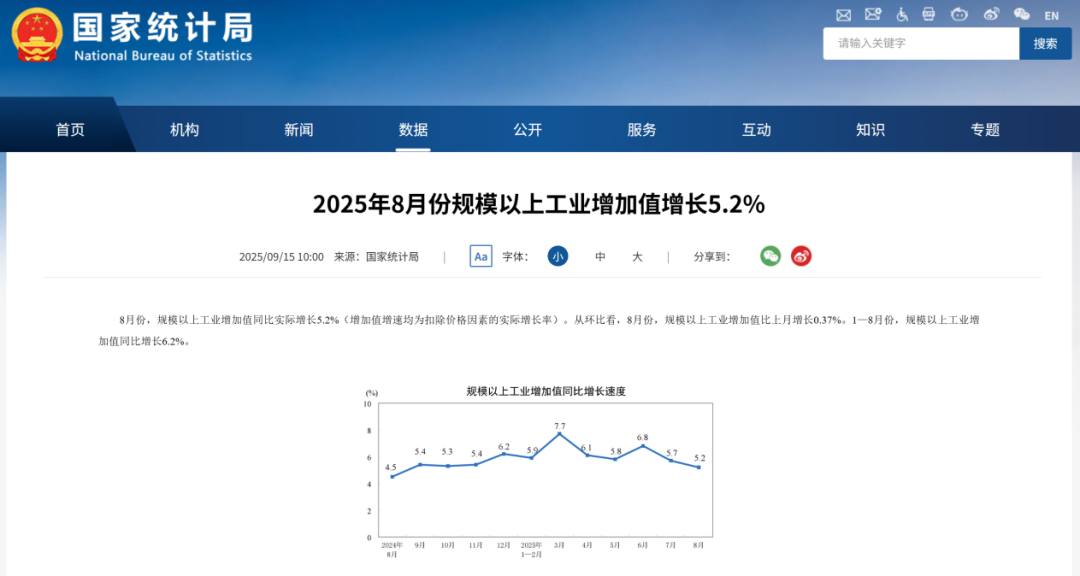
8月份全国规模以上工业增加值同比增长5.2%,环比增长0.37%
Zhong Guo Ji Jin Bao· 2025-09-15 06:54
Economic Overview - In August, the industrial added value of enterprises above designated size increased by 5.2% year-on-year, with a month-on-month growth of 0.37% [1][3] - From January to August, the industrial added value grew by 6.2% year-on-year [1][3] Industrial Production - The mining industry saw a year-on-year increase of 5.1%, manufacturing grew by 5.7%, and the electricity, heat, gas, and water production and supply industries increased by 2.4% [3] - Equipment manufacturing and high-tech manufacturing sectors performed well, with increases of 8.1% and 9.3% respectively, outpacing the overall industrial growth [3] Service Sector - The service sector production index rose by 5.6% year-on-year in August, with significant growth in information transmission, software, and financial services [4] - The business activity index for the service sector was at 50.5, indicating stable growth [4] Retail Sales - The total retail sales of consumer goods reached 39,668 billion yuan in August, a year-on-year increase of 3.4% [2][5] - Online retail sales amounted to 99,828 billion yuan from January to August, growing by 9.6% [5] Fixed Asset Investment - Fixed asset investment (excluding rural households) reached 326,111 billion yuan from January to August, with a year-on-year growth of 0.5% [6][7] - Manufacturing investment grew by 5.1%, while real estate development investment declined by 12.9% [7] Trade Performance - In August, the total value of goods imports and exports was 38,744 billion yuan, with exports growing by 4.8% and imports by 1.7% [8] - From January to August, the total trade value was 295,696 billion yuan, reflecting a year-on-year increase of 3.5% [8] Employment Situation - The urban surveyed unemployment rate was 5.3% in August, showing a slight increase from the previous month [9] - The average working hours for employees were reported at 48.5 hours per week [9] Price Trends - The Consumer Price Index (CPI) decreased by 0.4% year-on-year in August, while the core CPI rose by 0.9% [10] - The Producer Price Index (PPI) for industrial producers fell by 2.9% year-on-year, with a narrowing decline compared to the previous month [10]
冠通期货2025年8月宏观经济数据
Guan Tong Qi Huo· 2025-09-15 05:56
1. Report Industry Investment Rating No relevant content provided. 2. Core View of the Report In August 2025, under the strong leadership of the Party Central Committee with Comrade Xi Jinping as the core, the national economy maintained a generally stable and progressive development trend. Production and demand were basically stable, employment and prices were generally stable, and new driving forces were cultivated and strengthened [3]. 3. Summary by Relevant Catalogs Industry - In August, the added value of industrial enterprises above designated size increased by 5.2% year - on - year and 0.37% month - on - month. The added value of the mining industry, manufacturing, and the production and supply of electricity, heat, gas, and water increased by 5.1%, 5.7%, and 2.4% year - on - year respectively. The added value of the equipment manufacturing industry and high - tech manufacturing industry increased by 8.1% and 9.3% year - on - year respectively, faster than the overall industrial added value [3]. - From January to August, the added value of industrial enterprises above designated size increased by 6.2% year - on - year. In August, the manufacturing purchasing managers' index was 49.4%, up 0.1 percentage points from the previous month; the enterprise production and operation activity expectation index was 53.7%, up 1.1 percentage points [3]. - From January to July, the total profit of industrial enterprises above designated size was 40204 billion yuan, a year - on - year decrease of 1.7% [3]. Services - In August, the national service industry production index increased by 5.6% year - on - year. The production indexes of information transmission, software and information technology services, finance, and leasing and business services increased by 12.1%, 9.2%, and 7.4% year - on - year respectively, faster than the service industry production index [4]. - From January to August, the national service industry production index increased by 5.9% year - on - year. From January to July, the operating income of service enterprises above designated size increased by 7.4% year - on - year [4]. - In August, the service industry business activity index was 50.5%, up 0.5 percentage points from the previous month; the service industry business activity expectation index was 57.0%, up 0.4 percentage points. Some industries were in the high - level boom range [4]. Consumption - In August, the total retail sales of consumer goods were 39668 billion yuan, a year - on - year increase of 3.4% and a month - on - month increase of 0.17%. The retail sales of urban and rural consumer goods increased by 3.2% and 4.6% year - on - year respectively. The retail sales of goods and catering revenue increased by 3.6% and 2.1% respectively [5]. - From January to August, the total retail sales of consumer goods were 323906 billion yuan, a year - on - year increase of 4.6%. The national online retail sales were 99828 billion yuan, a year - on - year increase of 9.6%. The online retail sales of physical goods were 80964 billion yuan, a year - on - year increase of 6.4%, accounting for 25.0% of the total retail sales of consumer goods [5]. - From January to August, the service retail sales increased by 5.1% year - on - year, with relatively fast growth in cultural and sports leisure services, tourism consulting and leasing services, and transportation services [5]. Investment - From January to August, the national fixed - asset investment (excluding rural households) was 326111 billion yuan, a year - on - year increase of 0.5%. Excluding real estate development investment, it increased by 4.2%. Infrastructure investment increased by 2.0%, manufacturing investment increased by 5.1%, and real estate development investment decreased by 12.9% [6]. - The sales area of newly built commercial housing was 57304 million square meters, a year - on - year decrease of 4.7%; the sales volume was 55015 billion yuan, a year - on - year decrease of 7.3% [6]. - In August, fixed - asset investment (excluding rural households) decreased by 0.20% month - on - month [6]. Import and Export - In August, the total volume of goods imports and exports was 38744 billion yuan, a year - on - year increase of 3.5%. Exports were 23035 billion yuan, an increase of 4.8%; imports were 15709 billion yuan, an increase of 1.7% [7]. - From January to August, the total volume of goods imports and exports was 295696 billion yuan, a year - on - year increase of 3.5%. Exports were 176056 billion yuan, an increase of 6.9%; imports were 119640 billion yuan, a decrease of 1.2% [7]. - From January to August, general trade imports and exports increased by 2.2%, accounting for 63.9% of the total import and export volume. Imports and exports to countries along the Belt and Road increased by 5.4%. Private enterprise imports and exports increased by 7.4%, accounting for 57.1% of the total import and export volume, 2.1 percentage points higher than the previous year [7]. Price - In August, the national consumer price index (CPI) decreased by 0.4% year - on - year and remained flat month - on - month. The core CPI excluding food and energy prices increased by 0.9% year - on - year, with the growth rate expanding by 0.1 percentage points from the previous month [8]. - From January to August, the national consumer price index decreased by 0.1% year - on - year [8]. - In August, the ex - factory price of industrial producers decreased by 2.9% year - on - year, with the decline narrowing by 0.7 percentage points, and remained flat month - on - month; the purchase price of industrial producers decreased by 4.0% year - on - year, with the decline narrowing by 0.5 percentage points, and remained flat month - on - month [8]. Employment - From January to August, the average urban surveyed unemployment rate nationwide was 5.2%. In August, the urban surveyed unemployment rate was 5.3%, up 0.1 percentage points from the previous month, the same as the same month of the previous year [8]. - The surveyed unemployment rate of local household registration labor force was 5.4%; the surveyed unemployment rate of non - local household registration labor force was 5.0%, among which the surveyed unemployment rate of non - local agricultural household registration labor force was 4.7% [8]. - The surveyed unemployment rate in 31 large - scale cities was 5.3%, up 0.1 percentage points from the previous month and down 0.1 percentage points from the same month of the previous year. The average weekly working hours of enterprise employees nationwide were 48.5 hours [8].
渤海证券研究所晨会纪要(2025.09.15)-20250915
BOHAI SECURITIES· 2025-09-15 05:17
Macro and Strategy Research - The US labor market shows signs of weakness, with August non-farm employment data falling short of expectations and previous months' figures revised downwards, indicating a potential deterioration trend [3][4] - In Europe, the European Central Bank remains confident about future inflation and economic growth, with market expectations for a rate cut before mid-2026 dropping below 50% [4] - Domestic exports in China have declined year-on-year due to high base effects from last year, but exports to non-US regions continue to perform better, which may influence future growth [4][7] - The PPI in China is expected to show a low recovery in September, while CPI growth is significantly affected by food and energy prices [4][7] Fixed Income Research - The yield curve has steepened, with the bond market under pressure due to a strong equity market and adjustments in redemption fees affecting market sentiment [8][9] - In the primary market, the issuance of interest rate bonds totaled 74, with a net financing amount of 45.2 billion yuan, indicating a gradual decrease in supply pressure [7][9] - The central bank's actions, including potential 14-day reverse repos, will be crucial in determining the liquidity situation in the market [9] Industry Research - Chinese pharmaceutical companies showcased impressive research results at the World Lung Cancer Conference (WCLC), highlighting the strength of domestic innovation [10][12] - Hengrui Medicine has signed a licensing agreement for the HRS-1893 project and has received drug registration approval, indicating its ongoing expansion efforts [11][12] - The overall performance of the pharmaceutical and biotechnology sector has been positive, with the industry index showing a 1.76% increase, outperforming other sectors [11][12] - The upcoming China Clinical Oncology Society (CSCO) annual meeting and the European Society for Medical Oncology (ESMO) conference are expected to provide further insights into the industry's development [12]
大越期货聚烯烃早报-20250915
Da Yue Qi Huo· 2025-09-15 02:56
Report Overview - Report Title: Polyolefin Morning Report - Report Date: September 15, 2025 - Analyst: Jin Zebin from Dayue Futures Investment Consulting Department Industry Investment Rating - Not provided in the report Core Views - The manufacturing industry's prosperity has improved, with the official PMI at 49.4 in August, up 0.1 percentage points from the previous month, and the Caixin PMI at 50.4, up 0.6 percentage points from the previous month. China's export volume in August was $321.81 billion, a year-on-year increase of 4.4%, but a decline from July [4][7]. - Crude oil prices are fluctuating. Recent events such as Israel's attack on the capital of Qatar have led to renewed turmoil in the Middle East geopolitical situation, and the US, Europe, etc., are planning secondary sanctions on Russian oil [4][7]. - The demand for agricultural films is gradually entering the peak season, but overall demand is still weaker than in previous years. The demand for other packaging films has rebounded [4]. - The downstream demand for pipes, plastic weaving, etc., has improved [7]. - The LLDPE and PP futures main contracts are expected to fluctuate today [4][7]. Summary by Category LLDPE - **Fundamentals**: Overall neutral. The manufacturing industry's prosperity has improved, and the demand for agricultural films is entering the peak season, but overall demand is still weak. The current LLDPE delivery spot price is 7,180 (-20) [4]. - **Basis**: The basis of the LLDPE 2601 contract is 11, with a premium ratio of 0.2%, neutral [4]. - **Inventory**: PE comprehensive inventory is 545,000 tons (+35,000), bearish [4]. - **Market**: The 20-day moving average of the LLDPE main contract is downward, and the closing price is below the 20-day line, bearish [4]. - **Main Position**: The net long position of the LLDPE main contract is increasing, bullish [4]. - **Likely Factors**: Geopolitical turmoil provides cost support, and demand is gradually entering the peak season; however, the year-on-year demand is still weak [5]. PP - **Fundamentals**: Overall neutral. The manufacturing industry's prosperity has improved, and the downstream demand for pipes, plastic weaving, etc., has improved. The current PP delivery spot price is 6,980 (0) [7]. - **Basis**: The basis of the PP 2601 contract is 67, with a premium ratio of 1.0%, bullish [7]. - **Inventory**: PP comprehensive inventory is 575,000 tons (-8,000), bearish [7]. - **Market**: The 20-day moving average of the PP main contract is downward, and the closing price is below the 20-day line, bearish [7]. - **Main Position**: The net short position of the PP main contract is decreasing, bearish [7]. - **Likely Factors**: Geopolitical turmoil provides cost support, and demand is gradually entering the peak season; however, the year-on-year demand is still weak [8]. Supply and Demand Balance Sheets - **Polyethylene**: From 2018 - 2024, the production capacity, output, and apparent consumption of polyethylene generally showed an upward trend. The import dependence decreased from 46.3% in 2018 to 31.1% in 2023. The expected production capacity in 2025 is 4,319.5 [15]. - **Polypropylene**: From 2018 - 2024, the production capacity, output, and apparent consumption of polypropylene also generally showed an upward trend. The import dependence decreased from 18.6% in 2018 to 8.4% in 2023. The expected production capacity in 2025 is 4,906 [17].
X @外汇交易员
外汇交易员· 2025-09-15 02:01
Economic Indicators - China's August industrial production increased 52% year-over-year, below the expected 57% [1] - August retail sales increased 34% year-over-year, also below the expected 39% [1] - The surveyed urban unemployment rate in August was 53%, higher than the expected 52% [1] - Fixed asset investment in urban areas increased 05% year-over-year from January to August, below the expected 14% [1]
中国银行业:2025 年宏观、金融与房地产调研要点-China Banks_ Takeaways from 2025 macro, financial and property tour
2025-09-15 01:49
Summary of Key Points from the Conference Call Industry Overview - **Industry**: Chinese Banking Sector - **Date of Conference**: September 3-5, 2025 - **Location**: Hangzhou and Beijing Core Insights 1. **Economic Support and Government Policies**: The Chinese government has prioritized economic support through various policies since September 2024, including rate cuts and consumption stimuli, leading to a recovering capital market and alleviation of local government financing vehicle (LGFV) debt issues [2][3][4] 2. **GDP Growth Outlook**: Despite recent weakening economic data, experts believe China is on track to meet its approximately 5% GDP growth target for 2025, aided by a favorable base effect in the second half of the year. However, 2026 presents heightened risks [3][12] 3. **Monetary and Fiscal Policies**: Further policy rate cuts are deemed unlikely for the remainder of 2025, with a preference for targeted fiscal subsidies. The potential introduction of a consumption tax reform in 2025 is also noted [3][4][12] 4. **Inflation and Economic Structure**: Weak inflation persists, attributed to structural issues and overcapacity in the investment-driven growth model, particularly in manufacturing. Experts emphasize the need for long-term structural reforms [11][13] 5. **Capital Market Recovery**: The capital market is showing signs of recovery, supported by easing US-China tensions and improved global liquidity. The upward momentum is expected to continue [15] Banking Sector Insights 1. **Net Interest Margin (NIM) Outlook**: Banks are less negative about NIM outlooks, with many indicating that NIM is near its bottom and may stabilize soon. However, loan demand remains lackluster, particularly from non-government corporates and retail sectors [5][24] 2. **Dividend Preferences**: In light of macroeconomic uncertainties, banks with higher dividend yields, such as ICBC, CCB, CITIC, and regional banks like BOCD and BOHZ, are preferred [5][24] 3. **Individual Bank Performance**: - **ICBC**: Expects improved earnings in H2 2025, driven by fee income growth and trading gains, despite a slight decline in NIM [25] - **CCB**: Anticipates NIM stabilization, with potential downward pressure from previous LPR cuts [26] - **BOC**: Expects NIM to bottom out and aims to prioritize wealth management and consumer finance [27] - **CITIC**: Predicts stable NIM and improvement in retail asset quality by early next year [28] - **SPDB**: Noted revenue and NPAT growth in H1, with a focus on technology finance and inclusive finance [30] Additional Considerations 1. **Consumption Trends**: Retail consumer goods sales growth has slowed, with services consumption becoming increasingly significant, accounting for approximately 46% of total consumption in 2024. Policies to boost consumption are expected to be emphasized [16][17] 2. **Property Market Dynamics**: The residential property market remains weak, but there is high demand for quality homes. Experts express skepticism about new property policies due to limited room for easing [22][18] 3. **Tariff and Trade Outlook**: Tariffs are expected to remain stable, with potential RMB appreciation driven by trade dynamics. The relationship between China and the US is characterized as tight, with full decoupling seen as unlikely [19][22] Conclusion The conference highlighted a cautious yet optimistic outlook for the Chinese banking sector, with a focus on stabilizing NIMs, improving asset quality, and navigating macroeconomic challenges. The emphasis on structural reforms and consumption growth indicates a strategic shift in policy direction moving forward.




宏观周周谈:近期经济数据有何亮点?
2025-09-15 01:49
Summary of Key Points from Conference Call Records Industry Overview - The macroeconomic environment shows signs of a turning point in liquidity, with social financing growth slowing to 18.8% in August 2025, indicating a positive signal for the bond market [1][3] - China's exports in August 2025 increased by 3%, while imports decreased by 1%, influenced by weak global demand and trade tensions with the U.S. [1][5] - The U.S. job market remains robust with an unemployment rate of 3.9%, but labor participation has slightly declined [6][7] Core Insights and Arguments - **Social Financing and Credit**: In August, social financing increased by 2.57 trillion yuan, down 4.6 billion yuan year-on-year, with a credit increase of 620 billion yuan, reflecting a decline in government bond issuance [3][4] - **Inflation Trends**: China's CPI rose by 2.3% year-on-year, while PPI fell by 1.6%, indicating structural issues between consumer and production sectors [1][5] - **Short-term Loans**: There was a significant increase in short-term loans in August, attributed to improved corporate production intentions and a recovery in the manufacturing sector [8] - **Bill Market Performance**: The bill market saw a year-on-year increase in acceptance and discount amounts, but overall financing decreased, reflecting a weaker demand for bank loans [9][10] Additional Important Insights - **Deposit Trends**: Resident deposits decreased by 600 billion yuan year-on-year, while non-bank financial institution deposits increased by 550 billion yuan, indicating a potential shift of funds from banks to other investment avenues [11] - **M1 and M2 Growth**: M1 growth rose to 6.0%, while M2 growth remained stable, suggesting enhanced liquidity in the economy [12] - **Bond Market Dynamics**: The bond market has seen a general upward trend since August, driven by improved risk appetite and a lack of major asset allocation [13][14] - **Future Export Outlook**: The export growth rate is expected to slow down in the coming months due to increased tariffs and weakened demand from key markets [18][19] Conclusion - The macroeconomic landscape is characterized by a mix of challenges and opportunities, with signs of liquidity turning points, inflationary pressures, and evolving trade dynamics. The bond market's performance and the outlook for exports will be critical areas to monitor in the coming months.
宏观经济点评:降息周的市场悬念
Minsheng Securities· 2025-09-14 09:54
Group 1: Market Outlook - The Federal Reserve's upcoming interest rate cut is expected to influence China's capital market, potentially leading to a stable upward trend in A-shares, which may outperform U.S. stocks[1] - Since late June, A-shares have shown a synchronized performance with U.S. stocks, with A-shares experiencing upward movements following U.S. stock market highs[1] - The resilience of the A-share market reflects increasing attractiveness and inclusivity, as evidenced by its performance in both the overall market and technology sectors[1] Group 2: Monetary Policy Insights - The Federal Reserve is likely to cut rates by 25 basis points due to weak employment and manageable inflation, despite complex inflation dynamics compared to last year[2] - Domestic interest rate cuts may be delayed as economic pressures and market sentiment are better than in Q3 of last year, reducing the urgency for immediate cuts[2] - There remains potential for domestic rate cuts in Q4 as economic pressures increase and the Fed continues its rate-cutting trajectory[2] Group 3: Fiscal Policy and Economic Indicators - The fiscal revenue shortfall has expanded by approximately 680 billion yuan compared to the initial budget, indicating a need for enhanced fiscal and monetary policy coordination in Q4[3] - The early issuance of local government debt quotas aims to stabilize expectations and guide local governments in project preparation, particularly in light of the current fiscal constraints[4] - The rising youth unemployment rate may trigger further monetary easing, as historical trends suggest that increasing unemployment often leads to rate cuts[6]
帮主郑重:2.5万亿成交放量!A股涨跌分化里,这几个板块藏着中长线信号
Sou Hu Cai Jing· 2025-09-12 08:48
Market Overview - The A-share market experienced a significant trading volume of over 2.5 trillion, an increase of over 800 billion compared to the previous day, indicating a shift in capital direction [1][5] - The major indices showed minimal movement, with the Shanghai Composite Index down 0.12%, the Shenzhen Component down 0.43%, and the ChiNext Index down 1.09% [3] Sector Performance - The metals sector, particularly precious metals and copper, saw notable gains, with stocks like Hunan Silver and Northern Copper reaching their daily limit up [3] - The storage chip sector also gained traction, with stocks such as Beijing Junzheng and Xiangnong Chip rising over 10%, reflecting renewed interest in the semiconductor industry's recovery [3] Real Estate Sector - The real estate sector was active, with companies like Rongsheng Development and Huaxia Happiness hitting their daily limit up, driven by recent policy changes and stabilization in some companies' operations [4] - Investors are encouraged to focus on companies with strong fundamentals and core assets, as potential policy support could enhance long-term value in this sector [4] Other Sectors - The banking and liquor sectors faced adjustments, with banks like Pudong Development Bank dropping over 3% and liquor stocks experiencing a pullback after initial gains [4] - The banking sector is influenced by macroeconomic conditions and interest rate spreads, while the liquor sector's performance is tied to consumer recovery [4] Investment Strategy - The significant trading volume indicates a reallocation of funds across different sectors, suggesting a need for investors to focus on sectors with strong industrial logic and policy support [5] - It is advised to monitor the fundamental health of sectors experiencing declines, as short-term fluctuations may present opportunities for long-term investment [5]